Chuck Pfarrer

Chuck’s maps are clear, informative, and up to date. He posts fresh material most days

Chuck is a retired US Army SEAL (amongst other things). He writes and speaks from a position of considerable knowledge on military matters generally. On his X account, he analyses available information about conflicts around the world, at present particularly focussing on events in Ukraine.

Chuck thinks through whatever information he can glean from online sources and conversations with his contacts, and very quickly transfers the information and his conclusions onto excellent maps. He publishes the maps on his X channel. The maps are up-to-date and informative, but sometimes contain minor errors, like misspelled place names. Given the fact that he builds these maps so fast, I think he can be forgiven these minor errors.

Chuck’s maps are clear, informative, and up to date. He posts fresh material most days (but not every day) and in addition to the maps he includes views and opinions of his own, brief reports on events happening on the ground, and comment on what he has read or heard on public news channels.

The Mryia Report podcasts frequently contain input from Chuck, too.

I normally dip in to Chuck’s X account daily to see what he has posted in the previous 24 hours, and I’m usually rewarded by a new map or two, a brief analysis of a recent event or description of a weapon system newly in use.

See also:

Institute for the Study of War (ISW)

Every day , they collect and analyse data … , build an overall picture of what is happening … , and make the results available

ISW is a US think tank researching and reporting on conflicts worldwide. They issue daily bulletins on events in Ukraine and Russia as the war develops and continues. I’ve been reading these regular reports for a long time and greatly appreciate them.

There may be much more detail here than most people require; the reports are long and very thorough. One great thing to remember and appreciate is that ISW makes no attempt to predict outcomes of military actions or military planning.

They have no access to classified information, nor do they ask for it. They study publicly available sources only. These include free and commercially available satellite images, for example from NASA infra-red detectors which enable them to identify fires and explosions on the ground. They use videos published on YouTube and elsewhere, images on Facebook, X and so on from which they can sometimes geolocate events from the visible surroundings. They also assess public announcements by government and military spokespeople, media interviews and so forth.

Every day , they collect and analyse data of this kind, build an overall picture of what is happening on the ground, and make the results available in a daily digest with extensive text and maps. It’s an invaluable service.

Check out their website and the page on their Ukraine updates.

See also:

Yaroslava Antipina

Read Yara’s various projects for a refreshing rest from some of the other sources in the list

Yaroslava (Yara for short) lives in Kyiv. Like all the citizens of Ukraine she is living in a country at war – with all that entails. But Yara is not content to just sit idly by while her country and her city cope with missile and drone attacks. She has thoughts, opinions, and a delightful attitude to the arts, craft, music and traditions of her nation.

She writes about all these things and more, she takes and shares photos, usually very good and striking photos of the architecture, people, and the natural world around her. Sometimes she travels.

What I most like about Yara is that despite everything she brings a balanced and kind approach to a situation that is anything but balanced and kind. She provides news roundups, thoughtful comment, and even creative writing.

Find her on X, in greater depth at The Warcoffee Blog, on her daily news roundup War Coffee Daily, and her Public Letter (a new idea that I hope will continue after an initial trial).

Read Yara’s various projects above for a refreshing rest from some of the other sources in the list, sources that necessarily deal with the violence of war, or the more technical aspects of events.

See also:

Links- Russian invasion of Ukraine

Some of the sources include analysis and comment, others do not. Read widely; be aware.

Finding out what is happening on a day-to-day basis isn’t always easy. Many ordinary news sources have biases of one kind or another based on who owns them, funds them, or reads them. This is true for newspapers, TV, and internet sources alike.

The list below is not exhaustive. It contains people and organisations I trust to tell me the truth to the best of their ability, to describe the events and facts as they see them and the consequences that may flow from those events and facts. Some of the sources include analysis and comment, others do not. Read widely; be aware.

The list of links follows, with more explanation at the bottom of the page.

Articles:
Military and meta-military sources:
News sources:
Podcasts:

Ukraine: The Latest

Searches:
Social websites:
Sources from Russians:

Note: These are not ‘official’ sites, I will not include those as I judge them to be biased and unreliable. The links here are to Russian expatriot sources. People and organisations unable to share truth from within the country.

Videos:
Further explanation

I’ve started by providing some bare links, when I can I’ll add details about each source.

If the Russian invasion and its consequences are topics you’re interested in, you may find the list helpful. As time allows, for each person or organisation I’ll explain some of the features and advantages as I see them. I’ll add more items as I discover them and will remove any that I feel are no longer useful. If you are aware of other sources that I should consider, let me know in the comments or via my contact form.

Why am I publishing this list of links? And why now, in late 2023? There are two main factors. First, I believe that this war is a pivotal event historically; future historians will recognise this very clearly. What Ukraine is fighting for is freedom and the right to determine it’s own future. Ukraine is internationally recognised as an independent nation with well-defined borders, has a seat at the UN, enjoys a democratically elected government, and has no ambitions to encroach on its neighbours’ rights or territory. Russia, on the other hand, has shown an aggressive attitude towards its neighbours (not just Ukraine). It holds elections in a mockery of democracy, and its leaders seem to think threats, cheating and lies are acceptable ways to govern and conduct international diplomacy. Russia is the playground bully, pushing around the weaker kids and screaming in rage when opposed. (Russia is not alone in this approach, but is certainly the primary example.)

The second factor is that interest in the war has been fading. Public interest in long term situations is fickle, we focus more on new and recent events. That’s to be expected, it’s human nature. The easier it is to find fresh, up-to-date information, the better. This list is my way of encouraging readers to remember, to remain involved and interested. It’s also an attempt to make the information more accessible.

What is being done to Ukraine by Russia is wrong. What happens next is of critical importance to the entire world. Why? Simply because it will set the course of events going forward.

What can you do?

Do you want to live in the freest possible world where individuals and nations are kind to one another? Or do you prefer to live in a dark and fearful world where individuals and nations harm one another to achieve their aims and objectives? You must choose. The real world is forever a mix of light and dark, good and evil, kindness and cruelty. But all of us can affect the balance just a little by our own voices and actions, and even more by our collective voices and actions.

Be kind, and encourage kindness in others. Resist cruelty whenever you see it. Remain informed and stay alert. Do not be silent, share your thoughts with all who will listen.

North Coast 500 – Day 2

There are many of these Pictish stones in the north-east of Scotland, but the others are all in museums

Part 2 of a series – North Coast 500

Day 1 | Index | No later posts >

Weston-super-Mare to Dornoch – 17th June

The day began with a flight to Inverness Airport, and then a short journey north with several stops en route, ending at Dornoch where we spent the night in a traditional hotel.

We skipped breakfast as we were keen to get to the airport and could buy something there after checking in. Paul gave us a lift to Weston-super-Mare railway station where we loaded our luggage onto the Airport Shuttle bus and watched the countryside go by until turning into Lulsgate Airport. The bus service from Weston is very efficient and only £7 return, but on arrival we discovered our flight with EasyJet was running 45 minutes late because landing had been delayed at Schipol on the plane’s first flight of the day. We had more time than expected to grab coffee and choose a light breakfast.

Once on the plane (an Airbus A320), we were soon airborne and had good views of familiar local landmarks including south Bristol, the Chew Valley and Blagdon reservoirs, and Flat Holm in the Bristol Channel. After that we were in thick cloud until we got our first views of Scotland on our approach to Inverness Airport. We were soon in the arrivals area with our bags and had a rather long wait for our turn at the car hire desk. But then we were quickly on the road out from the airport and able to start our journey towards the north coast.

Heading north from Inverness

We had decided not to visit Inverness on this trip, but to get started right away on the NC500 route. We had visited Inverness briefly on an earlier holiday, and thought we might get a chance to visit again during our family get-together in the Cairngorms in August. We skirted the city on the A9, crossed the river by the bridge and visited the Shandwick Stone for our first stop. This is a Pictish carved monument encased in glass; there are many of these Pictish stones in the north-east of Scotland, but the others are all in museums so it’s great that this one still stands where it was erected, about 1200 years ago. It is a Christian monument with a cross forming an important part of the design, clearly showing that the Christian faith had reached the north-east of Scotland by 800 AD.

We drove on to Portmahomack, a pretty fishing village, well known for its mermaid sitting on a rock on the pebbly beach. We parked the car to explore on foot and take some photos, then we drove across a second bridge near Dingwall before heading on to Dornoch for our first night’s stay in a comfortable, little hotel in the town. Had we not flown we would have needed one or two nights en route to limit the daily driving. This would have been fun, and would have allowed us to explore others places in England and in Scotland on our way to Dornoch. But we didn’t have much time and wanted to focus on the NC500 route as much as possible.

Dornoch

We had time to explore a little during the late afternoon. Dornoch is a beautiful small town, peaceful and historic.

Strolling out to the coast just 1 km from the town centre, we ate at ‘The Highland Larder’, refreshingly different and with an open-sided shelter against wind and rain.

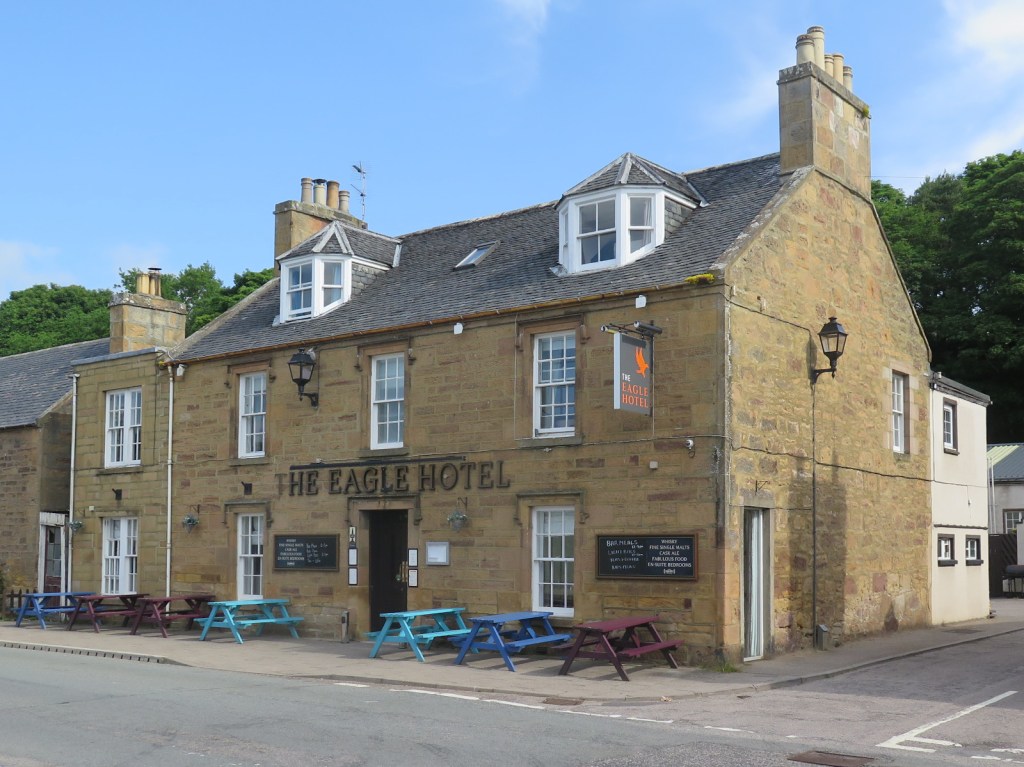
We walked around the old streets, noticed the widespread use of warm sandstone for older buildings like the little castle, and looked in shop windows as we passed. The cathedral here is the most northerly on the British mainland, only the Orkney Islands have a cathedral further north than this. We decided to look around the cathedral the next day and instead spend our time getting a feel for the town. We stayed in The Eagle Hotel which was unpretentious, comfortable and friendly.

See also:

North Coast 500 – Day 1

The tidal range is enormous, exceeded only by the Bay of Fundy in North America, and the beach is gently shelving here so the tide goes out several miles.

Part 1 of a series – North Coast 500

< No earlier posts | Index | Day 2 >

Cirencester to Weston-super-Mare – 16th June

We had decided to fly to Inverness and pick up a hire car there, mainly because we had limited time with Donna’s work and other commitments and we wanted to spend our time on the NC500 route, not driving to Inverness and back.

Perhaps the title is incorrect as the day was spent hundreds of miles from the North Coast 500 (NC500), but it was the first day of our holiday. Our nearest airport is Lulsgate, south-west of Bristol; and Donna’s brother Paul and his wife, Vanessa, live in Weston-super-Mare, which is very close; we drove down on Friday evening, 16th June, and spent the night with them ready to catch our flight the following morning.

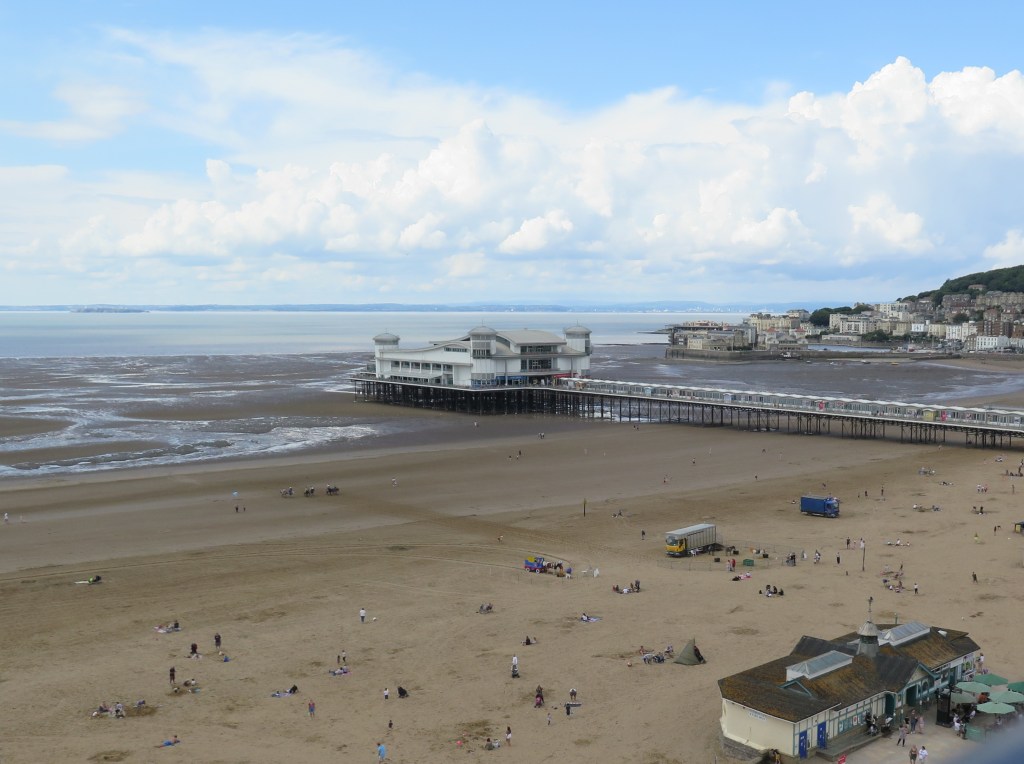
Weston-super-Mare beach and pier with the Welsh coast in the distance

It was good to spend the evening chatting over coffee, having a bit of a catch up. We like Weston, the photo shows the beach and the pier. In addition to those, notice the land on the horizon which is part of South Wales, the Bristol Channel which is very wide at this point, and the mud between the sea and the sand. The tidal range is enormous, exceeded only by the Bay of Fundy in North America, and the beach is gently shelving here so the tide goes out several miles. This photo shows Weston closer to high tide than low tide!

We brought our bags into the house and gave Paul the keys as we won’t be needing them and it would be good if he was able to move the car if a need arose.

We slept well, knowing we had a long journey in the morning. It would be the first day travelling north from Inverness.

What is the North Coast 500?

This name, often abbreviated to just NC500, is a famous touring route along the north coast of the mainland of Scotland. You can follow the route in either direction, starting from Inverness Castle. We chose the anti-clockwise version, making the fabulous Highlands scenery a grand finale to our journey.

Which part of a holiday is best in your view? Is it setting out on a new adventure, being away and exploring, or returning home?

See also:

North Coast 500 – INDEX

We diverted from part of the north coast to visit some inland places; it was a day of valleys, woodland, mountains, lochs and narrow, winding roads.


(See indexes on other topics)

Donna and I had an amazing trip around the north coast, mostly following the North Coast 500 route. We flew into Inverness and made our way north, then west and eventually south again, finally heading back to Inverness for the flight home.

Burrito Mama

If you live in or near Cirencester, or are visiting, I recommend this little gem of a place.

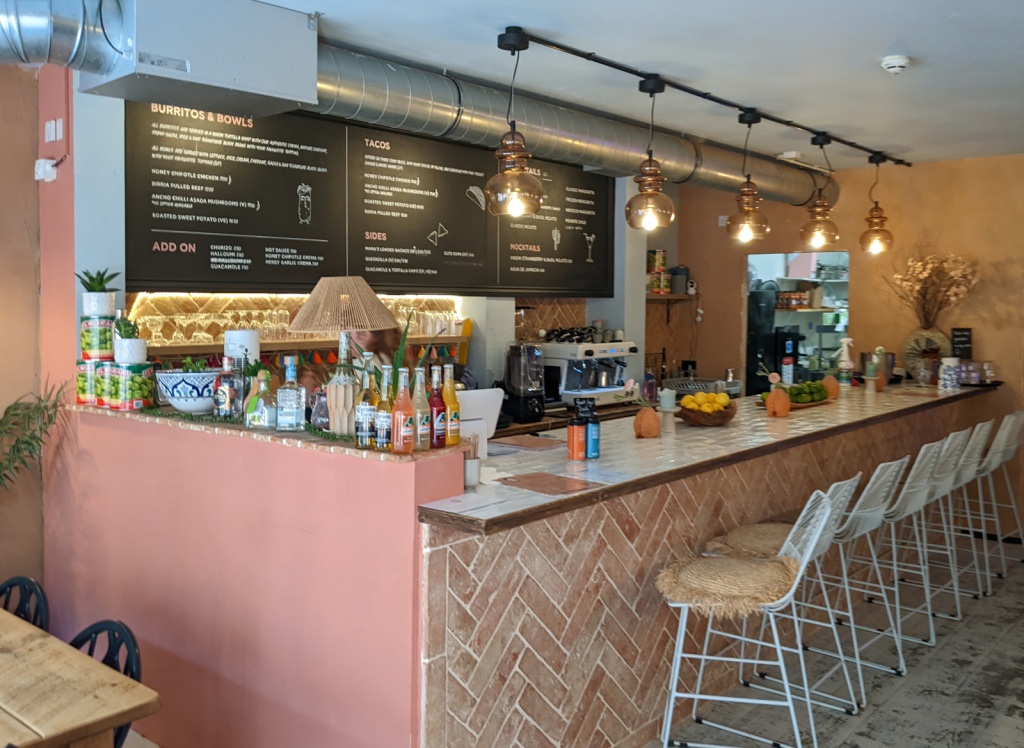
A new food outlet opened recently in Cirencester; we hadn’t had a chance to try it – until now. Burrito Mama is small, but very, very good.

Donna and I popped in at lunch time today to see what it was like. What we found was friendly, prompt service, lovely Mexicanesque decor, good coffee, tables inside and out, and an interesting menu. And when the food arrived it was nicely served and absolutely delicious. I chose their Ancho chilli asada mushrooms, and Donna went for the Honey chipotle chicken bowl. Both were great.

If you live in or near Cirencester, or are visiting, I recommend this little gem of a place. Check out their website online. Scroll down and take a look around. Book online or just pop in if they have space available. Locals will know where the Swan Yard is, very central, just beyond the west end of the Market Place.

Overall assessment… We’ll be back as soon as we have another opportunity!

Human origins

Theorists can move forward again – and the picture seems a little more complicated than we thought.

Where did we come from, and how? We’ve long thought in terms of an evolutionary ‘tree’, but our origins in Africa are more like a braided channel. This idea provides a better fit to the data.

Based on fossil evidence alone, studies of human evolution have long agreed that modern humans evolved in east Africa and radiated out from there. But with the development of cheap, fast and reliable DNA evidence from modern populations, and DNA from fossil teeth and bone samples, it’s becoming clear that theorists can move forward again – and the picture seems a little more complicated than we thought.

Human dispersion, events described in the article all took place in Africa – Image from Wikimedia

On 17th May, Ragsdale and others published a research paper in Nature; ‘A weakly structured stem for human origins in Africa’; their evidence suggests evolutionary connections in populations that were separated for a while before recombining. So instead of an evolutionary tree (which most people were expecting) it seems that our human past is more like a set of braided channels.

Previous views on human evolution proposed a tree structure (branching but not recombining). However, the new ‘weakly structured stem’ model fits the data better than a tree model. It also explains the diversity of genetic forms in modern human populations, and shows that there is no single place in Africa where humans ‘originated’. After this process within Africa, humans spread out as show in the map.

See also:

Blast from the past… 4

In March 1998, Donna and I were married!

< Previous | Index | Next >

Notes from bygone years – March after March after March

Two years ago

There were no posts in March 2021, but I walked a long section of the old Thames and Severn Canal. The photo shows the towpath on the left and the bed of the canal on the right. The canal is being restored, but it will be a long time before this section can carry barges again.

The old canal and towpath
Five years ago

In March 2018 I posted about moving into our new house and adding an extension (‘Our new home in the Cotswolds‘). The building work was disruptive in the extreme, of course. We had to move out for four weeks, and make do with just part of the original space for much longer than that. But it was worth it.

The lounge in chaos
We used to watch TV here!
Ten years ago
Grasshopper landing

In March 2013 I wrote about a TED interview with Elon Musk. Perhaps you haven’t heard of the TED talks, but everybody has heard of Elon. The post is interesting: Musk was already experimentally landing rockets ten years ago, and TED continues to be a great ideas platform. Take a look and explore the links in the original post.

Fifteen years ago

I reported on a meeting at home in March 2008.

Rachael also shared a picture of an old-fashioned plough making furrows. The soil needs to be churned up and overturned before something new can be grown. There is a necessary process of breaking before the land can be used.

We thought about how Father releases us from ourselves. At the beginning he said, ‘Let there be light’; he still speaks those words into his people today and pours light into the darkest places in our hearts.

Twenty years ago

March 2003, another early blog post about a meeting at home. This time there were only two of us, but we heard such a lot! For example, that the tiny stonecrop, the great cedar, and the mighty oak tree were all planted by Father’s hand. The important thing is not to be big or strong, but to be planted by the master.

Twenty-five years ago

And in March 1998, Donna and I were married!

< Previous | Index | Next >