I will build my church

If Jesus builds something, then he may ask us to help – but he will be in charge. He will teach us how to build, he will give us tasks he knows we can do.

A gathering (Wikimedia)

What did Jesus mean when he said, ‘I will build my church’? And what are the implications for us in our attempts to follow him? Here are some thoughts on the word ‘church’ and the action of building.

A gathering
(Wikimedia)

Aramaic is similar to Hebrew and was probably spoken at home and in the villages in Galilee in Jesus’ day, it was a widely used language in the region and even today is still used in a few areas of, for example, Syria. Jesus would have been taught Hebrew, as all Jewish boys were; this was the language of the Old Testament and was used in the Synagogues. There were some Greek towns and villages in the region, as there were throughout the Mediterranean more generally, so Jesus likely understood Greek. He might have known some Latin as well because that would have been spoken in imperial government and military circles.

In a conversation with his follower, Peter, he may have used an Aramaic word or possibly the Greek equivalent, ekklesia (church); and that’s how it’s recorded in the New Testament (Matthew 16:13-20). As a word it seems to have its roots in daily life; the village or town elders would have gathered as a local council to discuss and manage local affairs. As people meeting together more or less regularly, groups of people following Jesus may have been been given the same label – a gathering, therefore an ekklesia.

In the conversation described by Matthew, Jesus asks his followers, ‘Who do people say the Son of Man is?’ Of all of them, Peter was the most outspoken and would offer an opinion when the more cautious held back. Peter didn’t seem to worry about the risk of giving a wrong answer and looking foolish. So several of them gave the answer to the easy question – ‘Who do people say I am?’. But it was Peter who responded to the much more tricky question – ‘Who do you say I am?’

What Jesus says next seems ambiguous, at any rate the way Matthew describes it is ambiguous. Some people think he’s saying that Peter is the rock that he’ll build his church on. Others think the rock is the truth Peter expressed, the truth that Jesus is the Messiah, the Son of the Most High. Personally, I take the second view.

Jesus says that he will build his ekklesia, his church.

If Jesus builds something, then he may ask us to help – but he will be in charge. He will teach us how to build, he will give us tasks he knows we can do, but he remains the top man, the boss, the giver of instructions. We can’t just build what we want in the way that we want, call it church, and expect him to approve!

So let’s start by asking Jesus to show us what he wants us to do. And then when we each do our part, let’s keep checking with him that what we’re doing or saying is in line with his design. And then, as the job progresses, we’ll be able to gasp with astonishment saying, ‘Wow! This is far more amazing than anything I’d dreamed or imagined!’

It all starts with Jesus. The next step is that we have to learn to follow, to be Disciples. That will will steer us into Mission. And out of the results of mission we will see Church appear and grow.

Jesus, then Disciple, then Mission, then Church.

JDMC!

Useful? Interesting?

If you enjoyed this or found it useful, please like, comment, and share below. (If you don’t see those links, click the article’s title above the main photo and they will appear.) Send a link to friends who might enjoy the article or benefit from it – Thanks! My material is free to reuse (see conditions), but a coffee is always welcome and encourages me to write more often!

Every chapter is necessary

There is a synergy, a sparking of abundant life that comes from the interdependence of the parts.

A page from the book

This is a slightly modified copy of an article I wrote in 2014. I’m republishing it because I think it is still useful and deserves another airing. Perhaps it hints at some things we are liable to forget.

The book, Simple Church: Unity Within Diversity, contains twenty-four chapters. Each one discusses a positive aspect of church, something that is an essential part of the whole. Reading from the book I was deeply impacted by Chapter 22 from Kathy Escobar; the chapter is entitled A church that restores dignity where it’s been lost.

She writes:

Jesus calls [Lazarus] out of the tomb, but then he looks to the people around him – his community, friends, and advocates – and says to them ‘unbind him’. Unbind him. Unwrap him. Take off his graveclothes.

I think God calls us to participate in this uncovering-unwrapping-unbinding with each other through healing community.

And it struck me that although church is much more than the sum of its parts, all of the parts need to be actively present. There is a synergy, a sparking of abundant life that comes from the interdependence of the parts. Church is a person, the Bride of Christ.

Like all people, you and I are much more than the sum of hands, ears, spleen, heart, lungs and all the rest. But if any of these were missing we would either die or be unable to fully function. And it’s just the same with the church.

Just consider some of the other chapter themes. The church cherishes Jesus Christ, exhibits personal holiness, counts every member as key, assembles for mutual edification, and knows eternal life is free. Imagine all of those being true in a church that fails to restore dignity where it’s been lost. It would be a church without the active compassion necessary to unbind those who so desperately need it.

Or consider a church that clings to scriptural truth, is most notable for its love and is united in Christ but doesn’t follow the lead of the Holy Spirit. This would be a church that failed to hear where to go and what to do and did everything in its own strength.

Or what about a church that was composed of peacemakers, viewed itself as a people, restored dignity but failed to proclaim the gospel clearly?

The chapters of this book all stand alone and can be read alone. But they often overlap so that there are echoes and glimpses of them in one another. Yet taken together, with no part missing or inactive, they describe a holistic church, a wholesome church and a church that is alive and active and effective in the world. There are other aspects that are not explicitly covered in the book, prayer for example. But these are implied throughout in a variety of ways.

Church is as complex as any living organism, and just like a living organism it is not only complex but also multi-faceted, and astonishingly well constructed. The church is also alive with the life of Christ. And every part contributes!

Find the book on Google Play Books and on Amazon Books.

Useful? Interesting?

If you enjoyed this or found it useful, please like, comment, and share below. (If you don’t see those links, click the article’s title above the main photo and they will appear.) Send a link to friends who might enjoy the article or benefit from it – Thanks! My material is free to reuse (see conditions), but a coffee is always welcome and encourages me to write more often!

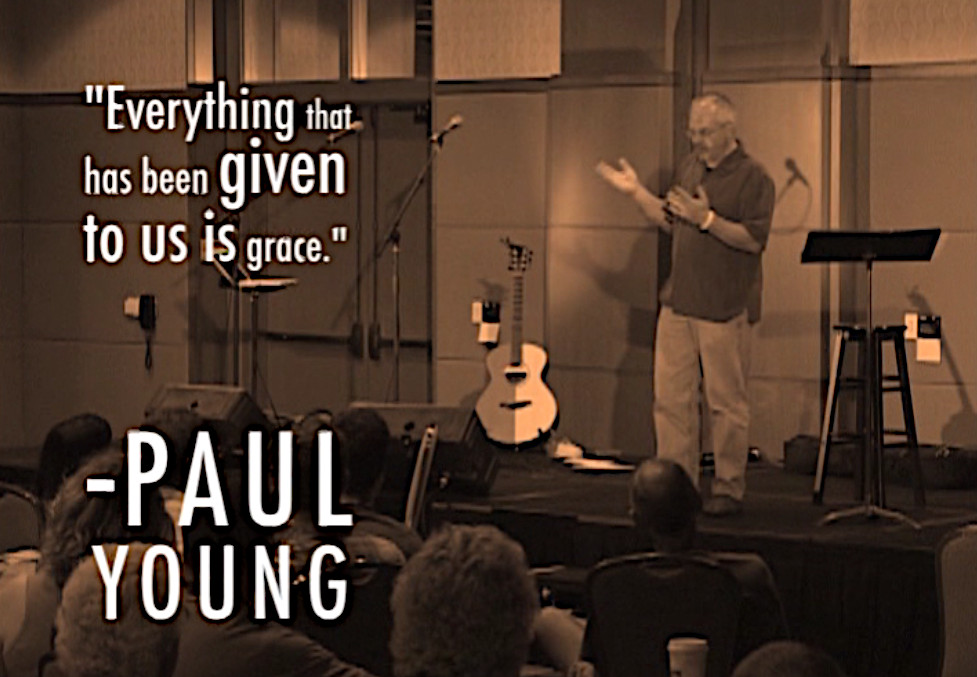
Paul Young, three videos

The videos are by turn funny, gripping, informative, and very, very useful.

Paul Young (sometimes William P Young) wrote The Shack for his children and it unexpectedly became a very famous best-seller and much later a movie.

Here he speaks to a House2House (H2H) conference in 2008, explaining how our traditions can trip us up and mislead us, how he came to write the book, and how Father’s grace can take any one of us and make the impossible possible.

Paul Young, speaking on the topic ‘Grace’

I’ve put the three YouTube videos into a playlist. The video is low quality as it was recorded in 2008 using the standards available at the time, but the sound is clear enough. Copyright for all three videos is with House2House and I have their permission to share the videos here.

Click the playlist link and watch away. These videos have, I suspect, changed many people’s lives – in a good way. They open up truths that have been hidden for some, for others they will confirm what they already thought. The videos are by turn funny, gripping, informative, and very, very useful today just as much as in 2008. Truth doesn’t change.

So for you, and your friends, it may be transformational or it may be confirming. Either way, my prayer for you is that you will be blessed and encouraged by listening.

Some background

The conference was over three days, the first day was for leaders; Paul spoke on Grace and covers how and why The Shack came to be written. In his opening remarks he notes that he’s in an environment that he’s not familiar with. However, he was very well received.

The second topic, Tradition, was presented to the full conference. In it, Paul discusses the fall and the interactions between Yawheh, Ish, Isha, and Lucifer. (We often think of Ish as ‘Adam’ and Ishah as ‘Eve’, Paul explains the distinction.)

The third topic, Soul, was again to the full conference. This time Paul explains his background and life story very frankly.

Useful? Interesting?

If you enjoyed this or found it useful, please like, comment, and share below. (If you don’t see those links, click the article’s title above the main photo and they will appear.) Send a link to friends who might enjoy the article or benefit from it – Thanks! My material is free to reuse (see conditions), but a coffee is always welcome and encourages me to write more often!
Praise and worship?

The word ‘worship’ isn’t here, but David does mention ‘praise’ in verses 5 and 6.

I was struck by the thought that perhaps we don’t often consider the basics. We use expressions like ‘The Worship Team’ or ‘The Worship Band’, and sometimes we call it ‘praise’. So what is the connection between worship and praise and music?

Praise and/or worship? (Photo by Terren Hurst on Unsplash)

Are praise and worship synonyms? If not, how they are they different? At last week’s Small Group meeting in Stratton we read Psalm 63 and thought through the questions provided by CBC. The psalm is quite short, only 11 verses, I suggest you read it now before returning to the rest of this article.

Defining our terms

It’s immediately clear from Psalm 63 that ‘praise’ and ‘worship’ might not actually be synonymous. The word ‘worship’ isn’t here, but David does mention ‘praise’ in verses 5 and 6.

The dictionary definition of the English word ‘worship’ as a noun is ‘the feeling or expression of reverence and adoration for a deity’, and as a verb, ‘show reverence and adoration for a deity’ So we can summarise it as ‘feeling or expressing reverence and adoration’.

We also use the word ‘worship’ in non-religious ways. People might say, ‘He worships that woman, or ‘She worships her cat’, and perhaps tellingly, we might even say, ‘He worships his car’. A feeling of reverence and adoration indeed!

Praise is easier to pin down; we use this word in everyday life quite often. You might praise a child for doing well in exams, or for working hard. You might praise a coffee shop for excellent coffee or good service.

So what’s the difference?

I think it’s clear that worship is about valuing something (or someone) very highly, whereas praise is saying that something is good or was well done. Saying that a car is good, well-designed, or reliable is to praise the car and, perhaps, the designer and manufacturer as well. But worshipping the car is saying it’s the most important thing in your life! You can’t live without it, you are dedicated to polishing it, and everything else in your life has less value and importance to you than the car.

Clearly, we should be very careful about who or what we worship. But we should pour out praise on everyone and everything that merits it. If I praise you because you have done well in some way, that is more than OK. It’s kind, it’s encouraging, it’s thoughtful, and it might make you even more eager to do well in future. But if I worship you, you would do well to try your utmost to stop me. Or just walk away – fast!

To put it another way, specifically for people who follow Jesus – we can worship only one person, or more accurately three people, the Father, Jesus and the Spirit that flows from them. We can praise them too, but we can also praise other people and even inanimate objects. And those worship bands that I mentioned at the start? Well, they make music, often very praiseworthy music. And the people listening are doing what, exactly? I’ll let you decide, leave me a comment and tell me what you make of all this. Thanks!

It might be useful to look at the Hebrew and Koine Greek words commonly translated ‘worship’ or ‘praise’. I’m not going to pursue that here, but I might come back to it some other time.

Useful? Interesting?

If you enjoyed this or found it useful, please like, comment, and share below. (If you don’t see those links, click the article’s title above the main photo and they will appear.) Send a link to friends who might enjoy the article or benefit from it – Thanks! My material is free to reuse (see conditions), but a coffee is always welcome and encourages me to write more often!
Wow! HalleluYah! Amen!

He captures the difference…

I’ve just read this short but truly excellent article by Chris Dryden, aka CD, aka DaManCD.

In his inimitable way, he captures the difference between typical church as most people know it, and the living organism of ekklesia as Jesus intends it. There’s an absolute chasm between the two, and Chris clarifies that.

Excellent! – Pop over there and take a look.