More on ground breaking

In the life of the church the central figure is Jesus and the central idea is that he is Lord. The church was founded on this person and this truth nearly 2000 years ago.

Where should we start in church life, where should we start in mission, or in teaching, or in any other aspect of being a believer and follower of Jesus? The answer is simple and rather obvious – we should start with Jesus himself.

Following my post ‘Ground breaking‘ on 26th February, I’d like to examine a particular example. In my study guide, JDMC, I set out to help small groups of individuals live out Jesus’ command to ‘go into all the world and make disciples’. The idea is that making disciples is the first step on the journey to starting a movement that will grow and grow. Alan Hirsch, in setting out this idea in his seminal book ‘The Forgotten Ways’, identified six factors that work together to make a movement buzz and thrive. The first factor is that there needs to be a person and an idea that together can become the focal point for the movement.

More groundbreaking – Image from Wikimedia
A person and an idea

All vigorously growing movements have this centralised focus. For the communist revolution in Russia in the early part of the 20th century the person was Karl Marx and the idea was that wealth should be shared, not held primarily by a ruling class. The means of production should be owned, not by industrialists, but by the workers themselves.

It’s not hard to identify the same structure in all sorts of other historical movements; think of Al Qaeda, the Methodist movement, female suffrage, the rise of the German Nazi party between the first and second world wars, the growth of Amazon as a supply and delivery business. I could go on, there are many examples, and it’s not hard to see a central personality and a central notion or purpose for each.

Jesus is Lord!

In the life of the church the central figure is Jesus and the central idea is that he is Lord. The church was founded on this person and this truth nearly 2000 years ago. He gave us everything we need to become disciples, and he imbued the church with everything it needs to be a thriving, thrusting movement. And although in the first few hundred years, there was explosive growth, a real movement on a major scale, something that swept through the Graeco-Roman world and far beyond – that momentum stalled. Something fundamental, in church today, seems to be missing.

This is the first of six essential ingredients that Alan Hirsch argues that we need to rediscover and reactivate in the church. I think he is right. We need to recover the sense that Jesus is at the heart of church life, and that he is Lord.

It’s fair to argue that this is exactly what Jesus himself meant when he told his disciples to go out into the world and make disciples. But he surrounded that command with some super-important statements. First he said that he has full authority, then he told them to go and make more disciples, he said to teach those new disciples to do all the things he’d taught his initial disciples, and then he finished by telling them that he’d be with them all the way. They did what he’d asked, they made many more disciples who also understood that Jesus is Lord and that they were, in turn, to make more disciples. And they did. And that is a movement! They literally changed their world.

But it’s essential that we do more than just repeat the slogan, ‘Jesus is Lord’. We need to live the slogan out; as disciples of Jesus, we need to do what he did, and to speak into our culture the things he spoke into his culture. He told us to love the people in our lives, he said we should forgive people who are unkind to us. He calls us to imitate his words, but also his thinking and his actions. It’s essential to go as he did, to bless the people around us, to help the helpless, feed the hungry, and meet every need as and when we come across it. Jesus blessed people in many ways, if we are truly his disciples so will we. But as Alan Hirsch points out, there’s more to it than just this one factor. We may be ever so familiar with Jesus, and have a close knowledge of him. We might study him at degree level, publish learned papers about him, write theses about his life and work, and read and write great books about him, and never once see any hint of a rapidly expanding movement.

Knowing Jesus is not, on its own, enough. It is, however an indispensable first step. We do need to know Jesus intimately, to understand who he is, and follow him to the best of our abilities. Yet this alone is insufficient for the rapidly growing movement we would all, surely, like to see! There are five other necessary factors and we will look at another one next time. Alongside the person and the idea there also needs to be a gift. We’ll discuss this in detail in the next part of this short series, but for now it’s enough to know that Jesus is not only the person, and his lordship the idea, but also Jesus himself is the gift. Jesus gave himself for us. This is the supreme gift, but there are others as we shall see.

BUT! In the meantime, get to know Jesus as never before. Spend time discovering him as a person by reading through the gospels of Matthew, Mark, Luke and John. Ask him to reveal himself more fully to you, he is always happy to answer this request, whether you are poor or wealthy, healthy or unwell, highly educated or unable to read. Consider what it means that he is Lord, and consider the cost involved in giving himself and the benefit of that gift to you and to me.

Remember, you need to get to know a person – Jesus: and you need to grapple with an idea – Jesus is Lord: and you need to understand a gift – Jesus’ action in pouring himself out for you, for me, for all of us.

Some resources

Meanwhile, let me leave you with some places to look for more information on this.

  • The best way to get to know Jesus better is to keep reading the Gospels (Matthew, Mark, Luke, John). They are freely available on line in a variety of languages and versions. Bible Gateway is a good source, but there are plenty of others. If you like, take a look at my website, Cruising the Gospel.
  • My guidebook, JDMC, presents Alan Hirsch’s six forgotten ways in a short, introductory, workbook format for individuals, or better, a small group of up to 12 people. Part One – Jesus at the Centre is the relevant section.
  • Alan Hirsch’s widely read book ‘The Forgotten Ways’ is available in print or in ebook form. Buy it from Eden, Google Play Books, Amazon or from your local bookshop.

Blast from the past… 5

Do things when you can. Don’t wait, don’t hesitate, who knows what tomorrow might bring…

< Previous | Index | Next >

Notes from bygone years – A load of Aprils

A year ago

I didn’t post an article in April 2022, but Donna and I visited Weston-super-Mare and I spotted this fruit and vegetable shop in one of the back streets. There were strawberries here, but they’re not in season; there were pineapples but those don’t grow in the UK; there were pears that should be ready to pick in September or October. Almost nothing in this shop was grown locally. Why?

A traditional greengrocer’s shop

It’s lovely to have choices like this, but they come at a cost to the environment that we usually overlook. The solution lies in my pocket and yours; we should try to buy locally produced fruit and vegetables that are within a few weeks of being in season.

<Mar 2022 – May 2022>

Two years ago

No blog posts in April 2021 either, but on 4th April the weather was warm and bright and we enjoyed eating outside for the first time in 2021.

Eating outside on 4th April
Three days later!

But oh my word, look at the same table just three days later. Snow! The moral of this little story is plain, do things while you can. Don’t wait, don’t hesitate, who knows what tomorrow might bring…

<Mar 2021 – May 2021>

Five years ago

In April 2018 I had a bit of a rant about rescuing Britain from the dreadful mess it seemed to be in. I grumbled about the effects of Brexit, about poverty, the underfunded health service, an underfunded education system, the need for food-banks, the excessive cost of homes.

Read the article. Let me know if you think things have improved in the last five years.

<Mar 2021 – May 2021>

Ten years ago
A child leading? – Image from Wikimedia

In April 2013 I wrote about ‘Men, women and children‘. The topic really was leadership, and I stand by all I wrote at that time.

Can men lead in church? How about women, are they allowed to lead? And what about children? Perhaps it depends who you ask, there are different opinions and different traditions.

Read my post from ten years ago and let me know what your views are.

<Mar 2013 – May 2013>

Fifteen years ago
The ‘Sagrada Familia’

There was no article in April 2008. However, we had a holiday in Catalonia and visited Barcelona where we took a look at the famous Sagrada Familia with its amazing ‘biological’ shapes. What an astonishing place it it!

To learn more about this wonderful feat of design and engineering by the architect Antoni Gaudi, read the Wikipedia article.

<Mar 2013 – May 2008>

Twenty years ago

In April 2003, I wrote about a meeting at home. Father spoke to us about leadership, coincidentally I drew on what I’d learned in this meeting when I wrote the article mentioned in the ‘Ten years ago’ section above!

A firm foundation

We are weak, like freshly poured concrete; but Jesus is patient and knows we will become strong enough for the task he’s given us.

Twenty-five years ago

In April 1998, Donna and I were on our way home from our honeymoon in Florida, and I began a new job at Unilever’s Colworth Laboratory north of Bedford.

Thirty years ago

In April 1995 my first wife, Judy, was recovering from failed chemotherapy for bowel cancer metastases. Clearly this was not a great situation, but she was fitter than she had been since before her operation to remove the primary tumour. We began meeting again at home with friends in Yatton, near Bristol, where we lived. These were by far the best meetings with friends in Jesus’ presence that any of us had ever experienced. Awesome and hard to describe adequately.

Erm… I can’t count! That was not thirty years ago, it was twenty-eight years ago! Ah well, I’ll let it stand.

Thirty years ago

I’ll try again! In April 1993 Judy and I were living in Yatton with our daughters, and my Mum and Dad visited us on 15th. We drove into Bristol and looked around the covered market and The Galleries shopping centre.

< Previous | Index | Next >
John 14:8-14 – Making it clear

Nobody has ever made claims like this before! It is either true, or Jesus is utterly deluded, or at worst he’s a complete fraud.

< Previous | Index | Next >

John 14:8-14 – Read it yourself (opens in a new tab)

This must have felt frustrating; Jesus has already explained to them all and then added more to help Thomas. But now Philip doesn’t understand either. But Jesus is able to cope with anything, and in this he leads the way for us; frustration doesn’t lead to impatience. We are called to be patient as he is patient.

Philip asks Jesus to show the Father to the puzzled, anxious disciples, and he adds that doing so will satisfy them. Jesus is surprised. I’ve been with you all this time, Philip: how can you not know me?

Simple truth

And he explains again the simple truth that he and his Father are one, ‘I’m in the Father, and he’s in me’. This simple truth is hard for Philip to grasp because it is so deep, so astonishing, yet so simple. Surely far too simple to be true, and far too shocking as well. Nobody has ever made claims like this before! It is either true, or Jesus is utterly deluded, or at worst he’s a complete fraud. No wonder Philip struggles! Jesus tells him that if he can’t believe what he says, he should certainly believe what he’s been doing – healing the sick, raising the dead, forgiving the guilty. Who else but the Father himself could do this stuff?

The Father’s glory

If you believe in me you’ll do even greater things because, when I’m in the Father’s presence, you’ll be able to ask whatever is needed and I’ll do it for you. Why? Because the Father’s glory (the Presence that has long been in the holiest place in the Temple) will instead be in Jesus and his glory will no longer be contained in the Holy of Holies but will be contained in Jesus instead. And although Jesus doesn’t say so here, the Father’s glory will therefore be in the church because we, the church, are Jesus’ body here in the world. Perhaps this is not fully understood or expressed until the Holy Spirit reveals it to Paul on the Damascus road. Paul knew that the Presence had been in the Holy Place, but that now there was a new Holy Place, the church, inhabited by the Son, and through him, by the Father too since they are one. Although this was plain to Paul even before the Temple’s destruction, it must have been far less clear to the disciples while Jesus was still physically with them.

We carry an inestimable treasure with us wherever we go! And if that doesn’t fill you with hope, joy, and encouragement, I don’t know what will.

< Previous | Index | Next >

Blast from the past… 4

In March 1998, Donna and I were married!

< Previous | Index | Next >

Notes from bygone years – March after March after March

Two years ago

There were no posts in March 2021, but I walked a long section of the old Thames and Severn Canal. The photo shows the towpath on the left and the bed of the canal on the right. The canal is being restored, but it will be a long time before this section can carry barges again.

The old canal and towpath
Five years ago

In March 2018 I posted about moving into our new house and adding an extension (‘Our new home in the Cotswolds‘). The building work was disruptive in the extreme, of course. We had to move out for four weeks, and make do with just part of the original space for much longer than that. But it was worth it.

The lounge in chaos
We used to watch TV here!
Ten years ago
Grasshopper landing

In March 2013 I wrote about a TED interview with Elon Musk. Perhaps you haven’t heard of the TED talks, but everybody has heard of Elon. The post is interesting: Musk was already experimentally landing rockets ten years ago, and TED continues to be a great ideas platform. Take a look and explore the links in the original post.

Fifteen years ago

I reported on a meeting at home in March 2008.

Rachael also shared a picture of an old-fashioned plough making furrows. The soil needs to be churned up and overturned before something new can be grown. There is a necessary process of breaking before the land can be used.

We thought about how Father releases us from ourselves. At the beginning he said, ‘Let there be light’; he still speaks those words into his people today and pours light into the darkest places in our hearts.

Twenty years ago

March 2003, another early blog post about a meeting at home. This time there were only two of us, but we heard such a lot! For example, that the tiny stonecrop, the great cedar, and the mighty oak tree were all planted by Father’s hand. The important thing is not to be big or strong, but to be planted by the master.

Twenty-five years ago

And in March 1998, Donna and I were married!

< Previous | Index | Next >

Ground breaking

Have we come to a time when the church is perfect and is missing nothing? I don’t think so! What fresh revelation will be next?

In a recent, very brief conversation on Twitter I suggested that something was ‘ground breaking’. Specifically it concerned some ideas about following Jesus, and whether one particular idea was ground breaking.

Thinking about this afterwards I realised that a useful conversation requires that we agree on what we mean by ‘ground breaking’ in the context of the lives and activities of believers interacting together in groups.

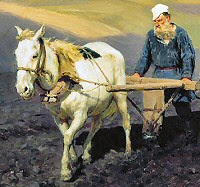
Ploughing with bullocks – From Wikimedia

Arguably, ‘ground breaking’ might originally be a farming or growing term. Before taking a harvest, it’s necessary to plant seeds in fertile soil, get them to germinate, and wait for them to grow. The farmer has much to do during that process, but the very first requirement is to do some ground breaking. Turning the soil with a plough (or a spade) loosens it, damages any weeds growing there, makes it easier to sow seed, and enables water and air to penetrate (both are needed). A bit of ground breaking can work wonders!

Jesus, ground breaker par excellence

In one sense of course, Jesus did all the ground breaking that could possibly be needed in church life. He only did what he saw his Father do, and only said what he heard his Father say. And he told his followers, ‘My Father is a gardener’. He also told a striking parable about seed falling in different places, including well prepared soil as well as several kinds of unprepared, unsuitable, or poorly prepared ground.

His is a foundational kind of ground breaking that we cannot and do not need to repeat. But there’s something else I would call ground breaking; something that happens every time principles, knowledge, or behaviour that the church has forgotten is restored. It’s happened over and over again.

Lesser ground breakings

One relatively recent example would be the spiritual revival that took place in the 1960s and 70s. I’m old enough to remember the excitement of discovering two things in those days. The understanding that the Holy Spirit poured out gifts on his people and wanted us to put them to use, and the idea that small groups meeting outside the denominations were capable of rapid and dynamic growth. They were exciting times. Out of this sprang three phenomena that are still with us today; multiple streams of new organisations like New Frontiers, New Wine, and many more; a re-invigoration of parts of most denominations, Anglican, Baptist, Methodist, Catholic and more; and thirdly the house church movement based around small, intimate groups of friends.

Going back a little we can see that the Azusa Street events were ground breaking in the same sense and resulted in the two main streams of Pentecostal churches.

Before that we might identify the Welsh revival when a new sense of unworthiness and Father’s forgiveness resulted in large numbers of people praising and worshipping, encouraging one another, and preaching to their neighbours in towns and villages. Before that the Wesleys and Methodism flourished and it was understood that small groups can be a powerful way for people to grow and develop together. And there are many more ground breaking events like these right back through the centuries.

When I talk about ground breaking I definitely include developments like these, discoveries that there was, in the earliest state of the church, some other element of following Jesus which has since fallen into disuse or even faded from memory entirely. Rediscovering how things used to be and might be again is ground breaking in this lesser sense.

New, vigorous growth

Such freshly re-broken ground almost always seems to result in new, vigorous growth where previously things had become somewhat tired and wooden. Think in terms of a neglected, weak, dehydrated plant that has just been potted up with fresh compost, is being watered regularly, and now stands in a new spot where there is fresh air, adequate humidity, and plenty of light. A plant like that will put on a sudden spurt of growth, form new shoots and leaves, and perhaps flower for the first time in ages.

We need to see more ground being rebroken and experience that fresh flush of growth and energy again and again. Have we come to a time when the church is perfect and is missing nothing? I don’t think so! What fresh revelation will be next?

Note: Ground breaking can also mean a ceremonial turning of soil at the start of a construction project. It can be instructive to think of Jesus’ work as the start of a building project – the New Jerusalem, which is the church (see Revelation 21:9-10). But that’s a whole topic on its own.

Speak to the bones

It’s good that we want to communicate and act, but it’s not good when we ourselves decide what to say and what to do.

Part 4 of a series – ‘The valley of dry bones’

< Taking a good look | Index | The word of Yahweh >

Now Yahweh says something strange to Ezekiel. He tells Ezekiel to speak to the bones, to prophecy to them. Is there any purpose in speaking to what is dead? Let’s look carefully at Ezekiel 37:4.

Then he told me, ‘Prophecy to these bones. Tell them, “Dry bones! Hear Yahweh’s word.”‘

Ezekiel 37:4

There are several important points to notice. If Ezekiel hadn’t understood these points the amazing things that are about to happen would not have happened. At least, they wouldn’t have happened through Ezekiel. Yahweh would have found another way, another person to serve him; Ezekiel would have missed out. Hearing is important, and the mechanism for hearing is complex.

1 – Listen and speak

Yahweh spoke to Ezekiel. Ezekiel listened so that he could pass on what he had received. This is the place where we often go wrong. We see a need and we act to meet it, we say what we think best, we do what we think best.

Structure of a human ear – From Wikimedia Commons

It’s good that we want to communicate and act, but it’s not good when we ourselves decide what to say and what to do. Even Yahshua (Jesus) didn’t do this, he set us a good example, he said only what he heard the Father say (John 12:49-50), he did only what he saw the Father do (John 5:19). If we don’t get this first step right we become unusable, no good for the eternal purposes of the Most High. Listen first. That’s what Ezekiel did and so should we.

2 – It may not make much sense

‘Prophecy to these bones’, says Yahweh. Put yourself in Ezekiel’s place, try to imagine it. Bones are not animate objects. At one time they were but now they are not. Here’s a conversation that didn’t take place – but it might have done. If Ezekiel had been like me it probably would have gone something along these lines…

Yahweh: ‘Listen to me carefully.’ – Ezekiel: ‘Yes, Lord. I’m listening.’

Yahweh: ‘I want you to talk to those bones over there, I want you to tell them that..’ – Ezekiel: ‘Wait, wait, wait. I must be hearing wrong, Lord. You want me to talk to who?’

Yahweh: ‘Not who, what. I want you to talk to the bones’. – Ezekiel: ‘No, Lord.’

Yahweh: ‘No? What do you mean – no?’ – Ezekiel: ‘Er.. No ears, Lord. I mean the bones can’t hear, they have no ears. They won’t hear me.’

Yahweh: ‘I’ll deal with that, you just get on and prophecy, OK?’ – Ezekiel: ‘But my friends will think I’m stupid.’ – Yahweh: ‘And your point is?’

Yahweh: ‘You’re wasting time here, Ezekiel. I need a job done and I need it to be done right away. I’ll find someone else.’ – Ezekiel: ‘No, no. I’ll do it. I’ll talk to the bones. Can I use a really quiet voice, Lord?’

Yahweh: ‘I need a very loud voice for this job. If you’re speaking to dry bones you have to speak up.’ – Ezekiel: ‘But, Lord, I have no idea what to say.’

Yahweh: ‘Might that be because I haven’ t told you yet? Hmm? You must command them to hear me, even though they have no ears.’ – Ezekiel: ‘OK-a-a-a-a-y’

Yahweh: ‘Tell them, “Dry bones! Hear Yahweh’s word.”‘

3 – Hear his word!

Before Ezekiel can give the message to the bones, he must command them to hear. Assuming we can get past steps 1 and 2, this third step is something we often miss out. Before giving the message we need to command the deaf to hear. This is a step of preparation. It may require months or even years of prayer. It may mean demanding to be heard over and over and over again. It may mean criticism and derision and even facing serious abuse. But it needs to be done. There are no short cuts in hearing and speaking, seeing and doing.

Will we be like Ezekiel? Will we be unwavering in our obedience even if we appear foolish or unpopular or at risk? And is it worthwhile speaking to something that’s dead? Yes! Lazarus was dead, Yahshua spoke to him, and he came out of the grave.

< Taking a good look | Index | The word of Yahweh >

Blast from the past… 2

In January 2013 there was a hard frost in St Neots

< Previous | Index | Next >

Here’s another blast from the past. What can we find as we look through earlier January posts?

Five years ago

In January 2018 I wrote about eating together and how the early church had no ceremony like our communion service. And I quoted from Victor Choudherie who urges us to ‘promote breaking of bread with simple Agape meals (love feasts) from house to house, that believers take with glad hearts’.

Eating together

Read the old post – Eat together

Ten years ago

In January 2013 there was a hard frost in St Neots where I lived at the time. Within four days, the ice and snow had gone and early hints of the coming spring had appeared. How fast things can change!

Read the old post – Icy pond in St Neots – IMAGE

Twenty years ago

In January 2003 I described the essence of a meeting at my home in which we were reminded that we are just to love, not to manipulate.

Read the old post – Eaton Ford – Walk with the King

< Previous | Index | Next >

My Father is a farmer

Human society seems to bring a certain amount of order to the scene, but it’s a deceptive kind of order. Anyone who has a garden will know that order demands great effort to achieve and continuous effort to maintain.

Some have argued that living things depend on structure and order. And of course, there is some truth in that; but it’s a limited kind of truth. Look at a forest, a coral reef (or any ecosystem) and you will see the most amazing and thriving mess. Colours and shapes intermingled haphazardly, lots of competition for space and light. Every single organism doing its own thing.

Coral reef, a rich mix of species (Image from Wikimedia)

Human society seems to bring a certain amount of order to the scene, but it’s a deceptive kind of order. Anyone who has a garden will know that order demands great effort to achieve and continuous effort to maintain. And much of that effort will involve destruction – rooting out things that grow where you don’t want them, trimming hedges to keep them straight, cutting grass to maintain a smooth lawn, poisoning unwanted insects and fungi. A garden has structure and looks nice, but that structure comes at great cost to nature and requires constant effort from the gardener. Jesus said his Father is a gardener.

Farmer is really a more appropriate English word. And not ‘farmer’ as in a modern monocrop system of extensive wheat or mile after mile of beans or peanuts. Papa isn’t bothered about measured lines and neat grass; his interests are more to do with fruitfulness than with structure. He is not a park attendant, he is a grower of vines and olives in the way they were grown 2000 years ago in Israel, sympathetically and naturally. Farmers in those days were helpers and encouragers of the abundance of the natural, not at all like today’s farmers who are more like dictators armed with diesel fuel, big machines, and farm chemicals.

For those who want to function in a structured environment with clear and appointed leadership roles and a liturgy – be my guest, feel free. Sometimes Papa calls me to be involved in those situations too. But mostly he calls me to the freedom, glory, and abundant life of his original garden. This is a place where you will rarely see a straight line, where men and women do not control the show, where there is no architecture and there are no roads. It’s a place where he invites his children to come and run free and shout with joy in his presence. There is no liturgy, just an outpouring of praise and worship from rejoicing hearts.

And out of the ‘disorder’ of this garden comes a deeper knowledge of the heart of the Most High and a richer walk with him. And the life I experience there in his presence with my brothers and sisters, that life is something I can take into this struggling world. Truly he is the way, the truth, and the life. HalleluYah!

Reflections from way back when

The weak are doubly rewarded, they’re glad to do the easy things and by their childlike faith and trust achieve the hard things too

This is an edited repost of one of my earliest blog messages, originally from 18th December 2002, so almost twenty years ago! In fact, it was my first serious post.

Back in those days I’d been meeting with my sister, Rachael, and some local friends. Sometimes we met in Rugby, at Rachael’s house, sometimes near Wellingborough where one of our friends lived, and sometimes at my home or others in St Neots.

The meetings were always full of spiritual life; we would sit together, share coffee, do a bit of a catch up chat, and then fall into a comfortable silence – waiting, and expecting the Holy Spirit to guide us. These were very fruitful times for all of us. Out of the quietness would come a mental picture, a thought, some Bible verses, a prayer, words in an unknown language, an interpretation, a song, some prophecy. Usually everyone would contribute something, and always by the end of the meeting we would see a clear thread running through the whole, something we could remember that would encourage us or bless us in some way.

The following is what I wrote twenty years ago:

Our meeting reminded me of the seventh day of creation, when He rested. Even God desires quiet times!

The other bit I particularly remembered was, ‘It’s not for us to do, but for Him to do in us’ (RK)

Four of us met and the Holy Spirit led us very gently. We felt encouraged and uplifted, it was a peaceful and quiet time with a variety of words and pictures.

There was a wonderful picture of still water, with a reflection of the Almighty’s glory clearly visible in it; the water also reflected images of us towards him. Our feet were in the water; and he said that we should be careful not to make disturbances as this would spoil the reflection, only if we stayed quiet and very still would we be able to see his reflected glory.

We also had a word that the easy things he wants done are overlooked by the great and the learned, while the difficult things are only ever attempted by the weak and foolish.

Thinking about this afterwards I realised that the great doubly miss out, they miss the easy things because they think they’re not worth doing, and they miss the hard things because they realise they’re too difficult to attempt. But the weak are doubly rewarded, they’re glad to do the easy things and by their childlike faith and trust achieve the hard things too!

We came away encouraged and strengthened – it was a great evening!

See the original post

(Note: RK is my sister, Rachael.)

A reflection of what is not directly visible – Image from Wikimedia Commons

My thought after the meeting is what I want to emphasise here in 2022. Perhaps we are much too easily impressed by the people in society who are thought to be great in wisdom, or wealth, or skill. Great leaders, great speakers, powerful company bosses. Reputation can be overvalued.

Perhaps we should be more willing to also value weakness, and to notice how the weak are doubly blessed. They achieve this by doing the easy things that the great may overlook or regard of little value, and they achieve the hard things by just doing them, often without recognising the difficulties.

So let’s value the weak and the humble. Let’s notice them, and learn from them. At the same time we can (and should) appreciate the people around us who achieve so much through skill, learning, persuasive speaking, and sheer hard work and persistence. The great are good, providing they are also humble and gentle. Indeed, good motives are fundamental, for both the strong and the weak.

And if you think you are weak – rejoice! Savour the double blessing.

Some questions

  • If you follow Jesus, could you meet like this? Have you tried?
  • What advantages are there in preparing the content, structure, and leadership of a meeting in advance?
  • Are there any disadvantages?
  • What does Paul mean when he says that all should contribute? (1 Corinthians 14:26) – For more on this question, see my subsequent tweet.

Why did I leave the Anglican Church?

The message from the New Testament seemed clear to me, there was supposed to be just one church, not a multiplicity of flavours brought about through a long series of historical disagreements and splits.

Developing faith – 1

< Previous | Index | Next >

I was asked this question some time ago, and at first I felt that it somehow missed the point because I tend to feel that I never was an Anglican. But it’s true that in my mid to late teens I would have called myself Anglican – perhaps.

My parents were Anglicans in the limited sense that they were not Methodists, Baptists, Presbyterians, Salvation Army or anything else. Dad was quite dedicated, jotting brief prayers in his diary and during parts of his life often attending communion at the parish church. I doubt that he made a conscious decision on this, it was just taken for granted, it had been the family tradition as far back as anyone knew. Mum was different, she was used to village life in Northern Ireland and taught Sunday school at the tiny village church, a simple and plain structure. She was uncomfortable with anything remotely high church, but if you’d asked her what she was she might have said Anglican, or Church of Ireland, or just Christian.

I was Christened when I was little and was encouraged to read the Bible as a child, at home, but more so at junior school and later in RE lessons at secondary school. By the age of 13 I was familiar with the outline contents of the Old and New Testaments, and with many of the stories recorded there. In my teens I was expected to attend confirmation classes and went along out of obedience rather than a desire to be there. In due course I was confirmed, though it didn’t mean much to me and life continued as before. I had not yet begun to grapple with what I did and did not believe.

As I went through the processes of sitting my O levels and A levels and applying for a place at university, I began to form my own ideas about faith. For a time I rejected faith of any kind, thinking that science would eventually explain everything. Yet I was intrigued by the Bible and began to take what I read there quite seriously. And I didn’t see much there to support Anglicanism or, indeed, denominations of any kind. The message from the New Testament seemed clear to me, there was supposed to be just one church, not a multiplicity of flavours brought about through a long series of historical disagreements and splits. And what about the many stories of healings, and the parables about how we should live, and the Pauline teachings about gifts of the Spirit, and the letters to churches in the Greek world of the time? I was taking all of this seriously, but saw little evidence that the denominations were doing the same. I explored more widely, visiting the Jehovah’s Witnesses, signing up for a Christadelphian magazine, reading books about the Mormons and Christian Science, but none of these avenues seemed to make much sense to me.

After graduating from university, getting married, and starting full time jobs, Judy and I spent our Sundays in Bristol doing some serious denominational exploration. We went to Sunday services at every church we could find, and never once had a sense of, ‘This is the one!’. We were searching, but not finding.

Zetland Evangelical Church in 2002

In the end, in utter desperation, we tried a weird place just down the road from our flat. In some ways it seemed more odd than any of the other places we’d tried. It had a large sign above the door in blue and gold reading ‘God is Love’, and didn’t look like a church building, more like a large house. This was Zetland Evangelical Church in Bristol, near the railway arches over the Cheltenham Road. We found to our surprise that we were instantly at home! The people there wanted to talk with us, and they shared some of our own thoughts about what we’d been reading in the Bible. We felt welcomed – as if by a large family. We’d found a real community, which is what we’d long hoped for. Not only that, when I went to a mid-week evening meeting I was blown away by teaching about David, perhaps from 2 Samuel, and a section I was familiar with. The fresh insights and explanations were very striking, here were people who knew their topic – and it all made perfect sense.

We still felt there was more, and we were joining one of those denominational ‘splinter groups’ that so perplexed us. But this was by far the best thing yet. At this point in our lives we would not have settled for Anglican or any other church tradition. We were particularly encouraged by the fact that there was no hierarchy at Zetland, there was no single leader, we were all equal, or so it appeared. There was no liturgy, no pastor, and once a month there was a delightful Sunday morning Open Meeting with nobody at the front and where all could contribute a prayer, a hymn, or some teaching. All, that is, except women and children. This was one of several niggling issues that we put to the back of our minds for the time being.

Eventually we discovered much more – but that’s another story.

Explanatory note – Please don’t think that I’m judging or disapproving of denominations and those who are involved with them. In this short article I’m describing how a much younger Chris Jefferies understood things. I have many non-denominational friends, but also friends from New Frontiers, Anglican, and particularly Baptist traditions. Particularly Baptist simply because at the time of writing I take part in a small home group that meets weekly and is part of Cirencester Baptist Church. I’m not a Baptist, I will not (cannot) become a church member. We are all part of one family, the family of those who follow Jesus. We are all brothers and sisters and we have individual perspectives and expressions of what that means. I honour and love each one as part of an undivided whole.

(This article has been cross-posted to Anglicanism.org)

< Previous | Index | Next >