There is a synergy, a sparking of abundant life that comes from the interdependence of the parts.
A page from the book
This is a slightly modified copy of an article I wrote in 2014. I’m republishing it because I think it is still useful and deserves another airing. Perhaps it hints at some things we are liable to forget.
The book, Simple Church: Unity Within Diversity, contains twenty-four chapters. Each one discusses a positive aspect of church, something that is an essential part of the whole. Reading from the book I was deeply impacted by Chapter 22 from Kathy Escobar; the chapter is entitled A church that restores dignity where it’s been lost.
She writes:
Jesus calls [Lazarus] out of the tomb, but then he looks to the people around him – his community, friends, and advocates – and says to them ‘unbind him’. Unbind him. Unwrap him. Take off his graveclothes.
I think God calls us to participate in this uncovering-unwrapping-unbinding with each other through healing community.
And it struck me that although church is much more than the sum of its parts, all of the parts need to be actively present. There is a synergy, a sparking of abundant life that comes from the interdependence of the parts. Church is a person, the Bride of Christ.
Like all people, you and I are much more than the sum of hands, ears, spleen, heart, lungs and all the rest. But if any of these were missing we would either die or be unable to fully function. And it’s just the same with the church.
Just consider some of the other chapter themes. The church cherishes Jesus Christ, exhibits personal holiness, counts every member as key, assembles for mutual edification, and knows eternal life is free. Imagine all of those being true in a church that fails to restore dignity where it’s been lost. It would be a church without the active compassion necessary to unbind those who so desperately need it.
Or consider a church that clings to scriptural truth, is most notable for its love and is united in Christ but doesn’t follow the lead of the Holy Spirit. This would be a church that failed to hear where to go and what to do and did everything in its own strength.
Or what about a church that was composed of peacemakers, viewed itself as a people, restored dignity but failed to proclaim the gospel clearly?
The chapters of this book all stand alone and can be read alone. But they often overlap so that there are echoes and glimpses of them in one another. Yet taken together, with no part missing or inactive, they describe a holistic church, a wholesome church and a church that is alive and active and effective in the world. There are other aspects that are not explicitly covered in the book, prayer for example. But these are implied throughout in a variety of ways.
Church is as complex as any living organism, and just like a living organism it is not only complex but also multi-faceted, and astonishingly well constructed. The church is also alive with the life of Christ. And every part contributes!
If you enjoyed this or found it useful, please like, comment, and share below. (If you don’t see those links, click the article’s title above the main photo and they will appear.) Send a link to friends who might enjoy the article or benefit from it – Thanks! My material is free to reuse (see conditions), but a coffee is always welcome and encourages me to write more often!
The videos are by turn funny, gripping, informative, and very, very useful.
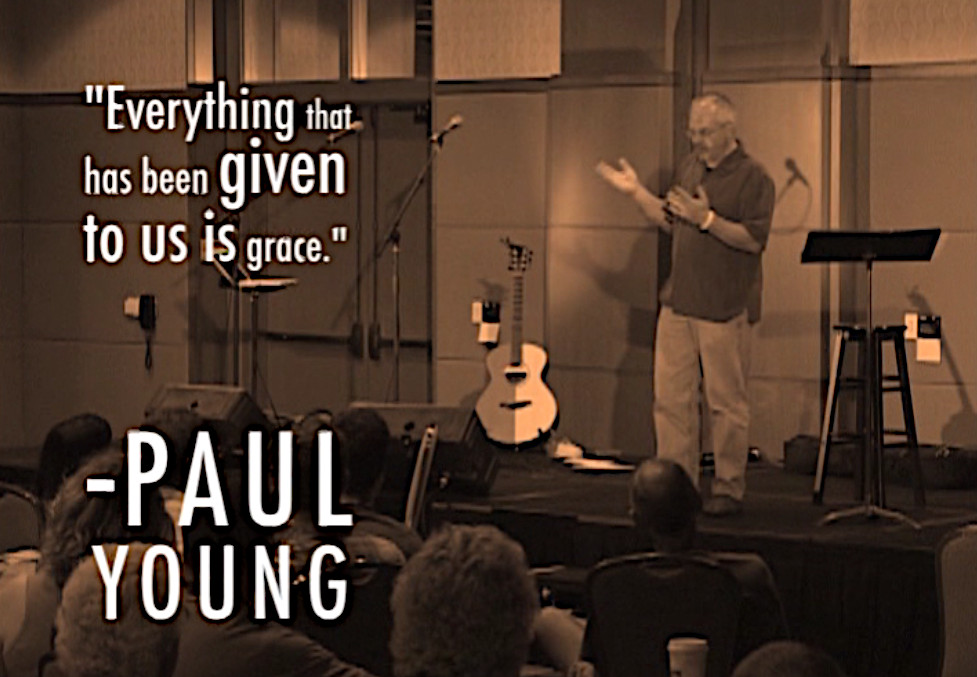
Paul Young (sometimes William P Young) wrote The Shack for his children and it unexpectedly became a very famous best-seller and much later a movie.
Here he speaks to a House2House (H2H) conference in 2008, explaining how our traditions can trip us up and mislead us, how he came to write the book, and how Father’s grace can take any one of us and make the impossible possible.
Paul Young, speaking on the topic ‘Grace’
I’ve put the three YouTube videos into a playlist. The video is low quality as it was recorded in 2008 using the standards available at the time, but the sound is clear enough. Copyright for all three videos is with House2House and I have their permission to share the videos here.
Click the playlist link and watch away. These videos have, I suspect, changed many people’s lives – in a good way. They open up truths that have been hidden for some, for others they will confirm what they already thought. The videos are by turn funny, gripping, informative, and very, very useful today just as much as in 2008. Truth doesn’t change.
So for you, and your friends, it may be transformational or it may be confirming. Either way, my prayer for you is that you will be blessed and encouraged by listening.
Some background
The conference was over three days, the first day was for leaders; Paul spoke on Grace and covers how and why The Shack came to be written. In his opening remarks he notes that he’s in an environment that he’s not familiar with. However, he was very well received.
The second topic, Tradition, was presented to the full conference. In it, Paul discusses the fall and the interactions between Yawheh, Ish, Isha, and Lucifer. (We often think of Ish as ‘Adam’ and Ishah as ‘Eve’, Paul explains the distinction.)
The third topic, Soul, was again to the full conference. This time Paul explains his background and life story very frankly.
Useful? Interesting?
If you enjoyed this or found it useful, please like, comment, and share below. (If you don’t see those links, click the article’s title above the main photo and they will appear.) Send a link to friends who might enjoy the article or benefit from it – Thanks! My material is free to reuse (see conditions), but a coffee is always welcome and encourages me to write more often!
You will only grow and progress if you do the work yourselves daily, weekly, and on into the extraordinary future that Father already has planned for you.
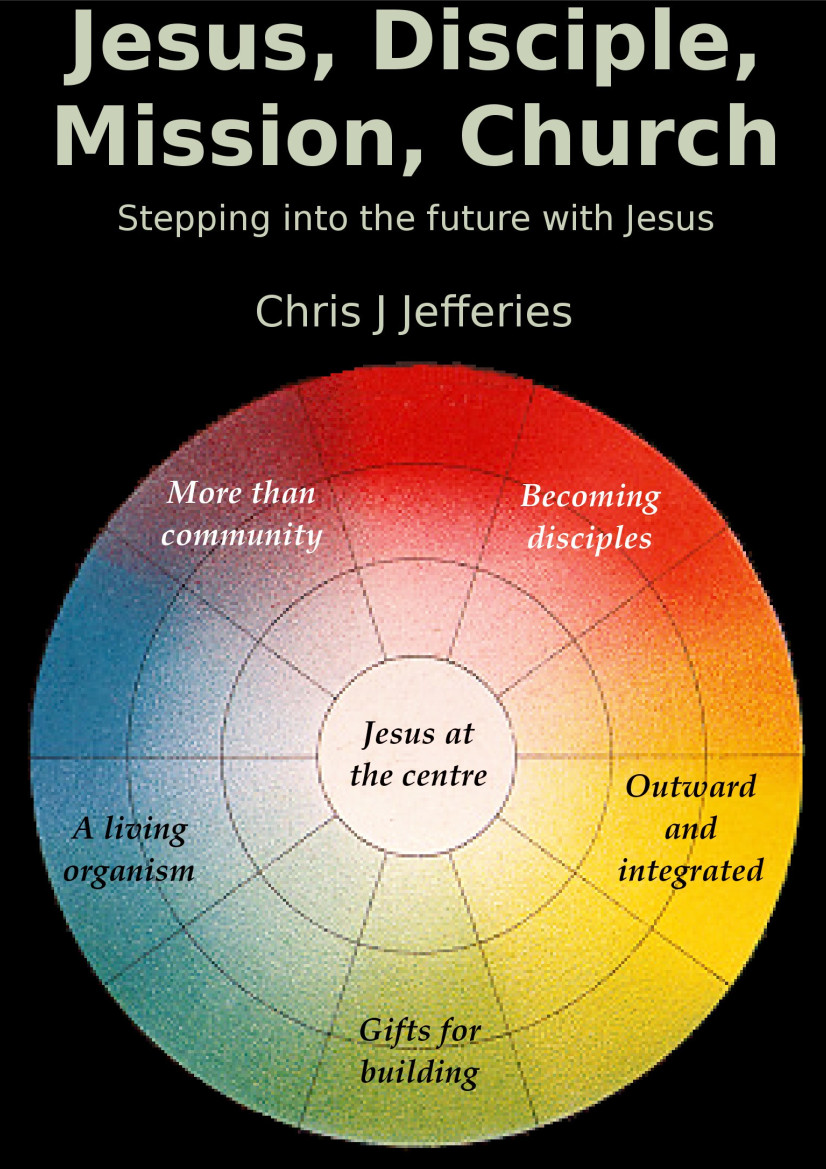
This article is an extract from my short book, Jesus, Disciple, Mission, Church (JDMC). The bite-sized piece below is roughly two percent of the book. It’s the very last section so is a bit different from the rest: there are no questions for readers to ponder, just a blessing at the end.
I suggest reading the blessing and making it your own. And why not see if any of your friends are interested too? Share the link with them, or meet over a coffee to chat about it. Alternatively you could return to the beginning of this series and get them started that way.
Not the end, just the beginning
JDMC cover
Please don’t think that because you have reached the end of the guide, you have also reached the end of the journey. I hope you’ll explore the more detailed books on ‘The Forgotten Ways’ as well.
The various parts of this JDMC guide are just that – a guide. You will only grow and progress if you do the work yourselves daily, weekly, and on into the extraordinary future that Father already has planned for you. He will show you and lead you but you must take the steps one by one. As you live and work and discover new things together you can expect to grow significantly and have an impact on those around you.
An intricate fabric
Remember that the six forgotten ways are woven together to form a rich and intricate fabric. Although I’ve presented them here individually and in a linear form, they are not like that in reality. Each depends on the others, all are needed in our lives together. They don’t begin with knowing Jesus and end with doing stretching things together, they are more like a grand party where the participants, the music, the lighting, the flowers, the food, and the decorations create an unparalleled overall experience.
Take one of them away and the party will be much the poorer.
However, each way does depend on the previous one and provoke the next in significant ways. People who put Jesus first will find themselves becoming disciples. If we truly follow him and love him, we’ll do what he says by going out and deep. Amongst groups of new believers who are open, the APEST gifts will find an opportunity. Where apostolic foundations take root, organic forms of church life will develop. And where church is active, stretching challenges are inevitable.
Just do it!
So make a start in your own lives and your own situation. Listen to what the Spirit says and do what he tells you. Keep Jesus at the centre. Make disciples and grow as disciples yourselves. Make sure to go out but also embed yourselves deep in the local culture. Explore your gifts and encourage one another in using them. Don’t over-organise but be ever more fully alive as parts of one living body. And face some stretching challenges together.
A blessing
I bless you in the name of Jesus, that you may you find yourselves at the heart of revolutionary and explosive growth. It might seem to begin ever so slowly, but stick with it and see what it will become! You’ll find your deepest peace, not by resting, but by being fully active children of the Father and walking daily with the Son.
This was extracted from Jesus, Disciple, Mission, Church (JDMC), page 49. Download the whole thing or read it online – GetJDMC.scilla.org.uk
Useful? Interesting?
If you enjoyed this or found it useful, please like, comment, and share below. (If you don’t see those links, click the article’s title above the main photo and they will appear.) Send a link to friends who might enjoy the article or benefit from it – Thanks! My material is free to reuse (see conditions), but a coffee is always welcome and encourages me to write more often!
What’s in an image? Sometimes quite a lot, more than meets the eye.
I’m posting an image every day (or as often as I can). A photo, an image from the internet, a diagram or a map. Whatever takes my fancy.
This is an image of an image of a story. It’s my photo of a stained glass window in a little church in the village of Upper Framilode near the River Severn in Gloucestershire.
The words at the bottom of the window read ‘Go and do thou likewise’ which we might rephrase in today’s English, ‘Now you go and do the same’.
It’s the punchline from a story Jesus told to show that love is an active thing, and if we don’t love the needy people around us in practical ways, how can we claim to be pure, or spiritual, or selfless?
Knowing what is the right thing to do is not the same as doing the right thing. It’s quite easy to mix those two ideas up in our minds, but it’s oh-so-important to have clarity about it.
You can read the story in modern English on the internet.
Themed image collections
The links below will take you to the first post in each collection
If you enjoyed this or found it useful, please like, comment, and share below. (If you don’t see those links, click the article’s title above the main photo and they will appear.) Send a link to friends who might enjoy the article or benefit from it – Thanks! My material is free to reuse (see conditions), but a coffee is always welcome and encourages me to write more often!
Jesus has been talking to his closest followers, the small group of twelve who were travelling with him. Now he begins to use the idea of a vine. Remember that everyone in Israel would have known what a grapevine is like, they were widely grown and wine was an important item in ceremonies as well as in ordinary life. It was essential in weddings, in the passover meal and so forth.
He now makes a strange claim, he says that he himself is a vine. Not only that, but he is the true vine. And he mentions that his Father is the gardener, though we shouldn’t think in terms of someone who looks after fruit, flowers and vegetables in the way we would today. Israel is the old vineyard, and Father is much more than just an employed labourer, he is the vineyard owner. The old vineyard (Israel) has not been fruitful. Jesus is a new vine and his Father will prune the branches to make him more fruitful. If you prune a vine wisely it becomes more vigorous and more fruitful; that’s true of all kinds of fruit tree too, anyone who manages an orchard will tell you that ageing trees fruit less but can be reinvigorated by good pruning. Old or diseased branches need to be removed and the others cut back to a strong, healthy bud.
And Jesus goes on to tell his followers, ‘You are the branches’! Who are his followers? Two thousand years ago they were the twelve disciples who followed him everywhere and were hungry to hear whatever he had to say. Today the things that he said to them, apply to us also. We are his branches, we are attached to him.
A two-way relationship
Notice that this is a two-way relationship. Jesus says we’ll be very fruitful if we remain in him and he remains in us. And notice too that it’s an all or nothing relationship; we’ll either be very fruitful or we can do nothing. There’s no option that makes us partly fruitful, or reasonably fruitful, fruitful in some things but not in others. We are fully in; or we are fully out. You will be precious and treasured, or you will be trash. So which will you choose? Will you be attached to the one true vine, or will you be disconnected?
And in verse seven we learn that if we remain in him and his words remain in us, we can ask anything we wish and it will be done for us! We need to be careful here, though. Jesus is not telling us that we can ask for things that are not in his will and purpose. He expects us to know we can ask anything in his Name and receive it. There’s no point in asking for something that will harm or destroy your enemies, for example, because Jesus made it clear that we are to love our enemy. If I ask for wrong things, I am not remaining in him and his word is not remaining in me.
While the nails were being driven through him into the cross, Jesus asked for something. He said, ‘Father forgive them, they have no idea what they’re doing’. Was that prayer answered? You bet it was. It’s a tremendous example of loving your enemy, isn’t it! Maybe one of those Romans was the one who later said, ‘Truly this man was the Son of God’.
Glorifying the Father
Finally, in verse eight we see the purpose of it all. It’s not about us at all. It’s not even about Jesus. It’s about the Father! Being very fruitful, and showing ourselves to be followers of Jesus, simply brings glory to the person who truly deserves it and should always receive it – the Father.
Our Father, who is far beyond our reach, let your Name be utterly holy, may Your will and purpose be done here on Earth, just as it is in Your dwelling place.
If you enjoyed this or found it useful, please like, comment, and share below. (If you don’t see those links, click the article’s title above the main photo and they will appear.) Send a link to friends who might enjoy the article or benefit from it – Thanks! My material is free to reuse (see conditions), but a coffee is always welcome and encourages me to write more often!
I’ve just read this short but truly excellent article by Chris Dryden, aka CD, aka DaManCD.
In his inimitable way, he captures the difference between typical church as most people know it, and the living organism of ekklesia as Jesus intends it. There’s an absolute chasm between the two, and Chris clarifies that.
There was a young man holding a baby just a few weeks old, and right opposite him a young woman, clearly the mother. The three of them were interacting so beautifully
Here’s a short story from a morning recently, here in Cirencester where I live. It involves the very briefest of interactions between me, a young man, a young woman, and their baby. Maybe we can learn several things from what happened, useful lessons about life, about ourselves, about politics, and about the nature of Love itself.
I sat in Coffee#1 in Cirencester enjoying a white Americano, I’d walked into town and had a heavy load of shopping in my rucksack to take back home, a range of fruit from the market stall in the beautiful old Market Place, and a loaf of fresh bread from a traditional bakery. I fancied a break before setting off for home.
I put down the weighty rucksack and my hat on a chair at a vacant table, ordered the coffee and waited while it was prepared, then returned to the table, put in my earbuds, and caught up with some of the news following the previous night’s exciting General Election. While I was watching and listening, I couldn’t help noticing the people at the next table. There was a young man holding a baby just a few weeks old, and right opposite him a young woman, clearly the mother. The three of them were interacting so beautifully, the parents obviously very fond of one another and completely relaxed, the baby equally happy to be held by either of them, and both the adults alert to the needs of the little one. It was a triangle of love and of trust, a happy and peaceful grouping.
They were still there when I got up to leave and I had to pass their table to reach the door. I put on my rucksack and hat, stopped briefly at their table and said, ‘I just have to say that you three are such a lovely little family, and I want to wish you the very best going forward’. I received two huge smiles and headed out through the door to the street. As I passed the shop window, they were still beaming and the young man and I waved to one another, both smiling.
Why am I sharing this little story? Because it seemed notable to me. How many young families are there with difficulties and troubles? All of them! We all have problems during our lives, the important thing is not whether we have them, but how we will handle them. The threesome at Coffee#1 will likely grow to four (maybe more) but it seems to me that they’ll deal with any difficulty wisely and lovingly and will come through any troubles stronger than before. Love is such a powerful thing. There’s a lesson there for everyone.
Go through life pouring out love towards those you meet along the way, and you’ll fare better than if you approach life asking, ‘What can I get out of it? How can I profit? How can I become wealthier or more successful? How can I benefit by ignoring the needs of others?
This is not irrelevant to the politics of our day. For some time there has been a rather nasty drift towards selfish, arrogant, pushy, self-serving, uncaring attitudes from some quarters. It’s not too hard to find examples of this approach in Britain or America with some disturbing and growing trends towards noisy, yet empty politics. The old adage remains true, ‘Empty vessels make the most noise’. In Britain, the Labour victory may work to quell this for the next four or five years, and hopefully the electorate will appreciate the change and clearly understand the dangers, and not support parties or politicians that behave like that.
We now have a chance for more well-considered sanity in our politics, and less mis- and dis-information, or so I fervently hope. We need debate that is less like the destructive accusations and anger inevitable in broken families, and more like the love and gentleness and hope for the future of that young family in Coffee#1.
I like what Paul wrote about love in 1 Corinthians 13, here’s an extract:
Love is patient, love is kind. It does not envy, it does not boast, it is not proud. It does not dishonour others, it is not self-seeking, it is not easily angered, it keeps no record of wrongs. Love does not delight in evil but rejoices with the truth. It always protects, always trusts, always hopes, always perseveres.
Love never fails.
Such love was abundantly present in those parents in Coffee#1. They clearly cared for one another, and they trusted one another completely in caring for the little one. Babies are vulnerable and helpless, it takes parental love to keep them safe and to guide them well as they grow. And the examples provided by two good parents will give a child the best possible chance to develop the same sort of love themselves as they grow and mature.
Paul, as he wrote about love, was thinking of the love of the Creator King acting as Parent, Offspring and life-giving Breath, showing love and care for us all; and the love that we have for one another, for the world, and even for our enemies as we do our best to follow his lead. Paul expresses this clearly, but he was also thinking about the nature and attributes of love itself.
The Victorian teacher and writer, Henry Drummond, had some wonderfiul perspectives on John’s words to the believers in Corinth; he, too, draws out deep truths about love.
If you enjoyed this or found it useful, please like, comment, and share below. (If you don’t see those links, click the article’s title above the main photo and they will appear.) Send a link to friends who might enjoy the article or benefit from it – Thanks! My material is free to reuse (see conditions), but a coffee is always welcome and encourages me to write more often!
This article is an extract from my short book, Jesus, Disciple, Mission, Church (JDMC). The bite-sized piece below is roughly two percent of the book.
Deacons
JDMC cover
Sometimes, in the early years as communities of believers formed, individuals or small teams were given particular tasks, often when there was a specific need. The men and women who were given these tasks were called ‘deacons’ (Greek ‘diakonos’). The word at its root means ‘dust kickers’, people who would run errands. Over time it came to have a more general meaning in everyday Greek, servant’, ‘waiter’ or ‘administrator’. Deacons in the early church were about getting things done.
At their first mention (in Acts 6:1-6) they were responsible for giving out aid to Greek widows who had been previously overlooked, but the task could be anything else that needed regular and reliable attention. For more on deacons see 1 Timothy 3:8-13).
Think it through – Read some of the passages about deacons and consider the people who were chosen to do the work. Can you identify people doing some of these things in the church today? (They may or may not be called ‘deacons’.) Do deacons have command authority or knowledge and wisdom authority?
Pastors
Pastor is an old fashioned English word for ‘shepherd’. Read about the The shepherding gift in the section on The APEST gifts, JDMC page 42. Bear in mind that there are many people today called ‘pastor’ who are administrators, teachers and managers. This is not the same thing as the gift of shepherding.
Priests
Where does this title come from and what does it mean? In the Old Testament we read about priests and, in particular the ‘High Priest’ or ‘Chief Priest’ (2 Chronicles 19:11). The priests were members of a single family, descended from Aaron and his sons (Exodus 29:44). The men of this family were responsible for offering sacrifices on the altar, first in the Tabernacle and later in the Temple. An animal would be slaughtered and offered on behalf of the people when they had transgressed the law in some way. A sin offering was required for forgiveness (Leviticus 4:27-31). The priest acted as a go-between, taking the living animal and offering its life (the blood) in place of the sinner’s life, a substitutionary sacrifice.
Priests today are church leaders who offer the bread and wine on our behalf, a role that the New Testament clearly states is not required. All who believe in and follow Jesus are priests! (1 Peter 2:9) We offer Christ’s substitutionary sacrifice to all who will accept him. We are the go-betweens, and need no-one to bring us into the Presence of the Father, something Jesus has already done once and for all (John 14:9).
Consider – Were the priests helpful towards Jesus or a hindrance? (eg Matthew 16:21) How do you suppose the church made the mistake of thinking we still need this role today? Think about the role of Jesus as our Great High Priest and our role as a Royal Priesthood (Hebrews 4:14).
Bishops, elders, deacons, pastors and priests today
(Bishops and elders were considered in the previous post in this series.) Many denominations use these words in a different sense than the early church. Often they are used for organisational roles. But if we see church as a living organism rather than an organisation we will also need to understand these terms in living ways instead.
Consider – Do we need to identify certain people as bishops, elders and deacons? Paul identified them, think about how he saw them and why he regarded them as necessary and useful. Did he see them as functions of control or of service? How do we see them? And is there a role for pastors and priests?
This was extracted from Jesus, Disciple, Mission, Church (JDMC), pages 47 and 48. Download the whole thing or read it online – GetJDMC.scilla.org.uk
Useful? Interesting?
If you enjoyed this or found it useful, please like, comment, and share below. (If you don’t see those links, click the article’s title above the main photo and they will appear.) Send a link to friends who might enjoy the article or benefit from it – Thanks! My material is free to reuse (see conditions), but a coffee is always welcome and encourages me to write more often!
It’s not about hearing a voice or seeing an image, it’s simply trusting that the Holy Spirit will inhabit the thoughts you are having and that it’s OK to express them.
People have a way of jargonising more or less anything (is that even a word? – well, it is now!). We need to understand the value and the dangers of inventing and using jargon. It may be convenient, but it can also be quite misleading. This is just as true for the Spirit as it is for more or less anything else. Over the centuries people have used jargon to streamline conversations, but latching onto words can obscure meaning.
What does the Bible say?
When it comes to Jesus’ followers and the Holy Spirit we need to be alert to the difficulties jargon can introduce. What do we really mean when we talk (or write) about the Holy Spirit’s presence in our meetings? As usual we need to see what the Bible and particularly the New Testament has to say and then take a careful look at how church has dealt with ideas that have sometimes seemed difficult. Here are a few New Testament quotes:
Matthew 3:11 – [Jesus] will baptise you with the Holy Spirit and fire: In other words, he will ‘drench’ you in the Holy Spirit and Father’s presence!
Mark 13:11 – Just say whatever is given you at the time, for it is not you speaking, but the Holy Spirit: Don’t try to process it or understand it, just say it.
Luke 1:15 – he will be filled with the Holy Spirit even before he is born. You don’t need to be older than an unborn child to be filled with the Spirit.
Luke 1:67 – Zechariah was filled with the Holy Spirit and prophesied. Whatever prophecy is, if you’re filled with the Holy Spirit you can do it.
Luk2:26 – It had been revealed to him by the Holy Spirit that… The Holy Spirit can show us what we don’t already know.
Luke 10:21 – Jesus, full of joy through the Holy Spirit… He can fill you with joy.
John 14:26 – … the Holy Spirit … will teach you all things and will remind you of everything. You will know and remember everything that matters.
John 20:22 – [Jesus] breathed on them and said, ‘Receive the Holy Spirit’. Receiving the Holy Spirit is like receiving life!Yahweh breathed on Adam in the same way and he became a living being.
Those are some verses I picked from the gospels, but there are plenty more New and Old Testament references to the Holy Spirit’s nature and activities. Given those quotes, think about what the Holy Spirit has done for you (has done, not will do, and not might do):
He has thoroughly drenched and saturated you, he gives you what you need when you need it, you are certainly as capable as any unborn child, you are prophetic, he’s shown you things you didn’t already know, he’s filled you with joy, he’s taught you and reminded you, he’s made you fully alive.
The problem with jargon
Let’s think for a moment about the things people say about the Holy Spirit and spiritual gifts. Here are some examples with my translations and suggestions what to do. (Jargon always needs translating, and what to do should be simple and easy.)
I had a word or I have a prophecy – I have a sense that the Holy Spirit wants me to say something. – No need to announce it, wait for a pause and just say it. Sometimes, once you start to speak more will come as you go along, if so keep speaking, but if not that’s fine too.
I have a vision or I have a picture – I had a thought about a hill, or a scarecrow, or a crashing wave, or an alligator, or a king on a bike. – Wait for a pause and just describe it; if you don’t know what it means, perhaps somebody else does. Don’t worry about that, but share what you have been given whether it’s a little or a lot.
Let’s sing… or We should sing… – I have a hunch this song will be useful at this point. – If you are brave enough, simply begin singing, or humming the tune, if not, ask if others know the song, if there’s someone there with a musical instrument they might be able to start, or break in and restart if the key was wrong.
Let’s turn to the passage xyz – There’s something quite relevant in the Bible. – Just read the verses and briefly explain why they’re relevant or outline what you’ve just thought about them. Try not to use up too much time (don’t preach a sermon).
Speaking in a tongue – These sounds are buzzing around in my mind and I think I should speak them out. – No need to say what you’re about to do, just start when there’s a gap. As with the prophetic words, once you start it’s quite likely that more will follow. Someone may interpret what you say, but if not, be prepared to step in and say something yourself. If you only have a short and simple interpretation that’s fine; let others have the chance first and if a long silence opens up, then say something even if it’s brief.
Let’s pray or Let’s turn to the Lord in prayer – A prayer is jiggling around in my head, wanting to come out. – Start to pray when you sense a suitable gap. Avoid being over-long, you will know when to stop with an, ‘Amen’ or a ‘Thank you, Father’ or just silence.
Interpret a tongue – I feel I should share what I’m thinking after hearing that. – It might be praise, or explanation, or like a translation. But however it starts, just go for it. The Holy Spirit wants someone to speak so that everything is done in an orderly way. Someone should say something in English and it might as well be you!
Sing in the Spirit – I just have to sing with unknown words; I can’t express what I feel any other way. – This can be delightful to hear, especially when several or all the people join in. It’s often very uplifting and feels like praise or worship; unlike tongues, nobody needs to interpret. I remember one occasion when I sang like this and after a pause of several seconds, somebody else sang the interpretation. That was amazing, but it’s just fine without.
The important thing here is not that we avoid jargon, but that we recognise it for what it is and don’t allow it to intimidate us. Remember that whatever words or phrases we use, it’s just labelling aspects of people expressing how they feel. It’s not about hearing a voice or seeing an image, it’s simply trusting that the Holy Spirit will inhabit the thoughts you are having and that it’s OK to express them.
I think the intimidation comes from the lack of transparency brought along by the jargon. There’s a sense of mystery when we hear, ‘speaking in a tongue’, ‘having a vision’, ‘interpretation’ or ‘prophecy’. But what is really happening is not mysterious at all; it’s just a matter of ordinary people expressing themselves when all is said and done! And if you’re taking part for the first time there’s the normal slight anxiety and nervousness we get when speaking to a group at work for the first time. How will I be received? Will I get this right, will I embarrass people, will I embarrass myself? All of this makes it harder to get started. But afterwards there’s a sense of relief (I did it!) and it’s much more comfortable after that. Just push up over that little hump in the road, and it’s downhill the rest of the way.
We’re not used to having opportunities to be really free and open, but it’s important that we do because this is how the Spirit guides us in our meetings. He will speak to each of us through the others. It’s not necessary for everyone to speak out, but it’s not unusual with smaller numbers that they will do. This sort of sharing together works best with groups between five or six and up to ten or twelve. The dynamics with two or three, or twenty-five to forty, are very different – and not always conducive to the sort of shared hearing from the Spirit described here. ‘Practice makes perfect’, as they say. So don’t be fazed by what seems to be slow progress or a bad meeting now and then – meet again anyway, keep going.
Finally, here’s a thought about confirmation. During a meeting there’s little opportunity for confirmation. Sometimes somebody might say, ‘I’m so glad you mentioned that because…’. But towards the end, it’s not unusual for a pattern to emerge, and everyone begins to understand that the whole meeting was on a theme of some kind. The sum of the parts was more significant than the individual contributions. When that happens, be grateful and be excited!
There can, by definition, never be a better meeting than one led by the Holy Spirit.
If you enjoyed this or found it useful, please like, comment, and share below. (If you don’t see those links, click the article’s title above the main photo and they will appear.) Send a link to friends who might enjoy the article or benefit from it – Thanks! My material is free to reuse (see conditions), but a coffee is always welcome and encourages me to write more often!
This article is an extract from my short book, Jesus, Disciple, Mission, Church (JDMC). The bite-sized piece below is roughly three percent of the book.
Why do we need to consider other leaders?
JDMC cover
We have already seen in part Four – Gifts for building, that the original pattern of church leadership springs from the apostolic gift (JDMC, page 41). We also saw that four further gifts are released to operate where there is an apostolic foundation, and we looked at these in more detail in the previous part, The APEST gifts (page 41-44). But the New Testament also mentions bishops (or overseers), elders and deacons, and today we use the terms pastor and priest quite widely. We need to briefly examine these too and understand how they fit into the overall picture. Before we do this, let’s consider the New Testament principles around authority – particularly what Jesus himself said and modelled.
It’s easy to think of the Greek words and their English translations as positions in a hierarchical authority structure, each with defined powers and roles. But as we have seen in Five – A living organism, church is much more a life form than an organisation. The six forgotten ways are not the only things that have been mislaid during the two millennia since Jesus’ time. Our understanding of the functions of bishops, elders and deacons has changed, and very dramatically so. We need to understand them again as they were understood by those early believers, just as recorded in the New Testament.
Perhaps the first thing to say is that as with the APEST gifts, bishops, elders and deacons are not positions of authority in the sense of ruling over other believers. Jesus explicitly told his disciples that they were to love one another as he had loved them (John 13:34-35). If he came to serve, so also should we. And he also told them that they were not to rule over one another as the gentiles do (Matthew 20:25-28). Paul writes that we should submit to one another (Ephesians 5:21). This much is very clear. So whatever else we may say about bishops, elders and deacons, we can be quite certain at the outset that they are not about enforcing rules, governing people’s behaviour or managing an organisation.
Bishops, elders and deacons don’t seem to chime with the idea of the APEST gifts of service or with church as a living organism. Is this a problem? If so, how can we resolve it? Consider this carefully before moving on.
Bishops
The Greek word here is ‘episkopos’ and it means, literally, ‘overseer’, someone who keeps watch, someone who keeps an eye on things. Another word we could use is ‘lookout’. It need not be understood to mean an official who makes sure everyone follows orders, although it might seem to imply control because that is the sense of the English word ‘overseer’ in everyday usage.
We need to check the New Testament to understand how the word is used there. Here are some wise words from JP Louw and EA Nida writing in Greek English Lexicon of the New Testament, ‘Though in some contexts [episkopos] has been regarded traditionally as a position of authority, in reality the focus is upon the responsibility for caring for others’. This is a responsibility we all share, we must all look out for one another.
‘Episkopos’ is not always used in a positive way; just take a look at 1 Peter 4:15. Which word in this verse contains the Greek ‘episkopos’ do you think? There’s another Greek word ‘allotri’ which means ‘other people’s business’ and ‘meddler’ (NIV) is ‘allotriepiskopos’, an ‘episkopos’ who meddles in other people’s business.
When Paul writes ‘episkopos’ it’s clear he is referring to particular people he regards as effective at keeping watch to detect – and respond to – error. But this doesn’t mean that the other believers were free to relax. If any of us sees error, or somebody promoting it, we must question it and, if necessary, alert others. Might it be that Paul is simply saying that we need people among us who will be alert and willing to respond? Perhaps he is just saying that some are better at this than others and it’s useful to identify them, recognise them, and pay attention to what they say. Indeed, the work of keeping watch is one of the things shepherds need to do , something they are gifted at. (See The shepherding gift, JDMC page 42)
Jesus himself can be regarded as an ‘episkopos’. In 1 Peter 2:25 we read that Jesus is ‘the shepherd and guardian of your souls’. Some versions translate this as guardian (NASB, TLB), some as overseer (ESV, NIV), and some as bishop (ASV, KJV). Once again, the sense is not of ruling but of taking care, keeping watch (part of what a shepherd does as noted above).
Look up ‘overseer’ in a concordance or search function and draw your own conclusions about the work of an overseer or lookout. Try to get a feeling for what these people were expected to do. Did they have authority over other believers?
Elders
Paul made a habit of identifying elders in the churches he planted (Acts 14:23, Titus 1:5). It’s worth mentioning that the word translated ‘appointed’ might equally well mean ‘pointed out’ or ‘identified’. But in English, the idea that Paul ‘pointed out’ elders is very different from the idea that he ‘appointed’ them. In everyday life, people who are appointed to a position are given authority to make decisions and to act in a particular role. But let’s remember that the New Testament and the words of Jesus himself suggest love, humility and submitting to one another as the primary focus.
The word ‘elder’ is from the Greek ‘presbuteros’ and it does literally mean an older person. But it is also used to signify someone who is wise, and this is probably the sense in which Paul uses it. Eldership is not a role involving the giving of instructions or the making of decisions on behalf of others. Rather, elders are those people in the church who have more experience and wisdom. They are people we would naturally turn to when we are confused or anxious or when conflict arises. Pointing such people out in new and inexperienced gatherings of believers was a wise precaution taken by Paul and those he coached.
Bear in mind that the word ‘authority’ has two rather different meanings. The police have authority and you do what they tell you or face the consequences; this is command authority. Plumbers have a different kind of authority and you do what they tell you because you have a problem they know how to fix; this is knowledge and wisdom authority. Which kind of authority do you suppose elders should exercise?
Did Jesus exercise command authority or knowledge and wisdom authority? (Trick question – you should be able to find examples of both.) What kind of authority does he want us to exercise over demons? What kind does he want us to exercise with one another?
PS – I liked this post by Christopher Dryden. It’s very much about the subject of elders, but written as a story from his own experience: Fun to read but gentle, kind and definitely not judgemental. He very clearly explains the difference between elders as often found in church life, and elders as Jesus intended them to be. He says what I wanted to say in the section on elders, but he says it more eloquently.
This was extracted from Jesus, Disciple, Mission, Church (JDMC), pages 45 to 47. Download the whole thing or read it online – GetJDMC.scilla.org.uk
Useful? Interesting?
If you enjoyed this or found it useful, please like, comment, and share below. (If you don’t see those links, click the article’s title above the main photo and they will appear.) Send a link to friends who might enjoy the article or benefit from it – Thanks! My material is free to reuse (see conditions), but a coffee is always welcome and encourages me to write more often!




 Journeys of Heart and Mind

