The need to accept one another as beloved brothers and sisters will start to seem more important than having this or that position accepted. The body will work together better, there will be less confrontation and more building going on.
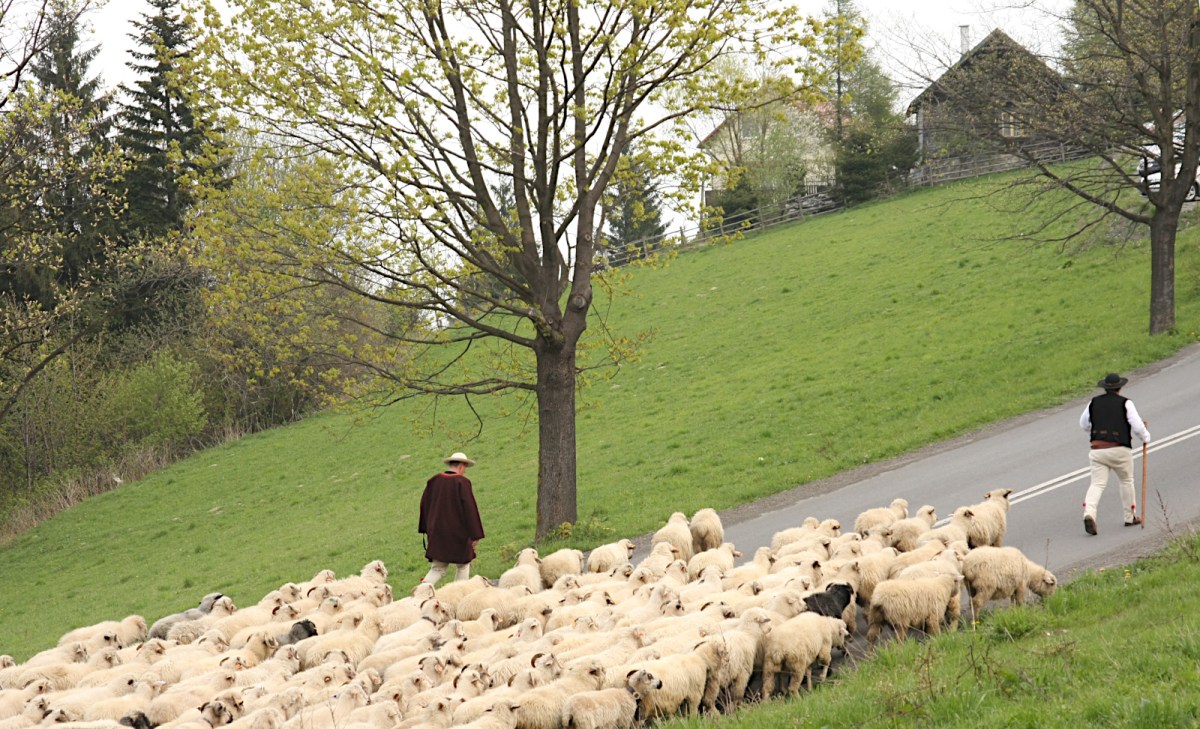
Shepherd and sheep (Wikimedia) -Click images to enlarge
Continuing the flow of church life and growth, where evangelists have been at work there will be a gathering of people following Jesus to the best of their ability; some will be absolute beginners. There are bound to be some difficulties and rough edges: some may come off track, stop coming to meetings and drift away. There may be disagreements, even angry arguments. There will certainly be differences of opinion and misunderstandings; friction and differing perspectives. And there may be some who will say, ‘Don’t go that way, come this way, it’s a much easier path.’
Where there is someone with a strong shepherding gift, all of these issues will be addressed, usually in straightforward, kind and helpful ways. People will be encouraged to understand alternative points of view even though they may strongly disagree. Those who wander away will be visited, given an opportunity to explain difficulties, ask questions and be encouraged even if they decide not to return. The need to accept one another as beloved brothers and sisters will start to seem more important than having this or that position accepted. The body will work together better, there will be less confrontation and more building going on.
Although Paul’s greatest gifting may have been apostolic and he was strong also in the prophetic, you can see the shepherd in him as he shows concern for the Corinthians who were losing their way. And I can imagine James, speaking about the widows and orphans saying, ‘Hey, these people need your help and love too. You’re watching them suffer and doing nothing to show them you care about them.’ Shepherds are always alert and ready to intervene when there’s a need.
We’re at a strong disadvantage here in Britain, our agricultural history has shepherds but no tradition of leading sheep. Instead our custom is to round them up and drive them in the way we want them to go. We use sheepdogs to help us frighten the sheep into submission. Take a look at the photo in this article, the shepherd is in front and the sheep are following, that would not happen in the UK, or in France, the USA, Australia or New Zealand. The photo is from Poland where some shepherds work like the traditional pastoralists in Israel and Arab nations. When Paul writes about the gift of a shepherd he’s not thinking about rounding up or driving a herd of anxious and scared sheep with the help of a descendent of the wolf family! There may be difficult moments where someone with a shepherd gift has to act very firmly to protect someone else from continuing unkind, selfish or unthinking behaviour, but hopefully these will be rare exceptions.
Why follow?
So why do sheep follow a shepherd? It’s because the shepherd knows what the sheep need, and the sheep know that the shepherd knows what they need. What do sheep need? They need grass to eat, water to drink, and safety from predators. Sheep are far from stupid, they soon learn that the shepherd will take them to green pastures, streams of living (ie flowing) water, and if a predator comes close the shepherd will drive it away.
And that, my friends, pretty much describes the gift of Shepherd in the life of the church. If you are a gift of Shepherd in the church nobody will be afraid of you. They will know from experience that your habit is to lead them to places where they will be able to thrive and grow in peace and safety. Places where they will be fed truth and have access to the living water, and that every kind of predator will either be won over or chased off.
Do you have this gift?
Yes, as with apostle, prophet and evangelist, we all have this gift to some degree. You cannot be like Jesus without having some level of shepherd about you. Jesus is the origin and source of all the gifts we’re discussing in this series. If you believe him and follow him then Christ is in you. And if the perfect Shepherd is in you then you are going to reflect that at some level.
Psalm 23
This famous Psalm sums it up really well. If you have a well-developed and deep gift of shepherd you will be a living example of Psalm 23 in action. The psalm describes how you will make the people around you feel.
How the gift of shepherd has been misunderstood
In the 20th and 21st centuries the word ‘pastor’ has been used (or misused) to identify people who may (or may not) have a shepherding gift. Often it is used to mean something like a manager or director – as if church is a sort of business enterprise. A Pastor in this sense is heavily loaded with many duties. He is the person where the buck stops – financially and managerially. He (for it’s usually a man) is expected to fix every problem, and solve every issue. The Pastor may have a team under him, often described as elders, people he can delegate to, call on for help when needed, and share the responsibilities with. Neither the pastor nor the elders will necessarily be shepherds in the sense I’ve outlined in this article. Some of them might be, but much of their time and effort is likely to be spent on management tasks.
Meanwhile any true shepherds in the congregation may not be identified, and might struggle to fulfil the role Jesus has bestowed on them. It’s a double-bind, in which shepherds and those who need the care of a shepherd are both frustrated.
Check the Daily Meditations link below to see some of the thoughts of a shepherd’s heart. Next time, we’ll take a look at the gift of teacher, that will round off APEST for us:
Apostle Prophet Evangelist Shepherd Teacher
After thinking about the teaching gift, we’ll take a look at how all five APEST gifts can be seen in the nature and teaching of Jesus himself.
If you enjoyed this or found it useful, please like, comment, and share below. (If you don’t see those links, click the article’s title above the main photo and they will appear.) Send a link to friends who might enjoy the article or benefit from it – Thanks! My material is free to reuse (see conditions), but a coffee is always welcome and encourages me to write more often!
Think of an evangelist as first and foremost a ‘people person’. They get their energy from being in the crowd. They love to talk, they smile and laugh a lot, they’re fun to be around, they tend to be party people.
A street party (Wikimedia) -Click images to enlarge
When apostles and prophets have done their stuff it’s high time for evangelists to join in. I don’t want to push the idea of a sequence too far; ideally we should be aiming for a situation where all the APEST gifts are operating simultaneously and abundantly, all at the same time. I’ve been using the analogy of building a house where apostles lay foundations and prophets make sure the structure is straight and true, but it should be very clear from Paul’s letters to the Corinthian church that all of the gifts need to work continuously. Unlike a house, when foundations are laid once and the stonework is raised once, for church to function as Jesus intended these are ongoing requirements. It’s not just urgent repair work as in Corinth, but it’s a living process of constant adjustment and calibration.
Following the apostle and prophet articles, the focus this time is on the gift of an evangelist – what it looks like, how it arises, how it affects a person who is expressing it, and how the rest of us can relate to it, support it, and, as an expression of church, benefit from it. Next time we’ll examine the gift of a shepherd in much the same way.
No room for wriggling
We all have this gift to some degree. You cannot be like Jesus without having some level of evangelist about you, so you can’t wriggle out of it completely. Jesus is the origin and source of all the gifts we’re discussing. If you believe him and follow him then Christ is in you. And if the perfect evangelist is in you then you are going to reflect that at some level. You may or may not be evangelical, but you will most certainly be somewhat evangelistic in character and nature.
We need to know how to recognise an evangelist, and that’s really not too difficult, but before I consider that I’d like to clear up a common misconception that can cause some confusion. There’s a (mistaken) understanding among many Christians that evangelists go out and convert people from whatever they currently believe. But that’s not quite right. It’s apostles who are called to go out and start new churches, very much following in Paul’s footsteps. But evangelists have a slightly different role. The Greek word is euangelion (εὐαγγέλιον). It’s a word of two parts εὐ which means ‘good’ hence a eulogy is a good word, and αγγέλιον or angelion meaning ‘messenger’, we get our words ‘angel’ and ‘angelic’ from this same Greek origin. So an evangelist is a ‘bringer of good news’, not only in the narrow sense of someone who preaches the good news but more in the sense that an evangelist is someone who is good news.
Think of an evangelist as first and foremost a ‘people person’. They get their energy from being in the crowd. They love to talk, they smile and laugh a lot, they’re fun to be around, they tend to be party people. Hence this article’s title Partying with an evangelist. Evangelists draw people in – ‘Come and have a drink with us.’Have you tried this amazing dessert?’ ‘Fantastic dog, what breed is it?’ ‘You’re looking really happy, it’s so good to see that’. They like to tell stories and will probably have everyone in stitches, and if you have a story they will want to hear it and will find comfortable ways to draw it out if they can. People gather around evangelists in a very natural way, and before long an evangelist will be telling them about things Jesus did in their lives, or asking them if they’ve ever met him in a meaningful way themselves.
An undemanding and comfortable gift
Where the gift of evangelist is operating, you’ll find a group of people who are both engaging and engaged. That’s why it’s such an important gift for joy, balance, and growth of the church (ekklesia) the called-out community of Jesus in a place. If we could only grasp and use this gift more fully, church would be the popular, local place for everyone to gather (not just believers). As always, Jesus has all of the gifts in a fullness we can never completely express. In part, that’s why the crowds followed him everywhere he went in Judea and Galilee – he was and remains really, really Good News! But I think I’ll leave Jesus as the fullest expression of the APEST gifts for a later article after we’ve worked through shepherd and teacher.
For now it’s enough to grasp that evangelists are about good news, not only in the message they bring but also in who they are (remember, who you are is far more fundamental than what you do).
On the more serious side
But there’s more to be said about the gift of evangelist. This gift to the body is not just about fun and being attractive and welcoming. Evangelistic people have a heart to welcome people, but they know the welcome should have the purpose of bringing people into Christ’s presence. They are passionate about this goal, but they also know they must bridge the huge gap that exists between ekklesia and the prevailing culture of the society beyond (and often it seems beyond the reach of) the church. But they also know that their particular gift can reach across that divide far more easily than the rest of us might think. Because the first step in reaching a person is to become a trusted friend.
The evangelist is propelled forward by a desire to see people come to know and trust Jesus and every opportunity to communicate the truth spurs them on. The evangelist may become impatient with slow processes and tend to be stronger at drawing in new believers than they are at discipling or teaching, those processes are not where their strengths lie.
In conclusion
One of the take-home messages from this article on the gift of evangelist is that we need to lighten up in church life and activity. We need a reputation of being the best and most sought after place and community in town! If this is not the way of things you may be lacking the gift of one or more evangelists. They’re there among you, but perhaps they’re regarded as lightweights, not learned enough, not Bible scholars or great preachers, not serious. Yet one of the reasons ordinary people avoid church is that it seems to be far too serious, dull, boring, a place for serious, dull, boring people. If this is how people see your church (or your small group), maybe you need to find the evangelists and apologise for suppressing them. Instead, invite them to lead a meeting or two, ask them to show you how you, too, could lighten up a bit. And if visitors are among you, for whatever reason, give the evangelists a bit of freedom.
This may not be the easiest of messages to hear, particularly because it is so rarely expressed or understood. Church was never meant to be a dull, hushed and deadly serious endeavour. Party food smells a great deal better and more exciting than the polish on Victorian church pews!
If you enjoyed this or found it useful, please like, comment, and share below. (If you don’t see those links, click the article’s title above the main photo and they will appear.) Send a link to friends who might enjoy the article or benefit from it – Thanks! My material is free to reuse (see conditions), but a coffee is always welcome and encourages me to write more often!
Gratitude demands taking hold of whatever is being offered, unwrapping it, and finding out what it is for and how it works. It also involves actually trying it out, taking it for test runs, expressing it, seeing how others react to it.
We considered the gift of an apostle last time, so now we’ll look at the gift of a prophet. And let’s be clear, once again I’m not writing about an individual person here, we’re going to focus on the gift itself – what it looks like, how it arises, how it affects a person who is expressing it, and how the rest of us can relate to it, support it, and, as an expression of church, benefit from it. Next time we’ll take a look at the gift of evangelist in the same way.
Making it real
As with each of the service gifts, let’s begin by reminding ourselves that we all have this gift to some degree. You cannot be like Jesus without having some level of the prophetic. Some will have a high level of this gift, some may have it at a relatively minor level. And in all of us it will exist alongside various mixtures of the other four APEST gifts. But whatever the level – low, medium or high – the source remains the same, it always springs from the nature and heart of Christ himself. He provides all of the gifts as he thinks fit. Make this real for yourself, personally. Jesus has carefully chosen and bestowed these five gifts on you in whatever proportions will enable you to play your part in his ekklesia, his called and appointed community. He is special, but he has made you special too; whatever happens in your life, never forget that.
Remember that a gift requires activity from both the giver and the receiver. A gift that is offered but not taken is no gift at all; it never fulfils it’s purpose. Gratitude demands taking hold of whatever is being offered, unwrapping it, and finding out what it is for and how it works. It also involves actually trying it out, taking it for test runs, expressing it, seeing how others react to it. And to properly receive it you should also hug the giver, tell them how much you love their thoughtful gift and tell them how much you love them, the giver, too. That’s not a big ask when Jesus is the giver!
Seeing and hearing are words we focus on when we think of the gift of a prophet. But these words can easily mislead us as they have to do with eyes and ears whereas the prophetic gift is much more to do with spiritual awareness. Because of this it might help to think in terms of prophets communicating Papa’s thoughts and nature to anyone who will listen. Sometimes that’s about Father’s character, sometimes it’s about his heart or his will, or his purpose. It might sometimes involve a message from him to the church, to a particular person, or to the world in general. Prophecy tends to be declaratory. Because they are in touch with the heart of the Father, prophets are often very sensitive to wrong attitudes; things that he hates will be things the prophet also detests.
A demanding and uncomfortable gift
Prophets are highly sensitive to and outspoken about unjust behaviour, unjust words, unkindness and untruthfulness. They always point up to the Father too, to his character and nature and presence. They declare peace and long to see brothers and sisters living in peace. They want all people to be at peace with the Father in heaven and with one another. Prophets can make people feel uncomfortable, too much truth can be hard to assimilate and difficult to deal with. A prophetic person may seem to be over-demanding, pointing church towards Jesus too firmly, insisting on change right now. A half-hearted prophet is a contradiction in terms, they want to see change and they want it right away, not tomorrow or next week! So where a prophet is at work, and the hearers pay attention, people should be growing more Christlike in their thoughts and actions towards one another, towards Father, and towards the world. And because Jesus is sacrificial in nature, a growing willingness to be sacrificial will grow in and among the community that is church as well.
We should also think about how the gift of prophet fits with the gift of apostle that we considered before. First apostle, then prophet, wrote Paul. We saw previously that Apostle comes first, not in importance but in sequence, so in what sense does the gift of prophet come next? Well, if an apostle has been at work there will be an excellent foundation laid upon which church may be built. And the prophetic gift helps us build straight and true; standing firmly on the foundation already laid. In the early days of church construction it would be easy to come unstuck, a lot of people might be doing the best they can but without the ability to distinguish between what seems good (but might be unhelpful) and what is truly in line with Father’s vision and purpose. Having a prophet or two acting like plumblines and right-angled set-squares reveals where a wall is not quite vertical or a corner not at ninety degrees. And these details will matter as the structure grows in height and complexity, so prophets do indeed come after apostles though both are of equal (though different) importance and value.
Now you are the body of Christ, and each one of you is a part of it. And God has placed in the church first of all apostles, second prophets, third teachers, then miracles, then gifts of healing, of helping, of guidance, and of different kinds of tongues. Are all apostles? Are all prophets? Are all teachers? Do all work miracles?Do all have gifts of healing? Do all speak in tongues? Do all interpret?(1 Corinthians 12:27-30)
Notice that the quote from 1 Corinthians above is different from the list in Ephesians 4 that we looked at in the post on apostles. There’s a reason for that and we’ll investigate it later, but the first two items in the list are the same. Apostles first, then prophets. The paragraph below is copied from the previous part of this series. It bears repeating because it is so important.
Our mistake is to think that these are special roles that most of us are not called to. But the truth is subtly different. All of us have all five of these gifts, but to varying degrees. I might be strong in one and you might be strong in another. Most of us are reasonably strong in one or two, few of us are strong in all five. So what does that imply for his locally gathered people, the ekklesia (church) in a particular place. It implies that any gathered group of believers will have all five of the gifts in differing amounts – we will lack nothing! But it’s the togetherness in the church that ensures we lack nothing. We all need to do our bit.
So let’s get on with the process
Think again about the process of building a house, and how all the building skills and trades are required for success. We need apostles, prophets, evangelists, shepherds, and teachers to build a local expression of church. And all are present wherever people are meeting regularly with Jesus and hearing his call to go and make disciples, baptise them, and teach them to do everything that’s needed for the next generation. All five are present, but sometimes they are not active. And that’s usually because we don’t provide room for them.
Remember that ‘Church’ on Sunday and ‘Small group’ on another day are both fully ekklesia, they are both communities of people called out and following Jesus. All five of these gifts of service should be fully present and working every day in every size of community. If they are not, something is seriously wrong and we need to rethink our paradigms and change our approach. We are all required to carry out Jesus’ orders in the great commission and we will need all five gifts to be active in order to fully hear that commission, let alone carry it out.
If I’m not expressing something of all these gifts, and if I’m not hearing and seeing them all in others, regularly and often, then I’m either in a deficient environment or I’m not paying proper attention. I need to examine and change either my position or my activity (or both). Assuming apostles and prophets are being heard we now have a straight and true structure of living stones standing firmly and safely on a foundation called Jesus the Messiah. It’s ready for use, it’s fit for purpose, but it’s empty inside. In other words it’s fit and ready for the gift of an evangelist, the third in Paul’s list of the five gifts of service. (Eph 4:11-13)
Why are Paul’s two lists of gifts different?
I mentioned earlier that we’d investigate this puzzle. Since apostle and prophet are the first two in both lists, it hasn’t begun to matter yet, but soon it will. It will help to read Ephesians 4 in its entirety to remind yourself of the context in which Paul mentions these five gifts of service.
Evangelist is next in Paul’s list because the empty structure needs to be filled with people. Paul’s list in 1 Corinthians is about the community after it’s been filled with people, it’s more about the gifts needed to keep things on track, an important list for an ekklesia that seems to have been in danger of derailment followed by a serious crash. Paul compiles a different list because there’s a different need, these are gifts for keeping things going and correcting errors. These people needed the apostolic and the prophetic to straighten and strengthen the existing structure. Then they need teaching, they need a bit of a miracle and they need healing and helping and guidance. Paul wrote his letter to them to provide these very things, but he knows that all the resources needed are right there in the spiritual gifts of the Corinthians themselves too, if only they will stop squabbling and pay proper attention to one another.
Perhaps this is why Paul doesn’t mention the gift of evangelist in the Corinthian list. The ekklesia in Corinth doesn’t need filling with more new believers, it needs straightening out first and it needs recalibrating. It never hurts to ask ourselves the same questions, does our church or our small group need straightening out and/or recalibrating?
A new house
The photo at the top of this article shows an empty house, here it is again. This is a second-hand house as it happens, not a newly built structure. But that doesn’t matter, you don’t need a brand new build to feel the excitement and hope of moving into a new place and converting it to a home where the family can live and love, work and play, eat and drink, and invite visitors.
See also:
I have struggled to find much that I can recommend on the gift of prophet in the church today, there is certainly a good deal of nonsense out there. So instead of some links, here’s a video of Alan Hirsch speaking about the fivefold APEST gifts (including the prophetic gift). Have a listen, see what you think. It’s short, less than five minutes.
If you enjoyed this or found it useful, please like, comment, and share below. (If you don’t see those links, click the article’s title above the main photo and they will appear.) Send a link to friends who might enjoy the article or benefit from it – Thanks! My material is free to reuse (see conditions), but a coffee is always welcome and encourages me to write more often!
This index brings together posts on the gradual process of spiritual development or spiritual formation during my life.
1 – Why did I leave the Anglican Church? – This set the pattern for me. It’s been a repeat pattern of deciding I was not where Father wanted me to be and exploring further with as open a mind as possible.
We didn’t see ourselves as a house church, more as a group of local believers from a range of denominations all wanting to be part of the exciting revival going on in the UK at the time, open to the gifts of the Spirit, but not wanting to become yet another splinter group.
Yatton, the village in Somerset where it all happened
Things were changing. We’d been fairly comfortable at Horsecastle Chapel in Yatton, and we’d learned a great deal and felt loved and made very welcome by the people there. But there were one or two niggles already mentioned in part two of this series. We felt it was not right, and rather unfortunate, that women were not able to take leading roles in meetings, that it was required that women wear hats (a minor thing, but an irritant nonetheless). It began to seem that some of these rules were made by people, not by our Father in heaven, and certainly not by his Son, Jesus. But the greater niggle was that we were not able to move in spiritual ways that were being revealed to us more and more as time went by.
An Anglican home group
For me it came into sharper focus when I went to an Anglican study group. Judy might have come to the same ideas in a different way, but she died in 1995 so I can’t check! I’m not sure we discussed it at the time, but we were moving on closely parallel paths, that I can say with certainty. I wanted to meet some of the Anglicans because I had the feeling there was supposed to be a single church, not a plurality of them. I couldn’t see any way that they could all be brought together, but I wanted to at least get to know some people of other denominations. Going along to the study group seemed a good way to approach this. I soon came to understand that the Holy Spirit was nudging me to go along, and rather quickly I discovered what he had in mind!
Friends and allies
The Anglican study group was held in the home of one of the St Mary’s congregation and was led by the Vicar, Revd Richard Acworth. I don’t remember what was discussed, but I very clearly remember the topic of humility coming up. There was a man in the group who protested, quite strongly, that he was not humble and didn’t intend to become so. I had the impression that he equated ‘humble’ with ‘impoverished’ or ‘weak’ or ‘demeaning’ or some other utterly unattractive idea. I think I was also a bit disappointed by the Vicar’s response.
Also in the group was a woman about my age and as we were leaving I mentioned the humility issue. She agreed quite enthusiastically and we had a brief conversation on the way home; her name was Faith. Judy and I would soon become good friends of Faith and her husband Tony. We shared a lot of views in common concerning Jesus, the Bible, and Church – and this excited me because we were from such different church traditions.
Meeting often
We began meeting quite regularly with Tony and Faith. We were like-minded on so many church matters, and some other things too. We both had young families so most often one of us would walk down to Tony and Faith’s house in Court Avenue in the evening while next time one of them would walk up to our house in Rectory Drive. We would do some Bible study, perhaps sing some of the Christian songs that were so common in those days, and we would pray together. But by far the most important thing we did was to listen to one another and to what the Holy Spirit seemed to be saying to us, sometimes in a whisper, sometimes rather loudly! We invited other people we knew to come and join us, especially Paul and Jenny who lived close as well, so four became six; and there were many other local people with us. On a weekly basis we took turns to host these larger meetings. Sometimes there’d be 20 people in our sitting room, on our sofa and armchairs or sitting on the floor. These were great times of blessing when all of us would feel the presence of the Holy Spirit right with us in every word read or spoken and in every song we sang. We were warned of the dangers we were facing by some of the elders at Horsecastle Chapel, we knew their hearts were in the right place and that the warnings were well-meant; but we knew we were following Jesus so we ignored the advice and warnings and carried on.
Music
Fountain at St Barnabas
Tony is a skilled bass guitarist, Paul was good on a steel-strung 12-string he had, And I would plonk along on a nylon-strung Spanish style acoustic guitar Judy and I had bought at a music shop in Park Street, Bristol while we lived in our flat in Belmont Road. This was an expensive instrument – I think it cost us £27 in 1970 or 1971 (around £540 today) and it replaced the two cheap, second-hand guitars we bought while at university. It seemed better to share one good guitar than to persevere with two older ones that were difficult to tune. Rather later, we were joined quite often by David and Mary Bolster, another couple living nearby. David worked for Scripture Union, and was usually busy with youth work of one kind or another. Judy and I went on a youth retreat with them one year at Wroughton near Swindon to help as assistant leaders, and visited them at a camp at Great Wood in the Quantock Hills, Somerset. The photo shows Fountain in the Church Hall at St Barnabas in Claverham (from left you can see Paul, Faith, me, Ian on flute, Jenny, Judy and Tony on bass). Ian joined us a little later but was a very useful addition providing a higher pitch in the mix and helping strengthen the melody line.
Tongues
One evening after walking down to Tony and Faith’s, Tony mentioned that he’d received the gift of tongues. We’d read about this in Acts and in some of Paul’s letters to the Greek churches. and we’d read about it in modern times too in books by Colin Urquhart, David Watson, Graham and Betty Pulkingham and others. On hearing this news from Tony I felt mild surprise, delight, frustration and envy all at the same time. So, of course I asked about how it had happened and what it was like. Tony told me he’d been having a bath so was very relaxed and he just started talking scribble. He felt warm and encouraged. As I walked home after that evening at Tony and Faith’s. I gave it a try – I talked some scribble words myself. I learned a valuable lesson right at that point. Was this a gift from the Holy Spirit or was it just me talking scribble and being really foolish. I realised right away that there was no way to tell. And I understood something that I’ve never forgotten since that evening. It’s not about me doing something or not doing something. Specifically, it’s all about Jesus doing something in me, and the only skill needed for that is the simple ability to listen to him and do what he wants, not what I want. This tiny revelation changed my entire life. Everything became real in that moment. In this journey with Jesus it’s not for us to do anything more than rest in his presence. If I do that one thing, consistently, he will do anything else that is necessary. My effort is not required, and life is often far better if I keep well out of the way, especially at moments when he’s touching someone else. My surprise and delight are in order, but never frustration or envy.
As the weeks and months went by, our home meetings grew in numbers, but more importantly in depth and in our appreciation of receiving gifts. We were being invited to bring music and teaching to local churches around the county of Avon and the northern areas of Somerset. We called ourselves ‘Fountain’, played all the latest choruses and songs, as well as some of our own songs and acted out little sketches to help people understand the charismatic revival that was taking hold all around us. Tongues and interpretation became normal for us in meetings, as did prophecy, but the most important things for me were the spirit of caring for one another that grew in our hearts and minds and the determination we all had to follow Jesus in everything.
Jesus provides gifts, but will we open them?
One of those sketches sticks in my mind so I’ll share it with you, Tony played the part of Jesus, and Paul was a typical church member. Tony had a cardboard box wrapped in colourful paper, perhaps with a ribbon tied in a bow. He gave the box to Paul, saying I have a special gift for you. Paul took it and made a point of thanking Tony several times, saying, ‘Oh it’s really lovely, thank you so much, but I don’t think I really deserve it’. He put it down on the table, walked round it, looked at it from all angles and carried on saying how lovely it was. Tony (Jesus) asked, ‘Aren’t you going to open it?’ I chose it specially for you, it’s just what you need, you know.’ Oh no, I couldn’t possibly open it,’ said Paul, ‘That would spoil it, it’s so beautifully wrapped, it would crumple that lovely paper. Jesus responded, but if you don’t open it you won’t find out what it is and you won’t be able to use it. I want you to open it’. And this went on for a while. Then we explained that Jesus has gifts for all of us, but we do need to open them and start using them. And without the gifts being unwrapped and used as intended, Jesus will find it a problem to help us do the work he has in mind for us. His work, building his church, growing his people involves him pouring his grace and love into us so that we can share those things with those around us. He does not want us to be timid. We must gratefully receive everything he has for us. It’s for his glory, not ours and we shouldn’t stand in his way.
Good News Crusade
Another thing we did around the same time was print a monthly local newsletter called ‘Community Spirit’ with details of forthcoming meetings at churches around the area, and any special events in the pipeline too. One of these was a Good News Crusade with a series of pre-Crusade rallies beforehand at a church in Portishead. I recorded many of these meetings on a portable stereo cassette machine, and I produced copies from the originals so they could be passed around the community as widely as necessary.
Not a house church
Eventually we would be hosting home meetings of up to twenty people once a week at our house, Tony and Faith’s, or Paul and Jenny’s and one or two other homes in the nearby village of Claverham. There were other similar house meetings going on (for example the Bank House Fellowship in Clevedon). We didn’t see ourselves as a house church, more as a group of local believers from a range of denominations all wanting to be part of the exciting revival going on in the UK at the time, open to the gifts of the Spirit, but not wanting to become yet another splinter group. Much of the leadership effort at the time was spent on starting new streams of churches, New Frontiers for example or Vineyard, or on the other hand bringing spiritual gifts into the established denominations – Anglican, Catholic, Methodist, Baptist and so on. Both of these efforts became successful and widespread, but from my perspective today I can see very clearly that we made by far the better, and perhaps more obedient choice. We thought the way forward was more about bringing people together in freedom to follow Jesus in flexible ways, while providing information, help and encouragement both in the established churches and chapels in our area, and amongst Jesus followers with no connections to established churches. We were also keen to encourage new and deeper spiritual growth in all the local churches, though our links with some of the larger places were more tenuous than those with the smaller and self-governing groups. I still feel privileged to see things this way – as if I had a narrow escape from taking a wrong path. I think we all had a narrow escape, Jesus was protecting us and whispering to us, ‘Not that way, this way, just follow me!’ Many of the churches and chapels we encouraged still exist and remain active, some of their websites are listed below under the See also: heading.
Prophecy
It wasn’t just Tony, as time went by we all found ourselves receiving spiritual gifts in a variety of ways. For me, visions and prophecy became the main gifts and I well remember the first time I became aware of it.
I was sitting on the floor in Tony and Faith’s front room, it was just the three of us. (so before Paul and Jenny became involved). In my mind I saw us as children playing on a building site. There were muddy puddles and stacks of bricks all around. We took some of the bricks and stacked them up to make little ‘houses’, four bricks for walls and another balanced on top to make a roof. We were happy playing with the bricks together, but just then the builder arrived and spotted us. He walked over and smiled, though we thought he’d be cross with us. Somehow I knew the the builder was a representation of Jesus. And he said to us, don’t play with the bricks but bring them to me because I know how to use them to build real houses. If you bring them to me you’ll save me time and I’ll be able to build faster.
So that’s what we did, and the first real house started to rise! It wasn’t much of a stretch to see that the real house represented the church, and our job was not to build something ourselves but to bring people into Jesus’ presence and watch while he builds the church.
It was an important lesson and a growth point for me personally and perhaps for all of us as a group. And I’ve been used that way in meetings ever since. Sometimes it’s been well received, sometimes not.
The Fisherfolk/Community of Celebration
Around this time we became aware of the Fisherfolk, a music ministry that wrote and recorded many new Christian choruses focusing on spiritual growth, and particularly the receiving and use of spiritual gifts. This was right up our street! We bought the music books with words and, most helpfully with keyboard score and guitar chords as well, we bought the LP recordings and avidly absorbed it all, practicing Fisherfolk and other songs as well as creating some of our own.
But then a special opportunity came up. We learned that a weekend of music, praise and worship was planned at a site in Dorset – Lytchett Minster. There was a field for camping, the Fisherfolk would be playing and there’d be a lot of like-minded people to discuss things with. We booked space for three tents and went along. It turned out to be a time of growth and learning, just as we’d hoped – hugely beneficial, confirming much that we were already doing and encouraging us to continue.
Impressed as we were by the community style of living demonstrated by the Community of Celebration, we briefly toyed with the idea of selling our three homes and buying an old farmhouse with some land around it, Faith, Paul and I thought this would be a great idea, but Judy, Tony and Jenny disagreed and we didn’t follow through on the plan. It was only an idea in the back of our minds, we didn’t even start to look into the practicalities. but without unanimity, it couldn’t get off the ground.
If you enjoyed this or found it useful, please like, comment, and share below. (If you don’t see those links, click the article’s title above the main photo and they will appear.) Send a link to friends who might enjoy the article or benefit from it – Thanks! My material is free to reuse (see conditions), but a coffee is always welcome and encourages me to write more often!











_05.jpg)
.jpg)