Together, all these engines produce 75.9 MN of thrust, much more than Saturn 5’s 34.5 MN.
The first question you might want answered as you read this title will be, ‘What on Earth is a ‘Mach diamond’?’ I’m glad you asked.
If you’re interested in rockets and spaceflight you may already know. Where there are rocket engines, there will be Mach diamonds (also known as ‘shock diamonds’). They are formed by the high velocity of the gases leaving a powerful jet or rocket engine. The shock waves created by this process interact with the ambient air around the nozzle, sculpting the exhaust into angled zones. When seen from the side, these appear as a repeated diamond pattern.
The largest rocket ever built is SpaceX’s Super Heavy booster designed to lift Starship to a high altitude on the first part of its journey to orbital velocity. This booster is powered by 33 Raptor engines clustered closely together; they behave rather like a single engine with a 9 m diameter nozzle. When the rocket flew for the second time in 2023, giant Mach diamonds appeared, 9 m across and 6 m in length. These truly are the world’s biggest Mach diamonds ever – by a very considerable margin.
This view shows all 33 Raptors firing shortly after liftoff on the 2nd flight test (IFT-2). Each engine bell has a diameter of 1.3 m and the rocket itself has a diameter of 9 m. Together, all these engines produce 75.9 MN of thrust, much more than Saturn 5’s 34.5 MN.
Here’s an image of the IFT-2 vehicle shortly after launch. The first Mach diamond is very sharply defined, subsequent diamonds less so as the exhaust plume slows, cools and becomes more ragged. Four can be clearly identified with some hints of a fifth and sixth.
So what is happening here? How are the diamonds generated?
Because a rocket engine is all about producing thrust, the velocity of the exhaust is paramount. Rocket engines are designed to maximise velocity and in doing so they minimise pressure. Inside the combustion chamber, pressures are extremely high; but the bell shape of a rocket nozzle expands the gases and directs them downwards. The pressure inside the exiting plume is much lower than the ambient air pressure. This pressure difference ‘squeezes’ the plume and prevents it spreading out sideways.
Higher in the atmosphere, air pressure is lower and the mach diamonds vanish; as atmospheric pressure drops away towards the vacuum of space, the exhaust plume spreads out sideways more and more because the exhaust gas is now at a higher pressure than the diminishing, surrounding air. Notice how the spacing of the diamonds decreases with distance from the rocket. This is because the exhaust velocity is falling off as the plume interacts and mixes with the air around it.
That’s the essence of the process in everyday language. Check the links below if you want more technical detail.
You have stirred up a hornet’s nest of criticism and anger and you are going to get badly stung.
I’m impressed. Slowly, your horrid war in Ukraine has been slowly slipping out of public attention in the West. It’s not that people don’t care (we do), but newspapers and TV channels always focus on what will best attract readers and viewers. Ukraine has been slipping onto the inside pages for months.
Now, with one night of more than 100 drones and missiles hitting Ukrainian cities (the largest strike of the war so far by all accounts) you have brought your cowardly actions back onto the front pages.
Here’s the Guardian website this morning, for example:
So – Congratulations! Your war is front and centre in everyone’s awareness again – which is where it should be. ‘Good job’ as our American friends would put it.
Take a look at social media, where people are now clamouring for their governments to do much more to help Ukraine in every way possible. Wait for the newspaper editorials and letter columns tomorrow. You have just interrupted conversations about all sorts of other issues; and all eyes are swivelling, staring, and glaring at you again.
You have miscalculated very badly with this strike, hitting a maternity hospital, apartment blocks, several schools, a shopping centre. You have stirred up a hornet’s nest of criticism and anger and you are going to get badly stung. You are losing the war; you are losing public support at home; Russians as well as Ukrainians are in pain and despair at the loss of friends and family in your unnecessary and unjustifiable act of war. You have no sound arguments to support your actions, those you offer are morally corrupt, historically inaccurate, militarily inept, politically suicidal, simple distortions, or downright lies.
See also:
Institute for the Study of War (ISW) – Daily reports
Beauty is power and elegance, right action, form fitting function, intelligence, and reasonability.
Kim Stanley Robinson, Red Mars Chapter 2 (1992)
This is a great quote. It’s true, I think, that these things are usually beautiful. But it’s worth paying attention to the times when they are not. Power, particularly can be turned to evil and then it is one of the most ugly things we can imagine. It’s quite possible to be elegantly cruel and not hard at all to be elegantly unkind. The same goes for intelligence.
For the other qualities listed here it seems much more difficult to distort them into ugliness.
What do you think? Leave a reply with some thoughts or examples.
We enjoyed every aspect of the house … and we plan to return in the summer to view the garden as well.
We visited Chastleton House recently, it’s a Jacobean country house in the Cotswolds, between Stow-on-the-Wold and Chipping Norton. Amongst other features it has the wonderful Long Gallery with a curved, plasterwork ceiling and panelled walls. Amazing!
The Long Gallery on the top floor
The house is in the care of the National Trust and was open to the public for the period leading up to Christmas. They’d decked it out with Christmas decorations as they might have been in the 1960’s – wrapped gifts, paper chain decorations, Christmas tree lights of the period, everything.
1960s decorations
But the real gem, and what I especially wanted to see, was the Long Gallery. It was certainly not a disappointment!
We enjoyed every aspect of the house, of course, and we plan to return in the summer to view the garden as well. Living, as we do, in Cirencester it’s not a long journey so we can also visit in spring and autumn too if we wish.
I can recommend a visit to Chastleton. It’s a gem of a place.
Notes from bygone years – December after December, Christmas after Christmas… Hint: Click on the thumbnails for larger images.
December 2022 (1 year before publishing this article)
A fine stack of cats
In December 2022 I posted my first attempt at ‘Blast from the past’. It was brief, covering just 1, 2, 5, 10 and 20 years; I only mentioned earlier JHM blog posts, nothing about my personal history or memories, and no images. It’s changed beyond recognition in 12 months!
On 17th December we drove up to York to visit my daughters and our grandchildren. On the way, the snowy fields and trees were really lovely to see. On the 18th we walked into the centre of York together and looked around Fairfax House, a fabulous and fascinating place – well worth a visit if you’re in York and haven’t seen it before. On 19th, back at home, I built a stack of cats! These were a present, a game where players take turns to add one cat – until the stack collapses.
Also in December 2022, I published an article about order and disorder, destruction and abundance, restrictions and freedom. I called it My Father is a farmer.
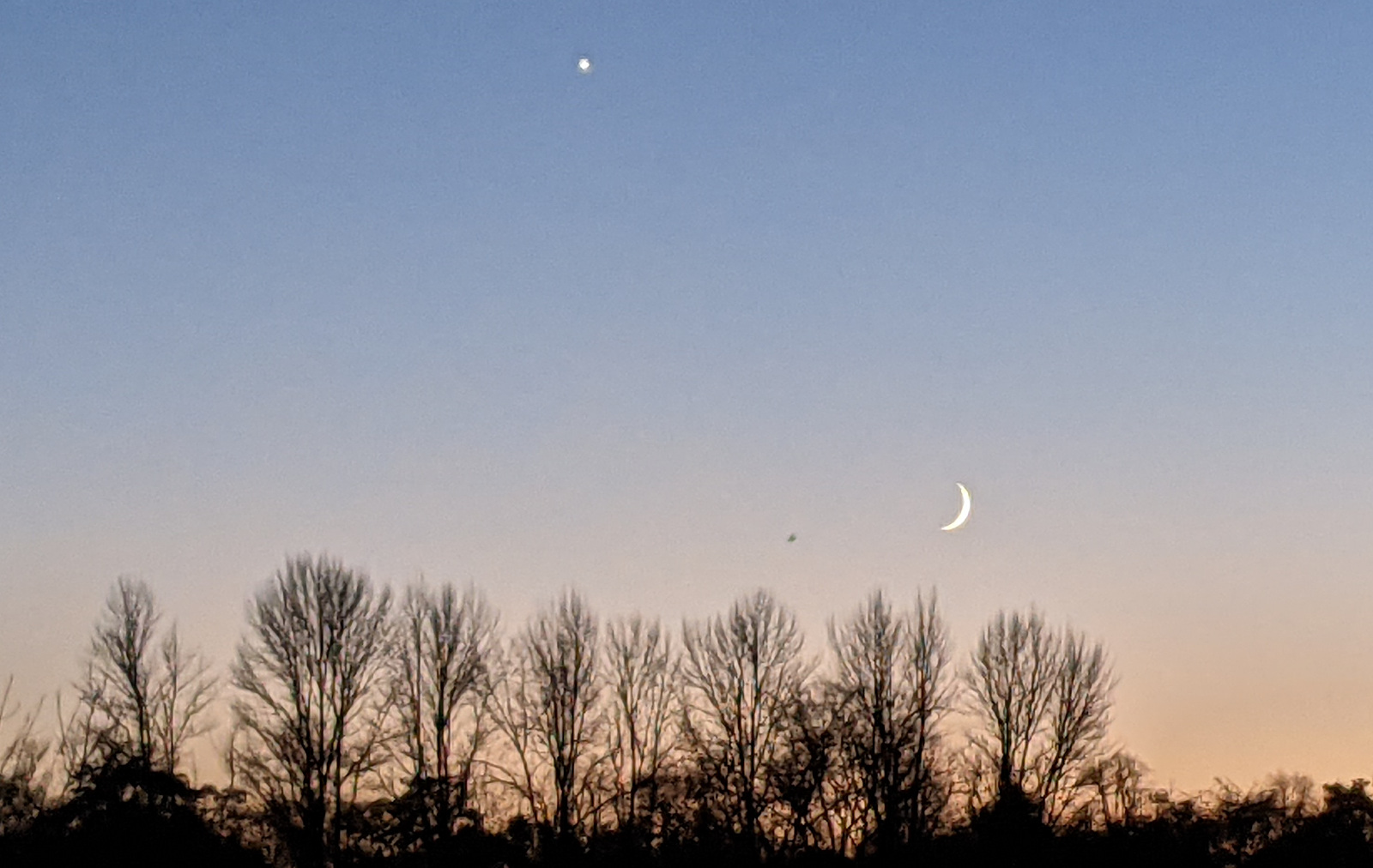
In December 2021 the young Moon and Venus made for a lovely sky in the evening twilight. I took this photo, only noticing later that a passing bird had photobombed the scene!
My friend, Nick Henderson invited me to write an article on why I left the Anglican church. You can read it here on my blog, and and on his website, Anglicanism.org.
In December 2018 I took a photo of the clock on Cirencester’s Parish Church tower. The honey coloured Cotswold limestone of the tower glows gloriously in the orange light of the setting sun. What a combination! Studying the photo later, I realised for the first time that the clock face is painted onto the stone of the tower. I had always imagined it was a large wooden or metal panel.
I posted an online card for Christmas and New Year, hoar frost on red berries.
In December 2013 I was at a Newforms Gathering in Nottingham. It was great to be amongst other people doing their best to follow Jesus and represent him in what is often a very broken world.
On JHM I wrote about food banks and why they were needed in Britain. Sadly they are still needed a decade later.
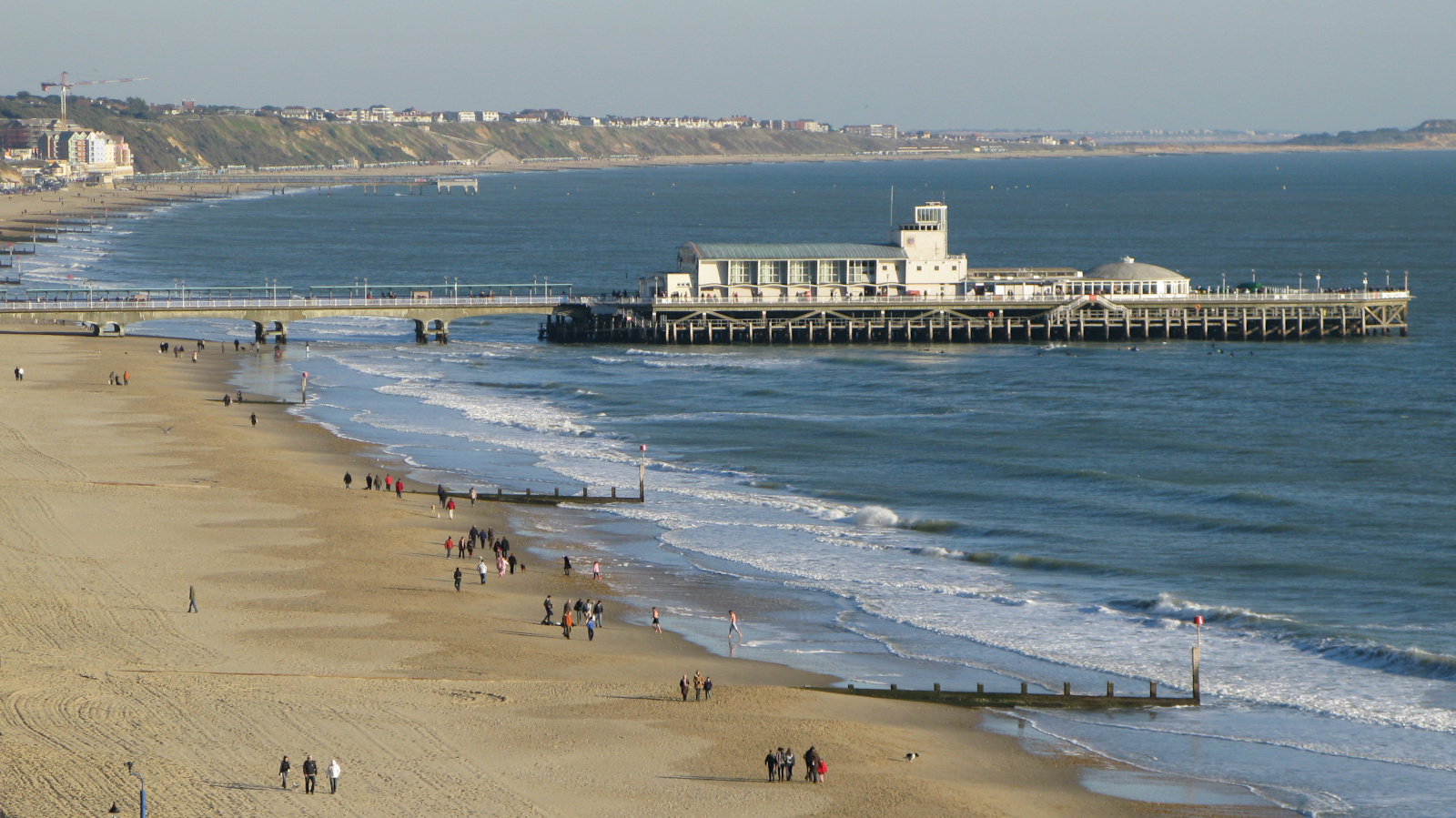
In December 2008 we visited Donna’s parents and walked along the coast near Bournemouth. It looked lovely with some strong sunshine, but my word it was cold!
I wrote an article on JHM the same month on the topics of science and technology.
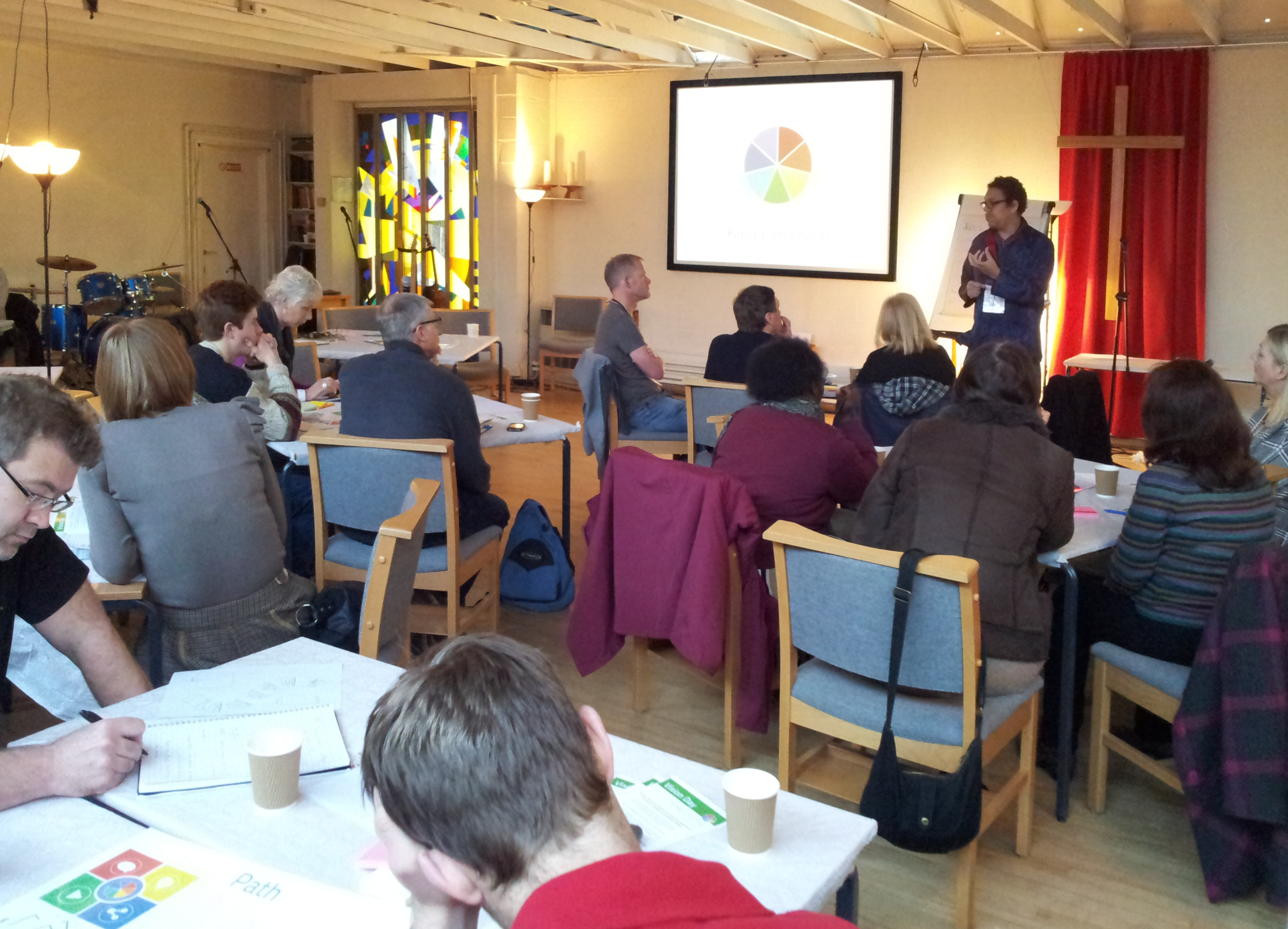
In December 2003 I was working for Unilever Research; and the department had a couple of working away days as a planning and learning exercise. These were always daytime effort and evening fun.
In December 1998 we were living in Tilbrook, a tiny village near Kimbolton, Bedfordshire. I received my replacement driving licence for the new address. There was no plastic card, this document folded up and fitted into a flexible plastic sleeve.
In December 1993 we were living in Yatton and visited Judy’s parents in Cheltenham for Christmas and my parents in Cirencester for New Year. Here are Cindy, Rachael, Neil and Tom in the dining room at Churnside, playing Buccaneer. It’s a 1938 game of pirates, treasure, shipwreck and rum – great fun.
In December 1988 we visited my parents in Cirencester. Dad still had his African land snail in the glass tank and everyone was interested to take a closer look at it. Beth is unfortunately hidden behind Debbie in this shot. The glass tank was originally for a lead-acid radio battery.
In December 1983, my department at Long Ashton was beginning the process of working out how proposed budget cuts would effect staff. Some would be redeployed in other research centres. Others would be made redundant.
In December 1978 Debbie was three and three quarters and Beth was 7 months old. We’d been in our 1960s mid-terrace house in Yatton for some time but there still seemed to be enough room for us. In Iran, two million people demonstrated in the streets against the Shah.
In December 1973, we were trying to save enough money for a deposit on a mortgage. We’d saved quite a lot, but house prices were rising faster than we could manage.
The Pioneer 10 spacecraft was the first probe to fly past Jupiter. The images were fuzzy by modern standards, but far better than any telescope could achieve at the time. I remember sitting in the library at work in my lunch break, reading about it in Science, Nature, and at home in New Scientist.
December 1968 was a significant month. As far as I can recall, on 31st December both families were in the same room in Cheltenham when I asked Judy’s Dad if I might marry his daughter. He said, ‘Yes’, right away so all was well. It’s possible this was very early January, but I think it was New Year’s Eve. Of course, Judy and I had decided this well in advance but it was fun to make the move with everyone present!
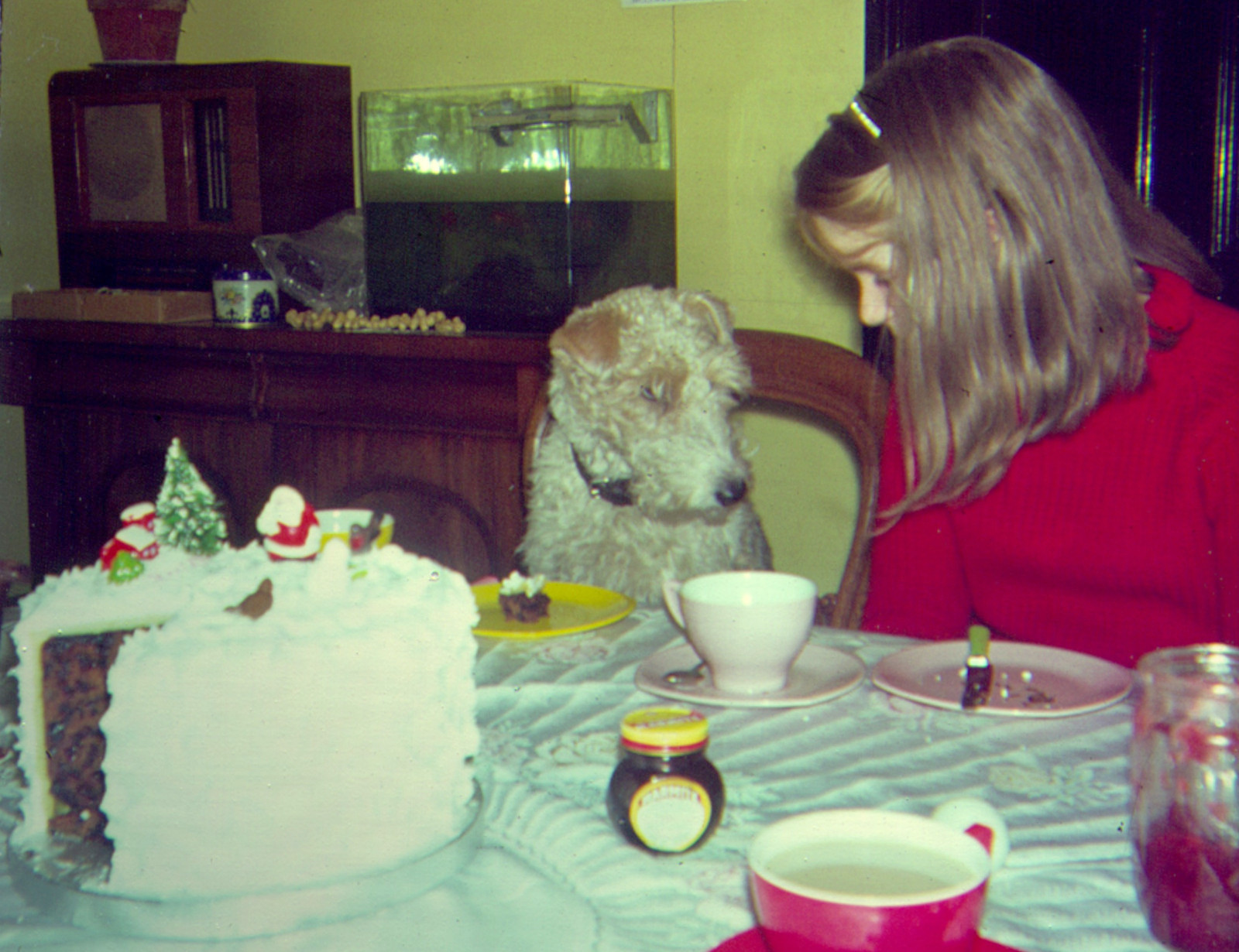
In December 1963 I was in the Fifth Form at Cirencester Grammar School. Mum made the usual stonkingly large Christmas cake (we always managed to eat it all in a week or so). Even Chloe, the dog has a small slice on her own plate in the photo. And, of course, it goes without saying that there’s Marmite on the table.
In December 1958 I was in my 6th and final year at Querns School. One of my friends from before we started school, Robert Kneale, wrote a Christmas poem for our teacher, Miss Taylor. We were both ten at the time, I wonder if he had a little help from his Dad, George? It’s a great effort – click on the image to read it.
At the end of December 1948 I was five months old and turned over by myself for the first time on 2nd. Dad had a 10/- raise in his wages and was busy lifting Christmas trees for sale.
In December 1943 Dad travelled by train to Paddington Station and on to Euston House where he went through a series of subject exams and aptitude tests. He was enlisted as a Radar Operator in the RAF Volunteer Reserve, received 10/6d pay, and was deferred for six months. He was very disappointed to have been turned down as a pilot.
Look at the world around you and you will see pain, loss, discouragement, guilt, and hard struggles for survival. But look at the world from just the right angle and you will see altogether better things.
I have something a little different for you this year. The photo shows a reflected image of Cirencester Parish Church in a puddle of water in Gosditch Street. What can this photo say to us?
What’s in a puddle?
More and more, the UK is a rich mix of people from many cultural backgrounds. That’s why the title is not ‘Christmas Greetings’. Please accept the greetings and replace the word ‘Season’ with whatever you like. If you’re Hindu you could choose Diwali as a reminder of your celebrations in November, or Jewish friends might go with Hannukah in December, if you’re Muslim you might look forward to Lailat al Miraj in February; Buddhists might consider Bodhi Day, and there are more groups of people I haven’t mentioned specifically. But whatever you celebrate, please take my greetings as a blessing for the whole of next year – spring, summer, autumn and winter.
I’d also like to bless you with a few thoughts about the picture. What, indeed, is in a puddle?
Look at the same puddle from any other angle and you would see dirty water; perhaps some litter; bits of road grit; a rather grubby, yellow ‘no parking’ line; and the general detritus of everyday life. But look at it from just the right angle and you see a reflected image, in this case an image of beautiful mediaeval architecture, detailed fine carving in stone, and the leaves of a living tree.
Look at the world around you and you will see pain, loss, discouragement, guilt, and hard struggles for survival. But look at the world from just the right angle and you will see altogether better things. Love for family, friends, and neighbours, beauty in nature and in people’s hearts and actions, joy, discovery, encouragement, peace, and thriving life. As a follower of Jesus (Yahshua, Isa), when I look at him in the right way I see a reflection of the Creator, the Source and Power behind this amazing universe.
Reflections in puddles also have another effect – they turn everything upside down. Jesus did that too: he confronted people with truth, he pointed out false motives, uncaring behaviour by the wealthy, blame-shifting, and striving for power or approval. People don’t like that, truth is often inconvenient.
Who should we think of this winter? Who can we help in some practical way? It might be someone in the road where we live, or the place where we work. In the world at large let’s remember the people in Ukraine, Gaza, and other places where there are struggles and loss of life (it’s not hard to think of more).
So my message this winter is that we should all help those around us. Talk with lonely people, provide some dried or canned food to your local food bank, donate warm clothes you no longer need, perhaps to a charity shop. If you can afford a gift of money, choose a charity that will use your donation wisely and effectively. And reach out more widely too, perhaps on the internet; send a message of encouragement or a gift to someone.
So whoever you are, whatever faith you have (or none), I hope 2024 will be a year to look forward to. As this year closes and the new one arrives, my hope, wish, and prayer for you is that grace and blessing will fill your life in ways hoped for and ways unexpected.
Let’s all be grateful for what we have, and display compassion and love towards those who need it. In that way, blessing will have a chance to touch you, and through you, touch others as well.
PS – If you like the puddle photo, click it for the full size version. Print it out, put it in a frame and hang it on the wall. Give a copy to friends if you think they’d like it; or send them a link to this message.
Notes from bygone years – Novembers one and all Hint: Click on the thumbnails for larger images.
November 2022
In November 2022 our friends Jim and Kevin drove over from St Neots to visit us for a day. Jim’s wife, Pam, couldn’t make it this time. We took them to see the Corinium Museum, and Jim was very impressed by some of the mosaic floors on display. Kevin, being an engineer by trade, was interested in the Roman iron tools on display.
A jigsaw map of Cirencester
A few days later we had a visit from Sean and Tania, friends from Bedford. So lots of ‘easterners’ visiting us during November!
And some friends lent us a lovely jigsaw made from an old map of Cirencester as it was in the late 19th century; we enjoyed fitting the pieces together and noticing the many changes that have taken place here over the years.
This month I published an article about Clifford’s Tower in York.
In November 2021 we visited Batsford Arboretum near Moreton-in-Marsh. This is an informal collection of trees, planted in the grounds of a lovely old house. It’s as much a large garden as it is a botanical collection. A great day out (and a good garden centre and restaurant into the bargain).
In November 2018 my sister, Cindy, launched a new book. Cindy is wearing the red hat in the photo; the new book was The Outrageous Fortune of Abel Morgan. You can find it in bookshops as well as on Google Play Books and Amazon.
I wrote about murmurations in November; if you don’t know what these are, you will be amazed. Play the video in the article for a grandstand view (with music).
In November 2013 our kitchen was being modified. Walls had to come down to incorporate a corridor, pantry and old coal bunkers into the main space followed by the addition of a steel beam, replastering and installing a full new kitchen. For a while it was a real mess!
In November 2008, Donna’s cat, Truffles, was getting on in years and had developed one white whisker, she looked lop-sided and it was very amusing. She developed more later, and looked far more dignified.
In November 2003 Nominet confirmed that I held the registration for the internet domain name scilla.org.uk, Donna and I have been using it now for a little over twenty years.
November 1998 saw us living in Tilly Cottage in the village of Tilbrook near Kimbolton. Donna went for a weekend visit to Eurodisney in Paris with a group of friends.
In November 1993 we had a visit from our German friends Gunter and Heidi Klauss. Judy and I met Gunter when he was in Cirencester on a school exchange. He stayed with several families during his time at Cirencester Grammar School, including a spell with my parents; so he and I knew one another rather well.
In November 1988 we took the train to Weston-super-Mare to view the Bridgwater Carnival. It was cold but a lot of fun. I took some video of the various floats as they passed. These images of Judy, Debbie and Beth are stills from the video.
In November 1983, discussions were ongoing about moving research on nursery stock from Long Ashton near Bristol to East Malling in Kent. Long Ashton was to focus on arable crop research and the team I was part of, working on fruit tree pollination, would be moved or closed down. With school age children, this was an anxious time.
In November 1978 Debbie was three and Beth was just 6 months. We were living in Yatton, near Bristol; at the time both were within the county of Avon. We lived in a 1960s mid-terrace house with three bedrooms and a tiny kitchen.
In November 1973, we were living in Belmont Road, Bristol. We had rented a first floor, unfurnished flat; this enabled us to buy some second hand furniture, save towards a house deposit, and raise a mortgage. The photo shows a sunset from our living room window.
In November 1968 I was in my third year at the University of Bath, studying for a BSc in Horticulture; Judy was in her second year at the University of Wales, Aberystwyth, studying Biochemistry. Naturally we wrote to one another frequently. In November we discussed a possible trip to see the 1970 Oberammergau Passion play, but as Judy rightly pointed out, we were already too late to find travel and accomodation for an event that is always massively oversubscribed.
In November 1963 I was living in Victoria Road, Cirencester, and I was in the Fifth Form at Cirencester Grammar School, also in Victoria Road. There could be no excuse for late arrival at school!
In November 1958 we were living in Queen Anne’s Road on Cirencester’s Beeches Estate; I was in my 6th and final year at Querns School. I achieved my toy master’s badge at Cubs.
In November 1953 we had fireworks in the back garden. I don’t think there were big public displays in those days, families bought a few rockets, a Roman candle or two, and a Catherine wheel. I remember Bengal matches that burned in pretty colours, and sparklers to wave around to make light patterns. Jumping Jacks used to leap about on the ground and frighten people, they were banned when I was a bit older.
At the end of November 1948 I was four months old. I would have been growing bigger and stronger, interacting more with Mum and Dad and other adults, beginning to vocalise more, and showing some interest in my surroundings.
In November 1943 Dad went to the RAF Recruiting Office in Gloucester for a medical; everything was good except his eyesight, but they passed him for aircrew. The following day (1st December) he was to go to London for further tests and to face the Selection Board.
Chuck’s maps are clear, informative, and up to date. He posts fresh material most days
Chuck is a retired US Army SEAL (amongst other things). He writes and speaks from a position of considerable knowledge on military matters generally. On his X account, he analyses available information about conflicts around the world, at present particularly focussing on events in Ukraine.
Chuck thinks through whatever information he can glean from online sources and conversations with his contacts, and very quickly transfers the information and his conclusions onto excellent maps. He publishes the maps on his X channel. The maps are up-to-date and informative, but sometimes contain minor errors, like misspelled place names. Given the fact that he builds these maps so fast, I think he can be forgiven these minor errors.
Chuck’s maps are clear, informative, and up to date. He posts fresh material most days (but not every day) and in addition to the maps he includes views and opinions of his own, brief reports on events happening on the ground, and comment on what he has read or heard on public news channels.
The Mryia Report podcasts frequently contain input from Chuck, too.
I normally dip in to Chuck’s X account daily to see what he has posted in the previous 24 hours, and I’m usually rewarded by a new map or two, a brief analysis of a recent event or description of a weapon system newly in use.
Every day , they collect and analyse data … , build an overall picture of what is happening … , and make the results available
ISW is a US think tank researching and reporting on conflicts worldwide. They issue daily bulletins on events in Ukraine and Russia as the war develops and continues. I’ve been reading these regular reports for a long time and greatly appreciate them.
There may be much more detail here than most people require; the reports are long and very thorough. One great thing to remember and appreciate is that ISW makes no attempt to predict outcomes of military actions or military planning.
They have no access to classified information, nor do they ask for it. They study publicly available sources only. These include free and commercially available satellite images, for example from NASA infra-red detectors which enable them to identify fires and explosions on the ground. They use videos published on YouTube and elsewhere, images on Facebook, X and so on from which they can sometimes geolocate events from the visible surroundings. They also assess public announcements by government and military spokespeople, media interviews and so forth.
Every day , they collect and analyse data of this kind, build an overall picture of what is happening on the ground, and make the results available in a daily digest with extensive text and maps. It’s an invaluable service.
Read Yara’s various projects for a refreshing rest from some of the other sources in the list
Yaroslava (Yara for short) lives in Kyiv. Like all the citizens of Ukraine she is living in a country at war – with all that entails. But Yara is not content to just sit idly by while her country and her city cope with missile and drone attacks. She has thoughts, opinions, and a delightful attitude to the arts, craft, music and traditions of her nation.
She writes about all these things and more, she takes and shares photos, usually very good and striking photos of the architecture, people, and the natural world around her. Sometimes she travels.
What I most like about Yara is that despite everything she brings a balanced and kind approach to a situation that is anything but balanced and kind. She provides news roundups, thoughtful comment, and even creative writing.
Read Yara’s various projects above for a refreshing rest from some of the other sources in the list, sources that necessarily deal with the violence of war, or the more technical aspects of events.









 Journeys of Heart and Mind

