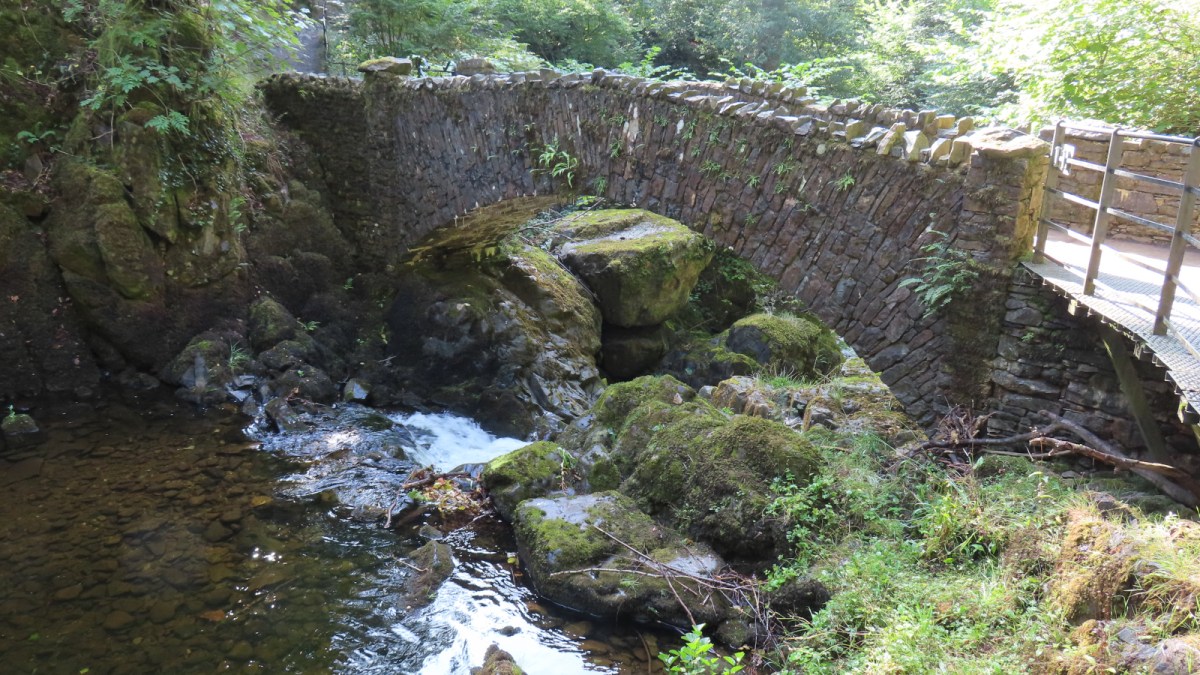
The stone arch footbridge at Aira Force
< Previous | Index | Next >
Image of the day – 209
What’s in an image? Sometimes quite a lot, more than meets the eye. I’m posting an image whenever I can.
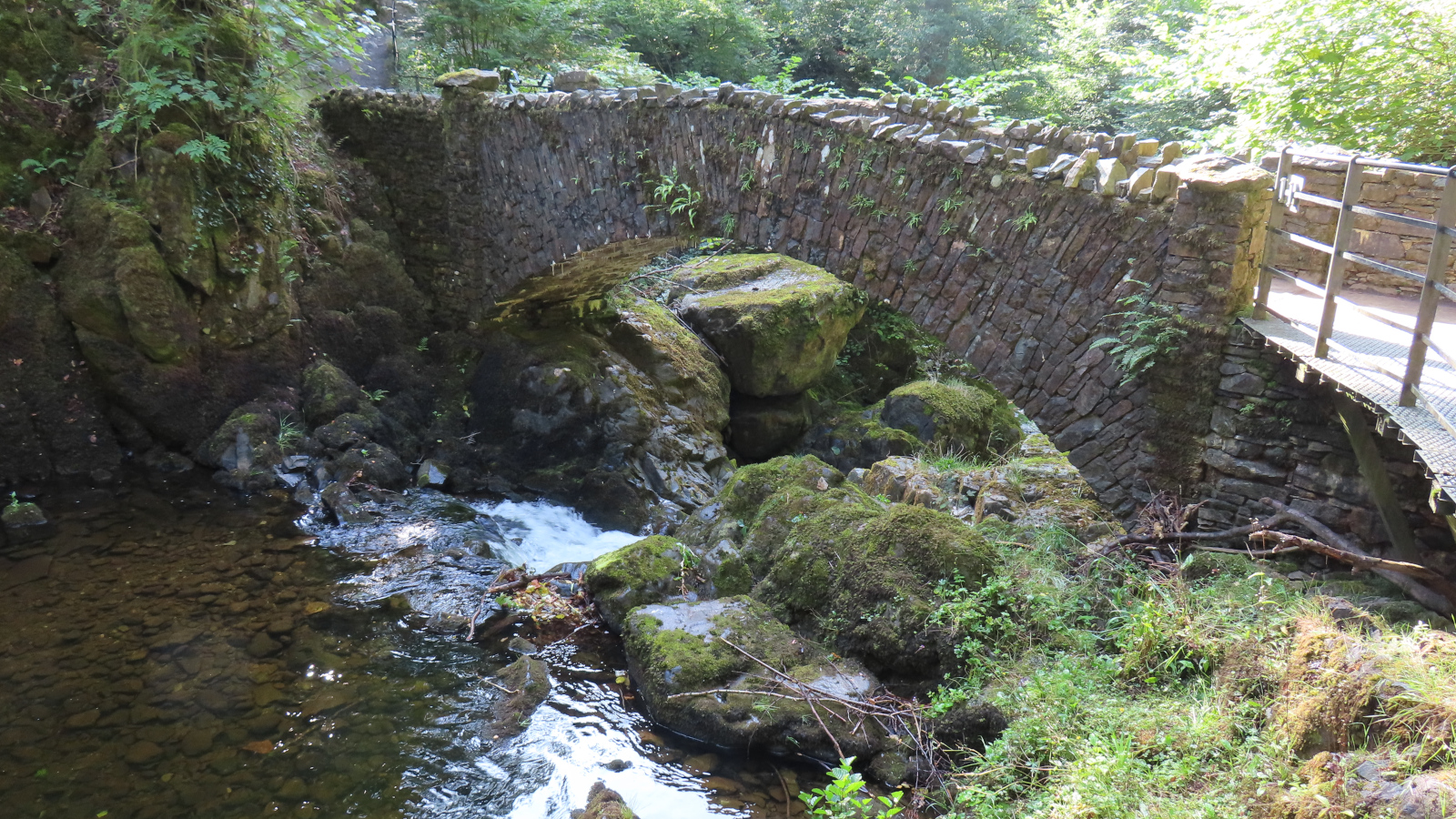
Stone built arches have a long history, they were invented by Mycenaean builders in the Bronze Age, the oldest known example being the Arkadiko Bridge, still in use today.
The main photo today is of the bridge at the top of Aira Force in the English Lake District.
How does it work?
On the face of it, using a series of stones to support a horizontal structure with nothing to hold them up seems, well, a bit crazy! The secret is simple enough though. Begin with a curved timber support and place the stones in contact with one another on top. Add further stone in horizontal rows on top to pin the arch in place, and when you remove the wooden former, the structure will remain in place. Each stone is held there by the pressure from the stones either side of it. There is not enough space for any one stone to slip through between its neighbours. Because of the curved shape of the structure all the gaps between the arch stones are wider at the top and narrower at the bottom.
Open the article below and look at the photo, how many arches can you see? (There’s no prize, but there may be more than you think).
A community of stones
Thinking about this later, it occurred to me that stones arrayed in an arch like this are a good illustration of community. Each stone is in contact with those either side of it; that’s a bit one dimensional, I suppose. In a community of people each one is in contact with one, several, or many others. But in other ways the stones illustrate community rather well.
- The stones support one another.
- They are in close contact and almost impossible to pull apart.
- They are far stronger than they were when out of contact.
- The structure comes from the contact – it’s not inherent in the individual stones.
- The arch (a band of brothers, or sisters, or both) can support more stones above it.
- Arches can support more than just roadways – roofs, floors, domes, smaller arches, moving objects (trucks, cars, entire railway trains).
A rainbow looks like an arch, but it’s really not. It can’t take any weight. It might fill you with delight, it might offer some hope or encouragement, but it doesn’t support you, you can’t swing from it or climb over it.
You can build an arch from stone, timber, steel or concrete, but you must choose a material with heft, something that has real substance and physical strength.
Have a think about any community you might be a part of – a family, a business, a town, church, a club of some sort. Think about the members being like the stones in an arch. Do you support one another? Are you in close contact and hard to pull apart? (Not perhaps physically, but in terms of community). Are you stronger together? Do you provide some kind of support in other, wider ways to people beyond your community? Do you provide a route that couldn’t be crossed without your presence as a community?
A different kind of stone arch
The high ceilings you see in stone-built cathedrals, often beautifully decorated are effectively supported by intersecting patterns of slim arches.
Most of the stone ribs you see here are arches. As a complex network they are more than adequate to support this glorious ceiling in Worcester Cathedral.
See also:
- Aira Force – Wikipedia
- Arch – Wikipedia
- Arkadiko Bridge – Wikipedia
- Lake District – Wikipedia
- Lake District National Park – Website
- Mycenae – Wikipedia
< Previous | Index | Next >
Useful? Interesting?
If you enjoyed this or found it useful, please like, comment, and share below. (If you don’t see those links, click the article’s title above the main photo and they will appear.) Send a link to friends who might enjoy the article or benefit from it – Thanks! My material is free to reuse (see conditions), but a coffee is always welcome and encourages me to write more often! 
Share this:


