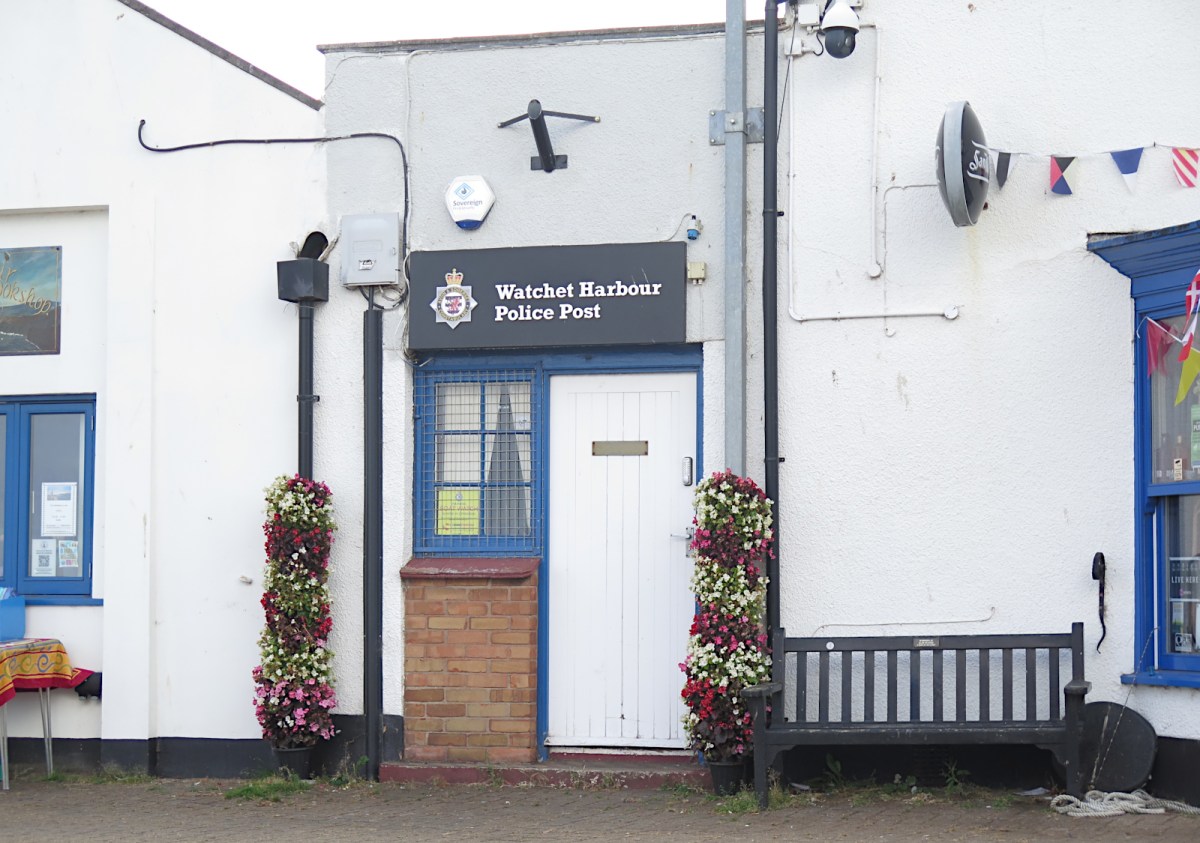
At Watchet Harbour on the north coast of Somerset stands possibly the smallest Police Station in the world. Certainly I’ve never seen one this tiny before. It’s just a door and a small window wide and has the grand title ‘Watchet Harbour Police Post’. If you know of a smaller police building anywhere in the world, please let me know in the comments section below.
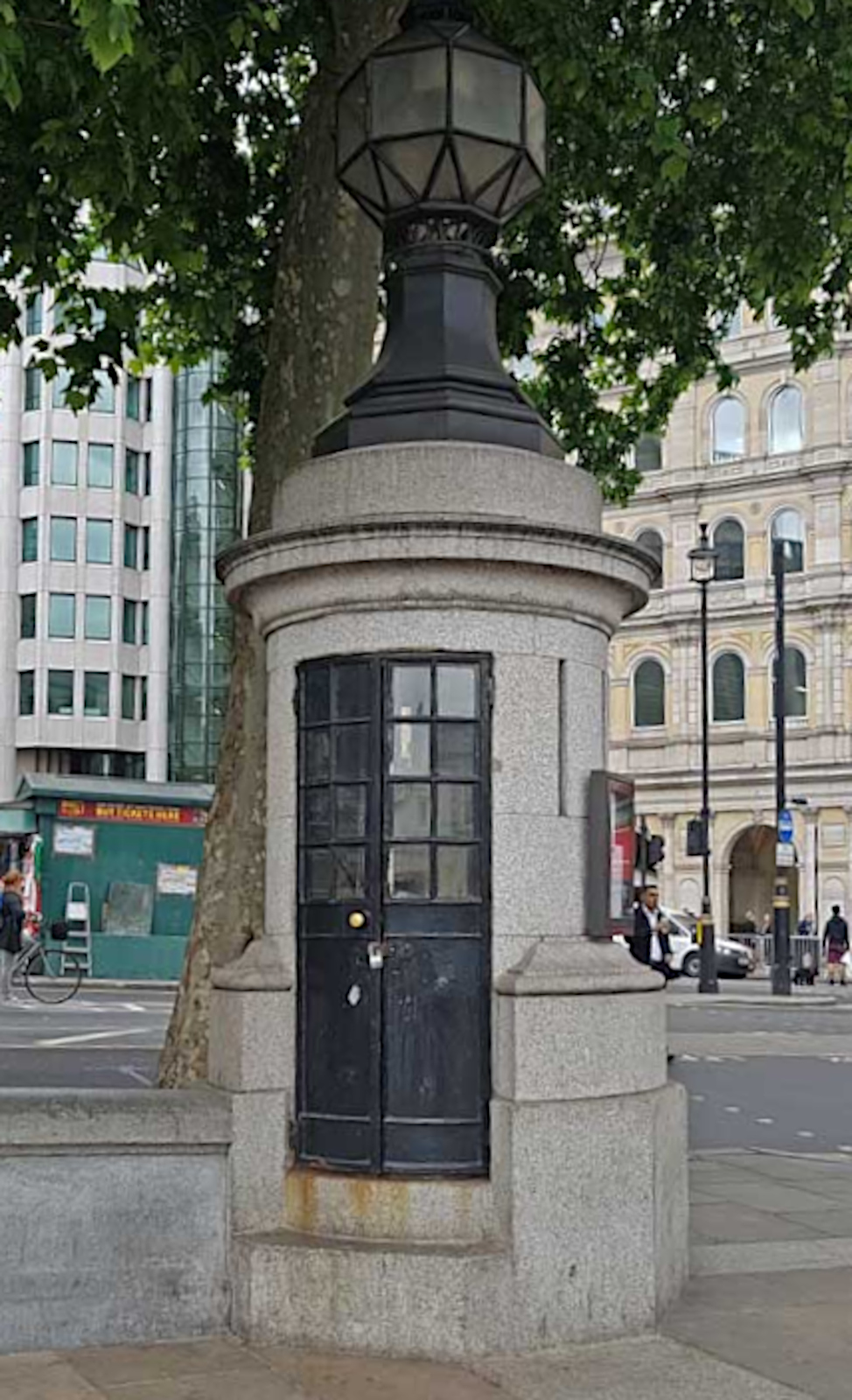
However, a quick Google search turned up an even smaller one in Trafalgar Square, London. So Watchet has already lost its brief claim to fame! Read more about the Trafalgar Square example. However, the London claimant is no longer used by the Police, so Watchet might still claim to have the smallest working police station in the UK.
International claimants
Florida also has a claim to the smallest working police station and it’s certainly much smaller than the police post in Watchet. Like the London version, Florida’s is sheltered by a tree.
I suppose it’s possible there’s a smaller one somewhere else in the world, but if so it must be so tiny that you’d need a smaller than average police officer to occupy it.
This is a bit different. You can’t measure a church in terms of how wide or long it is. Churches are measured in terms of how many people are meeting. Jesus once said, ‘Wherever two or three are gathered in my name, I’ll be there with them’. So the smallest church must be a meeting of two people (three if you include Jesus). That’s because church is not a building at all (although we often call a place where followers of Jesus meet ‘a church’. Is it still a church if the people have all gone home? No. Why? Because church is a community, not a building. Two people is the smallest possible community. We don’t always think of church as a community, but we should. If it’s not a community can it really be church at all?
If you enjoyed this or found it useful, please like, comment, and share below. (If you don’t see those links, click the article’s title above the main photo and they will appear.) Send a link to friends who might enjoy the article or benefit from it – Thanks! My material is free to reuse (see conditions), but a coffee is always welcome and encourages me to write more often!
From my longer perspective today at seventy-seven years old I can see that what seemed a minor difference between me and the Open Door elders is in truth a yawning gulf. It’s not just that I took a misstep, but that the entire edifice of following Jesus (Church almost everywhere and throughout history) took an enormous misstep.
Donna and I were married in 1998 and Tony was my best man; Donna’s best friend, Jane, was her chief bridesmaid. Donna had taken a new job with Unilever Research at their research site a little north of Bedford. She bought a cottage in the village of Tilbrook and when we were married I moved into the cottage with her and Unilever offered me a job on their intranet web team, initially to create a website that could be duplicated for each of their research sites – two in the UK, one in the USA and one in the Netherlands.
Donna was keen to find a church in the nearby town of St Neots, or if necessary in Bedford.
We soon found the cottage was far too small, and moved to a four-bedroom property in Eaton Ford, part of St Neots. The internet had barely hit its stride in the late ’90s, so it wasn’t nearly as easy to find a church (or anything else) as it would be today.
One weekend before we were married, I was visiting Donna , and on the Sunday I said, ‘Come on , let’s drive into St Neots and see what we can find’. She said, ‘No, you’ll never find anything that way’. But we jumped into the car and I prayed very briefly to be shown where to go – and off we went. We drove through the middle of the town and out towards Eynesbury but saw nothing of interest, then I turned right and down a couple of streets and coming to a secondary school we spotted an A-board welcoming people to ‘Open Door Church’. We followed the sign, parked the car, and made our way into ‘Ernulf School’ and there we were – Open Door Church! It turned out to be a lively, welcoming place, just what Donna was looking for. Over the next week or so she got to know some of the people and was invited to join a cell group run by Rob and Jean and a couple from France who were planning to return home in a few weeks time. And that was that! By the time I was working at Unilever and had moved into the cottage full time, Donna was well-established at Open Door, the French couple had moved back to France, and Rob and Jean were running the cell group on their own. They quickly became good friends, we even had a holiday in Scotland with them one year.
A wrong step
How easily we do this! Wanting to support Donna, I was happy to go along to the Sunday meetings at Open Door and, far more to my taste, join in with the weekly cell meetings every Wednesday or Thursday. But there was a fly in the church ointment. It was expected that people taking part regularly would ‘join’ the church and sign the membership book. This also involved promising to give your allegiance to Open Door. That was something I found hard – a step too far, a very big ask. My allegiance was to Jesus and him alone. But I did want to support Donna in her new membership of Open Door and it seemed to be something couples were expected to do together. So I put my doubts to one side and signed up – that was a major wrong step!
Trying to right the wrong
What’s the best thing to do if you take a wrong turning? Usually the best thing is to retrace your steps to the point of the mistake and take a different path. As the weeks went by it became clearer and clearer to me that I was in a bad place. I had agreed to be guided by the leaders of Open Door Church but knew that my only guidance should come through Jesus and his Spirit working in me and in my brothers and sisters.
So I wrote to the elders, explaining my mistake and asking to be released from membership and the promise of allegiance I had made. Nothing like this had happened before and they really had no idea what to do. They invited me to visit the lead elder’s (Tony’s) house, and when I went along he had also invited another elder, Brian. They asked me to explain what I meant. I told them, as gently as I could, that in my view all followers of Jesus should follow him alone. I added that this did not mean I wanted to leave Open Door. The reaction surprised me, almost as if I had decided to follow Islam, Hinduism or Buddhism. They were cold, even a bit frosty, and it was very clear that they felt I was rejecting their authority in some rather dangerous way. It was as if they felt that following Jesus implied following the elders. I was left feeling, ‘Hang on, this is my life in which I can follow anyone I wish, and I’ve chosen Jesus. Do you think he will lead me to cause problems for you?’
They wanted to talk again the following week, and this time told me that they’d heard my point of view and now wanted me to hear the conditions under which I might continue to come to Open Door meetings. The main point was that they wanted to be assured that if I said or did anything in a meeting that they objected to, and they asked me to stop, that I would do so. And so, on those terms, I was allowed to continue to meet with them on Sunday mornings and for weekday cell group meetings.
Meeting again with other friends
Although I continued to meet at Open Door for some time, I felt unable to contribute freely on Sunday mornings. Sometimes I would share something prophetic, or a vision, but I didn’t want to upset Tony or the elders so I was always quite careful. And now and again I’d sing in the Spirit and others would join in, or I’d speak in a tongue and someone would interpret and that always felt safe enough because the interpretation was not through me! Or I’d dance, usually near the back of the room.
Rob and Jean, however, were personal friends and also seemed to have no issues over anything I said or did either on Sundays or at cell group sessions, but rather welcomed the input. Over the years the group leaders were changed repeatedly but I was still allowed the same freedom almost all of the time we lived in St Neots.
Meeting at home
All of this left me feeling that life in St Neots was poorer in some ways than life in Yatton. I missed my friends, but above all I missed the spiritual depth and intensity of meeting completely freely, guided by the Holy Spirit alone and allowing him to speak to each one through the way he was using all the others. I missed the kind of community I’d experienced in Yatton. I knew it didn’t depend on particular people being involved, but instead, what it required was that all those present intended to rely only on Jesus. ‘I can do all things in Christ who strengthens me’ (Philippians 4:13) and ‘Without Christ I can do nothing’ (John 15:5).
Where was I to find these people? I can’t be sure of the details at this point – who was involved first or how we got started. But my sister Rachael was involved very early on, as were various St Neots friends, my friends Jody and Peter from Unilever, and eventually many more from a wide area in Cambridgeshire, Northhamptonshire and Bedfordshire.
For eleven years I kept a list of meetings and now I can refer to that list to pick out the first time we met at each new location, and that will give a feeling for how the meetings spread and grew. There were rarely more than 10 people at a meeting, but I knew how these small gatherings worked (from long experience in Yatton). There were no rules, but we encouraged everyone to feel free to contribute in any way providing they felt it was from the Spirit and aligned with the way Jesus would contribute. So there was usually a sense of openness and freedom. Almost always there would be tongues with interpretation, Bible readings or at least a few quotes, prayer for guidance and for any needs expressed by those present, prophecy, and plenty of peaceful silence for thought and processing of what others had contributed. The meetings were never boring, and more often than not we could identify a theme that had come together little by little as we met. Most times we’d begin with coffee and a chat.
Dec 2002 – Eaton Ford
May 2006 – Rugby
Nov 2006 – Eaton Socon
Mar 2007 – Great Doddington
Feb 2008 – Little Paxton
May 2010 – Brampton
Jun 2010 – Hinchingbrooke
Jul 2010 – Letchworth
Jul 2010 – Eynesbury
Aug 2010 – Cornerstone, St Neots
Sep 2010 – Watton-at-Stone
Oct 2010 – Corby
Feb 2011 – Offord d’Arcy
Apr 2011 – Moggerhanger
Apr 2011 – Costa, St Neots
Nov 2011 – Earls Barton
May 2012 – Oundle
As you can see, things got under way slowly but spread in an accelerating manner. And in addition to these meetings all around the area, some of us were involved in other things, we had larger celebration meetings when we’d invite other friends along and there’d be music, singing, dancing and the praise and worship would be free and enthusisastic. For me these little meetings were encouraging and exciting – just as in Yatton there was a feeling that Father was pouring his nature and character out amongst us. Jesus was with us.
Donna meanwhile continued with Open Door and the cell group meetings (later renamed Small Group). I drifted away from Open Door’s Sunday meetings as I found it difficult to contribute and disagreed with a fair proportion of the teaching on offer. There was far more freedom in the Small Group environment.
The Eatons
Some time in the past, St Neots Evangelical Church had planted an offshoot called ‘The Eatons’ in Eaton Ford and Eaton Socon (once Bedfordshire villages but by this time absorbed as districts of the growing town of St Neots). Over time, the number of people meeting each week had fallen significantly and only a handful remained. I don’t recall how I heard about this situation, but I felt the Holy Spirit nudging me to go along one Sunday morning to meet them, and specifically to encourage them.
So I began to meet with them every Sunday morning and they were encouraged. I explained why I was there, and that encouraged them too. A turning point for me was that some of the members would go into another room to pray with whoever had been chosen to speak that morning. Sometimes there would be a visiting speaker, other times it would be one or two of the group. One day, only one person, Jim, went out to pray so I followed him out and joined in the prayer. He was touched by this I think, and we struck up a friendship which has lasted right up to the present day.
The Eatons reminded me very much of Zetland Road Church and Horsecastle Chapel (see part 2 of this series), they were just the same kind of traditional, independent, evangelical gathering. The Eatons had made a bargain with Jesus, they had ‘laid out a fleece’. They had stated that if two or three new families joined them by the end of the current year they would continue, but if not they would close down the meetings and wrap up the finances and the organisation. They counted my appearance as a step in the right direction, but I explained gently that I was not a permanent feature but had been told to come and encourage them. I was even invited to speak to them one Sunday morning which I did, though I’m not a great public speaker – far from it! I don’t recall what I spoke about but it was politely and kindly received. In due course The Eatons did close down but I had made some new friends. Not just Jim and his wife Pam, but some others too including Sean. Jim and Sean became involved in some of the home meetings mentioned earlier.
A longer perspective
From my longer perspective today at seventy-seven years old I can see that what seemed a minor difference between me and the Open Door elders is in truth a yawning gulf. It’s not just that I took a misstep, but that the entire edifice of following Jesus (Church almost everywhere and throughout history) took an enormous misstep at some point in its past development. Do we follow Jesus and Jesus alone? Or do we follow people who have structured what began as a simple community into a series of organisations that often disagree with one another on the details of what to think, what to believe, and how to behave?
The change may have been kickstarted by the Roman Empire making Christianity the official religion of the Empire in the 300s CE. Or it may go back even before that. But whatever the origins, it’s a misinterpretation and misrepresentation of what Jesus and the early church intended and practised. That all are equal under one head (Jesus), that all are filled with and empowered by his Spirit, and structures of stone or of management are not required or permitted. Church is community, a structure of children, women and men organised and motivated by the Same Holy Spirit and following only one master – Jesus!
If you enjoyed this or found it useful, please like, comment, and share below. (If you don’t see those links, click the article’s title above the main photo and they will appear.) Send a link to friends who might enjoy the article or benefit from it – Thanks! My material is free to reuse (see conditions), but a coffee is always welcome and encourages me to write more often!
Teaching is not a bad thing, it’s an essential thing. A well-balanced community living in Jesus’ presence needs to receive truth from apostolic, prophetic, evangelistic, pastoral and teaching gifts.
A new family moved into the village and began to advise and work with Tony, Faith, Paul, Jenny and some of our friends from the next village, Claverham. During this time Judy and I began to feel that things were going a bit off-track. Judy actually wanted nothing to do with the new situation, I decided to go along to the meetings fairly often to keep in touch with our friends. I should add, right at the outset, that I don’t think there was any intention to derail the work that Father was doing amongst us, but rather to enrich it and bring additional knowledge and experience to the mix. But unintentionally this had the effect of changing track with a new focus on teaching that had not been there before. Teaching had never been a notable part of our meetings, we had always been guided mainly by prophecy, and by what we read in the Bible. We were exposed to teaching when we went to larger meetings (the pre-crusade rallies in Portishead for example and visits to Pip’n’Jay in Bristol or the meetings at Post Green), and from the popular books that were doing the rounds (books by Graham Pulkinhgham, Michael Harper, Colin Urquhart, David Watson and others) and we did a small amount of teaching when we were invited to visit local churches as ‘Fountain’. But in our own weekly and daily meetings there was little to no teaching. We were growing and learning together in our exciting faith journey. It was wonderful and extraordinary while it lasted.
But now Alan and Dorothy provided new songs (some of them truly excellent) and Alan taught regularly about how and when and where the meetings should take place as well as material about Jewish customs, feasts and celebrations. Alan and Dorothy came from a background of small gatherings in a different part of the UK (Blyth). So the Spirit-guided growth we had experienced gradually gave way to ideas and processes managed mainly by Alan. Something similar to this has happened over and over again throughout church history. Personally I learned a good deal by seeing it happen both from the outside (because I wasn’t directly involved in the events) and also from the inside (because I was at many of the meetings and had a ringside seat, so to speak). Sometimes I feel I should have shared my thoughts and feelings clearly, but Alan was experienced in meetings of this kind and I was not. I didn’t feel it was my place to interfere, nor was I part of what was happening. When I went along to a meeting I always felt I was accepted partly because I didn’t stir up trouble, but somehow seen as not quite making the grade. Everyone must have been aware that I had some doubts though I was careful not to express them too often or too forcefully. I was, however, grieving about the loss of the sense of direction we’d had together and the subtle shifts in emphasis.
A bad thing can sometimes spark good outcomes
What a strange heading, but it’s true! A few years later my wife Judy was diagnosed with bowel cancer and everything changed. Your friends are always your friends, through good times and bad, so at some point in late spring or early summer 1995 I think, I approached Tony and Faith with this really bad news and invited them to visit and pray with us. And because your friends are always your friends, they were not slow to respond. This coincided with a time when the meetings with Alan and Dorothy were proving rather difficult though I didn’t know that at the time.
Before long Tony and Faith, and Paul and Jenny were coming round for an evening visit at least once a week, and eventually two or even three times a week as Judy’s illness progressed. But what happened during those meetings was astounding and utterly unexpected. Jesus was palpably present every single time we met, and his Spirit was so active amongst us. We experienced prophecy, interpreted tongues, and deep coincidences between songs we were singing, what we were thinking and Bible readings that popped out in the moment. We knew we were right in Father’s presence every time we met. This was holy ground. None of us had experienced anything like it before. The cancer spread and I, for one, had no expectation of physical healing, but Judy and I were both blessed deeply by the renewed presence of our friends and by the experiences in the meetings. It’s fair to say we were all changed by these times together and I know that all of us who remain will never forget it. Judy died on 28th December 1995 and Paul is now no longer with us either. I’m sure all of us learned a lot through the shared experience of those times. Looking back from the perspective I have now, it seems that the change in the meetings following Alan and Dorothy’s arrival combined with the astounding times and experiences as we met again during Judy’s illness, starkly illuminated the difference between living and meeting in our own human wisdom and strength and the freedom we had in the pure presence of Jesus and his Spirit. There’s something further to say about this.
Teaching is not a bad thing, it’s an essential thing. A well-balanced community living in Jesus’ presence needs to receive truth from apostolic, prophetic, evangelistic, pastoral and teaching gifts. If any are missing or if there is an imbalance, any group, no matter how well-meaning, risks derailment in one form or another.
Winding down
After Judy’s death, the five of us continued to meet for a while, and sometimes we were joined by a couple from Clevedon, members of a new local church, and also by Donna (now my second wife) who was a work colleague from Long Ashton Research Station.
These meetings, too, were good but things were still changing. I remain in touch with Tony and Faith occasionally, though less so with Jenny. Donna and I were married a few years later and left the south-west for the east of England, but that’s another story and I’ll share my personal journey of faith there in the next part of this series. Paul and Jenny moved east as well to be closer to more of her family. Tony and Faith still live in the village of Yatton. Donna and I moved west again ten years ago and now live in Cirencester, Gloucestershire.
If you enjoyed this or found it useful, please like, comment, and share below. (If you don’t see those links, click the article’s title above the main photo and they will appear.) Send a link to friends who might enjoy the article or benefit from it – Thanks! My material is free to reuse (see conditions), but a coffee is always welcome and encourages me to write more often!
We cannot know exactly what this area would have been like when it was full of active volcanoes, but we can get a rough idea from modern subduction regions on Earth today. Under the Mediterranean, for example, the African plate is being subducted underneath the plate carrying Europe.
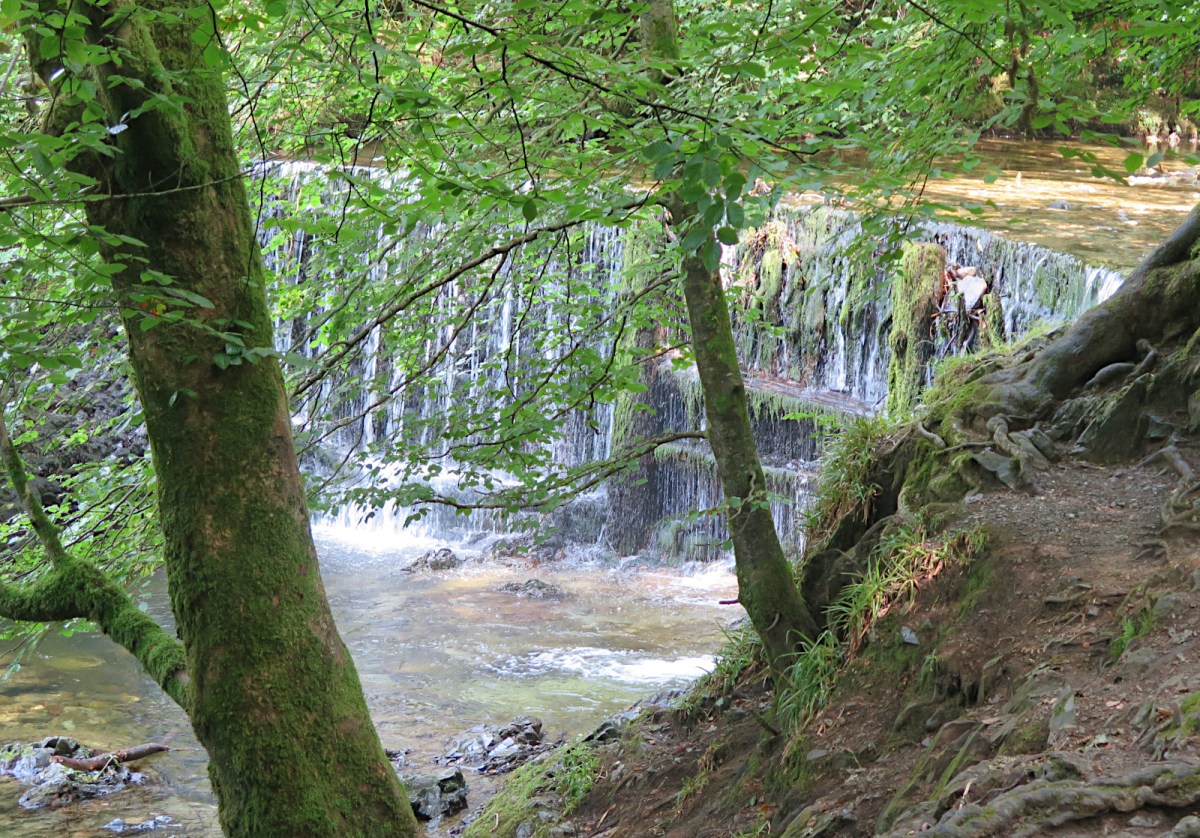
This is one of the waterfalls along Stock Ghyll just north-east of Ambleside, Cumbria in the English Lake District. It’s beautiful countryside, and the nearby Force Cafe and Terrace served us a wonderful ‘Full Force’ breakfast. In the local dialect, a waterfall is known as a ‘force’, and there’s a whole string of them along this stretch of Stock Ghyll. A ghyll or gill is a narrow, deep, wooded ravine with a stream running though it. The term can also be used for the stream itself. Donna and I made our way carefully along this muddy, stony footpath, and it was well worth the effort.
Stock Ghyll runs right down into the town of Ambleside where it once powered a series of watermills, and finally flows into the nearby lake of Windermere.
Bobbin mills
Bobbin mills were common in Ambleside in the 19th century. Coppiced timber was cut to length and shaped on a lathe, then wooden discs were attached to both ends and the completed bobbins sold to the textile spinning and weaving businesses in the industrial cities south of the Lake District where they were used to store thread after spinning and before weaving. They contributed to the rapid growth of spinning and weaving factories in northern England. Wooden bobbin manufacturing died out with the 20th century introduction of plastics.
Formation of the Lake District
Skiddaw in the distance
The granite structures of the fells and mountains of the Lake District erupted from volcanoes during the Ordovician period some 460 million years ago.
Much more recently, repeated glaciations ground out U-shaped valleys arranged more or less radially and when the glaciers melted during warmer periods, lakes remained in the valley bottoms. Rivers flowing into the lakes or sometimes from one lake to another, have silted up some of the lakes at one end, and these flat, silted zones are now rich areas of pasture and crop land as well as places where urban construction has become possible. The photo above shows the mountain of Skiddaw in the distance and farmland in the foreground. The town of Keswick, out of the frame to the right, is also built on this flatter land laid down as sediment in the northern part of Derwent Water.
What else can we learn
One thing is very clear, what happens in one time period may be changed drastically at another, later time.
We cannot know exactly what this area would have been like when it was full of active volcanoes, but we can get a rough idea from modern subduction regions on Earth today. Under the Mediterranean, for example, the African plate is being subducted underneath the plate carrying Europe. The Alps and the Pyrenees have risen as a result, and volocanoes like Etna and Vesuvius are still actively pumping out magma or ash. The Mediterranean region is also prone to earthquakes. Now imagine (if you can) a mile or more depth of ice resting on top of the Alps grinding down the rocks to form U-shaped valleys as they slide due to gravity across the rock surface far below.
In Roman times, the areas of river sediment like that in the photo above would have been smaller than they are today and the lakes would have been correspondingly longer.
It’s very much a dynamic process. It’s a bit like the life of a person, we start as a new born infant and learn to talk and walk, then run. We learn to eat, and we learn to reason. at school we learn a lot more about the world we live in, politics, science, other languages, geography, history; we fall in love, we marry and raise a family; we have a career and learn how to manage the work environment, run a business, serve customers, manage bank accounts and so forth. The world is our playground, we travel on business or just for fun, we become grandparents as we grow older and retire from work. There are many beginnings and endings along the rich tapestry that is a human life. And lives intertwine in so many ways – friends, family, work colleagues, neighbours. Just like the Lake District, at any point it’s impossible to know what the future might hold.
Life is the same. What happened in my life when I was young is very different from what is happening in my life today. Change and unpredictabilty are the only things that are consistent throughout. If the ice hadn’t melted when it did, the Lake District would be far different from the place we know and love.
How do we deal with this built-in uncertainty? One way that many have found is faith, following a guide that we trust in ways that stretch us and help to shape our characters. Faith can be like an anchor in a choppy sea or even a full-blown storm, holding us safely in the right place until calmer conditions return. I recommend having an anchor in this experience we call life. But if you choose an anchor, choose carefully, there are some pointers elsewhere on this website. Hunt around and see if there’s anything here that you find attractive or compelling.
I’m always fascinated by links and similarities between one thing and another, life is full of them and sometimes they help to broaden our vision and understanding in ways that are quite unexpected.
If you enjoyed this or found it useful, please like, comment, and share below. (If you don’t see those links, click the article’s title above the main photo and they will appear.) Send a link to friends who might enjoy the article or benefit from it – Thanks! My material is free to reuse (see conditions), but a coffee is always welcome and encourages me to write more often!
This index brings together posts on the gradual process of spiritual development or spiritual formation during my life.
1 – Why did I leave the Anglican Church? – This set the pattern for me. It’s been a repeat pattern of deciding I was not where Father wanted me to be and exploring further with as open a mind as possible.
We didn’t see ourselves as a house church, more as a group of local believers from a range of denominations all wanting to be part of the exciting revival going on in the UK at the time, open to the gifts of the Spirit, but not wanting to become yet another splinter group.
Yatton, the village in Somerset where it all happened
Things were changing. We’d been fairly comfortable at Horsecastle Chapel in Yatton, and we’d learned a great deal and felt loved and made very welcome by the people there. But there were one or two niggles already mentioned in part two of this series. We felt it was not right, and rather unfortunate, that women were not able to take leading roles in meetings, that it was required that women wear hats (a minor thing, but an irritant nonetheless). It began to seem that some of these rules were made by people, not by our Father in heaven, and certainly not by his Son, Jesus. But the greater niggle was that we were not able to move in spiritual ways that were being revealed to us more and more as time went by.
An Anglican home group
For me it came into sharper focus when I went to an Anglican study group. Judy might have come to the same ideas in a different way, but she died in 1995 so I can’t check! I’m not sure we discussed it at the time, but we were moving on closely parallel paths, that I can say with certainty. I wanted to meet some of the Anglicans because I had the feeling there was supposed to be a single church, not a plurality of them. I couldn’t see any way that they could all be brought together, but I wanted to at least get to know some people of other denominations. Going along to the study group seemed a good way to approach this. I soon came to understand that the Holy Spirit was nudging me to go along, and rather quickly I discovered what he had in mind!
Friends and allies
The Anglican study group was held in the home of one of the St Mary’s congregation and was led by the Vicar, Revd Richard Acworth. I don’t remember what was discussed, but I very clearly remember the topic of humility coming up. There was a man in the group who protested, quite strongly, that he was not humble and didn’t intend to become so. I had the impression that he equated ‘humble’ with ‘impoverished’ or ‘weak’ or ‘demeaning’ or some other utterly unattractive idea. I think I was also a bit disappointed by the Vicar’s response.
Also in the group was a woman about my age and as we were leaving I mentioned the humility issue. She agreed quite enthusiastically and we had a brief conversation on the way home; her name was Faith. Judy and I would soon become good friends of Faith and her husband Tony. We shared a lot of views in common concerning Jesus, the Bible, and Church – and this excited me because we were from such different church traditions.
Meeting often
We began meeting quite regularly with Tony and Faith. We were like-minded on so many church matters, and some other things too. we both had young families so most often one of us would walk down to Tony and Faith’s house in Court Avenue in the evening while next time one of them would walk up to our house in Rectory Drive. We would do some Bible study, perhaps sing some of the Christian songs that were so common in those days, and we would pray together. But by far the most important thing we did was to listen to one another and to what the Holy Spirit seemed to be saying to us, sometimes in a whisper, sometimes rather loudly! We invited other people we knew to come and join us, especially Paul and Jenny who lived close as well, so four became six, and there were many other local people with us so on a weekly basis we took turns to host these larger meetings. Sometimes there’d be 20 people in our sitting room, on our sofa and armchairs or sitting on the floor. These were great times of blessing when all of us would feel the presence of the Holy Spirit right with us in every word read or spoken and in every song we sang. We were warned of the dangers we were facing by some of the elders at Horsecastle Chapel, we knew their hearts were in the right place and that the warnings were well-meant; but we knew we were following Jesus so we ignored the advice and warnings and carried on.
Music
Fountain at St Barnabas
Tony is a skilled bass guitarist, Paul was good on a steel-strung 12-string he had, And I would plonk along on a nylon-strung Spanish style acoustic guitar Judy and I had bought at a music shop in Park Street, Bristol while we lived in our flat in Belmont Road. This was an expensive instrument – I think it cost us £27 in 1970 or 1971 (around £540 today) and it replaced the two cheap, second-hand guitars we bought while at university. It seemed better to share one good guitar than to persevere with two older ones that were difficult to tune. Rather later, we were joined quite often by David and Mary Bolster, another couple living nearby. David worked for Scripture Union, and was usually busy with youth work of one kind or another. Judy and I went on a youth retreat with them one year at Wroughton near Swindon to help as assistant leaders, and visited them at a camp at Greatwood near Bridgewater in Somerset. The photo shows Fountain in the Church Hall at St Barnabas in Claverham (from left you can see Paul, Faith, me, Ian on flute, Jenny, Judy and Tony on bass). Ian joined us a little later but was a very useful addition providing a higher pitch in the mix and helping strengthen the melody line.
Tongues
One evening after walking down to Tony and Faith’s, Tony mentioned that he’d received the gift of tongues. We’d read about this in Acts and in some of Paul’s letters to the Greek churches. and we’d read about it in modern times too in books by Colin Urquhart, David Watson, Graham and Betty Pulkingham and others. On hearing this news from Tony I felt mild surprise, delight, frustration and envy all at the same time. So, of course I asked about how it had happened and what it was like. Tony told me he’d been having a bath so was very relaxed and he just started talking scribble. He felt warm and encouraged. As I walked home after that evening at Tony and Faith’s. I gave it a try – I talked some scribble words myself. I learned a valuable lesson right at that point. Was this a gift from the Holy Spirit or was it just me talking scribble and being really foolish. I realised right away that there was no way to tell. And I understood something that I’ve never forgotten since that evening. It’s not about me doing something or not doing something. Specifically, it’s all about Jesus doing something in me, and the only skill needed for that is the simple ability to listen to him and do what he wants, not what I want. This tiny revelation changed my entire life. Everything became real in that moment. In this journey with Jesus it’s not for us to do anything more than rest in his presence. If I do that one thing, consistently, he will do anything else that is necessary. My effort is not required, and life is often far better if I keep well out of the way, especially at moments when he’s touching someone else. My surprise and delight are in order, but never frustration or envy.
As the weeks and months went by, our home meetings grew in numbers, but more importantly in depth and in our appreciation of receiving gifts. We were being invited to bring music and teaching to local churches around the county of Avon and the northern areas of Somerset. We called ourselves ‘Fountain’, played all the latest choruses and songs, as well as some of our own songs and acted out little sketches to help people understand the charismatic revival that was taking hold all around us. Tongues and interpretation became normal for us in meetings, as did prophecy, but the most important things for me were the spirit of caring for one another that grew in our hearts and minds and the determination we all had to follow Jesus in everything.
Jesus provides gifts, but will we open them?
One of those sketches sticks in my mind so I’ll share it with you, Tony played the part of Jesus, and Paul was a typical church member. Tony had a cardboard box wrapped in colourful paper, perhaps with a ribbon tied in a bow. He gave the box to Paul, saying I have a special gift for you. Paul took it and made a point of thanking Tony several times, saying, ‘Oh it’s really lovely, thank you so much, but I don’t think I really deserve it’. He put it down on the table, walked round it, looked at it from all angles and carried on saying how lovely it was. Tony (Jesus) asked, ‘Aren’t you going to open it?’ I chose it specially for you, it’s just what you need, you know.’ Oh no, I couldn’t possibly open it,’ said Paul, ‘That would spoil it, it’s so beautifully wrapped, it would crumple that lovely paper. Jesus responded, but if you don’t open it you won’t find out what it is and you won’t be able to use it. I want you to open it’. And this went on for a while. Then we explained that Jesus has gifts for all of us, but we do need to open them and start using them. And without the gifts being unwrapped and used as intended, Jesus will find it a problem to help us do the work he has in mind for us. His work, building his church, growing his people involves him pouring his grace and love into us so that we can share those things with those around us. He does not want us to be timid. We must gratefully receive everything he has for us. It’s for his glory, not ours and we shouldn’t stand in his way.
Good News Crusade
Another thing we did around the same time was print a monthly local newsletter called ‘Community Spirit’ with details of forthcoming meetings at churches around the area, and any special events in the pipeline too. One of these was a Good News Crusade with a series of pre-Crusade rallies beforehand at a church in Portishead. I recorded many of these meetings on a portable stereo cassette machine, and I produced copies from the originals so they could be passed around the community as widely as necessary.
Not a house church
Eventually we would be hosting home meetings of up to twenty people once a week at our house, Tony and Faith’s, or Paul and Jenny’s and one or two other homes in the nearby village of Claverham. There were other similar house meetings going on (for example the Bank House Fellowship in Clevedon). We didn’t see ourselves as a house church, more as a group of local believers from a range of denominations all wanting to be part of the exciting revival going on in the UK at the time, open to the gifts of the Spirit, but not wanting to become yet another splinter group. Much of the leadership effort at the time was spent on starting new streams of churches, New Frontiers for example or Vineyard, or on the other hand bringing spiritual gifts into the established denominations – Anglican, Catholic, Methodist, Baptist and so on. Both of these efforts became successful and widespread, but from my perspective today I can see very clearly that we made by far the better, and perhaps more obedient choice. We thought the way forward was more about bringing people together in freedom to follow Jesus in flexible ways, while providing information, help and encouragement both in the established churches and chapels in our area, and amongst Jesus followers with no connections to established churches. We were also keen to encourage new and deeper spiritual growth in all the local churches, though our links with some of the larger places were more tenuous than those with the smaller and self-governing groups. I still feel privileged to see things this way – as if I had a narrow escape from taking a wrong path. I think we all had a narrow escape, Jesus was protecting us and whispering to us, ‘Not that way, this way, just follow me!’ Many of the churches and chapels we encouraged still exist and remain active, some of their websites are listed below under the See also: heading.
Prophecy
It wasn’t just Tony, as time went by we all found ourselves receiving spiritual gifts in a variety of ways. For me, visions and prophecy became the main gifts and I well remember the first time I became aware of it.
I was sitting on the floor in Tony and Faith’s front room, it was just the three of us. (so before Paul and Jenny became involved). In my mind I saw us as children playing on a building site. There were muddy puddles and stacks of bricks all around. We took some of the bricks and stacked them up to make little ‘houses’, four bricks for walls and another balanced on top to make a roof. We were happy playing with the bricks together, but just then the builder arrived and spotted us. He walked over and smiled, though we thought he’d be cross with us. Somehow I knew the the builder was a representation of Jesus. And he said to us, don’t play with the bricks but bring them to me because I know how to use them to build real houses. If you bring them to me you’ll save me time and I’ll be able to build faster.
So that’s what we did, and the first real house started to rise! It wasn’t much of a stretch to see that the real house represented the church, and our job was not to build something ourselves but to bring people into Jesus’ presence and watch while he builds the church.
It was an important lesson and a growth point for me personally and perhaps for all of us as a group. And I’ve been used that way in meetings ever since. Sometimes it’s been well received, sometimes not.
The Fisherfolk/Community of Celebration
Around this time we became aware of the Fisherfolk, a music ministry that wrote and recorded many new Christian choruses focusing on spiritual growth, and particularly the receiving and use of spiritual gifts. This was right up our street! We bought the music books with words and, most helpfully with keyboard score and guitar chords as well, we bought the LP recordings and avidly absorbed it all, practicing Fisherfolk and other songs as well as creating some of our own.
But then a special opportunity came up. We learned that a weekend of music, praise and worship was planned at a site in Dorset – Lytchett Minster. There was a field for camping, the Fisherfolk would be playing and there’d be a lot of like-minded people to discuss things with. We booked space for three tents and went along. It turned out to be a time of growth and learning, just as we’d hoped – hugely beneficial, confirming much that we were already doing and encouraging us to continue.
Impressed as we were by the community style of living demonstrated by the Community of Celebration, we briefly toyed with the idea of selling our three homes and buying an old farmhouse with some land around it, Faith, Paul and I thought this would be a great idea, but Judy, Tony and Jenny disagreed and we didn’t follow through on the plan. It was only an idea in the back of our minds, we didn’t even start to look into the practicalities. but without unanimity, it couldn’t get off the ground.
If you enjoyed this or found it useful, please like, comment, and share below. (If you don’t see those links, click the article’s title above the main photo and they will appear.) Send a link to friends who might enjoy the article or benefit from it – Thanks! My material is free to reuse (see conditions), but a coffee is always welcome and encourages me to write more often!
Living fossils can be found and recognised over long periods of geological time, and appear very similar throughout. And they may have little diversity, in other words the species in the group all tend to be similar to one another.
The first two are required for recognition as a living fossil; some authors also require the third, others merely note it as a frequent trait.
To put this more simply, Living fossils can be found and recognised over long periods of geological time, and appear very similar throughout. And they may have little diversity, in other words the species in the group all tend to be similar to one another.
Here are some examples, listed in order of their discovery. In some cases the fossil organism was already known before a living form was discovered, in other cases the living form was known first:
Mymarommatidae or ‘false fairy wasps’ (2007ish, North America)
Syntexis libocedrii or ‘cedar wood wasp’ (2011, California to British Columbia)
What else can we learn from this
Two things really. The first thing is that species can sometimes exist for very much longer than normal. And the second thing we learn is that species with astonishingly similar appearance may rise independently more than once. So-called fossil species may be no more than independently arising lines that happen to look very similar.We see the same thing between different living groups, so there’s a marsupial mouse that looks quite like its European namesake. This is known as parallel or convergent evolution.
If you enjoyed this or found it useful, please like, comment, and share below. (If you don’t see those links, click the article’s title above the main photo and they will appear.) Send a link to friends who might enjoy the article or benefit from it – Thanks! My material is free to reuse (see conditions), but a coffee is always welcome and encourages me to write more often!
Charlie Barnett was a famous test and county cricketer … when he retired from cricket, he set up a business in Cirencester, selling fish, game, and more exotic items such as seagull eggs (1950).
May 2025 (3 months before publishing this article)
Click pics to enlarge
I invited my friend Mark to the Small Group barbecue at Bernard and Vivien’s in Berryhill Road. He enjoyed the food as well as the chance to meet and chat with some new people. Al, especially, enjoyed talking with Mark.
At the Old Prison
On 16th we took Donna’s Mum, Isobel, to the Old Prison Cafe in Northleach; it’s one of the places we like to visit from time to time as it’s not very far from home and is in relaxing surroundings. You can still visit the old prison cells, but they don’t look relaxing at all!
Paul and Vanessa visited for the day on 18th. We met them at Lynwood in the Market Place for coffee and cake and then back at our house for lunch, with Isobel as well. We chatted in the afternoon round the dining table and then on the patio.
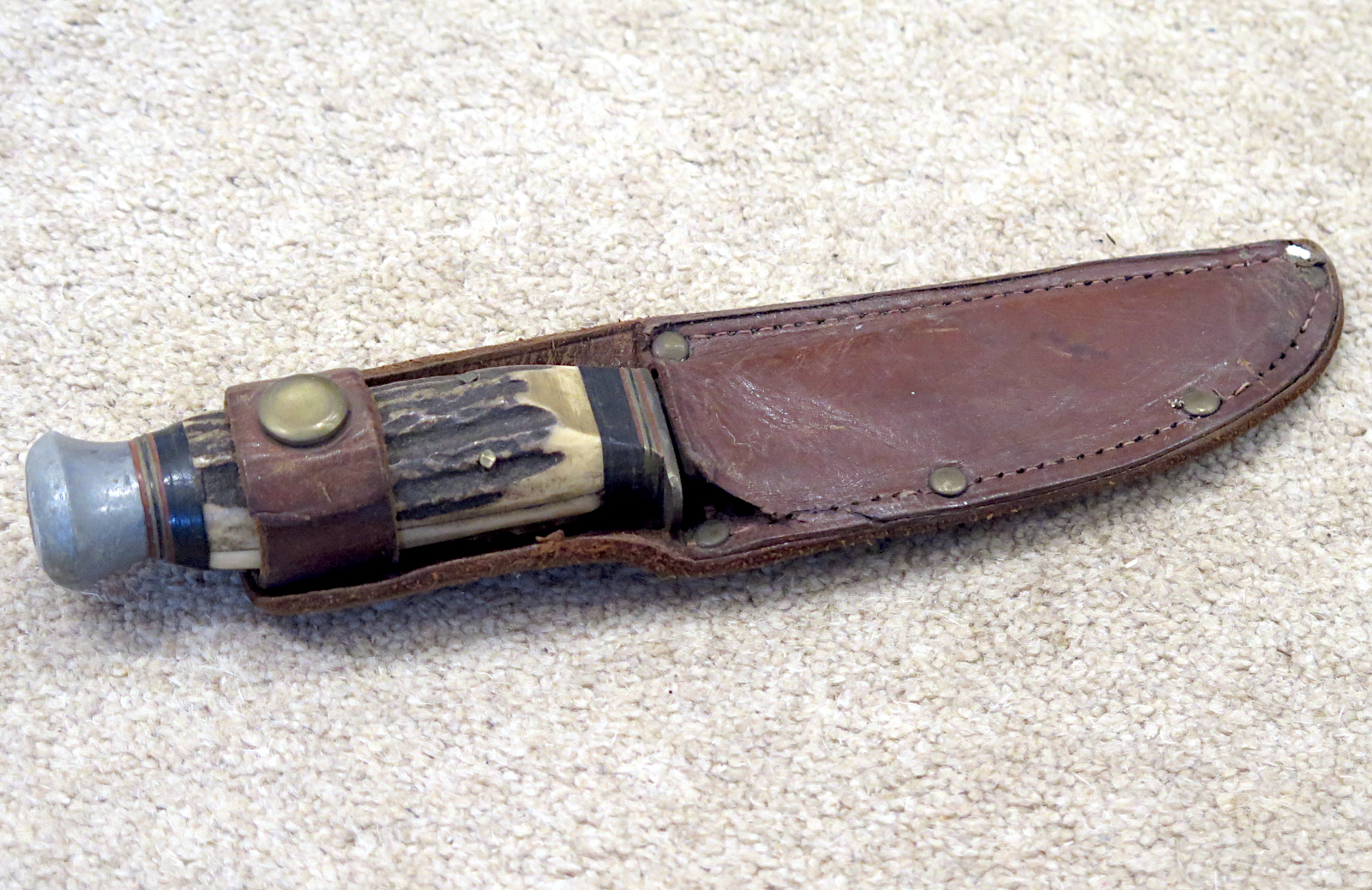
While going through some items from storage boxes I came across this old hunting knife, it has an antler handle and a leather case and I used it as a teenager as a scout knife. But I think it was given to me by an uncle who might have acquired it from his days in the British Army during World War 2. But wherever it came from, it’s not an object I could legally carry around while walking the streets in 2025!
Rococo Gardens
The snowdrops in Painswick’s Rococo Gardens looked lovely as they always do in season. Every year there are more, partly because gaps are being filled by natural spreading , and partly because additional areas are being planted up.
We had some issues with the new heat pump, mostly due to incorrect wiring during installation, but the engineers came back quickly to make fixes. The heating seemed better and better as time passed and we got to grips with the lifestyle changes – like using a summer duvet in the winter.
JHM: I wrote about truth and facts; and about an asteroid heading our way. World events: The Baltic states synchronised their power grids, connected to Europe and disconnected from Russia; and Thutmose II’s tomb was discovered.
We visited Springhill on our way north to Portrush. Mum used to talk about this old house and garden which she really loved. It was the home of William Conyngham who founded the village of Coagh where Mum was born and grew up.
We were on holiday with my daughters and their families, this time in Northern Ireland. On 7th we set out from the house and walked east along the coast to visit Dunluce Castle. Only Aidan and I went inside as we arrived near to closing time, but itwas well worth seeing.
Near the start of our walk
It’s a magnificent coast as you can see from the photo, there are beautiful beaches and rugged cliffs along the way. So it was a memorable walk. The second image shows some of us near the start of our expedition, on Portrush’s east beach with the town in the background. As always, click the thumbnail for a larger version. Read more about our holiday.
Back at home later in the month, I decided to finally close down my account on X. Back in the day when it was still Twitter I used it a lot and enjoyed the conversations, but in its later form it became full of unpleasantness and anger. I had already found a better, more friendly home in Bluesky – so goodbye X.
Beth and Paz celebrated their silver wedding this month, a grand achievment!
Cairn Gorm summit
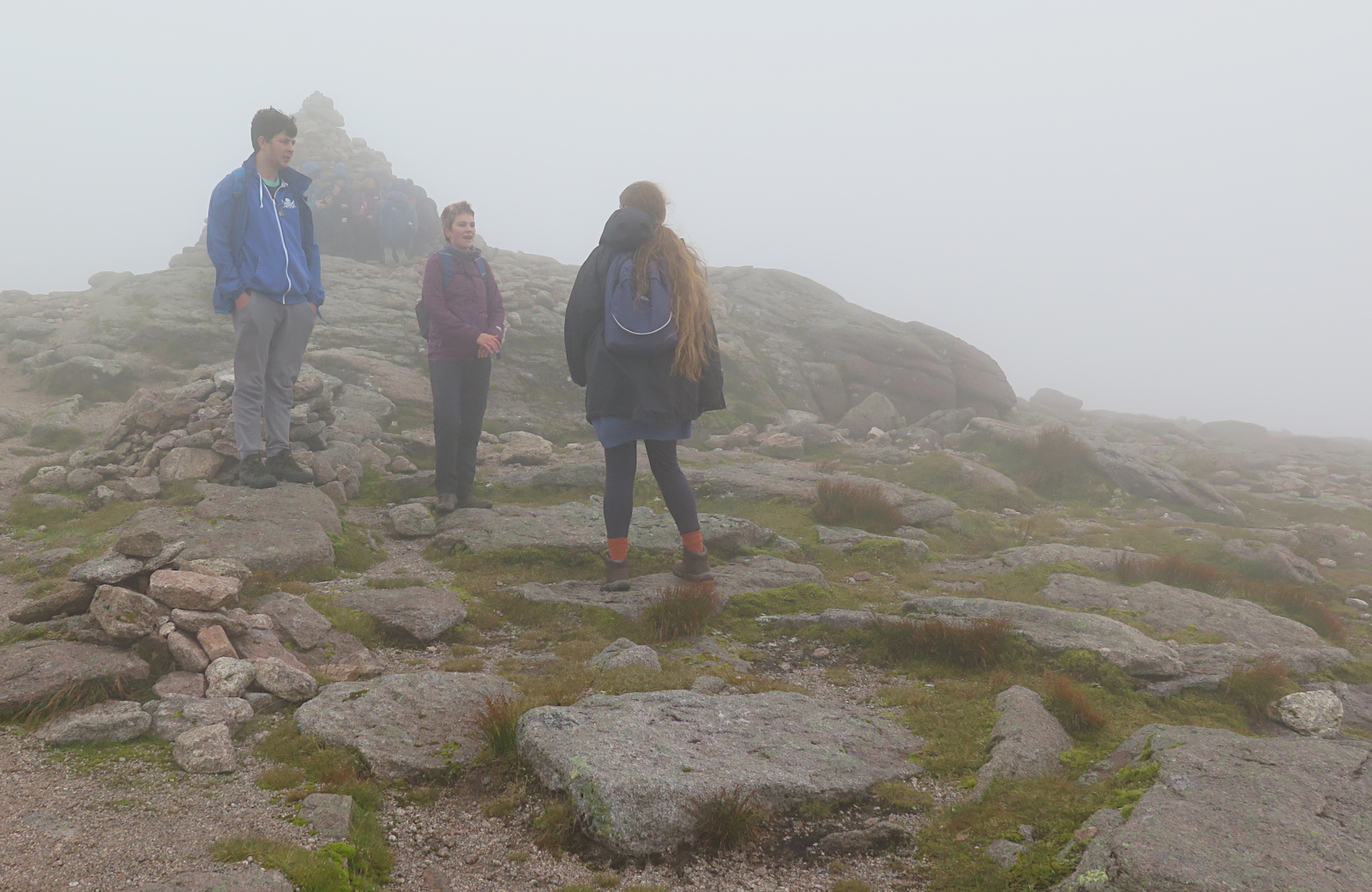
And we also had our family summer holiday, this year in Scotland. Beth, Aidan, Meredith and I made our way from the ski-lift car park to the summit of Cairn Gorm, but were unable to go further because of heavy cloud. On the way up we were lucky enough to spot a small herd of reindeer.
Freshwater beach, Aidan and Heidi
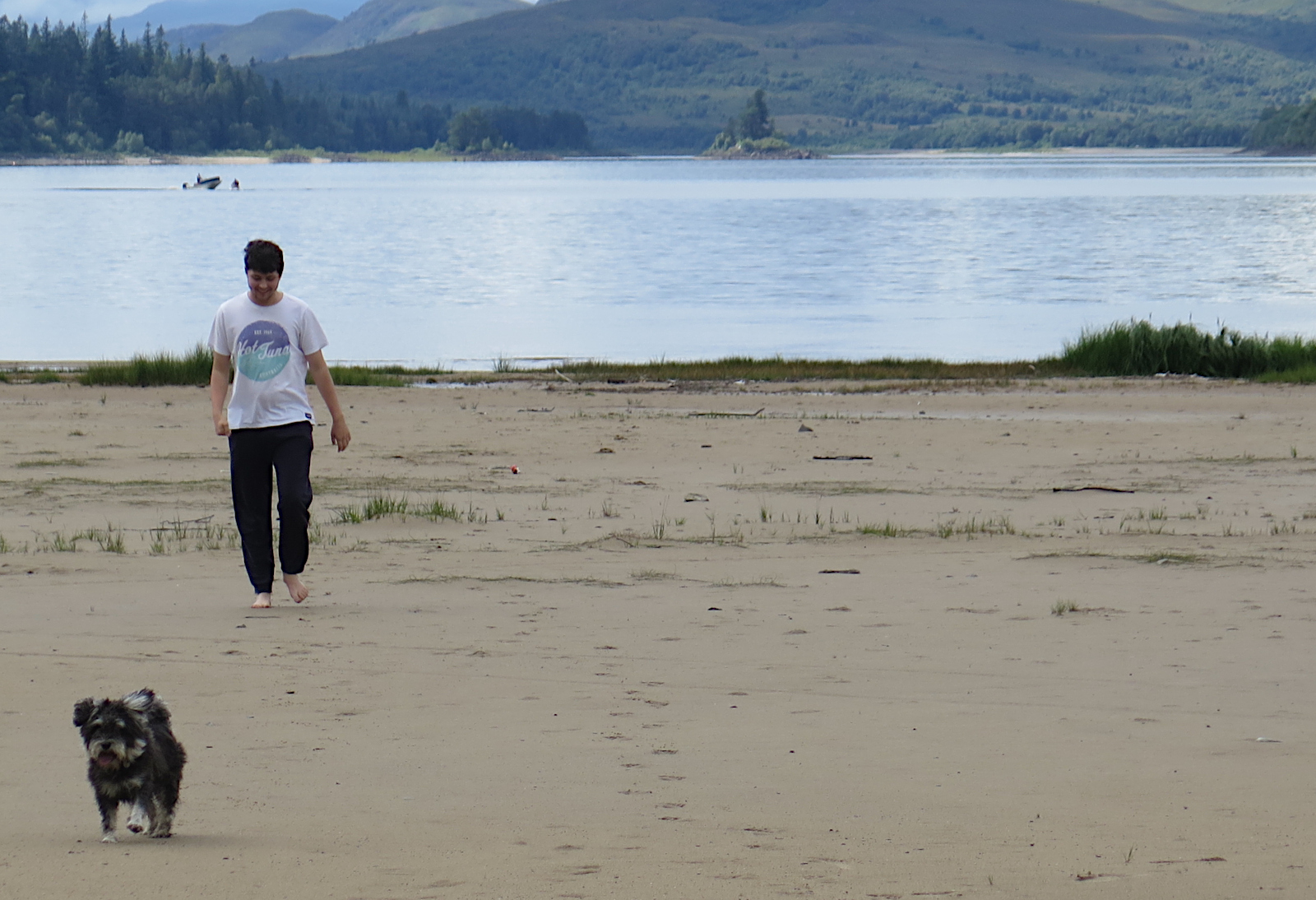
We visited a freshwater beach at Loch Laggan, a very strange thing to see, with patches of grass and seedling conifers growing in the sand.
We stayed in a big, old house in the village of Newtonmore. It held a few surprises for us, for example taking a shower caused water to drip through the ceiling in the dining room! But despite the quirks, we loved the house and the area.
Donna and I visited Boat of Garten where friends from near Cirencester were visiting family. Also in August, I went for a walk through the Beeches Estate where we lived until I was eleven-years-old; it brought back a lot of memories and I was able to jot them all down later when I got home.
Beth, Debbie and their families camped at Siddington. It was lovely to have them so close and to be able to pop out to spend time with them. in the photo you can see several members of the family and my sister, Cindy.
Near Snowshill
Paul and Vanessa came to stay for a long weekend and we did a circular walk from Snowshill, then we went to stay at their flat in Weston-super-Mare to look after the dogs while they were away. The photo shows Vanessa, Maizi, Paul and Donna.
And finally, Thomas Holme came to live with us for a period of time, starting on 22nd.
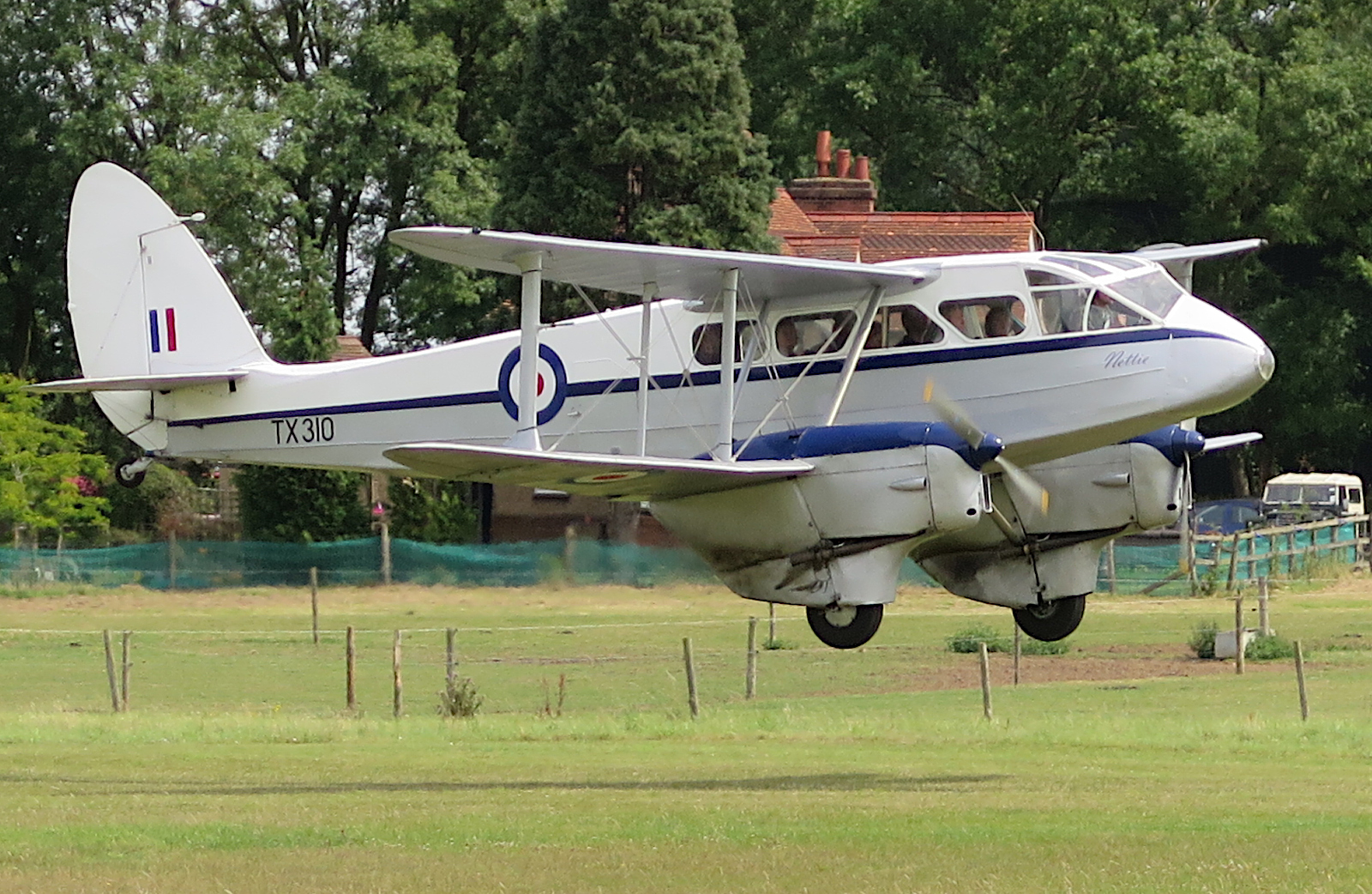
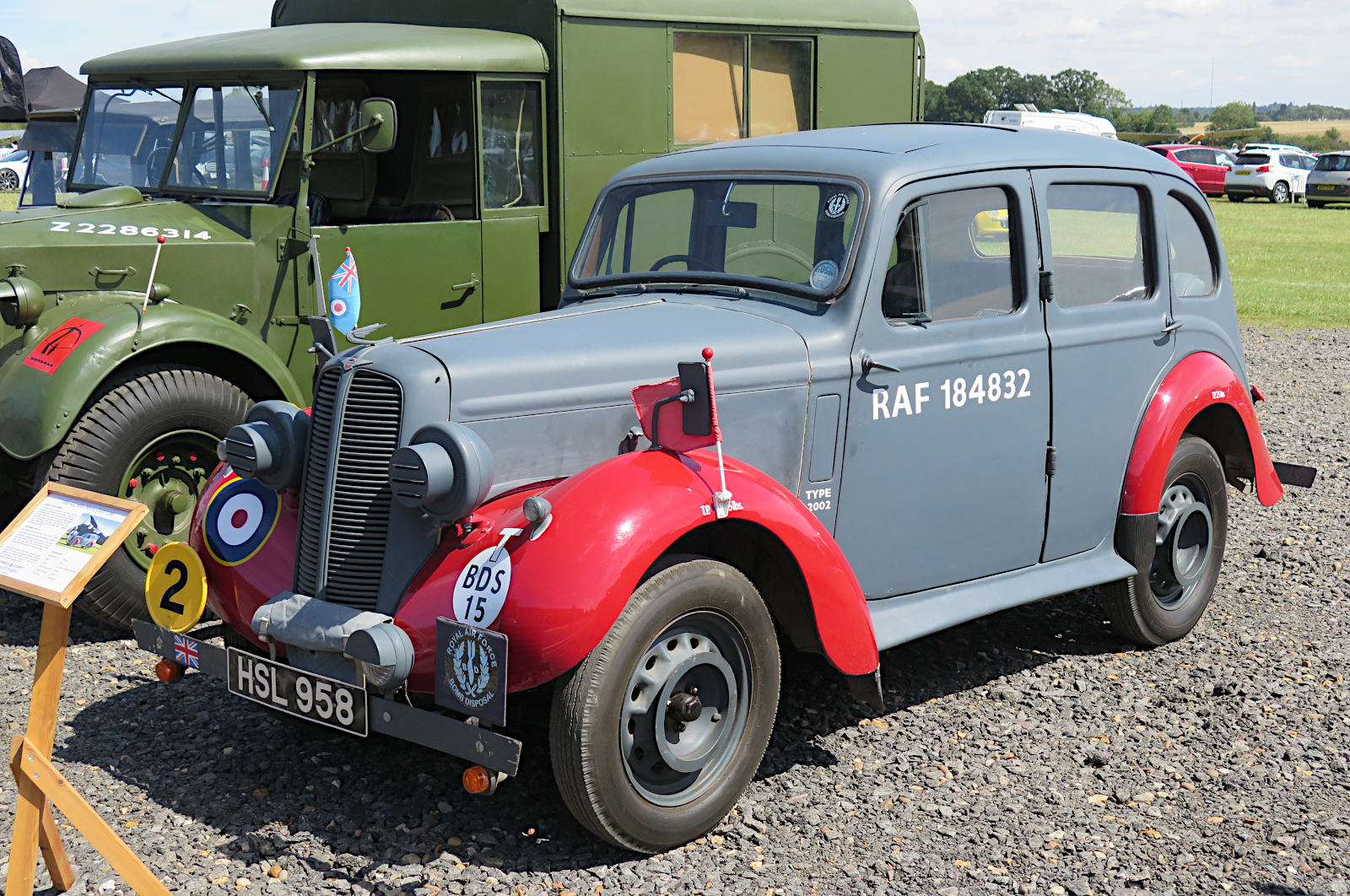
We went to a ‘Wings and Wheels Day’ at Old Warden airfield, not far from home in St Neots. It was amazing, with a series of vintage aircraft flying and vintage cars on display, and with a picnic as well. Donna booked the occasion well in advance, and as it turned out the weather was perfect.
Hillman Minx
The cars and trucks were a mix of civilian and military vehicles from throughout the twentieth century, some from before World War I. And many of them were in the air or driving about, often flown or driven by people in period costume. It was an amazing day!
Also in August – I released a new version of JDMC, Ed and Jo were married, Peter and Dadka came to live with us for a while, and we had a visit from Beth, Paz, Meredith and Verity. Quite an eventful month.
The Cornerstone cafe and bookshop opened for business in St Neots; after a lot of hard work by many people guided mainly by our friends Keith on the construction side and Jim on catering. We were able to hand over to Paul who had provided the original idea and most of the funds, and a series of volunteers for the day-to-day running of the business. Cornerstone also offered a small meeting room for local businesses and clubs, and a comfortable space for conversation or counselling. The first directors’ meeting would follow on 1st September, involving Paul, Jim, Donna and me, and Mark.
Donna and her Dad
We visited Broadstone near Poole to see Donna’s Mum and Dad. There was a naval display on, with ships off the coast and Royal Navy planes and helicopters in the air as well and we ate later at a local pub.
And finally, our Swedish friend David came for a short visit.
Donna’s church cell group went to an open air music event in Bedford, in the photo we were enjoying picnic food with our friends before the music began. A few weeks later the cell group went Greyhound racing, another fun social event.
Roman well
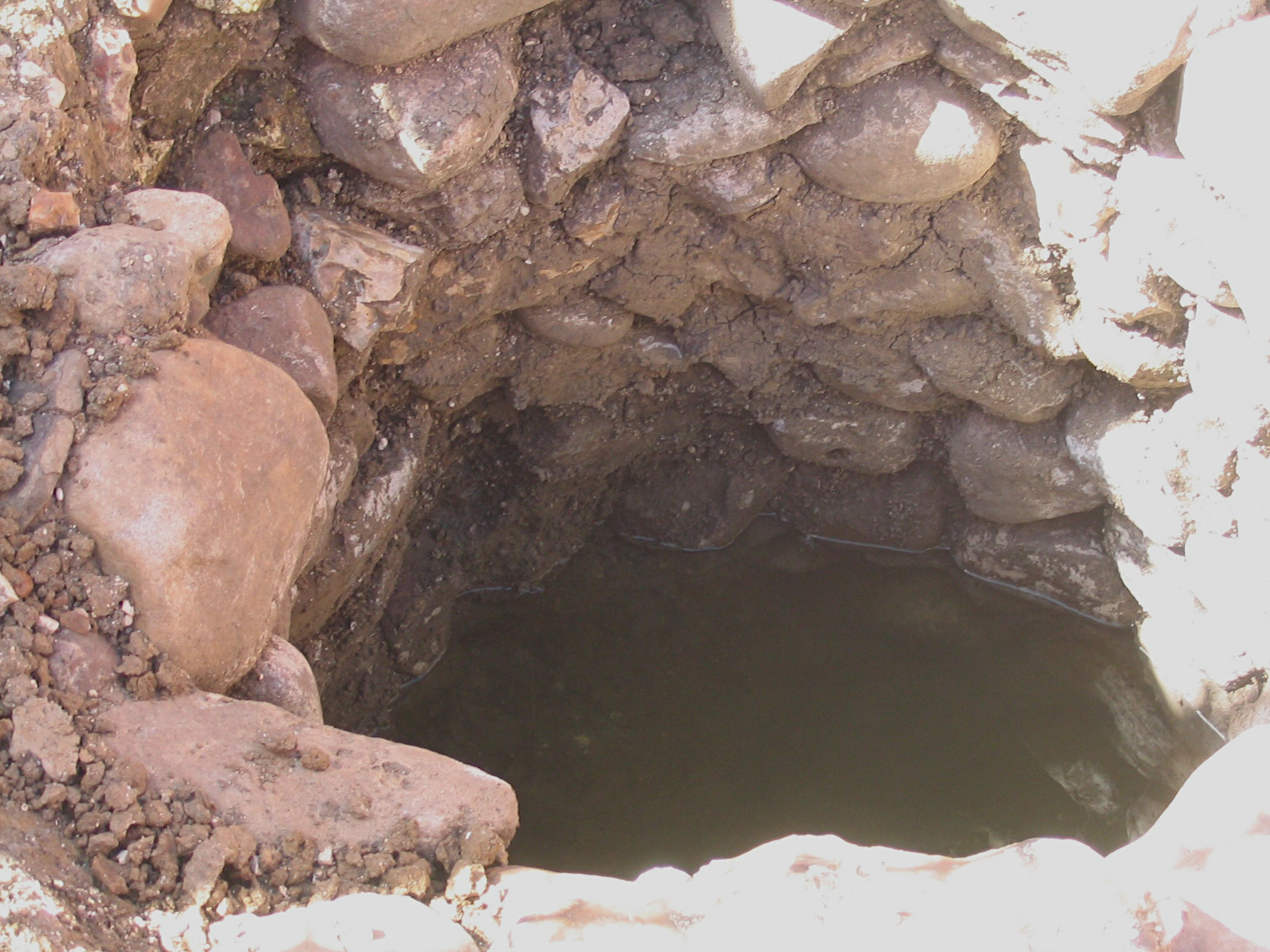
Towards the end of the month, I looked around Loves Farm on the edge of St Neots with our friends Ken and Gayna. Archaeological excavations were going on where a new area of housing and facilities were to be constructed. Iron Age, Roman, and Saxon remains were discovered and recorded on the large site. It seems clear that this land had been farmed continously from Iron Age times right up to today. The Roman well in the image was carefully lined with stone, and ancient ditches were clearly visible as bands of darker soil across the site with several roads and trackways also identified.
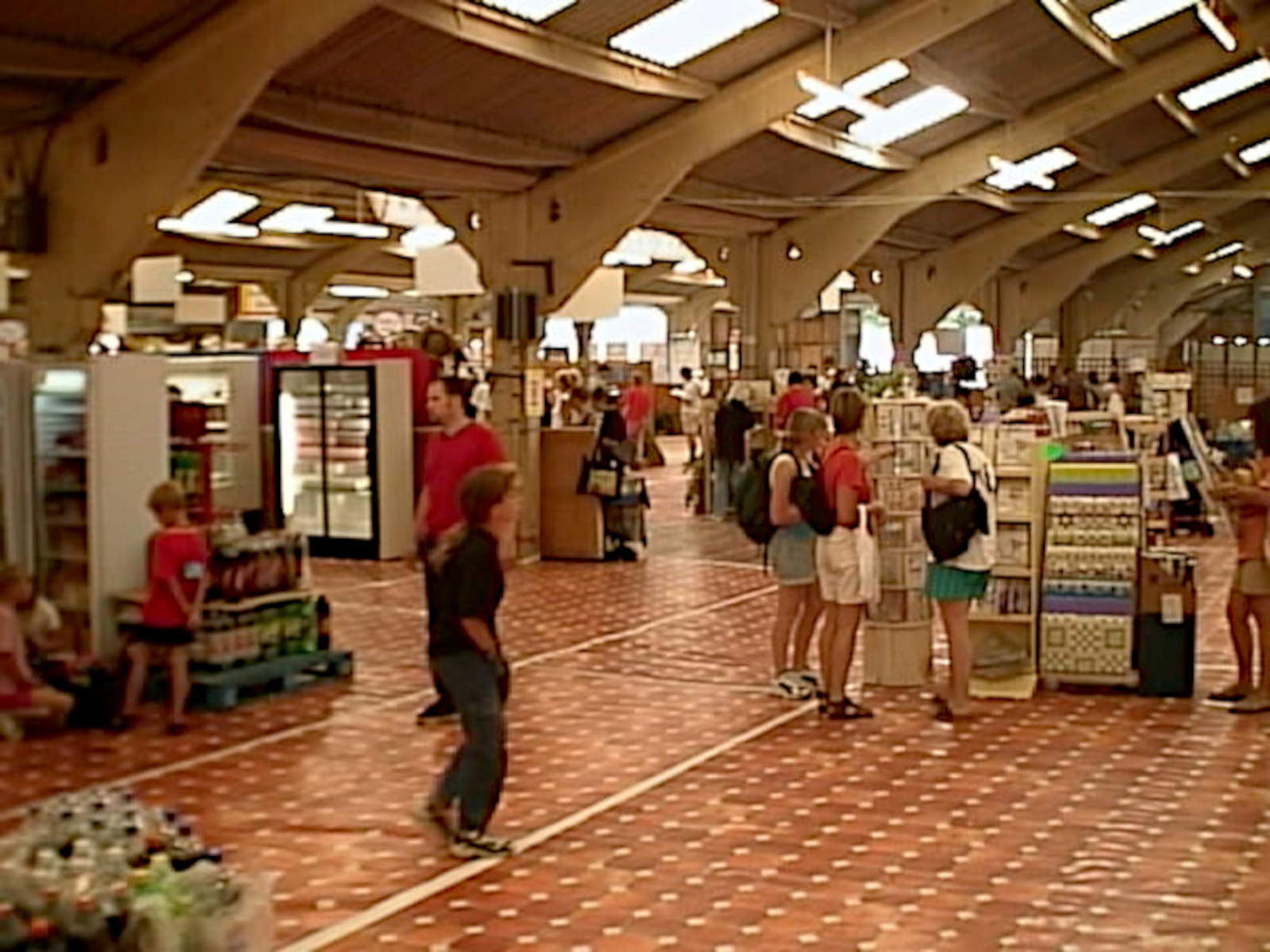
Donna travelled with her Open Door cell group to the New Frontiers annual event at the National Agricultural Showground at Stoneleigh; I drove up for the day on 1st August. The photo shows the book and music shop.
Table skittles
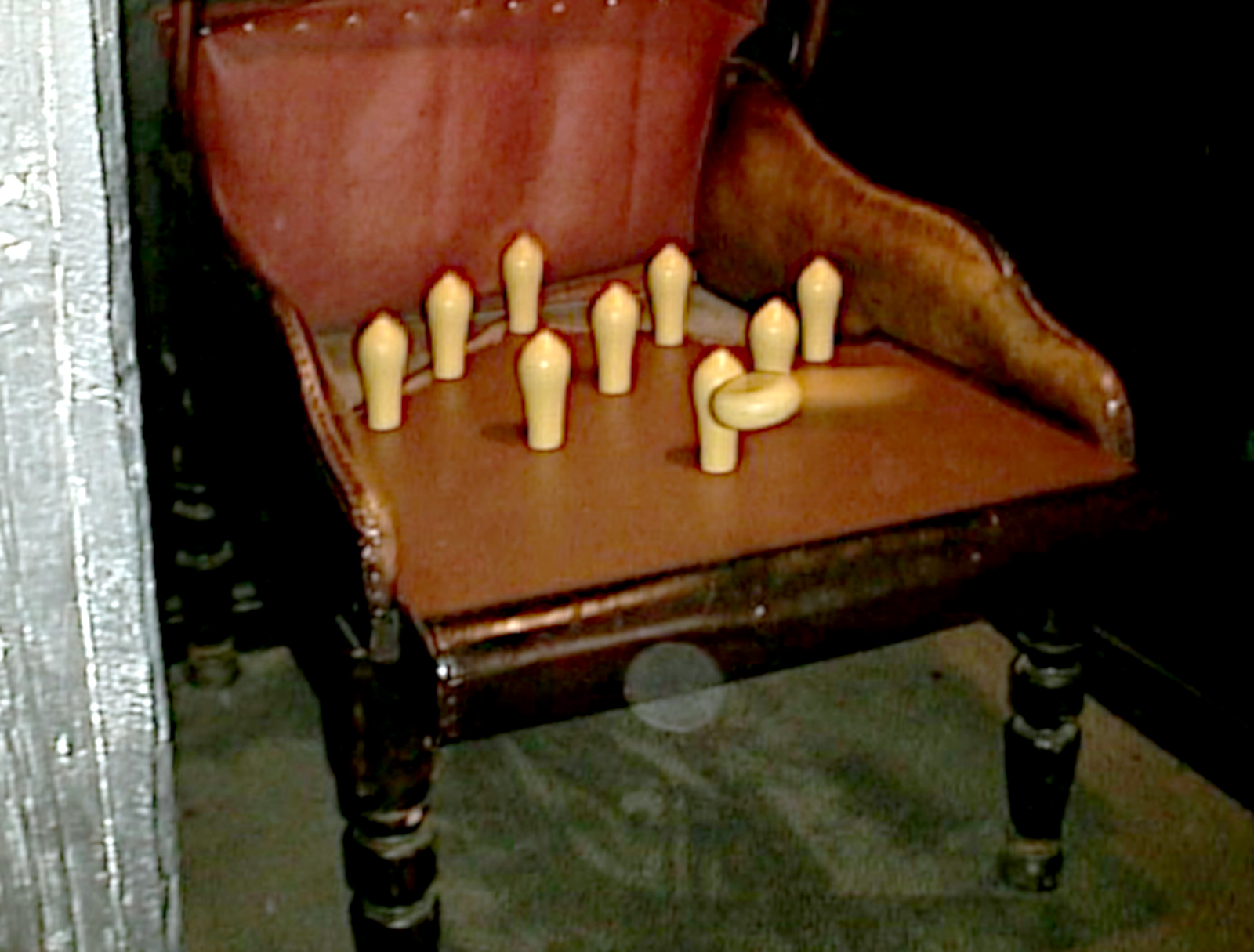
Knowledge Systems Group (KSG) met for lunch at the Beds Arms in Souldrop close to Unilever Research, Colworth. We often went there and played table skittles, a game local to the Northampton, North Befordshire area. Three ‘cheeses’ are thrown at the skittles and apart from that, the rules are very similar to normal ninepin skittles.
Other events this month were a visit from Donna’s Mum and Dad and a weekend with my Mum and Dad at Cirencester. We also visited Cindy and Paul at Bibury and I travelled to Amsterdam for a Unilever meeting on an intranet website, Research onLine.
World events: The Russian submarine Kursksank in the Barents Sea; and Tsar Nicholas II and his family were canonized .
Beth worked hard on her A-level biology project with help and advice from Judy. Debbie was well into her University degree work. Beth appears again in the distance in the second photo. It was a very hot and dry summer, vegetation was scorched, even deep-rooted trees were suffering and grass everywhere was dry and brown.
Blagdon Lake
Judy was still mobile and capable, leading a pretty normal life, though clearly losing weight and often suffering a little discomfort. I continued at Long Ashton Research Station, working for the Statistics and Computing Department and independently developing a Microscopes and Microscopy web site as a resource for professional microscopists. It was developed on my PC at home, and at first hosted only on the Long Ashton web server, but later a microscopist at an American University asked if he could mirror it for faster service in the US and after that it ran on both servers.
Meeting regularly with Tony, Faith, Paul and Jenny was becoming more and more special. Every time we all felt encouraged and peaceful, knowing that whatever the future held, everything would be OK.
It was around this time that Judy began collecting up all her old photos, putting them in albums, and and writing short notes about when, what and who appeared in the images. She was also getting them into date order as far as possible. Clearly she was planning ahead for me, Debbie, Beth and other family members. I’ve always been very appreciative of this, especially as I write these notes for the Blast From the Past series.
World events:Aided by NATO, Bosnian and Croatian forces continued to fight Serbian seperatists; and Eduard Shevardnadze survived an assasination attempt.
Debbie returned from her French exchange visit on 8th and we collected her from Lulsgate Airport. She had lots to tell us about her trip and had brought back some souvenirs including a huge French banknote!
Symonds Yat
Later in the month we visited the Forest of Dean and walked via Biblins Bridge to Symonds Yat where we crossed the river by the rope ferry, stopped for ice-creams, and returned to the car by the same route. And at the end of August we enjoyed a time at the Bristol Flower Show up on Clifton Down, and a trip on the North Somerset Steam Railway.
World events:Iraqinvaded Kuwait, leading to the Gulf War; and East and West Germany announced they would unite on October 3.
We had a holiday at Ogwen Bank in North Wales. Debbie and Beth are sitting just outside our caravan in the photo. The site was close to Bethesda so we were able to visit lots of interesting places all over Snowdonia
Debbie, Beth, and me!
One of the places we visited was Benllech Beach, lovely sand and rocks as you can see. I’ve always enjoyed messing around at the seaside, especially building miniature dams. So there were three kids on the beach and one adult – Judy, who took this photo.
Amongst other things we visited a working slate museum, a woollen mill, The island of Anglesey with its sea zoo and butterfly house, a couple of castles and more. Judy and the girls visited Port Meirion while I stayed at the caravan and worked on an Open University (OU) course.
Apart from the OU courses which ran through the summer, August was always a great time for family life. The girls were on holiday, so was Judy, and we were able to go out for day trips as well as have a week or two away somewhere.
Beth was interested in the cat, while the cat seemed to be interested in the paddling pool! And the sandpit in the background appeared to have been the scene of a nasty tractor accident. Just an ordinary summer day at 22 Rectory Drive.
Beth was just 2¼-years-old and Debbie was five and a half. Judy was considering beginning a teaching career having earned her qualification before Debbie was born while we were still living in our flat in St Andrew’s, Bristol. I was working at Long Ashton Research Station on fruit crop pollination, mostly on apples and plums; and I also had a week away at an Open University summer school.
World events:Hurricane Allen pounded Haiti, killing over 200 people; and the Gdańsk Agreement was signed in Poland allowing the free trade union, Solidarity.
Debbie turned five months old and was growing quickly in both size and ability. She was developing better coordination, holding things and beginning to interact with adults and distinguish between them.
We started to get the house tidier and items put away. We had much more floor space than at the flat and although our furniture was the same it seemed lost in a large space rather than crammed together. We had only the old, green carpet we’d brought with us; it had filled the lounge/diner at the flat, now it just covered the dining area! Every other section of floor was bare boards, including the stairs, but the kitchen retained the covering left by the previous owners.
I began cycling to work from Yatton to Long Ashton, for a couple of years I’d been used to cycling from St Andrew’s, Bristol. What a change! No more dangerous, heavy traffic to contend with, instead a longer but much more relaxing trip through attractive countryside and the villages of Claverham and Backwell.
World events: The Helsinki Accords recognising Europe’s national borders and human rights, was signed in Finland; and NASA launched the Viking 1 planetary probe toward Mars.
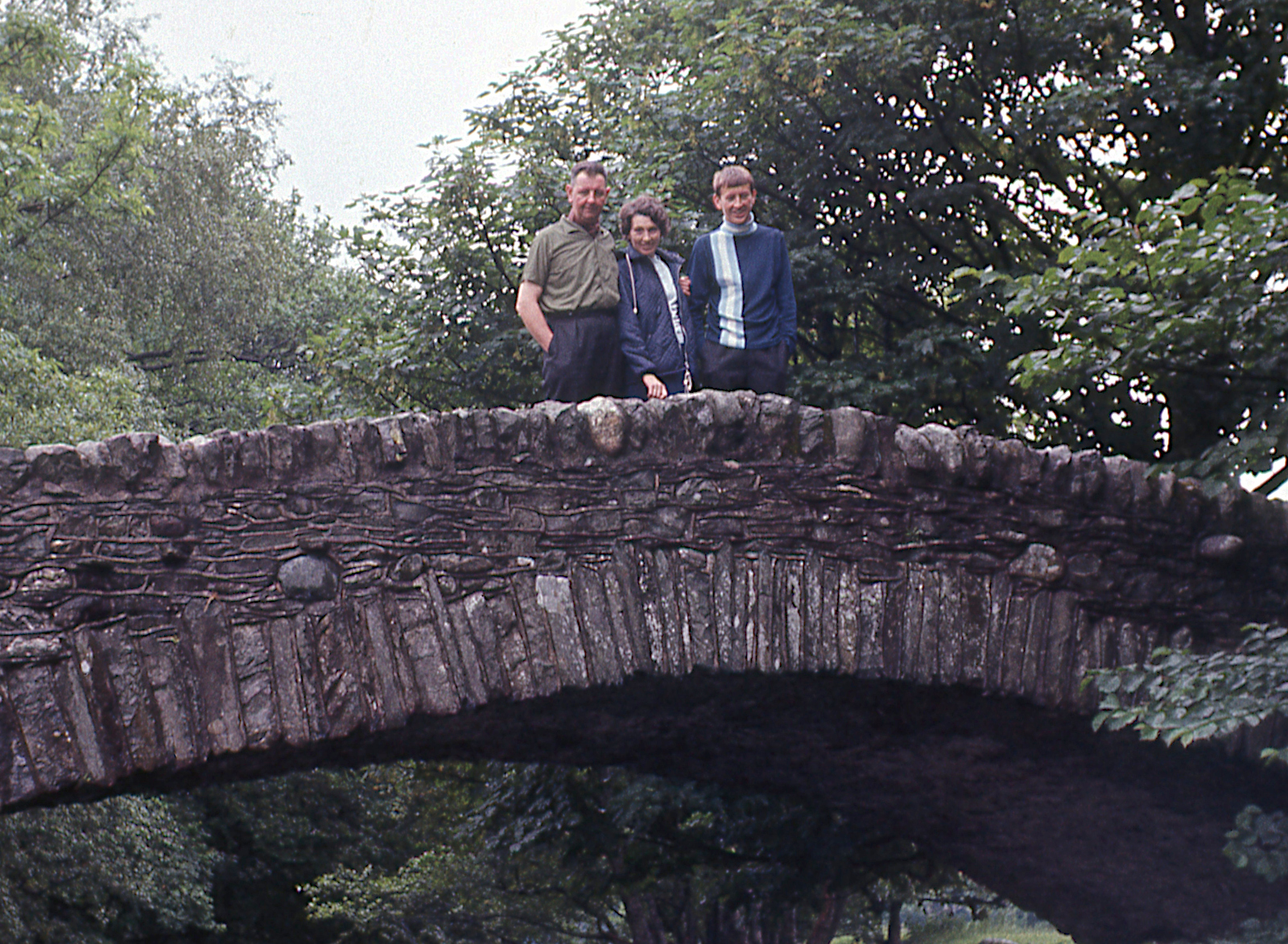
Judy was away on holiday for two weeks in the Lake District with her parents and brother, Frank. She took this photo at Watendlath Packhorse Bridge near Keswick.
Judy and I were planning for our wedding in early October, there were just some finishing touches to put in place really, but we didn’t want to run out of time.
Pete, a good friend from University, discovered the Ministry of Agriculture were empl0ying graduate students to interview farmers during the summer of 1970. We signed up for this survey work as we both had our own transport, and spent several weeks driving around the Cotwolds with the questionnaires interviewing the farmers and some of their employees. We lived at Mum and Dad’s house in Victoria Road as our base of operations. Part of the time they were on holiday in Northern Ireland with my sisters so Pete and I looked after the place while they were away.
World events: The Soviet Union launched Venera 7 towards Venus; and rubber bullets for riot control were used for the first time.
This was the month of the Grammar School Explorers Club expedition to Scotland, organised and led by one of my biology teachers, Mr Castle. I was one of two sixth formers who travelled with him in his Bedford van with the lighter equipment (the heavy stuff went by train). Graham and I camped just outside Edinburgh while Mr Castle returned by train to travel north again with the fourth and fifth form members of the expedition. Most of us would travel by coach while Mr Castle brought the van and equipment. Graham and I were assistant leaders.
We walked up the Dee Valley into the Cairngorms, then to Ben McDhui and Cairn Gorm, descending along the ski lift route. We visited Pitlochry for a night or two and then to Mallaig and the ferry to Skye where we viewed the Cuillins from Elgol beach and went to the Portree Highland Gathering. After a night at the coral beaches, we returned to the mainland to visit Fort William and walk to the top of Ben Nevis.
It was quite a journey and an experience I shall never forget.
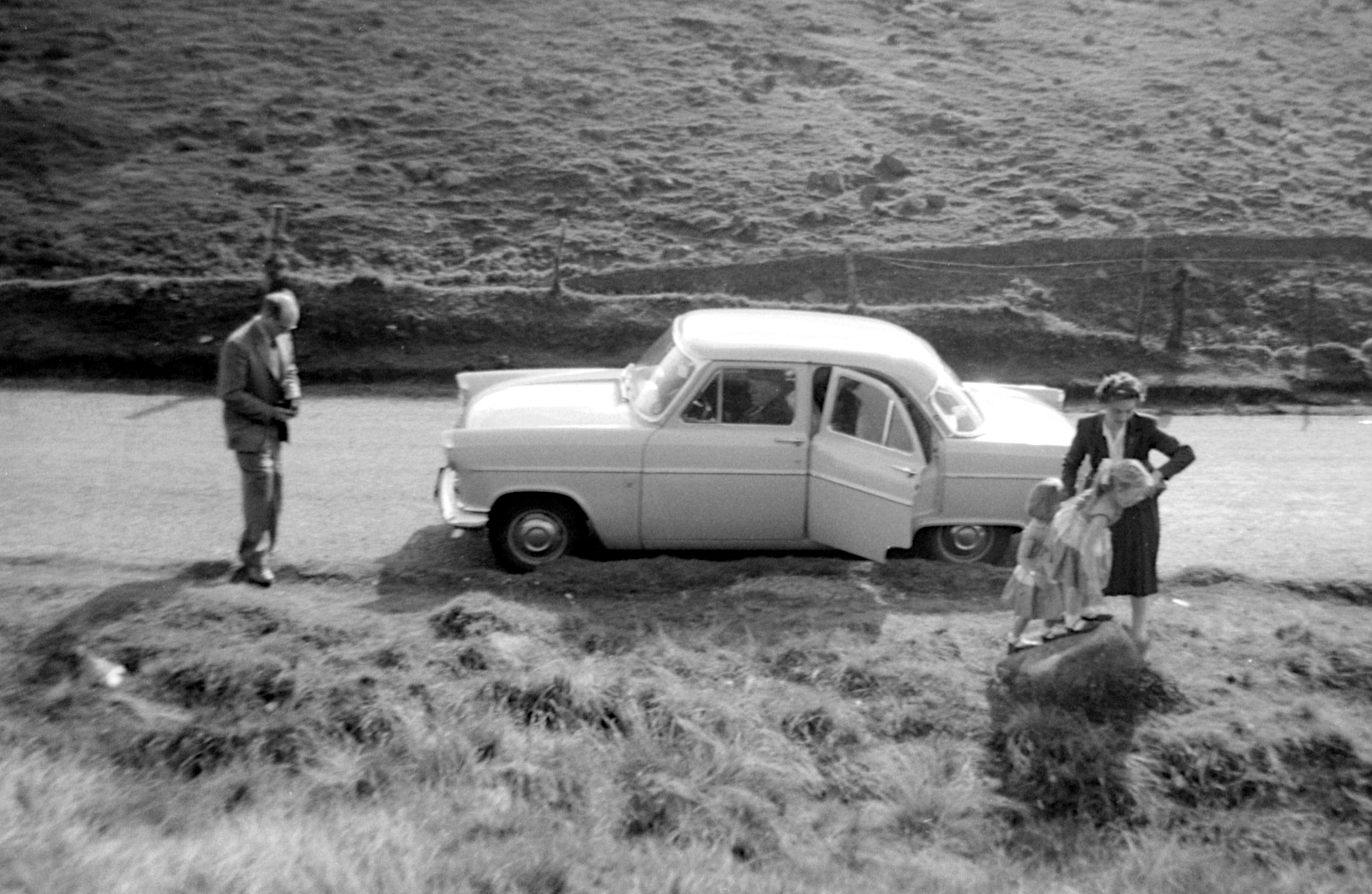
Our annual holiday this year was in Northern Ireland, staying at Holmlea in Coagh, Co Tyrone with Mum’s parents. The photo was a brief stop near the Spelga Dam in the Mountains of Mourne during a day out. I had scrambled up the steep bank and took this image of Dad taking a photo of Mum and my younger sisters, Ruth and Rachael, Granda is sitting in the car. Granny and Cindy may have still been in the car as well. How did we all squeeze in for the trip? Ruth and Rachael were small enough to sit on an adult lap, probably with Mum and Granny.
We’d have done a number of trips out like this one, almost certainly including a day at the seaside at Portrush, maybe a trip to see the Giant’s Causeway, and definitely visits to Cookstown and to Mum’s cousin on the farm at Killycurragh on Slieve Gallion. The first (and only) time that I milked a cow was at Killycurragh, but what I remember most was high tea, where the table with its white cloth groaned under a huge choice of delicious food, much of it home grown and home made.
World events:The Beatles began a 48-night residency at the Indra Club in Hamburg; and Russia launched Sputnik 5 carrying two dogs, mice and rats, and plant specimens. All the animals returned safely after a day in orbit.
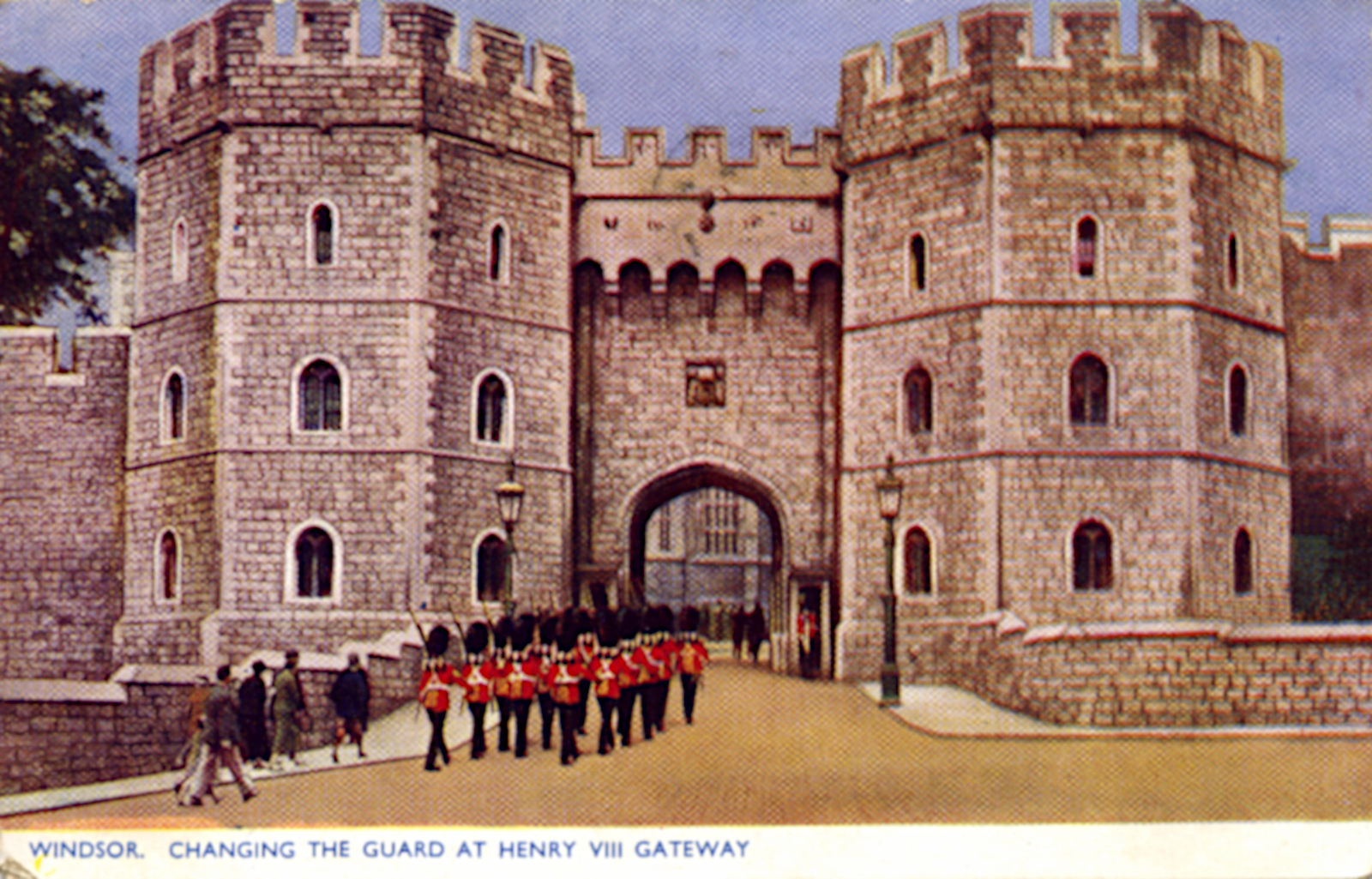
In August we visited Windsor Castle, I don’t remember this trip although I was seven-years-old at the time.
Mum sent the postcard to her younger sister, Annabelle, and wrote on the back,
‘Christopher & Cynthia couldn’t take their eyes off the soldiers & had to send you this picture so that you could see them too. Wish you were all with us. Much love from us all. Your loving Sister, Lilias.’
I needed a photo for the summer of 1950 but couldn’t find one. I’m guessing this is a bit more recent, perhaps between 1950 and 1960; but it does capture business life in Cirencester in that era. In those days there were no supermarkets, you would have visited a variety of small bakers, butchers, grocers, greengrocers and so forth. Barnett’s was one of these.
Charlie Barnett was a famous test and county cricketer, born in Gloucestershire. When he retired from cricket, he set up a business in Cirencester, selling fish, game, and more exotic items such as seagull eggs. The photo shows him working in his shop.
We must have been settling into our new home in Queen Anne’s Road at this time. There were probably boxes to unpack, clothes to put away, as well as the normal household chores of laundry; and for Dad there’d have been the task of getting the garden area tidy, clearing weeds, removing building rubble, stones and so forth, and planning a garden.
World events: North Korea’s Air Force was largely destroyed by anti-communist forces; and Uruguay beat Brazil 2–1, to win the 1950 World Cup.
On 2nd August Mike had the bad news that he was being posted overseas. He had to rush to get Lilias to Cirencester as fast as possible, perhaps something they’d planned to do a little later.
He arrived in Stranraer on 3rd and was in Coagh on the evening of 4th. By 7th they were on the train south from Stranraer. On 8th his mother, Nor, met them at Cheltenham Station with the car and Mike drove them home. They then had five clear days to enjoy time together in Cirencester and around the south Cotswolds until Mike was required back by the RAF on 14th. But this was a really good day because the victory over Japan was announced and the war was finally over. Medicals, inoculations, and the issuing of tropical kit took almost two weeks; then there was a final twenty-four hour period when he was able to get back to Cirencester to see Lilias and his parents, and the last three days of August were spent on duty in Blackpool waiting for a ship to become available.
World events:Winston Churchill supported the idea of a pan-European army; and Pope Pius XII declared evolution to be a serious hypothesis that does not contradict essential Catholic views.
There’s not enough information to write something for every month in the 1940s. Dad’s diaries start in January 1943, so for January 1940 to December 1942 I’ll write about things I know, or draw on dated photos and documents. Sometimes I might use a photo or document with a guessed date.
Cinder-block bins
For August 1940 I’m going to write about another of the John Jefferies & Son nurseries, this time a very small one, the Abbey Nursery. The medieval Abbey owned a great deal of land, not just in the town but in the surrounding countryside. Part of the Abbey’s land lay inside City Bank, and part of it formed the Abbey Nursery. It had a shed for equipment, and cinder block bins for sand, grit, gravel and other garden materials. The bins are still there, just inside the gate on the left. Today the land is a nature reserve and is open to the public.
All Cirencester people will know where City Bank is. As the name might suggest, it has to do with a city (which Cirencester is not). But in Roman times its predecessor Corinium was a large and important city only exceeded in size by Londinium, present day London. In the later years of Roman Britain, most cities aspired to a wall, perhaps defensive, or perhaps just a way to demonstate high status. So there was a city wall. In medieval and later times, the useful cut stone was robbed from the old walls and used to build the town anew. What was left of the old walls was a bank of tumbled stone and soil, covered with grass and scrub, hence City Bank, not City Wall.
In 1940 and up until John Jefferies and Son’s nurseries gradually fell out of use from 1975 onwards, the Abbey Nursery was used mainly for growing Christmas trees for sale in November and December, but was also the storage site for the Cotswold stone and paving slabs used by the landscape construction part of the business.
In August 1940 my father, Mike, was nine-years-old and lived with his parents at ‘Churnside’, 37 Victoria Road. His Father, Edward (Ted, Guv, or ‘the Governor’) was 60 and his mother, Norah (Nor) was 61. His brothers, John, Richard (Dick), and Robert (Bob) were 33, 30, and 27 respectively.
World events: Lithuania, Latvia, and Estonia were annexed by the Soviet Union; and the Royal Air Force bombed Berlin for the first time.
Anything that appears in this section will have some connection with the 1930’s but may extend beyond the decade to follow a meaningful topic more fully.
An illustration from the book
Uncle John and Auntie Jo were married on 15th September 1932. John was my father’s oldest brother, born in 1907 and 19 years older than his little brother. This is a large gap between the oldest and youngest in the family so it seems my Dad may have been an unexpected late addition!
John and Jo lived at 4 Tower Street, Cirencester; it was a three-storey town house and the features I remember most were a floor to ceiling mirror in the narrow hallway which made the narrow space look much more spacious, and the front reception room with a stone fireplace. There was a fine collection of hand-bells on the mantelpiece, collected over the years it seems and not a set, but nevertheless, in tune with one another. I remember a long passageway with the kitchen at the far end and a little, shady garden beyond that. The floor above must have contained bedrooms and a bathroom, but the top floor was the most exciting as there was a storage room at the front with all sorts of intriguing items discarded from everyday use. An Aladdin’s cave! John and Jo’s daughter, Jill, was my godmother so I was invited round from time to time. She always had something interesting for me to see or fun activities to do.
John and Jo had a poodle (one of the larger kind). He was called Gigot and I remember Auntie Jo collecting the wool when he was clipped and storing it year by year until there was enough to be washed, carded and spun into yarn. Gigot was a mid brown colour and she knitted herself a cardigan from the wool!
As a young child I always found Uncle John a bit solemn and aloof, even a little bit scary, but of course he was quite good fun in many ways if perhaps a little on the serious side. He became Chairman of Cirencester Urban District Council, almost but not quite the Lord Mayor. Cirencester had no mayor in those days, though today it does, and the chain of office is still the one once worn by John.
When my grandfather died, John and his brothers Dick and Bob took over John Jefferies & Son as directors. John’s role had long been managing the landscape design and construction side of the business, using the entire top floor over the shop in Cirencester Market Place as the design studio. I remember Desmond Walker who helped as John’s deputy in the design office. Desmond lived right next to Tower Street Nursery and had a mulberry tree in his garden.
World events (August 1935): The volcanic island of Anak Krakatau began to form permanently in the Sunda Strait. (August 1930): United States President Franklin D. Roosevelt signs the Social Security Act into law.
As with the 1930s material, everything in this section will have a connection of some kind with these two decades.
My father, Mike, was born on 4th June 1926. He would almost certainly have been born at home – Churnside, 37 Victoria Road, Cirencester. His parents were Edward Arthur Jefferies and Norah Jefferies (nee Monger), usually known as Guv or Ted and Nor. Mike had three much older brothers, John, Dick and Bob (19, 17, and 15 years older). Because he was a bouncy baby, his brothers called him ‘Tigger’ and this stuck. He was still known as ‘Tig’ by the brothers and by his parents while they were still alive. Churnside would itself have been fairly new when Dad was little, the house is Edwardian and was built shortly before Guv and Nor were married. This and the house next door are semi-detatched so were built as a pair, I believe they were the first houses on this section of Victoria Road.
World events (August 1900): International troops entered Peking to free European hostages during the Boxer Rebellion. (August 1905): Norway voted to break from the union with Sweden. (August 1910):Japan formally annexed Korea. (August 1915): In the First World War Gallipoli campaign, the Battle of Sari Bair was fought.
If you enjoyed this or found it useful, please like, comment, and share below. (If you don’t see those links, click the article’s title above the main photo and they will appear.) Send a link to friends who might enjoy the article or benefit from it – Thanks! My material is free to reuse (see conditions), but a coffee is always welcome and encourages me to write more often!
What’s in an image? Sometimes quite a lot, more than meets the eye. I’m posting an image every few days.
Click to enlarge
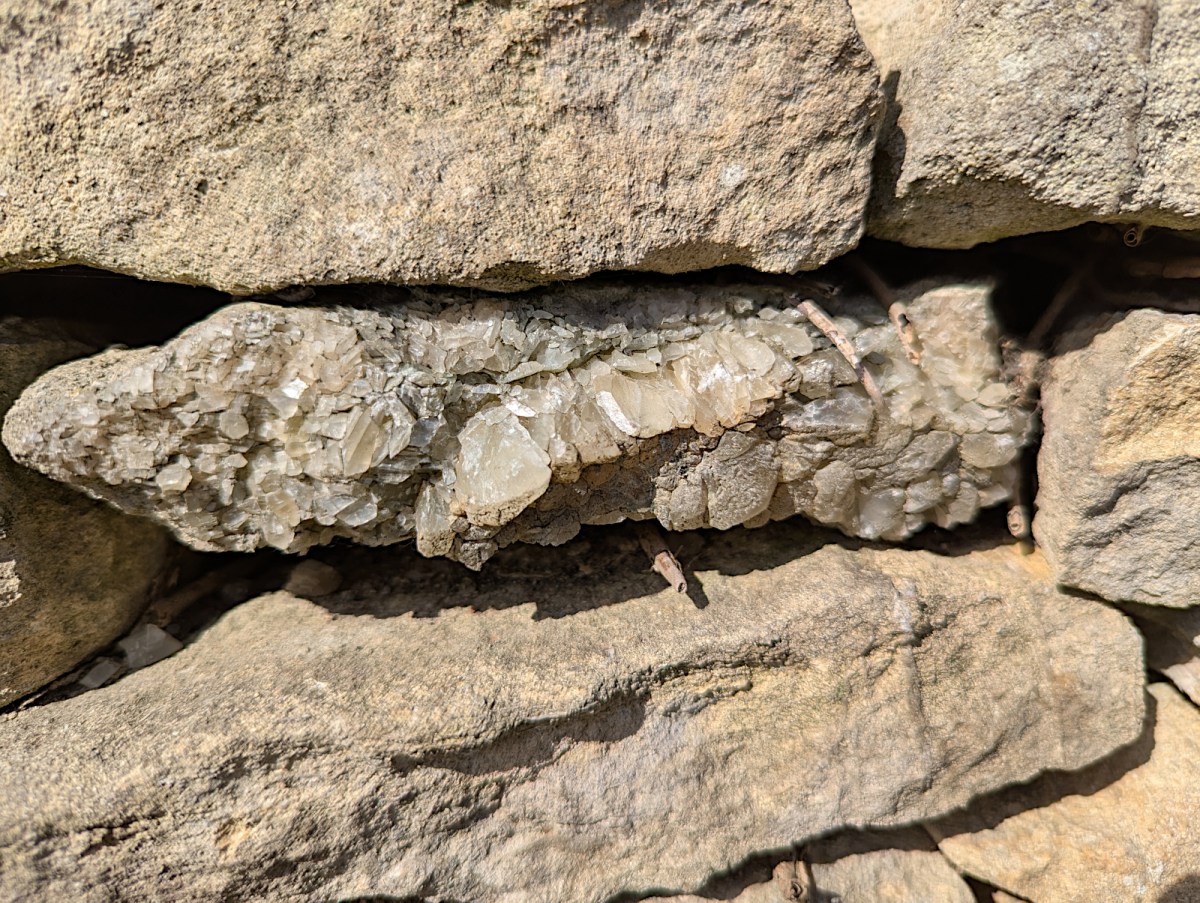
There’s a long stretch of dry stone Cotswold wall along the western edge of the Gloucester Road between Cirencester and Stratton. Walking along the footpath one day I was surprised to see the crystalline inclusions featured in this photo. The crystals look to me like a form of quartz (six-sided columns with six-faced prisms at both ends).
This might be part of a geode fractured open while quarrying the stone. There’s a small chance that the other side of the geode exists elsewhere in the same wall or in some other structure built around the same time. It seems that quartz geodes are not unusual in Oolitic limestone deposits. When they are stained purple purple the crystals are known as amethyst. The formation in the photo shows no hint of colour at all. The deposit must have formed from a particularly pure solution of quartz.
If you enjoyed this or found it useful, please like, comment, and share below. (If you don’t see those links, click the article’s title above the main photo and they will appear.) Send a link to friends who might enjoy the article or benefit from it – Thanks! My material is free to reuse (see conditions), but a coffee is always welcome and encourages me to write more often!



















 Journeys of Heart and Mind
