Trump, Vance and fruit

Did Jesus discuss politics with his followers? Most certainly he did! ‘Whose head is on this coin’, he asked. ‘Well then, pay Caesar his due, but make sure to pay the Almighty his due as well.’ And that’s just one example of many.

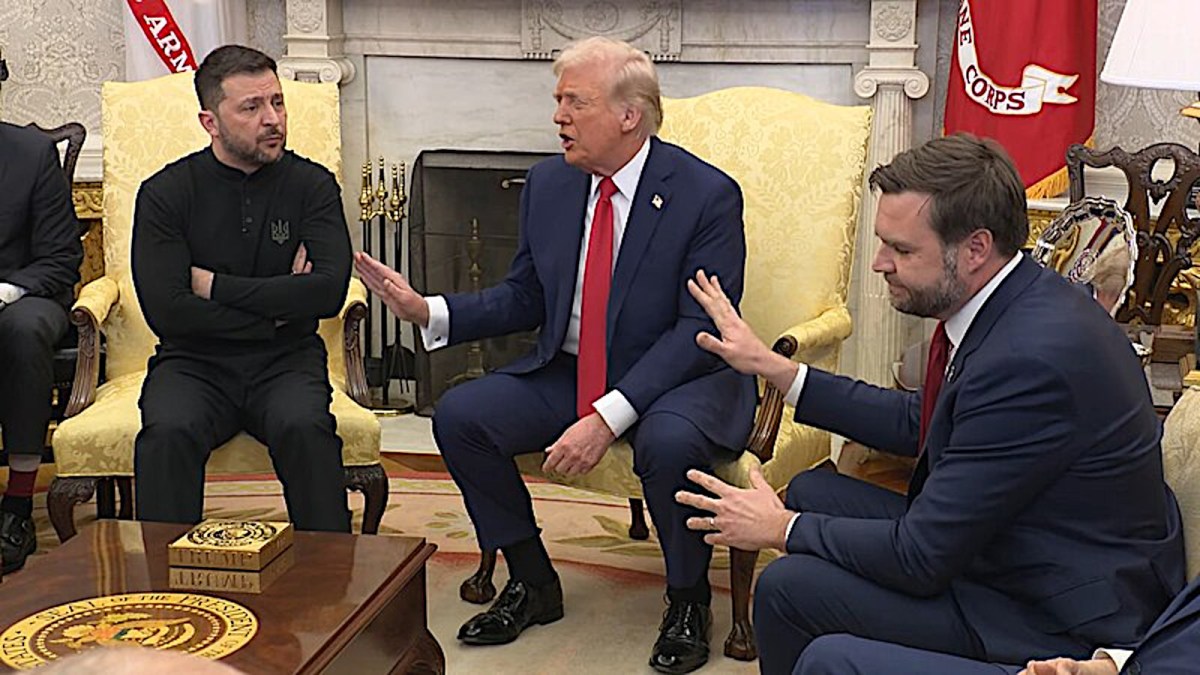
That meeting with Zelenskyy (Wikimedia)

Thinking out loud – 3

Oval Office
(Wikimedia)

There is a view out there that religion and politics shouldn’t be mixed. We don’t want to offend one another and politics is likely to be a topic that people feel strongly about – so let’s avoid unnecessary divisions.

I’m all in favour of unity, but I have two issues with that thinking.

The first issue is the word ‘religion’. Do I follow a religion? I sincerely hope not! I do my best to follow Jesus, he’s the best example of living well that I have. He taught his followers by example, by argument and by his loving heart. That’s not religion, it’s simply the practice of following the best example!

The second issue is the word ‘politics’. Following Jesus, if it means anything, means following him in every aspect of life. So unless we define politics as somehow not being an aspect of life, it follows that we should include it as just another part of life in which we can follow Jesus. Did Jesus discuss politics with his followers? Most certainly he did! ‘Whose head is on this coin’, he asked. ‘Well then, pay Caesar his due, but make sure to pay the Almighty his due as well.’ And that’s just one example of many.

So with those two points cleared up, what about Trump, Vance and fruit?

Trump and Vance

Whatever you think of the politics, and whatever you make of their words, I’d like you to look deeper than that – please consider their actions as well, and particularly consider the motives and intentions that led to the words and actions. We’ll come back to those in a moment, but first let’s look at fruit.

Fruit?

Yes. Fruit.

Paul wrote 2000 years ago about the fruit of the Spirit of Jesus working in the hearts and minds of people following Jesus. Here’s how that works. When something grows (a young plant, a young animal, a child) there is always some kind of fruit. An apple tree will always produce apples, more and more in maturity as it reaches full size. A young animal will develop attitudes to prey and predators that will enable it to survive and produce offspring. A child will develop attitudes and actions based on those of parents, siblings, teachers and so on.

The fruit of Jesus’ Spirit working in his followers is described by Paul in Galatians 5:22-25. It’s fruit, it develops as you grow. It ripens with maturity, it has fragrance and flavour. Here are Paul’s words:

The fruit of the Spirit is love, joy, peace, patience, kindness, goodness, faithfulness, gentleness and self-control. Against such things there is no law.

Back to Trump and Vance

Love, joy, peace, patience, kindness, goodness, faithfulness, gentleness, self-control. How much of those attributes have you noticed in the words and actions of the USA’s President and Vice-President?

If you want a specific example, think of the way they treated Ukraine’s President Zelenskyy in the Oval Office recently.

Here are the opposites of the fruit in Paul’s list – hatred, gloom, impatience, unkindness, unfaithfulness, harshness, out-of-control. If the first list is the fruit of the Spirit of Christ, where does the opposite fruit come from?

See also:

Useful? Interesting?

If you enjoyed this or found it useful, please like, comment, and share below. My material is free to reuse (see conditions), but a coffee is always welcome!

What’s next in US politics?

This analysis of the situation during and following these last few days of voting in the USA is something of a must read. Is the future really as bleak as Warren Morgan suggests? I think it may well be.

Mr Trump has a terrible track record, we should not expect better this time around. Have a read… Leave a comment…

War in Ukraine – War in Europe

Despite repeated assurances that no invasion was planned, Russian forces crossed the border into Ukraine on 24th February 2022. As the tanks and support vehicles rolled towards Kyiv, paratroops were dropped to take the city’s Hostomel Airport.

On 24th February, 2022, Russian forces moved into Ukraine, despite Russia’s repeated assurances that they had no such intention. That moment represented a step change in Russian relations, not just with Ukraine, but with the rest of Europe and the entire world. The tanks, personnel carriers, and self-propelled howitzers rolled across the border from Russia and from Belarus, much as the German tanks had rolled across Eastern Poland and into the Soviet Union 80 years earlier.

Informed opinion among Western military and government thinkers was that Ukrainian forces would buckle, the government would fall within a few days, President Zelensky would be captured or would flee, and a new, puppet regime would be set up by the Russians. There would be almost no resistance, defeat would be swift and complete. Everyone was wrong-footed, Ukraine resisted, Zelensky stayed in Kyiv, and the Russian invasion stalled. And here we are ten months after the invasion, and Ukraine’s army has the upper hand having forced three or four major Russian retreats (it depends how you count them).

Map of Ukraine before the 2022 Russian invasion (From Wikimedia)
Why did Russia invade?

Logical, reasonable thinking always begins with unbiased observation; but there’s an inbuilt human tendency to instead begin with our own opinions which may or may not be biased, and then to look for things that will back those up. There are plenty of examples all around us: for example the tobacco industry in the 1970’s and 80’s had the opinion that smoking provided them with solid profits and was not harmful to health and looked for ways to argue against any evidence for harm. That’s just human nature.

And that’s exactly how Russia’s invasion of Ukraine began. The Russian government began with assumed opinions about history and about NATO intending to harm Russia. Next, serious attempts to justify these positions were made: Russia was the origin of Ukraine which was therefore no more than a Russian region along with the Baltic states and some other parts of the old Soviet Union; NATO was not a defensive organisation but had expansive territorial ambitions, the West wanted to destroy Russia.

On the basis of these assumptions political arguments were made by Vladimir Putin and his supporters, that bringing Ukraine back into line would return territory that had always been Russian, would expose Ukraine’s military weakness, prevent NATO expansion, be welcomed by the majority of Ukrainian citizens, and be tacitly accepted by a weak-minded West. And on that basis, after building up forces along the Ukrainian borders with Russia and with Belarus, the ‘Special Military Operation’ began. Mr Putin’s miscalculations were exposed very quickly. Ukrainian citizens did not support Russia; the Ukrainian forces were much stronger than expected; the West including the EU and USA supported Ukraine in practical ways and applied sanctions; Sweden and Finland were alarmed and applied to join NATO.

Stages of the war

Despite repeated assurances that no invasion was planned, Russian forces crossed the border into Ukraine on 24th February 2022. As the tanks and support vehicles rolled towards Kyiv, paratroops were dropped to take the city’s Hostomel Airport. The plan was to capture the city quickly, arrest President Zelensky, install a puppet regime, and then mop up the remnants of the fleeing Ukrainian forces. But that didn’t work out well for the Russians.

The paratroops were defeated at the airport and the city of Kyiv did not fall. The armoured columns and their support vehicles and troops were badly mauled by the Ukrainians and were forced to retreat north across the border and east as far as Kharkiv, and something of a stalemate resulted in the north. In the south, Russian forces fanned out from Crimea and took the coastline of the Sea of Azov, capturing Kherson. Ukrainian forces were able to stop the Russian advance before the cities of Mykolaev and Zaporizhzhia. In the east, Russia expanded their hold on Luhansk and eastern Donetsk, and captured the city of Mariupol.

For some time there was a stalemate in terms of territory, with relentless Russian shelling of settlements along the line of control. During this period the Ukrainian forces grew stronger with aid and materiel from the West, particularly the USA but also the UK and other European and some non-European powers. At the same time Russia was weakened by a heavy toll on both troops and equipment.

As a result of astute leadership and good use of Western precision armaments, Ukraine became strong enough to push the Russians back, initially in the north, and then also in the south where Russian forces had to retreat from Kherson. This seems to be a development that is still ongoing as we approach the beginning of 2023. There are signs that Ukraine is growing stronger while Russia continues to grow weaker. It’s likely that we’ll see further Ukrainian military successes and Russian forces holding less and less territory. What is harder to predict is how the Russian government, armed forces, and population will react as these failures become more and more clear for all to see.

An analysis to consider

Here’s a video of Michael McFaul speaking at Stanford University. He is familiar with government figures including presidents Putin, Zelensky, and Biden; he understands their thinking; he presents a shrewd and well considered analysis of the situation – one that is well worth watching. I’m not going to write anything here in the way of conclusions; far better to settle back and listen to McFaul’s thoughts and ponder his arguments and conclusions for yourself. His address therefore forms the conclusion to my article.