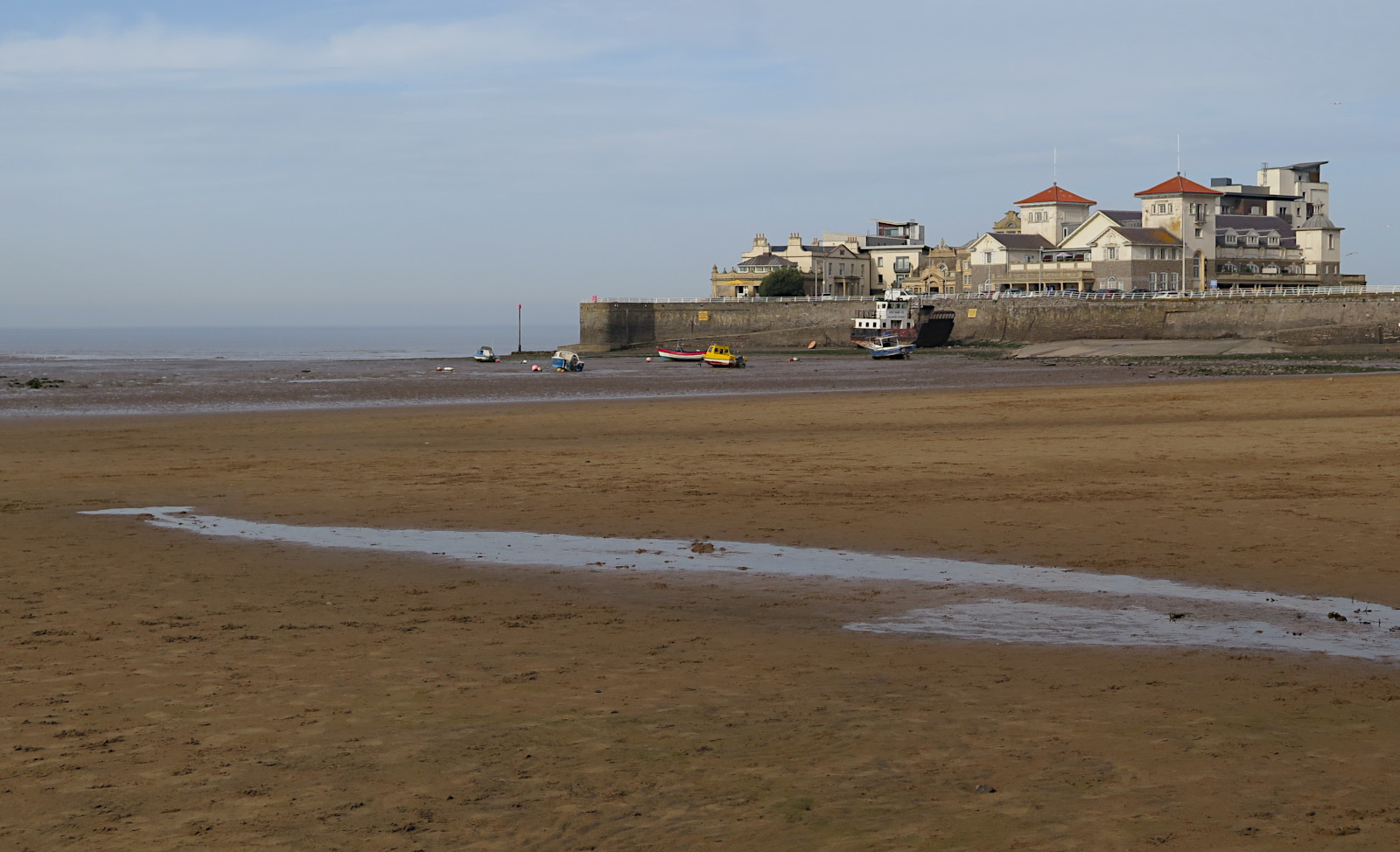
Knightstone Causeway

The largest boat you can see is the Steep Holm Ferry. It makes return trips out to Steep Holm island with a stay of ten to twelve hours, and basically it’s the only way to get there unless you have your own seaworthy vessel.

< Previous | Index | Next >

Image 132 – What’s in an image? Sometimes quite a lot, more than meets the eye. I’m posting an image every day or so.

Click to enlarge

The beach in the photo is at Weston-super-Mare. Beyond it is Knightstone Harbour with boats high and dry because the tide is partly out. And beyond the harbour and the causeway you can see the buildings including Dr Fox’s Tearoom, Knightstone baths, Stones Cafe, and Knightstone Opera House. When we’re in Weston, Donna and I sometimes enjoy breakfast at Stones.

Originally it must have been a sandbank jutting out towards the Severn Estuary, perhaps with a backbone of exposed rock. Today it’s been built up and would barely be recognisable to the local people of two hundred years ago.

The largest boat you can see is the Steep Holm Ferry. It makes return trips out to Steep Holm island with a stay of ten to twelve hours, and basically it’s the only way to get there unless you have your own seaworthy vessel. The water here can’t make up its mind whether it’s the River Severn estuary or the North Somerset coast. It’s sixteen or so kilometres wide, in terms of weather and water conditions it can be treacherous.

See also:

< Previous | Index | Next >

Useful? Interesting?

If you enjoyed this or found it useful, please like, comment, and share below. (If you don’t see those links, click the article’s title above the main photo and they will appear.) Send a link to friends who might enjoy the article or benefit from it – Thanks! My material is free to reuse (see conditions), but a coffee is always welcome and encourages me to write more often!

Comet G3 (Atlas)

[This] image featured in NASA’s Astronomy Picture of the Day for 25th January 2025. Visit the website and have a browse around, there are so many fine images here!

< Previous | Index | Next >

Image 131 – What’s in an image? Sometimes quite a lot, more than meets the eye. I’m posting an image every day or so.

Enlarge
(NASA)

This might be the most striking photo you’ll ever see of a comet. OK, I dare say there will be better images out there, but this one is still pretty amazing.

The image featured in NASA’s Astronomy Picture of the Day for 25th January 2025. Visit the website and have a browse around, there are so many fine images here!

If you look closely (click the thumbnail and expand it as far as it will go) you’ll see plenty of stars in the image, too. Of course, they are way, way in the background far beyond the Solar System whereas the comet is right here inside the system along with the Sun, Planets, Moon, me and you.

See also:

< Previous | Index | Next >

Useful? Interesting?

If you enjoyed this or found it useful, please like, comment, and share below. (If you don’t see those links, click the article’s title above the main photo and they will appear.) Send a link to friends who might enjoy the article or benefit from it – Thanks! My material is free to reuse (see conditions), but a coffee is always welcome and encourages me to write more often!

Lichens

Lichens are the main food source for a variety of animal species from small mites and insects to the remarkably large reindeer. They tend to be protein-poor but may be rich in carbohydrates.

< Previous | Index | Next >

Image 130 – What’s in an image? Sometimes quite a lot, more than meets the eye. I’m posting an image every day or so.

Enlarge

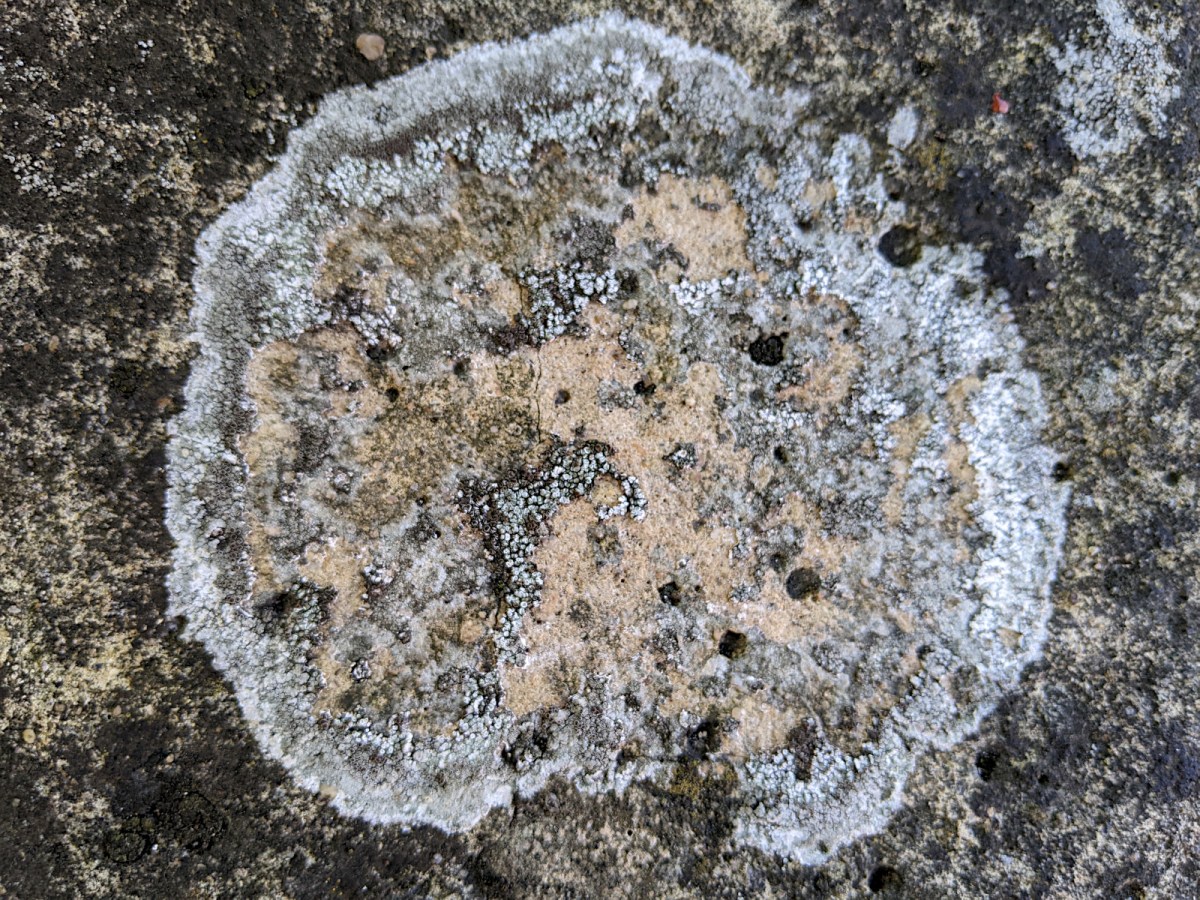
Lichens are amazing. They’re always small, they grow in slowly expanding colonies, and they consist of cooperating fungi and algae. A number of different species of fungi can grow like this, combined with various yeasts and bacteria. The assemblage often looks like a simple plant, often almost flat, but sometimes filamentous, branching or in the form of flakes. Circular forms like the one in the image are common. The Wikipedia article listed below has photos of a range of different forms.

The grey colony in the photo has grown out from the centre ‘cleaning’ other life forms from the surface of the underlying limestone and spreading out further around the perimeter. The black lichen was destroyed as the grey lichen crossed over it, but new colonies of the black lichen have established on the clean rock left behind. The situation is dynamic, but very slow. Return for another photo a month later and little will have changed.

Lichens are the main food source for a variety of animal species from small mites and insects to the remarkably large reindeer. They tend to be protein-poor but may be rich in carbohydrates.

See also:

< Previous | Index | Next >

Useful? Interesting?

If you enjoyed this or found it useful, please like, comment, and share below. (If you don’t see those links, click the article’s title above the main photo and they will appear.) Send a link to friends who might enjoy the article or benefit from it – Thanks! My material is free to reuse (see conditions), but a coffee is always welcome and encourages me to write more often!
Really?

Professor J P Hudson offered a prize to anyone who could submit a paper for publication without … a spelling mistake, or a punctuation error, or an unclear phrase. And I don’t think he ever had to pay out the prize.

< Previous | Index | Next >

Image 129 – What’s in an image? Sometimes quite a lot, more than meets the eye. I’m posting an image every day or so.

Enlarge

I was amused when I saw this in a local shop window a couple of years ago. Sometimes we’re not quite as good with words as we should be, and right at the start I admit that I’m just as bad as anyone else. But this one did give me a chuckle. It just begs the question,

‘So.. er… What would unconscious eating be, exactly?’

Just my silly sense of fun!

I think what happens, ever so easily, is that I word something in a way that’s not clear and then cannot, myself, spot the issue. It needs a fresh eye, a fresh mind to spot mistakes like this.

When I worked at Long Ashton Research Station in the 1970s, the Director, Professor J P Hudson, offered a prize to anyone who could submit a paper for publication without him spotting a spelling mistake, or a punctuation error, or an unclear phrase. And I don’t think he ever had to pay out the prize (£5 I think, quite a lot in those days).

Sometimes we need to see what we have written from a new perspective in order to fix or avoid simple mistakes. And sometimes we need the same fresh look at our habits, likes and dislikes, relationships with others, understanding of science, what we believe about the world, the people we meet, and not least, what we believe to be true about spiritual things.

It’s far too easy to go along familiar pathways in our lives without seeing the need to question what we think and say and do.

When: 25th September 2023
Where: Cirencester

See also:

< Previous | Index | Next >

Useful? Interesting?

If you enjoyed this or found it useful, please like, comment, and share below. (If you don’t see those links, click the article’s title above the main photo and they will appear.) Send a link to friends who might enjoy the article or benefit from it – Thanks! My material is free to reuse (see conditions), but a coffee is always welcome and encourages me to write more often!

A quarter of a million miles

The horizon is, perhaps, 2 km away, you can see buildings and trees out there, they give a good clue to scale. Some of the clouds might be a bit further away.

< Previous | Index | Next >

Image 128 – What’s in an image? Sometimes quite a lot, more than meets the eye. I’m posting an image every day or so.

Enlarge

This is a view of the local neighbourhood, you can only see a short distance – little more than 380 000 km or about 250 000 miles.

Uh?!

Can you see why I wrote about seeing 380 000 km? Is there something you missed in the photo? Look more closely…

The horizon is, perhaps, 2 km away, you can see buildings and trees out there, they give a good clue to scale. Some of the clouds might be a bit further away. But that little white dot near the centre of the photo is the Moon, the furthest thing you can see in this picture.

The scale of our universe is nothing short of astonishing! The Moon is just our nearest neighbour in terms of the Solar System. All of the other planets are much, much further away than our friendly little Moon. Then consider that the entire Solar System is just a little speck in terms of our galaxy, The Milky Way. And if you travelled the Milky Way from end to end you’d still have seen only a very, very, very insignificant fraction of everything else that’s out there. My goodness this is a big place!

If you want to get a feel for this, try Scale of the Universe. It starts with things of everyday size and you can slide left (smaller) or right (larger).

When: 10th September 2025
Where: Cirencester

See also:

< Previous | Index | Next >

Useful? Interesting?

If you enjoyed this or found it useful, please like, comment, and share below. (If you don’t see those links, click the article’s title above the main photo and they will appear.) Send a link to friends who might enjoy the article or benefit from it – Thanks! My material is free to reuse (see conditions), but a coffee is always welcome and encourages me to write more often!