Image of the day – 62

In the uneasy relationship between abbey and town, the town had the last laugh when Henry VIII dissolved the abbey.

< Previous | Index | Next >

What’s in an image? Sometimes quite a lot, more than meets the eye.

I’m posting an image every two days (or as often as I can). A photo, an image from the internet, a diagram or a map. Whatever takes my fancy.

Click to enlarge

This is the porch of Cirencester’s Parish Church, St John the Baptist. It’s used as the main south entrance into the Church, and the door on the north side is also usually open, but the main West Door is kept closed and bolted. A three storey porch is a rarity, and in fact the two upper floors were once used as the Town Hall. But it seems the porch was built by the nearby Abbey as administrative offices and only attached to the Parish Church after the Abbey was dissolved.

This image shows the front detail, but I’ll post another photo soon showing the entire building. The architecture is interesting, with carved animals both real and imaginary, and niches for statues, now empty.

I think there’s something we can learn from this. There was an uneasy rivalry between the Abbott and the townspeople in medieval times. It’s thought that Cirencester was given a royal charter at one time, but the Abbot got hold of it somehow and destroyed it. Building the administrative centre right in front of the Parish Church makes me wonder about the motives involved in that, as well. Maybe there are other explanations I’m not aware of.

But we should always strive to get on well with those around us. It takes two to argue, but it also takes two to agree and agreement is usually better in the long run. In the uneasy relationship between abbey and town, the town had the last laugh when Henry VIII dissolved the abbey. And the town used the building in the picture and later gave it to the church to be added to the structure as perhaps the grandest church porch in all England!

Cirencester

For convenience, here’s a list of all the Cirencester area images:

A417 roadworks, Advent Market, Bishops Walk, Baunton, Canal 1, 2, Castle Street, Christmas lights 1, 2, Church 1, 2, 3, 4, 5, 6, Churn flood, Countryside, Fallen tree, Fleece, Gasworks, Gloucester Street, Hare 1, 2, Hospital, Market Place 1, Phoenix Fest, Riverside Walk, Stone plaque, Stratton Meadow, Tank traps, View, Wonky 1, 2, Yellow Iris

Themed image collections

The links below will take you to the first post in each collection

Cirencester, Favourites, Irish holiday 2024, Roman villa

< Previous | Index | Next >

Useful? Interesting?

If you enjoyed this or found it useful, please like, comment, and share below. Send a link to friends who might enjoy the article or benefit from it – Thanks! My material is free to reuse (see conditions), but a coffee is always welcome and encourages me to write more often!

Living in the presence

To come away with a shining face you must first go into the place where the glory is, you must stand face-to-face with the One who is the Presence.

Reading Chris Dryden’s ‘Concepts’ post, I was aware that I should write about how Father deals with me face to face. He always does this when I’m least expecting it, but I always know it’s him.

When I was a child, back in the 1950s and early ’60s, I had one or two luminous toys, and later a luminous watch. I never tired of holding these up to the light at night time and then turning the light off and watching the weird, greenish glow fade slowly over the next few minutes.

Some background
The Orrery
(Wikimedia)

Let’s begin by setting the scene. Here I was, married and with an infant daughter, living in a very modest house in a very modest street, Judy and I had to be careful with the little money we had. Second hand everything, no car, riding my bike to work. A very typical story in the early years of married life. We were friends with another couple just a street away and had been meeting with them to read the Bible, pray together, and explore what the Holy Spirit was doing at that time in our area. They were Anglicans, we were from the Evangelical chapel at the far end of the village, but differences like that seemed utterly irrelevant.

On one particular evening as we were praying, a picture came into my mind. We were children, playing with bricks from large piles stacked on the ground. We were making little houses with them, walls of a few bricks with a gap for a doorway, another gap for a window and a few more bricks balanced on the top for a roof. We’d made several of these tiny ‘houses’ when the builder arrived on the scene.

He strode towards us through the mud and puddles and looked down at us. We thought he’d be cross so we jumped up to run away; if we ran in different directions we might all get away! But he smiled down at us and said,

‘I’m here to build a real house. If you scatter the bricks around, it’ll slow down my work, but if you bring the bricks to where I’m working, you’ll save me time and the house will be finished sooner’. So we did exactly that, we ran around collecting bricks and stacking them at his feet, while he got on with the work of building the house. And up it went, it was magnificent.

What we understood from this

I shared this ‘picture’ with my friends, Tony and Faith. And we could all see what it meant right away. The house is the church – not Anglican, not Evangelical, just the church. And the bricks were people – us, our friends, anyone we could bring into the builder’s presence. And the builder, of course, was Jesus. He is the one who said, ‘I will build my church’. And what resulted over the next few years was that a number of people including us (the living stones) were built into something very special indeed. It was a body pulsing with spiritual life and energy, especially when we met, but overflowing into the world around us too. I can say that for me, having this foundation and experience changed how I viewed my life more generally – at work, at home, with my parents, with friends, with family.

So don’t build structures with the people who belong to Jesus, but assist him as he directs and builds. Chris Dryden, writing on his site Life with CD, wrote recently about Moses speaking face-to-face with Yahweh. Maybe you should read his post and then come back here afterwards…

For 40 days – Day 8: Covenant Renewed: Concepts

…Reading the concepts article sparked a new thought in my mind. All those years ago in the mid 1970s I’d had face-to-face conversations with Father through the presence of his Spirit! That describes the way it felt (and still does).

Moses in the Presence

Chris Dryden wrote about Moses and the conversations he had with Yahweh, face-to-face, created-to-creator, follower-to-leader. That was a mighty privilege; it still is! And it left Moses with a glow on his face (and I imagine, a glow in his heart as well). Do I have a glow on my face after conversing with Jesus through the power and presence of his Spirit? Yes, I think I do. The connection and the conversation leave me changed in a way that people can see. Not a visible glowing, but a glowing heart and a face that relaxes and smiles in a new way as I describe the revelation to those around me. Really, I suppose, an awestruck and amazed face!

Have you witnessed the glowing hearts and faces of people who’ve been in the Presence, in conversation with the King of Kings? If you’ve spent time in meetings when the Holy Spirit is allowed in and there are prophesies and pictures and singing and dancing and arms raised – then yes, I bet you’ve seen those shining faces! There is nothing to beat face-to-face time. That’s true with family, with friends, and it’s true with Jesus as well. We come away encouraged, lifted up, newly informed – there is nothing like being in the Presence. We all come away with shining faces, you bet we do!

But, just like Moses, to come away with a shining face you must first go into the place where the glory is, you must stand face-to-face with the One who is the Presence. The Shekinah Glory is his and his alone. Our faces shine with an absorbed light, just like those luminous toys.

But what is even more precious is that going about, living my ordinary life, the Spirit often surprises me. I see something, hear something, think something, and suddenly in that moment I realise there’s a spark from him. He speaks face-to-face with me without any effort on my part. He lives within me even when I’m unaware!

Useful? Interesting?

If you enjoyed this or found it useful, please like, comment, and share below. Send a link to friends who might enjoy the article or benefit from it – Thanks! My material is free to reuse (see conditions), but a coffee is always welcome and encourages me to write more often!

Image of the day – 61

The good news is that the canal is being restored and is already in water again through Stroud.

< Previous | Index | Next >

What’s in an image? Sometimes quite a lot, more than meets the eye.

I’m posting an image every two days (or as often as I can). A photo, an image from the internet, a diagram or a map. Whatever takes my fancy.

Siddington canal bridge

Cirencester and its surroundings have changed dramatically over the years. This old bridge in Siddington takes a country lane over the old Thames and Severn canal. Although the canal is derelict, looking down from the bridge you get a clear view of the ladder of locks that used to be here. The good news is that the canal is being restored and is already in water again through Stroud. It will be reconnected to the national canal network within the next three years or so. Work has also started at the Cotswold water park, repairing the section from the spine road to Latton, and in Lechlade where it joins the Thames.

Sadly, there is no plan to restore any part of the Cirencester Arm of the canal, but it’s possible to trace the route of the towpath almost the entire way from Siddington to the bottom of Querns Hill where Cirencester Wharf used to see the loading and unloading of cargo.

Cirencester

For convenience, here’s a list of all the Cirencester area images:

A417 roadworks, Advent Market, Bishops Walk, Baunton, Canal 1, 2, Castle Street, Christmas lights 1, 2, Church 1, 2, 3, 4, 5, 6, Churn flood, Countryside, Fallen tree, Fleece, Gasworks, Gloucester Street, Hare 1, 2, Hospital, Market Place 1, Phoenix Fest, Riverside Walk, Stone plaque, Stratton Meadow, Tank traps, View, Wonky 1, 2, Yellow Iris

Themed image collections

The links below will take you to the first post in each collection

Cirencester, Favourites, Irish holiday 2024, Roman villa

< Previous | Index | Next >

Useful? Interesting?

If you enjoyed this or found it useful, please like, comment, and share below. Send a link to friends who might enjoy the article or benefit from it – Thanks! My material is free to reuse (see conditions), but a coffee is always welcome and encourages me to write more often!

How life begins

The gap has been closing little by little from both the astronomical and biological sides. But though it’s narrower now than ever before, it’s still a gap.

How did life begin? It seems possible, even very likely, that simple chemistry has the potential to generate life given the right conditions and plenty of time.

There’s always been a big puzzle over the origin of life here on Earth. Life is everywhere and in a vast array of forms. From the simplest archaea and bacteria, to the giant redwood and the humble grass in the field, the blue whale down to the smallest mite. So rich in variety, so wide in its presence from the deepest oceans to the highest mountains. Life is amazing!

The processes of evolution are well understood and impossible to deny; so puzzles over the many forms of life, its adaptability, and changes in the forms we see coming and going over deep time are clearly understood and well explained by biologists. (When did you last see a dinosaur?)

But how did it all start?

Ah! That has always been the unexplained mystery. Once we have a simple, replicating form of life on the planet we can see it might thrive, spread and grow in complexity.

There are various proposals. Perhaps it arrived in an asteroid kicked off Mars or somewhere else. But that does no more than move the origin to a different place in the Solar System. Maybe it all began at mid-ocean ridges where hot mineral-laden springs flow from hot rock layers below the surface. Perhaps, yes.

We know that many of the precursors for life exist out among the stars. Here in the Solar System, comets and asteroids are often richly endowed with amino acids, ribonucleotides, and all sorts of smaller precursors. These are the building blocks of proteins, RNA, DNA and so forth. We understand how these precursors can form spontaneously given simpler materials like water, methane, ammonia, compounds including atoms of phosphorus, sulphur and so forth. It just takes chance interactions, time, and a source of energy like ultraviolet light. The basic ingredients are there in the gas clouds that condense to form new stars and the material orbiting in disks around them.

All of these things are fairly well understood, but there’s a gap in our understanding between the presence of the components and the presence of life. The gap has been closing little by little from both the astronomical and biological sides. But though it’s narrower now than ever before, it’s still a gap.

Life in a computer?

Well, yes! And, no.

Some clever work by Blaise Agüera y Arcas, a Google vice-president of engineering, has uncovered an intriguing process. Setting a very simple ‘machine’ running random code (no meaningful program whatsoever) and waiting for something to happen, shows that eventually some very simple self-replicating code will appear in the system, and once it exists it replicates very quickly and then slowly increases in complexity. It’s not biological life of course, but it has all the qualities that we would recognise as lifelike. It replicates itself, different forms of replicating code compete with one another, they evolve, and they grow more and more complex. This doesn’t show us in any detail how biological forms got started, but it demonstrates that self-replication could happen in principle, and given enough time that it’s almost inevitable.

For the detail and background you should listen to Sean Carroll interviewing Blaise, the conversation is absolutely fascinating.

See also:

Useful? Interesting?

If you enjoyed this or found it useful, please like, comment, and share below. Send a link to friends who might enjoy the article or benefit from it – Thanks! My material is free to reuse (see conditions), but a coffee is always welcome and encourages me to write more often!
Image of the day – 60

Other species…include red kites, you’ll see these frequently in the skies around Cirencester, often flying very low, even over housing estates.

< Previous | Index | Next >

What’s in an image? Sometimes quite a lot, more than meets the eye.

I’m posting an image every two days (or as often as I can). A photo, an image from the internet, a diagram or a map. Whatever takes my fancy.

Yellow flag Iris

These beautiful, water tolerant, native Irises pop up every year in the waterways in and around Cirencester. The photo was taken at the junction of Riverside Walk and Gloucester Street right by Abbey Way Services. The photo was taken in May, just as they were reaching their best.

Although our natural environment is struggling to cope with the many pressures we put on it, some species manage to do quite well. This is one of them. But there are many others that are in danger. Some of these, plants and animals, are fairly stable or even recovering in and around the Cirencester area with careful conservation management. Examples include the lovely snakeshead fritillaries that flower abundantly in North Meadow just south of Cricklade, pasqueflowers in a strong colony to the north of the town near the Stow Road, and the large blue butterfly on a reserve west of the town and on common land near Stroud.

Other species, once rare but now much more common include red kites, you’ll see these frequently in the skies around Cirencester, often flying very low, even over housing estates. Back along Riverside Walk you may be lucky enough to see a heron, a kingfisher, or a little egret.

Cirencester

For convenience, here’s a list of all the Cirencester area images:

A417 roadworks, Advent Market, Bishops Walk, Baunton, Canal 1, 2, Castle Street, Christmas lights 1, 2, Church 1, 2, 3, 4, 5, 6, Churn flood, Countryside, Fallen tree, Fleece, Gasworks, Gloucester Street, Hare 1, 2, Hospital, Market Place 1, Phoenix Fest, Riverside Walk, Stone plaque, Stratton Meadow, Tank traps, View, Wonky 1, 2, Yellow Iris

Themed image collections

The links below will take you to the first post in each collection

Cirencester, Favourites, Irish holiday 2024, Roman villa

< Previous | Index | Next >

Useful? Interesting?

If you enjoyed this or found it useful, please like, comment, and share below. Send a link to friends who might enjoy the article or benefit from it – Thanks! My material is free to reuse (see conditions), but a coffee is always welcome and encourages me to write more often!
A moving story

After finishing her education and working in management roles at a number of major companies in Pakistan, Sabeeta still had the continual feeling of background obstacles and pressures because of her faith.

Here, in brief, is the story of Sabeeta, beginning in Pakistan as a child with an awareness that she and her family were not entirely acceptable and eventually moving to the UK with her husband.

From Qayyumabad
Pakistan to UK

Sabeeta Mushtaq writes about her life in Pakistan where she lived in constant awareness that as a Christian in a Muslim culture, she was seen as a misfit in her country of birth. It’s difficult for many of us here in the UK to imagine what this must be like. Though regrettably, some people living in Britain with non-UK backgrounds might feel related tensions and anxieties.

After finishing her education and working in management roles at a number of major companies in Pakistan, Sabeeta still had the continual feeling of background obstacles and pressures because of her faith. Later still she married a British citizen and after a few more years they made the decision to move to the UK…

To London

…arriving in the difficult early days of COVID.

Eventually she found friends and a spiritual home in a London Anglican congregation and has now become a Lay Deacon. I like her closing sentence and quote it here in full:

My journey, though filled with obstacles, has strengthened my belief that God’s plan for us unfolds in ways we cannot always foresee, but in the end, it is always for a greater purpose.

All of us are on our own, individual journeys, with or without Jesus. And in my opinion, far better with than without! Read Sabeeta’s full story at Anglicanism.org.

Useful? Interesting?

If you enjoyed this or found it useful, please like, comment, and share below. Send a link to friends who might enjoy the article or benefit from it – Thanks! My material is free to reuse (see conditions), but a coffee is always welcome and encourages me to write more often!
Image of the day – 59

If you could visit the Market Place in 1500 you would struggle to recognise anything other than the Parish Church.

< Previous | Index | Next >

What’s in an image? Sometimes quite a lot, more than meets the eye.

I’m posting an image every two days (or as often as I can). A photo, an image from the internet, a diagram or a map. Whatever takes my fancy.

Christmas lights

This is Cirencester Market Place on 5th January 2021, still in its decorated-for-Christmas state. In the 17th century this space was full of buildings and narrow streets. Roughly where the red car stands, imagine an old inn with a street either side, and beyond it two rows of buildings, Butter Row and Butcher’s Row, so three streets at that point. Many old buildings were destroyed in town improvement schemes over the years. If they still existed today they would attract preservation orders.

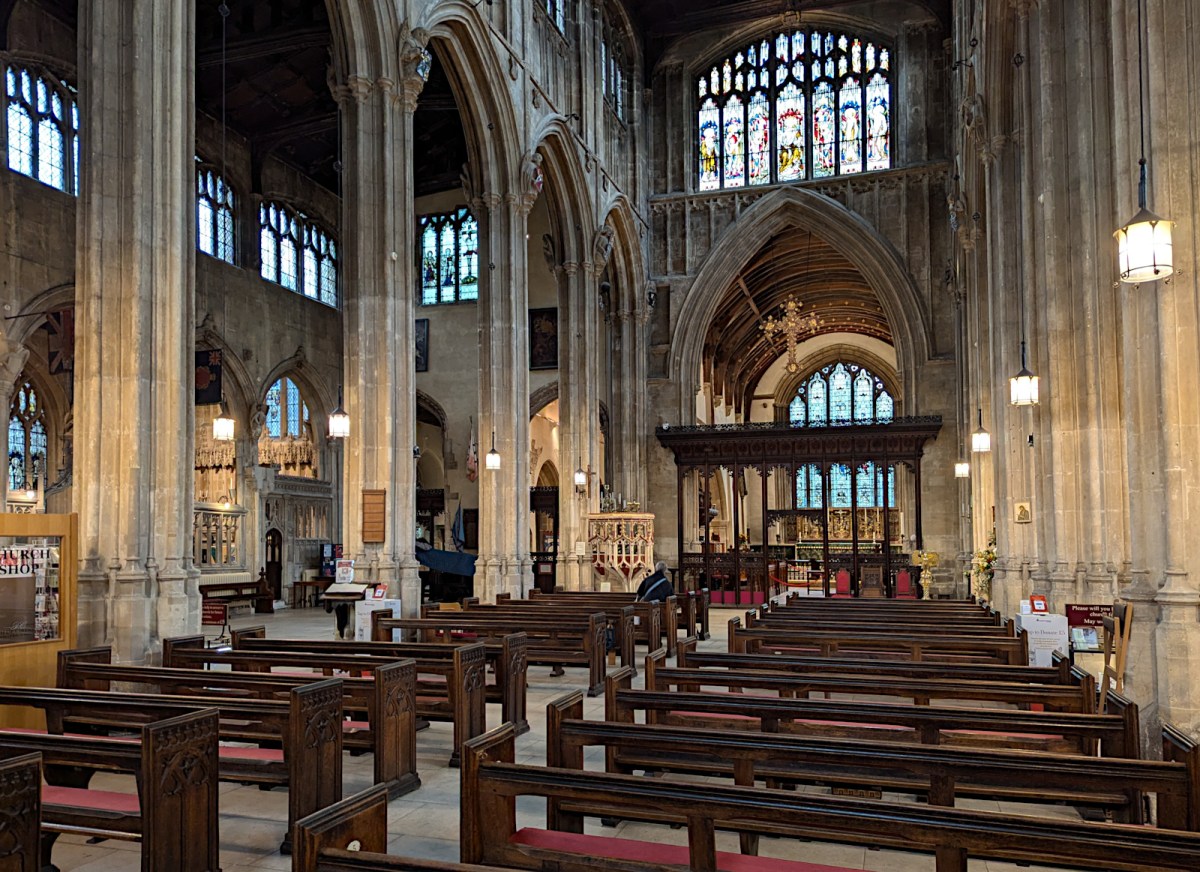
If you could visit the Market Place in 1500 you would struggle to recognise anything other than the Parish Church. All the fine, Cotswold stone buildings were constructed more recently than that, the shops and dwellings at that time would have been timber framed with overhanging upstairs floors. The entire look and feel of the place would be different. At that time the Abbey was thriving with the Abbey Church behind the existing Parish Church. The entirety of what is now the Abbey Grounds would have been busy with monks on errands and at work in the gardens, at the fishing lake (still there today), in the mill and bakery and so much more. It was almost a walled town within a town.

In the year 1000, shortly before the Norman invasion, some of Saxon Cirencester may still have been outside the old Roman walls, but there was a Saxon church in the area of the Abbey Grounds and it’s likely that other parts of the Roman City would have been cleared and put to use.

And in the year 500 the Romans had left only 100 years earlier. The city would have been more or less intact, but derelict. Initially, Saxon settlers lived outside the old city walls. Some of those walls would still have been standing, at least in places, and the larger buildings inside the city would have been identifiable – the Basilica, the Forum, and probably Baths and a Theatre (now lost). The Saxons built timber framed houses and farms initially outside the walls. Piles of rubble and stone, no doubt ridden with extensive and impenetrable growths of brambles and trees, would have seemed far less useful than the arable land outside the old walls.

Go back another five hundred years and the area where the town now stands consisted of a flood plain with low gravel banks and the River Churn meandering through. There would have been yellow iris, water mint, alder and willow in wetter areas with other trees on higher ground. The waterways would have been easily forded and the local Dobunni people likely fished in the area and farmed on higher ground nearby. The Roman army constructed the Fosse Way from Exeter to Lincoln and built a timber fort in the eastern part of modern Cirencester. It’s likely that a trading settlement grew up near the fort and the town was officially recognised in 75 CE. By the later Roman period it had become the second largest city in Britain (London was the largest).

All of this took place in and around the area we know today as Cirencester Market Place.

Cirencester

For convenience, here’s a list of all the Cirencester area images:

A417 roadworks, Advent Market, Bishops Walk, Baunton, Canal 1, 2, Castle Street, Christmas lights 1, 2, Church 1, 2, 3, 4, 5, 6, Churn flood, Countryside, Fallen tree, Fleece, Gasworks, Gloucester Street, Hare 1, 2, Hospital, Market Place 1, Phoenix Fest, Riverside Walk, Stone plaque, Stratton Meadow, Tank traps, View, Wonky 1, 2, Yellow Iris

Themed image collections

The links below will take you to the first post in each collection

Cirencester, Favourites, Irish holiday 2024, Roman villa

< Previous | Index | Next >

Useful? Interesting?

If you enjoyed this or found it useful, please like, comment, and share below. Send a link to friends who might enjoy the article or benefit from it – Thanks! My material is free to reuse (see conditions), but a coffee is always welcome and encourages me to write more often!

Managing old family photos

Images fade, especially if exposed to light, they are susceptible to damage by fire, water, mechanical action and so forth.

For some years now I’ve been transferring family photos, videos and documents to digital storage in an attempt to preserve the information. There are pros and cons to both physical storage and digital storage and we’ll discuss those in this article.

But first, lets take a look at an example photo.

An old photo from my collection – May 1969

The image above is from a 35 mm transparency. It shows my fellow students on the Bath University Horticulture degree course the year before we graduated. We were visiting a commercial horticultural business and there’s a TV personality in the image as well. (One of our lecturers, Peter Thoday, later became well known as the narrator in the TV series, The Victorian Kitchen Garden. He’s at the back of the group on the right in the photo, tall and with very dark hair.)

Details of the photos and how I manage them

Quite a few of the old photos I have are colour transparencies; these come in different sizes depending on the type of camera and film that were used. The majority are on 35 mm film stock, with sprocket holes along two sides; these engage with the film transport mechanism in the camera. After the film was processed and dried it was cut into individual frames and mounted in card or plastic frames. My film scanner can handle mounted and unmounted slides and saves them as digital image files.

Once I have the images in digital format I remove slides from their frames and check the frame numbers exposed on the film when it was manufactured. This makes it easy to get the slides into correct sequence as they may have been reordered accidentally or even deliberately when they were projected in the past. Having confidence that the photos are correctly in sequence makes it much more likely that I can eventually arrange the films into longer sequences based on events, people and places in the images. This is a work of reconstruction, sometimes easy, sometimes very difficult. I keep notes of what I have done and why, for my own reference and for anyone else who might find the information useful later. I’ve got better at doing this with experience.

Advantages and disadvantages of physical storage

The original negatives and transparencies contain more information than digital copies. For one thing, the dynamic range is greater and the resolution is always going to be a little higher. Scanning processes are very good indeed these days, but they’ll never be absolutely perfect.

On the other hand, originals deteriorate over long time periods. Images fade, especially if exposed to light, they are susceptible to damage by fire, water, mechanical action and so forth. And as each image is unique, if it’s lost or damaged there is no way to recover it.

And two final points – storing negatives, transparencies and prints takes a lot of space, more and more as the numbers increase. And viewing them becomes an issue, only a few people can view them at a time.

Advantages and disadvantages of digital storage

Digital copies of the images can be almost as good as the originals for most purposes, and digital processing can improve colours and remove blemishes when the originals are faded, scratched or have dust that is strongly attached to the surface. In these cases, the digital copy may be more acceptable than the original.

Digital storage is increasingly cheap and capacious, so a very large collection of photos can be stored on a cheap, tiny SD card. This in turn makes it possible to have multiple copies in multiple locations, providing security far beyond anything possible with the originals. Remote storage on Dropbox or similar facilities takes this a step further. Multiple copies and remote storage both make it possible for many people to be able to view the images independently and from wherever they happen to be.

Perhaps the biggest downside of digital storage is the need to constantly move images from old storage media to newer technology. How many of us have devices to read data from a floppy disk or an old CD? Remote storage helps again because the company offering the service takes on the task of managing data storage and retrieval and moving to newer technologies whenever necessary.

And there’s a hidden factor here too, the images need to be stored in a file format that is still readable on current devices. JPG and PNG are widely used and may be readable by future devices for a very long time, but nothing is certain and it may become necessary to re-save the images in a different file format in future. This would be a major task for a large image collection.

My approach to all this

I’ve thought about this a lot. Currently, everything is stored in high quality JPG format. Yes, I know there are very slight compression artefacts in JPG, but unless the images are repeatedly edited and re-saved this is not an issue in practical terms. I use an Epson Perfection V600 Photo scanner which for me is a good compromise between quality and price. The images are stored initially on my laptop and automatically to Dropbox, and I back up my laptop on an external hard drive at intervals. Other members of the family have their own copies of some of the data, though keeping this refreshed has been a problem.

Something I have not yet fully resolved is what happens when I’m no longer able to manage all this data. Of course, at that point the future of the images will no longer be of personal interest. Nonetheless, I’d like to have some kind of plan in place, perhaps handing on access to my Dropbox account would be a good way forward.

See also

Useful? Interesting?

If you enjoyed this or found it useful, please like, comment, and share below. Send a link to friends who might enjoy the article or benefit from it – Thanks! My material is free to reuse (see conditions), but a coffee is always welcome and encourages me to write more often!

Image of the day – 58

In the New Testament flames flicker on the heads of the believers when the Spirit falls on them in the upper room where they’re meeting.

< Previous | Index | Next >

What’s in an image? Sometimes quite a lot, more than meets the eye.

I’m posting an image every two days (or as often as I can). A photo, an image from the internet, a diagram or a map. Whatever takes my fancy.

Warmth from a fire

Fire is both beneficial and dangerous. There’s nothing better than a nicely controlled fire in the living room on a cold January day; but there are few things worse than an out-of-control fire consuming your entire home! Even if the fire brigade arrives quickly and manages to save the house, they will do so by pouring hundreds or thousands of litres of water into your home. What is saved from burning will be wrecked by water.

If you read the Bible you’ll soon understand that the Holy Spirit is sometimes described as fire. The Old Testament describes Isaiah as being touched on the lips by fire. Ouch! (Though he comes to no harm.) And in the New Testament flames flicker on the heads of the believers when the Spirit falls on them in the upper room where they’re meeting in Jerusalem. (Again, they come to no harm.)

But both Isaiah and the believers in the upper room are changed, they are changed at a fundamental level and they are changed permanently. So let me just add that the Holy Spirit is the Spirit of Christ, he is the very nature of Jesus, he is a person, one of the three who live together in complete harmony – the Father, the Son (Jesus), and their Spirit. It’s not possible to know any of them without being changed fundamentally and permanently. And when I say ‘know’ I imply more than some casual meeting. If you get to know any one of them you will soon realise that you know all three.

My only advice is not to be put off by the idea of fire, yes it’s dangerous, but life itself is dangerous. Living a normal life in this world always leads to death, for nobody lives for ever. If you reach 100 you are doing really, really well. But seek first the heavenly things, welcome the fundamental and permanent change. It’s nothing to be afraid of.

How to begin? Find out about the life of Jesus. Read one of the gospels, they were specifically written about him. If you don’t know where to start, try reading Mark. If you want to see my thoughts along the way, you can join me in Cruising the Gospel.

Themed image collections

The links below will take you to the first post in each collection

Cirencester, Favourites, Irish holiday 2024, Roman villa

< Previous | Index | Next >

Useful? Interesting?

If you enjoyed this or found it useful, please like, comment, and share below. Send a link to friends who might enjoy the article or benefit from it – Thanks! My material is free to reuse (see conditions), but a coffee is always welcome and encourages me to write more often!
DaManCD

Articles that dig deep into where we are going, why, and how, what is expected of us, our fears, hopes, failures, successes.

This is a quick heads up for my readers, a mention of another website you might like to take a look at.

Chris Dryden’s website

There are a multitude of websites out there, often on very specific topics, so many that there’s something for absolutely everyone. So many that it can be hard to find what you need. My online friend DaManCD (aka Chris Dryden) runs one of them, and I run another. We’ve been aware of one another since we both contributed a chapter in a collaborative book, and we’ve interacted from time to time over the years, especially recently (though we’ve never actually met).

Chris’s website is called Life with CD and it’s well worth a visit. Chris draws on his life experience as a follower of Jesus to produce articles that dig deep into where we are going, why, and how, what is expected of us, our fears, hopes, failures, successes. His focus is always on the King who leads us. Why not take a look at a recent article starting a great series on the theme of 40 days?

Useful? Interesting?

If you enjoyed this or found it useful, please like, comment, and share below. Send a link to friends who might enjoy the article or benefit from it – Thanks! My material is free to reuse (see conditions), but a coffee is always welcome and encourages me to write more often!