Image 102 – What’s in an image? Sometimes quite a lot, more than meets the eye. I’m posting an image every day or so.
Larger view
Hen Brook is a very small tributary stream that flows into the River Great Ouse in St Neots, Cambridgshire. We lived in St Neots for years before moving to Cirencester in 2017.
Walking just 100 metres or so from this point, Hen Brook really is tiny, but the final stretch before it enters the river was widened and deepened so that barges could reach the point in the town where much of the industry was in Victorian times. Today it remains navigable, as does the river itself. There’s an area for private boats around this area, and a yacht marina further downstream on the river itself. This was such a peaceful view that I just had to take a photo to remember it by, and years later I’m very glad I did. I hope you will like the composition as much as I do.
When: Summer 2010 (ish) Where: St Neots, Cambridgeshire
Favourites
For convenience, here’s a list of my favourite images:
If you enjoyed this or found it useful, please like, comment, and share below. (If you don’t see those links, click the article’s title above the main photo and they will appear.) Send a link to friends who might enjoy the article or benefit from it – Thanks! My material is free to reuse (see conditions), but a coffee is always welcome and encourages me to write more often!
The news headlines are covering all kinds of world issues – the Russo-Ukrainian war, the revolution in Syria, Donald Trump’s coming second term in the White House, world economics, and more.
But there’s an event going on of far greater importance than any of those other issues, and that concerns the latest results of research into Antarctic sea-ice.
The problem? It’s melting much faster than we thought.
And why is that such a big deal? Because of the implications that global warming is progressing so much faster than we realised, combined with the potential loss of ice shelves, one and a half metres of sea-level rise far sooner than we expected, and the further potential for catastrophic sea level rises much, much greater than that.
That’s alarming in anyone’s book. But it’s not alarmist, it’s just stating an unpalatable truth. The time to begin thinking about consequences and mitigation is now, not in ten or twenty years time. And it’s most certainly way past time to deny that climate change is a thing at all.
I urge you to listen to the New Scientist podcast on this, episode 279 released on 6th December 2024. It has all the details.
Useful? Interesting?
If you enjoyed this or found it useful, please like, comment, and share below. (If you don’t see those links, click the article’s title above the main photo and they will appear.) Send a link to friends who might enjoy the article or benefit from it – Thanks! My material is free to reuse (see conditions), but a coffee is always welcome and encourages me to write more often!
I really like Lariana’s drawings and paintings, as time has passed, they’ve reached a very professional level. All are good, many are outstanding.
Lariana’s drawingsandpaintings
Larger view
Today I want to write a little about a gifted artist I know. I first saw some of Lariana’s work when she and one of my friends, Kevin, met and later married. Kevin and I go back a number of years as good friends so my wife and I were delighted to get to know Lariana too.
I really like Lariana’s drawings and paintings, as time has passed they’ve reached a very professional level. All are good, many are outstanding. She covers a range of subjects including amusing, playful, cartoonish images that stretch the imagination, pictures connected with following Jesus, pets (Lariana is happy to work from photos of dogs or cats), wild animals (especially African big cats), and portraits (again, she will work from photos).
Lariana is willing to discuss commissions, but she also works on her own ideas and subjects. If you’d like to talk with her about a project you have in mind, or just browse some items she has produced in the past, please contact her on her Facebook page.
Useful? Interesting?
If you enjoyed this or found it useful, please like, comment, and share below. (If you don’t see those links, click the article’s title above the main photo and they will appear.) Send a link to friends who might enjoy the article or benefit from it – Thanks! My material is free to reuse (see conditions), but a coffee is always welcome and encourages me to write more often!
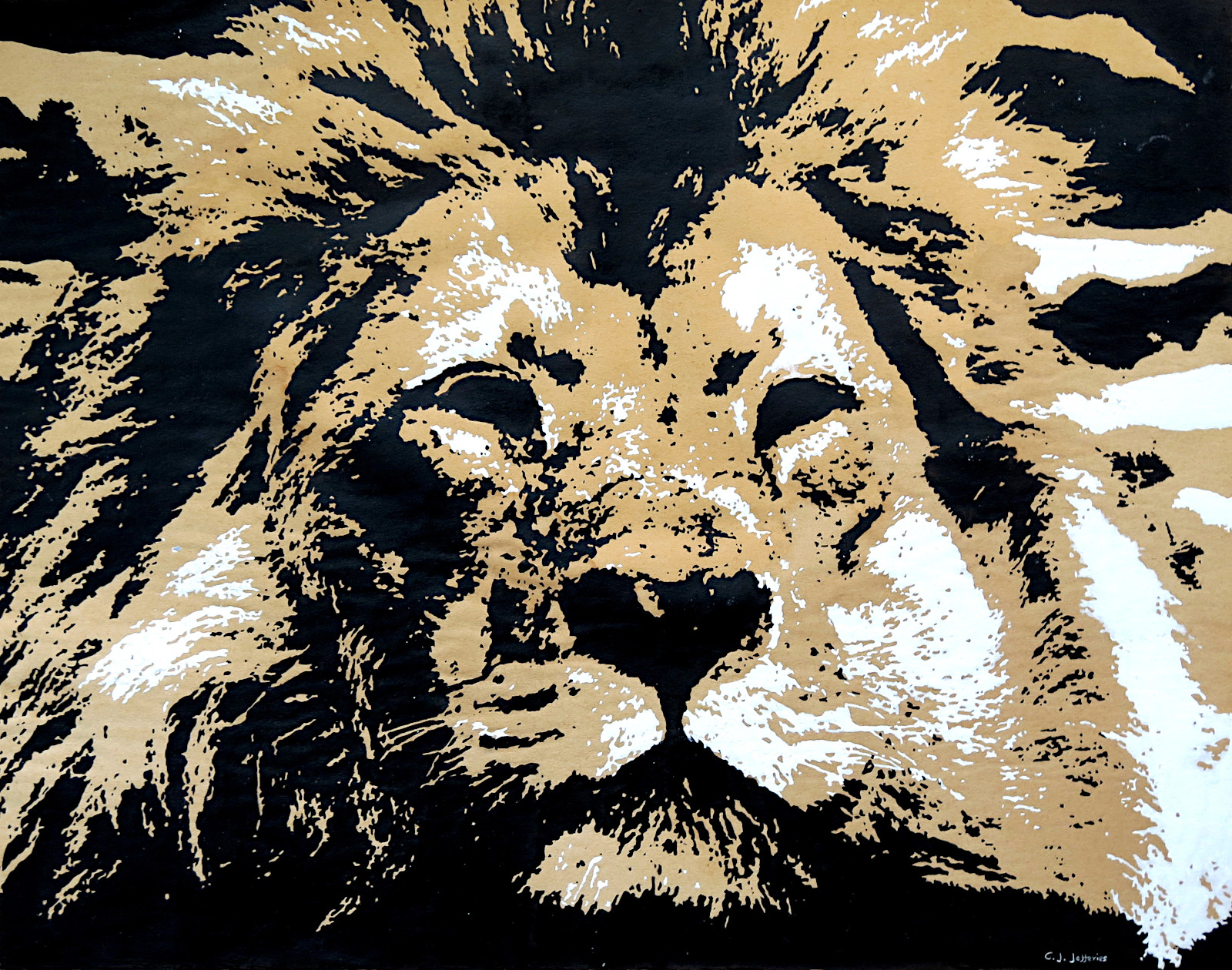
I made a tracing using a soft grade of pencil, then turned the tracing paper over on top of a dull yellow sheet of art-grade paper, and rubbed down the traced lines.
Image 101 – What’s in an image? Sometimes quite a lot, more than meets the eye. I’m posting an image every day or so.
Larger view
Meet Leo! I’m going to share the story behind this image.
This image of a lion first appeared printed on paper carrier bags from a British menswear chain in the 1960s. The chain was Foster Brothers, and I had bought something there and was given the paper carrier. I was impressed with the picture on the bag, it was in white, grey (not yellow), and black and I was fascinated at the way it had been rendered in three brightness levels. These days it would be dead easy with image manipulation software, but in the 1960s it must have involved clever photographic printing at high contrast levels and then some work by an artist.
I was so impressed by the image that I decided to make a copy of it for my girlfriend, Judy (later my wife). I made a tracing using a soft grade of pencil, then turned the tracing paper over on top of a dull yellow sheet of art-grade paper, and rubbed down the traced lines to leave an impression on the yellow paper. (For a lion, dull yellow seemed far more suitable than grey.)
Then, using white and black Indian inks, I filled in the traced areas using the carrier bag for guidance. The carrier had a cut-out to act as a handle, so I had to make up the missing area. It took a long time, but the final result is what you see here, and I was pleased with it. I also made a wooden frame for the picture and used a scrap piece of greenhouse glass salvaged from the family’s nursery business, suitably cut to size.
Judy was surprised as she didn’t know I’d been working on it. And she was delighted with it too. It hung on her bedroom wall at her parent’s house, and then after we were married, in our bedsit, then our flat, and finally our house in Yatton. After Judy died in 1995, and Donna and I married, Leo came too and still hangs on the wall in our dining room. I was about 18 when I made the picture, now I’m 76 and I still have it.
That’s the story of how Leo came to be. But I have more to say, not about the picture but about the nature of a lion. I might get to that tomorrow, but if not, then certainly within the next week or two.
If you enjoyed this or found it useful, please like, comment, and share below. (If you don’t see those links, click the article’s title above the main photo and they will appear.) Send a link to friends who might enjoy the article or benefit from it – Thanks! My material is free to reuse (see conditions), but a coffee is always welcome and encourages me to write more often!
The seeds are not released until spring, and all winter long, these white ‘beards’ can be seen in Cotswold hedges, adding a touch of interest in an otherwise rather drab time of year.
Image 100 – What’s in an image? Sometimes quite a lot, more than meets the eye. I’m posting an image every day or so.
Click to enlarge
These are the seeds of Clematis vitalba or ‘Old Man’s Beard’. This plant grows abundantly in Cotswold hedgerows, tolerating the limey soils in the region. In the summertime it doesn’t stand out, but if you know what to look for you can see its characteristic leaves and its stems winding through hedgerow plants and the lower branches of trees. The flowers are quite insignificant too, unlike the Clematis in garden centres, bred for large and showy flowers.
But wild Clematis comes into its own in the autumn; the seeds are hairy, as you can see, enabling them to blow away in the wind. If they land in a suitable spot they will germinate, put out a shoot with leaves, and try to find some support to climb up. But the seeds are not released until spring, and all winter long, these white ‘beards’ can be seen in Cotswold hedges, adding a touch of interest in an otherwise rather drab time of year.
The colourful garden Clematis cultivars were once propagated by grafting onto the wild seedlings as they were not easy to root as cuttings. But these days cuttings are the norm; with modern rooting hormones and high humidity conditions they root and grow very well indeed.
If you enjoyed this or found it useful, please like, comment, and share below. (If you don’t see those links, click the article’s title above the main photo and they will appear.) Send a link to friends who might enjoy the article or benefit from it – Thanks! My material is free to reuse (see conditions), but a coffee is always welcome and encourages me to write more often!
What will they think of next? The Scientific Journal Nature published an article about this amazing contraption, a fixed wing drone with legs. Like a bird it can walk, hop, and launch itself into the air with a jump. Legs and feet are important.
Unlike the normal multicopter drones we’re all familiar with, this one has some mobility on the ground and, like all fixed wing vehicles, is more energy-efficient in the air. It can’t hover, at least not yet. Hummingbirds and kestrels can hover though, so who knows what some future development of RAVEN might manage?
Visit Nature to sign up for alerts, and watch the video in their article or below.
Useful? Interesting?
If you enjoyed this or found it useful, please like, comment, and share below. (If you don’t see those links, click the article’s title above the main photo and they will appear.) Send a link to friends who might enjoy the article or benefit from it – Thanks! My material is free to reuse (see conditions), but a coffee is always welcome and encourages me to write more often!
As the group size grows, the dynamics change; ten to twenty people will chat together (like the group in the photo), though sometimes there will be more than one conversation going on.
Image 99 – What’s in an image? Sometimes quite a lot, more than meets the eye. I’m posting an image every day or so.
Click to enlarge
People like to sit in the sun and chat. Social interaction is central to human nature with group sizes anywhere between two and a hundred; more than a hundred becomes a crowd in which there are some people who don’t know one another at all. And the larger the crowd, the more anonymous the experience becomes.
Group dynamics
A group of two or three has the potential to be quite intimate; close friends who trust one another may share things they wouldn’t discuss more widely.
As the group size grows, the dynamics change; ten to twenty people will chat together (like the group in the photo), though sometimes there will be more than one conversation going on. Generally most people will have something to say; the intimacy is lost, but everyone has a chance to join in.
As group size increases beyond twenty, to say thirty or forty, it’s no longer possible for everyone to hear. If it’s an informal gathering, people will break into smaller groups to chat and often there will be a few left out, not engaging with others at all. Or if it’s a more formal gathering a chairperson may manage things and individuals will take turns to make their points.
Sharing food and drink
The people in the photo are eating and drinking together, this is helpful in getting a group to relax. Here, things are completely informal, but in more formal groups of this size or larger it may help to provide tea and coffee, or even a buffet. This relaxes everyone.
Right-sizing
If you are planning a group meeting for a specific purpose it’s beneficial to consider group size and how it affects things. Often we do this automatically, these group dynamics are so familiar that we don’t need to make any special effort to get it right. Sometimes it’s useful to break a big group up into smaller ones, sitting people at tables of six or so to make sure everyone is able to talk and interact while also being part of something bigger (perhaps with a speaker at the front from time to time). This enables a focus/discuss/focus/discuss dynamic which can be very useful.
When: 21st June 2024 Where: Weston-super-Mare, North Somerset, England
Favourites
For convenience, here’s a list of my favourite images:
If you enjoyed this or found it useful, please like, comment, and share below. (If you don’t see those links, click the article’s title above the main photo and they will appear.) Send a link to friends who might enjoy the article or benefit from it – Thanks! My material is free to reuse (see conditions), but a coffee is always welcome and encourages me to write more often!
Look at the world around you and you will see pain, loss, discouragement, guilt, and hard struggles for survival. But look at the world from just the right angle and you will see altogether better things.
This photo of the interior of Cirencester Parish Church reminds us of the dedication, hard work, and sheer skill put into building a church nearly 1000 years ago. That should stop us in our tracks and make us think – why go to so much effort?
Click to enlarge
Work on building Cirencester’s Parish Church of John Baptist began in the twelfth century. The chancel (where the altar stands) is the oldest part of the structure and replaced a previous Saxon Church, and perhaps a Roman one beneath that. Additions, alterations, repairs and improvements date to almost every century, the most recent change returning sculptures to two empty niches on the tower in 2019. It’s been a lot of work over a period of a thousand years.
Why? There will, of course, be many reasons. Wealthy townspeople have been willing to spend large sums of money from time to time, and masons, carpenters and other tradespeople will have worked for payment. Some people may have been motivated by their faith, others by a desire to contribute to something beautiful and special, perhaps some to say, ‘Thank you’, for answered prayer. We will never know the full detail, mostly we can only imagine.
But for me, this photo illustrates something quite different. My own understanding of Jesus’ teachings is that we have received a great treasure and should do whatever we can to share it freely with friends, family, neighbours, even enemies, with everyone who will listen. This is an altogether different kind of building work. We are raising a beautiful structure, not of stone and timber, brass and lead, stained glass, silver and bronze. We are building as Jesus builds, a structure of trust, love, grace and peace, of joy, precious thoughts, acts of kindness and caring, a work of self sacrifice, healing, truth, and acceptance. A drawing in as well as a raising up, a work that can always be extended further.
Am I good at it? No, not really. Only Jesus is truly good at this task. He came to reveal his Father, and to pour out his Spirit. And he told us (his followers, his apprentices) to carry on his work.
So, as a very small part of this task, I say to you my readers (if you are still reading at this point) whatever your faith, or religion or view of life, my wish for you, my prayer for you, is that these weeks as 2024 grows old, will be a time of growing peace in your heart. Life isn’t always easy, so my hope is that you will find something to smile about even in difficult times.
Here’s something I wrote last year, I’ll offer it up to you again now. More and more, the UK is a rich mix of people from many cultural backgrounds. That’s why the title is not ‘Christmas Greetings’. Please accept the greetings and replace the word ‘Season’ with whatever you like. If you’re Hindu you could choose Diwali as a reminder of your celebrations in October, or Jewish friends might go with Hannukah in December, if you’re Muslim you might look forward to Lailat al Miraj in February; Buddhists might consider Bodhi Day, and there are more groups of people I haven’t mentioned specifically. But whatever you celebrate, please take my greetings as a blessing for the whole of next year – spring, summer, autumn and winter.
And I apologise to my southern hemisphere friends whose new beginnings may come in June or July!
PS – If you like the photo, click the thumbnail for the full size version. Print it out, put it in a frame and hang it on the wall. Give a copy to friends if you think they’d like it; or send them a link to this message.
Image 98 – What’s in an image? Sometimes quite a lot, more than meets the eye. I’m posting an image every day or so.
Click to enlarge
This cloud seems to be throwing itself out widely in all directions like a truly massive explosion. No doubt meteorologists have a name for something of this kind. Or perhaps it’s just a foreshortened view and what seem to be extensions spreading sideways are really parallel to one another.
Either way, it seemed to me to be equisitely beautiful and therefore well worth a photo and a post here on JHM.
When: 25th November 2024 Where: Cirencester, Gloucestershire, England
Favourites
For convenience, here’s a list of my favourite images:
If you enjoyed this or found it useful, please like, comment, and share below. (If you don’t see those links, click the article’s title above the main photo and they will appear.) Send a link to friends who might enjoy the article or benefit from it – Thanks! My material is free to reuse (see conditions), but a coffee is always welcome and encourages me to write more often!
If you enjoyed this or found it useful, please like, comment, and share below. (If you don’t see those links, click the article’s title above the main photo and they will appear.) Send a link to friends who might enjoy the article or benefit from it – Thanks! My material is free to reuse (see conditions), but a coffee is always welcome and encourages me to write more often!




 Journeys of Heart and Mind

.jpg)