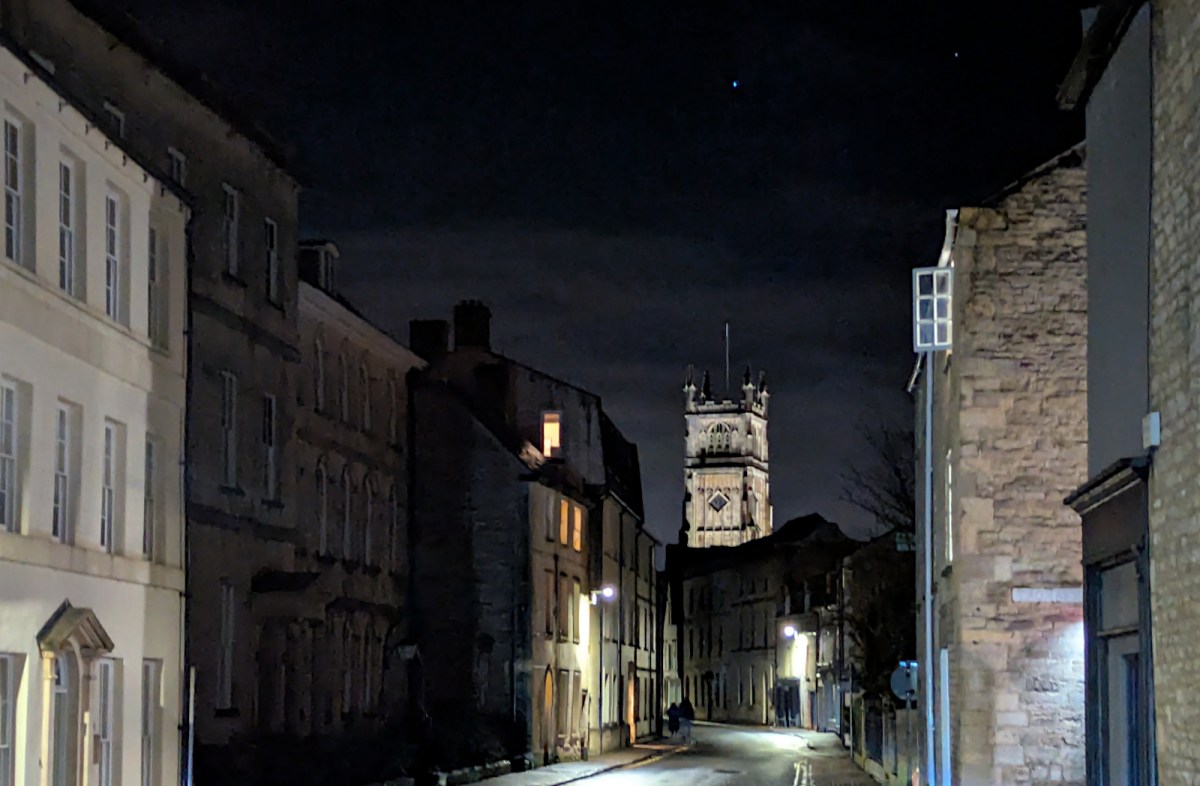
We are looking more or less along what was once a Roman street in old Corinium. Although it winds left and right here and there, nearly 2000 years ago it would have run almost entirely straight.
What’s in an image? Sometimes quite a lot, more than meets the eye. I’m posting an image every few days.
Jupiter and the church tower
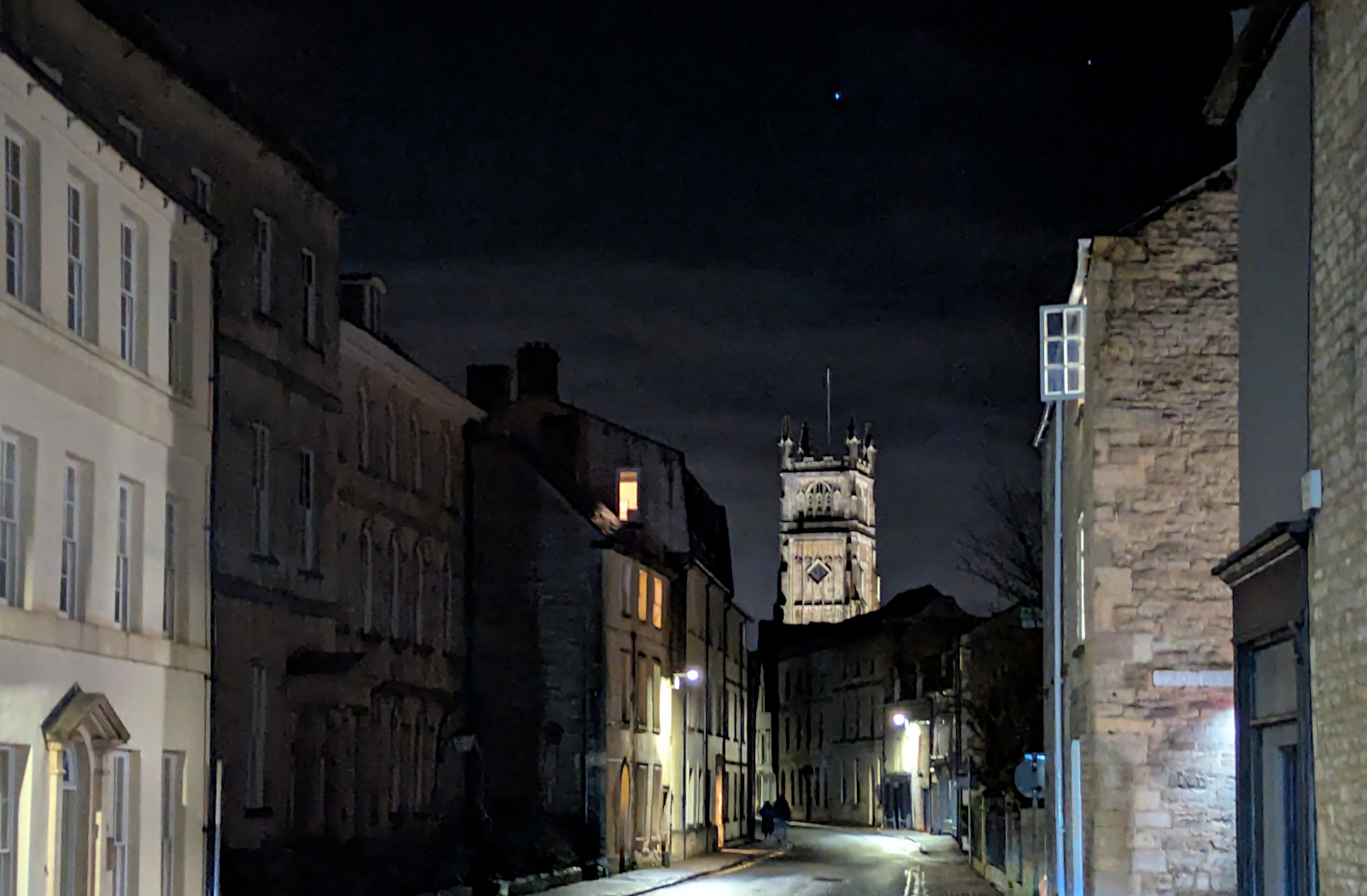
The town’s streetlights illuminate the lovely old architecture in Dollar Street, and Jupiter is bright enough to see high above the church tower’s flag pole. Click the thumbnail to enlarge it and you’ll also see a star a little further to the right, almost over the open window. This is Saiph, the bottom-left star of Orion. If you’re looking at the sky from the southern hemisphere Saiph will be Orion’s top-right star and Jupiter will be very low in the sky.
Looking south
We are looking more or less along what was once a Roman street in old Corinium. Although it winds left and right here and there, nearly 2000 years ago it would have run almost entirely straight, part of the Roman military road between Glevum (Gloucester) and Calleva (Silchester) through the local Iron Age kingdom of the Dobunni whose capital was about four miles to the north of Corinium in what is now the village of Bagendon. Behind you, in this view, the road continued north-west to Glevum where there was a military fortress. Some British tribes were allies of the Romans, including the local Dobunni. Some tribes opposed the Romans and their conquest of these islands. In the south-east direction the same Roman road (Ermin Way) passed through the town’s Forum, past the Basilica and made its way to Calleva to the south and east.
If you enjoyed this or found it useful, please like, comment, and share below. (If you don’t see those links, click the article’s title above the main photo and they will appear.) Send a link to friends who might enjoy the article or benefit from it – Thanks! My material is free to reuse (see conditions), but a coffee is always welcome and encourages me to write more often!
What’s in an image? Sometimes quite a lot, more than meets the eye. I’m posting an image every few days.
The Norrington Room (Click to enlarge)
The photo shows the basement of Blackwell’s Bookshop in the centre of Oxford, the famous university town in the UK.
Blackwell’s Bookshop in Oxford is huge
You can get a good idea of size from the photo, there are four or five floors above the basement, large but not as open; the upper floors are smaller and have no long views like this one as the line of sight is broken up by countless units of shelving.
Map centred on Blackwell’s
This was where the original Blackwell’s bookshop was, but it has grown larger and larger over the years. The basement, shown in the photo, is known as The Norrington Room and has five kilometres of bookshelves in it, containing 200 000 books. Blackwell’s in Oxford also hosts a Caffè Nero on the first floor. The map (opens in a new tab, click to resize and drag it) is centred on the bookshop in the very heart of Oxford.
Some history
The current bookshop in Broad Street opened in 1879, though it was much smaller in those days, at a mere 4 m square. The first bookshelf unit is still in use, at the top of the stairs to the first floor. The shop soon expanded, incorporating the cellar and the first floor as well as several adjacent shops. There was an earlier Blackwell’s bookshop, also in Oxford, that opened in 1846.
Blackwell’s had an online presence from 1995, selling books worldwide. It also opened retail outlets in many other cities and towns across the UK. As a company it remained independent until the business was bought in 2022 by Waterstones, another major British book retailer.
If you enjoyed this or found it useful, please like, comment, and share below. (If you don’t see those links, click the article’s title above the main photo and they will appear.) Send a link to friends who might enjoy the article or benefit from it – Thanks! My material is free to reuse (see conditions), but a coffee is always welcome and encourages me to write more often!
It’s likely the cracking will have been caused by differential thermal expansion and contraction with the iron changing its dimenions rather more than the ceramic glaze.
What’s in an image? Sometimes quite a lot, more than meets the eye. I’m posting an image every few days.
Click images to enlarge
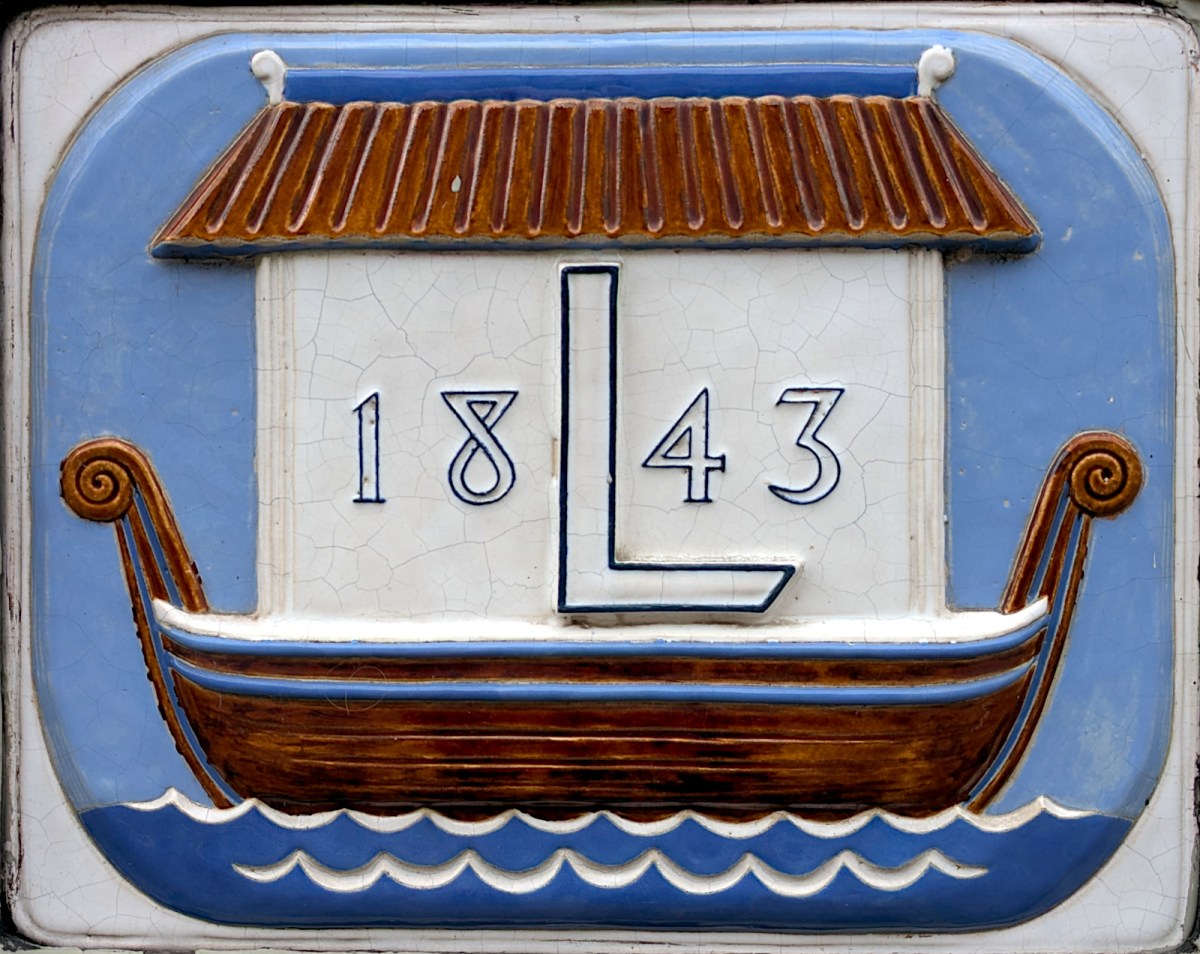
This is one of the old brewery plaques, once numerous across Britain. This example is in Castle Street, outside The Brewers Arms, not far from the junction with Querns Lane and Lewis Lane.
Arkell’s Brewery
The brewery originated in 1843, the year on the plaque. It was founded in Swindon by John Arkell, remains family-owned and operates as one of the oldest remaining brewery companies in Britain.
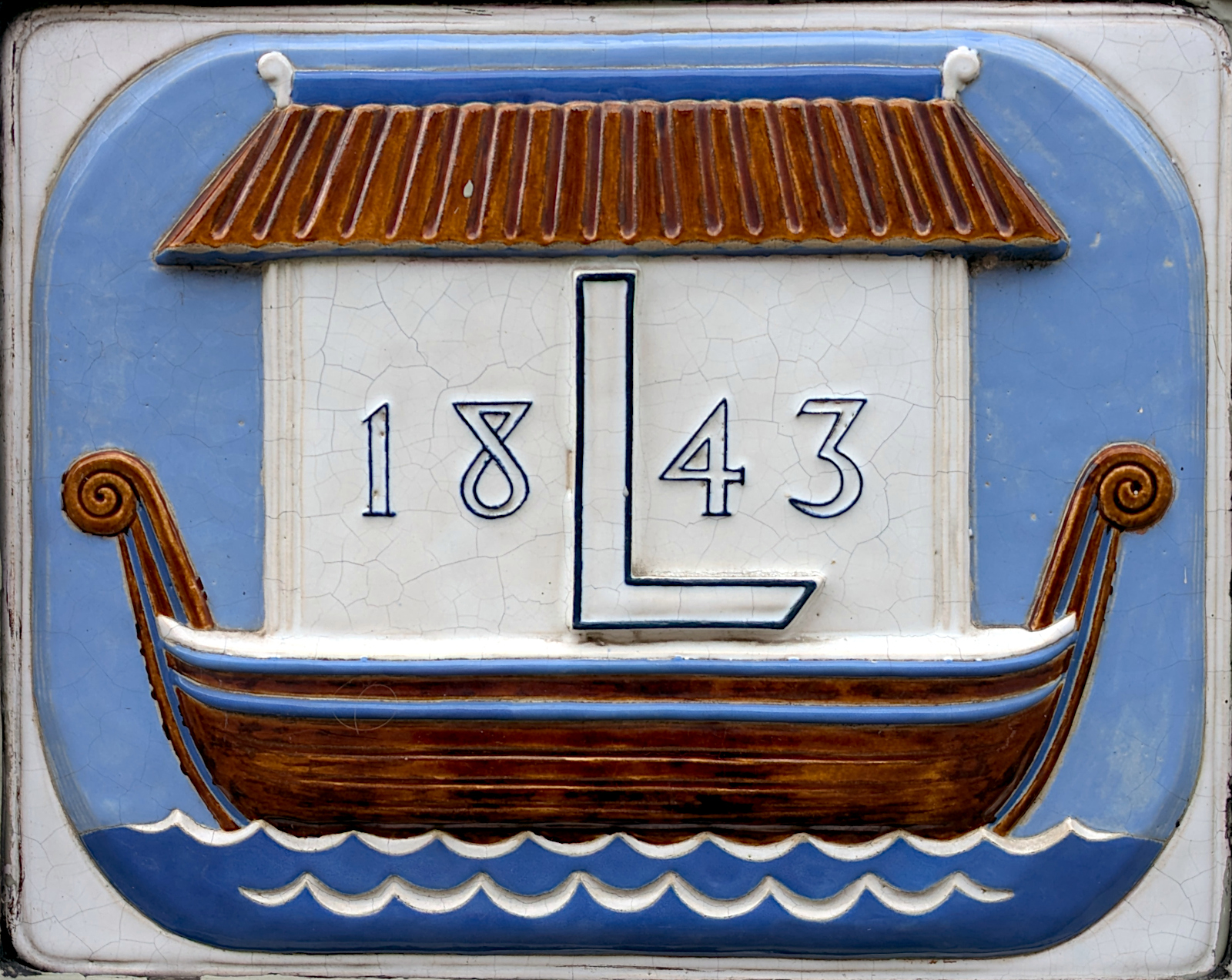
The plaque is probably of cast iron with enamel decoration and apart from some cracks seems to be in almost perfect condition. It’s likely the cracking will have been caused by differential thermal expansion and contraction with the iron changing its dimenions rather more than the ceramic glaze. The plaque has seen more than 180 day/night cycles in its time!
Brasso
The image is of Noah’s ark with a large capital letter ‘L’, so a play on Arkell (‘arkL’). There’s a long history of businesses advertising their presence with logos and other illustrations, it happens in all nations and cultures, sometimes the themes, names and images employed can become quite famous and long-lived. When I was a young child, Brasso (a British brass polish) was sold in steel containers with blue and white rays coming out in all directions. It’s still available today in cans with the same design. And it probably looked just the same in Victorian times as well! When I was young it was fitted with a low-profile, steel screw-cap, today it has a much larger, plastic cap. Otherwise, it looks identical to me.
If you enjoyed this or found it useful, please like, comment, and share below. (If you don’t see those links, click the article’s title above the main photo and they will appear.) Send a link to friends who might enjoy the article or benefit from it – Thanks! My material is free to reuse (see conditions), but a coffee is always welcome and encourages me to write more often!
Think of an evangelist as first and foremost a ‘people person’. They get their energy from being in the crowd. They love to talk, they smile and laugh a lot, they’re fun to be around, they tend to be party people.
A street party (Wikimedia) -Click images to enlarge
When apostles and prophets have done their stuff it’s high time for evangelists to join in. I don’t want to push the idea of a sequence too far; ideally we should be aiming for a situation where all the APEST gifts are operating simultaneously and abundantly, all at the same time. I’ve been using the analogy of building a house where apostles lay foundations and prophets make sure the structure is straight and true, but it should be very clear from Paul’s letters to the Corinthian church that all of the gifts need to work continuously. Unlike a house, when foundations are laid once and the stonework is raised once, for church to function as Jesus intended these are ongoing requirements. It’s not just urgent repair work as in Corinth, but it’s a living process of constant adjustment and calibration.
Following the apostle and prophet articles, the focus this time is on the gift of an evangelist – what it looks like, how it arises, how it affects a person who is expressing it, and how the rest of us can relate to it, support it, and, as an expression of church, benefit from it. Next time we’ll examine the gift of a shepherd in much the same way.
No room for wriggling
We all have this gift to some degree. You cannot be like Jesus without having some level of evangelist about you, so you can’t wriggle out of it completely. Jesus is the origin and source of all the gifts we’re discussing. If you believe him and follow him then Christ is in you. And if the perfect evangelist is in you then you are going to reflect that at some level. You may or may not be evangelical, but you will most certainly be somewhat evangelistic in character and nature.
We need to know how to recognise an evangelist, and that’s really not too difficult, but before I consider that I’d like to clear up a common misconception that can cause some confusion. There’s a (mistaken) understanding among many Christians that evangelists go out and convert people from whatever they currently believe. But that’s not quite right. It’s apostles who are called to go out and start new churches, very much following in Paul’s footsteps. But evangelists have a slightly different role. The Greek word is euangelion (εὐαγγέλιον). It’s a word of two parts εὐ which means ‘good’ hence a eulogy is a good word, and αγγέλιον or angelion meaning ‘messenger’, we get our words ‘angel’ and ‘angelic’ from this same Greek origin. So an evangelist is a ‘bringer of good news’, not only in the narrow sense of someone who preaches the good news but more in the sense that an evangelist is someone who is good news.
Think of an evangelist as first and foremost a ‘people person’. They get their energy from being in the crowd. They love to talk, they smile and laugh a lot, they’re fun to be around, they tend to be party people. Hence this article’s title Partying with an evangelist. Evangelists draw people in – ‘Come and have a drink with us.’Have you tried this amazing dessert?’ ‘Fantastic dog, what breed is it?’ ‘You’re looking really happy, it’s so good to see that’. They like to tell stories and will probably have everyone in stitches, and if you have a story they will want to hear it and will find comfortable ways to draw it out if they can. People gather around evangelists in a very natural way, and before long an evangelist will be telling them about things Jesus did in their lives, or asking them if they’ve ever met him in a meaningful way themselves.
An undemanding and comfortable gift
Where the gift of evangelist is operating, you’ll find a group of people who are both engaging and engaged. That’s why it’s such an important gift for joy, balance, and growth of the church (ekklesia) the called-out community of Jesus in a place. If we could only grasp and use this gift more fully, church would be the popular, local place for everyone to gather (not just believers). As always, Jesus has all of the gifts in a fullness we can never completely express. In part, that’s why the crowds followed him everywhere he went in Judea and Galilee – he was and remains really, really Good News! But I think I’ll leave Jesus as the fullest expression of the APEST gifts for a later article after we’ve worked through shepherd and teacher.
For now it’s enough to grasp that evangelists are about good news, not only in the message they bring but also in who they are (remember, who you are is far more fundamental than what you do).
On the more serious side
But there’s more to be said about the gift of evangelist. This gift to the body is not just about fun and being attractive and welcoming. Evangelistic people have a heart to welcome people, but they know the welcome should have the purpose of bringing people into Christ’s presence. They are passionate about this goal, but they also know they must bridge the huge gap that exists between ekklesia and the prevailing culture of the society beyond (and often it seems beyond the reach of) the church. But they also know that their particular gift can reach across that divide far more easily than the rest of us might think. Because the first step in reaching a person is to become a trusted friend.
The evangelist is propelled forward by a desire to see people come to know and trust Jesus and every opportunity to communicate the truth spurs them on. The evangelist may become impatient with slow processes and tend to be stronger at drawing in new believers than they are at discipling or teaching, those processes are not where their strengths lie.
In conclusion
One of the take-home messages from this article on the gift of evangelist is that we need to lighten up in church life and activity. We need a reputation of being the best and most sought after place and community in town! If this is not the way of things you may be lacking the gift of one or more evangelists. They’re there among you, but perhaps they’re regarded as lightweights, not learned enough, not Bible scholars or great preachers, not serious. Yet one of the reasons ordinary people avoid church is that it seems to be far too serious, dull, boring, a place for serious, dull, boring people. If this is how people see your church (or your small group), maybe you need to find the evangelists and apologise for suppressing them. Instead, invite them to lead a meeting or two, ask them to show you how you, too, could lighten up a bit. And if visitors are among you, for whatever reason, give the evangelists a bit of freedom.
This may not be the easiest of messages to hear, particularly because it is so rarely expressed or understood. Church was never meant to be a dull, hushed and deadly serious endeavour. Party food smells a great deal better and more exciting than the polish on Victorian church pews!
If you enjoyed this or found it useful, please like, comment, and share below. (If you don’t see those links, click the article’s title above the main photo and they will appear.) Send a link to friends who might enjoy the article or benefit from it – Thanks! My material is free to reuse (see conditions), but a coffee is always welcome and encourages me to write more often!
Gratitude demands taking hold of whatever is being offered, unwrapping it, and finding out what it is for and how it works. It also involves actually trying it out, taking it for test runs, expressing it, seeing how others react to it.
We considered the gift of an apostle last time, so now we’ll look at the gift of a prophet. And let’s be clear, once again I’m not writing about an individual person here, we’re going to focus on the gift itself – what it looks like, how it arises, how it affects a person who is expressing it, and how the rest of us can relate to it, support it, and, as an expression of church, benefit from it. Next time we’ll take a look at the gift of evangelist in the same way.
Making it real
As with each of the service gifts, let’s begin by reminding ourselves that we all have this gift to some degree. You cannot be like Jesus without having some level of the prophetic. Some will have a high level of this gift, some may have it at a relatively minor level. And in all of us it will exist alongside various mixtures of the other four APEST gifts. But whatever the level – low, medium or high – the source remains the same, it always springs from the nature and heart of Christ himself. He provides all of the gifts as he thinks fit. Make this real for yourself, personally. Jesus has carefully chosen and bestowed these five gifts on you in whatever proportions will enable you to play your part in his ekklesia, his called and appointed community. He is special, but he has made you special too; whatever happens in your life, never forget that.
Remember that a gift requires activity from both the giver and the receiver. A gift that is offered but not taken is no gift at all; it never fulfils it’s purpose. Gratitude demands taking hold of whatever is being offered, unwrapping it, and finding out what it is for and how it works. It also involves actually trying it out, taking it for test runs, expressing it, seeing how others react to it. And to properly receive it you should also hug the giver, tell them how much you love their thoughtful gift and tell them how much you love them, the giver, too. That’s not a big ask when Jesus is the giver!
Seeing and hearing are words we focus on when we think of the gift of a prophet. But these words can easily mislead us as they have to do with eyes and ears whereas the prophetic gift is much more to do with spiritual awareness. Because of this it might help to think in terms of prophets communicating Papa’s thoughts and nature to anyone who will listen. Sometimes that’s about Father’s character, sometimes it’s about his heart or his will, or his purpose. It might sometimes involve a message from him to the church, to a particular person, or to the world in general. Prophecy tends to be declaratory. Because they are in touch with the heart of the Father, prophets are often very sensitive to wrong attitudes; things that he hates will be things the prophet also detests.
A demanding and uncomfortable gift
Prophets are highly sensitive to and outspoken about unjust behaviour, unjust words, unkindness and untruthfulness. They always point up to the Father too, to his character and nature and presence. They declare peace and long to see brothers and sisters living in peace. They want all people to be at peace with the Father in heaven and with one another. Prophets can make people feel uncomfortable, too much truth can be hard to assimilate and difficult to deal with. A prophetic person may seem to be over-demanding, pointing church towards Jesus too firmly, insisting on change right now. A half-hearted prophet is a contradiction in terms, they want to see change and they want it right away, not tomorrow or next week! So where a prophet is at work, and the hearers pay attention, people should be growing more Christlike in their thoughts and actions towards one another, towards Father, and towards the world. And because Jesus is sacrificial in nature, a growing willingness to be sacrificial will grow in and among the community that is church as well.
We should also think about how the gift of prophet fits with the gift of apostle that we considered before. First apostle, then prophet, wrote Paul. We saw previously that Apostle comes first, not in importance but in sequence, so in what sense does the gift of prophet come next? Well, if an apostle has been at work there will be an excellent foundation laid upon which church may be built. And the prophetic gift helps us build straight and true; standing firmly on the foundation already laid. In the early days of church construction it would be easy to come unstuck, a lot of people might be doing the best they can but without the ability to distinguish between what seems good (but might be unhelpful) and what is truly in line with Father’s vision and purpose. Having a prophet or two acting like plumblines and right-angled set-squares reveals where a wall is not quite vertical or a corner not at ninety degrees. And these details will matter as the structure grows in height and complexity, so prophets do indeed come after apostles though both are of equal (though different) importance and value.
Now you are the body of Christ, and each one of you is a part of it. And God has placed in the church first of all apostles, second prophets, third teachers, then miracles, then gifts of healing, of helping, of guidance, and of different kinds of tongues. Are all apostles? Are all prophets? Are all teachers? Do all work miracles?Do all have gifts of healing? Do all speak in tongues? Do all interpret?(1 Corinthians 12:27-30)
Notice that the quote from 1 Corinthians above is different from the list in Ephesians 4 that we looked at in the post on apostles. There’s a reason for that and we’ll investigate it later, but the first two items in the list are the same. Apostles first, then prophets. The paragraph below is copied from the previous part of this series. It bears repeating because it is so important.
Our mistake is to think that these are special roles that most of us are not called to. But the truth is subtly different. All of us have all five of these gifts, but to varying degrees. I might be strong in one and you might be strong in another. Most of us are reasonably strong in one or two, few of us are strong in all five. So what does that imply for his locally gathered people, the ekklesia (church) in a particular place. It implies that any gathered group of believers will have all five of the gifts in differing amounts – we will lack nothing! But it’s the togetherness in the church that ensures we lack nothing. We all need to do our bit.
So let’s get on with the process
Think again about the process of building a house, and how all the building skills and trades are required for success. We need apostles, prophets, evangelists, shepherds, and teachers to build a local expression of church. And all are present wherever people are meeting regularly with Jesus and hearing his call to go and make disciples, baptise them, and teach them to do everything that’s needed for the next generation. All five are present, but sometimes they are not active. And that’s usually because we don’t provide room for them.
Remember that ‘Church’ on Sunday and ‘Small group’ on another day are both fully ekklesia, they are both communities of people called out and following Jesus. All five of these gifts of service should be fully present and working every day in every size of community. If they are not, something is seriously wrong and we need to rethink our paradigms and change our approach. We are all required to carry out Jesus’ orders in the great commission and we will need all five gifts to be active in order to fully hear that commission, let alone carry it out.
If I’m not expressing something of all these gifts, and if I’m not hearing and seeing them all in others, regularly and often, then I’m either in a deficient environment or I’m not paying proper attention. I need to examine and change either my position or my activity (or both). Assuming apostles and prophets are being heard we now have a straight and true structure of living stones standing firmly and safely on a foundation called Jesus the Messiah. It’s ready for use, it’s fit for purpose, but it’s empty inside. In other words it’s fit and ready for the gift of an evangelist, the third in Paul’s list of the five gifts of service. (Eph 4:11-13)
Why are Paul’s two lists of gifts different?
I mentioned earlier that we’d investigate this puzzle. Since apostle and prophet are the first two in both lists, it hasn’t begun to matter yet, but soon it will. It will help to read Ephesians 4 in its entirety to remind yourself of the context in which Paul mentions these five gifts of service.
Evangelist is next in Paul’s list because the empty structure needs to be filled with people. Paul’s list in 1 Corinthians is about the community after it’s been filled with people, it’s more about the gifts needed to keep things on track, an important list for an ekklesia that seems to have been in danger of derailment followed by a serious crash. Paul compiles a different list because there’s a different need, these are gifts for keeping things going and correcting errors. These people needed the apostolic and the prophetic to straighten and strengthen the existing structure. Then they need teaching, they need a bit of a miracle and they need healing and helping and guidance. Paul wrote his letter to them to provide these very things, but he knows that all the resources needed are right there in the spiritual gifts of the Corinthians themselves too, if only they will stop squabbling and pay proper attention to one another.
Perhaps this is why Paul doesn’t mention the gift of evangelist in the Corinthian list. The ekklesia in Corinth doesn’t need filling with more new believers, it needs straightening out first and it needs recalibrating. It never hurts to ask ourselves the same questions, does our church or our small group need straightening out and/or recalibrating?
A new house
The photo at the top of this article shows an empty house, here it is again. This is a second-hand house as it happens, not a newly built structure. But that doesn’t matter, you don’t need a brand new build to feel the excitement and hope of moving into a new place and converting it to a home where the family can live and love, work and play, eat and drink, and invite visitors.
See also:
I have struggled to find much that I can recommend on the gift of prophet in the church today, there is certainly a good deal of nonsense out there. So instead of some links, here’s a video of Alan Hirsch speaking about the fivefold APEST gifts (including the prophetic gift). Have a listen, see what you think. It’s short, less than five minutes.
If you enjoyed this or found it useful, please like, comment, and share below. (If you don’t see those links, click the article’s title above the main photo and they will appear.) Send a link to friends who might enjoy the article or benefit from it – Thanks! My material is free to reuse (see conditions), but a coffee is always welcome and encourages me to write more often!
The simplest and cheapest way to travel would have been to walk, and people often did exactly that. For an example look no further than the old story of Dick Whittington.
What’s in an image? Sometimes quite a lot, more than meets the eye. I’m posting an image every few days.
Click images to enlarge
This photo was taken in Cirencester, peering in through an entrance to a courtyard beyond. If you are familiar with the town, I wonder if you know where this is? *The answer is at the bottom of the post.
There’s an invitation in this photo
That’s why I called it ‘Come right in!’ There seems to be an unspoken welcome here. What appeals to you most in this picture? Is it the warmth of the light? Or perhaps the sparkle of the decorative lights at the far end? Or the open doors beckoning you to enter? In days of yore, this double doorway might have allowed a horse to be brought inside for stabling, feeding, watering and grooming to recover for use the following day. The carriage would have remained on the street outside.
‘Days of yore’, this funny old expression is a poetical way of saying long ago. ‘yore’ is an Old English word closely related to the modern word ‘year’. So the sense is ‘in the days of years ago’. There’s a large garden at the back of the hotel, with a lawn scattered with tables and chairs, a lovely place to eat and drink with friends or family in the summer months. I imagine the horses sometimes being turned out to graze in a grassy field here, what a treat for them!
Shelter for travellers
Travelling on horseback or by horse and carriage was a slow affair, requiring regular stops for meals or to shelter for the night, and that’s why the old routes between towns in Britain are liberally scattered with pubs, inns and hostels. Practically every village of hamlet would have had one and towns would have had many more. They’re not hard to spot, although these days many have been converted to other uses.
It wouldn’t always have been necessary to pay for accommodation, friends or family along or near the route would have made travellers welcome and on dry, warm, summer nights it would have been possible to pull off the main roads and sleep outside or in the carriage. The simplest and cheapest way to travel would have been to walk, and people often did exactly that. For an example look no further than the old story of Dick Whittington. In Roman times there were parallel systems for official/military and public use. Every 30 to 50 km (a day’s journey) there were mansiones or official stops with good accomodation, fresh horses, dining areas, and perhaps even baths. And between these were mutationes, (literally ‘changes’) for a brief stop, a fresh horse, and perhaps some refreshments but without overnight facilities. Non-official, privately run facilities included cauponae and tabernae, some of these were a bit rough and disreputable, some were well appointed with courtyards, kitchens, and decorated dining rooms. Several modern English terms come from these words – mansion, mutation, and tavern are notable.
The Bible is usually regarded as a religious book, but it’s also a good historical source as well. Read the book of Acts, for example, to get a good idea of what travel by land and sea was like 2000 years ago. See for example Acts 28:11-16 where a place near Rome called ‘Three Taverns’ is mentioned (Tres Tabernae).
* It’s the Corinium Hotel in Gloucester Street, once the Corinium Court Hotel.
If you enjoyed this or found it useful, please like, comment, and share below. (If you don’t see those links, click the article’s title above the main photo and they will appear.) Send a link to friends who might enjoy the article or benefit from it – Thanks! My material is free to reuse (see conditions), but a coffee is always welcome and encourages me to write more often!
We use the word ‘see’ in two very different ways – seeing with our eyes, but also seeing with our understanding. Do you see what I mean? And in that latter sense all believers have ‘seen’ Christ. Jesus himself made this clear to his disciples when he commissioned them in Matthew 28:19–20.
I’ve been thinking recently about who I am and what I do and I’ve been writing about those themes here on Journeys of heart and mind as you’ll know if you’ve been reading along.
The articles are not particularly about myself, but more about the principles. And if you’ve been reading the blog for quite a long time you probably also know that I’ve written in the past about the so-called APEST gifts – apostle, prophet, evangelist, shepherd, and teacher. These are not so much gifts to particular people, they are better described as gifts of people to the church. And in that sense I feel it’s high time I tried to convey more fully to my readers the nature of these gifts and the people who carry them and use them in the work of building and sustaining church life. As the church has aged over the 2000 years since Jesus was leading his disciples around Galilee and Judea, much has changed. Some of the original nature of church has been lost through a process of the encrustation of traditions and the discovery of ‘better’ ways of doing things. The APEST gifts have been one of the greatest of those losses.
We can’t do without these gifts, church doesn’t function well without them, yet most of the people who consider themselves to be part of church don’t understand them, don’t recognise them when they’re active and don’t value them. How can we value something we don’t understand?
So I’m going to attempt a pen portrait of each of these gifts, starting with apostle. And let’s be clear, I’m not proposing to write about an individual person here, I plan to write about the gift itself – what it looks like, how it arises, how it affects a person who is expressing it, and how the rest of us can relate to it, support it, and, as an expression of church, benefit from it. And next time we’ll take a look at the gift of prophet in the same way.
I used the ChatGPT AI to collect and organise some background information before writing this article. You can see the information it provided if you wish.
AI can do some great spadework, but it can’t think or make judgements, and it cannot respond to the Holy Spirit, so now we need to draw our own conclusions. I’ll explain what I think, and why.
First we need to give some thought to the difference, already mentioned, between the thinking, judging and responding to the Spirit that’s unavailable to AI. Also, AI has no experience of what it’s like to be in a church environment. Paul said that the gifts of people to the church involve first apostles, then prophets, evangelists, shepherds and teachers. (Ephesians 4:11-13)
In particular, let’s consider the idea that an apostle is someone who has seen the risen Christ, been directly commissioned by him and is sent to found and oversee communities. Does this allow for people in our generation to be apostles?
The answer to that, in turn, depends on what we mean by ‘seen the risen Christ’. We use the word ‘see’ in two very different ways – seeing with our eyes, but also seeing with our understanding. Do you see what I mean? And in that latter sense all believers have ‘seen’ Christ. Jesus himself made this clear to his disciples when he commissioned them. We are to do what the original twelve were told to do.
Therefore go and make disciples of all nations, baptising them in the name of the Father and of the Son and of the Holy Spirit,and teaching them to obey everything I have commanded you. And surely I am with you always, to the very end of the age. (Matthew 28:19–20)
Notice particularly that Jesus says ‘teaching them to obey everything I have commanded you’. The word ‘everything’ here includes going, making disciples, baptising them and teaching them to do everything I commanded you’. This is a down the generations command, we can’t escape, we shouldn’t want to escape, this is Jesus’ command to us, to you, to me.
So are we all apostles? The shocking answer is yes, we should all be prepared to be apostles.
So Christ himself gave the apostles, the prophets, the evangelists, the pastors and teachers,to equip his people for works of service, so that the body of Christ may be built upuntil we all reach unity in the faith and in the knowledge of the Son of God and become mature, attaining to the whole measure of the fullness of Christ. (Ephesians 4:11-13)
Our mistake is to think that these are special roles that most of us are not called to. But the truth is subtly different. All of us have all five of these gifts, but to varying degrees. I might be strong in one and you might be strong in another. Most of us are reasonably strong in one or two, few of us are strong in all five. So what does that imply for his locally gathered people, the ekklesia (church) in a particular place. It implies that any gathered group of believers will have all five of the gifts in differing amounts – we will lack nothing! But it’s the togetherness in the church that ensures we lack nothing. We all need to do our bit.
Why does Paul say first apostles – most important perhaps? No, we are all important. Think about the process of building a house. First you need the skills and knowledge of foundation makers, then you need bricklayers, next roofers for the roof structure and then tilers to make the roof water tight. Then double-glazing people for the windows and external doors, carpenters to fit internal doors and partitions, kitchen fitters, plumbers, electricians and so on. Which of those are most important? The foundation layers?
No! You need them all to build a house, And in the same way you need apostles, prophets, evangelists, shepherds, and teachers to build a local expression of church. And all are present wherever people are meeting regularly with Jesus and hearing his call to go and make disciples, baptise them, and teach them to do everything that’s needed for the next generation. All five are present, but sometimes they are not active.
What does an apostle look like?
Don’t expect apostolic people to look different from anyone else; to identify the apostolic person you need to watch what they do and what drives them. Apostles are all-rounders, and for very good reason. Because they are driven to go out they need to have some level of competence at all five of the gifts of service. Until a new community of Jesus followers has been formed the other gifts will not be available, so as the one who goes out and teaches people to follow Jesus, the apostle has to provide a bit of prophecy, evangelism, shepherding and teaching. You can see this clearly in Paul’s life. As you read through Acts, Paul stops in one new town after another, acting in all these ways. But one of the things he is doing is noticing the gifts in other people and encouraging them to start using those gifts for themselves.
One identifying feature of apostolic people is that they go out, start something in one place, then go out again and start somewhere else. They have very itchy feet! And that’s usually because we don’t provide room for them. They build churches, then move on. They’re not interested in making the house cosy and comfortable, they don’t bother with carpets or furniture, the newly built house (or church) has inhabitants who will do all of that. So you could say an apostle is about structure, nor decor. But because good structure is important to them they’ll often come back for visits, to check things are still on track. Paul did that a lot.
Aiding and encouraging apostles
These people need support, sometimes in terms of money or practical help, and definitely in terms of encouragement. It’s good to ask them where they have been, who they’ve been meeting with, and what they plan to do next.
Listening to apostles
They’re here to help you grapple with problems concerning church structure and difficulties that may arise. Apostolic people can be very forthright in pointing out issues a local church may not have noticed, consider how Paul intervened when widows or orphans were not getting the help they needed or when he saw people gossiping or not focusing on things in the right way. Apostles tend to be sensitive to things that are not quite right, sometimes they may seem a little rude or pushy, but hear them out and take what they say seriously.
People shopping (Click images to enlarge)
The photo at the top of this article shows shoppers in Western-super-Mare, here it is again; few of these people are followers of Jesus Christ, most of them are unaware of him or follow other faiths. Many are too busy to talk. What are we doing to reach them or engage them? We need to find effective, apostolic ways to do it – try the links below for some ideas.
If you enjoyed this or found it useful, please like, comment, and share below. (If you don’t see those links, click the article’s title above the main photo and they will appear.) Send a link to friends who might enjoy the article or benefit from it – Thanks! My material is free to reuse (see conditions), but a coffee is always welcome and encourages me to write more often!
To provide some basic background for my article ‘Travelling with an apostle‘, I used the AI tool ChatGPT. In case you’re interested here’s the prompt I used (in blue) and the result returned by the AI. I then wrote my article, not based on the ChatGPT output, but informed by it. It’s easy to use to research any topic and can be a big time saver.
To try it yourself just visit chatgpt.com, it’ll open in a new tab.
My Prompt:
Explain what is meant by the word ‘apostle’ and how the meaning or interpretation may have changed over time.
ChatGPT’s response:
The word “apostle” comes from the Greek ἀπόστολος (apostolos), and its meaning has both a linguistic history and a history of interpretation shaped by theology and church practice.
1. Original Greek meaning
In classical Greek, apostolos meant “one who is sent out” — a messenger, envoy, or delegate. It derives from the verb ἀποστέλλω (apostellō), meaning to send off or to dispatch. The term could be used in secular contexts for:
a naval expedition or fleet
an official envoy or ambassador
a commissioned representative sent with authority
The key idea was authorized sending — someone acting on behalf of another.
2. Use in the New Testament
In the New Testament, the word takes on a more specific religious meaning.
a. The Twelve Apostles
Most prominently, it refers to the Twelve chosen by Jesus (e.g., Mark 3:14; Luke 6:13). Here, an apostle is:
personally chosen by Jesus
commissioned to preach and teach
given authority to act in his name
In this sense, “apostle” becomes almost a technical title. The Twelve symbolize the restoration of the twelve tribes of Israel and serve as foundational witnesses to Jesus’ ministry and resurrection.
b. A broader missionary sense
The New Testament also uses apostolos more broadly. Figures like Paul, Barnabas, and possibly Junia (Romans 16:7) are called apostles. Paul emphasizes that his apostleship comes from being sent by Christ, not from human appointment (Galatians 1:1).
Here the meaning expands to:
A commissioned messenger of Christ sent to establish and guide communities.
This sense highlights mission and authority, not just membership in the Twelve.
3. Early Christian development
As Christianity spread, the term evolved further.
a. Apostles as foundational witnesses
By the late 1st and 2nd centuries, “apostle” increasingly referred to the original generation of eyewitnesses to Jesus. Apostolic authority became linked to:
authentic teaching
continuity with the original witnesses
the foundation of the church
This gave rise to the idea of apostolic tradition and later apostolic succession — the belief that church leaders inherit authority through an historical chain tracing back to the apostles.
b. Narrowing of the term
Over time, many Christian traditions restricted the title to the earliest figures. In much of Catholic, Orthodox, and traditional Protestant theology:
the apostles are a unique, unrepeatable group
their authority is foundational rather than ongoing in the same form
4. Later and modern interpretations
a. Missionary and honorary usage
In later centuries, “apostle” was sometimes used honorifically, such as:
“Apostle to the Gentiles” (Paul)
“Apostle to Ireland” (St. Patrick)
“Apostle of Germany” (St. Boniface)
Here it means an exceptionally influential missionary, not a member of the original apostolic circle.
b. Contemporary Christian movements
Some modern Christian groups, especially in charismatic and restorationist movements, use “apostle” for contemporary leaders who are seen as:
church planters
spiritual overseers
pioneers of new ministries
This reflects a return to the broader New Testament sense of sent ones, though it is debated among Christians. Many denominations reject applying the title to modern figures, arguing that apostolic authority was unique to the early church.
5. Summary of the shift in meaning
Across time, the meaning of apostle has moved through several stages:
Classical Greek: a commissioned envoy or messenger
New Testament (narrow): the Twelve chosen by Jesus
New Testament (broad): missionaries sent with Christ’s authority
Early church: foundational eyewitnesses and guarantors of tradition
Later usage: honorary title for great missionaries
Modern movements: active leadership office in some churches
The constant thread is authorized sending, but the scope of who qualifies — and what authority they carry — has been interpreted differently depending on historical and theological context.
If you like, I can compare how different Christian traditions (Catholic, Orthodox, Protestant, and charismatic) specifically understand apostles today, or look more closely at how Paul defended his apostleship.
We have a character and a nature as well as a lifetime of learning and practice based on those things. My behaviour, and your behaviour (what we do) is based on our characters and our experiences (who we are).
A steel girder structure (Click images to enlarge)
We’ve thought now about the foundations of church and we’ve considered things that are often seen as foundational, yet are not. These are important distinctions. This time we’ll start to consider what follows from this.
The most import thing that follows is recognising we are not here to tell one another what to do or how to go about it. I do what he calls me to do, and you do what he calls you to do. There are no hierarchies in church life. We all have a place and a function, but we don’t tell one another what to do, or when, or how. This doesn’t mean we can’t talk about it, encourager is a ministry gift and we’d struggle without it sometimes. But there are no people managers in church life, or rather, there is only one and his name is Jesus.
First I need to explain what I mean by ‘who we are’ on the one hand, and ‘what we do’ on the other. Basically, all people can be defined by who they are and by what they do. But to me, being is fundamental, doing much less so; I believe that’s true for all people because what we do springs ultimately from who we are.
If you want an example, look no further than Donald Trump. He bullies people and nations, he often seems to act or speak before thinking things through, and he’s always looking for ‘a deal’ that will benefit him, or the USA in some way. Why does he behave like this? Because it’s in his nature, and his lived experience is based on his nature as well, so what he does is natural but is also amplified and reinforced by a long life of living that way. Think about Claude Monet, Adolf Hitler, Albert Einstein, Isambard Kingdom Brunel or Charles Dickens; their actions sprang from their personalities and natures; they began with character and their behaviour found its source there.
We’re all fundamentally like that. We have a character and a nature as well as a lifetime of learning and practice based on those things. My behaviour, and yours (what we do) is based on our characters and our experiences (who we are). I might be better than you at creating websites or conducting biological experiments. You will undoubtedly be better than me in other areas of life and ability, our abilities and actions spring from our natures and characters. What we do, and indeed what we can do comes from who we are, supported by much practice.
Who am I and what do I do in church?
Am I defined by what I do or by who I am? What makes me significant in church life? It’s no different than any other aspect of my life. I am defined by who I am.
I’m a child of my Father in heaven, I’m a brother (or a sister) of Jesus, I’ve been filled with his Spirit. I’m much more now than just a biological specimen in an organic body that will eventually fail. This is why I’m significant. If I matter to Papa, and to Jesus, and contain their Holy Spirit, and will live eternally in them and without the necessity of a physical body, what can I add to that by what I do?
So let’s look at the detail; what do I do? I continue for a little while longer in this frail, physical body. I read and study the Bible, I write blog posts that I hope may open up a new world for some of my readers, I care about my daughters and their families, I try to be a blessing and a guide and a help to my friends, to the people I meet as I live my life, I do my best to be kind and helpful to others. Is my significance in any of these things, or even all of it taken together? No, I don’t think it is. I do these things because of the significance I have in Christ. He is my source and my destination. He is the first and the last, the beginning and the end, I can do all things in him (Phil 4:13), and apart from him I can do nothing whatsoever (John 15:5).
Just as in the rest of life I’m defined by who I am, not by what I do. But over the two millennia between Jesus walking this Earth and my doing so, something fundamental has shifted. Jesus always taught that we’re defined by who we are. So did Paul, so did the other apostles. Paul wrote that he was laying foundations and that the only possible foundation is Christ (1 Cor 3:11). None of them said anything about studying the Bible, reading it every day, having clearly defined leaders, meeting in special buildings, or celebrating special days; all of that was invented by people who thought what we do matters and that right activity should be the guiding principle. But the people who had met with Jesus and been deeply changed by those encounters knew better! ‘I’m a son, a daughter, a much-loved child of Papa in Heaven. That’s the only thing that truly matters. That’s who I am, and I’ve been filled with the Spirit for my daily guidance, the Spirit of Christ is in me. Every day the Holy Spirit turns me to point in the right direction, and all I have to do is take a step. Tomorrow he’ll adjust the direction and I’ll take another step. I don’t need more detail than that, I don’t have to plan (though he does), but I just step out daily in faith.
Writing things down can clarify our thinking, it can be helpful and satisfying. That’s what’s happened here for me, I think. I’ve been making a conscious effort over the last few weeks to dig as deep as I can into this topic and try to come up with observations and understanding that will help me (and my readers) stand on the only foundation (Jesus) that is strong enough to provide his people with everything they need to grow and thrive and live in newness and freshness every single day. What we do can never support us in this, the best we can do will never be enough. we’re going to need the best that Jesus offers. Then, and only then, can church function as he intends it to. This, for me, is a statement of faith, I’ll go on standing on the only foundation worth choosing, that is… Jesus and when I finally leave this world, I will still stand on him and continue to draw from his strength and direction.
I don’t want to live my life according to tasks that need to be done (though there are always plenty of those!) I want to live my life out of Who I am in Christ. Isn’t that why John writes that ‘without Christ I can do … nothing’? And also Paul, that ‘I can do all things in Christ who strengthens me’?
I really do feel that this is essential for all my brothers and sisters also, but that it’s somehow been squeezed out of much of the teaching of the churches almost everywhere because doing the right things seems more important and more fundamental; in truth what we do is empty, it’s only as good as our own abilities and strengths and choices. I am not interested in programmes because I know that when I’m walking with Jesus, programmes are unhelpful. I believe, deep down, I’ve been called to recognise the difference between being and doing and share it whenever possible (not necessarily with words but perhaps more by behaviour). And I feel that as believers we are called to community so that we can listen to Jesus and the Spirit together and share what we are hearing and seeing day by day. And for that reason I greatly miss meetings where there are no leaders, and everyone present is waiting to hear what Jesus has to say about things and speak, sing, dance in whatever way will express what he is saying to his gathered body. Without us he is just a head, we are his body turning his thoughts and purposes into action. What future does a headless body have? None at all! No sense of direction, no sense of purpose, and quite unable to grow in the fruit of the Spirit – love, joy, peace, patience, kindness, goodness, fidelity (or faithfulness), gentleness, and self control.
So for the next few weeks I plan to continue digging into this stuff as deeply as I can, sticking close to Jesus along the way. I’m going to live in the presence as fully as possible and make notes on anything I hear or see so I can revisit them later. Will you join me in standing on the one, true foundation who is Jesus? We can live this adventure together in him!
I pray for abundant grace and peace to all my readers here on Journeys of Heart and Mind. And I urge you all to pay more attention to who you are, and a whole lot less on your activities. You just need to know that there is someone in charge and that you are part of a team, you don’t need to understand the overall strategy, you do need to let yourself be turned to the right direction and then step out for today. And you need a very simple faith that expects the one in charge to adjust your direction again tomorrow so that you can take one more step. You don’t need to plan, you don’t need to understand, you don’t need to be aware of your role or the big picture.
A question
Ask yourself, ‘Who am I?’ (Don’t ask, ‘What am I doing?’) Also, ask Jesus, ‘Who am I?’ He knows the answer better than you. If you ask him, ‘What should I be doing?’ he’ll say , ‘Don’t worry about that, Papa will make sure you know when the time comes. Meanwhile you are my sister, my brother, we have the same Father. He guides me with a little nudge here and a word there. You know what it’s like when you listen to a piece of music on Spotify or iTunes. You click Start or press the button and nothing happens – until it does! There’s an opening chord, a drumbeat, and the melody begins. And you recognise it instantly and join in singing at the top of your voice. It’s the old, old song of love, joy and peace, patience, kindness, overwelming goodness and faithfulness, gentleness and self-control, the great and familiar song you remember so well from Galatians 5:22-23! You were not being asked to do something difficult or learn something new! You are learning, quite simply, to be obedient.
A dream?
One night a few weeks ago I had a dream, I rarely wake up remembering a dream, but this was an exception. I was living in Cirencester during the Second World War (I’m not that old, but in the dream it was during the war). I was working with a construction crew on a specialised site of some kind, we were building several structures out of steel girders according to a plan we’d been given. We had no idea what they were for. When these objects were finished we had to move them to Stamford in Lincolnshire.
I don’t know how well you know Stamford, but Donna and I had friends there when we lived in St Neots so we know the town well. It’s like a Cotswold town in many ways as it lies on the same band of oolitic limestone that is so familiar here in the Cotswolds. I have no idea how we moved these building-sized steel structures from Cirencester to Stamford! But it didn’t seem to be a problem in the dream.
But when we arrived we found a site already prepared where they were a perfect fit and a team of workers who were expecting them to arrive and knew exactly what to do with them. That was all we needed to know and we just travelled back to Cirencester understanding that there was a designer somewhere who’d done the planning and had made all the necessary arrangements.
If you enjoyed this or found it useful, please like, comment, and share below. (If you don’t see those links, click the article’s title above the main photo and they will appear.) Send a link to friends who might enjoy the article or benefit from it – Thanks! My material is free to reuse (see conditions), but a coffee is always welcome and encourages me to write more often!
















 Journeys of Heart and Mind
.jpg)