Image of the day – 89

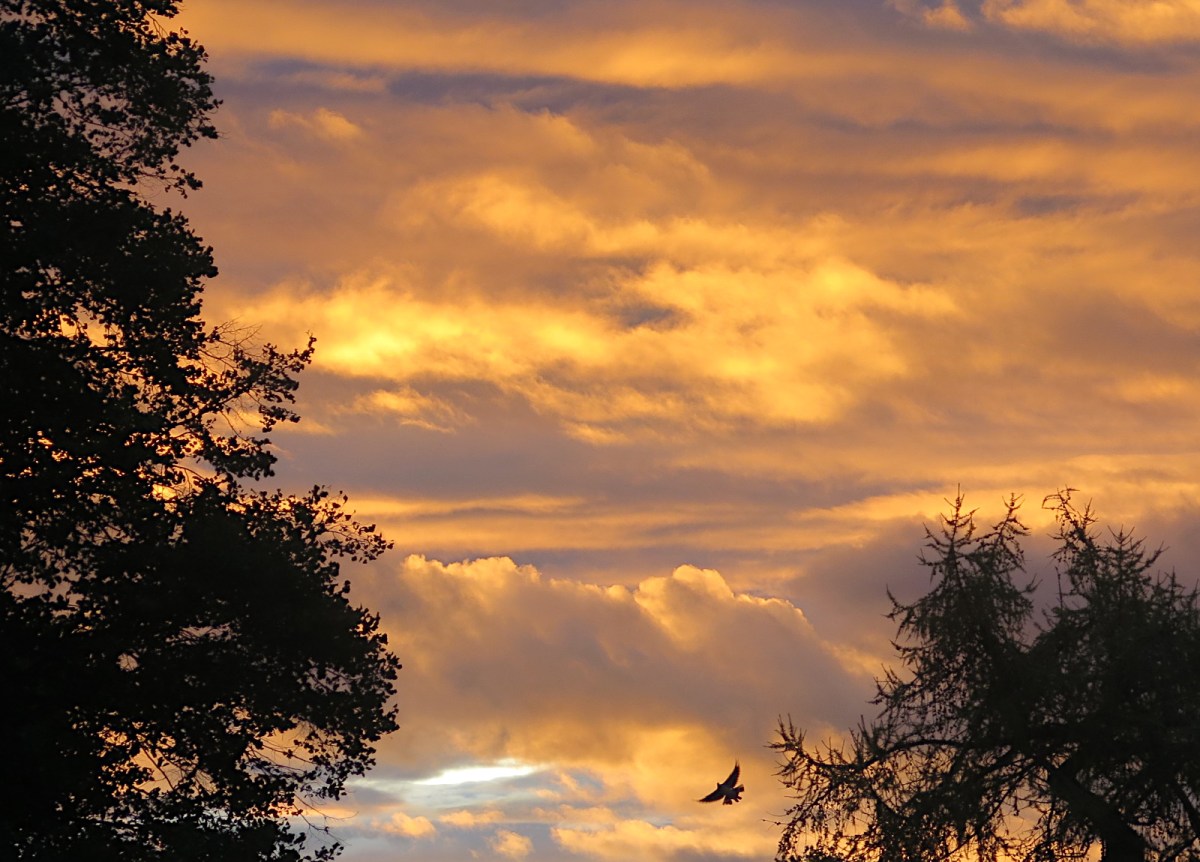
Quite by chance, as I clicked the exposure, a bird flew out of tree and the shot automagically composed itself! It looks like something from the Jurassic, a flying dinosaur with four wings.

< Previous | Index | Next >

What’s in an image? Sometimes quite a lot, more than meets the eye. I’m posting an image every two days or so.

Click to enlarge

For the next few photos, I’m going to leave the series on our Irish holiday, and the series on Cirencester, and instead just focus on images I love (pun only slightly intended).

Let’s start with this photo of a sunset seen from my study window. Quite by chance, as I clicked the exposure, a bird flew out of a tree and the shot automagically composed itself! It looks like something from the Cretaceous, a flying dinosaur with four wings, or a raptor that’s just snatched some unlucky feathered prey. Anyone have other opinions on ID?

The intended subject was the sunset, it was very spectacular and deserved to be recorded. The clouds were luminous, truly breath-taking and the photo fails to do them justice. In my experience that’s often the case with sunsets, the contrasts are too wide so details are lost both in the brightest and darkest areas; to show those details you have to compromise on the contrast – you really do need both. The Earth’s atmosphere scatters short wavelength blue light and that’s why the sky appears blue and is darker at higher altitudes (most of the air is below). While at sunset or sunrise the light takes a long, grazing path to your eyes and the blue scattering along that path leaves mostly oranges and reds.

Favourites

For convenience, here’s a list of my favourite images:

Anemone, Cloud, Honeybee, Hydrangea, Kiftsgate1, Kiftsgate2, Large White, Mugshot, Nelson, Robin, Rose, Spilhaus, Sunset1, Weston beach

Themed image collections

The links below will take you to the first post in each collection

Cirencester, Favourites, Irish holiday 2024, Roman villa

< Previous | Index | Next >

Useful? Interesting?

If you enjoyed this or found it useful, please like, comment, and share below. (If you don’t see those links, click the article’s title above the main photo and they will appear.) Send a link to friends who might enjoy the article or benefit from it – Thanks! My material is free to reuse (see conditions), but a coffee is always welcome and encourages me to write more often!

The Starship System

SpaceX will want to repeat the launch and landing of a booster at least monthly and then weekly going forward.

SpaceX has just made history by catching a returning Superheavy booster in mid air. Not only is this a milestone for SpaceX and a milestone for spaceflight in general, it was achieved on the first attempt.

Larger view, still from Marcus House video

The now well-known US space company, SpaceX, has made history multiple times, and now they’ve done it again. On 13th October 2024 they launched their Super Heavy booster carrying a Starship on top, this from their private factory/launch site complex at Boca Chica on the coast of Texas right next to the US border with Mexico.

What was new for this 5th test flight, and quite astonishing, was the fact that the booster rocket returned from the edge of space to Boca Chica, and was caught by the launch tower that it had left less than nine minutes earlier. That was time enough to deliver Starship to space, and return. Nobody has ever caught a returning rocket stage before – it’s a world first. And the Super Heavy booster is no lightweight, even empty of fuel it weighs 500 tonnes and it’s the world’s largest launch vehicle. Not only that, once in space Starship accelerated to orbital velocity, flew right across the Caribbean and the Atlantic, across Africa and much of the Pacific, and made a landing with pin-point accuracy in the Indian Ocean.

Why is this useful?

Quite simply, the long term goal is to launch, refuel, and launch again – several times a day. So one reusable booster and an adequate fuel supply could put several Starships into Earth orbit in a single day. Starships are intended to be developed for several different purposes, one of these will be a tanker that can refuel another Starship in orbit and return to Earth empty for another load. Several refuelling trips (at least eight) would result in a fully fuelled Starship in orbit, sufficient to deliver 100 tonnes of cargo or perhaps 50 crew members almost anywhere in the Solar System. (SpaceX claims 150 tons or 100 crew, but we’ll see. I remain conservative in my expectations.)

NASA has already chosen Starship as its human landing system for the return to the Moon. A fully fueled Starship-based Moon lander could collect several astronauts from NASA’s projected lunar space station, carry them and a lot of supplies to a Moon landing, and still have sufficient fuel for the return trip to the NASA Station and on to Earth for recovery and reflight. Today’s booster return was a necessary requirement for this plan to proceed.

What’s next?

Big improvements and lots of practice, that’s what comes next. SpaceX will want to repeat the launch and landing of a Super Heavy at least monthly and then weekly going forward. They will need to make improvements to the boosters until they can be safely and frequently re-used. They will also want to fly Starship into full orbits of Earth and practice re-entry and catching for those too. The heat shield for Starship needs improvement but the next version is already in production and incorporates some of the required changes. Then they will need to fly Starship with cargo (almost certainly the new, larger version of the Starlink satellites) until its safety record is good and it has proven reusability.

After that, they need to design, build and test the tanker and the lunar landing versions of Starship. Next comes flying astronauts to the Moon, and probably in parallel with that, landing cargo on Mars in preparation for sending crew there. This is all a huge ask, but SpaceX keeps surprising us. Can they do it? I don’t know, but if anyone can, SpaceX can.

See also:

Useful? Interesting?

If you enjoyed this or found it useful, please like, comment, and share below. (If you don’t see those links, click the article’s title above the main photo and they will appear.) Send a link to friends who might enjoy the article or benefit from it – Thanks! My material is free to reuse (see conditions), but a coffee is always welcome and encourages me to write more often!

Image of the day – 69

I don’t know the age of this house, but it is clearly a timber-framed structure and some of those main timbers have adjusted comprehensively to the action of gravity over several centuries.

< Previous | Index | Next >

What’s in an image? Sometimes quite a lot, more than meets the eye.

I’m posting an image every two days (or as often as I can). A photo, an image from the internet, a diagram or a map. Whatever takes my fancy.

Click to enlarge

Here’s Cirencester’s wonkiest house – well, one of them. Until the 18th century, many buildings would have been constructed of timber, and we all know that timber is prone to warp even after seasoning, and it also responds to pressure and stress by slowly changing its shape.

Modern engineered wooden products generally avoid these issues. For example, plywood is in layers with the grain running in different directions from layer to layer. A thin sheet of wood is weak along the line of the grain, in that direction it will split easily when bent. But it will resist bending and splitting if rotated 90°. So multiple sheets glued together can be strong in all directions.

A timber-framed house

I don’t know the age of this house in Dollar Street, but it is clearly a timber-framed structure and some of those main timbers have adjusted comprehensively to the action of gravity over several centuries. Look at the glazing in the windows, for example, compare the windows with their fellows, side-by-side and up and down. See what I mean? At some point a layer of render was added to hide and protect the timbers so these are no longer visible.

The building is unoccupied at present, but I imagine it’s safe enough. Imagine how the new owners in due course will struggle to make right-angled furniture fit into walls and floors at odd angles

What about us?

Are we sometimes a little bit like this house? Do the pressures of life, sustained over years, even decades, cause us to be a little distorted? Is it difficult for other people with their right-angled opinions and requirements to fit into our expectations given our out-of-true alignments? Is the truth about us sometimes plastered over and hidden from view?

Or might it be the other way around? Am I, are you, straight and true and the fault lies with everyone else?

Cirencester

For convenience, here’s a list of all the Cirencester area images:

A417 roadworks, Advent Market, Bishops Walk, Baunton, Canal 1, 2, Castle Street, Christmas lights 1, 2, Church 1, 2, 3, 4, 5, 6, Churn flood, Countryside, Fallen tree, Fleece, Gasworks, Gloucester Street, Hare 1, 2, Hospital, Market Place 1, Phoenix Fest, Riverside Walk, Stone plaque, Stratton Meadow, Tank traps, View, Wonky 1, 2, Yellow Iris

Themed image collections

The links below will take you to the first post in each collection

Cirencester, Favourites, Irish holiday 2024, Roman villa

< Previous | Index | Next >

Useful? Interesting?

If you enjoyed this or found it useful, please like, comment, and share below. (If you don’t see those links, click the article’s title above the main photo and they will appear.) Send a link to friends who might enjoy the article or benefit from it – Thanks! My material is free to reuse (see conditions), but a coffee is always welcome and encourages me to write more often!

The Wayback Machine

So let’s look at some examples… But do bear in mind that the retrieval process may be quite slow. Time travel takes time.

Time travel would be interesting, but we can be pretty sure it can’t be done. However, history lets us visit the past in a sense. And when it comes to the web, there’s always the amazing Wayback Machine.

The Wayback Machine archives websites and stores them for future use, and anyone can use it to see past versions of sites, or visit sites that are no longer available. Also, anyone can enter a web address and ask for it to be archived.

The Wayback Machine has had a torrid time with DDoS attacks and data theft over the last few weeks, but it’s all fixed and working again as of 14th October (though in read-only mode for the time being).

So let’s look at some examples. Click the links below to check them out, but do bear in mind that the retrieval process may be quite slow. Time travel takes time:

Why not explore some old websites for yourself? Just visit web.archive.org and search for a website you like or one that no longer exists.

What serious uses does it have?

The Wayback Machine (or Web Archive) serves a number of useful purposes beyond viewing old versions of websites for fun.

  • Historical research
  • For checking accountability
  • Verification
  • As legal evidence
  • Viewing websites that no longer exist

For further details, read the Wikipedia article on the Wayback Machine.

Useful? Interesting?

If you enjoyed this or found it useful, please like, comment, and share below. (If you don’t see those links, click the article’s title above the main photo and they will appear.) Send a link to friends who might enjoy the article or benefit from it – Thanks! My material is free to reuse (see conditions), but a coffee is always welcome and encourages me to write more often!

How life begins

The gap has been closing little by little from both the astronomical and biological sides. But though it’s narrower now than ever before, it’s still a gap.

How did life begin? It seems possible, even very likely, that simple chemistry has the potential to generate life given the right conditions and plenty of time.

There’s always been a big puzzle over the origin of life here on Earth. Life is everywhere and in a vast array of forms. From the simplest archaea and bacteria, to the giant redwood and the humble grass in the field, the blue whale down to the smallest mite. So rich in variety, so wide in its presence from the deepest oceans to the highest mountains. Life is amazing!

The processes of evolution are well understood and impossible to deny; so puzzles over the many forms of life, its adaptability, and changes in the forms we see coming and going over deep time are clearly understood and well explained by biologists. (When did you last see a dinosaur?)

But how did it all start?

Ah! That has always been the unexplained mystery. Once we have a simple, replicating form of life on the planet we can see it might thrive, spread and grow in complexity.

There are various proposals. Perhaps it arrived in an asteroid kicked off Mars or somewhere else. But that does no more than move the origin to a different place in the Solar System. Maybe it all began at mid-ocean ridges where hot mineral-laden springs flow from hot rock layers below the surface. Perhaps, yes.

We know that many of the precursors for life exist out among the stars. Here in the Solar System, comets and asteroids are often richly endowed with amino acids, ribonucleotides, and all sorts of smaller precursors. These are the building blocks of proteins, RNA, DNA and so forth. We understand how these precursors can form spontaneously given simpler materials like water, methane, ammonia, compounds including atoms of phosphorus, sulphur and so forth. It just takes chance interactions, time, and a source of energy like ultraviolet light. The basic ingredients are there in the gas clouds that condense to form new stars and the material orbiting in disks around them.

All of these things are fairly well understood, but there’s a gap in our understanding between the presence of the components and the presence of life. The gap has been closing little by little from both the astronomical and biological sides. But though it’s narrower now than ever before, it’s still a gap.

Life in a computer?

Well, yes! And, no.

Some clever work by Blaise Agüera y Arcas, a Google vice-president of engineering, has uncovered an intriguing process. Setting a very simple ‘machine’ running random code (no meaningful program whatsoever) and waiting for something to happen, shows that eventually some very simple self-replicating code will appear in the system, and once it exists it replicates very quickly and then slowly increases in complexity. It’s not biological life of course, but it has all the qualities that we would recognise as lifelike. It replicates itself, different forms of replicating code compete with one another, they evolve, and they grow more and more complex. This doesn’t show us in any detail how biological forms got started, but it demonstrates that self-replication could happen in principle, and given enough time that it’s almost inevitable.

For the detail and background you should listen to Sean Carroll interviewing Blaise, the conversation is absolutely fascinating.

See also:

Useful? Interesting?

If you enjoyed this or found it useful, please like, comment, and share below. (If you don’t see those links, click the article’s title above the main photo and they will appear.) Send a link to friends who might enjoy the article or benefit from it – Thanks! My material is free to reuse (see conditions), but a coffee is always welcome and encourages me to write more often!