Image of the day – 21

The plant, on the other hand, is a living organism. Nobody designed or manufactured it – life is much more wonderful than that!

< Previous | Index | Next >

What’s in an image? Sometimes quite a lot, more than meets the eye.

I’m posting an image every day (or as often as I can). A photo, an image from the internet, a diagram or a map. Whatever takes my fancy.

It’s quite amazing how life clings on, even in the most adverse circumstances. This plant was growing in my front drive, somehow finding a way to get its roots into a narrow gap in the block paving. The blocks were designed by a garden landscaping company and manufactured to particular standards of hardness and resistance to my car rolling over them. They were designed to last.

The plant, on the other hand, is a living organism. Nobody designed or manufactured it – life is much more wonderful than that! The universe we live in is tailored to build ever more complex things from very simple beginnings. A handful of quantum fields is all it takes, and these are exquisitely able to give rise to fundamental subatomic particles. These group together, eventually settling into simple atomic nuclei. As the universe expanded and cooled, atoms of simple elements appeared, almost entirely hydrogen and helium. Stars condensed and formed heavier elements up to iron. I could go on, but it’s a long story! Maybe some other time?

For now, just consider the battle between order (my paving blocks and the urge I have to remove weeds that neither I nor my wife want to see growing there) and disorder (weeds thriving wherever they can, despite my best efforts). Life always wins in the end, it seems!

Themed image collections

The links below will take you to the first post in each collection

Cirencester, Favourites, Irish holiday 2024, Roman villa

< Previous | Index | Next >

Useful? Interesting?

If you enjoyed this or found it useful, please like, comment, and share below. My material is free to reuse (see conditions), but a coffee is always welcome!

Human origins

Theorists can move forward again – and the picture seems a little more complicated than we thought.

Where did we come from, and how? We’ve long thought in terms of an evolutionary ‘tree’, but our origins in Africa are more like a braided channel. This idea provides a better fit to the data.

Based on fossil evidence alone, studies of human evolution have long agreed that modern humans evolved in east Africa and radiated out from there. But with the development of cheap, fast and reliable DNA evidence from modern populations, and DNA from fossil teeth and bone samples, it’s becoming clear that theorists can move forward again – and the picture seems a little more complicated than we thought.

Human dispersion, events described in the article all took place in Africa – Image from Wikimedia

On 17th May, Ragsdale and others published a research paper in Nature; ‘A weakly structured stem for human origins in Africa’; their evidence suggests evolutionary connections in populations that were separated for a while before recombining. So instead of an evolutionary tree (which most people were expecting) it seems that our human past is more like a set of braided channels.

Previous views on human evolution proposed a tree structure (branching but not recombining). However, the new ‘weakly structured stem’ model fits the data better than a tree model. It also explains the diversity of genetic forms in modern human populations, and shows that there is no single place in Africa where humans ‘originated’. After this process within Africa, humans spread out as show in the map.

See also:

Elephant hawk moth

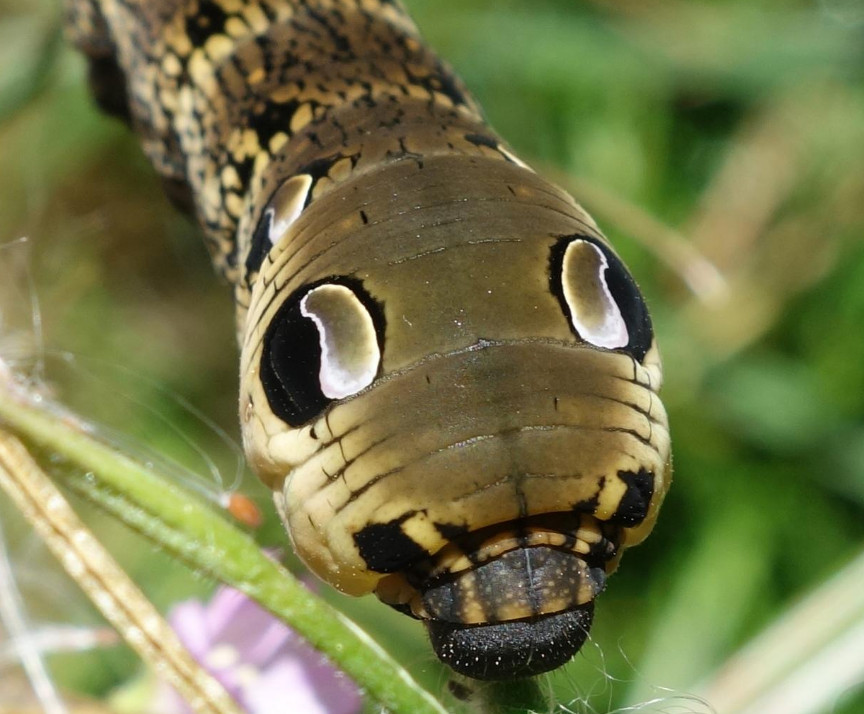
The caterpillar did something extraordinary – it mimicked a small snake

Have you ever seen an elephant hawk moth? If you live in Europe or Asia you might have spotted one of these amazing insects. In the United Kingdom they are fairly common, but perhaps not often seen. It’s a real treat to spot an adult or a caterpillar, both are amazing sights.

An elephant hawk moth male (credit: Wikipedia)
The circle marks the spot (credit OpenStreetmap)

Walking in the Cotswold Water Park recently, near the Gateway Centre on Lake 6, we spotted an elephant hawk moth caterpiller crossing the footpath (close to the grey circle in the map.

For a short time we just watched as it made its way across the path. But before it made it to the vegetation on the far side, some people appeared with a dog. The dog ran up enthusiastically to greet us and accidentally kicked the caterpiller before running off again. The caterpillar did something extraordinary – it mimicked a small snake.

Am I a caterpillar, or am I a snake?

The caterpillar crossing a stony path

For perhaps 20 seconds or so it writhed its body in a convincingly snakelike movement, and it pumped up several body segments behind the head, tucking its head down at the same time. With eye spot markings on its flanks, a scaly pattern on the entire body, and by raising up the front part of the body, it really did look the part. I wasn’t fast enough to get a photo, but I did get some video of the recovered caterpillar continuing on its way afterwards.

Searching the internet later, I found several good images of the caterpillar mimicking a small snake. Perhaps the best of these is show below.


The caterpillar looking very much like a snake (credit iSpot)

The natural world is so amazing, and so full of surprises, but mimicry is quite a common feature in both plants and animals. The European white dead-nettle has leaves that cannot sting but match the appearance of the unrelated stinging nettle very closely. Some insects look like pieces of wood, or a leaf, or a patch of white lichen, or a bird dropping. Many slugs look very much like animal droppings of various kinds, and as they move so slowly only an alert predator is likely to notice them. Predators, too, use camouflage which is not truly mimicry, but helps them merge into dappled sunshine and shade. Fish are often dark on top and silvery underneath. Sometimes they are patterned and look like the gravel bed of a stream or river.

Amazing!

See also: