Life, death, resurrection

Unlike life, death is stable. It’s not often that you see a dead body come alive again. That would be resurrection, it’s not something that we expect to see happening regularly (or at all)!

Snowdrops, new every year

ad hoc post – 6

< Previous | Index | Next >

Snowdrops

I’m writing about these three topics in obedience to a prompting from the Holy Spirit. I need to say that at the outset. And I think I’m going to need to create two versions, one for people who are following Jesus, and another for people who have no idea what I’m talking about. I’m going get stuck right in, please bear with me; my hope and prayer is that there’ll be something here for everyone.

For those who have no idea

We all know what life is, or at least, we think we do. Life is a metastable state. Let’s define ‘metastable’ – Imagine a pencil lying near the centre of a table; if you push it a little it will move across the surface but it won’t fall over. It can’t! (unless you push it so far that it reaches beyond the edge of the table it is always fully supported on the table’s surface. That pencil is a stable object.

Now take the pencil and stand it up on it’s point. Let it go and it will fall over. A pencil standing on its point is unstable.

Now take the pencil and stand it on the table with its point uppermost. If the pencil has a good, flat end and the table surface is even and horizontal, you will be able to do this with a little care. Now push the pencil point sideways a tiny amount and then release it, it’ll wobble a bit but then remain standing and settle down. But push it beyond a certain amount and it will fall over. That’s metastable, the pencil can cope with a tiny movement, but push it too far and it’ll fall over.

Life is like that, it’s a metastable condition. Most of the time we live day after day as the weather changes, sometimes warmer, sometimes cooler, sometimes wet, sometimes dry. Put us in a place too hot, too cold, too dry (a desert), or too wet (an ocean) and we will die. Not immediately, perhaps, but push us too far, and like the point-up pencil, we’ll fall. Life is metastable. All of us will die eventually, if not of overheating or drowning, then eventually of old age. It’s not normal to live for ever.

Unlike life, death is stable. It’s not often that you see a dead body come alive again. That would be resurrection, it’s not something that we expect to see happening regularly (or at all)!

That’s about all there is to say to the ‘No idea’ group.

For those following Jesus (or might like to)

Jesus had some really interesting things to say about life. He reminded people that life is metastable, but without using that term. He claimed that there is a different kind of life, a spiritual life parallel to biological life, a life that is stable rather than metastable, a life that has the potential to be stable as either permanent life or permanent death. And he further explained that we can choose either permanent condition.

These claims don’t make sense, do they? I’ve stated them as simply and straightforwardly as I can. I should add that these deep truths cannot be grasped by intellect or understood by logic. They are, I suspect, completely distinct from the physical world and from the rationality of mind and brain. These things are unmeasurable and indescribable, available only through faith, hope, and love.

So if you want to explore further, faith, hope and love are the tools you will need to do so. Faith is a mysterious idea, quite hard to pin down or explain. Hope is something we all have, though perhaps we all hope for slightly different things. But love is the most important and the strongest of the three, it’s the one key you truly need to unlock resurrection (a return to life) and to grasp the enormous benefit of permanent life and the desperate state of permanent death. So take love as the starting point. If you are new to all this, Henry Drummond is a good guide and companion on the exciting journey that lies ahead.

See also:

< Previous | Index | Next >

Useful? Interesting?

If you enjoyed this or found it useful, please like, comment, and share below. My material is free to reuse (see conditions), but a coffee is always welcome!

You might also like:

Tree shading

Put an upturned bucket over a patch of grass in your garden. Lift the bucket every day and take a look, then re-cover the patch… How long does it take for the grass to die?

< Previous | Index | Next >

Image of the day – 178

What’s in an image? Sometimes quite a lot, more than meets the eye. I’m posting an image every few days.
Click to enlarge

Trees provide shade, most welcome on a hot day, and they provide shelter when it rains (though this may be unwise during thunderstorms).

But notice the absence of grass beneath these conifers. Shade and shelter are exactly what other plants don’t need; they depend on plenty of light and water to enable them to grow. Light is essential as it provides the energy to split water into hydrogen and oxygen, and water is essential as the raw material for this process. The oxygen is released into the atmosphere, while the hydrogen is bonded with carbon dioxide from the atmosphere to make energy-storing sugars for use at night and to build cellulose, the main support molecule that gives stems, branches and tree trunks their strength.

The lack of light and water under tree canopies creates a kind of local desert. You can see this clearly in the photo from the presence and absence of grass. So how do the trees survive? That’s a great question! Their roots spread out widely and deep, far enough to reach moist soil and deep ground water. In persistent rain, water drips from the drenched leaves above. And root, trunk and branch all contain stores of water so a tree can cope with a long, dry summer far better than the grass can.

Light

Here’s an experiment anyone can do. Put an upturned bucket over a patch of grass in your garden. Lift the bucket every day and take a look, then re-cover the patch. See how long it takes for the grass to turn yellow. How long does it take for the grass to die?

For plants, light is essential. There are some animals that live in dark caves or underground, with no light. Earthworms are a good example, but like all animals they get their food by consuming plants and other animals. But for most creatures, including us humans, light is essential nonetheless. Whether we are plant eaters (like cows and sheep) or meat eaters (like lions and wolves) or omnivores eating either or both (like humans and rats) we still need light to see in order to find and identify the things we must eat to stay alive.

Water

For plants, water is part of their ‘food’, it’s needed to make sugars. For animals water is of no value as food, but it’s essential to prevent dangerous dehydration. All animals know when they’re thirsty and they’ll find water and drink to keep themselves alive. Think of a man lost in a desert, the cartoons have him croaking out, ‘Water.. Water..’ Imagine someone unable to find water, they’d die of thirst long, long before they died of hunger. Most of us would be in danger after a few days without drinking, but we could live for several weeks with nothing to eat. And of course, if you are a fish too little water would mean you couldn’t breathe, and if you were a land animal too much would mean you would drown.

Spiritual (not religious)

The idea of essentials has been carried over into spiritual ideas too. Light and water (and food) are so clearly necessary for life that they make good analogies and illustrations. What did Jesus mean when he said, ‘I am the way, the truth and the life’? Or when he explained to the Samaritan woman at the well that he would provide water that never runs out, or when he told his followers, ‘I am the bread of life’ or ‘I am the light of the world’?

He was simply saying, I am essential, you can’t live without me. I’m necessary for life. Just as in the physical world, how would it feel to live in the dark, without water and without sustenance? How long would you last? How long would I last?

Many people today feel sure there is no spiritual aspect to life at all, it’s just about living your life in the here and now and then dying from accident, illness, or just old age. Others think there’s much more to life than that. At the very least there are moral and philosophical truths to consider. We should care for one another, help one another, and cooperate in helpful and kind ways.

Food for thought. Let me know below how you think about the essentials of life. Do you have any thoughts to share on this?

See also:

< Previous | Index | Next >

Useful? Interesting?

If you enjoyed this or found it useful, please like, comment, and share below. My material is free to reuse (see conditions), but a coffee is always welcome!

You might also like:

Cloud reflection

Just from this image the brain understands there are ripples on the surface of the water and from past experience will also know that these ripples will be moving.

< Previous | Index | Next >

Image of the day – 176

What’s in an image? Sometimes quite a lot, more than meets the eye. I’m posting an image every few days.

Click to enlarge

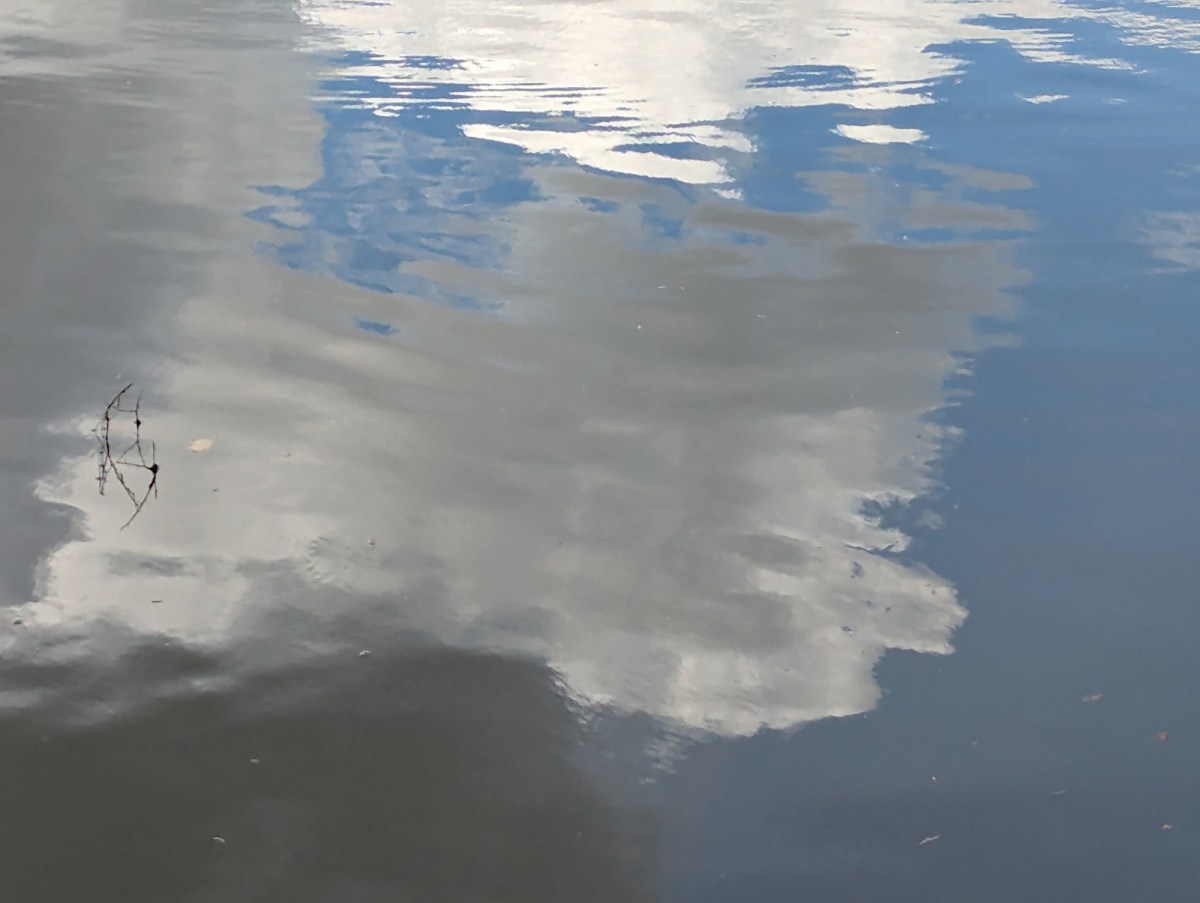
Sometimes we see things indirectly, and our brains are capable of retrieving far more information than you might at first think. It’s true of all our senses – hearing, touch, taste, smell and all the rest. The senses provide information but the brain makes much more of it all.

What do we see in this image? It’s just a pattern of coloured patches reflected from a water surface. That’s what the eye sees. But the brain tells us there are clouds in the sky above and there are ripples on the water. Then the brain compares this basic information with what it recalls from past experience and it can construct two narratives, one for the clouds and another for the water.

The clouds

There is a dark cloud and it’s the closest one to us, it threatens a shower of rain. A second image taken a few seconds later would be enough for the brain to decide the direction of movement of the cloud and predict whether the rain might fall here or somewhere else. Paler clouds, white clouds and blue sky suggest there’s some sunshine around as well so although there might be a brief shower, it won’t turn into ongoing steady rain. All of that from from a few colour patches.

The water

Because of the way the cloud reflections are distorted, the brain can infer the water is neither heavily disturbed not completely calm. Just from this image the brain understands there are ripples on the surface of the water and from past experience will also know that these ripples will be moving. The same brain will realise that there are two likely causes; either there is a light breeze blowing or perhaps a boat has passed recently. Once again, past knowledge in memory is necessary to arrive at these conclusions. There are some large ripples and, near the top of the image, some much smaller ones too. There was a small disturbance in the water further away as these small ripples seem to form an expanding circle of which we see only a small part.

Here and there things are floating on the water, small leaves, perhaps? If so, there must be trees nearby, perhaps with branches overhead. What a lot the brain can reconstruct on the basis of prior knowledge! And all of these conclusions come from some patches of colour in a still image. And what about the little sticks emerging from the water on the left-hand side? It’s the remains of vegetation of some kind. Was there a plant growing in the water? Did a strong wind break twigs off an overhead tree branch?

And one last point – it was not raining at the moment the photo was taken. The water would have been covered with dozens of circular disturbances if rain was falling. That’s a lot of information that your eyes and brain can glean from a single fragment of time trapped by my camera!

We are, as the Bible expresses it, fearfully and wonderfully made (Psalm 139:14).

See also:

< Previous | Index | Next >

Useful? Interesting?

If you enjoyed this or found it useful, please like, comment, and share below. My material is free to reuse (see conditions), but a coffee is always welcome!

You might also like:

The Lake District

We cannot know exactly what this area would have been like when it was full of active volcanoes, but we can get a rough idea from modern subduction regions on Earth today. Under the Mediterranean, for example, the African plate is being subducted underneath the plate carrying Europe.

< Previous | Index | Next >

Image of the day – 173

A force on Stock Ghyll

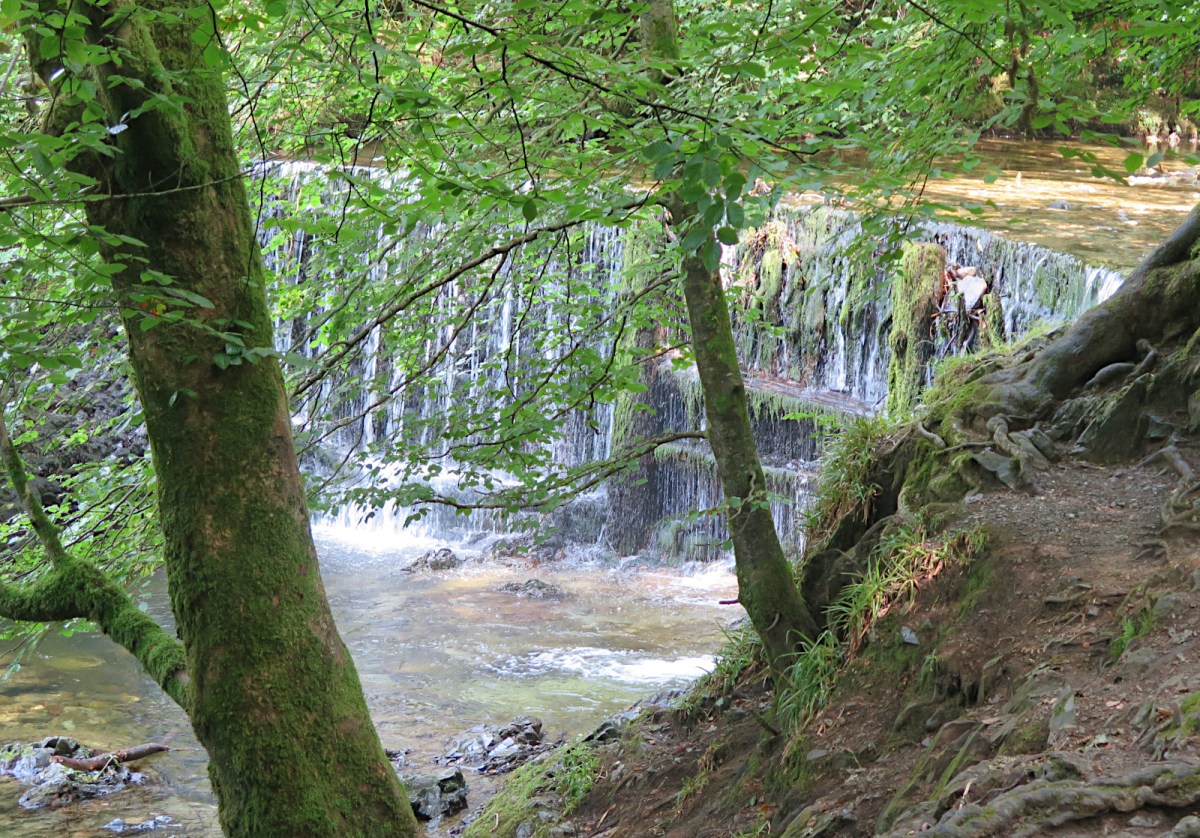
This is one of the waterfalls along Stock Ghyll just north-east of Ambleside, Cumbria in the English Lake District. It’s beautiful countryside, and the nearby Force Cafe and Terrace served us a wonderful ‘Full Force’ breakfast. In the local dialect, a waterfall is known as a ‘force’, and there’s a whole string of them along this stretch of Stock Ghyll. A ghyll or gill is a narrow, deep, wooded ravine with a stream running though it. The term can also be used for the stream itself. Donna and I made our way carefully along this muddy, stony footpath, and it was well worth the effort.

Stock Ghyll runs right down into the town of Ambleside where it once powered a series of watermills, and finally flows into the nearby lake of Windermere.

Bobbin mills

Bobbin mills were common in Ambleside in the 19th century. Coppiced timber was cut to length and shaped on a lathe, then wooden discs were attached to both ends and the completed bobbins sold to the textile spinning and weaving businesses in the industrial cities south of the Lake District where they were used to store thread after spinning and before weaving. They contributed to the rapid growth of spinning and weaving factories in northern England. Wooden bobbin manufacturing died out with the 20th century introduction of plastics.

Formation of the Lake District

Skiddaw in the distance

The granite structures of the fells and mountains of the Lake District erupted from volcanoes during the Ordovician period some 460 million years ago.

Much more recently, repeated glaciations ground out U-shaped valleys arranged more or less radially and when the glaciers melted during warmer periods, lakes remained in the valley bottoms. Rivers flowing into the lakes or sometimes from one lake to another, have silted up some of the lakes at one end, and these flat, silted zones are now rich areas of pasture and crop land as well as places where urban construction has become possible. The photo above shows the mountain of Skiddaw in the distance and farmland in the foreground. The town of Keswick, out of the frame to the right, is also built on this flatter land laid down as sediment in the northern part of Derwent Water.

What else can we learn

One thing is very clear, what happens in one time period may be changed drastically at another, later time.

We cannot know exactly what this area would have been like when it was full of active volcanoes, but we can get a rough idea from modern subduction regions on Earth today. Under the Mediterranean, for example, the African plate is being subducted underneath the plate carrying Europe. The Alps and the Pyrenees have risen as a result, and volocanoes like Etna and Vesuvius are still actively pumping out magma or ash. The Mediterranean region is also prone to earthquakes. Now imagine (if you can) a mile or more depth of ice resting on top of the Alps grinding down the rocks to form U-shaped valleys as they slide due to gravity across the rock surface far below.

In Roman times, the areas of river sediment like that in the photo above would have been smaller than they are today and the lakes would have been correspondingly longer.

It’s very much a dynamic process. It’s a bit like the life of a person, we start as a new born infant and learn to talk and walk, then run. We learn to eat, and we learn to reason. at school we learn a lot more about the world we live in, politics, science, other languages, geography, history; we fall in love, we marry and raise a family; we have a career and learn how to manage the work environment, run a business, serve customers, manage bank accounts and so forth. The world is our playground, we travel on business or just for fun, we become grandparents as we grow older and retire from work. There are many beginnings and endings along the rich tapestry that is a human life. And lives intertwine in so many ways – friends, family, work colleagues, neighbours. Just like the Lake District, at any point it’s impossible to know what the future might hold.

Life is the same. What happened in my life when I was young is very different from what is happening in my life today. Change and unpredictabilty are the only things that are consistent throughout. If the ice hadn’t melted when it did, the Lake District would be far different from the place we know and love.

How do we deal with this built-in uncertainty? One way that many have found is faith, following a guide that we trust in ways that stretch us and help to shape our characters. Faith can be like an anchor in a choppy sea or even a full-blown storm, holding us safely in the right place until calmer conditions return. I recommend having an anchor in this experience we call life. But if you choose an anchor, choose carefully, there are some pointers elsewhere on this website. Hunt around and see if there’s anything here that you find attractive or compelling.

I’m always fascinated by links and similarities between one thing and another, life is full of them and sometimes they help to broaden our vision and understanding in ways that are quite unexpected.

See also:

< Previous | Index | Next >

Useful? Interesting?

If you enjoyed this or found it useful, please like, comment, and share below. My material is free to reuse (see conditions), but a coffee is always welcome!

You might also like:

Living fossils

Living fossils can be found and recognised over long periods of geological time, and appear very similar throughout. And they may have little diversity, in other words the species in the group all tend to be similar to one another.

Leaves of Ginkgo biloba, the Maidenhair tree

< Previous | Index | Next >

Image of the day – 172

Every now and again biologists discover a plant or animal that looks uncannily like a known fossil. It’s happened a number of times.

Ginkgo leaves Wikimedia

Living fossils have two main characteristics, although some have a third:

  1. Living organisms that are members of a taxon that has remained recognizable in the fossil record over an unusually long time span.
  2. They show little morphological divergence, whether from early members of the lineage, or among extant species.
  3. They tend to have little taxonomic diversity.[5]

The first two are required for recognition as a living fossil; some authors also require the third, others merely note it as a frequent trait.

To put this more simply, Living fossils can be found and recognised over long periods of geological time, and appear very similar throughout. And they may have little diversity, in other words the species in the group all tend to be similar to one another.

Here are some examples, listed in order of their discovery. In some cases the fossil organism was already known before a living form was discovered, in other cases the living form was known first:

  • Dinoflagellates (1753, worldwide in salt and fresh water)
  • Ginkgo or ‘Maidenhair tree’ (1800s or before, southwestern China)
  • Echinothurioida or ‘Soft sea urchins’ (1870s, southern England)
  • Eomeropidae or ‘Scorpion flies’ (1909, southern Chile)
  • Coelacanth there are two living species (discovered in 1938 in the Indian Ocean) and (late 1990s off Indonesia).
  • Metasequioa ( discovered in 1941 in Hunan, China)
  • Glypheoid lobsters (1970s, Philippines)
  • Jurodidae or ‘Jurodid beetles’ (1996, Siberia)
  • Mymarommatidae or ‘false fairy wasps’ (2007ish, North America)
  • Syntexis libocedrii or ‘cedar wood wasp’ (2011, California to British Columbia)

What else can we learn from this

Two things really. The first thing is that species can sometimes exist for very much longer than normal. And the second thing we learn is that species with astonishingly similar appearance may rise independently more than once. So-called fossil species may be no more than independently arising lines that happen to look very similar.We see the same thing between different living groups, so there’s a marsupial mouse that looks quite like its European namesake. This is known as parallel or convergent evolution.

See also:

< Previous | Index | Next >

Useful? Interesting?

If you enjoyed this or found it useful, please like, comment, and share below. My material is free to reuse (see conditions), but a coffee is always welcome!

You might also like:

Pasqueflower

Plants are available from garden centres and will grow happily in your garden given the right conditions. These plants belong to the buttercup family and are near relatives of the anemones.

< Previous | Index | Next >

Image of the day – 150

What’s in an image? Sometimes quite a lot, more than meets the eye. I’m posting an image every few days.

Click to enlarge

This makes it three in a row for flower images. The pasqueflower (Pulsatilla vulgaris) grows wild in the Cotswolds on dry grassland areas open to full sunshine. It was once quite common, and although not actually threatened, is something of a rarity these days. There’s a Cotwold dry valley site near Cirencester where there’s a reasonably large colony, but to keep the plants safe, the location is not advertised. However, plants are available from garden centres and will grow happily in your garden given the right conditions. These plants belong to the buttercup family and are near relatives of the anemones.

Protecting endangered or rare species (both plants and animals) is of ever growing importance. There are several ways species come under pressure and we’ll look at those first.

Challenges to survival

Habitat loss is the primary cause of decline for many plants, including the pasqueflower. Land improvement, especially the use of fertilisers to increase crop yields, is an issue for plants adapted to poorer soils.

Physical removal of plants or hunting of animals is an issue too. Most species can cope with limited amounts of removal, but if population levels fall drastically, there are real dangers. The dodo died out on the island of Mauritius following hunting by European sailors. The flightless birds were unafraid as they had no natural predators, so they didn’t run away from their hunters. They were welcome fresh meat after weeks at sea on salt beef.

Ecological damage also causes harm, sometimes unexpectedly. After the dodo became extinct, a tree species mysteriously stopped reproducing. Gradually the population was reduced to only older trees. It turned out that the fruit contained toughly seeds with tough shells that would only germinate after passing through the gut of a dodo. Links like this between organisms can be critical.

Climate change is another danger, especially for plants. If climate change is slow organisms can change the range of places where they grow; if it’s fast, animals might adapt, but some plants may need an entire year to move a few metres.

Pollution is a further serious issue and can exacerbate the other problems already mentioned above.

Diseases of both plants and animals can become pandemic and risk extinction, especially when populations are already stressed by droughts, loss of habitat, or pollution.

Attitudes

Given all of the above, what should our attitude be to the current situation?

Some people will shrug their shoulders. – Perhaps they don’t understand the peril the world faces, or they don’t understand the need to help the natural world recover. Or maybe they just feel there is nothing they can do about it.

Others may understand enough of the science to realise there is a danger, to see that it can be reduced (if not entirely averted), and to take some personal actions to help.

Biologists, ecologists, nature enthusiasts, and climate scientists understand only too well what is happening. Usually, they will be trying to communicate the issues whenever and wherever they can.

Followers of Jesus, and people of other faiths will often understand that we should do all we can to protect this world we live in, and live in ways that will reduce the damage.

All of the groups mentioned here are either responding already, or need help to see and understand that the natural world needs our help and that every single one of us can make a difference. Education and commitment are the way forward, so please share this post with anyone you know who might be influenced by it.

See also:

< Previous | Index | Next >

Useful? Interesting?

If you enjoyed this or found it useful, please like, comment, and share below. My material is free to reuse (see conditions), but a coffee is always welcome!

You might like these posts too…

The heart of a tulip

I worked as a professional botanist when I was in my twenties and thirties, studying and publishing scientific papers on pollen and pollination.

< Previous | Index | Next >

Image of the day – 149

What’s in an image? Sometimes quite a lot, more than meets the eye. I’m posting an image every few days.

Click to enlarge

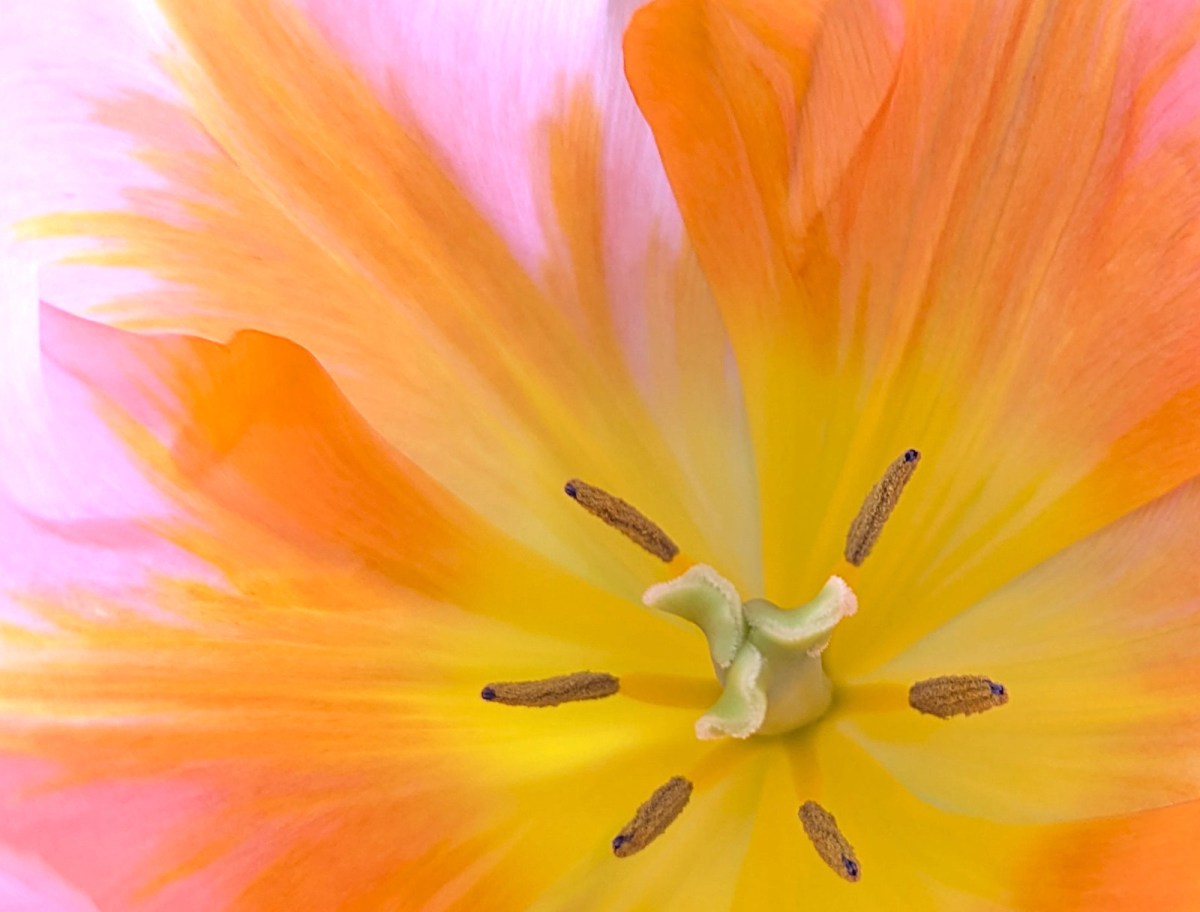
I have another flower image for you today. This one shows the centre of a tulip flower in more detail than you might normally see. I’ve placed the centre of the flower towards the lower right of the frame so you can see more of the petals towards the upper left. You’ll notice that the petals are yellow near the centre, orange a bit further out, and pink further out again. What a beautiful combination!

The reproductive parts

Tulips are monoecious, a botanical term that means each plant produces both male and female reproductive tissues. The female part of a tulip flower has three stigmas in the centre. Unlike animals and some more primitive plants, the male reproduction process doesn’t involve motile sperm. Instead, pollen is released as a yellow dust, sometimes dry and carried by the wind but in the case of tulips and many other plants, sticky and carried by flying insects.

Flowers work as attractive beacons for pollinating insects, they’re usually brightly coloured, are often fragrant which helps insects detect them from a distance, and provide food – sugary nectar at the base of the petals, and pollen. Bees collect the pollen and carry it back to the hive as a protein rich food for their larvae. Plants produce more pollen than necessary and can spare some in return for the pollen transport provided by the bees. The pollen grains stick to the pollinating insects and as they visit flower after flower, some of the pollen is transferred from the anthers of one plant to the stigmas of another. This cross-pollination is exactly what the plant needs for the female tissues to develop further and produce viable seeds.

Tulips have five of these anthers, and if you enlarge the image and peer closely you can see yellow dust clinging to them. That dust is the pollen.

Intricate

It’s an astonishingly intricate process in which the plants depend on the insects and the insects depend on the plants. I could go into much greater detail; I worked as a professional botanist when I was in my twenties and thirties, studying and publishing scientific papers on pollen and pollination. Maybe some time I’ll write a bit more about that.

Next time you see tulips in the park, at a florist or supermarket, or in your garden – just think about the intricate interactions going on right there!

See also:

  • Pollen – Wikipedia (contains a more detailed photo of a tulip anther with pollen, about ¼ of the way down the article. Hint: compare the Wikipedia photo with mine.)

< Previous | Index | Next >

Useful? Interesting?

If you enjoyed this or found it useful, please like, comment, and share below. My material is free to reuse (see conditions), but a coffee is always welcome!

You might like these posts too…

An old survivor

Much of the old tree would have survived for while, so the new shoot was shaded and would have grown out at an angle, attracted towards the light. Since then, the new growth has itself become a mature tree.

< Previous | Index | Next >

Image of the day – 138

What’s in an image? Sometimes quite a lot, more than meets the eye. I’m posting an image every day or so.

Click to enlarge

I spotted this old tree when we visited Blenheim Palace today. It’s probably an ancient oak though I didn’t get close enough to check with certainty.

The thickest part, the lumpy-looking base is the remaining stump, all that remains of the original tree that would have grown from an acorn many hundreds of years ago. That tree was a sapling, then a youthful, vigorously growing tree; eventually if became a mature, majestic oak. But then the rot would have set in – literally. Holes made by a woodpecker, or damage from a storm cracking off a branch, gave access to unprotected wood beneath the bark. Insects may have burrowed into the wood, and eventually fungal spores would have germinated and started the decay process in earnest.

The weakened tree would have lost its vigour and been reduced to a hollow stump and failing branches. But finally, a new shoot must have appeared near the base and formed new, young growth. Much of the old tree would have survived for while, so the new shoot was shaded and would have grown out at an angle, attracted towards the light. Since then, the new growth has itself become a mature tree.

Another possibility is that a branch of the original tree survived, and with the other branches missing, grew into the shape we now see. A careful examination of the tree might reveal the truth. But however this curious old tree survived, it certainly has an unusual story to tell!

Donna and I enjoyed our day at Blenheim and will visit again from time to time this year as the seasons roll by. I’ll probably write about the place again.

See also:

< Previous | Index | Next >

Useful? Interesting?

If you enjoyed this or found it useful, please like, comment, and share below. My material is free to reuse (see conditions), but a coffee is always welcome!

Image of the day – 27

In the natural way of things, each Aloe will produce an average of one new plant, and the population will remain in balance.

< Previous | Index | Next >

What’s in an image? Sometimes quite a lot, more than meets the eye.

I’m posting an image every day (or as often as I can). A photo, an image from the internet, a diagram or a map. Whatever takes my fancy.

Aloe aristata

Today’s picture is a close up of an Aloe aristata plant with a developing flower bud. All plants, animals, fungi, bacteria and even viruses have ways of reproducing themselves. That’s one of the defining characters of life of any kind. We can be absolutely confident that the same will be true of any life forms anywhere in the universe.

The Aloe flower bud will develop on a tall stalk and if the flowers that form are pollinated they will produce and release seeds that stand a chance of germinating and growing into new, similar, Aloe plants. In the natural way of things, each Aloe will produce an average of one new plant, and the population will remain in balance.

The only choices available to life are to survive for ever with no reproduction, or to live for a limited time and leave behind new versions to carry on the process. What life cannot do is live forever and reproduce: that would lead to overpopulation and catastrophic failure of resources. Even with reduced family sizes, the planet is no longer capable of supporting the billions of people on our planet. We face catastrophic population collapse due to lack of resources at some point unless we can reduce our population size in some other way first. That’s a matter of simple arithmetic, not a political statement or some kind of guesswork. If we don’t face and fix the issue, something else will sooner or later.

Themed image collections

The links below will take you to the first post in each collection

Cirencester, Favourites, Irish holiday 2024, Roman villa

< Previous | Index | Next >

Useful? Interesting?

If you enjoyed this or found it useful, please like, comment, and share below. My material is free to reuse (see conditions), but a coffee is always welcome!

Image of the day – 23

By cooperation and coordination they manage all the behaviours and activities that we see on the larger scale. 

< Previous | Index | Next >

What’s in an image? Sometimes quite a lot, more than meets the eye.

I’m posting an image every day (or as often as I can). A photo, an image from the internet, a diagram or a map. Whatever takes my fancy.

The fresh green of spring

There are few things as amazing as life. Perhaps there’s literally nothing as amazing as life in the entire universe! The photo shows the young, expanding leaves of a small-leaved lime tree (Tilia cordata).

Like all deciduous, temperate trees, leaf buds are formed the previous summer and over-winter after the old, mature leaves fall in late autumn. As temperatures increase in springtime, these buds swell and grow and the young leaves appear and expand. At first they’re a beautiful, pale green (lime green) but become a darker and duller shade as the days lengthen and they mature.

These processes all take place naturally in ways that are more complex than most of us might expect. Both plants and animal bodies are composed of countless tiny cells in much the same way that a large building might be made of bricks. Each cell is alive, contains a full copy of the organism’s DNA, and many of them have specialised roles to play. By cooperation and coordination they manage all the behaviours and activities that we see on the larger scale. So in some respects an expanding leaf is a lot like a growing community of people working together as a village or business. Having specialists makes it possible to do so much more, but cooperation becomes essential, not merely optional.

The rioting we’ve seen in some British cities in recent days has been disruptive and damaging to society as a whole. When the cells of an organism behave in uncoordinated and uncontrolled ways we call it a cancer. Rioting is a kind of cancer in a human society. We all know what happens when cancer becomes so widespread that the organism can no longer function. But organisms have ways of dealing with errant cells before they become overwhelming, and so do societies. Both police action and peaceful counter-demonstrations have been effective in controlling the UK riots in recent days.

Themed image collections

The links below will take you to the first post in each collection

Cirencester, Favourites, Irish holiday 2024, Roman villa

< Previous | Index | Next >

Useful? Interesting?

If you enjoyed this or found it useful, please like, comment, and share below. My material is free to reuse (see conditions), but a coffee is always welcome!