Image of the day – 90

Hidcote is an informally formal garden, if I can put it that way, while Kiftsgate is not formal at all. Both are full of surprises and delights at almost every turn.

< Previous | Index | Next >

What’s in an image? Sometimes quite a lot, more than meets the eye. I’m posting an image every two days or so.

Click to enlarge

Today’s photo was taken at Kiftsgate Court Gardens in the far north of Gloucestershire. The pool was designed for swimming, though today it’s just ornamental. Kiftsgate Court is a large house on the top of a local hill; the pool is below the house and has an amazing view across the valley to further hills beyond.

The people who lived here knew a thing or two about designing a wonderful garden. It’s right next to Hidcote, another marvellous garden and perhaps better known, but if you’re visiting one of them and have the time, try to see them both. They are both great but designed very differently, Hidcote is an informally formal garden, if I can put it that way, while Kiftsgate is not formal at all. Both are full of surprises and delights at almost every turn.

See also:
Favourites

For convenience, here’s a list of my favourite images:

Anemone, Cloud, Honeybee, Hydrangea, Kiftsgate1, Kiftsgate2, Large White, Mugshot, Nelson, Robin, Rose, Spilhaus, Sunset1, Weston beach

Themed image collections

The links below will take you to the first post in each collection

Cirencester, Favourites, Irish holiday 2024, Roman villa

< Previous | Index | Next >

Useful? Interesting?

If you enjoyed this or found it useful, please like, comment, and share below. (If you don’t see those links, click the article’s title above the main photo and they will appear.) Send a link to friends who might enjoy the article or benefit from it – Thanks! My material is free to reuse (see conditions), but a coffee is always welcome and encourages me to write more often!

Image of the day – 89

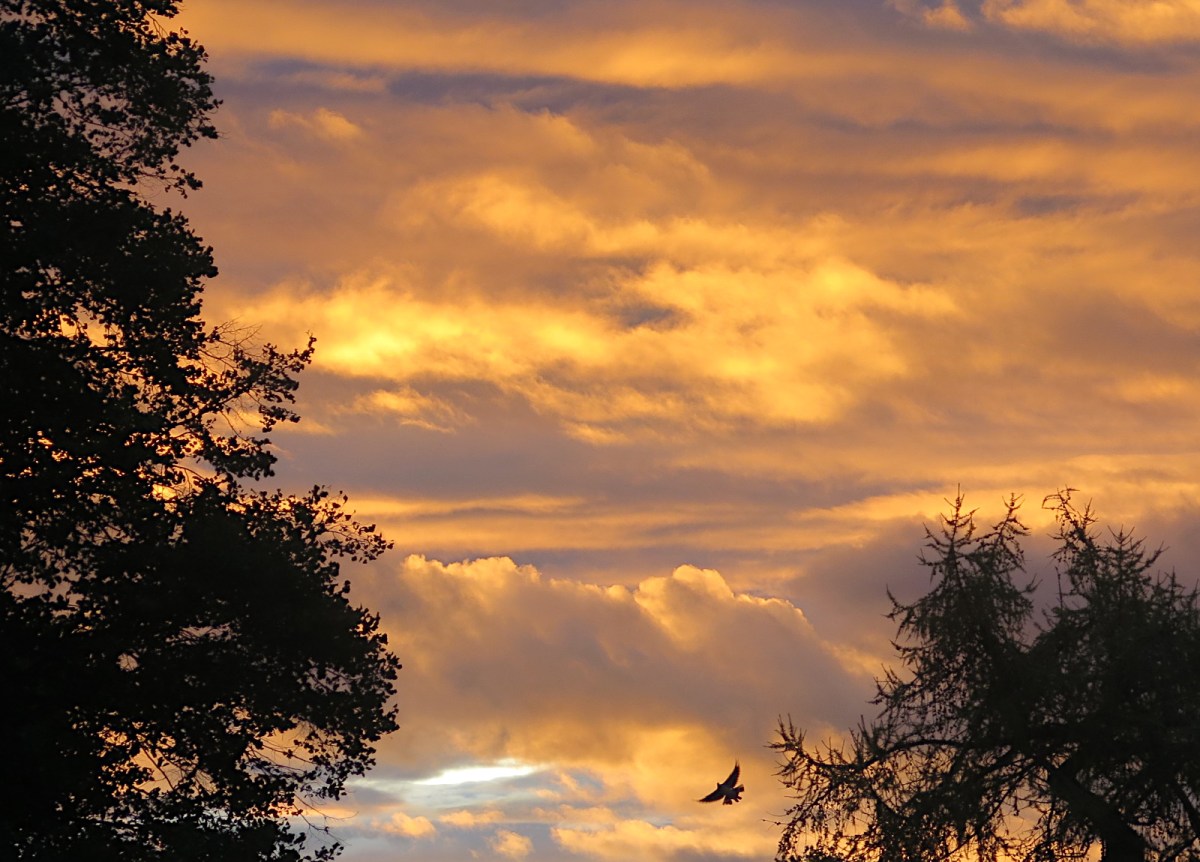
Quite by chance, as I clicked the exposure, a bird flew out of tree and the shot automagically composed itself! It looks like something from the Jurassic, a flying dinosaur with four wings.

< Previous | Index | Next >

What’s in an image? Sometimes quite a lot, more than meets the eye. I’m posting an image every two days or so.

Click to enlarge

For the next few photos, I’m going to leave the series on our Irish holiday, and the series on Cirencester, and instead just focus on images I love (pun only slightly intended).

Let’s start with this photo of a sunset seen from my study window. Quite by chance, as I clicked the exposure, a bird flew out of a tree and the shot automagically composed itself! It looks like something from the Cretaceous, a flying dinosaur with four wings, or a raptor that’s just snatched some unlucky feathered prey. Anyone have other opinions on ID?

The intended subject was the sunset, it was very spectacular and deserved to be recorded. The clouds were luminous, truly breath-taking and the photo fails to do them justice. In my experience that’s often the case with sunsets, the contrasts are too wide so details are lost both in the brightest and darkest areas; to show those details you have to compromise on the contrast – you really do need both. The Earth’s atmosphere scatters short wavelength blue light and that’s why the sky appears blue and is darker at higher altitudes (most of the air is below). While at sunset or sunrise the light takes a long, grazing path to your eyes and the blue scattering along that path leaves mostly oranges and reds.

Favourites

For convenience, here’s a list of my favourite images:

Anemone, Cloud, Honeybee, Hydrangea, Kiftsgate1, Kiftsgate2, Large White, Mugshot, Nelson, Robin, Rose, Spilhaus, Sunset1, Weston beach

Themed image collections

The links below will take you to the first post in each collection

Cirencester, Favourites, Irish holiday 2024, Roman villa

< Previous | Index | Next >

Useful? Interesting?

If you enjoyed this or found it useful, please like, comment, and share below. (If you don’t see those links, click the article’s title above the main photo and they will appear.) Send a link to friends who might enjoy the article or benefit from it – Thanks! My material is free to reuse (see conditions), but a coffee is always welcome and encourages me to write more often!

Image of the day – 60

Other species…include red kites, you’ll see these frequently in the skies around Cirencester, often flying very low, even over housing estates.

< Previous | Index | Next >

What’s in an image? Sometimes quite a lot, more than meets the eye.

I’m posting an image every two days (or as often as I can). A photo, an image from the internet, a diagram or a map. Whatever takes my fancy.

Yellow flag Iris

These beautiful, water tolerant, native Irises pop up every year in the waterways in and around Cirencester. The photo was taken at the junction of Riverside Walk and Gloucester Street right by Abbey Way Services. The photo was taken in May, just as they were reaching their best.

Although our natural environment is struggling to cope with the many pressures we put on it, some species manage to do quite well. This is one of them. But there are many others that are in danger. Some of these, plants and animals, are fairly stable or even recovering in and around the Cirencester area with careful conservation management. Examples include the lovely snakeshead fritillaries that flower abundantly in North Meadow just south of Cricklade, pasqueflowers in a strong colony to the north of the town near the Stow Road, and the large blue butterfly on a reserve west of the town and on common land near Stroud.

Other species, once rare but now much more common include red kites, you’ll see these frequently in the skies around Cirencester, often flying very low, even over housing estates. Back along Riverside Walk you may be lucky enough to see a heron, a kingfisher, or a little egret.

Cirencester

For convenience, here’s a list of all the Cirencester area images:

A417 roadworks, Advent Market, Bishops Walk, Baunton, Canal 1, 2, Castle Street, Christmas lights 1, 2, Church 1, 2, 3, 4, 5, 6, Churn flood, Countryside, Fallen tree, Fleece, Gasworks, Gloucester Street, Hare 1, 2, Hospital, Market Place 1, Phoenix Fest, Riverside Walk, Stone plaque, Stratton Meadow, Tank traps, View, Wonky 1, 2, Yellow Iris

Themed image collections

The links below will take you to the first post in each collection

Cirencester, Favourites, Irish holiday 2024, Roman villa

< Previous | Index | Next >

Useful? Interesting?

If you enjoyed this or found it useful, please like, comment, and share below. (If you don’t see those links, click the article’s title above the main photo and they will appear.) Send a link to friends who might enjoy the article or benefit from it – Thanks! My material is free to reuse (see conditions), but a coffee is always welcome and encourages me to write more often!

Image of the day – 40

Nobody knows when rose breeding began, it may have been as far back as Greek or Roman times.

< Previous | Index | Next >

What’s in an image? Sometimes quite a lot, more than meets the eye.

I’m posting an image every day (or as often as I can). A photo, an image from the internet, a diagram or a map. Whatever takes my fancy.

A beautiful rose at Powerscourt Gardens

While we were at the Powerscourt Estate, Donna wanted to look at the rose garden; this photo shows a really beautiful example of the flowers on view. Looking at the image now I can almost smell the fragrance in my mind!

Roses like these are not part of the natural world; they’re the work of plant breeders crossing a range of wild species and selecting for characteristics they liked. Nobody knows when rose breeding began, it may have been as far back as Greek or Roman times, but was certainly underway in medieval Europe and perhps in the middle and far east as well.

I wrote an article four years ago that includes photos of a much more natural rose. Comparing the two images emphasises how plant breeding can make huge changes (the breeders might say ‘huge improvements’) to wild forms. The same is true for animal breeding, just compare any modern breed of dog with the wild, wolf ancestor for example!


Images from our Irish holiday 2024

For convenience, here’s a list of all the Irish holiday images:

28th Jul – Welsh Botanic Garden, Robin, Fishguard
29th Jul – Wicklow Mts, Glendalough, Powerscourt, Rose, Greystones
30th Jul – Liffey, Temple Bar, St Patrick’s Cathedral
31st Jul – Newgrange, Battle of the Boyne
1st Aug – Monasterboice, Mourne, Thrift, Window
2nd Aug – Spelga Dam, Hydrangea, Pipework, Lough Neagh
3rd Aug – Coagh, Springhill, Portrush
4th Aug – Beach at Portrush
5th Aug – Giant’s Causeway, Carrick-a-Rede, Portrush

Themed image collections

The links below will take you to the first post in each collection

Cirencester, Favourites, Irish holiday 2024, Roman villa

< Previous | Index | Next >

Useful? Interesting?

If you enjoyed this or found it useful, please like, comment, and share below. (If you don’t see those links, click the article’s title above the main photo and they will appear.) Send a link to friends who might enjoy the article or benefit from it – Thanks! My material is free to reuse (see conditions), but a coffee is always welcome and encourages me to write more often!

Image of the day – 29

Tree roots probe small cracks and as they grow, heave even heavy structures aside.

< Previous | Index | Next >

What’s in an image? Sometimes quite a lot, more than meets the eye.

I’m posting an image every day (or as often as I can). A photo, an image from the internet, a diagram or a map. Whatever takes my fancy.

Silver birch

Today’s image shows a piece of ground lightly covered with silver birch; but the history of this area is interesting. During the war it was an RAF airfield (RAF Riccall) with runways, brick and concrete buildings, bomb stores and more. The airfield was in used from 1944 to 1958, and today the brick structures are collapsing, the runways have cracked and are mostly covered by layers of moss, grass and other low vegetation, and the other areas have become scrubland and lightly wooded areas as shown in the photo.

This clearly illustrates how much time and maintenance effort is required to hold back the natural world from recolonising our built infrastructure. What begins with the typical grass and weeds of cultivated ground soon becomes an impenetrable mass of brambles and young trees. As they grow larger, the trees shade out the brambles, and fallen leaves cover the concrete and tarmac and accumulate as fresh soil. Tree roots probe small cracks and, as they grow, heave even heavy structures aside. It’s a fascinating process. Skipwith Common, with the old airfield on its north-western edge, is representative of Yorkshire’s lowland heath ecology.

We think our built environment is solid and secure – not so! It’s easily overwhelmed once we stop maintaining it. Look at the land around the site of Chornobyl in Ukraine for another example of the speed of wildlife return to an area substantially left alone by humans.

< Previous | Index | Next >

Useful? Interesting?

If you enjoyed this or found it useful, please like, comment, and share below. (If you don’t see those links, click the article’s title above the main photo and they will appear.) Send a link to friends who might enjoy the article or benefit from it – Thanks! My material is free to reuse (see conditions), but a coffee is always welcome and encourages me to write more often!