Lichens

Lichens are the main food source for a variety of animal species from small mites and insects to the remarkably large reindeer. They tend to be protein-poor but may be rich in carbohydrates.

< Previous | Index | Next >

Image 130 – What’s in an image? Sometimes quite a lot, more than meets the eye. I’m posting an image every day or so.

Enlarge

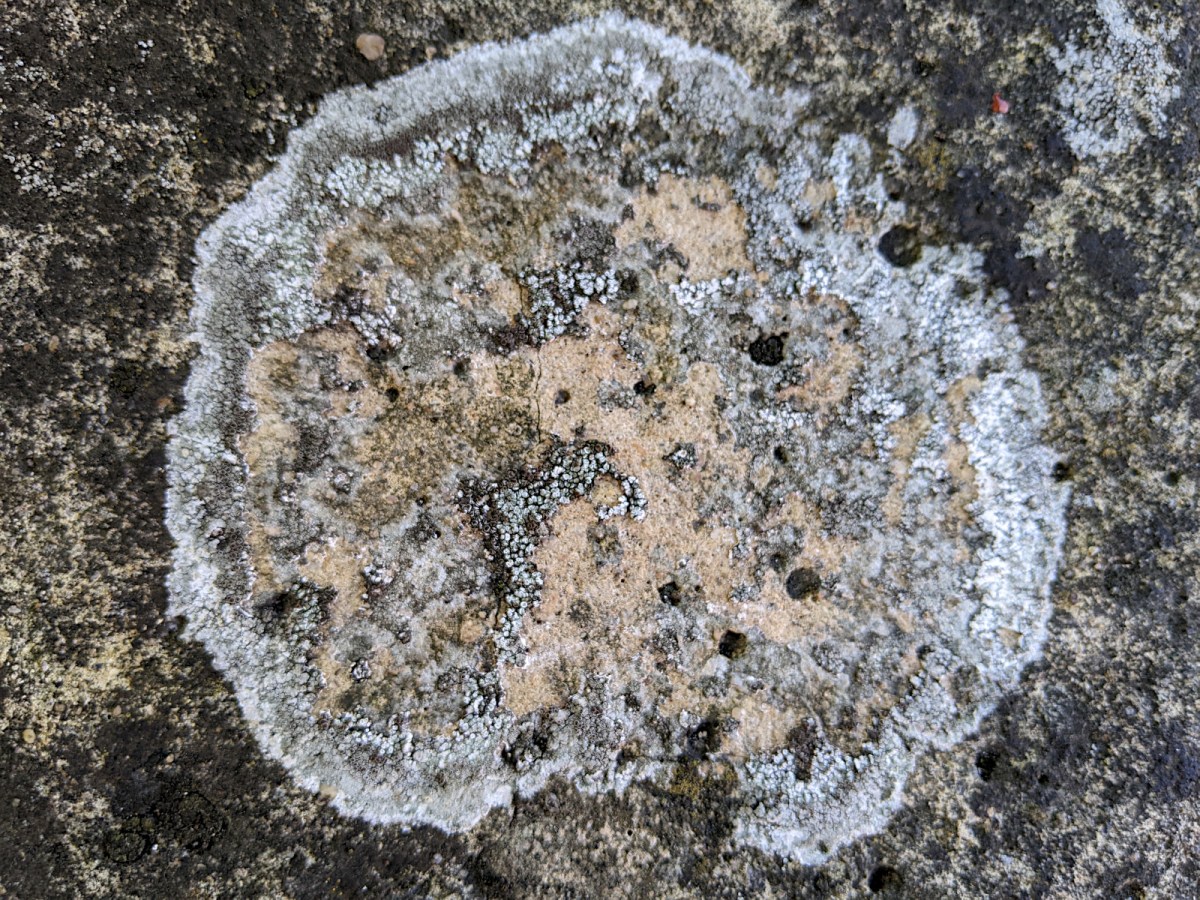
Lichens are amazing. They’re always small, they grow in slowly expanding colonies, and they consist of cooperating fungi and algae. A number of different species of fungi can grow like this, combined with various yeasts and bacteria. The assemblage often looks like a simple plant, often almost flat, but sometimes filamentous, branching or in the form of flakes. Circular forms like the one in the image are common. The Wikipedia article listed below has photos of a range of different forms.

The grey colony in the photo has grown out from the centre ‘cleaning’ other life forms from the surface of the underlying limestone and spreading out further around the perimeter. The black lichen was destroyed as the grey lichen crossed over it, but new colonies of the black lichen have established on the clean rock left behind. The situation is dynamic, but very slow. Return for another photo a month later and little will have changed.

Lichens are the main food source for a variety of animal species from small mites and insects to the remarkably large reindeer. They tend to be protein-poor but may be rich in carbohydrates.

See also:

< Previous | Index | Next >

Useful? Interesting?

If you enjoyed this or found it useful, please like, comment, and share below. (If you don’t see those links, click the article’s title above the main photo and they will appear.) Send a link to friends who might enjoy the article or benefit from it – Thanks! My material is free to reuse (see conditions), but a coffee is always welcome and encourages me to write more often!

Fine weather if you have fine kit!

We had the right gear for staying dry in rain, mud and heavily dripping vegetation, so we were warm and comfortable amid the fragrance of wet grass and decaying leaves.

< Previous | Index | Next >

Image 121 – What’s in an image? Sometimes quite a lot, more than meets the eye. I’m posting an image every day or so.

Enlarge

There is a saying amongst the walking fraternity, that ‘There’s no such thing as bad weather, just bad kit’. Here are two of my friends, the three of us were out for a lovely walk in wet weather in the Cotswolds. We had the right gear for staying dry in rain, mud and heavily dripping vegetation, so we were warm and comfortable amid the fragrance of wet grass and decaying leaves.

Perhaps this not not everyone’s favourite activity, but we loved it! Damp October days like this one are good for spotting early autumn colour on the trees as well as mushrooms and toadstools amongst the fallen leaves and blades of grass. There is so much to see everywhere you look.

When: 19th October 2023
Where: Near Edgeworth, Cotswolds

< Previous | Index | Next >

Useful? Interesting?

If you enjoyed this or found it useful, please like, comment, and share below. (If you don’t see those links, click the article’s title above the main photo and they will appear.) Send a link to friends who might enjoy the article or benefit from it – Thanks! My material is free to reuse (see conditions), but a coffee is always welcome and encourages me to write more often!
Cotswold skies

One of the joys of these walks is the sky. Sometimes it’s grey and overcast, sometimes it’s blue from horizon to horizon, but sometimes it’s full of interesting cloud formations at various heights.

< Previous | Index | Next >

Image 103 – What’s in an image? Sometimes quite a lot, more than meets the eye. I’m posting an image every day or so.

Larger view

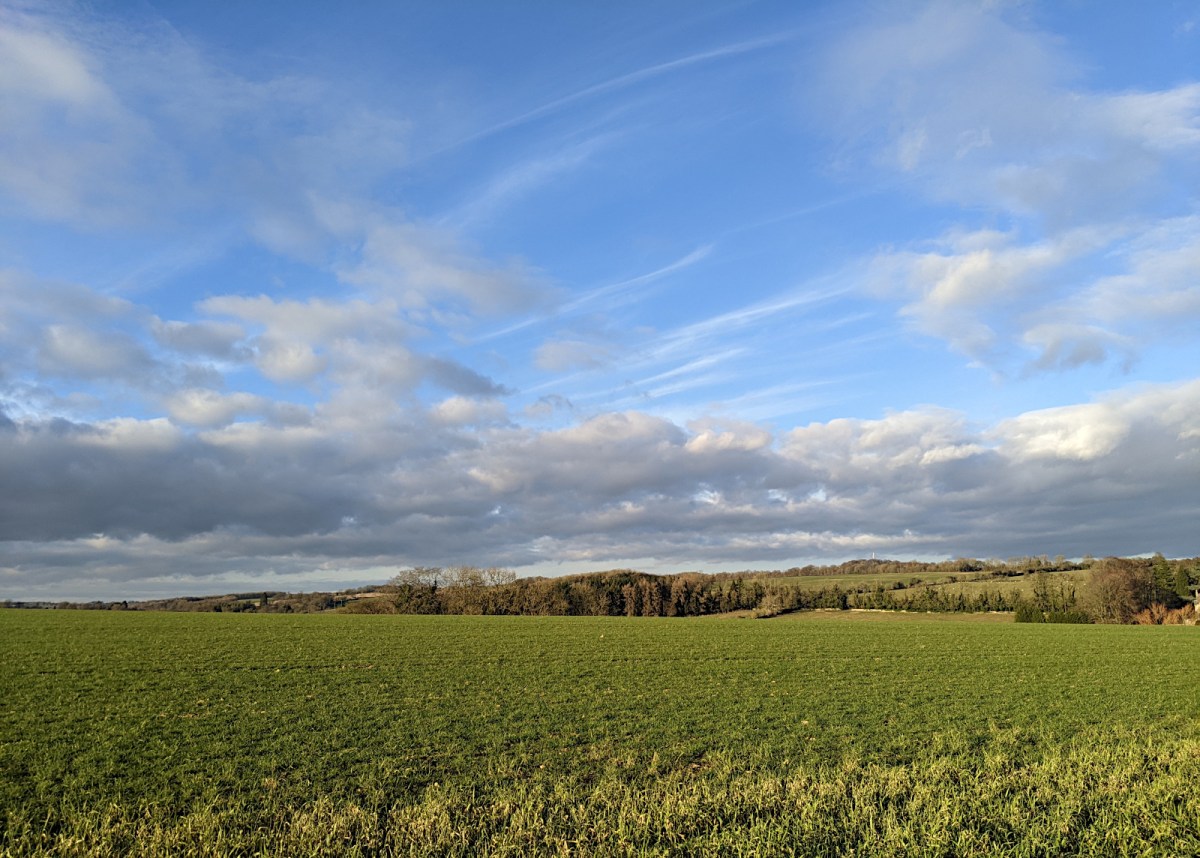
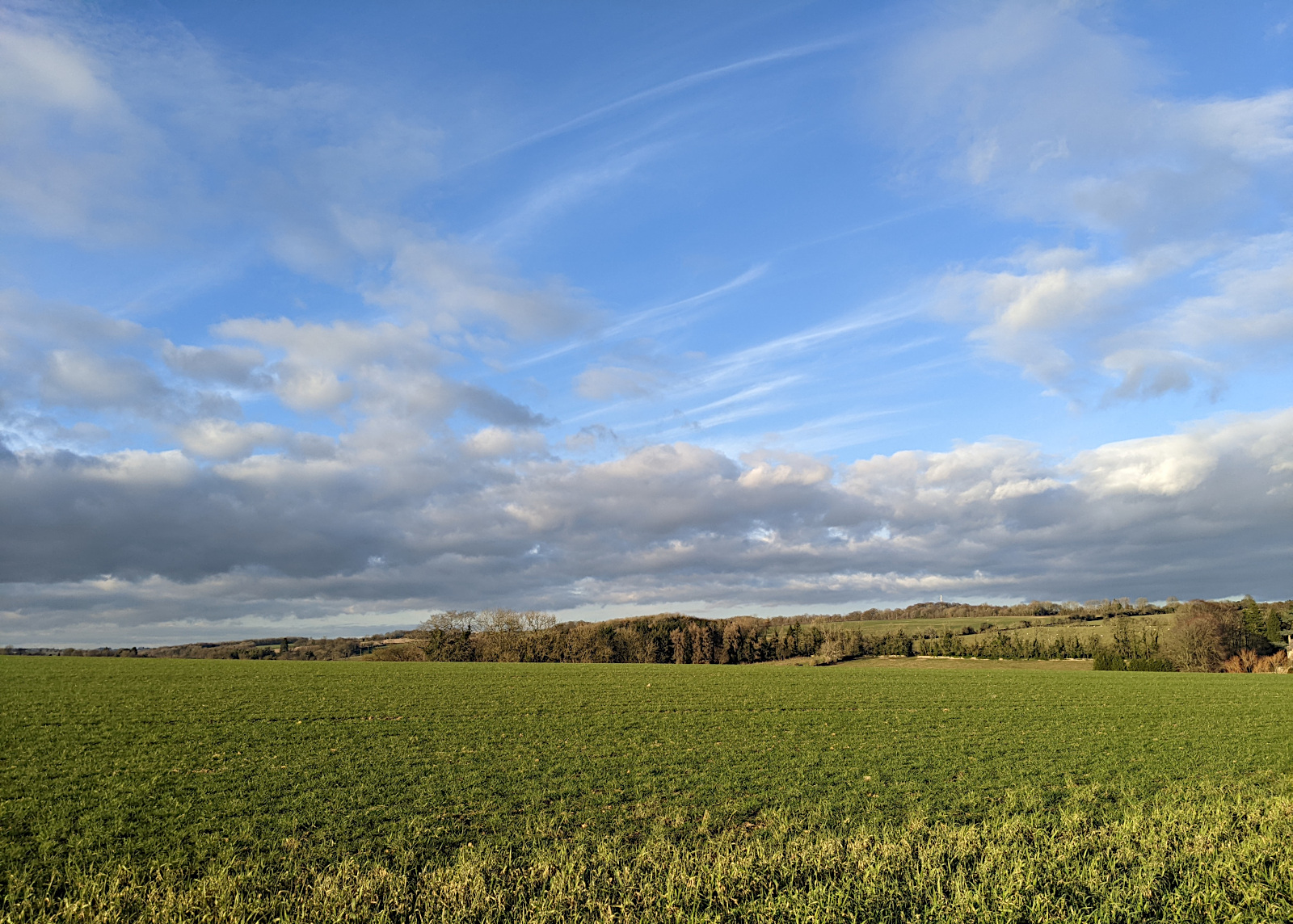
Traditional Cotswold fields were quite small, but as in many parts of the UK, farmers have removed hedgerows to combine small fields into larger ones that can be more efficiently cultivated, planted, and managed. Although this has some deleterious effects on wildlife and biodiversity, it does create some big skies. Here is an example.

This field is an easy walk west from Stratton where I live, along a permitted route along a stony track. I come out this way from time to time to enjoy the wide open spaces, to look at the nearby polo fields, to listen to the larks that nest here in considerable numbers, and to watch them rise higher and higher before plummeting down to land.

And one of the joys of these walks is the sky. Sometimes it’s grey and overcast, sometimes it’s blue from horizon to horizon, but sometimes it’s full of interesting cloud formations at various heights.

This wonderful world is full of beauty in big skies and also in tiny details. And it’s always different, no two days are alike.

When: 19th January 2024
Where: North-west of Cirencester

Favourites

For convenience, here’s a list of my favourite images:

Anemone, Cloud, Honeybee, Hydrangea, Kiftsgate1, Kiftsgate2, Large White, Mugshot, Nelson, Robin, Rose, Spilhaus, Sunset1, Weston beach

Themed image collections

The links below will take you to the first post in each collection

Cirencester, Favourites, Irish holiday 2024, Roman villa

< Previous | Index | Next >

Useful? Interesting?

If you enjoyed this or found it useful, please like, comment, and share below. (If you don’t see those links, click the article’s title above the main photo and they will appear.) Send a link to friends who might enjoy the article or benefit from it – Thanks! My material is free to reuse (see conditions), but a coffee is always welcome and encourages me to write more often!

Large White

The adult in the photo is feeding on nectar from a Buddleia inflorescence. Butterflies and bees home in on these.

< Previous | Index | Next >

Image 94 – What’s in an image? Sometimes quite a lot, more than meets the eye. I’m posting an image every day or so.

Announcement – I’m making a few more changes, The image number is moving down so the title can be more relevant to the content, and I’m adding date and place for the image source.

Click to enlarge

The large white butterfly is the bane of vegetable gardeners. The adult females lay their eggs under the leaves of brassica crops – cabbages, cauliflowers, brussels sprouts and more. The caterpillars that hatch out feed voraciously on the plants, and as they grow larger they consume the leaves faster and faster, sometimes leaving just a stalk and nothing for the gardener to harvest.

The adult in the photo is feeding on nectar from a Buddleia inflorescence. Butterflies and bees home in on these. Although the photo’s one of my favourites, it’s technically poor as it’s enlarged from a small part of a shot taken back in September. Still – I like it and I want to share it.

When: 16th September 2024
Where: Hidcote Garden, Gloucestershire, England

See also:
Favourites

For convenience, here’s a list of my favourite images:

Anemone, Cloud, Honeybee, Hydrangea, Kiftsgate1, Kiftsgate2, Large White, Mugshot, Nelson, Robin, Rose, Spilhaus, Sunset1, Weston beach

Themed image collections

The links below will take you to the first post in each collection

Cirencester, Favourites, Irish holiday 2024, Roman villa

< Previous | Index | Next >

Useful? Interesting?

If you enjoyed this or found it useful, please like, comment, and share below. (If you don’t see those links, click the article’s title above the main photo and they will appear.) Send a link to friends who might enjoy the article or benefit from it – Thanks! My material is free to reuse (see conditions), but a coffee is always welcome and encourages me to write more often!

Image of the day – 93

The worker honeybee in the photo is collecting pollen. Insect-pollinated plants have slightly sticky pollen that lodges on the bee’s hairy body. Bees visit flowers to collect nectar from the base of the petals, but get dusted with sticky pollen in the process.

< Previous | Index | Next >

What’s in an image? Sometimes quite a lot, more than meets the eye. I’m posting an image every two days or so.

Click to enlarge

Like all plants and animals, bees are pretty well suited to the actions they need to perform to live and reproduce. That’s what evolution does, it homes in on the best shape and size of wings, the optimum size for flight muscles, best arrangement of hairs on the legs to brush loose pollen towards the pollen sac for collection and transport, the best mouthparts for collecting nectar and so forth.

Quite a challenge, and an astounding achievement, but entirely doable by making small, random changes and selecting the best.

Here’s an example to make that bold claim clearer. If a random change enables the worker bees to carry on just a few days longer in the autumn, the hive will have slightly larger stores of honey for the coming winter. That hive will survive when a hive with less capable workers might not. And that’s enough. The new queens from the surviving hive will carry the altered gene and it’ll be present in the workers of the new colonies those queens create. The altered colonies will also survive in slightly colder places than before so will succeed at slightly higher altitudes and in slightly cooler climates.

The worker honeybee in the photo is collecting pollen. Insect-pollinated plants have slightly sticky pollen that lodges on the bee’s hairy body. Bees visit flowers to collect nectar from the base of the petals, but get dusted with sticky pollen in the process. Bees clean themselves like most insects (you’ve probably seen houseflies doing it, sweeping off particles of dust with one leg while standing on the others). When bees clean themselves, most of the pollen end up stuck together as a lump and lodges on a series of special hairs on the hind legs. Look closely and you can see this bee’s pollen load on its rear leg; an orange/yellow colour. Pollen is protein rich and the bees feed it to the bee pupae in the hive.

The plant feeds the bees nectar for energy and pollen for growing young bees; while the bees move pollen from flower to flower, and often from plant to plant over quite long distances, sometimes a mile or more. So the bees and the plants both benefit, it’s a useful co-operative effort.

Favourites

For convenience, here’s a list of my favourite images:

Anemone, Cloud, Honeybee, Hydrangea, Kiftsgate1, Kiftsgate2, Large White, Mugshot, Nelson, Robin, Rose, Spilhaus, Sunset1, Weston beach

Themed image collections

The links below will take you to the first post in each collection

Cirencester, Favourites, Irish holiday 2024, Roman villa

< Previous | Index | Next >

Useful? Interesting?

If you enjoyed this or found it useful, please like, comment, and share below. (If you don’t see those links, click the article’s title above the main photo and they will appear.) Send a link to friends who might enjoy the article or benefit from it – Thanks! My material is free to reuse (see conditions), but a coffee is always welcome and encourages me to write more often!