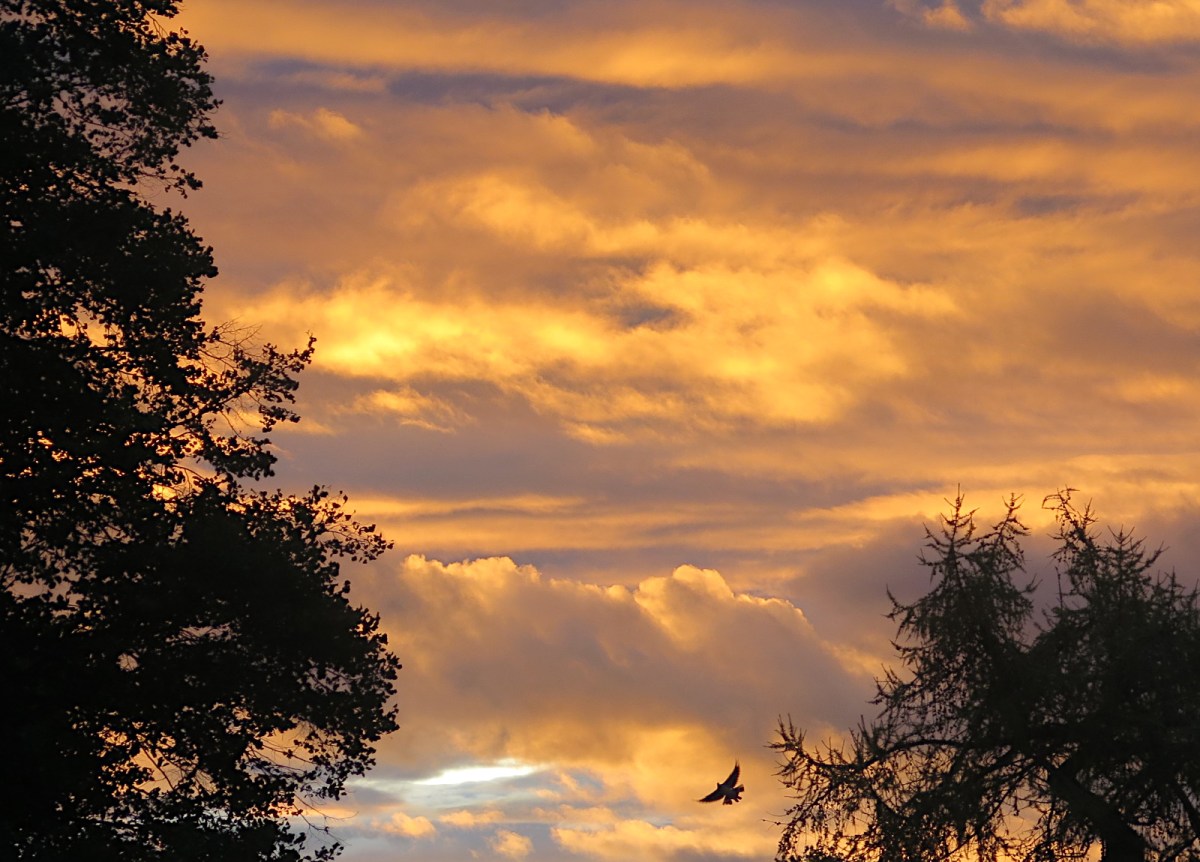
Quite by chance, as I clicked the exposure, a bird flew out of tree and the shot automagically composed itself! It looks like something from the Jurassic, a flying dinosaur with four wings.
What’s in an image? Sometimes quite a lot, more than meets the eye. I’m posting an image every two days or so.
Click to enlarge
For the next few photos, I’m going to leave the series on our Irish holiday, and the series on Cirencester, and instead just focus on images I love (pun only slightly intended).
Let’s start with this photo of a sunset seen from my study window. Quite by chance, as I clicked the exposure, a bird flew out of a tree and then shot automagically composed itself! It looks like something from the Cretaceous, a flying dinosaur with four wings, or a raptor that’s just snatched some unlucky feathered prey. Anyone have other opinions on ID?
The intended subject was the sunset, it was very spectacular and deserved to be recorded. The clouds were luminous, truly breath-taking and the photo fails to do them justice. In my experience that’s often the case with sunsets, the contrasts are too wide so details are lost both in the brightest and darkest areas; to show those details you have to compromise on the contrast – you really do need both. The Earth’s atmosphere scatters short wavelength blue light and that’s why the sky appears blue and is darker at higher altitudes (most of the air is below). While at sunset or sunrise the light takes a long, grazing path to your eyes and the blue scattering along that path leaves mostly oranges and reds.
Favourites
For convenience, here’s a list of my favourite images:
If you enjoyed this or found it useful, please like, comment, and share below. (If you don’t see those links, click the article’s title above the main photo and they will appear.) Send a link to friends who might enjoy the article or benefit from it – Thanks! My material is free to reuse (see conditions), but a coffee is always welcome and encourages me to write more often!
What’s in an image? Sometimes quite a lot, more than meets the eye.
I’m posting an image every two days (or as often as I can). A photo, an image from the internet, a diagram or a map. Whatever takes my fancy.
Yellow flag Iris
These beautiful, water tolerant, native Irises pop up every year in the waterways in and around Cirencester. The photo was taken at the junction of Riverside Walk and Gloucester Street right by Abbey Way Services. The photo was taken in May, just as they were reaching their best.
Although our natural environment is struggling to cope with the many pressures we put on it, some species manage to do quite well. This is one of them. But there are many others that are in danger. Some of these, plants and animals, are fairly stable or even recovering in and around the Cirencester area with careful conservation management. Examples include the lovely snakeshead fritillaries that flower abundantly in North Meadow just south of Cricklade, pasqueflowers in a strong colony to the north of the town near the Stow Road, and the large blue butterfly on a reserve west of the town and on common land near Stroud.
NOTE: If you visit any of these sites, please treat them with respect. Stay on marked paths if they’re available, avoid trampling on plants, stay out of restricted areas, and definitely don’t dig anything up. Pay attention to signs and notices. Thanks!
Other species, once rare but now much more common include red kites, you’ll see these frequently in the skies around Cirencester, often flying very low, even over housing estates. Back along Riverside Walk you may be lucky enough to see a heron, a kingfisher, or a little egret.
Cirencester
For convenience, here’s a list of all the Cirencester area images:
If you enjoyed this or found it useful, please like, comment, and share below. (If you don’t see those links, click the article’s title above the main photo and they will appear.) Send a link to friends who might enjoy the article or benefit from it – Thanks! My material is free to reuse (see conditions), but a coffee is always welcome and encourages me to write more often!
What’s in an image? Sometimes quite a lot, more than meets the eye.
I’m posting an image every day (or as often as I can). A photo, an image from the internet, a diagram or a map. Whatever takes my fancy.
A beautiful rose at Powerscourt Gardens
While we were at the Powerscourt Estate, Donna wanted to look at the rose garden; this photo shows a really beautiful example of the flowers on view. Looking at the image now I can almost smell the fragrance in my mind!
Roses like these are not part of the natural world; they’re the work of plant breeders crossing a range of wild species and selecting for characteristics they liked. Nobody knows when rose breeding began, it may have been as far back as Greek or Roman times, but was certainly underway in medieval Europe and perhps in the middle and far east as well.
I wrote an article four years ago that includes photos of a much more natural rose. Comparing the two images emphasises how plant breeding can make huge changes (the breeders might say ‘huge improvements’) to wild forms. The same is true for animal breeding, just compare any modern breed of dog with the wild, wolf ancestor for example!
Images from our Irish holiday 2024
For convenience, here’s a list of all the Irish holiday images:
If you enjoyed this or found it useful, please like, comment, and share below. (If you don’t see those links, click the article’s title above the main photo and they will appear.) Send a link to friends who might enjoy the article or benefit from it – Thanks! My material is free to reuse (see conditions), but a coffee is always welcome and encourages me to write more often!
What’s in an image? Sometimes quite a lot, more than meets the eye.
I’m posting an image every day (or as often as I can). A photo, an image from the internet, a diagram or a map. Whatever takes my fancy.
Silver birch
Today’s image shows a piece of ground lightly covered with silver birch; but the history of this area is interesting. During the war it was an RAF airfield (RAF Riccall) with runways, brick and concrete buildings, bomb stores and more. The airfield was in used from 1944 to 1958, and today the brick structures are collapsing, the runways have cracked and are mostly covered by layers of moss, grass and other low vegetation, and the other areas have become scrubland and lightly wooded areas as shown in the photo.
This clearly illustrates how much time and maintenance effort is required to hold back the natural world from recolonising our built infrastructure. What begins with the typical grass and weeds of cultivated ground soon becomes an impenetrable mass of brambles and young trees. As they grow larger, the trees shade out the brambles, and fallen leaves cover the concrete and tarmac and accumulate as fresh soil. Tree roots probe small cracks and, as they grow, heave even heavy structures aside. It’s a fascinating process. Skipwith Common, with the old airfield on its north-western edge, is representative of Yorkshire’s lowland heath ecology.
We think our built environment is solid and secure – not so! It’s easily overwhelmed once we stop maintaining it. Look at the land around the site of Chornobyl in Ukraine for another example of the speed of wildlife return to an area substantially left alone by humans.
If you enjoyed this or found it useful, please like, comment, and share below. (If you don’t see those links, click the article’s title above the main photo and they will appear.) Send a link to friends who might enjoy the article or benefit from it – Thanks! My material is free to reuse (see conditions), but a coffee is always welcome and encourages me to write more often!
What’s in an image? Sometimes quite a lot, more than meets the eye.
I’m posting an image every day (or as often as I can). A photo, an image from the internet, a diagram or a map. Whatever takes my fancy.
The fresh green of spring
There are few things as amazing as life. Perhaps there’s literally nothing as amazing as life in the entire universe! The photo shows the young, expanding leaves of a small-leaved lime tree (Tilia cordata).
Like all deciduous, temperate trees, leaf buds are formed the previous summer and over-winter after the old, mature leaves fall in late autumn. As temperatures increase in springtime, these buds swell and grow and the young leaves appear and expand. At first they’re a beautiful, pale green (lime green) but become a darker and duller shade as the days lengthen and they mature.
These processes all take place naturally in ways that are more complex than most of us might expect. Both plants and animal bodies are composed of countless tiny cells in much the same way that a large building might be made of bricks. Each cell is alive, contains a full copy of the organism’s DNA, and many of them have specialised roles to play. By cooperation and coordination they manage all the behaviours and activities that we see on the larger scale. So in some respects an expanding leaf is a lot like a growing community of people working together as a village or business. Having specialists makes it possible to do so much more, but cooperation becomes essential, not merely optional.
The rioting we’ve seen in some British cities in recent days has been disruptive and damaging to society as a whole. When the cells of an organism behave in uncoordinated and uncontrolled ways we call it a cancer. Rioting is a kind of cancer in a human society. We all know what happens when cancer becomes so widespread that the organism can no longer function. But organisms have ways of dealing with errant cells before they become overwhelming, and so do societies. Both police action and peaceful counter-demonstrations have been effective in controlling the UK riots in recent days.
Themed image collections
The links below will take you to the first post in each collection
If you enjoyed this or found it useful, please like, comment, and share below. (If you don’t see those links, click the article’s title above the main photo and they will appear.) Send a link to friends who might enjoy the article or benefit from it – Thanks! My material is free to reuse (see conditions), but a coffee is always welcome and encourages me to write more often!
What’s in an image? Sometimes quite a lot, more than meets the eye.
I’m posting an image each day, or as often as I can; a photo I took, an image from Wikipedia, NASA, or some other open source, a diagram or a map. Whatever takes my fancy. This is the second in the series.
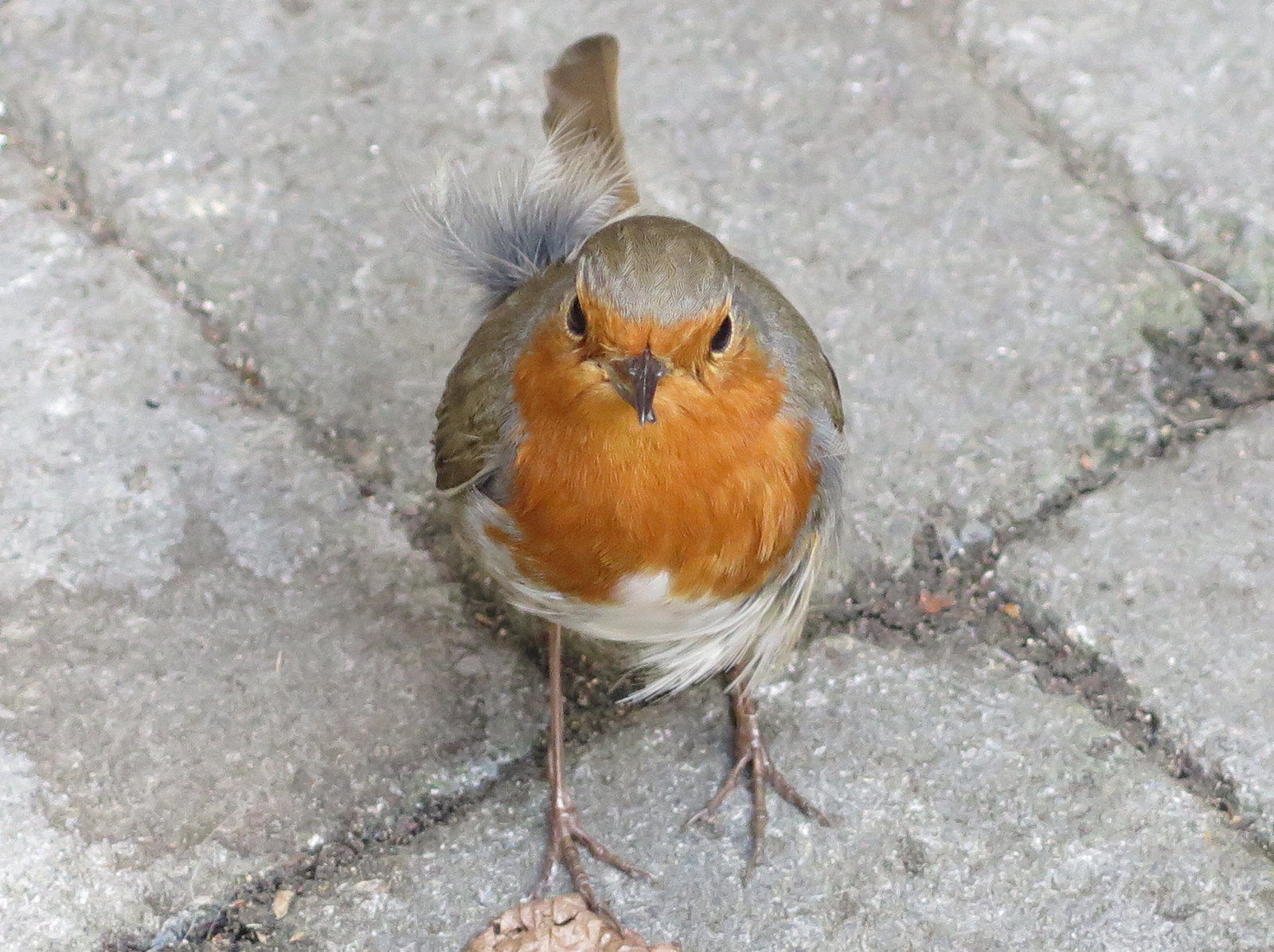
The robin at Pretty and Pip
Pretty & Pip is one of my favourite coffee shops in Cirencester. I wrote ‘therobin‘ because he’s always there, in their lovely courtyard. If I didn’t know the guy that owns and manages this place I might even think the robin ran it! He certainly thinks he belongs there, and he does a pretty good job of picking up cake crumbs and generally keeping the place spick and span.
But come on mate, get preening! How do you expect to find an attractive female robin with scruffy, untidy feathers like that?
Favourites
For convenience, here’s a list of my favourite images:
If you enjoyed this or found it useful, please like, comment, and share below. (If you don’t see those links, click the article’s title above the main photo and they will appear.) Send a link to friends who might enjoy the article or benefit from it – Thanks! My material is free to reuse (see conditions), but a coffee is always welcome and encourages me to write more often!
I set out for a walk along the canal, not intending anything more than a quick explore. I began near Chalford and thought of walking in the Stroud direction, but on the spur of the moment I decided to follow the canal through Chalford village instead as I hadn’t gone that way before.
This is a typical view of the canal in this section
A gentle stroll turns into a major plan
I was enjoying my walk and soon decided to extend it as far as the mouth of the canal tunnel at Daneway Inn. While driving home afterwards I had the idea of walking the entire route in small chunks. So I now have a plan for the old Thames and Severn canal; I’ve done several sections previously, but this time I hope to repeat the walks, covering as much as possible in short sections, and writing up each walk for Journeys of Heart and Mind (JHM).
Part of the canal runs through a tunnel with several sections blocked by collapses, some other sections run through private property and can’t be accessed. Others have been filled in, turned into roads, or are otherwise not walkable. But where the canal has been restored, the towpaths are in great condition. Elsewhere, towpaths are usually passable, especially in dry weather, and they are usually open for use even when the canal itself remains derelict.
Making a start
I was able to park the car right by the tow path (Map), just off London Road west of Chalford (very near Belvedere Mews). Don’t assume you’ll be able to do the same; you might, but there’s only room for half a dozen cars here.
The canal is quite derelict in this section, there’s water in it at many points, but not everywhere. The stonework and brickwork of the locks is severely damaged, and more recent structures such as pipes and small bridges cross the canal and will need to be rerouted or rebuilt. In places the canal has been filled in and one section has been used as a diversion and is now part of the River Frome. The eastern part of today’s route will be very expensive to restore; there are, for example, sixteen locks to rebuild, and not just a simple refurbishment of the masonry and new, timber, lock gates. For the most part it will be a combination of restoration and refacing where possible, but full reconstruction from scratch in many places where the damage is particularly severe.
It’s hard to grasp how destructive the natural world is to our built environment. The canal was dug 235 years ago (completed in 1789) and during its period of use must have been well maintained and repaired whenever necessary. The last narrow boat traffic passed this way about 100 years ago. It was already in bad shape by then, but natural decay, leaks and the growth of trees has resulted in the dereliction we see today.
Section by section
Leaving the car, and carrying my rucksack with a water bottle, I headed east along the tow path. I didn’t take a map, but the path is well marked. I subscribe to the OS maps on my phone (good enough for walks like this) and next time I plan to use the OS 6-inch map for 1892 to 1914 to better understand the canal’s surroundings while it was still in use.
The River Frome in Chalford
(Hint: Click any image to enlarge it.)
The section through Chalford village is very pretty, on the information boards it’s likened to a Swiss valley. That’s a fair comparison, I think. The wooded valley rises sharply on either side, the River Frome (or Stroudwater) runs along the valley bottom, and stone cottages cling to the slopes on either side. If you could only visit one place along the canal, Chalford would be an excellent choice.
Swan’s nest
Beyond the eastern end of Chalford, the tow path passes a lake on the left; originally this was a mill pond, supplying water to turn the wheel at Baker’s Mill. When the canal was constructed, water supply was a frequent problem and the mill pond was extended by the canal engineers to keep this section of the canal full enough even when the locks were operating frequently due to higher traffic levels. The lake is partly silted up now, especially close to the mill, and it has become a wildlife reserve. Passing this point I spotted a swan’s nest in use and a group of mallards nearby.
Marsh marigold in the canal
Some sections of the canal are badly silted and are full of plants like this glorious marsh marigold close to Siccaridge Wood. The nature reserve is well worth a visit if you have time. The site stretches up the hill from the canal and faces south, so it’s a warm spot when the sun shines and likely avoids early frosts in autumn and late ones in the spring. Further on again, a small footbridge crosses the canal and the tow path continues on the north bank until it reaches Daneway Lane.
I stopped at the Daneway Inn for a lovely Coronation Chicken sandwich with a simple salad and some crisps along with a welcome cup of coffee. I have to report that service was prompt and I felt welcomed. The canal continues a little further and the path resumes from the corner of the Inn car park. The tunnel portal (Map) looks mysterious and, frankly, uninviting. It would have been an adventure to travel through the tunnel in a narrow boat; one day it may be possible again!
If you enjoyed this or found it useful, please like, comment, and share below. (If you don’t see those links, click the article’s title above the main photo and they will appear.) Send a link to friends who might enjoy the article or benefit from it – Thanks! My material is free to reuse (see conditions), but a coffee is always welcome and encourages me to write more often!
The caterpillar did something extraordinary – it mimicked a small snake
Have you ever seen an elephant hawk moth? If you live in Europe or Asia you might have spotted one of these amazing insects. In the United Kingdom they are fairly common, but perhaps not often seen. It’s a real treat to spot an adult or a caterpillar, both are amazing sights.
Walking in the Cotswold Water Park recently, near the Gateway Centre on Lake 6, we spotted an elephant hawk moth caterpiller crossing the footpath (close to the grey circle in the map.
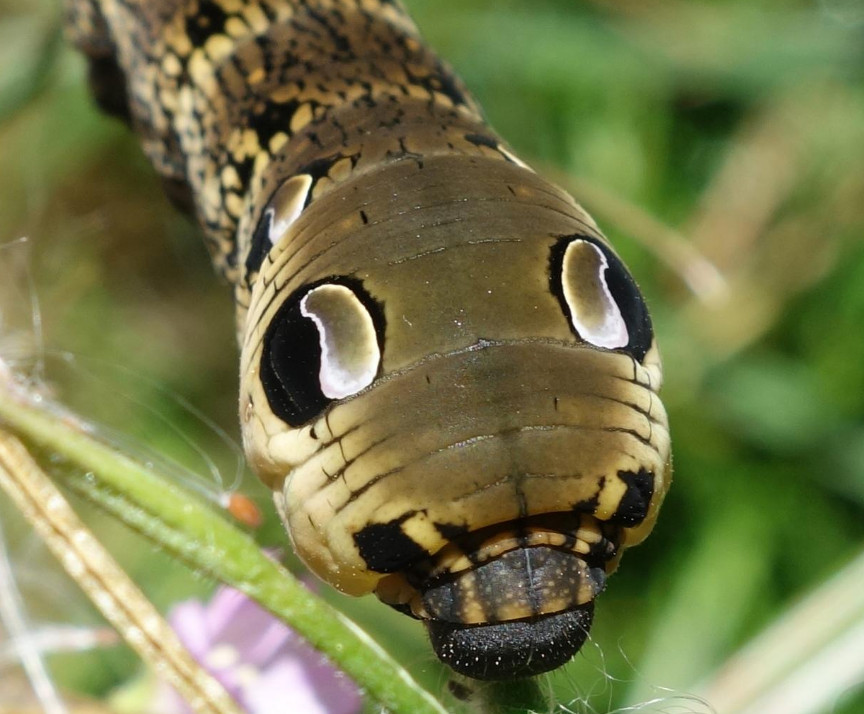
For a short time we just watched as it made its way across the path. But before it made it to the vegetation on the far side, some people appeared with a dog. The dog ran up enthusiastically to greet us and accidentally kicked the caterpiller before running off again. The caterpillar did something extraordinary – it mimicked a small snake.
Am I a caterpillar, or am I a snake?
The caterpillar crossing a stony path
For perhaps 20 seconds or so it writhed its body in a convincingly snakelike movement, and it pumped up several body segments behind the head, tucking its head down at the same time. With eye spot markings on its flanks, a scaly pattern on the entire body, and by raising up the front part of the body, it really did look the part. I wasn’t fast enough to get a photo, but I did get some video of the recovered caterpillar continuing on its way afterwards.
Searching the internet later, I found several good images of the caterpillar mimicking a small snake. Perhaps the best of these is show below.
The caterpillar looking very much like a snake (credit iSpot)
The natural world is so amazing, and so full of surprises, but mimicry is quite a common feature in both plants and animals. The European white dead-nettle has leaves that cannot sting but match the appearance of the unrelated stinging nettle very closely. Some insects look like pieces of wood, or a leaf, or a patch of white lichen, or a bird dropping. Many slugs look very much like animal droppings of various kinds, and as they move so slowly only an alert predator is likely to notice them. Predators, too, use camouflage which is not truly mimicry, but helps them merge into dappled sunshine and shade. Fish are often dark on top and silvery underneath. Sometimes they are patterned and look like the gravel bed of a stream or river.




 Journeys of Heart and Mind