Image of the day – 93

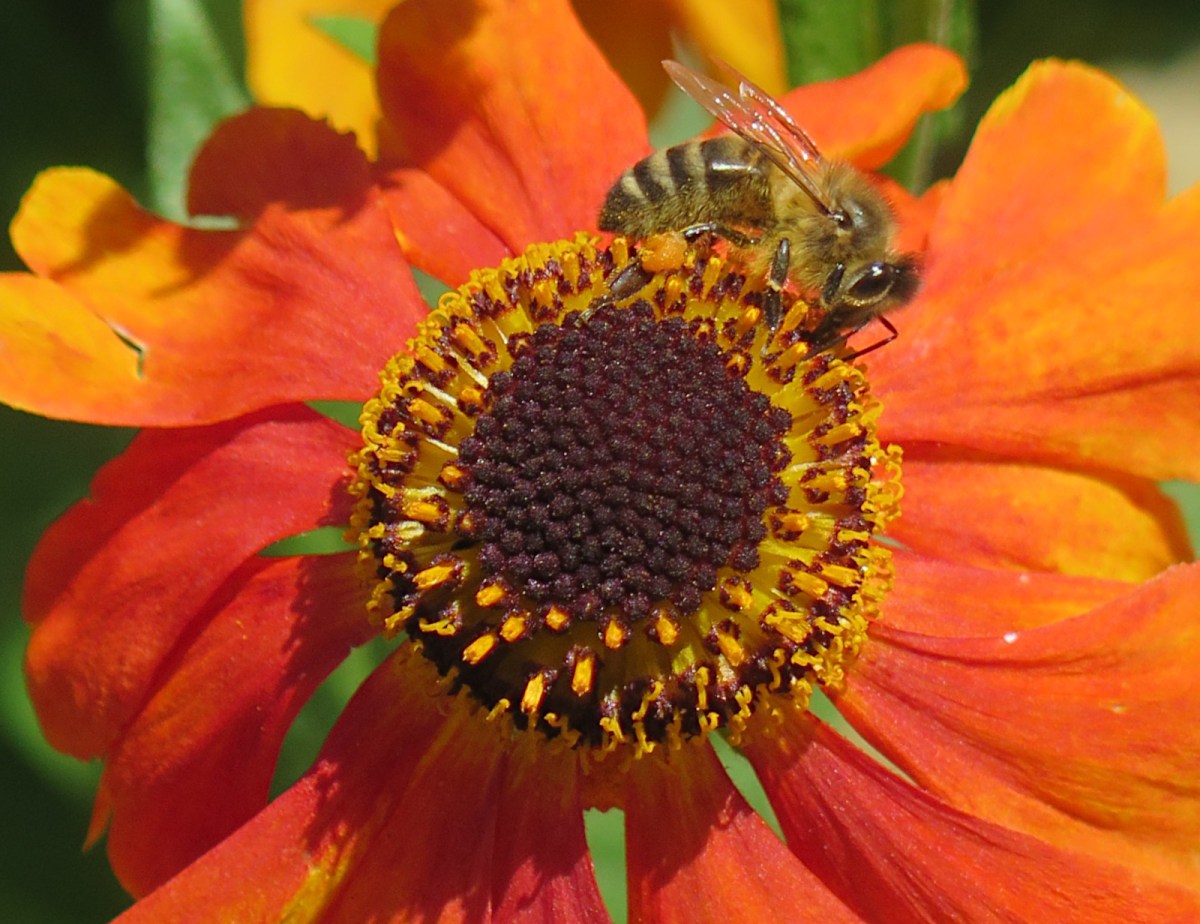
The worker honeybee in the photo is collecting pollen. Insect-pollinated plants have slightly sticky pollen that lodges on the bee’s hairy body. Bees visit flowers to collect nectar from the base of the petals, but get dusted with sticky pollen in the process.

< Previous | Index | Next >

What’s in an image? Sometimes quite a lot, more than meets the eye. I’m posting an image every two days or so.

Click to enlarge

Like all plants and animals, bees are pretty well suited to the actions they need to perform to live and reproduce. That’s what evolution does, it homes in on the best shape and size of wings, the optimum size for flight muscles, best arrangement of hairs on the legs to brush loose pollen towards the pollen sac for collection and transport, the best mouthparts for collecting nectar and so forth.

Quite a challenge, and an astounding achievement, but entirely doable by making small, random changes and selecting the best.

Here’s an example to make that bold claim clearer. If a random change enables the worker bees to carry on just a few days longer in the autumn, the hive will have slightly larger stores of honey for the coming winter. That hive will survive when a hive with less capable workers might not. And that’s enough. The new queens from the surviving hive will carry the altered gene and it’ll be present in the workers of the new colonies those queens create. The altered colonies will also survive in slightly colder places than before so will succeed at slightly higher altitudes and in slightly cooler climates.

The worker honeybee in the photo is collecting pollen. Insect-pollinated plants have slightly sticky pollen that lodges on the bee’s hairy body. Bees visit flowers to collect nectar from the base of the petals, but get dusted with sticky pollen in the process. Bees clean themselves like most insects (you’ve probably seen houseflies doing it, sweeping off particles of dust with one leg while standing on the others). When bees clean themselves, most of the pollen end up stuck together as a lump and lodges on a series of special hairs on the hind legs. Look closely and you can see this bee’s pollen load on its rear leg; an orange/yellow colour. Pollen is protein rich and the bees feed it to the bee pupae in the hive.

The plant feeds the bees nectar for energy and pollen for growing young bees; while the bees move pollen from flower to flower, and often from plant to plant over quite long distances, sometimes a mile or more. So the bees and the plants both benefit, it’s a useful co-operative effort.

Favourites

For convenience, here’s a list of my favourite images:

Anemone, Cloud, Honeybee, Hydrangea, Kiftsgate1, Kiftsgate2, Large White, Mugshot, Nelson, Robin, Rose, Spilhaus, Sunset1, Weston beach

Themed image collections

The links below will take you to the first post in each collection

Cirencester, Favourites, Irish holiday 2024, Roman villa

< Previous | Index | Next >

Useful? Interesting?

If you enjoyed this or found it useful, please like, comment, and share below. (If you don’t see those links, click the article’s title above the main photo and they will appear.) Send a link to friends who might enjoy the article or benefit from it – Thanks! My material is free to reuse (see conditions), but a coffee is always welcome and encourages me to write more often!

Image of the day – 2

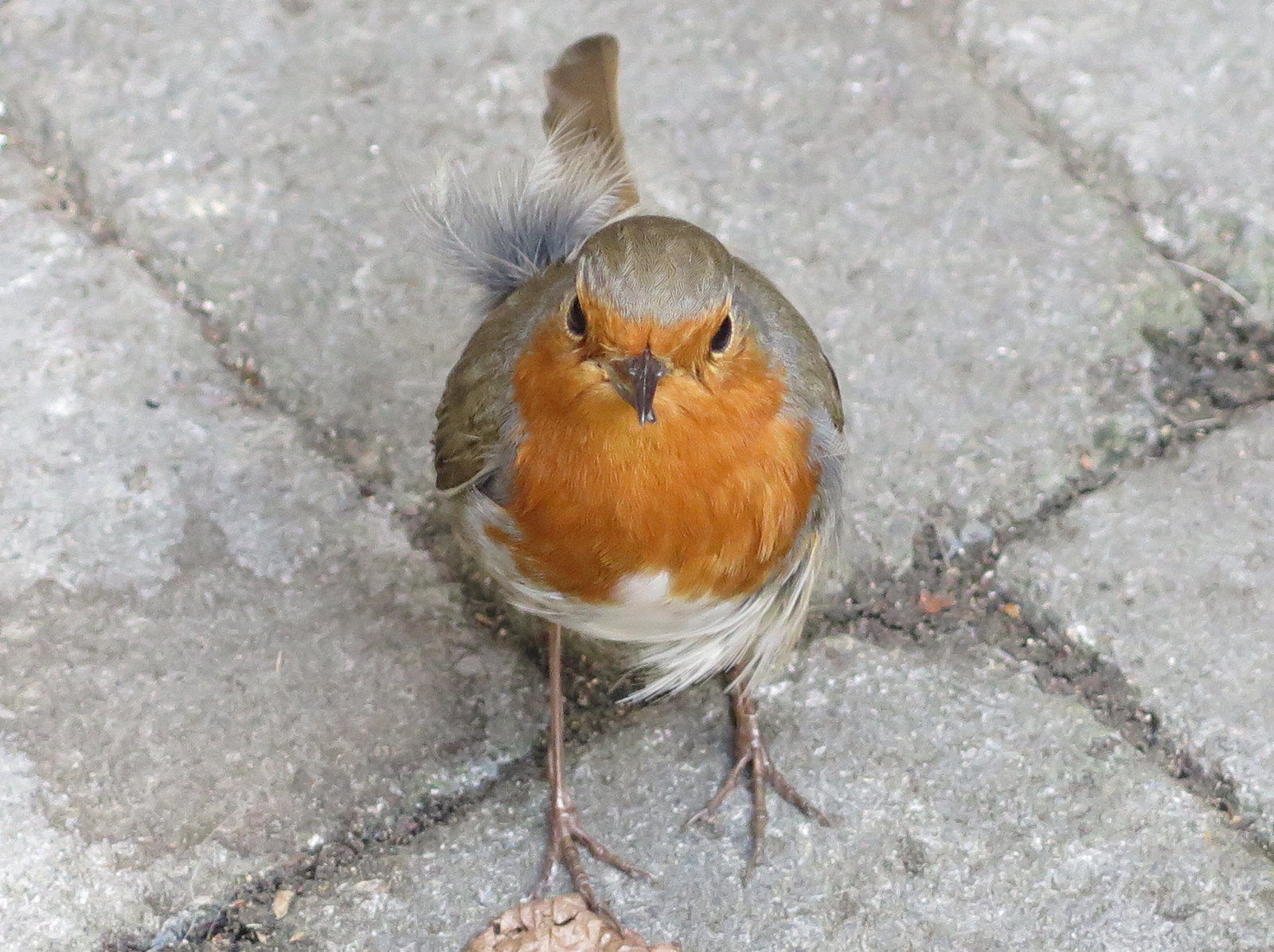
Come on mate, get preening! How do you expect to find an attractive female robin with scruffy, untidy feathers like that?

< Previous | Index | Next >

What’s in an image? Sometimes quite a lot, more than meets the eye.

I’m posting an image each day, or as often as I can; a photo I took, an image from Wikipedia, NASA, or some other open source, a diagram or a map. Whatever takes my fancy. This is the second in the series.

The robin at Pretty and Pip

Pretty & Pip is one of my favourite coffee shops in Cirencester. I wrote ‘the robin‘ because he’s always there, in their lovely courtyard. If I didn’t know the guy that owns and manages this place I might even think the robin ran it! He certainly thinks he belongs there, and he does a pretty good job of picking up cake crumbs and generally keeping the place spick and span.

But come on mate, get preening! How do you expect to find an attractive female robin with scruffy, untidy feathers like that?

Favourites

For convenience, here’s a list of my favourite images:

Anemone, Cloud, Honeybee, Hydrangea, Kiftsgate1, Kiftsgate2, Large White, Mugshot, Nelson, Robin, Rose, Spilhaus, Sunset1, Weston beach

Themed image collections

The links below will take you to the first post in each collection

Cirencester, Favourites, Irish holiday 2024, Roman villa

< Previous | Index | Next >

Useful? Interesting?

If you enjoyed this or found it useful, please like, comment, and share below. (If you don’t see those links, click the article’s title above the main photo and they will appear.) Send a link to friends who might enjoy the article or benefit from it – Thanks! My material is free to reuse (see conditions), but a coffee is always welcome and encourages me to write more often!
Elephant hawk moth

The caterpillar did something extraordinary – it mimicked a small snake

Have you ever seen an elephant hawk moth? If you live in Europe or Asia you might have spotted one of these amazing insects. In the United Kingdom they are fairly common, but perhaps not often seen. It’s a real treat to spot an adult or a caterpillar, both are amazing sights.

An elephant hawk moth male (credit: Wikipedia)
The circle marks the spot (credit OpenStreetmap)

Walking in the Cotswold Water Park recently, near the Gateway Centre on Lake 6, we spotted an elephant hawk moth caterpiller crossing the footpath (close to the grey circle in the map.

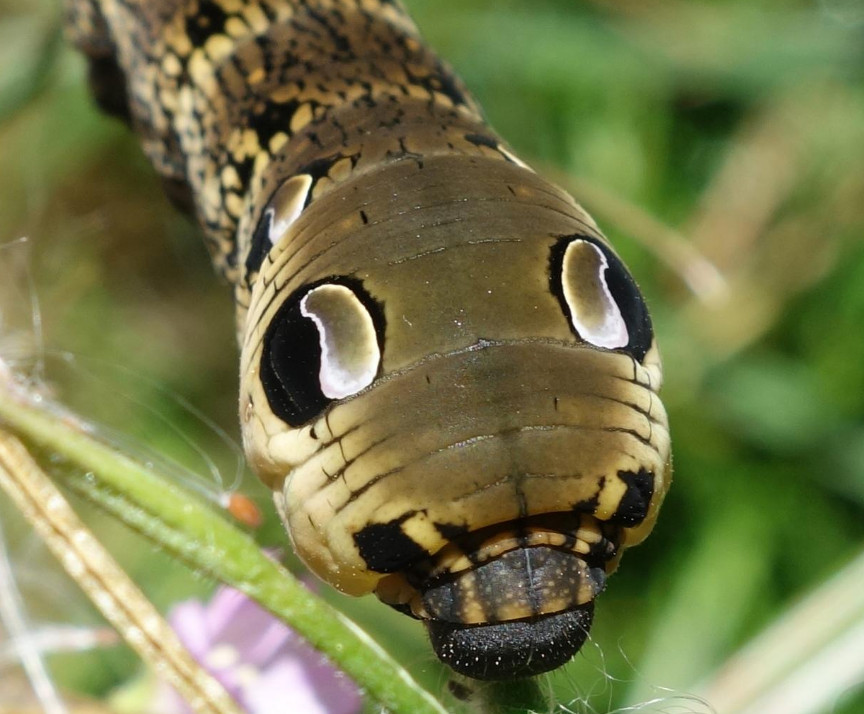
For a short time we just watched as it made its way across the path. But before it made it to the vegetation on the far side, some people appeared with a dog. The dog ran up enthusiastically to greet us and accidentally kicked the caterpiller before running off again. The caterpillar did something extraordinary – it mimicked a small snake.

Am I a caterpillar, or am I a snake?

The caterpillar crossing a stony path

For perhaps 20 seconds or so it writhed its body in a convincingly snakelike movement, and it pumped up several body segments behind the head, tucking its head down at the same time. With eye spot markings on its flanks, a scaly pattern on the entire body, and by raising up the front part of the body, it really did look the part. I wasn’t fast enough to get a photo, but I did get some video of the recovered caterpillar continuing on its way afterwards.

Searching the internet later, I found several good images of the caterpillar mimicking a small snake. Perhaps the best of these is show below.


The caterpillar looking very much like a snake (credit iSpot)

The natural world is so amazing, and so full of surprises, but mimicry is quite a common feature in both plants and animals. The European white dead-nettle has leaves that cannot sting but match the appearance of the unrelated stinging nettle very closely. Some insects look like pieces of wood, or a leaf, or a patch of white lichen, or a bird dropping. Many slugs look very much like animal droppings of various kinds, and as they move so slowly only an alert predator is likely to notice them. Predators, too, use camouflage which is not truly mimicry, but helps them merge into dappled sunshine and shade. Fish are often dark on top and silvery underneath. Sometimes they are patterned and look like the gravel bed of a stream or river.

Amazing!

See also:

Life together

Only living things can form a murmuration. Not only that, the individuals must all be alive with the same kind of life, don’t expect to see seagulls and starlings together in the same formation.

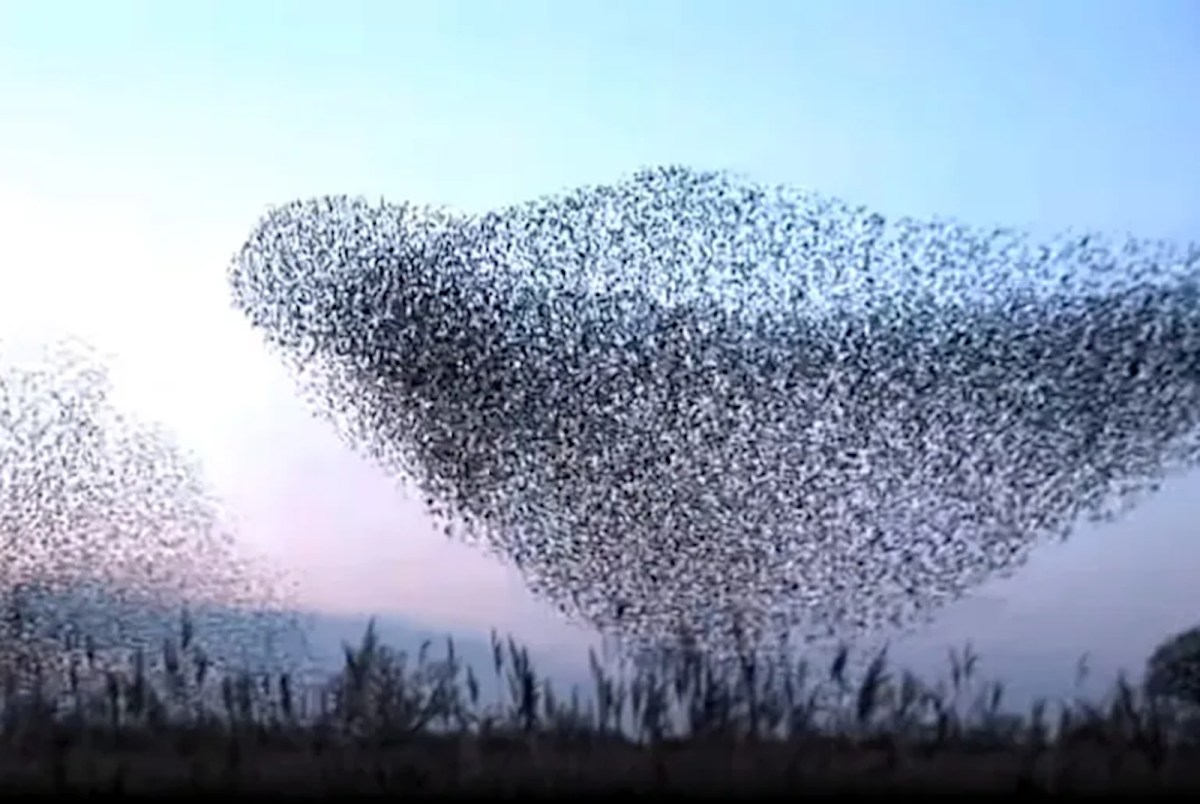
A murmuration of starlings

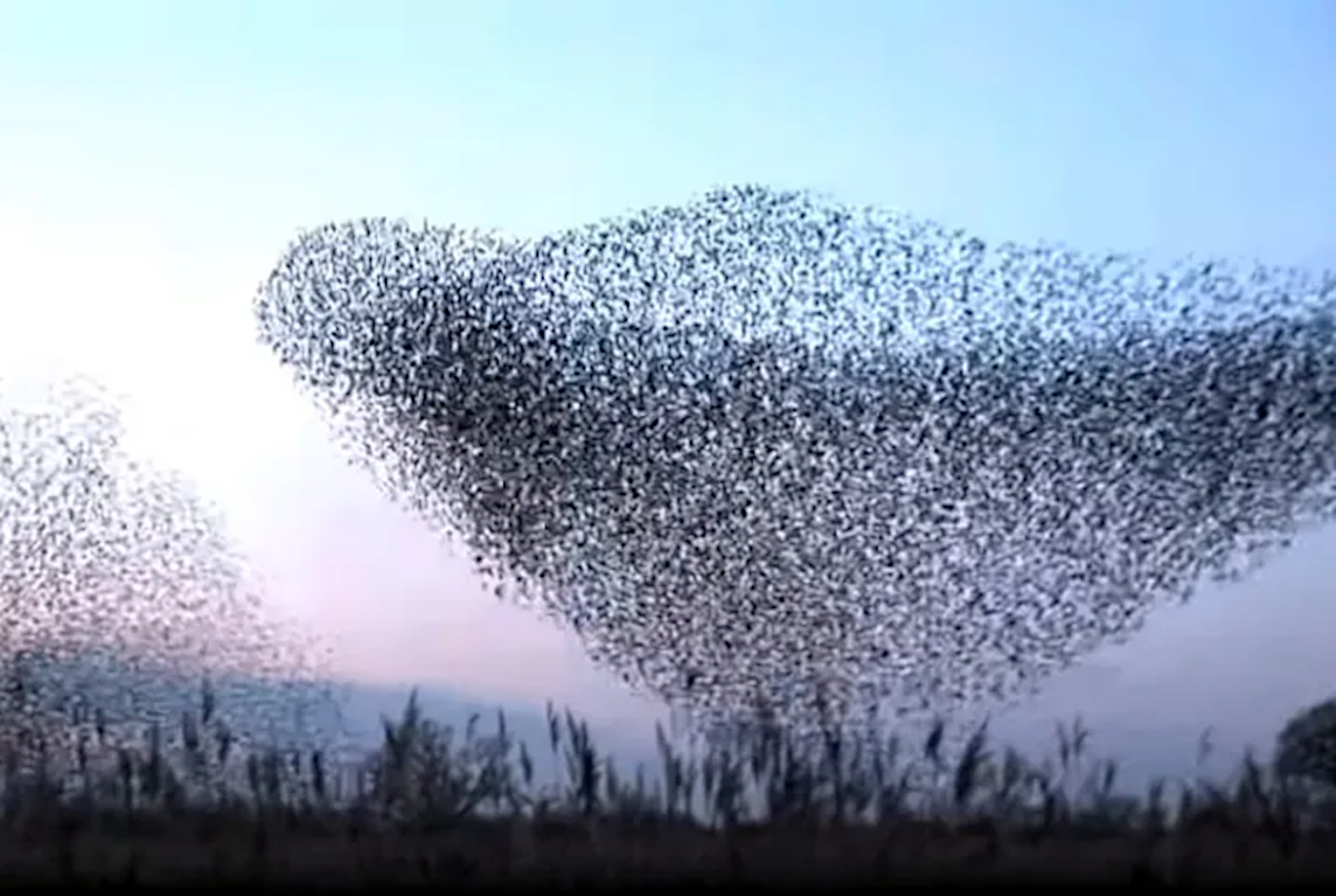
This morning, swilling out the cafetiere, watching the dark coffee grounds fan out and spiral down the drain, a word popped into my mind – ‘murmuration’. This word is used for a flock of birds flying together, swirling hither and thither, flying together as one yet moving independently and in smaller groups within that one flock. Starlings are particularly known for this behaviour as they go to roost in the evening light, and the dark specks of coffee reminded me of a murmuration of these birds.

Murmuration of starlings

But looking at those coffee grounds made it very clear to me that only living things can form a murmuration. Not only that, the individuals must all be alive with the same kind of life, don’t expect to see seagulls and starlings together in the same formation. The living entities must also be in a fluid environment (air or water, large shoals of fish can exhibit the same phenomenon). And they must be aware of one another and able to respond rapidly to one another’s movements.

Take a look at this video of a starling murmuration. It’s stunning!

So it should be with the church. A formation of individuals all alive with the same life, the life of Christ, all filled with his Spirit. Church should be a fluid environment, the individuals free to move in every dimension, yet always aware of one another and responding to one another.

When the church flows like a murmuration, individually alive with Christ, individually free to move yet mutually aware, responding to one another’s presence and movement, unconstrained except in obedience to Christ, then, my friends, we will see her transcendent glory revealed and the whole world will gasp. People will say, ‘Oh wow, how can this collection of individuals flow together with such transcendent beauty and grace?’

If not, we are little better than coffee grounds swirling into the drain. Not alive at all, merely acted on by random currents as gravity draws us ever downwards. Paul expressed this when he wrote to the church in Ephesus,

We must no longer be children, tossed to and fro and blown about by every wind of doctrine, by people’s trickery, by their craftiness in deceitful scheming. But speaking the truth in love, we must grow up in every way into him who is the head, into Christ, from whom the whole body, joined and knit together by every ligament with which it is equipped, as each part is working properly, promotes the body’s growth in building itself up in love.