Canal walk 1 – Severn to Saul Junction

Severn trows were flat-bottomed, single masted sailing vessels, and the Stroudwater canal was wide and deep enough to take them.

< Previous | Index | Next >

This section of Stroudwater Navigation is not being restored, but it is certainly of historical interest and mostly remains visible on the ground. It’s still possible to walk almost all of the towpath and not too hard to imagine what it might have been like when it was in use.

The connection to the River Severn
The River Severn at Framilode (near high tide)

The physical point where the canal joined the Severn is not accessible as it’s on private land. However, it’s easy to get very close. The River Severn is still tidal at this point, and the canal engineers had to take this into account. Instead of a single lock gate providing access, there were several; this allowed boats to transfer between river and canal for longer periods as the tide ebbed and flowed.

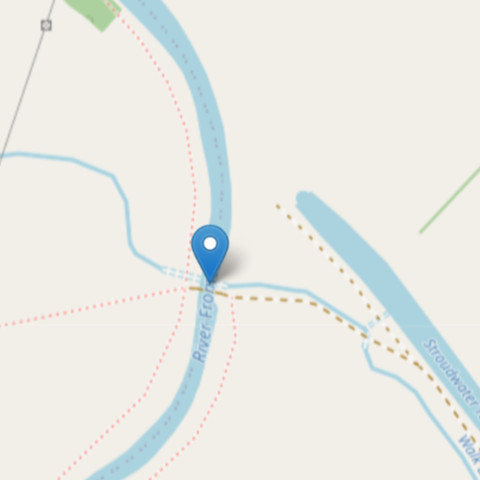
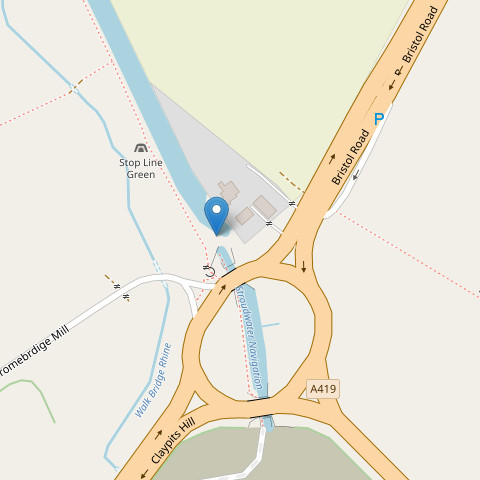
To find this spot on the ground, visit the village of Upper Framilode and look for the point near Lock House where the road crosses the line of the canal, then click the tiny map on the right for a larger, draggable and scalable version. The pointer shows where the canal and river meet, the place where Severn trows and other boats would have entered the canal heading towards Stroud, or exited into the Severn to make their way north towards Gloucester, Hereford and Worcester, or south towards Bristol and the River Wye to Chepstow and Monmouth. If you have time, pop into St Peter’s church in the village and enjoy the simple stained glass and the beautifully painted ceiling. A peaceful place, used by the local community in many interesting ways.

Severn trows were flat-bottomed, single masted sailing vessels, and Stroudwater Navigation was wide and deep enough to take them, with locks sized accordingly.

You can also view a map of the canal from the 1840s to compare with the current map. This, too, is draggable and scalable. If you open two browser windows side-by-side with the modern map in one and the historical map in the other, it’s fascinating to see the many changes that have taken place.

To start the walk south from Upper Framilode, look for the footpath just left of the canal as seen from Canal Row. This is the old towpath and runs between the canal and the row of buildings that grew up along the first 100 m of the canal. Presumably most, if not all, of these buildings sold necessities to the passing canal traffic. I can imagine everything from ale to fresh well water and hens eggs and other garden produce being traded while boats loaded and unloaded or just waited for a lock to fill or empty.

Heading south
View back to Canal Row – from left are the canal, grassy towpath, and row of buildings

The first landmark you will come across is ‘The Ship’ inn. You’ll pass the pub and then its car park, both on the left. After passing it, looking back you’ll see its name painted on the building’s wall. It’s only 250 m or so from the start of the walk.

It’s not hard to imagine the trows travelling to and fro along this section of the canal. No doubt the pub was a popular stop.

The Ship Inn, looking back towards the start

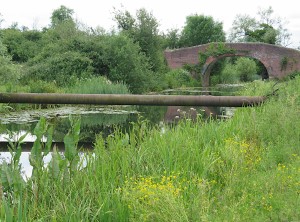
As you can see, this first section of canal is still in water, and along the way you will have noticed the large stones edging the canal. Lock gates and other wooden structures have long since gone, of course, rotted away by the action of rain, fungi and bacteria. Like all human technology, canals must be maintained if they are to continue working. Although there’s still water at this point the canal is certain to be heavily sited up, and reeds, rushes and other water-tolerant and water-dependent plants have colonised very effectively.

Saul Bridge

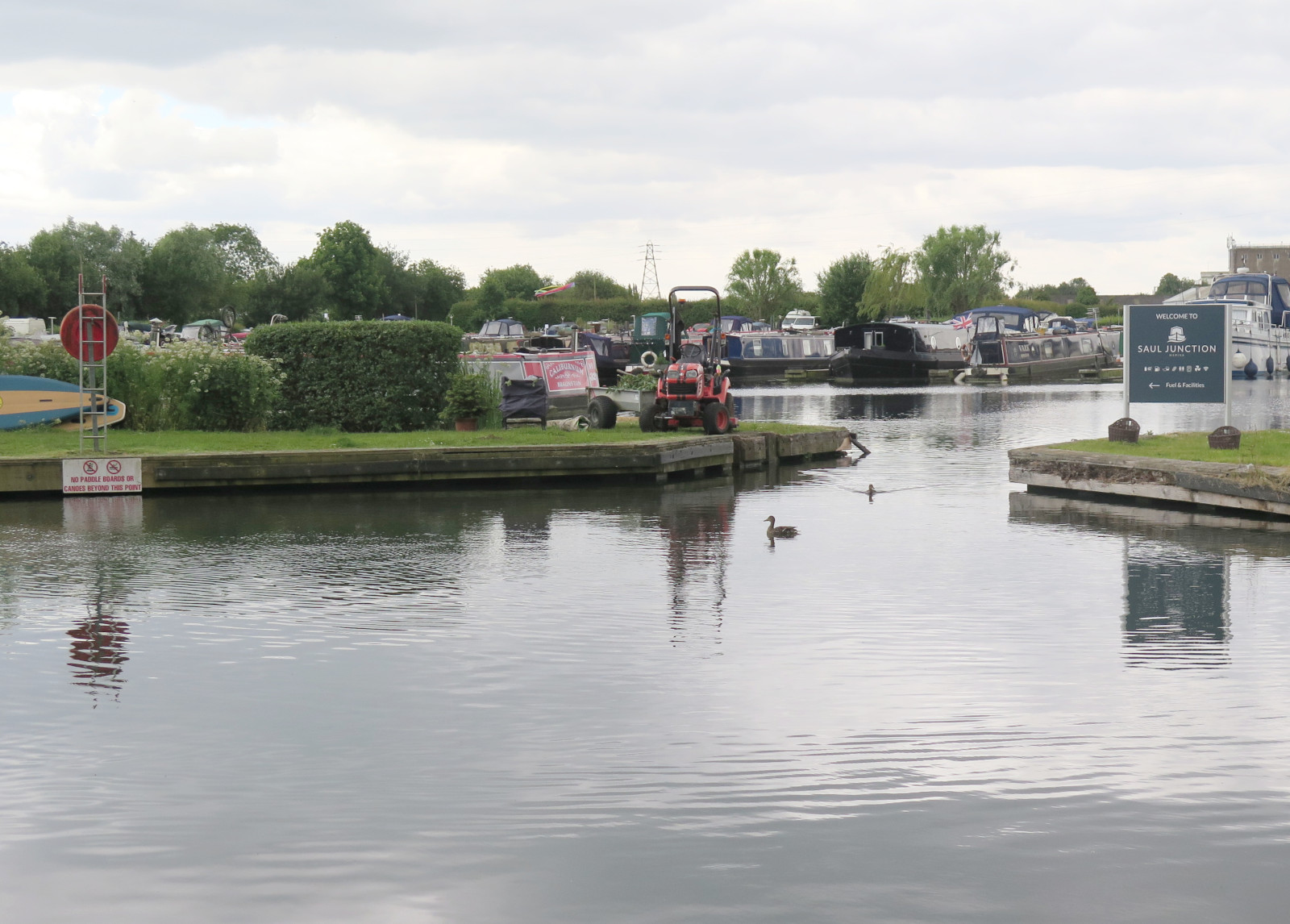
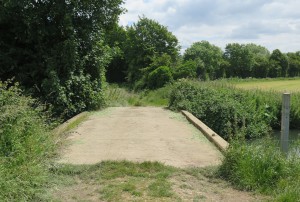
The map marks the next point on the journey, the place where Moor Street crosses the canal over Saul Bridge. It’s the first bridge you come to and is not far beyond The Ship Inn. Originally this was a swing bridge, but the modern replacement is concrete and brick. Continue along the towpath beyond the bridge and you quickly come to the end of the section of canal remaining in water. The scene changes quite a bit from here on.

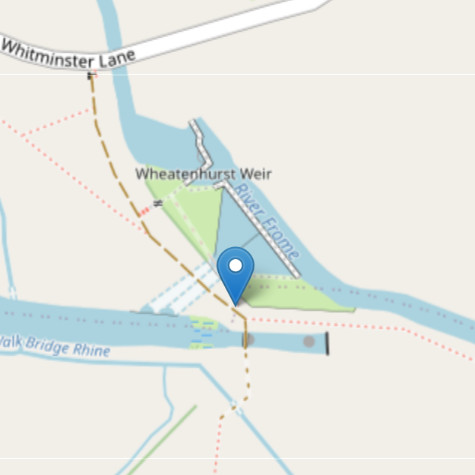
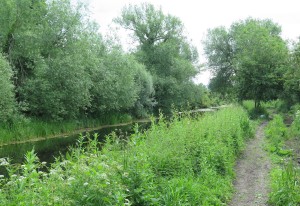
The River Frome comes alongside the tow path on the left at a point where the canal (still on the right) becomes dry; you can see this point on the map in the previous section. Don’t be confused! For a while you will see the Frome on the left of the tow path and the dry canal on the right. In places the canal has been filled in and that makes things even more difficult to visualise. Sometimes you can spot the left bank of the canal as a curved ridge, even when it runs through an open, grassy field. The towpath would probably have run along the flat top of this ridge.

River, footpath, and the bank of the canal

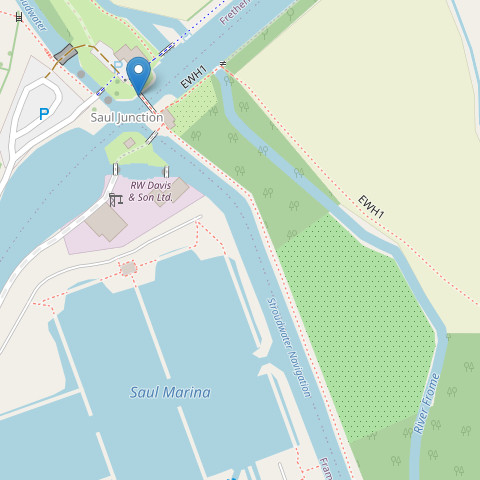
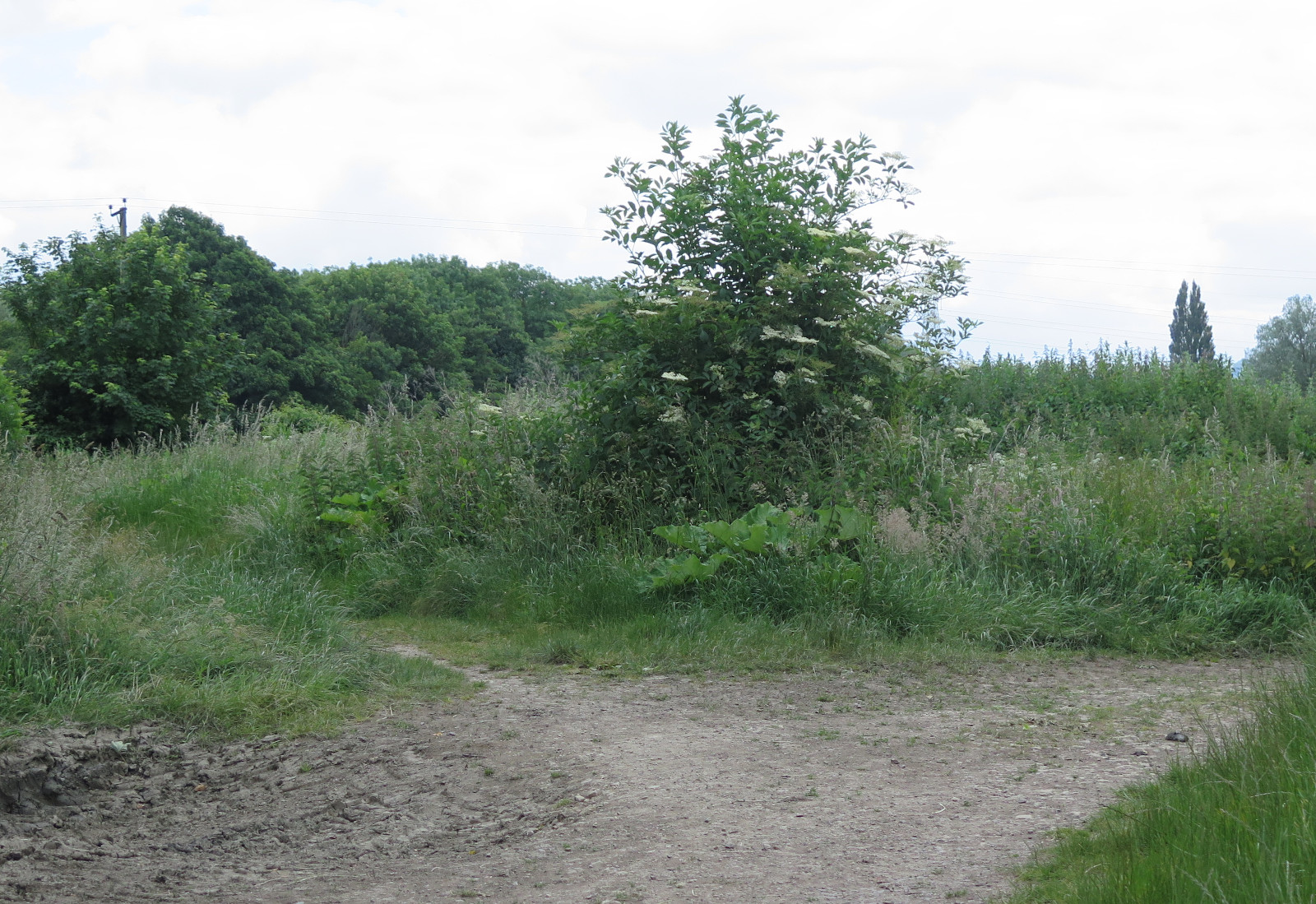
Just keep walking on the footpath and you’ll be OK. If you see signs for the Thames and Severn Way, Cotswold Canals Trust, or Saul Junction follow them; they will all guide you along this section of the canal. After the section of infilled canal, there’s a very overgrown part, and finally the footpath opens onto Saul Junction itself.

Here, the Stroudwater Navigation (opened in 1779) continues straight across the much larger Gloucester and Sharpness Canal, which opened in 1827, carries much larger vessels, and connects Gloucester Docks with Sharpness. At Sharpness, vessels can continue on the river to and beyond Bristol. Look across the ship canal where you will see Stroudwater Navigation continuing, not only full of water, but still in use. I’ll write about that next section in a future article.

Once the ship canal was open, it made a much better, non-tidal route to Gloucester or Bristol, and that’s why this section of the Stroudwater Navigation languished and fell out of use. The crews of trows coming and going to Stroud simply had no reason to enter the Severn from Saul Junction after 1827.

See also:

< Previous | Index | Next >

*This is a great source of canal images, history and all sorts of detail. Highly recommended and well worth exploring!

Useful? Interesting?

If you enjoyed this or found it useful, please like, comment, and share below. Send a link to friends who might enjoy the article or benefit from it – Thanks! My material is free to reuse (see conditions), but a coffee is always welcome and encourages me to write more often!

Another message from Yara

Sometimes the worst things are done when the perpetrators are most afraid; and right now I think Putin is very much afraid.

This is a message of despair from a brave Ukrainian lady who deserves so much better. All Ukrainians deserve so much better. Yet I know the despair will be temporary.

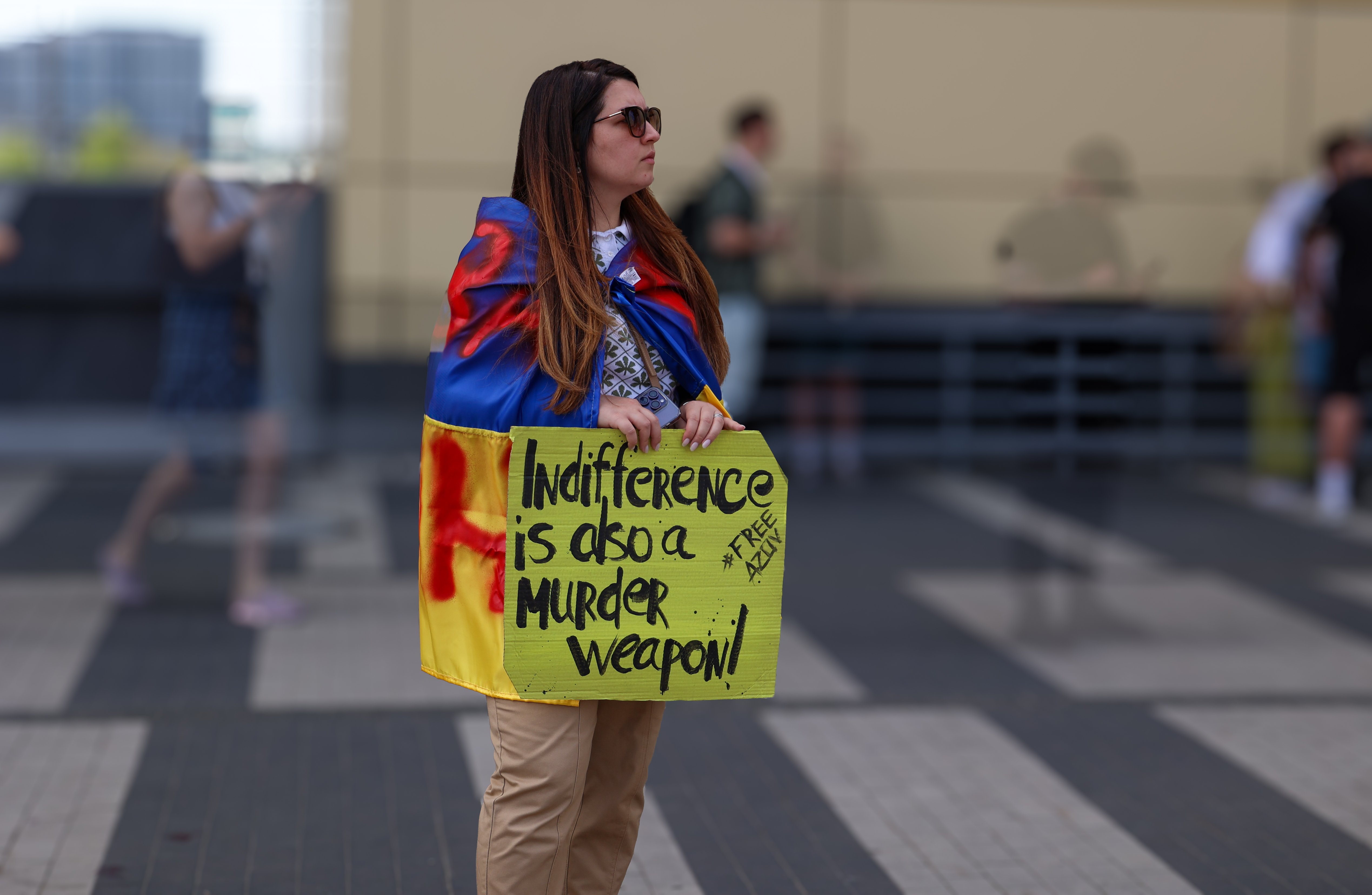
A photo from Yara’s message

Yara has an irrepressible nature and despite the terrible circumstances I know she will regain a measure of hope and want to share Ukrainian culture and art with her readers again quite soon.

Please do read her message for today. Below I’ve copied a reply to it that I posted there a few minutes ago. I think there is growing cause for hope, and that’s what I wrote about and want to emphasise.

But before I share that reply: What can you do to help? Visit Yara’s site and take a good look around, read some of her other, more upbeat, messages. Consider becoming a supporting member, buy her a coffee, leave her a reply to one or more of her posts. Contact your government representative asking them to do more. In the UK write to your MP. Hint: Write again after our upcoming elections, you might find you have a different MP.

My reply

Wanting better for you, Yara. Wanting better for Kharkiv. Wanting better for every part of Ukraine.

Sometimes the worst things are done when the perpetrators are most afraid; and right now I think Putin is very much afraid.

Everything in Russia is beginning to fall apart – in fact, more than ‘beginning’. The evidence is everywhere.

  • There is a big shake up in the Russian Army, many senior officers are being arrested, perhaps because Putin fears a coup. Shaking things up does not make an army more effective. Just the opposite.
  • Inflation is ‘under control’ according to Putin. He is ignoring something like 8% inflation per month. How long can he pretend?
  • Crime rates are spiralling out of control.
  • Buildings are collapsing (not bombed, just badly built and lacking maintenance).
  • Roads and railways are broken, water supplies are broken, power supplies are broken, Ukraine is destroying oil refineries. Nothing is being repaired because so many skilled people either left Russia, or have been sent to die in Ukraine.
  • Nearly half the Black Sea Fleet is on holiday, resting peacefully on the sea bed.
  • Aircraft, air defence, airfields are being destroyed daily.
  • The war is going badly, very badly in fact.

What will happen next?

Putin’s time is probably short now, everything is going wrong for him.

Ukraine’s nightmare might end very suddenly, though nobody knows when. It could be in a year’s time, or just a month, or a week, or it might be tomorrow.

None of this affects how you feel right now, so you (like so many in Ukraine) will have to suffer longer. But feelings change day by day, One day, hope will grow like a tree in the springtime. Hope will blossom and flourish. But perhaps not today.

I know you, like all Ukrainians, will cling to hope until it’s no longer needed. Then you will all be able to sing, and dance, and have parties in the street, and then start on the huge task of rebuilding your shattered lives and towns and cities.

Slava Ukraini! Heroyam slava! 🇺🇦 🇺🇦 🇺🇦 🇺🇦 🇺🇦

War, survival, victory

Nobody asks your permission or opinion, and suddenly people and places you love are injured and damaged by bombs and missiles.

Today I want to bring you news from Ukraine. I’m going to do this by giving you a glimpse through the eyes of Yaroslava Antipina who lives in Kyiv; if you want to know about a topic, the best sources always include local people.

The image above shows one of Yara’s pages on the web, here (and elsewhere) she writes regularly to inform her readers about the war, but also about Ukraine and Ukrainians. She shows us the architecture, the places she visits, the art galleries and museums and cathedrals and much, much more. Like all Ukrainians, and like my parent’s generation in the UK, Yara knows what it’s like to be thrust unwillingly into armed conflict. Nobody asks your permission or opinion, and suddenly people and places you love are injured and damaged by bombs and missiles.

But that’s enough from me today. I’m simply going to re-post Yara’s latest Sunday message to her followers. I recommend and urge you to read more of her material, you can find her in various places.

–oOo–

Hi!

I am writing to you from sunny Kyiv. The weather is mild and gentle, and on such days, it is hard to believe that the war is walking heavily somewhere on our land.

The situation in Kyiv is not so bad compared to frontline or near frontline territories. If you come here, you will see a city that tries hard to live. And you even feel this tension, this strong desire to show everyone, especially the enemy, that we are alive and our spirit is strong.

I have just got this thought…

Do you also feel that my letters are like conversations between two people? I hope so.

Okay, in this letter, you will see photos of Ukrainian artists from the so-called Samarkand era. Samarkand is a city in Uzbekistan. From 1941 to 1944, this city became a home for many Ukrainian artists. I will briefly tell you about this era a bit later in the letter. And the photos are from the exhibition I visited this week.

Petro Sulymenko (1914-1996), Sher-Dor, 1942

Some explanation: Sher-Dor Madrasa is a 17th-century madrasa (Islamic school) in the historical centre of Samarkand.

Let’s talk about the war. I rarely tell you about the situation on the frontline. It is a topic better explained by war experts or military personnel. But this week, I heard and read a lot about it, especially Chasiv Yar, so I decided to figure out why Chasiv Yar is so important for the russians.

So, Chasiv Yar is a city in Donetsk Oblast. About 13,000 people lived here, but as of early April, about 700 remained. It is the highest point for hundreds of kilometres around. The city stands on hills that protect it from the east and south like defensive walls.

Chasiv Yar is the ‘gateway’’ to the cities of Kostiantynivka (7 km to the west) and Kramatorsk (25 km to the northwest). If the russian forces manage to capture Chasiv Yar, they will have the opportunity to launch an offensive on them and other settlements of Donetsk Oblast, which still are controlled by Ukraine. You can read a short review in Politico or a detailed explanation of the importance of Chasiv Yar in The New York Times.

Oleksandr Syrotenko (1897-1975), Evening. Samarkand, 1943

I want to add a few lines about the situation in Chasiv Yar now. Of the 700 people still living in the city, 80-85% are older people who refused to evacuate. Their main argument is that this is their home, and they want to stay here till the end.

Since February 2023, Chasiv Yar has had no gas and water supply, electricity, and poor mobile phone connection. Those who have stayed here rely on generators and water from wells to keep themselves alive.

All high-rise buildings in Chasiv Yar have been damaged by shelling; 80% of the damages are critical.

–oOo–

There are four more images of beautiful paintings and more informative text, but I want to encourage you to see those on Yara’s site… Thank you!

Attic staircase

Perspective changes how we see things generally … Whether you’re considering a person, or an opinion, or solving a practical problem, the way you look at things can change everything.

Donna and I visited William and Jane Morris’ home, Kelmscott Manor, in the little, Oxfordshire village of Kelmscott. They lived here from 1871 until 1896. It was a warm, sunny day and we enjoyed lunch in the garden as well as exploring the house.

The attic staircase

Kelmscott Manor is full of furniture from the Jacobean to Victorian periods, and of course it’s also full of William Morris designs in the form of wallpapers, fabrics, and tapestries. An amazing place and well worth a visit.

Yet something that stood out for me was this staircase connecting the attic space in the roof with the the lower floors of the house proper. What I like about the photo is the effect of light from the window, and the various textures: the sturdy, wrought iron handrail, which crosses oddly and uncompromisingly in front of the window; the wood of the stair treads; the polished timber of the railing at the top; the mix of reflected colours on what is actually a plain, white wall; and the odd angles created by variations in perspective – it’s quite magical!

Maybe I’ll post again about this lovely old house and its fabulous contents, but for now I’ll leave you with the interesting composition of light playing on an ordinary, day-to-day, attic staircase.

And there’s a life lesson here for us if we think a little deeper. Perspective changes how we see things generally, not just staircases. Whether you’re considering a person, or an opinion, or solving a practical problem, the way you look at things can change everything. Maybe you’re better at this than me, but I need to learn to alter my perspective more willingly when necessary.

See also:

A coffee is always welcome!

Everyone should see this

If you want to face down the playground bully you need more friends than he has, and preferably a larger, heavier stick to fight with.

Here’s a Times Radio interview of General Sir Richard Shirreff, sharing his thoughts on events in Ukraine, recorded on 9th April.

Times Radio interviews General Sir Richard Shirreff

Why do I think everyone should see it? Britain has done more to help Ukraine than many Western nations. So have Poland, France, Germany, Canada, the Baltic States, Finland, Norway and Sweden.

But we need to do so much more. If we do not, we are risking a future war between Russia and NATO. That, of course, is the last thing we want to happen, but if we don’t prepare for the worst case now, it may happen anyway, and partly (even largely) because of our lack of preparedness.

If you want to face down the playground bully you need more friends than he has, and preferably a larger, heavier stick to fight with. We have friends, but right now we are brandishing a twig and hoping the bully will turn away in fear.

He will not.

Sir Richard makes this very clear. That’s why we all need the chance to hear and evaluate what he has to say.

A coffee is always welcome!

Are we helping Ukraine enough?

The main thing that is necessary, and therefore the first thing to address, is to decide what outcome we want to see. How do we want this war to end?

Here in the democratic world, we claim to be helping Ukraine. But are we really doing enough? I think we began rather late, but after (and even before) the Russian invasion in February 2022 we did make some efforts to help Ukraine with arms and ammunition. And two final questions, ‘Why does it matter anyway?’ and ‘What more should we do?’

Beautiful Ukrainian scenery in Crimea (Wikimedia)

In thinking this through there are several things to be considered. Let’s deal with those briefly before discussing in more detail whether we are helping Ukraine enough.

The democratic world

We often hear people talk about ‘The West‘ as a catch-all term for the USA, Europe, and any other similar democracies around the globe. This would include the UK, Canada, Australia, New Zealand, Japan, South Korea and I could list more. ‘The democratic world’ is not the way we usually express it, but I think it’s a more accurate term than ‘The West’.

Ukraine

Most of us know where Ukraine is, particularly following the Russian invasion. Regular news coverage has given most people a reasonable level of knowledge about the place geographically, socially and historically. But we need to acknowledge that there are two distinct understandings of Ukraine. The democratic world accepts that Ukraine became an independent nation when the Soviet Union broke apart in 1991. Ukraine is also recognised by the UN and other international bodies, with borders widely accepted to include Crimea and the Donbas. But the current Russian leadership has a different view, claiming that Ukraine remains part of the Russian World and should be brought back into the fold, by force if necessary.

Countries that don’t identify as part of either the democratic world or the Russian world also view Ukraine in one of those two ways depending on the strength of their association with Russia. North Korea and Iran, for example, accept the Russian version. Many countries in South America, Africa, the Middle East, and Asia take the view of the democratic world, but by no means all. Voting at the UN reveals where the balance of opinion lies – and it’s not with Russia.

Helping Ukraine

Aid of various kinds has been provided to Ukraine. There has been financial support to the Ukrainian government to help with provision of public services and for reconstruction following Russian destruction of power supplies, hospitals, schools, industries and housing. At the same time a wide range of sanctions have been applied to Russian trade and we can see this as support for Ukraine as well.

Additionally there has been considerable help in the supply of weapons and ammunition to help Ukraine fend off Russian attacks; but this has come with strict limits (don’t use what we are giving you to strike targets inside Russia). Limiting the use of weapons in this way is effectively tying the Ukrainian armed force’s hands behind their backs. The argument is that the Democratic World does not want to ‘provoke’ Russia. That’s a serious weakness, not just for Ukraine, but for all of us.

And although European nations and their allies are still providing arms and ammunition, the USA is not, due to internal wrangling in the House of Representatives.

Is there more we should do?

Undoubtedly, yes, much more. The main thing that is necessary, and therefore the first thing to address, is to decide what outcome we want to see. How do we want this war to end? We should have decided this more than two years ago, even before Russian armour, aircraft, supply vehicles, and troops crossed the international border in a drive to Kyiv on 24th February 2022. There are only four possible answers here:

  • We want Russia to win
  • We want the war to drag on and on while Russia continues to commit war crimes, destroying towns and cities, targeting essential civilian infrastructure, and killing Ukrainian men, women and children
  • We want a ceasefire agreement
  • We want Ukraine to win, ie drive Russia back beyond the 1991 borders

So let’s consider the implications of each outcome.

We want Russia to win

This way lies madness, and I don’t think any democratic country is suggesting it. Even if we ignore the illegality of the war, and even if we ignore what Russia would do next (we can guess, given their actions in Bucha, Mariupol, Bakhmut, Avdiivka and so forth), we should never overlook Russia’s existing threats beyond Ukraine. Serious threats have been expressed towards Finland, the three Baltic States, even Poland; and who is to say it would stop there?

We want the war to drag on

In this case we would have to accept that we’d need to go on supporting Ukraine indefinitely with financial and military aid. That represents a very expensive choice! It would also seem to be an abhorrent and immoral choice as it would allow the civilian suffering to continue indefinitely. Does anyone seriously support such an option?

We want a ceasefire agreement

Ukraine would gain a respite from fighting, and so would Russia; it seems like a good choice that many people would support. But we need to think a bit harder about this option. First, it rewards the illegal hostility and land grab that has already taken place. A ceasefire would put an end to Ukrainian hopes of regaining its occupied territory, territory taken against international law and international recognition of borders. Are we really willing to let Russia benefit from its aggression?

And how long would such a ceasefire last? Russia has declared that it wants all of Ukraine (Reuters). Five or six years for Russia to regain its strength, build up its army and armaments, and what would then stop them from starting a new ‘special military operation’. Up until the day of the invasion in 2022, Russia had been telling the world it had no intention of attacking Ukraine! Putin is not a man of his word. Words mean nothing to him; he’s made that clear over and over again. He would simply ignore any commitments previously made in a ceasefire agreement. Trust him at your peril!

We want Ukraine to win

Considering the arguments above, this has to be a no-brainer. Why isn’t it? The answer is clear – we have not thought it through very thoroughly.

I want Ukraine to win, and I want all the countries that support Ukraine to want them to win too. And further, I want all those countries to let Russia know, in no uncertain terms, that our clearly declared intention is that they should lose this unprovoked, illegal war for which they alone carry the responsibility.

Why is it important that Russia understands this? Simply this, that Mr Putin respects strength and clearly expressed intentions. If he is in any doubt that we will settle for less than a full Russian withdrawal from Ukraine including from Crimea and Donbas, he will procrastinate and continue to fight. He may do that anyway, of course. But he must, if necessary, be forced to leave Ukraine.

Why does it matter anyway?

Russia is militarily weaker that they believed themselves to be two years ago, and Ukraine has proved to be far stronger than Putin expected. Russia will not give up voluntarily, so it’s essential that they are forced to do so. It is essential for Ukraine to win as soon as possible, to save innocent lives, to reduce the financial costs for Ukraine and her supporters, and to put Putin and Russia back into a place where they know they have lost and will be unwilling and unable to try again. It’s essential for peace and security in Eastern Europe, and very possibly in Western Europe too. We must not fail Ukraine and we must not fail ourselves. Democratic people deserve to live in a peaceful world. Autocracies must not, in the end, prevail. Indeed, all people deserve to live in a peaceful and harmonious world.

Please don’t misunderstand me, I would very much like peace and harmony with Russia. But that will not become possible until Russian forces withdraw from Ukraine, and accept that military conquest to extend Russian territory is not acceptable.

Historians remind us that we were in a similar situation in 1938 when Czechoslovakia was forced to give significant border areas to Germany ‘to prevent a wider war’. The disputed land was duly given to Germany, but German forces subsequently moved into the rest of the country and took control anyway. World War II broke out soon afterwards when German forces entered Poland.

And that’s what might happen now. Ukraine would be forced to give significant border areas to Russia ‘to prevent a wider war’. The disputed land would be duly given to Russia, but Russian forces would subsequently move into the rest of the country and take control anyway. World War 3 would break out soon afterwards when Russian forces enter Poland and/or the Baltic States.

Let’s not fall into that trap. We need to say, ‘No’, and say it very clearly indeed. We must not say, ‘OK, settle for part of what you want’. Because Putin will smile, take what we agree, and then take the rest later. And he won’t stop there.

There’s another thing to remember. We are not dealing with a reasonable person. Vladimir Putin has lied before, he has never been trustworthy, when he agrees to something it’s because it will bring him an advantage. He regards keeping his word as a serious weakness. He casually murders those who oppose him – even his friends. It’s hard to imagine permanent peace in Europe as long as Putin is alive and free. Russia cannot change while he is in charge. That, too, should remind us of the run up to World War II.

What more should we do?

We should immediately provide much more military support. France is working to provide more armour and air defence missiles. The United States must be deeply embarrassed at their present inability to provide ammunition and air defence help. Czechia has done really well to arrange to supply more than a million shells.

In parallel, our governments should urgently be ramping up manufacture of ammunition for our own stocks in addition to supplying Ukraine, and we must increase military budgets to innovate and enlarge our armed forces. Perhaps the war will not spread beyond Ukraine, but we cannot assume that. It is always better to be safe than sorry. We must stop acting as if war is far away and can never come closer. The old Boy Scouts motto applies – ‘Be prepared’.

See also:

Complete clarity on Ukraine

The Russian official line is certain to be rejected and disregarded by most governments, by NATO, by the UN, and by people of goodwill

Just take a look at Russia’s current demands for peace with Ukraine, expressed by Dmitry Medvedev. I’m sure you’ll agree that he puts it rather clearly; does this seem reasonable and fair to you?

How Russia treated Mariupol (Wikimedia)

The text below is an extract from today’s ISW report on the war in Ukraine. These are the Russian conditions for peace. It’s the official line, published by Dmitry Medvedev, currently Deputy Chairman of the Russian Security Council. This is what he calls a ‘peace formula’, it does have the merit of leaving us in no doubt about what Russia wants.

Medvedev begins the “peace plan” by rhetorically stripping Ukraine of its sovereignty, referring to it as a “former” country and placing the name Ukraine in quotation marks. Medvedev laid out the points of his “peace formula”, which he sardonically described as “calm”, “realistic”, “humane” and “soft.”

The demands are:

  • Ukraine’s recognition of its military defeat
  • Complete and unconditional Ukrainian surrender
  • Full “demilitarization”
  • Recognition by the entire international community of Ukraine’s “Nazi character”
  • The “denazification” of Ukraine’s government
  • A United Nations (UN) statement stripping Ukraine of its status as a sovereign state under international law
  • A declaration that any successor states to Ukraine will be forbidden to join any military alliances without Russian consent
  • The resignation of all Ukrainian authorities and immediate provisional parliamentary elections
  • Ukrainian reparations to be paid to Russia
  • Official recognition by the interim parliament to be elected following the resignation of Ukraine’s current government that all Ukrainian territory is part of Russia
  • The adoption of a “reunification” act bringing Ukrainian territory into the Russian Federation
  • The dissolution of the provisional parliament
  • UN acceptance of Ukraine’s “reunification” with Russia
Reformatted, extracted from the ISW report for 14th March 2024.

In a sense, this can be taken as a reply to the Pope’s recent statement about Ukraine ‘raising the white flag’. The Pope has since backtracked and clarified his statement, but Medvedev is most unlikely to backtrack his response.

The Russian official line is certain to be rejected and disregarded by most governments, by NATO, by the UN, and by people of goodwill throughout most of the globe. It is not acceptable as a starting point for negotiations of any kind, more a vain wish-list that very few can accept. Why, exactly, would Ukraine ‘recognise its military defeat’ when it is very clearly not defeated? And why does Medvedev think the entire world would ‘recognise’ that Ukraine has a ‘Nazi character’? Most of the world would be more likely to perceive such a character in the Russian government’s imperialist ambitions.

Dmitry Medvedev, and more to the point Vladimir Putin, seem to think they can get away with rewriting history, disregarding truth, invading an internationally recognised member state of the UN, breaking international law, and have the entire world let them get away with it. They are deluded. We will not and must not allow it.

Who innovates, and who reacts?

By an astonishing combination of determination and resolve, shrewd and innovative military action … the government in Kyiv not only hung on, but pushed the Russian Army back in disarray.

Russia invaded Ukraine two years ago, and everyone (including the Russian leadership) has been surprised at Ukraine’s success and ability to continue for so long. Right at the start of this war, as Russian columns crossed the international borders from both Russia and Belarus, few of us could have predicted that Ukraine would do so well and for so long. Many of us expected it would all be over in two or three days, yet two years later Ukraine still holds out. How?

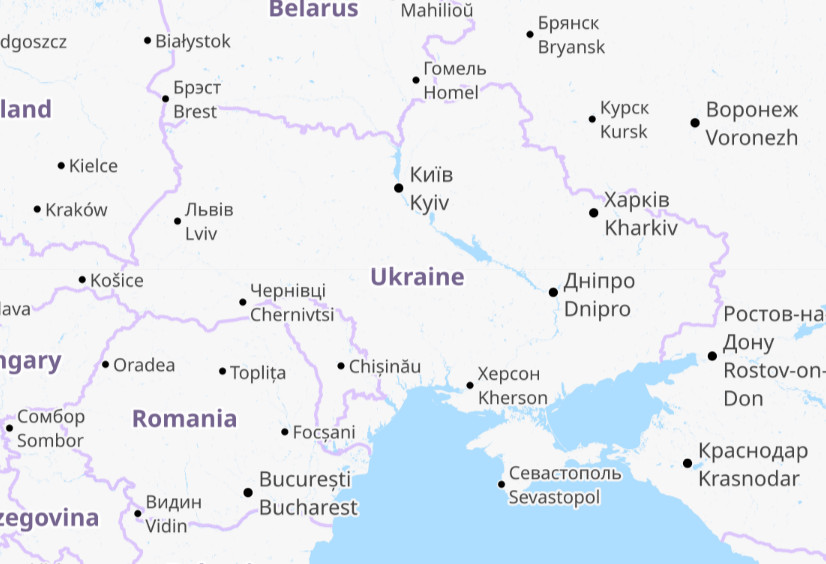
Outline map of Ukraine – Open Streetmap

Let’s think this through, breaking the topic down to war on land, at sea and in the air. First though, here’s a brief note on the historical background.

Ukraine has a long history and was instrumental in founding Moscow way back in early mediaeval times, but Ukraine was subsequently overrun (along with many other lands) by the Mongol empire in the 13th century. Much more recently, after a long period as a republic within the Soviet Union, Ukraine along with several other republics gained its independence when the Soviet Union collapsed in 1991. At that time Ukraine was recognised world-wide, including by the Russian Federation, as an independent state with its boundaries clearly defined and agreed.

Ukraine is a founding member of the United Nations, entering that body in 1945. On 24th February 2022, when Russian forces invaded Ukraine, they broke international law.

On land

Most people, including many military analysts, assumed that within a few days of the invasion President Zelensky would have fled the country, been captured, or would be dead. Instead he made the now famous announcement that he needed ammunition, not a ride. And by an astonishing combination of determination and resolve, shrewd and innovative military action, and rapid assistance and weapons supply by the West, the government in Kyiv not only hung on, but pushed the Russian Army back in disarray.

This initial action was followed throughout the rest of the year by further advances against Russian forces and a Russian withdrawal from Kherson. In 2023, a western-style counteroffensive was launched without the air support western military doctrine would have required. Although some ground was gained, it was costly in troops and materiel. More recently, because of greatly reduced arms and ammunition supply by the West, despite promises to provide it, the tide seems to be turning in Russia’s favour in the land war.

Appearances can be deceptive, however. Russia’s land war has been glacially slow and every gain has come at enormous cost in Russian lives, equipment and expenditure. Although Russia is slowly gaining ground at the moment, Ukraine has shown they can take on a powerful invading force and significantly weaken it. This has been a war unlike any previous one. The Ukrainian use of drones has surprised the world’s military experts. First Person View (FPV) drones in particular have brought the demise of very large numbers of Russian armoured vehicles, aided and abetted it must be said by wave after wave of troops and equipment providing a constant supply of targets.

There are many other ways in which Ukraine is developing new tactics and weapons. This isn’t the place to go into details but as a single example, they have focussed on damaging transport hubs, bridges, radar installations, ammunition depots, oil production, arms and munitions factories, steel plants, storage facilities and military headquarters buildings. Why? Because doing so deprives Russian forces of the sustaining facilities they need to continue fighting. Ukraine’s military planners are shrewd and innovative.

At sea

Ukraine has sunk a significant portion of Russia’s Black Sea Fleet and the remaining ships are at serious risk if they put to sea (or even if they don’t). Port infrastructure in Crimea has been seriously damaged, so ports like Sevastopol are no longer suitable places for repairing or storing vessels. They are not safe places to rearm ships, re-provision them, refuel them, or exchange crews.

And Ukraine’s ability to do this has depended on a number of things. They have developed sea drones that are both stealthy and effective. They have used Storm Shadow and Scalp missiles supplied by Britain and France but they have also carefully prepared the conditions to give them the best chances of success. They have been inventive and have used a range of countermeasures to make it much harder for Russia to detect and counter the incoming missiles.

In the air

Recently, Ukrainian forces have brought down a number of Russian aircraft, from the Su 35 fighters and Su34 multirole planes to the largest and most capable radar aircraft, the A-50s. Just recently, they have been making an almost daily habit of this, making it difficult for Russia to risk flying anywhere near the front line areas. Russia had been using glide bombs allowing them to attack ground forces and civilian targets without coming too close. Now they are having to stay even further back. Estimates are that Ukraine has downed over 600 Russian aircraft over the two years of the conflict so far, roughly half fixed-wing and half helicopters.

Future developments

Ukraine’s ability to innovate at a rapid pace is highly significant in this war. Being outnumbered and with less equipment and ammunition than Russia, with a smaller industrial base and arms industry, places Ukraine at a huge disadvantage. The support they have received from the West has helped enormously of course, by providing them with more advanced weapons systems than the Russians have available. But without the necessary ammunition for these weapons, Ukraine knows she cannot entirely depend on the West.

And that’s why innovation is so important. I’ve already mentioned aerial and sea drones. These are not just capable attack weapons against army and naval targets, but they can provide useful intelligence as well. Drones can return detailed images of battlefields, harbours, dockyards, airfields, movements of troops and equipment. As a result, military planners and troops on the ground are better informed and can make better decisions. Ukraine is good at this. They have also proved effective in limiting Russia’s ability, for example by downing the A-50 aircraft mentioned earlier. In war, as in business, government, science and almost every area of human endeavour, knowing the situation is an essential ingredient in planning and decision making.

Ukraine has not settled for what is already available or what her allies are able and willing to provide. There’s a long history of engineering excellence in Ukraine. In Soviet times they played a major role in developing aircraft, rockets, spacecraft and more.

So who has been most innovative in this war so far? Ukraine, without a shadow of doubt. And who has been most reactive so far? Most certainly that’s Russia. Two years in, the pattern is very clear. From the first days when Ukraine defeated Russian forces at Hostomel Airfield and destroyed a traffic-jam of tanks and supply vehicles heading towards Kiev, Ukraine has wrong-footed Russia again and again. The sinking of the flagship ‘Moskva’; the rapid advances east from Kharkiv; the dislodging of Russian forces from Kherson; damaging the Kerch Bridge (twice); the attacks on naval and air bases in Crimea; freeing the western Black Sea from Russian control; restarting grain shipments by a safe route; repeatedly destroying infrastructure in Russia; developing aerial, land and naval drones. Russia has been wrong-footed over and over again, having to react to Ukrainian innovations every time.

And finally, here are my longer term guesses. Ukraine will continue to innovate while Russia will continue to react. Ukraine will win this war, though it may take a lot more time, and will involve much more pain and sacrifice before victory is secured; the Kerch Bridge will be destroyed; Russia will be forced to leave Crimea, much as they had to leave Kherson and the western Black Sea; eventually, Ukraine will join both the EU and NATO; the Russian Federation will collapse militarily, economically and politically and may break up into a series of independent nations; and Vladimir Putin (if he survives) will end up as a captive, either held prisoner by his own people, or in the Hague.

See also:
  • Shooting Down 11 Jets In 11 Days – Forbes
  • That dreadful war in Ukraine – JHM
  • Ukraine’s Long-Term Path to Success – Critical Threats

That dreadful war in Ukraine

There is cause for concern, but there is also cause for hope.

The war in Ukraine (and increasingly in Russia now as well) is on everyone’s minds – or certainly should be.

Part of an image from ISW

Below, I present a quote from today’s ISW report on the Russian attempt to conquer Ukraine. ISW is the ‘Institute for the Study of War’, an independent and influential American think-tank reporting every day as events unfold. But today they began their report with an overall assessment following two years of the war. Here’s the extract, with links to today’s full article and more at the bottom. There is cause for concern, but there is also cause for hope.

Ukraine continues to defend against Russian aggression and the Kremlin’s attempt to destroy Ukrainian statehood and identity despite growing difficulties two years after the start of Russia’s
full-scale invasion. Two years ago Russia launched a full-scale war of conquest to overthrow the Ukrainian government and forcibly install a pro-Russian regime firmly under Moscow’s control. Russian forces drove on Kyiv from several directions and struck at Kharkiv, Kherson, Mariupol, and other Ukrainian cities. Russian
President Vladimir Putin expected Ukrainians to welcome his forces or flee. Instead, Ukrainians fought for their freedom. They stopped the Russian drives on Kyiv and Kharkiv cities, stopped the Russian advance on Mykolayiv and Odesa cities, and fought Putin’s troops to a standstill along the rest of the line. Then, armed with experience,
courage, determination, and growing Western aid, Ukraine struck back. Ukrainian forces drove the Russians from Kyiv and away from Kharkiv and liberated large swathes of territory in northeastern Ukraine. They liberated Kherson City and forced Russian forces off the west (right) bank of the Dnipro River. They ended the
threat to Ukraine’s existence for the time.

But the Russians did not abandon their war aims or slacken their military operations. They remained in control of areas strategically and economically vital to Ukraine’s survival and of millions of Ukrainians whom they are subjecting to brutal Russification campaigns and deportation schemes. The Russians launched a missile and drone campaign against Ukraine’s energy infrastructure and cities that continues to this day. The Russians then ground through the eastern city of Bakhmut, taking losses so devastating that they prompted an armed rebellion against Moscow. The Russians also prepared themselves for the expected Ukrainian 2023
counteroffensive. The excessive hopes for that counteroffensive were not met. The war assumed a positional character, and the expected US assistance has been held up.

The situation today is grave, but it is far from hopeless. Russian forces have regained the initiative across the theater and are attacking and making gains. Those gains thus far are very limited and extremely costly. More Russian soldiers have likely died to seize Avdiivka than died in the entire Soviet-Afghan war. Ukrainians are weary and worried that American military assistance will cease, but they continue to fight with determination, ingenuity, and skill. Ukraine’s air defenders are dropping Russian planes from the sky while Ukrainian drone-and missile operators sink Russian ships. And Ukrainian soldiers are fighting for their positions against
Russian “meat assaults” using drones in novel ways as well as the artillery, tanks, and traditional weapons of war available to them. The Ukrainian Air Force will receive its first F-16s in the coming months, and Ukraine’s European allies are racing to make good deficiencies in other war materiel. American military assistance
remains essential—only the United States has the resources to give Ukraine right now what Ukraine most needs. If the United States, in the end, withholds that aid, then the situation can become very grave indeed.

But the war is far from over. Ukraine has not lost and there is no reason for Ukraine to lose. Russians are adapting for a long war effort in Ukraine, but they are not the Red Army hordes wrapped in the triumphant banners of World War II victories that Putin and his propagandists pretend them to be. The Russian military suffers from many flaws that Ukraine has learned to exploit. And the combined economic power of Ukraine’s allies is many times that of Russia.

Putin remains a deadly threat to NATO as well as to Ukraine, however. The Kremlin has been setting conditions to conduct hybrid warfare operations in the Baltic States and Finland for months and is currently engaged in such operations against Moldova. Putin’s aims remain the destruction of NATO as an effective alliance, the breaking of the tie between the United States and Europe, and the construction of a new global order in which Russia’s voice and power are dominant. The interests of America, Europe, and America’s allies in Asia and around the world are inextricably tied with helping Ukraine defeat Russia.

I hope those words from ISW encourage you, they certainly should. Ukraine had done astonishingly well in this horrible war so far, and will continue to do well providing she continues to receive sufficient help from her allies.

Tomorrow I plan to post again, this time with some of my own thoughts about the state of affairs in the war and the likely outcome. Meanwhile, here are some links to ISW and relevant pages.

Congratulations, Mr Putin.

You have stirred up a hornet’s nest of criticism and anger and you are going to get badly stung.

I’m impressed. Slowly, your horrid war in Ukraine has been slowly slipping out of public attention in the West. It’s not that people don’t care (we do), but newspapers and TV channels always focus on what will best attract readers and viewers. Ukraine has been slipping onto the inside pages for months.

Now, with one night of more than 100 drones and missiles hitting Ukrainian cities (the largest strike of the war so far by all accounts) you have brought your cowardly actions back onto the front pages.

Here’s the Guardian website this morning, for example:

So – Congratulations! Your war is front and centre in everyone’s awareness again – which is where it should be. ‘Good job’ as our American friends would put it.

Take a look at social media, where people are now clamouring for their governments to do much more to help Ukraine in every way possible. Wait for the newspaper editorials and letter columns tomorrow. You have just interrupted conversations about all sorts of other issues; and all eyes are swivelling, staring, and glaring at you again.

You have miscalculated very badly with this strike, hitting a maternity hospital, apartment blocks, several schools, a shopping centre. You have stirred up a hornet’s nest of criticism and anger and you are going to get badly stung. You are losing the war; you are losing public support at home; Russians as well as Ukrainians are in pain and despair at the loss of friends and family in your unnecessary and unjustifiable act of war. You have no sound arguments to support your actions, those you offer are morally corrupt, historically inaccurate, militarily inept, politically suicidal, simple distortions, or downright lies.

See also: