Canal walk 1 – Severn to Saul Junction

Severn trows were flat-bottomed, single masted sailing vessels, and the Stroudwater canal was wide and deep enough to take them.

< Previous | Index | Next >

This section of Stroudwater Navigation is not being restored, but it is certainly of historical interest and mostly remains visible on the ground. It’s still possible to walk almost all of the towpath and not too hard to imagine what it might have been like when it was in use.

The connection to the River Severn
The River Severn at Framilode (near high tide)

The physical point where the canal joined the Severn is not accessible as it’s on private land. However, it’s easy to get very close. The River Severn is still tidal at this point, and the canal engineers had to take this into account. Instead of a single lock gate providing access, there were several; this allowed boats to transfer between river and canal for longer periods as the tide ebbed and flowed.

To find this spot on the ground, visit the village of Upper Framilode and look for the point near Lock House where the road crosses the line of the canal, then click the tiny map on the right for a larger, draggable and scalable version. The pointer shows where the canal and river meet, the place where Severn trows and other boats would have entered the canal heading towards Stroud, or exited into the Severn to make their way north towards Gloucester, Hereford and Worcester, or south towards Bristol and the River Wye to Chepstow and Monmouth. If you have time, pop into St Peter’s church in the village and enjoy the simple stained glass and the beautifully painted ceiling. A peaceful place, used by the local community in many interesting ways.

Severn trows were flat-bottomed, single masted sailing vessels, and Stroudwater Navigation was wide and deep enough to take them, with locks sized accordingly.

You can also view a map of the canal from the 1840s to compare with the current map. This, too, is draggable and scalable. If you open two browser windows side-by-side with the modern map in one and the historical map in the other, it’s fascinating to see the many changes that have taken place.

To start the walk south from Upper Framilode, look for the footpath just left of the canal as seen from Canal Row. This is the old towpath and runs between the canal and the row of buildings that grew up along the first 100 m of the canal. Presumably most, if not all, of these buildings sold necessities to the passing canal traffic. I can imagine everything from ale to fresh well water and hens eggs and other garden produce being traded while boats loaded and unloaded or just waited for a lock to fill or empty.

Heading south
View back to Canal Row – from left are the canal, grassy towpath, and row of buildings

The first landmark you will come across is ‘The Ship’ inn. You’ll pass the pub and then its car park, both on the left. After passing it, looking back you’ll see its name painted on the building’s wall. It’s only 250 m or so from the start of the walk.

It’s not hard to imagine the trows travelling to and fro along this section of the canal. No doubt the pub was a popular stop.

The Ship Inn, looking back towards the start

As you can see, this first section of canal is still in water, and along the way you will have noticed the large stones edging the canal. Lock gates and other wooden structures have long since gone, of course, rotted away by the action of rain, fungi and bacteria. Like all human technology, canals must be maintained if they are to continue working. Although there’s still water at this point the canal is certain to be heavily sited up, and reeds, rushes and other water-tolerant and water-dependent plants have colonised very effectively.

Saul Bridge

The map marks the next point on the journey, the place where Moor Street crosses the canal over Saul Bridge. It’s the first bridge you come to and is not far beyond The Ship Inn. Originally this was a swing bridge, but the modern replacement is concrete and brick. Continue along the towpath beyond the bridge and you quickly come to the end of the section of canal remaining in water. The scene changes quite a bit from here on.

The River Frome comes alongside the tow path on the left at a point where the canal (still on the right) becomes dry; you can see this point on the map in the previous section. Don’t be confused! For a while you will see the Frome on the left of the tow path and the dry canal on the right. In places the canal has been filled in and that makes things even more difficult to visualise. Sometimes you can spot the left bank of the canal as a curved ridge, even when it runs through an open, grassy field. The towpath would probably have run along the flat top of this ridge.

River, footpath, and the bank of the canal

Just keep walking on the footpath and you’ll be OK. If you see signs for the Thames and Severn Way, Cotswold Canals Trust, or Saul Junction follow them; they will all guide you along this section of the canal. After the section of infilled canal, there’s a very overgrown part, and finally the footpath opens onto Saul Junction itself.

Here, the Stroudwater Navigation (opened in 1779) continues straight across the much larger Gloucester and Sharpness Canal, which opened in 1827, carries much larger vessels, and connects Gloucester Docks with Sharpness. At Sharpness, vessels can continue on the river to and beyond Bristol. Look across the ship canal where you will see Stroudwater Navigation continuing, not only full of water, but still in use. I’ll write about that next section in a future article.

Once the ship canal was open, it made a much better, non-tidal route to Gloucester or Bristol, and that’s why this section of the Stroudwater Navigation languished and fell out of use. The crews of trows coming and going to Stroud simply had no reason to enter the Severn from Saul Junction after 1827.

See also:

< Previous | Index | Next >

*This is a great source of canal images, history and all sorts of detail. Highly recommended and well worth exploring!

Useful? Interesting?

If you enjoyed this or found it useful, please like, comment, and share below. My material is free to reuse (see conditions), but a coffee is always welcome!

Attic staircase

Perspective changes how we see things generally … Whether you’re considering a person, or an opinion, or solving a practical problem, the way you look at things can change everything.

Donna and I visited William and Jane Morris’ home, Kelmscott Manor, in the little, Oxfordshire village of Kelmscott. They lived here from 1871 until 1896. It was a warm, sunny day and we enjoyed lunch in the garden as well as exploring the house.

The attic staircase

Kelmscott Manor is full of furniture from the Jacobean to Victorian periods, and of course it’s also full of William Morris designs in the form of wallpapers, fabrics, and tapestries. An amazing place and well worth a visit.

Yet something that stood out for me was this staircase connecting the attic space in the roof with the the lower floors of the house proper. What I like about the photo is the effect of light from the window, and the various textures: the sturdy, wrought iron handrail, which crosses oddly and uncompromisingly in front of the window; the wood of the stair treads; the polished timber of the railing at the top; the mix of reflected colours on what is actually a plain, white wall; and the odd angles created by variations in perspective – it’s quite magical!

Maybe I’ll post again about this lovely old house and its fabulous contents, but for now I’ll leave you with the interesting composition of light playing on an ordinary, day-to-day, attic staircase.

And there’s a life lesson here for us if we think a little deeper. Perspective changes how we see things generally, not just staircases. Whether you’re considering a person, or an opinion, or solving a practical problem, the way you look at things can change everything. Maybe you’re better at this than me, but I need to learn to alter my perspective more willingly when necessary.

See also:

A coffee is always welcome!

Burrito Mama

If you live in or near Cirencester, or are visiting, I recommend this little gem of a place.

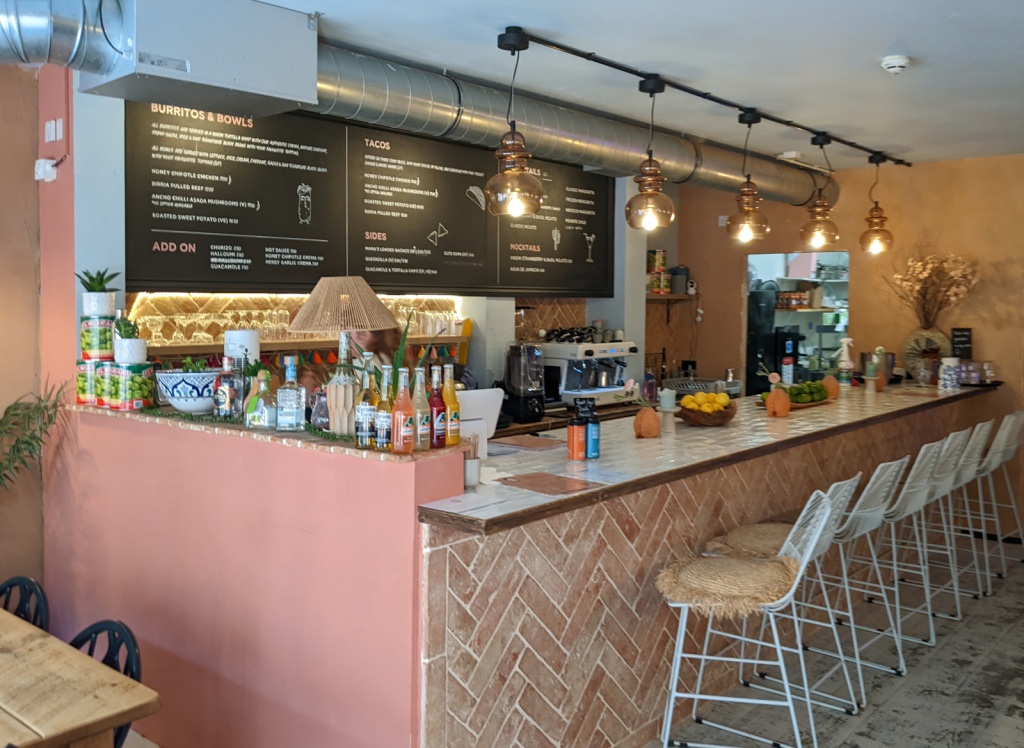
A new food outlet opened recently in Cirencester; we hadn’t had a chance to try it – until now. Burrito Mama is small, but very, very good.

Donna and I popped in at lunch time today to see what it was like. What we found was friendly, prompt service, lovely Mexicanesque decor, good coffee, tables inside and out, and an interesting menu. And when the food arrived it was nicely served and absolutely delicious. I chose their Ancho chilli asada mushrooms, and Donna went for the Honey chipotle chicken bowl. Both were great.

If you live in or near Cirencester, or are visiting, I recommend this little gem of a place. Check out their website online. Scroll down and take a look around. Book online or just pop in if they have space available. Locals will know where the Swan Yard is, very central, just beyond the west end of the Market Place.

Overall assessment… We’ll be back as soon as we have another opportunity!

Blast from the past… 4

In March 1998, Donna and I were married!

< Previous | Index | Next >

Notes from bygone years – March after March after March

Two years ago

There were no posts in March 2021, but I walked a long section of the old Thames and Severn Canal. The photo shows the towpath on the left and the bed of the canal on the right. The canal is being restored, but it will be a long time before this section can carry barges again.

The old canal and towpath
Five years ago

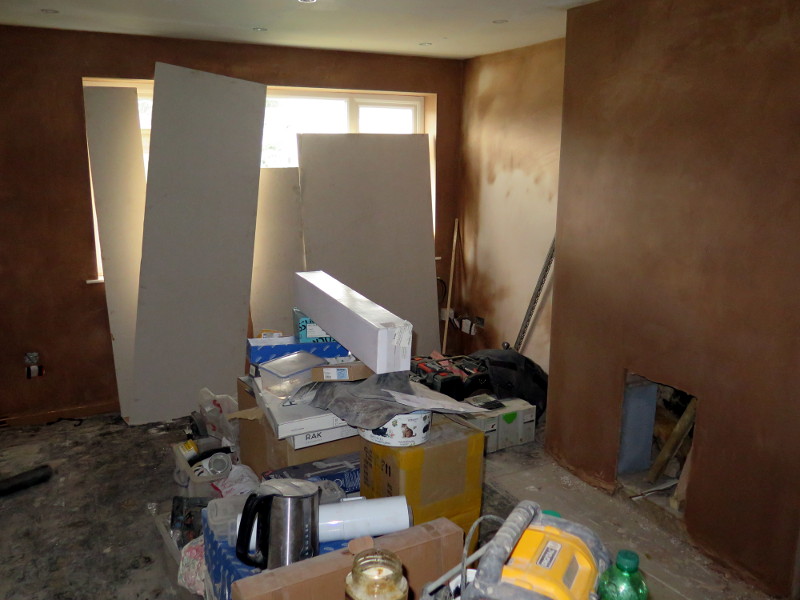
In March 2018 I posted about moving into our new house and adding an extension (‘Our new home in the Cotswolds‘). The building work was disruptive in the extreme, of course. We had to move out for four weeks, and make do with just part of the original space for much longer than that. But it was worth it.

The lounge in chaos
We used to watch TV here!
Ten years ago
Grasshopper landing

In March 2013 I wrote about a TED interview with Elon Musk. Perhaps you haven’t heard of the TED talks, but everybody has heard of Elon. The post is interesting: Musk was already experimentally landing rockets ten years ago, and TED continues to be a great ideas platform. Take a look and explore the links in the original post.

Fifteen years ago

I reported on a meeting at home in March 2008.

Rachael also shared a picture of an old-fashioned plough making furrows. The soil needs to be churned up and overturned before something new can be grown. There is a necessary process of breaking before the land can be used.

We thought about how Father releases us from ourselves. At the beginning he said, ‘Let there be light’; he still speaks those words into his people today and pours light into the darkest places in our hearts.

Twenty years ago

March 2003, another early blog post about a meeting at home. This time there were only two of us, but we heard such a lot! For example, that the tiny stonecrop, the great cedar, and the mighty oak tree were all planted by Father’s hand. The important thing is not to be big or strong, but to be planted by the master.

Twenty-five years ago

And in March 1998, Donna and I were married!

< Previous | Index | Next >

Cirencester tales and trails – 1

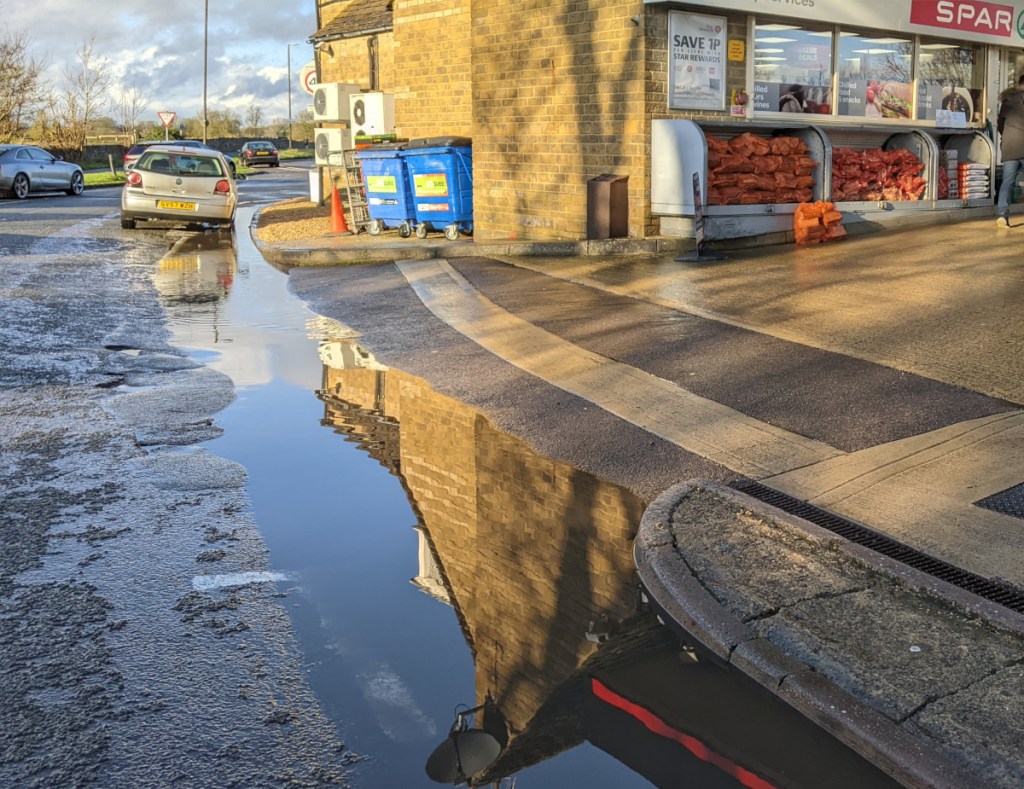
The sun came out and brightened everything up, even the puddles seemed more cheerful

I spend quite a bit of time in Cirencester so sometimes there are short stories to tell (tales), and I walk a lot in and around the local area (trails). Some of these might be interesting, fun, or even useful.

Puddles in the sunshine

Today the weather has been quite mixed, a sort of shall I/shan’t I go out. There was a good deal of rain in the morning, but it cleared a bit by mid morning and I decided to dodge the showers and walk down from Stratton where I live; I got a bit damp on the way, but not really wet. I had a couple of items of food shopping to do, so visited Tesco for those, then it began to rain again and I popped into Fora for coffee and to stay dry.

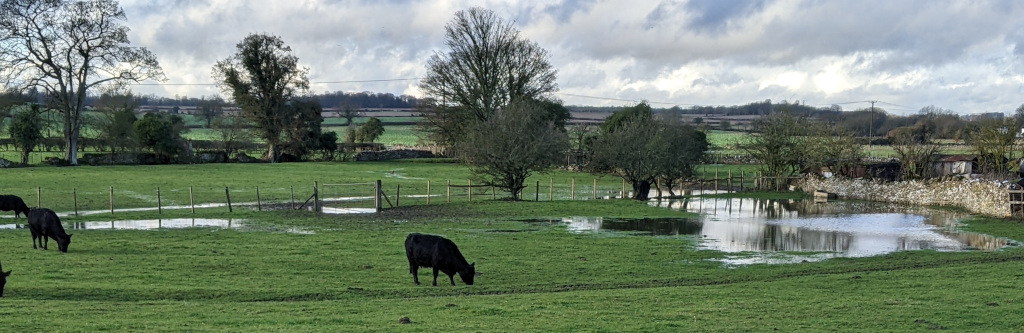
Walking home afterwards, the sun came out and brightened everything up, even the puddles seemed more cheerful. The Dexter cattle in the field west of the Gloucester Road didn’t apparently care about the weather, they didn’t even mind the fact that parts of their field have now become ponds, or even small lakes!

Dexter cattle in a partly flooded field
See also:

Christmas and New Year 2021

It’s good to be out and about to see it all and just as good to get back to a warm house.

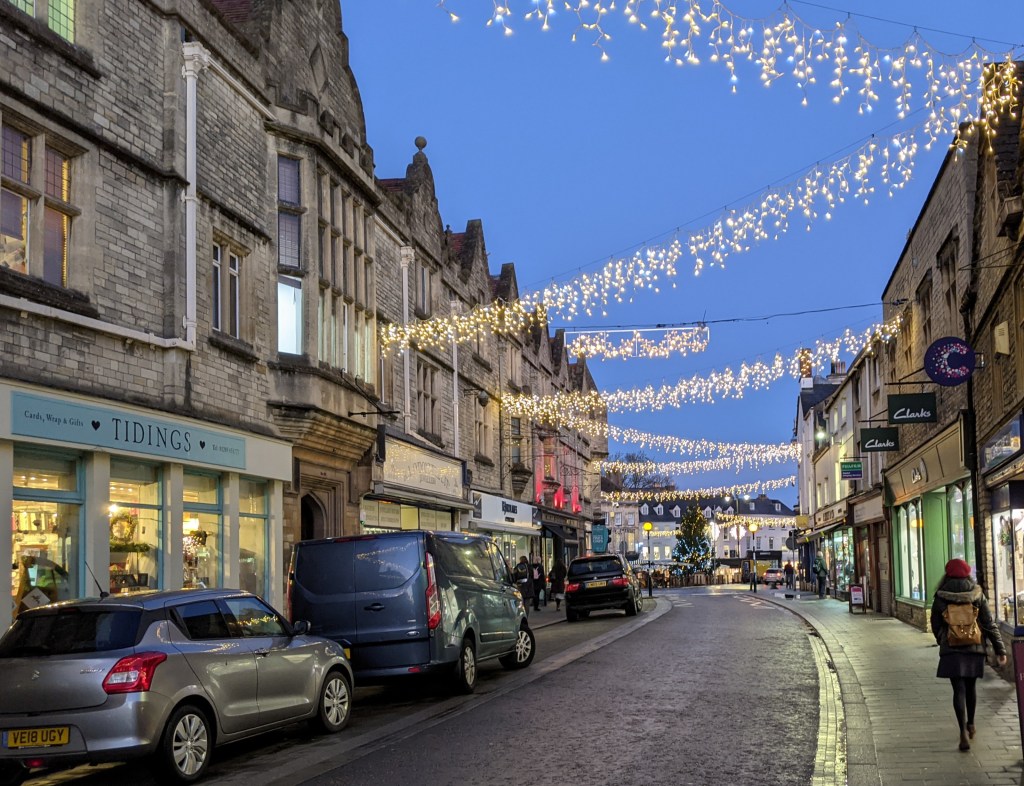
Castle Street in Cirencester

Season’s greetings to all my readers! Cirencester is showing off its tasteful street decorations once again, the days are short, the nights are long, and it’s good to be out and about to see it all and just as good to get back to a warm house afterwards.

My thoughts are especially with those who have no warm house to come back to this year, there are so many – the homeless sleeping alone in shop doorways, refugees desperately crossing the sea and hoping for asylum, and people who do have a roof over their heads but lack money for presents for the children or depend on food banks for their next meal.

Life can be wonderful, fun, exciting. It can also be tough, exhausting, and depressing. Whoever you are, whatever your circumstances, my prayer and hope is that people will be kind to you, there will be new opportunities in your life, and that there’ll be reasons to hope and overcome the difficulties.

And if your life is comfortable and you have more than enough, my prayer and hope is that you will be kind to others, search out new opportunities for them, and provide reasons for hope and ways to overcome difficulties.

None of us can solve all of the problems; but all of us can solve some of the problems.

Some ideas:

And don’t forget to enjoy Christmas with your friends and family. Grace and peace to you all.

PS – As a reward for reading to the end, here’s a bonus – A Christmas Song!

Other years

2025, 2024, 2023202220212020
2019201820172016

Elephant hawk moth

The caterpillar did something extraordinary – it mimicked a small snake

Have you ever seen an elephant hawk moth? If you live in Europe or Asia you might have spotted one of these amazing insects. In the United Kingdom they are fairly common, but perhaps not often seen. It’s a real treat to spot an adult or a caterpillar, both are amazing sights.

An elephant hawk moth male (credit: Wikipedia)
The circle marks the spot (credit OpenStreetmap)

Walking in the Cotswold Water Park recently, near the Gateway Centre on Lake 6, we spotted an elephant hawk moth caterpiller crossing the footpath (close to the grey circle in the map.

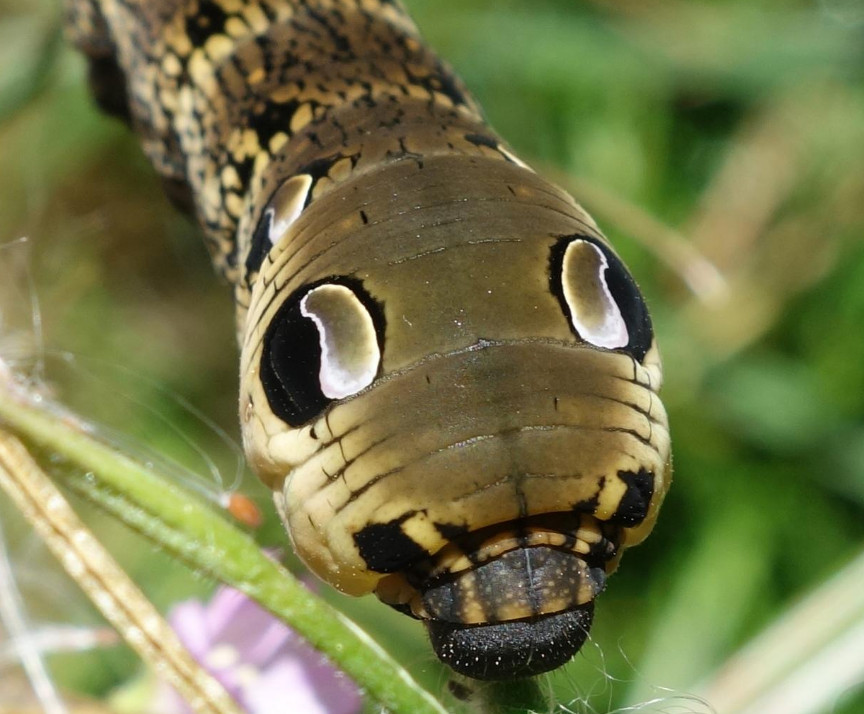
For a short time we just watched as it made its way across the path. But before it made it to the vegetation on the far side, some people appeared with a dog. The dog ran up enthusiastically to greet us and accidentally kicked the caterpiller before running off again. The caterpillar did something extraordinary – it mimicked a small snake.

Am I a caterpillar, or am I a snake?

The caterpillar crossing a stony path

For perhaps 20 seconds or so it writhed its body in a convincingly snakelike movement, and it pumped up several body segments behind the head, tucking its head down at the same time. With eye spot markings on its flanks, a scaly pattern on the entire body, and by raising up the front part of the body, it really did look the part. I wasn’t fast enough to get a photo, but I did get some video of the recovered caterpillar continuing on its way afterwards.

Searching the internet later, I found several good images of the caterpillar mimicking a small snake. Perhaps the best of these is show below.


The caterpillar looking very much like a snake (credit iSpot)

The natural world is so amazing, and so full of surprises, but mimicry is quite a common feature in both plants and animals. The European white dead-nettle has leaves that cannot sting but match the appearance of the unrelated stinging nettle very closely. Some insects look like pieces of wood, or a leaf, or a patch of white lichen, or a bird dropping. Many slugs look very much like animal droppings of various kinds, and as they move so slowly only an alert predator is likely to notice them. Predators, too, use camouflage which is not truly mimicry, but helps them merge into dappled sunshine and shade. Fish are often dark on top and silvery underneath. Sometimes they are patterned and look like the gravel bed of a stream or river.

Amazing!

See also:

New situation, new (old) ways

If meetings back then were small, informal, and participatory, could that become the norm again for us?

Is church unbalanced? | Index | No later posts >

I’d better begin by explaining the title – ‘New situation, new (old) ways’. We are certainly in a new situation! Covid-19 requires us to avoid large gatherings of people in close proximity, whether at the beach, in the supermarket, at sports events, or in church. It may be a long time before the situation will ease, so this could become the new normal for most of us. In terms of church meetings, many of us have been learning to make do with internet services and small group meetings using Zoom or some other form of online discussion. These are stop-gap measures.

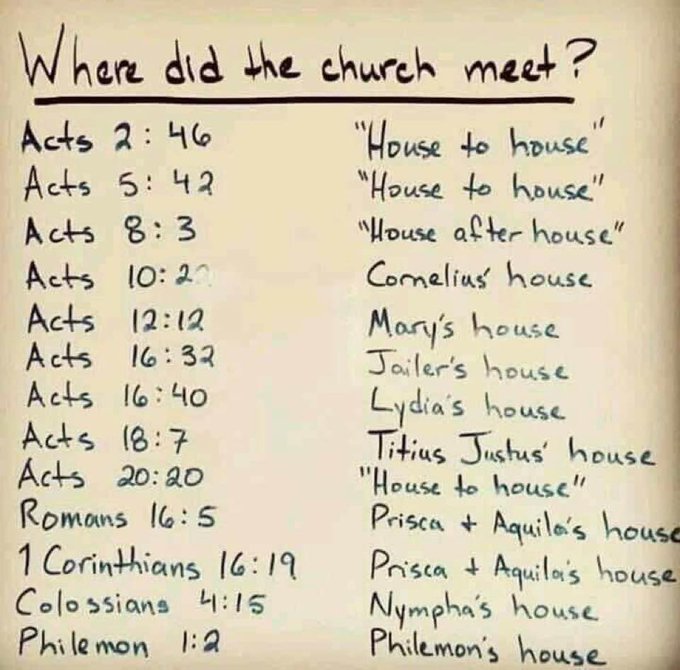
Meeting at home in the New Testament – image from Michael Frost

So what do I mean by ‘New (old) ways’? The original form of church meeting is described very clearly in the New Testament (see this tweet from Michael Frost – I borrowed his image for the article). It was based in people’s homes. What is preventing us making this old form of church life into our ‘new’ form in response to our current circumstances? I suggest two answers – habit and prejudice – or to roll them into one, familiarity. More about that in a moment, but first I’d like to suggest reading through some of the replies to Michael’s tweet. All sides of the debate are pretty well covered.

Familiarity

For most believers in Western and some other contexts, church meetings normally take place in church buildings and have done so for many generations. Closely allied to the church building experience come other expectations, among them a worship band, rituals, a minister or pastor, sitting in rows, a liturgy, hierarchical leadership, and limited participation. Not all of these factors are found in every church, but some mix of them is normal. The danger is that familiarity gives us expectations and blinkers us to alternatives.

Not only does the New Testament remind us that people often met in homes, it also describes what these meetings were like (1 Cor 14:26-40, for example). They were informal, everyone was encouraged to contribute, spiritual gifts were exercised freely, there was a shared meal, and sometimes things got a bit out of hand. So if meetings back then were small, informal, and participatory, could that become the norm again for us?

House church in our time

House church meetings do exist today, they are common in places and times of persecution – China, Iran, India, Pakistan, North Korea to name a few examples. But they are also quite widespread in the USA, the UK, and the Western world in general. Try a Google search for ‘house church uk‘ and you’ll be surprised at what pops up. Bear in mind that most groups of this kind don’t have an internet presence so the hits you see are the tip of a considerable iceberg. Some of the websites represent wide groups or networks of home churches.

Is this ‘the new (old)’? I think it could be, in part. One way of dealing with Covid-19, would be meeting in limited groups in homes or, indeed, in the open air. It’s important to respect government guidelines on gatherings, but even a few people face to face might be better than trying to get by online. Jesus said, ‘Where one or two are gathered in my name, I’ll be right there with them.’

You do not need permission to start a home meeting in the UK. So if anyone in or near Cirencester wants to meet like this or is already doing so, I’d be very interested in exploring the possibilities. Please leave a comment and I’ll be in touch.

Is church unbalanced? | Index | No later posts >

Sarah Reynolds

Sarah has focussed on collaborating with producers, writing, tracking and editing vocals, and releasing some songs

Sarah Reynolds is a talented song writer, composer and music producer who also has considerable ability as a singer. Her most recent release is ‘Covers Me’; she wrote the lyrics, composed the music, and sings the track too.

I was impressed when I first heard this song and liked it more and more on listening again – see what you think…

This particular song fits right into the genre of Christian music, but Sarah’s musical tastes are far more wide ranging than that. She’d like to develop her work in a variety of ways, writing music for TV and film for example; she has abilities and skills in recording, mixing, and production as well. That adds up to an unusual and valuable breadth in understanding and communication across the whole spectrum of roles in the music business.

Bio in a nutshell

Sarah was brought up in the Cotswolds in a house that was full of music. She learned piano and flute during her school years, at ten she was performing the lead role of Joseph in the school production of ‘The Techicolour Dreamcoat’, and she has a Music A level. Sarah achieved Grade 8 on the piano and then began improvising, taking a keen interest in the music of Alicia Keys’ early albums. She taught herself guitar while at university.

Sarah began writing songs as a teenager, and played in a songwriting competition at ‘The Cavern’ – Yes, that Cavern! She also began working with sound engineers, producers and other musicians, recording some of her songs, performing gigs around London, and learning more about production, recording, sound engineering and mixing.

Going forward

Recently, Sarah has focussed on collaborating with producers, writing, tracking and editing vocals, and releasing some songs. She works with others online a good deal, quite an advantage in these days of Covid-19. She’s always looking for talented writers, producers and artists to co-operate with, and to learn from. Here are some examples of her work with others:

In the future, I hope Sarah finds more great people to work with – I know she has significant talent and wide experience and won’t disappoint!

You can follow Sarah online: