Human society seems to bring a certain amount of order to the scene, but it’s a deceptive kind of order. Anyone who has a garden will know that order demands great effort to achieve and continuous effort to maintain.
Some have argued that living things depend on structure and order. And of course, there is some truth in that; but it’s a limited kind of truth. Look at a forest, a coral reef (or any ecosystem) and you will see the most amazing and thriving mess. Colours and shapes intermingled haphazardly, lots of competition for space and light. Every single organism doing its own thing.
Coral reef, a rich mix of species (Image from Wikimedia)
Human society seems to bring a certain amount of order to the scene, but it’s a deceptive kind of order. Anyone who has a garden will know that order demands great effort to achieve and continuous effort to maintain. And much of that effort will involve destruction – rooting out things that grow where you don’t want them, trimming hedges to keep them straight, cutting grass to maintain a smooth lawn, poisoning unwanted insects and fungi. A garden has structure and looks nice, but that structure comes at great cost to nature and requires constant effort from the gardener. Jesus said his Father is a gardener.
Farmer is really a more appropriate English word. And not ‘farmer’ as in a modern monocrop system of extensive wheat or mile after mile of beans or peanuts. Papa isn’t bothered about measured lines and neat grass; his interests are more to do with fruitfulness than with structure. He is not a park attendant, he is a grower of vines and olives in the way they were grown 2000 years ago in Israel, sympathetically and naturally. Farmers in those days were helpers and encouragers of the abundance of the natural, not at all like today’s farmers who are more like dictators armed with diesel fuel, big machines, and farm chemicals.
For those who want to function in a structured environment with clear and appointed leadership roles and a liturgy – be my guest, feel free. Sometimes Papa calls me to be involved in those situations too. But mostly he calls me to the freedom, glory, and abundant life of his original garden. This is a place where you will rarely see a straight line, where men and women do not control the show, where there is no architecture and there are no roads. It’s a place where he invites his children to come and run free and shout with joy in his presence. There is no liturgy, just an outpouring of praise and worship from rejoicing hearts.
And out of the ‘disorder’ of this garden comes a deeper knowledge of the heart of the Most High and a richer walk with him. And the life I experience there in his presence with my brothers and sisters, that life is something I can take into this struggling world. Truly he is the way, the truth, and the life. HalleluYah!
The weak are doubly rewarded, they’re glad to do the easy things and by their childlike faith and trust achieve the hard things too
This is an edited repost of one of my earliest blog messages, originally from 18th December 2002, so almost twenty years ago! In fact, it was my first serious post.
Back in those days I’d been meeting with my sister, Rachael, and some local friends. Sometimes we met in Rugby, at Rachael’s house, sometimes near Wellingborough where one of our friends lived, and sometimes at my home or others in St Neots.
The meetings were always full of spiritual life; we would sit together, share coffee, do a bit of a catch up chat, and then fall into a comfortable silence – waiting, and expecting the Holy Spirit to guide us. These were very fruitful times for all of us. Out of the quietness would come a mental picture, a thought, some Bible verses, a prayer, words in an unknown language, an interpretation, a song, some prophecy. Usually everyone would contribute something, and always by the end of the meeting we would see a clear thread running through the whole, something we could remember that would encourage us or bless us in some way.
The following is what I wrote twenty years ago:
Our meeting reminded me of the seventh day of creation, when He rested. Even God desires quiet times!
The other bit I particularly remembered was, ‘It’s not for us to do, but for Him to do in us’ (RK)
Four of us met and the Holy Spirit led us very gently. We felt encouraged and uplifted, it was a peaceful and quiet time with a variety of words and pictures.
There was a wonderful picture of still water, with a reflection of the Almighty’s glory clearly visible in it; the water also reflected images of us towards him. Our feet were in the water; and he said that we should be careful not to make disturbances as this would spoil the reflection, only if we stayed quiet and very still would we be able to see his reflected glory.
We also had a word that the easy things he wants done are overlooked by the great and the learned, while the difficult things are only ever attempted by the weak and foolish.
Thinking about this afterwards I realised that the great doubly miss out, they miss the easy things because they think they’re not worth doing, and they miss the hard things because they realise they’re too difficult to attempt. But the weak are doubly rewarded, they’re glad to do the easy things and by their childlike faith and trust achieve the hard things too!
We came away encouraged and strengthened – it was a great evening!
A reflection of what is not directly visible – Image from Wikimedia Commons
My thought after the meeting is what I want to emphasise here in 2022. Perhaps we are much too easily impressed by the people in society who are thought to be great in wisdom, or wealth, or skill. Great leaders, great speakers, powerful company bosses. Reputation can be overvalued.
Perhaps we should be more willing to also value weakness, and to notice how the weak are doubly blessed. They achieve this by doing the easy things that the great may overlook or regard of little value, and they achieve the hard things by just doing them, often without recognising the difficulties.
So let’s value the weak and the humble. Let’s notice them, and learn from them. At the same time we can (and should) appreciate the people around us who achieve so much through skill, learning, persuasive speaking, and sheer hard work and persistence. The great are good, providing they are also humble and gentle. Indeed, good motives are fundamental, for both the strong and the weak.
And if you think you are weak – rejoice! Savour the double blessing.
Some questions
If you follow Jesus, could you meet like this? Have you tried?
What advantages are there in preparing the content, structure, and leadership of a meeting in advance?
Are there any disadvantages?
What does Paul mean when he says that all should contribute? (1 Corinthians 14:26) – For more on this question, see my subsequent tweet.
The message from the New Testament seemed clear to me, there was supposed to be just one church, not a multiplicity of flavours brought about through a long series of historical disagreements and splits.
I was asked this question some time ago, and at first I felt that it somehow missed the point because I tend to feel that I never was an Anglican. But it’s true that in my mid to late teens I would have called myself Anglican – perhaps.
Early rumblings
My first memorable experience of the voice of the Father in my life was when I was around the age of 6 or 7. I was standing by the side wall of the junior school, and I was alone. Perhaps I’d just been dropped off at school in the morning, or maybe I was outside at playtime or lunchtime. I was aware of a deep rumbling sound, like a distant thunderstorm but much more stretched out in time. And it came twice, like two spoken sentences. My parents had talked about ‘God’ sometimes and I knew he lived in a place called ‘heaven’, and I was immediately certain that this rumbling voice was significant and came from this ‘God’ that I later came to see as ‘Father’ or ‘Papa’. I didn’t understand the meaning, but I knew who was speaking and that there was a purpose in it, that he was calling me in some mysterious way. Although puzzled, I also felt special and chosen for a specific task, though I didn’t know what that might be. I have never forgotten this strange experience.
Family background
My parents were Anglicans in the limited sense that they were not Methodists, Baptists, Presbyterians, Salvation Army or anything else. Dad was quite dedicated, jotting brief prayers in his diary and during parts of his life often attending communion at the parish church. I doubt that he made a conscious decision on this, it was just taken for granted, it had been the family tradition as far back as anyone knew. Mum was different, she was used to village life in Northern Ireland and taught Sunday school at the tiny village church, a simple and plain structure. She was uncomfortable with anything remotely high church, but if you’d asked her what she was she might have said Anglican, or Church of Ireland, or just Christian.
I was Christened when I was little and was encouraged to read the Bible as a child, at home, but more so at junior school and later in RE lessons at secondary school. By the age of 13 I was familiar with the outline contents of the Old and New Testaments, and with many of the stories recorded there. In my teens I was expected to attend confirmation classes and went along out of obedience rather than a desire to be there. In due course I was confirmed, though it didn’t mean much to me and life continued as before. I had not yet begun to grapple with what I did and did not believe.
Growing up
As I went through the processes of sitting my O levels and A levels and applying for a place at university, I began to form my own ideas about faith. For a time I rejected faith of any kind, thinking that science would eventually explain everything. Yet I was intrigued by the Bible and began to take what I read there quite seriously. And I didn’t see much there to support Anglicanism or, indeed, denominations of any kind. The message from the New Testament seemed clear to me, there was supposed to be just one church, not a multiplicity of flavours brought about through a long series of historical disagreements and splits. And what about the many stories of healings, and the parables about how we should live, and the Pauline teachings about gifts of the Spirit, and the letters to churches in the Greek world of the time? I was taking all of this seriously, but saw little evidence that the denominations were doing the same. I explored more widely, visiting the Jehovah’s Witnesses, signing up for a Christadelphian magazine, reading books about the Mormons and Christian Science, but none of these avenues seemed to make much sense to me.
Married life
After graduating from university, getting married, and starting full time jobs, Judy and I spent our Sundays in Bristol doing some serious denominational exploration. We went to Sunday services at every church we could find, and never once had a sense of, ‘This is the one!’. We were searching, but not finding.
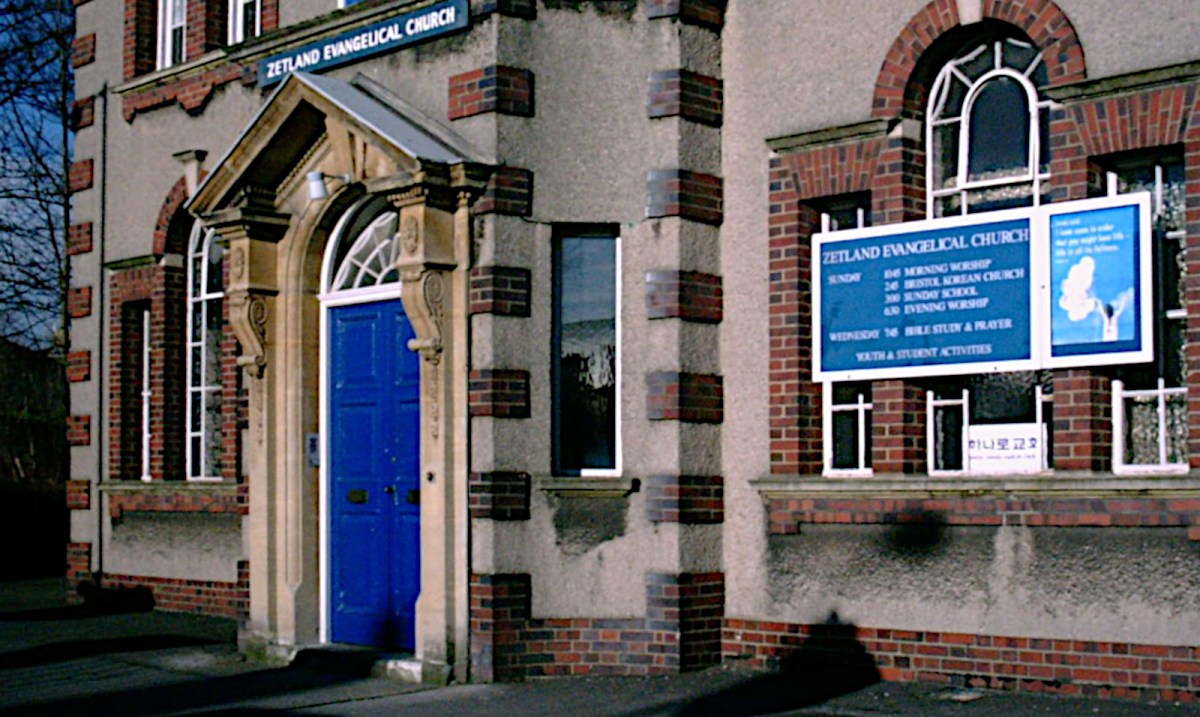
Zetland Evangelical Church in 2002
In the end, in utter desperation, we tried a weird place just down the road from our flat. In some ways it seemed more odd than any of the other places we’d tried. It had a large sign above the door in blue and gold reading ‘God is Love’, and didn’t look like a church building, more like a large house. This was Zetland Evangelical Church in Bristol, near the railway arches over the Cheltenham Road. We found to our surprise that we were instantly at home! The people there wanted to talk with us, and they shared some of our own thoughts about what we’d been reading in the Bible. We felt welcomed – as if by a large family. We’d found a real community, which is what we’d long hoped for. Not only that, when I went to a mid-week evening meeting I was blown away by teaching about David, perhaps from 2 Samuel, and a section I was familiar with. The fresh insights and explanations were very striking, here were people who knew their topic – and it all made perfect sense.
We still felt there was more, and we were joining one of those denominational ‘splinter groups’ that so perplexed us. But this was by far the best thing yet. At this point in our lives we would not have settled for Anglican or any other church tradition. We were particularly encouraged by the fact that there was no hierarchy at Zetland, there was no single leader, we were all equal, or so it appeared. There was no liturgy, no pastor, and once a month there was a delightful Sunday morning Open Meeting with nobody at the front and where all could contribute a prayer, a hymn, or some teaching. All, that is, except women and children. This was one of several niggling issues that we put to the back of our minds for the time being.
Eventually we discovered much more – but that’s another story.
Explanatory note – Please don’t think that I’m judging or disapproving of denominations and those who are involved with them. In this short article I’m describing how a much younger Chris Jefferies understood things. I have many non-denominational friends, but also friends from New Frontiers, Anglican, and particularly Baptist traditions. Particularly Baptist simply because at the time of writing I take part in a small home group that meets weekly and is part of Cirencester Baptist Church. I’m not a Baptist, I will not (cannot) become a church member. We are all part of one family, the family of those who follow Jesus. We are all brothers and sisters and we have individual perspectives and expressions of what that means. I honour and love each one as part of an undivided whole.
(Much of this article has been cross-posted to Anglicanism.org)
Do we need to talk about Jesus or should we demonstrate his character?
Michael Frost
Michael Frost is a great communicator with excellent presentational skills. He expands our horizons by opening up the truth about church, evangelism, and living as followers of the one who is the way, the truth, and the life.
Michael speaks very clearly about whether we need evangelism or whether it’s better to focus on loving those around us. Should we tell people about Jesus or should we demonstrate his character by touching lives in practical ways? It’s a false dichotomy – we need both. But how does this work in practice? Few have explored this fully, so most of us need to hear it.
Michael’s message is as fresh and as necessary now as it was in 2015 when this video was made. Please don’t miss it!
I’d better begin by explaining the title – ‘New situation, new (old) ways’. We are certainly in a new situation! Covid-19 requires us to avoid large gatherings of people in close proximity, whether at the beach, in the supermarket, at sports events, or in church. It may be a long time before the situation will ease, so this could become the new normal for most of us. In terms of church meetings, many of us have been learning to make do with internet services and small group meetings using Zoom or some other form of online discussion. These are stop-gap measures.
So what do I mean by ‘New (old) ways’? The original form of church meeting is described very clearly in the New Testament (see this tweet from Michael Frost – I borrowed his image for the article). It was based in people’s homes. What is preventing us making this old form of church life into our ‘new’ form in response to our current circumstances? I suggest two answers – habit and prejudice – or to roll them into one, familiarity. More about that in a moment, but first I’d like to suggest reading through some of the replies to Michael’s tweet. All sides of the debate are pretty well covered.
Familiarity
For most believers in Western and some other contexts, church meetings normally take place in church buildings and have done so for many generations. Closely allied to the church building experience come other expectations, among them a worship band, rituals, a minister or pastor, sitting in rows, a liturgy, hierarchical leadership, and limited participation. Not all of these factors are found in every church, but some mix of them is normal. The danger is that familiarity gives us expectations and blinkers us to alternatives.
Not only does the New Testament remind us that people often met in homes, it also describes what these meetings were like (1 Cor 14:26-40, for example). They were informal, everyone was encouraged to contribute, spiritual gifts were exercised freely, there was a shared meal, and sometimes things got a bit out of hand. So if meetings back then were small, informal, and participatory, could that become the norm again for us?
House church in our time
House church meetings do exist today, they are common in places and times of persecution – China, Iran, India, Pakistan, North Korea to name a few examples. But they are also quite widespread in the USA, the UK, and the Western world in general. Try a Google search for ‘house church uk‘ and you’ll be surprised at what pops up. Bear in mind that most groups of this kind don’t have an internet presence so the hits you see are the tip of a considerable iceberg. Some of the websites represent wide groups or networks of home churches.
Is this ‘the new (old)’? I think it could be, in part. One way of dealing with Covid-19, would be meeting in limited groups in homes or, indeed, in the open air. It’s important to respect government guidelines on gatherings, but even a few people face to face might be better than trying to get by online. Jesus said, ‘Where one or two are gathered in my name, I’ll be right there with them.’
You do not need permission to start a home meeting in the UK. So if anyone in or near Cirencester wants to meet like this or is already doing so, I’d be very interested in exploring the possibilities. Please leave a comment and I’ll be in touch.