What was happening on the blog in past Februaries?
Five years ago
I didn’t write any blog posts in February 2018, so here’s a photo instead. Donna’s father, Tony, was 80 on 1st of the month; we drove down to Broadstone near the south coast of Dorset to meet the rest of the family. He was very pleased with his cake, though there were only eight candles on it. Eighty would have needed ten times the effort to blow out!
How should we manage and govern our meetings? How is church to be led? Everything changed in the 1960s and 70s as the Holy Spirit swept into the denominational church. Existing churches were impacted, the house church movement began, and new streams of church sprang up.
Read it if you’d like to, but also read the comments where some very good points are made.
Twenty years ago
On the 18th February 2003, I met at home with friends and the Holy Spirit spoke to us about walls being broken down. We heard about other related things too. The notes from the meeting outline what happened.
Now Yahweh says something strange to Ezekiel. He tells Ezekiel to speak to the bones, to prophecy to them. Is there any purpose in speaking to what is dead? Let’s look carefully at Ezekiel 37:4.
Then he told me, ‘Prophecy to these bones. Tell them, “Dry bones! Hear Yahweh’s word.”‘
There are several important points to notice. If Ezekiel hadn’t understood these points the amazing things that are about to happen would not have happened. At least, they wouldn’t have happened through Ezekiel. Yahweh would have found another way, another person to serve him; Ezekiel would have missed out. Hearing is important, and the mechanism for hearing is complex.
1 – Listen and speak
Yahweh spoke to Ezekiel. Ezekiel listened so that he could pass on what he had received. This is the place where we often go wrong. We see a need and we act to meet it, we say what we think best, we do what we think best.
It’s good that we want to communicate and act, but it’s not good when we ourselves decide what to say and what to do. Even Yahshua (Jesus) didn’t do this, he set us a good example, he said only what he heard the Father say (John 12:49-50), he did only what he saw the Father do (John 5:19). If we don’t get this first step right we become unusable, no good for the eternal purposes of the Most High. Listen first. That’s what Ezekiel did and so should we.
2 – It may not make much sense
‘Prophecy to these bones’, says Yahweh. Put yourself in Ezekiel’s place, try to imagine it. Bones are not animate objects. At one time they were but now they are not. Here’s a conversation that didn’t take place – but it might have done. If Ezekiel had been like me it probably would have gone something along these lines…
Yahweh: ‘Listen to me carefully.’ – Ezekiel: ‘Yes, Lord. I’m listening.’
Yahweh: ‘I want you to talk to those bones over there, I want you to tell them that..’ – Ezekiel: ‘Wait, wait, wait. I must be hearing wrong, Lord. You want me to talk to who?’
Yahweh: ‘Not who, what. I want you to talk to the bones’. – Ezekiel: ‘No, Lord.’
Yahweh: ‘No? What do you mean – no?’ – Ezekiel: ‘Er.. No ears, Lord. I mean the bones can’t hear, they have no ears. They won’t hear me.’
Yahweh: ‘I’ll deal with that, you just get on and prophecy, OK?’ – Ezekiel: ‘But my friends will think I’m stupid.’ – Yahweh: ‘And your point is?’
Yahweh: ‘You’re wasting time here, Ezekiel. I need a job done and I need it to be done right away. I’ll find someone else.’ – Ezekiel: ‘No, no. I’ll do it. I’ll talk to the bones. Can I use a really quiet voice, Lord?’
Yahweh: ‘I need a very loud voice for this job. If you’re speaking to dry bones you have to speak up.’ – Ezekiel: ‘But, Lord, I have no idea what to say.’
Yahweh: ‘Might that be because I haven’ t told you yet? Hmm? You must command them to hear me, even though they have no ears.’ – Ezekiel: ‘OK-a-a-a-a-y’
Before Ezekiel can give the message to the bones, he must command them to hear. Assuming we can get past steps 1 and 2, this third step is something we often miss out. Before giving the message we need to command the deaf to hear. This is a step of preparation. It may require months or even years of prayer. It may mean demanding to be heard over and over and over again. It may mean criticism and derision and even facing serious abuse. But it needs to be done. There are no short cuts in hearing and speaking, seeing and doing.
Will we be like Ezekiel? Will we be unwavering in our obedience even if we appear foolish or unpopular or at risk? And is it worthwhile speaking to something that’s dead? Yes! Lazarus was dead, Yahshua spoke to him, and he came out of the grave.
I sum these topics up on my Twitter profile as biology, web, science, technology, family, faith, history, and travel.
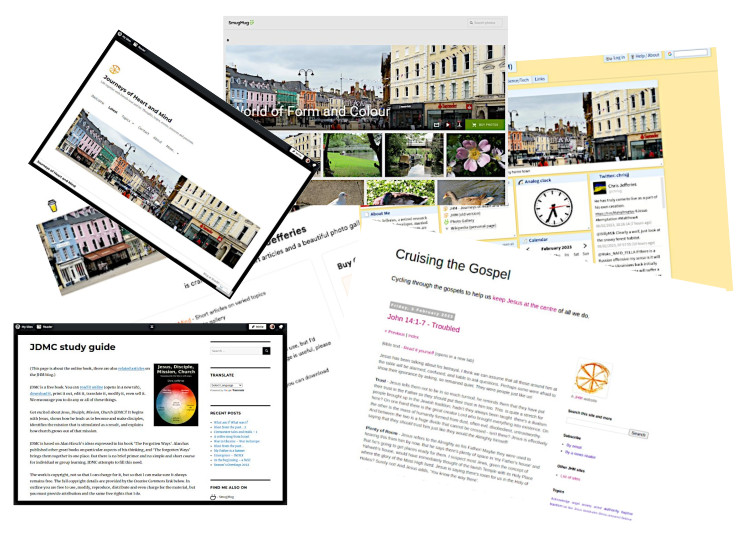
Having recently restarted blogging after a long pause, I’ve been thinking through how best to move forward – what should I change, what should I drop, and what should I keep?
Today’s post explains some of this, I’ll share what I’m doing and what I plan to do next. I’ll consider any comments you may leave, either here on the blog, or on Twitter or Facebook. But here’s how I see things right now.
Buy me a coffee
I’m offering everything I publish for free, but will always be delighted to receive a small gift, especially if you have sold or republished something (though even then it’s optional). Details are at coffee.scilla.org.uk .
Cruising the Gospel
This is a moribund blog that I’m in the process of restarting. I’m not sure yet whether to continue it in its present form, or to roll it into Journeys of Heart and Mind (JHM) as a topic in its own right. Currently I’m inclined to keep it as it is, and perhaps generate some PDFs from each book I complete. See it at gospel.scilla.org.uk .
Gateway
My Gateway site is mainly for my own use, but it’s full of links about Cirencester (my home town in England), local time and weather, some Christian links, local and national news, science and technology links and so forth. Some of you might like to take a peek. If so, head to gate.scilla.org.uk .
JDMC
JDMC stands for Jesus, Disciple, Mission, Church and is an introduction to Alan Hirsch’s Forgotten Ways. To learn more and download a copy to print (or read online), visit jdmc.scilla.org.uk . I need to update this booklet and plan to when I have time, unfortunately the web links in the PDF open OK, but using the browser to return take you back to the title page; I’ve been unable to fix this so far. If you open the links in a new tab you’ll be OK, but it’s easy to forget.
Journeys of Heart and mind
I intend to continue with this more or less as it stands. That means a mix of topics will appear here, articles about all of the things that motivate me as they occur to me (so in no particular order). I sum these topics up on my Twitter profile as biology, web, science, technology, family, faith, history, and travel. Others include photography, astronomy, spaceflight, archaeology and a few more. One thing I will add is a way of seeing just posts on one of these topics at a time, I think that will be useful; not everyone wants to see everything. You’re reading on this site at the moment.
Photos
I use Smugmug to display my photos and will continue with this, but I need to rearrange things in topic folders to make it more usable. Visit photos.scilla.org.uk to browse my all time favourites.
Twitter
My main Twitter account is ChrisJJ, but I have a second account, JHM. I haven’t used the JHM account for a long while, but might post tweets about faith topics there, and everything else on ChrisJJ. My mind is far from made up on this as there are quite a few pros and cons.
The stonework to turn doorways into windows suggests a change of use at some time after the building was first erected
This dilapidated, old building, of lovely Cotswold limestone (including the roof) stands inside Cirencester Park at the end of Barton Lane. It’s part of The Barton Farm, along with the ancient nearby dovecote and magnificent, old barn.
But what was its original purpose? If it could speak it would no doubt have an interesting tale to tell. What might it say?
A row of cottages
I was row of cottages, full of the sounds of children playing in the sunshine, chopping and stirring sounds from a kitchen table indoors, smoke rising into the air from my chimneys. How many families lived in me? How many were born here, lived and worked here, died here?
Stables
I was a row of stables, my partly built up doorways were once open and inside each one was a stall for a horse. Inside I would have smelled of horses, sweat, droppings, and in a room at the back I would have had the aroma of well cared-for leather – saddles, harness, heavy collars for pulling.
Storage shed
I was a place where valuable implements were stored and cared for. Oiled steel hoes, shovels, spades and rakes with well-worn wooden handles. An old plough, a harrow, scythes. Or perhaps I was used to store fruit from the orchard, and sacks of seed for sowing crops in winter or spring.
A base for farm workers
I was a bothy where the farm workers would gather to eat bread and cheese and perhaps a mug of cider. I’d be used for breakfast, a mid morning break, or a mug of hot tea on a cold afternoon, a shelter from heavy rain. Perhaps there was banter, silly tasks given to the youngest worker, ‘Go and fetch me the glass hammer from the big house, ask the Master for it – politely like’.
There are some clues
The stonework to turn doorways into windows suggests a change of use at some time after the building was first erected. There are two brick chimneys, so clearly there were regular fires. Maybe the far end was a dwelling while the right end was a workshop, or a smithy, or a place for basket-making, or laundry.
If you have other thoughts on what this place might once have been, or you live locally and know for sure, why not leave a comment?
Here’s another blast from the past. What can we find as we look through earlier January posts?
Five years ago
In January 2018 I wrote about eating together and how the early church had no ceremony like our communion service. And I quoted from Victor Choudherie who urges us to ‘promote breaking of bread with simple Agape meals (love feasts) from house to house, that believers take with glad hearts’.
In January 2013 there was a hard frost in St Neots where I lived at the time. Within four days, the ice and snow had gone and early hints of the coming spring had appeared. How fast things can change!
The sun came out and brightened everything up, even the puddles seemed more cheerful
I spend quite a bit of time in Cirencester so sometimes there are short stories to tell (tales), and I walk a lot in and around the local area (trails). Some of these might be interesting, fun, or even useful.
Puddles in the sunshine
Today the weather has been quite mixed, a sort of shall I/shan’t I go out. There was a good deal of rain in the morning, but it cleared a bit by mid morning and I decided to dodge the showers and walk down from Stratton where I live; I got a bit damp on the way, but not really wet. I had a couple of items of food shopping to do, so visited Tesco for those, then it began to rain again and I popped into Fora for coffee and to stay dry.
Walking home afterwards, the sun came out and brightened everything up, even the puddles seemed more cheerful. The Dexter cattle in the field west of the Gloucester Road didn’t apparently care about the weather, they didn’t even mind the fact that parts of their field have now become ponds, or even small lakes!
Shalom is not just peace as in absence of war, quietness, or a chance to think. It means much more than that.
Back in 2007, Donna and I visited Israel. The day we arrived it rained torrentially and our plane had to circle while water was removed from the runway at Tel Aviv airport. But the weather quickly improved and we had a very interesting trip. Much of it I still remember vividly, and the notes I made and the photos I took fill in much more detail.
While we were there, we bought a coffee mug at a tourist site. We still have it, and I enjoy using it now and then. The vivid colours remind me of the bright sunshine and friendly people we met, the colours of items in the market in Jerusalem, the colours of the clothes of the people in the streets.
This mug is special, it carries the word ‘Shalom’ in Hebrew and in English, it means ‘peace’. How I wish for peace in 2023 in Ukraine and around the world. Shalom is not just peace as in absence of war, quietness, or a chance to think. It means much more than that. It means joy, completeness, health in body, mind, and spirit. It means prosperity and a fragrant life.
(I was prompted to write this by Yaroslava Antipina, perhaps to use on her Twitter feed or her blog. Please click the links and leave her some kind thoughts. Thanks!)
Despite repeated assurances that no invasion was planned, Russian forces crossed the border into Ukraine on 24th February 2022. As the tanks and support vehicles rolled towards Kyiv, paratroops were dropped to take the city’s Hostomel Airport.
On 24th February, 2022, Russian forces moved into Ukraine, despite Russia’s repeated assurances that they had no such intention. That moment represented a step change in Russian relations, not just with Ukraine, but with the rest of Europe and the entire world. The tanks, personnel carriers, and self-propelled howitzers rolled across the border from Russia and from Belarus, much as the German tanks had rolled across Eastern Poland and into the Soviet Union 80 years earlier.
Informed opinion among Western military and government thinkers was that Ukrainian forces would buckle, the government would fall within a few days, President Zelensky would be captured or would flee, and a new, puppet regime would be set up by the Russians. There would be almost no resistance, defeat would be swift and complete. Everyone was wrong-footed, Ukraine resisted, Zelensky stayed in Kyiv, and the Russian invasion stalled. And here we are ten months after the invasion, and Ukraine’s army has the upper hand having forced three or four major Russian retreats (it depends how you count them).
Map of Ukraine before the 2022 Russian invasion (From Wikimedia)
Why did Russia invade?
Logical, reasonable thinking always begins with unbiased observation; but there’s an inbuilt human tendency to instead begin with our own opinions which may or may not be biased, and then to look for things that will back those up. There are plenty of examples all around us: for example the tobacco industry in the 1970’s and 80’s had the opinion that smoking provided them with solid profits and was not harmful to health and looked for ways to argue against any evidence for harm. That’s just human nature.
And that’s exactly how Russia’s invasion of Ukraine began. The Russian government began with assumed opinions about history and about NATO intending to harm Russia. Next, serious attempts to justify these positions were made: Russia was the origin of Ukraine which was therefore no more than a Russian region along with the Baltic states and some other parts of the old Soviet Union; NATO was not a defensive organisation but had expansive territorial ambitions, the West wanted to destroy Russia.
On the basis of these assumptions political arguments were made by Vladimir Putin and his supporters, that bringing Ukraine back into line would return territory that had always been Russian, would expose Ukraine’s military weakness, prevent NATO expansion, be welcomed by the majority of Ukrainian citizens, and be tacitly accepted by a weak-minded West. And on that basis, after building up forces along the Ukrainian borders with Russia and with Belarus, the ‘Special Military Operation’ began. Mr Putin’s miscalculations were exposed very quickly. Ukrainian citizens did not support Russia; the Ukrainian forces were much stronger than expected; the West including the EU and USA supported Ukraine in practical ways and applied sanctions; Sweden and Finland were alarmed and applied to join NATO.
Stages of the war
Despite repeated assurances that no invasion was planned, Russian forces crossed the border into Ukraine on 24th February 2022. As the tanks and support vehicles rolled towards Kyiv, paratroops were dropped to take the city’s Hostomel Airport. The plan was to capture the city quickly, arrest President Zelensky, install a puppet regime, and then mop up the remnants of the fleeing Ukrainian forces. But that didn’t work out well for the Russians.
The paratroops were defeated at the airport and the city of Kyiv did not fall. The armoured columns and their support vehicles and troops were badly mauled by the Ukrainians and were forced to retreat north across the border and east as far as Kharkiv, and something of a stalemate resulted in the north. In the south, Russian forces fanned out from Crimea and took the coastline of the Sea of Azov, capturing Kherson. Ukrainian forces were able to stop the Russian advance before the cities of Mykolaev and Zaporizhzhia. In the east, Russia expanded their hold on Luhansk and eastern Donetsk, and captured the city of Mariupol.
For some time there was a stalemate in terms of territory, with relentless Russian shelling of settlements along the line of control. During this period the Ukrainian forces grew stronger with aid and materiel from the West, particularly the USA but also the UK and other European and some non-European powers. At the same time Russia was weakened by a heavy toll on both troops and equipment.
As a result of astute leadership and good use of Western precision armaments, Ukraine became strong enough to push the Russians back, initially in the north, and then also in the south where Russian forces had to retreat from Kherson. This seems to be a development that is still ongoing as we approach the beginning of 2023. There are signs that Ukraine is growing stronger while Russia continues to grow weaker. It’s likely that we’ll see further Ukrainian military successes and Russian forces holding less and less territory. What is harder to predict is how the Russian government, armed forces, and population will react as these failures become more and more clear for all to see.
An analysis to consider
Here’s a video of Michael McFaul speaking at Stanford University. He is familiar with government figures including presidents Putin, Zelensky, and Biden; he understands their thinking; he presents a shrewd and well considered analysis of the situation – one that is well worth watching. I’m not going to write anything here in the way of conclusions; far better to settle back and listen to McFaul’s thoughts and ponder his arguments and conclusions for yourself. His address therefore forms the conclusion to my article.
In September 2002 I wrote one of my earliest blog posts. I mentioned scanning my Dad’s old photos and meeting with other Jesus followers in informal ways.
I thought it would be fun to take a look back at older posts from Journeys of Heart and Mind. So here we go with a blast from the past. I started blogging on 5th February 2002 so it’s time to do some historical trawling! I’ll probably post another of these every now and then.
Five years ago
Here’s my Christmas message from 2017, it was one of the most popular Christmas posts I’ve made. Everyone liked the photo, many of you may remember it.
In December 2012 I was impressed by a TED video I came across. In the video, Ronnie Edry explained how he had inadvertently started a viral peace movement! It’s an amazing tale and very heart-warming.
In September 2002 I wrote one of my earliest blog posts. I mentioned scanning my Dad’s old photos and meeting with other Jesus followers in informal ways: I’m still doing those two things twenty years later!
Human society seems to bring a certain amount of order to the scene, but it’s a deceptive kind of order. Anyone who has a garden will know that order demands great effort to achieve and continuous effort to maintain.
Some have argued that living things depend on structure and order. And of course, there is some truth in that; but it’s a limited kind of truth. Look at a forest, a coral reef (or any ecosystem) and you will see the most amazing and thriving mess. Colours and shapes intermingled haphazardly, lots of competition for space and light. Every single organism doing its own thing.
Coral reef, a rich mix of species (Image from Wikimedia)
Human society seems to bring a certain amount of order to the scene, but it’s a deceptive kind of order. Anyone who has a garden will know that order demands great effort to achieve and continuous effort to maintain. And much of that effort will involve destruction – rooting out things that grow where you don’t want them, trimming hedges to keep them straight, cutting grass to maintain a smooth lawn, poisoning unwanted insects and fungi. A garden has structure and looks nice, but that structure comes at great cost to nature and requires constant effort from the gardener. Jesus said his Father is a gardener.
Farmer is really a more appropriate English word. And not ‘farmer’ as in a modern monocrop system of extensive wheat or mile after mile of beans or peanuts. Papa isn’t bothered about measured lines and neat grass; his interests are more to do with fruitfulness than with structure. He is not a park attendant, he is a grower of vines and olives in the way they were grown 2000 years ago in Israel, sympathetically and naturally. Farmers in those days were helpers and encouragers of the abundance of the natural, not at all like today’s farmers who are more like dictators armed with diesel fuel, big machines, and farm chemicals.
For those who want to function in a structured environment with clear and appointed leadership roles and a liturgy – be my guest, feel free. Sometimes Papa calls me to be involved in those situations too. But mostly he calls me to the freedom, glory, and abundant life of his original garden. This is a place where you will rarely see a straight line, where men and women do not control the show, where there is no architecture and there are no roads. It’s a place where he invites his children to come and run free and shout with joy in his presence. There is no liturgy, just an outpouring of praise and worship from rejoicing hearts.
And out of the ‘disorder’ of this garden comes a deeper knowledge of the heart of the Most High and a richer walk with him. And the life I experience there in his presence with my brothers and sisters, that life is something I can take into this struggling world. Truly he is the way, the truth, and the life. HalleluYah!