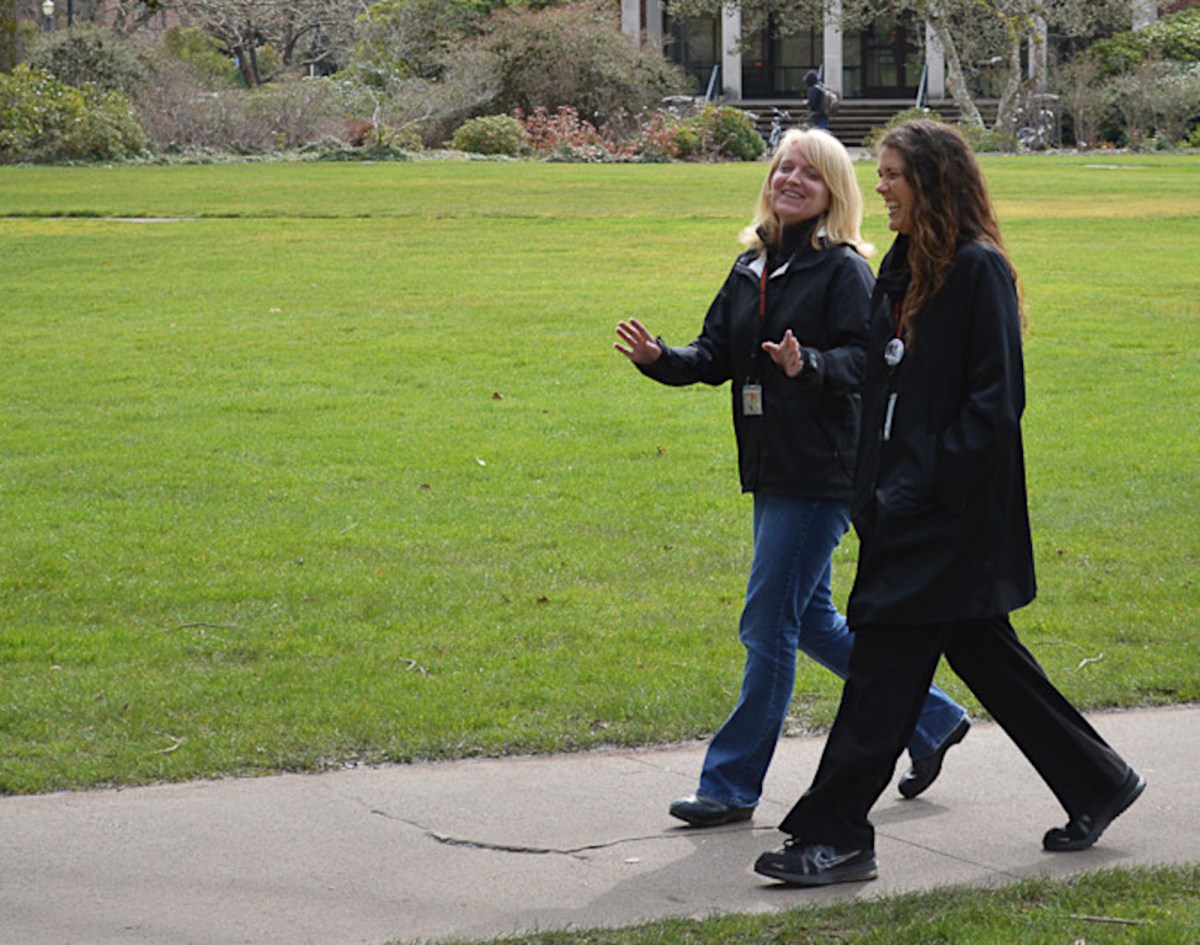
The first step is hearing about the things Jesus did and said, discovering his nature and purpose.
There’s an idea out there among some people that the first step towards following Jesus is going to church, or developing a faith, or taking vows or something like that.
Click to enlarge
Nothing could be further from the truth!
The first step is hearing about the things Jesus did and said, discovering his nature and purpose, finding that he is a likeable, kind, and helpful person to everyone who gets to know him. Everything follows from that. It’s where the adventure begins!
Plants are available from garden centres and will grow happily in your garden given the right conditions. These plants belong to the buttercup family and are near relatives of the anemones.
What’s in an image? Sometimes quite a lot, more than meets the eye. I’m posting an image every few days.
Click to enlarge
This makes it three in a row for flower images. The pasqueflower (Pulsatilla vulgaris) grows wild in the Cotswolds on dry grassland areas open to full sunshine. It was once quite common, and although not actually threatened, is something of a rarity these days. There’s a Cotwold dry valley site near Cirencester where there’s a reasonably large colony, but to keep the plants safe, the location is not advertised. However, plants are available from garden centres and will grow happily in your garden given the right conditions. These plants belong to the buttercup family and are near relatives of the anemones.
Protecting endangered or rare species (both plants and animals) is of ever growing importance. There are several ways species come under pressure and we’ll look at those first.
Challenges to survival
Habitat loss is the primary cause of decline for many plants, including the pasqueflower. Land improvement, especially the use of fertilisers to increase crop yields, is an issue for plants adapted to poorer soils.
Physical removal of plants or hunting of animals is an issue too. Most species can cope with limited amounts of removal, but if population levels fall drastically, there are real dangers. The dodo died out on the island of Mauritius following hunting by European sailors. The flightless birds were unafraid as they had no natural predators, so they didn’t run away from their hunters. They were welcome fresh meat after weeks at sea on salt beef.
Ecological damage also causes harm, sometimes unexpectedly. After the dodo became extinct, a tree species mysteriously stopped reproducing. Gradually the population was reduced to only older trees. It turned out that the fruit contained toughly seeds with tough shells that would only germinate after passing through the gut of a dodo. Links like this between organisms can be critical.
Climate change is another danger, especially for plants. If climate change is slow organisms can change the range of places where they grow; if it’s fast, animals might adapt, but some plants may need an entire year to move a few metres.
Pollution is a further serious issue and can exacerbate the other problems already mentioned above.
Diseases of both plants and animals can become pandemic and risk extinction, especially when populations are already stressed by droughts, loss of habitat, or pollution.
Attitudes
Given all of the above, what should our attitude be to the current situation?
Some people will shrug their shoulders. – Perhaps they don’t understand the peril the world faces, or they don’t understand the need to help the natural world recover. Or maybe they just feel there is nothing they can do about it.
Others may understand enough of the science to realise there is a danger, to see that it can be reduced (if not entirely averted), and to take some personal actions to help.
Biologists, ecologists, nature enthusiasts, and climate scientists understand only too well what is happening. Usually, they will be trying to communicate the issues whenever and wherever they can.
Followers of Jesus, and people of other faiths will often understand that we should do all we can to protect this world we live in, and live in ways that will reduce the damage.
All of the groups mentioned here are either responding already, or need help to see and understand that the natural world needs our help and that every single one of us can make a difference. Education and commitment are the way forward, so please share this post with anyone you know who might be influenced by it.
If you enjoyed this or found it useful, please like, comment, and share below. (If you don’t see those links, click the article’s title above the main photo and they will appear.) Send a link to friends who might enjoy the article or benefit from it – Thanks! My material is free to reuse (see conditions), but a coffee is always welcome and encourages me to write more often!
17:13 – There’s so much in Jesus’ heart and mind as he completes the prayer for his immediate disciples. And there’s a lot for us to dig into and appreciate here too.
Do bear in mind throughout, that Jesus would have been speaking not only to the Father, but also wanted and expected his apprentices to overhear. His words are for them too, and through them passed on to you and me as well, in written form. Jesus intended you to read his words. It’s very personal!
Joy
Jesus wants his followers to have his own joy within them. What is Jesus’ joy? He doesn’t state it here, but surely what makes Jesus joyful is completing the work his Father sent him to do, returning to be in his Father’s presence again after living a life here in our broken world; and knowing that the Father himself is delighted and joyful that, despite unimaginable hardship, the task is completed and has broken the barriers that kept people from entering his Presence. Jesus has the same joy because he knows the same thing, the work is done, the goal is achieved, the way into Father’s presence is open to every Jesus follower, everyone doing Jesus’ own work. That work is love – love towards family, friends, neighbours, even enemies.
17:14 – Yahshua (Jesus) continues to speak to his Father about the situation, making four points.
He mentions that he has given them the Father’s word (not words, this is singular). Jesus is himself the Word spoken into physical existence.
The world has hated them.
The reason the world hates them is because they don’t belong to the world, and the world loves its own.
We are like Jesus, not belonging to the world.
One thing we should take away from this is that telling the Father things he already knows is perfectly acceptable. Our expressing them to him is neither pointless repetition nor trying his patience. We can do this too, we’re laying out the situation as we see it before we ask for help, guidance, comfort, encouragement, or action. The Holy Spirit may respond as we do this, showing us things we’d overlooked, pointing out the way forward, changing our perspective.
17:15-16 – Think about conversations between two friends, perhaps over a coffee or sitting in the shade on a hot, summer’s day. A typical conversation might include saying hello (a greeting), checking how the other person is, asking questions, offering help, discussing mutual interests and more. Yahshua says we are no longer servants, but friends, and he says he and the Father are one. He told the disciples, ‘If you’ve seen me you have seen the Father’. So it’s more than OK to be on friendly terms with the Father, the Son, and the Spirit; all those things we might discuss with any friend are things we can discuss with the Father. It’s what he wants us to do!
Only after describing the situation does Jesus move on to asking for things. He begins with clarity about what he is not asking, and then he asks for their (and our) protection from the enemy. Think about it! You are following Jesus, and he has asked for the Father’s protection over you, personally. The prince of darkness is restrained from harming you. How far does this go? Well, let me assure you, it goes the entire way. Down the centuries many of Jesus’ followers have died, as he did, at the hands of bad or ignorant people – killed by lions in Roman arenas or hanged by Nazis in the Second World War like Dietrich Bonhoeffer or Martin Niemöller. But all of them were protected from the greater catastrophe of falling into the hands of a spiritual enemy.
Why do we get this special treatment? Because in following Jesus we become like him. Jesus is not of this world, and neither are we.
Sanctified
17:17-19 – This Greek word, ἁγίασον (hagiason), is specific in its meaning; its sense is the act or process of making a thing or a person holy, to consecrate, to set apart, or as here to sanctify. Greek versions of the Old Testament use the same word in explaining that the Tabernacle and later the Temple were holy, and the priests were holy (set apart to serve). Jesus used the word when talking about the Temple, and in the Lord’s prayer when he said ‘Hallowed be thy Name’. In modern English we might say, ‘Let your name be kept holy’.
Here, speaking to his Father, he uses the same word of his followers, ‘Make them holy by the truth, your word is truth’. If you are following Jesus, then know that he has made you holy and set you apart to serve him and him alone! He asks that we be made holy, set apart, by the truth. So what truth is this?
Elsewhere Jesus said, ‘I am the Way, the Truth and the Life’. He also said, ‘The truth shall set you free’. He says here in verse 17, ‘Your word is truth’. This makes perfect sense, Jesus himself is The Word, spoken into a broken world by the everlasting Father.
And finally, in verse 19, Jesus says very clearly that he has set himself apart for his Father’s use on our behalf, so that we, too, can be truly set apart for the Father’s use as well.
Don’t forget who you are
If you take away nothing else from these verses, take away the amazing truth that following Jesus demonstrates you are set apart, holy and fit to serve the Father, precious and special. Do not be hoodwinked into thinking you are not significant. And don’t for one moment think that you’re significant because of what you do. You are significant because of who you are! Jesus is your brother, you’ve been brought right into the family, welcomed and hugged and loved by the Trinity, no less.
If you enjoyed this or found it useful, please like, comment, and share below. (If you don’t see those links, click the article’s title above the main photo and they will appear.) Send a link to friends who might enjoy the article or benefit from it – Thanks! My material is free to reuse (see conditions), but a coffee is always welcome and encourages me to write more often!
If I’m given misinformation and base my thoughts, words and actions on that, sooner or later I’ll run into a problem.
Originally posted in December 2020, I’m republishing a revised version of this article in response to (and in agreement with) a new post today by Christopher Dryden, ‘Keep your word‘. His message is well written and well worth reading.
Click to enlarge
Truth matters. It matters because basing our thoughts, words and actions on falsehood is asking for trouble. Truth is like light: it enables us to see clearly, it banishes darkness, but it can be snuffed out and then we’re left in the dark.
Let’s explore the background, why am I writing about truth at this particular time? And why am I writing about it at all? I’m writing about it at this particular time because truth seems to be valued by fewer people than ever before. There have always been those who trample on truth, but we do seem to be living at a time when peddling falsehoods has become pandemic. Perhaps the most obvious examples are in the political sphere, where governments and their opponents have sometimes made claims based on almost anything other than the simple facts. Policies and decisions are being made on the basis of opinion, personal ambition, whim, wishful thinking, and even denial of clear evidence. I’m writing about it because it matters. It really does. We’ll get to that in a minute.
In a time of deceit telling the truth is a revolutionary act
George Orwell
Is this a new phenomenon? No, people have always made things up, sometimes to fill gaps in what is known, sometimes to deny what is known because it’s distasteful or hard to deal with, or for the base motives that are common, if we’re honest, to all of us – greed, self preservation, shame, fear and the rest. Survival, self-respect, money and power are important to us – sometimes important enough that we will cheat, lie, and ignore inconvenient truths that are staring us in the face.
So why does it matter?
(I said we’d get to that.)
The answer is really quite simple. If I’m given misinformation and base my thoughts, words and actions on that, sooner or later I’ll run into a problem. You can’t avoid the truth indefinitely, it will come back and bite you. Misinformation leads inevitably to error and confusion.
Imagine a map that shows a bridge across a river. An ambulance crew see that the bridge provides a valuable short cut to reach a seriously ill patient in half the time. But when they arrive at the river – there is no bridge. They have to retrace their journey and try a different way, but they are too late and the patient dies. Truth matters, and it can be critically important, even to the point of life or death.
Or imagine a general fighting a battle. He is told by his intelligence agents that the enemy is almost out of ammunition; he decides to mount an immediate attack, before new supplies can reach his opponents. If the intelligence report is true, he will win the battle easily. If they made it all up and it’s false, he might be heavily defeated. Does truth make a difference? Yes – because it leads to right action. This is why intelligence and counter intelligence matter.
Unfortunately, a strategy to deceive and confuse is now being applied widely within our society. We should be friends speaking the truth to one another, but much of the untruth flying around these days seems deliberate and causes serious difficulty for all of us. It’s become a bad habit. Who should I believe? Which ‘facts’ can I depend upon? How can I check? How should we deal with this difficulty? Here are some suggestions.
Dealing with it
Be sceptical of assertions – in other words, ask people for evidence
Don’t accept claims without supporting evidence
Remember that lots of people saying something doesn’t make it more true
Use fact checking websites
Beware of false claims presented as evidence
Treat people with respect and kindness even if they are making false claims
So what is the take away message here? We can all make a difference for better or worse. Search for the truth in every situation, look for evidence, listen to what people say but don’t accept anything without evidence of some kind (this might be evidence about the claims being made or it might be evidence that the person making the claims is reliable and usually speaks the truth). Then base any decisions or choices on the truth, never on claims you know to be false. Never deliberately mislead others. And always bear in mind that people with an agenda may sometimes behave like an enemy general. They may see you as the enemy and will misinform you if they think it will help them in some way. The world is a wonderful place, but it can also be a deceptive and dangerous place. Go in peace, but go very carefully!
Let’s base our lives on what is true, and not on what is false. Even though it’s sometimes hard to tell what is, or is not, true – it’s always worth making the attempt. And let’s remember that truth will never let us down. Untruth is just as reliable – it will always let us down in the end. No wonder Jesus said. ‘The truth will set you free’ (John 8:32). He was talking particularly about spiritual truth, but it’s a valid statement for truth in general. And let’s also bear in mind that science is a search for truth, and all the technology we depend on every day works only because it stands on that foundation of truth.
Whether we turn to the spiritual or the physical realm, we can only rely upon what is true. Truth is a thing of beauty, but deceit is ugly beyond measure. Choose beauty. Choose the light. Choose truth!
If you enjoyed this or found it useful, please like, comment, and share below. (If you don’t see those links, click the article’s title above the main photo and they will appear.) Send a link to friends who might enjoy the article or benefit from it – Thanks! My material is free to reuse (see conditions), but a coffee is always welcome and encourages me to write more often!
What’s in an image? Sometimes quite a lot, more than meets the eye. I’m posting an image every few days.
Click to enlarge
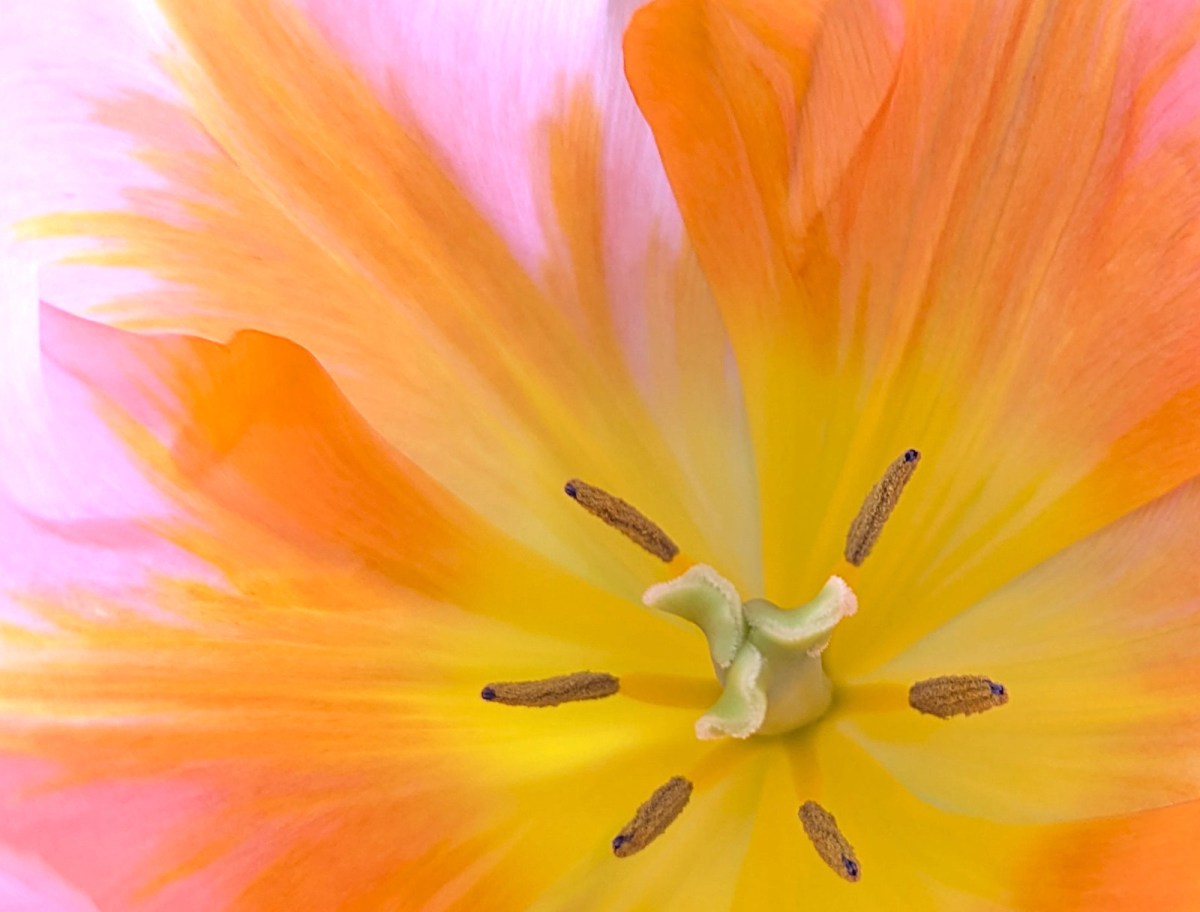
I have another flower image for you today. This one shows the centre of a tulip flower in more detail than you might normally see. I’ve placed the centre of the flower towards the lower right of the frame so you can see more of the petals towards the upper left. You’ll notice that the petals are yellow near the centre, orange a bit further out, and pink further out again. What a beautiful combination!
The reproductive parts
Tulips are monoecious, a botanical term that means each plant produces both male and female reproductive tissues. The female part of a tulip flower has three stigmas in the centre. Unlike animals and some more primitive plants, the male reproduction process doesn’t involve motile sperm. Instead, pollen is released as a yellow dust, sometimes dry and carried by the wind but in the case of tulips and many other plants, sticky and carried by flying insects.
Flowers work as attractive beacons for pollinating insects, they’re usually brightly coloured, are often fragrant which helps insects detect them from a distance, and provide food – sugary nectar at the base of the petals, and pollen. Bees collect the pollen and carry it back to the hive as a protein rich food for their larvae. Plants produce more pollen than necessary and can spare some in return for the pollen transport provided by the bees. The pollen grains stick to the pollinating insects and as they visit flower after flower, some of the pollen is transferred from the anthers of one plant to the stigmas of another. This cross-pollination is exactly what the plant needs for the female tissues to develop further and produce viable seeds.
Tulips have five of these anthers, and if you enlarge the image and peer closely you can see yellow dust clinging to them. That dust is the pollen.
Intricate
It’s an astonishingly intricate process in which the plants depend on the insects and the insects depend on the plants. I could go into much greater detail; I worked as a professional botanist when I was in my twenties and thirties, studying and publishing scientific papers on pollen and pollination. Maybe some time I’ll write a bit more about that.
Next time you see tulips in the park, at a florist or supermarket, or in your garden – just think about the intricate interactions going on right there!
See also:
Pollen – Wikipedia (contains a more detailed photo of a tulip anther with pollen, about ¼ of the way down the article. Hint: compare the Wikipedia photo with mine.)
If you enjoyed this or found it useful, please like, comment, and share below. (If you don’t see those links, click the article’s title above the main photo and they will appear.) Send a link to friends who might enjoy the article or benefit from it – Thanks! My material is free to reuse (see conditions), but a coffee is always welcome and encourages me to write more often!