Science at the cutting edge

We can be sure there’s trouble ahead and we can imagine some of the long term issues. The authors of this article are putting out a broad warning and setting out the probable longer term dangers.

Recommended – 2

In this series I recommend articles or other work I’ve seen that I really like and want to share with my readers.

Click to enlarge

A quick summary follows, but I encourage you to read the original with its much deeper analysis.

It’s very difficult to analyse the long-term effects of actions that began only three months ago, and may continue for some time; we can only guess how long this process will last and what new forms it might take in future months or years. It’s as if the captain of a large vessel had ordered a hard turn to starboard and the crew was scrambling to put the order into effect. With the ship’s rudder now clearly turning and signs of a change in course, what can possibly be concluded?

The ship will start to lean a little, some loose objects will slide around, these immediate effects are predictable. But what about the longer term? Will there be a catastrophic collision with another ship? Will we run aground? It’s clear there are dangers but it’s too soon to make detailed predictions.

That’s the situation US science finds itself in today. We can be sure there’s trouble ahead and we can imagine some of the long term issues. The authors of this article are putting out a broad warning and setting out the probable longer term dangers.

Damage caused by the Trump administration, science-policy experts warn, could set the United States back for decades. “So many of the damaging impacts are going to be extremely difficult to reverse and are going to take a very long time to recover from,” says John Holdren, a science adviser to former US president Barack Obama.

The authors begin by summarising what’s been done in the first three months and pointing out that it’s just a start; cuts of up to half seem likely. Reader surveys by Nature show well over 90% are troubled by the cuts.

About half the US science budget goes on defence-related programs and more than a quarter on health. The cuts are being presented as necessary to combat waste, corruption and propaganda, but no evidence has been offered to back up these claims. An assumption is being made that private sector research will shoulder the burden, though that is most unlikely for fundamental studies.

Another aspect of budget cuts is the resulting loss of skilled and knowledgeable staff, an immediate loss that will take a long time to rebuild. Indeed, the damage done in a few months will take decades to recover. It seems likely that Congress will be unable (or unwilling) to resist the probable budget cuts for 2026 and the situation is not likely to be alleviated by the various political demands being made of universities by the Trump administration. The USA seems already to be suffering loss of reputation and is less appealing for foreign scientists, not only are fewer international staff and students planning to work in the USA, but American scientists are starting to look abroad for work.

There are worries that other nations will advance beyond what the US can do in years ahead, and putting broken US science together again will be very difficult and expensive to achieve.

The article also contains helpful links for additional reading on the topics discussed.

See also:

Useful? Interesting?

If you enjoyed this or found it useful, please like, comment, and share below. (If you don’t see those links, click the article’s title above the main photo and they will appear.) Send a link to friends who might enjoy the article or benefit from it – Thanks! My material is free to reuse (see conditions), but a coffee is always welcome and encourages me to write more often!

You might also like

Enigmatic computer

Once it was realised that a letter could be coded as any other letter except itself, even this tiny clue could help point the cryptographers in the right direction.

< Previous | Index | Next >

Image of the day – 155

What’s in an image? Sometimes quite a lot, more than meets the eye. I’m posting an image every few days.

Click to enlarge

Why is this old computer enigmatic? Some of you will know, some might guess correctly, others may have no idea. I took the photo in July 2012 at the Museum of Computing at Bletchley Park where highly secret work was done during the Second World War to break the German Enigma code as well as other enemy codes and ciphers.

This is a working replica of the famous Colossus computers used to crack those very difficult codes. And computer power alone couldn’t do it, it required clever minds to look for little hints that could make the ‘unbreakable’ code breakable. As an example, once it was realised that a letter could be coded as any letter other than itself, even this tiny clue could help point the cryptographers in the right direction. And there were always cribs that could help, the knowlege that a particular operator always began with the same phrase was an enormous help.

No original Colossus machines exist, after the war ended, Churchill gave strict orders that they should all be dismantled and the parts broken into small pieces.

The idea behind Colossus was the brainwave of Alan Turing, a mathematical genius who worked at Bletchly Park during the war. The Bombe that preceded it was originally designed and built by Polish engineers. Turing and his team designed and built a British version, physically different but doing the same job.

CSO (then based at Bletchly, now at GCHQ) intercepted the coded messages, while teams produced the German plain text, translated it into English and passed it to the British government and military planners.

See also:

< Previous | Index | Next >

Useful? Interesting?

If you enjoyed this or found it useful, please like, comment, and share below. (If you don’t see those links, click the article’s title above the main photo and they will appear.) Send a link to friends who might enjoy the article or benefit from it – Thanks! My material is free to reuse (see conditions), but a coffee is always welcome and encourages me to write more often!

You might also like:

Rotated parking

Consider the poor removals staff when it comes to picking up or delivering a whole houseful of furniture.

< Previous | Index | Next >

Image of the day – 154

What’s in an image? Sometimes quite a lot, more than meets the eye. I’m posting an image every few days.

Click to enlarge

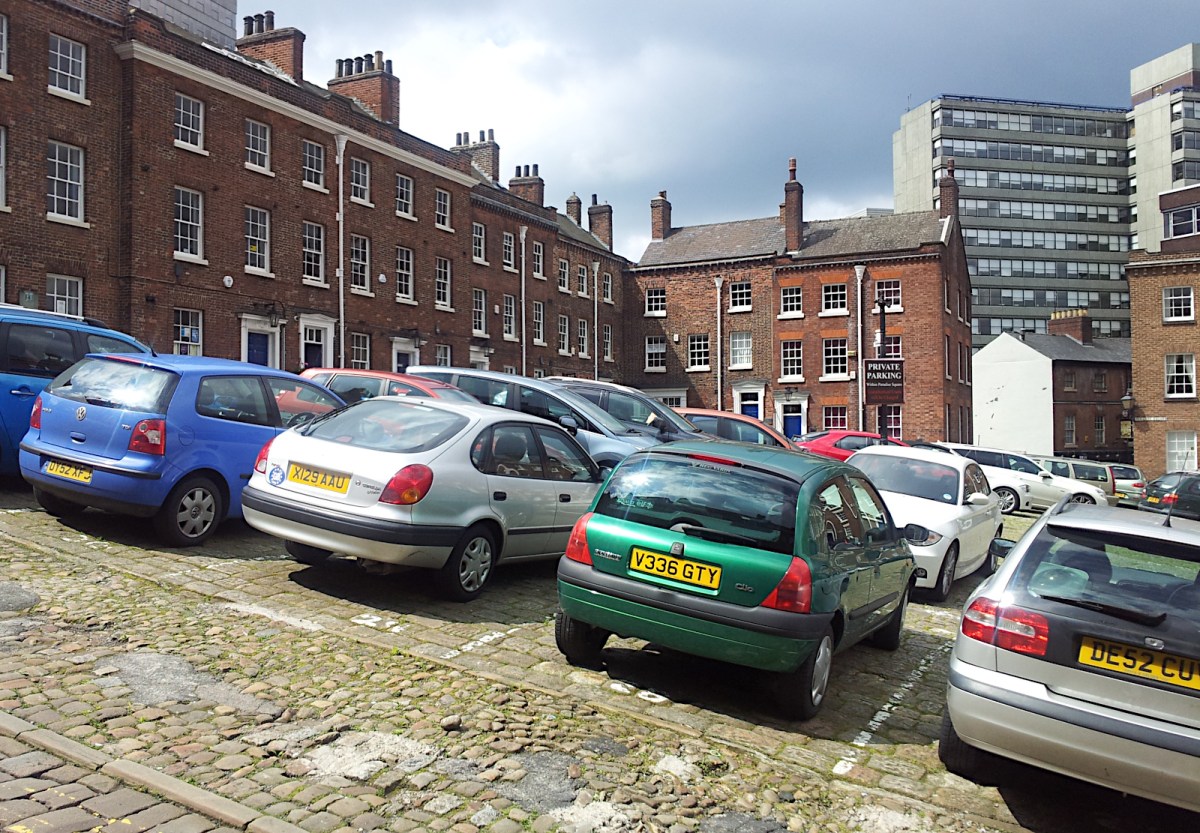
Today’s photo is slightly giddying. This is Paradise Square in Sheffield; I took it in July 2012 when we were visiting family there. Here’s an amusing thought, but perfectly true – more car parking spaces are available in Paradise Square than had it been on level ground! But that doesn’t mean it’s a car parking paradise. Make sure your handbrake is firmly on and if your car has a manual gearbox, perhaps leave it in gear for added safety. Be careful when opening the door, too. I wonder if car insurance is more expensive if your address is on Paradise Square?

And consider the poor removals staff when it comes to picking up or delivering a whole houseful of furniture. Those hydraulic lifts at the back of the vehicle, usually so helpful, would be almost worse than useless! Would it be best to park across the slope? Or would facing uphill or downhill be better?

This must be one of the steepest car parks in the world. If you’re aware of one with an even steeper slope than Paradise Square, leave a comment. Thanks! (I found one, linked below, but I bet there are more.)

See also:

< Previous | Index | Next >

Useful? Interesting?

If you enjoyed this or found it useful, please like, comment, and share below. (If you don’t see those links, click the article’s title above the main photo and they will appear.) Send a link to friends who might enjoy the article or benefit from it – Thanks! My material is free to reuse (see conditions), but a coffee is always welcome and encourages me to write more often!

You might also like:

Dinosaurs and the Bible

We are to learn about love, fruitfulness, brokenness, restoration, and our place in this Universe, responsibility, culpability, truth, life and wisdom. We are to understand these things in our own lives, in one another, and also in and through Yahweh.

Dinosaur (Wikimedia)

ad hoc post – 2

< Previous | Index | Next >

Click to enlarge (Wikimedia)

I recently listened to a podcast by Two pastors in a pub (episode 55).  I enjoyed the episode which was about the questions asked and statements sometimes made, to the effect that the presence of dinosaur remains in the fossil record demonstrates the Bible to be incorrect. All sorts of these points are examined and discussed during the podcast. But I think there’s a much more fundamental argument to be made – and it has nothing to do with dinosaurs.

The underlying questions, I believe, are:

  • ‘What is the Bible for?’ That is, ‘What is it’s purpose?’
  • ‘Why was it written?’
  • ‘How was it written?’ and
  • ‘How should I read it?’

What’s in a name?

The background to my answers to those questions is to say that I believe there’s a power of some kind invisible to us, external to the Universe yet responsible for its existence and its nature. We’ll come back to the questions soon, but first let’s go a bit further with the background.

Note first that there is no way I can prove this belief of mine to be true or false. It’s a matter of faith, not of proof and not of evidence. It’s simply something I believe to be true. The set of provable statements is limited to those within and about the Universe; this set does not, cannot, apply to anything exterior to the Universe.

I give this creating and sustaining Authority in which I believe, a name. I like to use the name ‘I am what I am’. It’s the name offered for use by Moses when he asked, ‘Who shall I say has sent me?’ In Hebrew, this enigmatic name is יהוה ie YHWH, the vowels being left out. It’s transliterated into English variously as ‘Yahweh’ or ‘Yahveh’, ‘Yahoveh’ or in the past frequently ‘Jehovah’.

You can read more about Moses and the name in Exodus 3.

Taking the trouble to use something akin to the name given to Moses makes it easier to think this through. A name implies a person; so let’s imagine this creating and sustaining authority as a person called Yahweh.

Back to the questions

What is the Bible for? What is its purpose?

First remember that this person called Yahweh is not here with us inside this Universe we inhabit. Yahweh is outside it, if I make something I cannot also be a part of the thing I made. Suppose I write a story and there are characters in my story, as the author I might want to communicate with the characters. I think that’s the simplest way to answer the question, ‘What’s the Bible for’. I suggest that it’s Yahweh’s way of communicating with us. By influencing people like Moses, but also many others down the long ages of history, Yahweh has encouraged them to write down accounts that explain so many things that we need to know. That is the purpose and function of the Bible. It’s a collection of writings from many times and places written by many different contributors, but all inspired by Yahweh’s character and nature. That inspiring process is so fundamental that we might even regard Yahweh as the author, working behind the scenes.

Why was it written?

If the Bible had not been written, we would know little or nothing about the author. The fact that Yahweh wants you and me and others to know is reason enough. We are to to learn about character, purpose and relationship in particular. We are to learn about love, fruitfulness, brokenness, restoration, and about our place in this Universe, responsibility, culpability, truth, life and wisdom. We are to understand these things in our own lives, in one another, and also in and through Yahweh.

There’s plenty of geography, poetry, history, story, wisdom and more in the Bible, yet it’s not a geography text, or a poetry text , or a history text. Instead, the Bible employs all these forms to put across the core message. When Jesus told the story of the good Samaritan, or the woman who lost a coin, they were not necessarily historical events or real people, the story was to clarify something deeper and far more important than mere, everyday fact. And everything in the Bible, including the Genesis creation account, is there for that kind of purpose. None of the accounts in the Bible is required to be true palaeontologically, that’s not their function. They are there to explain relationship, responsibility and a deeper kind of truth.

How was it written?

Little by little is one answer. The books of the Bible were written at different times, by the efforts of many diverse authors, and based both on the author’s knowledge of the ways and history of the times in which they lived, and on direct inspiration by Yahweh.

How should I read it?

As it was (and is) intended! Don’t go searching for scientific evidence, geographical facts, or historical analysis with supporting documentation. Expect to have flashes of understanding from time to time, particularly about the nature, purposes and character of Yahweh. Most importantly, try to understand Yahweh’s perspective in dealing with characters in stories both imagined and historical. And especially try to grasp and crystallise what you are being shown about yourself, particularly in terms of your relationships and attitudes to others and to Yahweh as well.

Dinosaurs

Given all of that, you should now be in a good place to see that dinosaurs in the fossil record contradict nothing in the Bible. There is good, geological and palaeontological evidence for creatures living on the land and in the oceans of Earth way back in the past. There’s good evidence too to show that they were reptiles and that some of them were very large. There’s further good evidence to reveal that they did not, after all, die out completely. One branch of the dinosaur line survived and gave rise to all the birds that still live in the world today.

But none of this in any way contradicts my personal faith in a power external to the Universe.

And finally

There’s just one more point to make. What I’ve written here is only the merest beginning. You’ll find more right here in Journeys of heart and mind. I suggest using the search box near the top of the right-hand column (you’ll have to scroll up to find it). Try searching for Yahweh or for Jesus. Alternatively begin with this post:

So, is Jesus the same person as Yahweh? I can only give you a weird answer – Yes, he is, and no he’s not! There’s a great deal more to be said about this, and I plan to write more soon. When I do, I’ll leave a link right here.

< Previous | Index | Next >

See also:

Useful? Interesting?

If you enjoyed this or found it useful, please like, comment, and share below. (If you don’t see those links, click the article’s title above the main photo and they will appear.) Send a link to friends who might enjoy the article or benefit from it – Thanks! My material is free to reuse (see conditions), but a coffee is always welcome and encourages me to write more often!
You might also like:

An early photo

The dog in the photo was Chloe, a wire-haired fox terrier. Although it’s a fine day, the waves look fairly energetic suggesting strong winds across the Irish Sea.

< Previous | Index | Next >

Image of the day – 153

What’s in an image? Sometimes quite a lot, more than meets the eye. I’m posting an image every few days.

Click to enlarge

This is a photo of my younger sister, Ruth. Bear in mind that I’ll be 77 this summer, and you can deduce right away that the photo is quite old! I took it on a beach in mid-Wales, I believe in 1963 so it’s worn well. Ruth was building a lovely sand castle; Mum and Dad were on the beach nearby, as were my other two sisters, the weather was sunny and warm, and all was well with the world. It usually is when you’re on holiday!

But what else can we learn from this image?

Well, you might notice it’s a bit blurry, that’s because it was taken with a cheap Kodak Starmite camera with no focus control and a cheap lens. But what you can’t see is that the original was poorly framed and had a sloping horizon so I had to crop it for a better composition. The original is a Kodachrome transparency on 127 roll film. It’s dusty and I had use GIMP to clean it up.

But there are other things we can see. The bucket is red plastic, but the spade has a wooden handle and a painted steel blade. That alone would give an approximate date, given that plastic buckets were a recent innovation while wood and steel spades would have been similarly replaced with plastic only a little later. The flags were paper with wooden sticks.

Just think of this from a waste point of view. Only the bucket in this image would have produced waste that could not recycle itself. The spade, the flags, the clothes Ruth is wearing, even her footwear, when discarded would gradually rust or be digested by soil bacteria. Most of it would be gone within a few decades, though the rubber soles might take a tad longer. But the plastic bucket will still exist in some form unless it was incinerated. Most likely it’s still in landfill somewhere near Cirencester as that’s where we lived at the time.

The dog in the photo was Chloe, a wire-haired fox terrier. Although it’s a fine day, the waves look fairly energetic suggesting strong winds across the Irish Sea.

I have other early photos, mostly on black and white emulsions of the Ilford FP series, but a few others in colour.

See also:

< Previous | Index | Next >

Useful? Interesting?

If you enjoyed this or found it useful, please like, comment, and share below. (If you don’t see those links, click the article’s title above the main photo and they will appear.) Send a link to friends who might enjoy the article or benefit from it – Thanks! My material is free to reuse (see conditions), but a coffee is always welcome and encourages me to write more often!

You might also like: