The art of persuasion

We need to be noticed for our goodness. If we are filled with the spirit of Jesus we will bear the fruit of his spirit; and here’s that fruit – love, joy, peace, patience, kindness, goodness, faithfulness, gentleness, self-control.

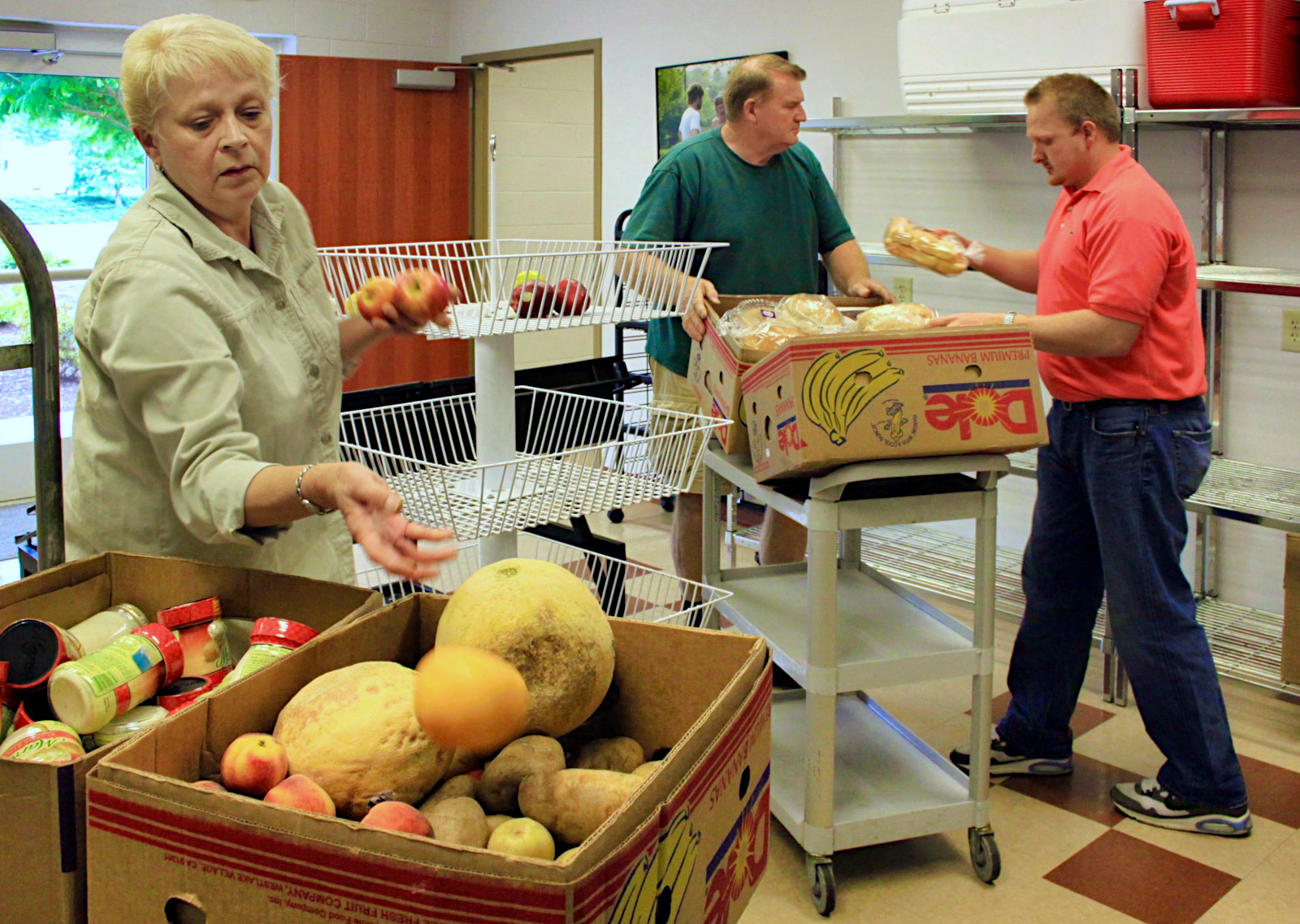
Working at a food bank (Wikimedia)

Thinking out loud – 2

My previous post was an image of the day. I wrote about evening mist, and how our lives have a beginning, a middle, and an end, just like a day there’s a certain mistiness about growing old. I ended by writing:

The teaching of Jesus is very logically sound, not testable but also, as far as I can see, internally coherent and free of self contradiction. That quality amazes me, I believe his claims to be true, testable or not. He has convinced me. Maybe he has convinced you too, or maybe not. We have that freedom, and we cannot persuade one another using the scientific approach, good as that is for studying more measurable and therefore testable matters.
Food bank
(Wikimedia)

If we can’t persuade others using the scientific method of testable hypotheses, how then can we reach those around us? There is a way, of course, so lets take it step by step.

How I live

The first thing to realise is that if we are following Jesus, we are his ambassadors in this world. An ambassador represents one nation by being present in another. Jesus came as an ambassador (and much more than that, of course). He came to represent his Father and his Kingdom here on Earth. He demonstrated Kingdom values and ways as well as talking about them.

I’m an ambassador too, I’m here to represent Jesus and his Kingdom to others. If I’m to represent Jesus I need to be like him as much as possible. So let’s dig into his character for a moment. Why did people 2000 years ago in Israel listen to Jesus? He did speak to individuals and even to crowds, but he also did things that surprised people. He met people’s needs (that will always get attention). He fed hungry people, he listened to lonely people. He healed sick people (that definitely got attention) He told stories (something else that people will listen to). But primarily (and what lay behind everything else) – he loved people and cared about them. So that’s what I aspire to: love people and care about them, meet their needs, feed the hungry, listen to the lonely, heal the sick, and tell good stories. Those are things I try to do as an ambassador for Jesus.

There’s a lot of love but also a good deal of uncaring in this human world of ours. People usually love their close family and their best friends and it’s love that drives us to help, to go the extra mile, to put up with those times when we feel let down or disappointed. But with people we don’t know we may be cautious at first. Some people seem not to care at all about others, appearing to be driven by selfishness alone. But the fact is that almost all of us are a mix, we display love sometimes, at other times or with other people we just don’t care very much.

We need to be noticed for our goodness. If we are filled with the spirit of Jesus we will bear the fruit of his spirit; and here’s that fruit – love, joy, peace, patience, kindness, goodness, faithfulness, gentleness, self-control – this list was written down in Greek by Paul, an early follower of Jesus. Read what he wrote in context.

It’s not so much about what I say, it’s about what I do. Helping in a food-bank, for example, picking up litter, planting snowdrops on grass verges, listening, learning to be more like Jesus.

Talking about Jesus

If I walk up to a stranger in the street and start telling them about Jesus, what will happen? Will they listen? I think we all know the answer!

If people notice how I behave and what I do and are surprised about that in some way, they might sometimes ask me about it. And I’ll explain that it’s simply because I’m trying to become more like Jesus. They might ask about that as well.

If I claim to be following Jesus, people will assume that Jesus is like me. That is a huge responsibility. If I fail in how I live, what I say will not be believed. Answering questions is always better than telling people things they may not be eager to hear. Reaching people is a matter of my behaviour being interesting enough to spark the why question and then providing good answers.

See also:

Useful? Interesting?

If you enjoyed this or found it useful, please like, comment, and share below. My material is free to reuse (see conditions), but a coffee is always welcome!

Rejoice in persecution

Our suffering for Christ is not wasted; it is a testimony of our allegiance to Him and a pathway to deeper intimacy with [him].

Recommended – 1

This is the first of what may become an occasional series in which I recommend creators and their creations when they produce things I really like and have found useful.

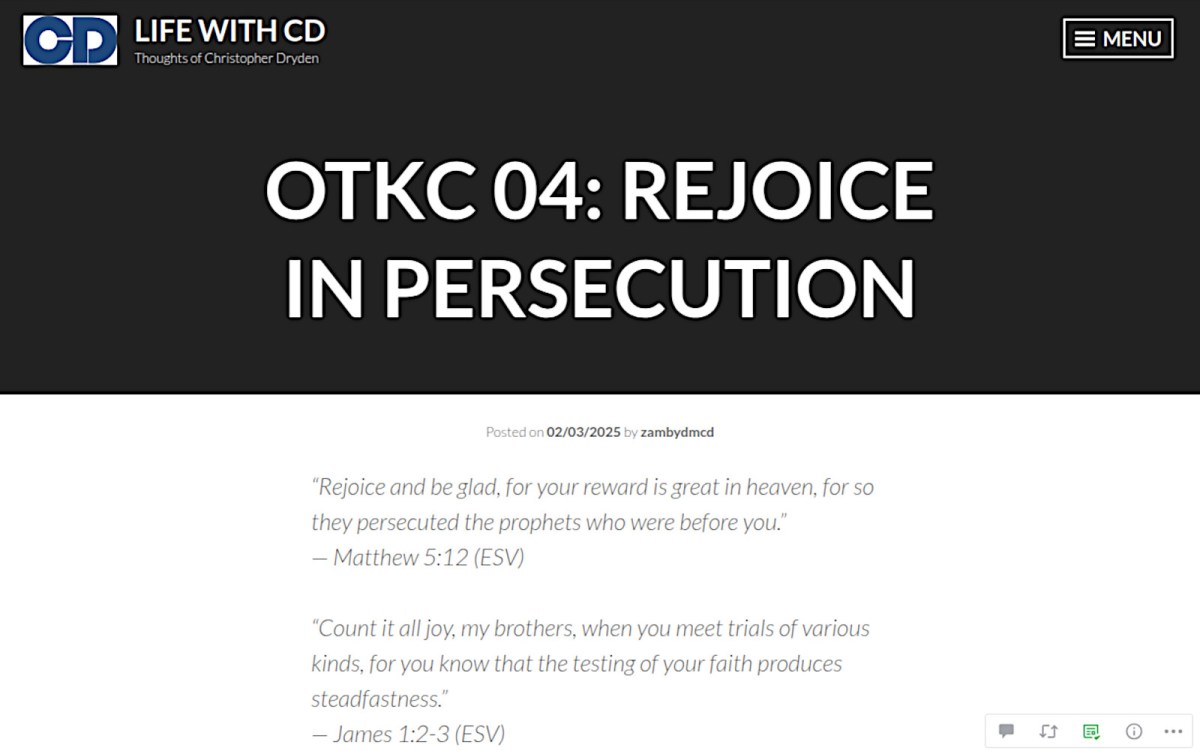
Today I’ve chosen an article by Chris Dryden who writes at ‘Life with CD’. Here’s a quote from his piece:

Rejoicing in persecution is not about denying pain or pretending hardship doesn’t hurt. It’s about lifting our eyes beyond the immediate struggle to see the eternal reward that awaits us. Our suffering for Christ is not wasted; it is a testimony of our allegiance to Him and a pathway to deeper intimacy with our Saviour.

Read Chris’s full article on his webpage.

It’s a useful read, in fact all of Chris’s articles are worth a look. For those of us attempting to live like Jesus, there’s a lot of thought-provoking stuff to read and consider here.

If you’re reading out of a more general interest you’ll still find much to value, perhaps as life lessons or just to understand why Jesus is a person of such long-standing interest to so many people.

See also:

Useful? Interesting?

If you enjoyed this or found it useful, please like, comment, and share below. My material is free to reuse (see conditions), but a coffee is always welcome!

Praying for the fundamentals

Jesus begins by reading back what he already knows. It’s time. His followers still don’t fully understand, but hearing this now, they will gradually understand as events unfold.

< Previous | Index | Next >

Cruising the gospel – John 17:1-5

Bible text – Read it yourself (opens in a new tab)

Take a look first
A fragment of John’s gospel
(Wikimedia)

17:1 – Here, Jesus reveals to us what is really fundamental through his prayer. He even begins with something fundamental, but it’s easy to read the words without noticing the implication – He looked up.

Jesus looked up. This was the first thing he did, even before he spoke. He looked towards the Father before he spoke to him. This is exactly what we all do immediately before we speak to another person. We look at them and then we begin to say whatever is on our mind. The looking is an important part of the communication; it announces an intention to say something, checks if the other party is ready to listen, and alerts others nearby that a conversation is about to start.

At the very least, if we’re about to say something it is kind and thoughtful to look and see if right now is a good time to do that. We are checking, but also making the connection to establish communication.

Now speak, freely and openly. Jesus speaks to the Father but also to his apprentices, the disciples.

The hour has come

Jesus begins by reading back what he already knows. It’s time. His followers still don’t fully understand, but hearing this now, they will gradually understand as events unfold. They will later recall that Jesus knew what they did not – and that he was prepared for it.

Glory!

17:2-3 – Jesus knows that he is going to receive glory, but he also knows that the purpose of it is that he can then glorify the Father. He has authority over everyone and he’s been given the power to give eternal life to those entrusted to him by the Father.

And what is eternal life? Why, it’s the knowledge of the Father and of the Son that the Father sent! Jesus has told them already, that if they’ve seen him, they have seen the Father. It really is that simple! Simple to say, yet still very hard for them to comprehend at this point. Right now they just don’t get it – but after Pentecost they will.

The work is complete

17:4 – The Father receives glory by the Son completing the task he was sent to do. Jesus has done everything except the very brief final act. Think about what he has already achieved. He was born into a broken world, and grew up as a young child, obedient to his parents. By the time he was twelve-years-old he had understood who his real Father is and was capable of debating with Jewish scholars at the Temple in Jerusalem. He grew up, learning the trade of carpentry. He went out into the river country to be baptised by John in the Jordan, and then he called people to follow him, teaching them everything they would need to know. He had prepared everything for them so that they could accept his Holy Spirit (the Spirit of Christ) when he would arrive and fill them just a little later.

17:5 -Now he is ready to be obedient in the final act too, and to receive again the glory he had in his Father’s presence even before the world began. These five verses at the beginning of John 17 summarise everything he has done and will do.

< Previous | Index | Next >

Useful? Interesting?

If you enjoyed this or found it useful, please like, comment, and share below. My material is free to reuse (see conditions), but a coffee is always welcome!

Speaking in Jesus’ place

We do not get to choose which parts of his work we are to do. We are to do all of it! We absolutely need one another in this task, when we stand alone we are weak, but together we are strong.

< Previous | Index | Next >

Cruising the gospel – John 16:25-33

Bible text – Read it yourself (opens in a new tab)

They will ask the Father
A fragment of John’s gospel
(Wikimedia)

Now we come to something extraordinary, and it’s something we need to take on board very personally. Every single follower of Jesus must grasp this for themselves. Don’t miss it! Seize it, hold this truth in your own understanding, feel it to be the deep truth that it actually is.

16:25-26 – So far, Jesus’ language has been figurative as he helps his followers grapple with things that are, frankly, too hard for them to comprehend. Now he says that a time is coming when he’ll communicate plainly with them, there’ll be no need to use figures of speech any more. Surely that time is the period after they receive the fullness of the Spirit of Christ? It will happen in the upper room at the soon-to-arrive Pentecost. From then on, Jesus says ‘they will ask in my name‘.

We (and they) are to stand in Jesus’ place and ask the Father as if we (they) are the Son! How many times must he tell us – we are his body walking this Earth! Collectively, we are intended and expected to carry on his work. We do not get to choose which parts of his work we are to do. We are to do all of it! We absolutely need one another in this task, when we stand alone we are weak, but together we are strong. Jointly and in concert we are Jesus’ body, walking this Earth.

So we no longer say, ‘Jesus, please ask the Father to do this and that’. Now we must say, ‘Father, we’re here in Jesus’ name asking you to do this and that.’ We must not feel how weak and small we are – and we are weak and small individually. Instead together, as the church, because we are Christ’s body, we have his strength and greatness!

Me – weak and small. Us – strong and great.

16:27-28 – Do we have the Father’s love? We do! Why? Because we love Jesus and know who sent him! Jesus explains that there’s a symmetry here. He came from the Father into the world. Now he will leave the world and go back to the Father. His physical presence in the world was a temporary exception.

Clarity and faith

16:29-30 – And Jesus’ followers get it. They tell him that he’s speaking clearly now, that they can see he knows everything, and that he doesn’t need anyone to ask him questions. Does that seem a little odd to you? It seemed odd to me at first.

Perhaps it’s simply that this was a method other Jewish Rabbis habitually used, encouraging their followers to ask questions to find out where they lacked knowledge and to then guide the teaching to address those gaps. Instead, Jesus already seems to know where the gaps are and he is well able to address gaps in their understanding without waiting to hear their questions.

Might it be this uncanny ability of Jesus that persuades them he really has been sent by the Most High?

What will they do next?

16:31-33 – Now Jesus asks them a question. You just told me you believe I came from the Almighty, but do you really believe? Truly? And he tells them they’ll all run away, back home, leaving him alone. These followers, the disciples learning to be like their Master, his trainees, his apprentices – they’re going to run off and leave him? Remember that they’d been treading the highways and byways of Judea and Samaria and Galilee, and even the ten Greek cities (The Decapolis) for three long, dusty, weary, yet exciting years. Are they going to abandon him now?

Jesus tells them they will, but he also says he won’t actually be alone because the Father will be with him. And he explains that he has shared all this with them so that in him they can have peaceful hearts. He’s told them what will happen, and he is not fazed by it, and neither should they be! They might feel they’ve let him down in his time of great need, he anticipates this and wants to let them know in advance that it’s OK. They shouldn’t be disheartened.

The world will throw more than enough trouble at them, but he wants their hearts to remain peaceful because he, Jesus, has already overcome the world.

< Previous | Index | Next >

Useful? Interesting?

If you enjoyed this or found it useful, please like, comment, and share below. My material is free to reuse (see conditions), but a coffee is always welcome!

John 16:16-24 – Sadness and joy

Questions and enigmas make us think harder, and discuss the possibilities amongst ourselves, while the observing teacher gets a clear sense of whether the students are understanding the important principles.

< Previous | Index | Next >

Bible text – Read it yourself (opens in a new tab)

Not seeing, then seeing
A fragment of John’s gospel
(Wikimedia)

What Jesus says next is a complete riddle for his followers. ‘Soon you won’t see me, but soon after that you will see me.’ They discussed this amongst themselves, over and over it seems; but they didn’t ask the Master to explain what he meant. Perhaps they were embarrassed because they couldn’t work it out. In verse 10, Jesus had mentioned he would be ‘going to the Father’ and they were puzzled about that as well. And what did ‘soon’ imply?

Jesus understood perfectly what was going on in their minds and that they’d like to ask him about it, but were not going to. And this is typical of him in his dealings with all his followers, not just then, but now as well. He asks questions and he makes enigmatic remarks. The reactions of his followers inform him more than a straightforward conversation would and, more to the point, they help his followers learn.

How we learn

Any teacher knows how to use this method whether the subject is art, maths, science, history – whatever. Questions and enigmas make us think harder, and discuss the possibilities amongst ourselves, while the observing teacher gets a clear sense of whether the students are understanding the important principles. It’s likely this was a method used by any Jewish rabbi. Ask a tricky question, then let the learners wrestle with it and observe their level of understanding.

So remember, when Jesus gives you a question or a problem to resolve, it’s most likely just a way of helping you go deeper or further. And if necessary, don’t be afraid to ask him! He knows your difficulties but he wants you to make the effort and, if necessary, he will help you out. Even if he needs to explain, the fact that you wrestled with it first will help his explanation stick.

So what did he mean?

First he lets them know that he understands their struggles and need to ask, and then he adds a little more information – that they will cry in deep sadness while the world rejoices. And here comes another standard teaching idea, use an illustration, something quite different, something familiar, but something with important similarities. Jesus tells them it will be like a woman giving birth – lots of pain and anguish but with relief and great joy when accomplished.

And now they understand the principle, he adds more detail for them. Their time of grief is now, but he’ll see them again and they’ll rejoice. Nobody will be able to steal that joy from them and they won’t need to ask him any more questions. In fact, they’ll be able to ask his Father (in Jesus’ name) for anything. So far they have not done this – ask, receive, and rejoice!

And what about us?

Can we expect the same? Should we, too, expect to ask in Jesus’ name, receive, and rejoice? Yes! Indeed we should! Does Jesus say to us, ‘So far you have not done this’? Perhaps he does for some of his people and for some of the time. Often we think in terms of faith – ‘Do I have too little faith?’. Frankly, it’s a bad question.

Faith is important, of course. Faith is one of the three things that Paul tells us will remain. The other two are hope and love. And Paul is very, very clear about it, the greatest of the three is not faith, but love! (1 Corinthians 13:1-2) Do you love Jesus? Does he love you? Do you have the Father’s love?

Let me remind you, that yes you do! And this love is greater than faith. Faith is required, but it’s not the measure of the answer. Father’s love is always the measure of the answer.

When you ask for something in Jesus’ name, you may or may not see the answer you expect. Anyone moved a mountain recently? Faith expects that you will trust the answer to Father’s wisdom and love. We don’t always see what we expect. We don’t always immediately receive what we ask. We need to be wise, recognise his love, remain patient and not give up.

And another thing to remember, sometimes we ask in hope, not faith. That’s OK too. There’s nothing wrong with the prayer of hope; there’s no shame in it. Sometimes there is a gift of faith, received in the moment, and we feel certain that what we ask will be done. If so, go ahead and use it! If not, pray anyway, Father listens, he does not turn away. He loves you! We all know what that’s like, we have all been children and some of us have been parents.

< Previous | Index | Next >

Useful? Interesting?

If you enjoyed this or found it useful, please like, comment, and share below. My material is free to reuse (see conditions), but a coffee is always welcome!

John 16:12-15 – The Spirit

This is fully mature fruit seen at its most complete in the heart of the One who will send the Spirit. This is the source of the spiritual fruit talking.

< Previous | Index | Next >

Bible text – Read it yourself (opens in a new tab)

Getting the whole story
A fragment of John’s gospel
(Wikimedia)

Just four verses this time. Why so few? It’s because these verses are so heavily loaded with deep truth. There’s a lot here that we need to consider and absorb.

Jesus simply can’t tell them everything he wants them to know; he’s well aware they wouldn’t be able to deal with. It would, he says, ‘be more they they could bear’. It says a very great deal about his nature that he holds back for their sakes, so they won’t be overwhelmed. This is caring, this is gentleness, this is concern for the other, this is understanding.

Cast your mind forward to Paul writing to the Galatians about the fruit of the Spirit – love, patience, kindness, gentleness, self control (Galatians 5:22-23). This is fully mature fruit seen at its most complete in the heart of the One who will send the Spirit. This is the source of the spiritual fruit talking. Interrupting his precious narrative because he respects his followers’ weakness. It would destroy them so he holds back. We can learn so much from him about spiritual fruit.

Jesus is also the author and source of faith, he knows he can leave essential things unsaid because he knows in all certainty that the Spirit he will later send will explain these things to them, when they are able to cope with the hard, difficult truth. He doesn’t worry, or think, ‘What if they just don’t get it later?’ He knows it’s safe to wait. He doesn’t just have faith, he is faith incarnate! We can learn so much from him about faith.

A trustworthy Spirit

In verse 13, Jesus explains how they will know later what he cannot share with them right now. He needs to explain that the Spirit (who they have not yet experienced) will ‘guide them into all the truth’.

The Spirit will not speak ‘on his own’ – He will, in fact, speak with the Father and with the Son, so his words will be of them and from them, and will carry their full authority.

He will speak only ‘what he hears’. – The Spirit is privy to what the Father and the Son say to one another.

He will ‘tell you what is yet to come’. – In other words the Spirit is prophetic, he will share with them whatever they need to know, even if it’s about things that have not yet happened.

The disciples would not have missed the connection with the Jesus they already know and love. He has claimed to be one with the Father and to say only what he hears the Father say. And isn’t Jesus, here in this conversation, telling them about ‘things that are to come’? That is to say, the Holy Spirit.

And then finally, in verses 14 and 15, Jesus repeats what he’s already told them. He wants to be absolutely sure they understand! The links in the chain are as clear as they could possibly be; what belongs to the Father (Yahweh, the one who just IS) has been given to Jesus. Next, these things are given by Jesus to the Spirit, and then, finally, the Spirit will pass it all on to his followers.

Simple, straightworward, but oh how awesome!

And if you are following Jesus, then it is all your inheritance too. You don’t need to do a thing to inherit something, you just need a family member who has decided to pass it on. Jesus is handing all the richness of heaven and of the Father to you on a plate! The least you can do is receive it and be grateful!

< Previous | Index | Next >

Useful? Interesting?

If you enjoyed this or found it useful, please like, comment, and share below. My material is free to reuse (see conditions), but a coffee is always welcome!

John 16:1-11 – Warnings and leaving

If his apprentices had been given a vote, they would all have called for Jesus to stay with them. Of course from our perspective it’s clear that the sending of the Holy Spirit was the necessary next step in the life of the church. But that’s very much the benefit of hindsight!

< Previous | Index | Next >

Bible text – Read it yourself (opens in a new tab)

Dangers ahead
A fragment of John’s gospel
(Wikimedia)

From what Jesus tells them next, the future sounds pretty dreadful; but there’s purpose in the telling. What he has already told them was to prevent them from giving up. There’s nothing like hard times to discourage us, and Jesus is well aware of that. But now, knowing time is short, he explains how bad it will get and the great hope that remains.

Jesus explains that people who know neither him nor his Father will reject his followers and even murder them, thinking they are serving Yahweh in doing so. Now that Jesus is leaving the disciples he’s telling them things he’d shielded them from previously.

Where next?

Jesus has told them several times before that he is leaving them, he’s well aware that they haven’t asked where he plans to go and are already feeling sad and downcast (even abandoned) at losing him. It’s easy to imagine them thinking they’ve failed in some way, that he’s going to look for better followers somewhere else. So he explains that his departure will be good for them because if he stays the ‘Advocate’ won’t come. They won’t understand what this means until Pentecost when the Holy Spirit will fill them and a lot of mysteries will begin to be answered in their minds and hearts. For some reason he says that unless he leaves them, he won’t be able to send this ‘Advocate’.

If his apprentices had been given a vote, they would all have called for Jesus to stay with them. Of course from our perspective it’s clear that the sending of the Holy Spirit was the necessary next step in the life of the church. But that’s very much the benefit of hindsight!

Sin, righteousness, and judgement

The world (and especially the Jewish world in which the disciples lived) knew that sin, righteousness and judgement were important things. The Law and the Prophets were full of these three ideas – from Genesis right through to Malachi. Mankind is sinful because of disobedience, sinful people cannot claim any sort of righteousness, and without sacrifice for sin all are judged and found wanting.

Jesus now tells them that the world has all three of these important things wrong – completely wrong!

In the case of sin, people are wrong because they don’t believe in Jesus, He came to deal with sin once and for all, but many of the learned people saw Jesus himself as sinful, a blasphemer, misinformed, deserving of arrest and punishment – even a death sentence!

In the case of righteousness, people were wrong because Jesus was now returning to the Father where he could no longer be seen. Jesus himself is our righteousness and he represents us in the Father’s presence.

And in the case of judgement, people were wrong because they’d backed the wrong horse. They’d chosen ‘The Prince of this World’ who was now condemned. And who might that be? Not Jesus, clearly, but the Evil One, the opposer of everything good, who tried to condemn Yahweh but is now himself condemned.

Get sin, righteousness and judgement wrong and you have no hope! Get these right, follow Jesus, and it will all become clear. What a revelation!

< Previous | Index | Next >

Useful? Interesting?

If you enjoyed this or found it useful, please like, comment, and share below. My material is free to reuse (see conditions), but a coffee is always welcome!

John 15:22-27 – Guilt and testimony

They understood that some things are good and others are evil, but their thinking was confused. So, very often, is ours. The creator can see into the hearts of the created.

< Previous | Index | Next >

Bible text – Read it yourself (opens in a new tab)

What is good? What is evil?
A fragment of John’s gospel
(Wikimedia)

Jesus begins here by saying something extraordinary, he tells his followers that people are only guilty of sin because he has spoken to them. This is just how it was at the beginning; in Eden there was no possibility of guilt until the man and woman had eaten the fruit of the knowledge of good and evil. We need to dig deep here to understand more clearly.

They were created naked, they walked in the garden with Yahweh naked, and he said that everything he had made was good (Genesis 1:26-31, specifically v 31). So we cannot claim it is bad, or wrong, or evil to be naked in the presence of others. That idea, which is very commonly held, perhaps especially by those who call themselves Christians, is simply wrong. There is no evidence to support it!

But when they gained the knowledge of good and evil, they were ashamed in his presence and hid themselves when he came to walk and talk with them. Yahweh didn’t come to look at their bodies, he came to look at their hearts! They understood that some things are good and others are evil, but their thinking was confused. So, very often, is ours. The creator can see into the hearts of the created. They wanted to hide their disobedient hearts from him, but that is impossible; instead the best they could manage was to hide their bodies and ignore their disobedience. It’s a form of ‘making an excuse’, hiding what Yahweh pronounced good, because of their feelings of shame. Let’s hide whatever we can in the hope that the things we can’t hide will be overlooked – sorry, it won’t work, it’s never worked.

If I’m not able to see the reality of good and evil in my heart, that does not permit me to pretend to fix it by cloaking the reality with a more comfortable and palatable alternative. The guiltiness of a sinful heart runs deep and cannot just be covered over. Because Jesus did things that no mere, guilty human being could do (healing a Jewish leper for example, or casting out a dumb demon, or healing a person born blind*), they turned against both Jesus and his Father. Even this fulfilled the law! And notice that Jesus says, ‘Their law’, he does not say ‘My law’ or ‘My Father’s Law’ (v 25). That too is significant!

A reminder

Jesus reminds them that a master is greater than his servants. We’ll be treated as he was if we are his followers. He’s reminded them of this before – more than once. John just mentioned it. But Jesus’ preference is to call us, not servants, but his friends (John 15:15).

The coming Spirit

The chapter ends with Jesus announcing that the Spirit will come. Jesus calls his Spirit ‘the Advocate’, someone who will argue the case for us, someone who will remind us of everything we need to know and remember and do and be. And we must do what the Spirit does – testify about Jesus. Remember what he says elsewhere, ‘Without me you can do … nothing.’ But if we have the Spirit of Christ living in us, we can do anything he calls us to!

See also:

< Previous | Index | Next >

Useful? Interesting?

If you enjoyed this or found it useful, please like, comment, and share below. My material is free to reuse (see conditions), but a coffee is always welcome!

John 15:18-21 – Hatred

A master issues instructions, a servant follows instructions. Jesus teaches, his chosen apprentices learn; and it follows that if Jesus is persecuted they will be too.

< Previous | Index | Next >

Bible text – Read it yourself (opens in a new tab)

Meaning of the word
A fragment of John’s gospel
(Wikimedia)

The subject of hatred can be difficult, hating someone is not just a matter of disliking them, maybe we need to look at a dictionary definition.

The Greek word used here (μισέω – miseo) literally means to ‘detest’ (See the Bible Hub definition for details). In the Graeco-Roman world of the time it implied a strong emotional response of enmity and hostility. In Hebrew thought it was a little different, hatred was seen as being the opposite of love, but also as a righteous attitude to sin and idols. This can lead to misunderstanding in English translations when we read, for example, that we should ‘hate’ our father and mother. A better translation might be that we should love our father and mother less than we love Jesus.

We are Christ’s

In the previous section Jesus was talking about love; in verse 17 we read, ‘This is my command: love each other.’ And immediately afterwards he says, ‘If the world hates you, remember that it hated me first’. In other words, the world sees Jesus as sinful and idolatrous, and sees us in the same way because we follow him. We see this most clearly when we consider the approach of the Priests, the Pharisees, and the Saducees. They really did see Jesus and his followers as teaching dangerous and abhorrent errors.

He tells his apprentices (disciples) that the world would love them if they were themselves worldly. But we, too, are his disciples so let’s make this more direct and personal – the world would love you and me if we were worldly. Are we worldly? I hope not! And why are we not worldly? Because Jesus has chosen us out of the world. If you’re popular in the world you should be alarmed! Jesus is the head, not us. We are merely the body of Christ. Or more encouragingly, we are amazingly the body of Christ. So when the vicar offers you a wafer and tells you, ‘This is the body of Christ, broken for you’; you might retort, ‘No it’s not, I am part of the body of Christ, as are you’. But I’m not sure how well that would go down!

Master and servant

Jesus reminds them of something he told them previously, namely that masters are greater than their servants. A master issues instructions, a servant follows instructions. Jesus teaches, his chosen apprentices learn; and it follows that if Jesus is persecuted they will be too. And those who follow Jesus’ teaching will also follow theirs. They are going to share in more than his life, for elsewhere he clearly states that they have become his friends (no longer servants), so they (and we) become teachers like him and will be persecuted by some, followed by others.

The abuse will come because of his name, because they don’t know the Father. Jesus came as a servant, a messenger, in his Father’s name. We go as servants, as messengers, in Jesus’ name. And we go to those who don’t know his name, his mission or his character. Jesus came to reveal the truth to an ignorant world, to bring life to a dying world. So should we – but if we do not, can we really claim to be his followers at all?

< Previous | Index | Next >

Useful? Interesting?

If you enjoyed this or found it useful, please like, comment, and share below. My material is free to reuse (see conditions), but a coffee is always welcome!

Gifts for building-2

Talk together about the gifts you see in one another, give one another feedback; most people are strong in one or more gifts.

< Previous | Index | Next >

This article is an updated extract from my short book, Jesus, Disciple, Mission, Church (JDMC). The bite-sized piece below is roughly two percent of the book. This is the second part of the fourth forgotten way.

B – Activating the forgotten ways (continued)

2 – Encouraging one another
As you go out to reach the world together, put time aside to think and pray about what you are doing. Ask one another questions about how things are going. A weekend retreat now and then will help with this sort of planning and remembering. Don’t slip back from mission and become inward-focussed; it happens all too easily.

Reawaken one another to the gospel, are you drifting away from your first calling as mission-minded people? Avoid becoming lukewarm (Revelation 3:14-22), be wary of busyness and make mission an essential part of life. Mission-focussed prayer helps the six elements work together as they should, so keep mission at the heart of your prayer together. This will help everyone remember that Father stirs up mission and is involved in it. Jesus said we should pray for more workers in the harvest (Luke 10:1-4). Consider prayer walking areas where you’re connecting with people.

Jesus said, ‘I will build my church and the gates of Hades will not prevail against it’ (Matthew 16:18). So what sort of environment has he provided in which this building (or growing) will take place? History shows that whenever there has been major growth in mission there has always been apostolic leadership at work.

Discuss – How are you doing in these areas? Talk together about successes
and failures, ways you might do more or improve your focus. Pray  about it.

C – Identifying purpose

There will be a reason that your group exists, it is likely to be something to do with a shared passion which has been implanted in you by the Spirit for a specific purpose. Read Isaiah 55, and especially verse 11. Find out what you are passionate about, Papa will reveal it to you, and he will walk in it with you as well. Is it a particular function (such as helping the poor, feeding the hungry, or reaching the lonely)? Is it to reach out to a specific area or people group? Whatever it may be, talk about it, pray about it, and ask one another significant questions. Apostolic leadership will help this process.

It takes patience and commitment to discover purpose. Pray regularly, reflect and work together, ask outsiders who are familiar with what you do. Here are some useful questions… Why did the Lord create the group? What was the original dream? How has the group been used? What does the group do best?

Discuss or consider – What is your purpose? If you don’t yet know, agree to spend some time investigating.

D – Growing the gifts

Read and watch material that helps you develop an understanding of the five service gifts – they’re often called ministry gifts (Ephesians 4:11-12). Check out the JDMC section on The APEST gifts as a starting point. Talk together about the gifts you see in one another, give one another feedback; most people are strong in one or more gifts. Recognise that these gifts are not limited to experts, but are distributed throughout the body. If any of the gifts is significantly absent in your group, ask Jesus to bring the right people to join you. There’s no room here to examine all the service gifts in depth, but make time to understand them early.

Use the do it and consider it approach mentioned earlier. Provide books, DVDs and articles and encourage people to go to conferences and workshops. Find suitable networks. Explore ‘For more information’ at the end of this part of JDMC and use the material.

Be careful not to control anyone (Matthew 20:25-28), there’s no need for it and it undermines the life that Father has poured into the group. Instead, just inspire people and let them do what they do best. People don’t have power because it’s been granted by a leader but because it’s been granted by Jesus (Acts 1:8). Look for passion, ask questions, encourage experimentation. Free up time for all this, don’t over-programme, and aim to get the group dreaming.

Discuss or consider – Delegate five people from your group (or five small teams of people) to find out more about the five service gifts. One person or team to investigate one gift. Agree a time to report back, perhaps a week or two.

E – Sparking connections

Apostolic people link others together for positive action (Acts 11:19-30). Encourage them! They are starters, full of ideas, and inspire others. As catalysts, they get people talking and connect those with similar passions. They intuitively keep track of people and relationships. Sometimes they even network networks. If that sounds strange, just think of the internet. It’s called the internet because it networks company, government, and other networks. Apostles sometimes work at that sort of scale – Paul did.

People with an apostolic gift are widely connected and love to put the people they know in touch with one another. Sometimes the results are startling and unpredictable (in a good way). Movements really need people who can do this, it makes it far easier for good ideas to be shared widely and rapidly. A well-connected movement is an agile movement. Not everyone who sparks connections is apostolic, but all apostles are good at this.

scuss – Do you know anyone with this ability to connect people and
build networks? Could you do this too? Like all the gifts of service, this is
part of the church DNA that is in all of us to some degre

Discuss or consider – Do you know anyone with this ability to connect people and build networks? Could you do this too? Like all the gifts of service, this is part of the church DNA that is in all of us to some degree.

Develop and encourage each other

Bounce ideas off one another and keep thinking about the gifts of service. Try to work out where each of you is strongest and encourage any strengths (2 Corinthians 13:11). Tell one another, ‘I noticed you come alongside Steve when he was struggling. It seems to me you have some of the instincts of a shepherd. Well done!’, or, ‘I’m glad you reminded us to pray earlier, we needed to hear that.’ And above all, look for and encourage everyone who shows signs of going out to actively press forward with new things, laying foundations, making a fresh start, stirring people up, drawing out dormant gifts.

More sections of JDMC

IntroductionJDMC, what does it contain?Using JDMC – how to approach it

Working together in six waysIntro and Way 1Ways 2, 3 and 4Ways 5 and 6, six ways

Way One, Jesus at the centreJesus at centre 1Jesus at centre 2Jesus at centre 3

Way Two, Becoming disciplesDisciples 1Disciples 2Disciples 3

Way Three, Outward and integratedOutAndInt1, OutAndInt2

Way Four, Gifts for buildingGiftsForBuilding1, GiftsForBuilding2

Way Five, A living organismLivingOrg1, LivingOrg2

More sections will appear here…

The work of the SpiritIntroJesus, disciples, outwardGifts, living, community, help

Other church leadersIntro, bishops, eldersDeacons, pastors, priests

Last wordsThe end can also be the beginning

< Previous | Index | Next >

Read the book

This was extracted from Jesus, Disciple, Mission, Church (JDMC), pages 17 and 18. Download the whole thing or read it online – GetJDMC.scilla.org.uk

Useful? Interesting?

If you enjoyed this or found it useful, please like, comment, and share below. My material is free to reuse (see conditions), but a coffee is always welcome!