Here’s a nice NASA video illustrating the dark … side of the Moon.
What do people mean when they talk about ‘the dark side of the Moon’? Is there a dark side of the Moon at all? How did this strange phrase originate?
This popular phrase is usually misunderstood. Astronomers often object strongly, ‘The far side of the Moon gets the same amount of sunlight as the visible near side’. They are both correct and incorrect. In terms of solar illumination they’re correct, of course.
But good astronomers are not necessarily good linguists. The word ‘dark’ in this phrase does not mean absence of light, it means hidden from view or obscured. Dark meant ‘hidden’ or ‘secret’ long before it came to be used to mean an absence of light. See the Wiktionary definition.
Here’s a nice NASA video illustrating the dark (hidden) side of the Moon. You’ll notice it has night and day periods of course, just like the near side.
I’m not going to add any comment of my own here; both videos speak for themselves, they are eloquent.
Please watch these two videos, one from Times Radio, the other from Anna who publishes a daily video about events in Ukraine as it struggles against the continuing Russian invasion and partial occupation of its land. Watch them to the end, and pass on the link to this article or to the videos themselves. Let family members, friends, and local politicians see this for themselves. Thank you.
First the news and discussion on Times Radio:
And next, an impassioned plea from Anna:
I’m not going to add any comment of my own here; both videos speak for themselves, they are eloquent. It is, I believe, well beyond time for the collective West to face down the evil regime in the Kremlin much more directly, much more effectively, and with greater and growing determination.
The actions ordered daily by Russian political and military leaders are not acceptable in any way.
I’ve just read this short but truly excellent article by Chris Dryden, aka CD, aka DaManCD.
In his inimitable way, he captures the difference between typical church as most people know it, and the living organism of ekklesia as Jesus intends it. There’s an absolute chasm between the two, and Chris clarifies that.
There was a young man holding a baby just a few weeks old, and right opposite him a young woman, clearly the mother. The three of them were interacting so beautifully
Here’s a short story from a morning recently, here in Cirencester where I live. It involves the very briefest of interactions between me, a young man, a young woman, and their baby. Maybe we can learn several things from what happened, useful lessons about life, about ourselves, about politics, and about the nature of Love itself.
I sat in Coffee#1 in Cirencester enjoying a white Americano, I’d walked into town and had a heavy load of shopping in my rucksack to take back home, a range of fruit from the market stall in the beautiful old Market Place, and a loaf of fresh bread from a traditional bakery. I fancied a break before setting off for home.
I put down the weighty rucksack and my hat on a chair at a vacant table, ordered the coffee and waited while it was prepared, then returned to the table, put in my earbuds, and caught up with some of the news following the previous night’s exciting General Election. While I was watching and listening, I couldn’t help noticing the people at the next table. There was a young man holding a baby just a few weeks old, and right opposite him a young woman, clearly the mother. The three of them were interacting so beautifully, the parents obviously very fond of one another and completely relaxed, the baby equally happy to be held by either of them, and both the adults alert to the needs of the little one. It was a triangle of love and of trust, a happy and peaceful grouping.
They were still there when I got up to leave and I had to pass their table to reach the door. I put on my rucksack and hat, stopped briefly at their table and said, ‘I just have to say that you three are such a lovely little family, and I want to wish you the very best going forward’. I received two huge smiles and headed out through the door to the street. As I passed the shop window, they were still beaming and the young man and I waved to one another, both smiling.
Why am I sharing this little story? Because it seemed notable to me. How many young families are there with difficulties and troubles? All of them! We all have problems during our lives, the important thing is not whether we have them, but how we will handle them. The threesome at Coffee#1 will likely grow to four (maybe more) but it seems to me that they’ll deal with any difficulty wisely and lovingly and will come through any troubles stronger than before. Love is such a powerful thing. There’s a lesson there for everyone.
Go through life pouring out love towards those you meet along the way, and you’ll fare better than if you approach life asking, ‘What can I get out of it? How can I profit? How can I become wealthier or more successful? How can I benefit by ignoring the needs of others?
This is not irrelevant to the politics of our day. For some time there has been a rather nasty drift towards selfish, arrogant, pushy, self-serving, uncaring attitudes from some quarters. It’s not too hard to find examples of this approach in Britain or America with some disturbing and growing trends towards noisy, yet empty politics. The old adage remains true, ‘Empty vessels make the most noise’. In Britain, the Labour victory may work to quell this for the next four or five years, and hopefully the electorate will appreciate the change and clearly understand the dangers, and not support parties or politicians that behave like that.
We now have a chance for more well-considered sanity in our politics, and less mis- and dis-information, or so I fervently hope. We need debate that is less like the destructive accusations and anger inevitable in broken families, and more like the love and gentleness and hope for the future of that young family in Coffee#1.
I like what Paul wrote about love in 1 Corinthians 13, here’s an extract:
Love is patient, love is kind. It does not envy, it does not boast, it is not proud. It does not dishonour others, it is not self-seeking, it is not easily angered, it keeps no record of wrongs. Love does not delight in evil but rejoices with the truth. It always protects, always trusts, always hopes, always perseveres.
Love never fails.
Such love was abundantly present in those parents in Coffee#1. They clearly cared for one another, and they trusted one another completely in caring for the little one. Babies are vulnerable and helpless, it takes parental love to keep them safe and to guide them well as they grow. And the examples provided by two good parents will give a child the best possible chance to develop the same sort of love themselves as they grow and mature.
Paul, as he wrote about love, was thinking of the love of the Creator King acting as Parent, Offspring and life-giving Breath, showing love and care for us all; and the love that we have for one another, for the world, and even for our enemies as we do our best to follow his lead. Paul expresses this clearly, but he was also thinking about the nature and attributes of love itself.
The Victorian teacher and writer, Henry Drummond, had some wonderfiul perspectives on John’s words to the believers in Corinth; he, too, draws out deep truths about love.
If you enjoyed this or found it useful, please like, comment, and share below. (If you don’t see those links, click the article’s title above the main photo and they will appear.) Send a link to friends who might enjoy the article or benefit from it – Thanks! My material is free to reuse (see conditions), but a coffee is always welcome and encourages me to write more often!
When the canal is navigable all the way back to Saul Junction, there will be significant canal traffic and the bridges as well as the locks will need to be used fairly frequently.
In this fourth section of the canal walk, we continue along Stroudwater Navigation. Although the canal is in working condition along most of this section it is not yet connected to any other navigable waterway except for part of the Thames and Severn Canal that we’ll cover later.
This walk is 5.0 km (3.1 miles)
In the previous article we passed under the new Jubilee Railway Bridge and reached The Ocean. (Hint: Click the map icons for larger, draggable and scalable versions. Click the photos for full size, too.)
The map marker points to The Ocean at the end point of the previous walk. You can access the towpath from the A419 via Court Farm Mews, but if you arrive by car I suggest parking on Boakes Drive or one of the roads connected to it. You can walk past St Cyr’s church to the canal, and cross the Ocean swing bridge to reach the towpath. All of this will be clear if you expand the map.
While you’re in this area you might like to walk through the nature conservation area. There are good views of the canal from Nutshell Bridge as well, accessible by footpath from the towpath (more on that shortly) or from the churchyard. When you are ready, walk east along the towpath, leaving The Ocean behind and passing under Nutshell Bridge.
Looking back to Nutshell Bridge
There is no direct access to the bridge from the towpath, but about 60 m beyond the bridge, look for a narrow footpath leading away from the canal. If you want to access the bridge from here, take this footpath, turn right onto a similar path at the four-way crossing, then right again to cross the bridge. Retrace your steps to return to the towpath. Next you’ll pass Boakes Drive (photo below) where modern, brick-built homes have enhanced surroundings provided by the canal, you might even see boats in the canal at this point, although currently they can only travel moderate distances.
Boats on the canal at Boakes Drive
A little further on again you pass under Stonehouse Bridge with its murals. This modern bridge carries the Stonehouse to Leonard Stanley, Dursley and Nailsworth road. It was built by Gloucestershire County County in 1999.
Stonehouse to Ebley Mill
This section is 2.0 km (1.2 miles)
Ryeford Bridge and a canal workboat
After one further bridge and some woodland on the left bank, look out for ‘Skew Bridge’. This is an old iron Midland Railway bridge that crosses over the canal at an angle (hence ‘skew’). The railway was closed in 1966 and now the bridge carries a cycle route. Immediately after Skew Bridge, the A419 passes over the canal, as does Ryford Road North, this time on a fine, slightly humped, stone bridge with a brick parapet (photo above). As you continue, look for the Ryeford footbridge with white, criss-cross pattern sides, and then you’ll pass under the black gantry of a pipeline bridge.
The next point of interest is a little further on; the Ryford double-lock with three lock gates was built to allow a greater rise in a short distance. Walking on from the double lock brings you to a part of the canal undergoing dredging (at the time of writing).
Dredging is an essential form of maintenance because canals typically get shallower over time due to a build up of silt on the bottom. Dredging when necessary restores the full depth of the canal allowing deeper draught vessels to use the canal.
In the event of active dredging, signs will re-route you to the towpath further along to avoid dangerous areas and allow the work to continue uninterrupted.
Passing under Oil Mills Bridge brings you to an attractive housing development with homes and gardens along the opposite bank. After the canal was opened, industry spread to this area (Ebley) from the Stroud direction, you’ll see plenty of evidence for this. The chimney of Ebley Mills is particularly impressive, and even the newer, residential blocks echo the shapes of the warehouses of the past. This is a good place for a coffee and a snack with pleasant indoor and outdoor seating. Cross the Ebley Wharf Bridge to the little square (expand the map, the pointer marks the bridge) and you’ll find Kitsch coffee-bar (K coffee-bar on the sign). Check it out on Trip Advisor or just take my word for it.
One other feature you might wonder about is the single lock gate across the canal, but there’s no lock! It’s part of an ingenious flood-prevention measure, diverting flood water to the River Frome whenever that becomes necessary.
Ebley Mill to Stroud
This section is 1.8 km (1.1 miles)
Now for the final section of this canal walk. Continue walking east from Ebley Mill along the towpath which takes you between the canal and the River Frome. You will pass Queen Elizabeth II Playing Field on your right, quite likely you’ll see the children’s play area with its ‘canal boat’. I walked over to take a look at this, it’s evidently inspired by Stroudwater Navigation and no doubt much enjoyed by younger children.
Ella’s boat and other murals
Hilly Orchard Footbridge is another, black, girder structure on brick piers; the towpath passes underneath. This is followed by Dudbridge Road Bridge carrying the A419; as you walk underneath this large, concrete bridge you’ll see a lot of fine murals painted by local schoolchildren, many of them showing refreshing, young humour at its best. One of my favourites is ‘Ella’s Boat’ making big waves washing over the sides of a bridge. It’s hard to work out which way the boat is moving, but it’s definitely travelling much too fast for the Stroudwater Navigation!
Chestnut Lane Bridge
After the A419 bridge and its memorable artwork you will reach Dudbridge Lock and then Foundry Lock. This pair of locks needs further repair after initial restoration some time ago. Several other things are going on here, there’s a turbine generating electricity between the two locks as well as a water discharge to Ruscombe Brook and two weirs. Continuing the walk you will pass Chestnut Lane Bridge and then Lodgemore Lane Bridge, many of the opening bridges can be operated by anyone holding the correct key. With the canal in its present state the bridges rarely need to be opened, but in a few year’s time, when the canal is navigable all the way back to Saul Junction, there will be significant canal traffic and the bridges as well as the locks will need to be used fairly frequently. This will bring new challenges with water supply and traffic management.
As you return to a more industrial area, you will pass through an opening in a dressed-stone wall. As you do so, look carefully at the stonework on the left side of this entrance. The deep, horizontal grooves in the stone were caused by the rubbing of barge tow ropes over many years of use. They are a visible relic of the passing of countless barges, bargees, horses and ropes over a couple of centuries!
Thames and Severn shake hands
Just a short distance more and you will come to a monument by the towpath (open the map below, the marker points to the monument). This is the end of the Stroudwater Navigation. We are now in Stroud where coal from South Wales and the Forest of Dean would have been brought by barge from the north and west bank of the River Severn for use in Stroud’s many spinning and cloth weaving mills. Traditionally these had been water powered, but the arrival of steam power required coal, and this could be obtained more cheaply than before once the canal had been built with some of the cost savings providing profit for the canal owners and barge operators.
The Thames and Severn Canal was constructed to continue the waterway further east to make it possible to take goods from Stroud to Lechlade on the River Thames. It opened in 1789, ten years after the Stroudwater Navigation. The next part in this series will continue eastwards from the shaking hands monument as we explore the Thames and Severn Canal.
Canal walk 4 is complete, so thanks for coming along.
If you enjoyed this or found it useful, please like, comment, and share below. (If you don’t see those links, click the article’s title above the main photo and they will appear.) Send a link to friends who might enjoy the article or benefit from it – Thanks! My material is free to reuse (see conditions), but a coffee is always welcome and encourages me to write more often!
Heading further south-east from the A38 roundabout we cover the ‘Missing Mile’ and then reach a section under heavy repair, and finally a section that is actually navigable. Read about it in this third article.
In the previous article we reached the short, new section of canal inside the A38 roundabout. (Hint: Click the map icons for larger, draggable and scalable versions. Click the photos for full size, too.)
This time. we begin from the gate between the field and the centre of the roundabout; the map marker points to your initial position on the roundabout. Facing the roundabout, turn right and cross the exit and entrance of Fromebridge Mill, then follow the footpath along the right-hand carriageway of the A38. This is not a pleasant walk, but fortunately it’s not long.
Look out for the point where the road crosses the river, and 50 m beyond that you need to cross both carriageways (with great care, one carriageway at a time, the traffic can be fast). Find the footpath through the gate on the other side of the road. The map marker points to the path and the photo below will help you identify the gate you need.
Start of the path along the Frome
This footpath runs along the south-east bank of the River Frome and gradually approaches the M5 motorway which you’ll soon see and hear ahead of you. If you spot any markers for the Thames and Severn Way you can safely follow them for now.
The Stroudwater Navigation canal is filled in at this point and was some distance beyond the river but running roughly parallel. This is part of the section called the ‘Missing Mile’, the remainder of it is the other side of the M5. The river runs under the motorway, while the footpath passes through a tunnel alongside the river. Sometimes water and mud collects just inside the tunnel entrance; hopefully your footwear will be up to the task of passing this point and you’ll emerge on the eastern side of the M5.
Taking the canal under the M5
You’ve just walked beneath the M5, but how will the canal manage it? The original canal passed some distance north-east of the footpath tunnel and it would very expensive indeed to build a new route under the motorway. However, the River Frome passes under the M5 and it was decided that the best solution is to divert the canal from its old route and share the channel used by the river. A barrier will be built under the road to separate the river and canal from one another.
The Missing Mile will need to be re-dug, but along a slightly different route to take the canal from the A38 roundabout to the M5 crossing, and then joining up with the remaining canal by another new section returning to its original route again.
The gravelled track
Meanwhile our walk takes us along the river bank until we reach a road called Springhill in the village of Churchend. Turn left on to the road and in a short distance, take the gravelled track on the left (see photo).
At the far end of the short track you will come out near to a brick bridge. This is Westfield Bridge, part of the original canal and it marks the other end of the missing mile.
The map marker is centred on the middle of the bridge. Standing on the bridge and looking left you will see the course of the new section and work ongoing in preparation for excavating the channel. Looking right you will will see restoration under way on the original canal as it continues eastwards. The brickwork for Westfield Lock (aka John Robinson Lock) is under reconstruction right by the bridge (photo below). The Missing Mile is all behind you now!
Westfield Lock
At the bridge, look for any temporary signs for the towpath (a public footpath at this point). The path might be before or after crossing the bridge; if possible, you need to turn right (east) from the bridge along the canal. Note: if the footpath is closed because of the ongoing work, the alternative is to return down the track back to the road and turn left up the hill to Pike Bridge. But assuming the footpath is open, along the way you’ll see a lot of work ongoing to restore the old canal to a working state. Several locks are being actively worked on. The footpath takes you up to Pike Bride where you can look back to get an excellent view of the ongoing work. Cross the bridge and you’ll see the continuing canal in water and in good condition.
Onward to The Ocean
Follow the towpath east from Pike Bridge, after passing Pike Lock on your right, the first thing to note is the riveted, iron narrowboat ‘Leviathan’, used until the 1990s as a workboat by restoration volunteers. Another 150 m brings you to Blunder Lock, very close to the A419 road and the second in a ladder of locks – Pike, Blunder and Newtown. Blunder Lock probably got its name because it was dug to the wrong depth by the engineer, despite clear and detailed instructions.
Bond’s Mill
Another 90 m brings us to Newtown Lock and we start to get away from the A419; the tow path takes us through an idyllic, wooded area with a peaceful canal full of water as it would have been as a working waterway. Bond’s Mill is the next landmark and the unusual two-storey World War II pillbox is notable. It’s worth stopping for a while if you have time. Sometimes the pill box is open, but if not there are useful information boards on the outside.
Ocean Jubillee Bridge
Soon after Bond’s Mill comes a major achievement, the Ocean Jubilee Bridge. The canal was here before the railway, of course, and when the railway was built, they simply constructed a bridge to cross the canal, just as they would to cross a river or a road. The canal went out of use, largely due to competition from the much faster and more efficient railways; over time the bridge needed replacement. When the time came to do this, the railway engineers decided that a culvert would suffice, with the embankment extended over it. This left the disused canal in a state where it could not be restored without building a new bridge. Network Rail engineers did exactly that, and the result is what you see today.
And, finally for this part of our canal journey, walk under the bridge and take a look at the widening of the canal at this point. This body of water, a haven for wildlife of all kinds, has been known for a very long time as ‘The Ocean’. Nobody knows for sure how or why it acquired that name, but it might have been the largest body of open water known to the local people.
That’s it for Canal walk 3, thanks for travelling with me.
If you enjoyed this or found it useful, please like, comment, and share below. (If you don’t see those links, click the article’s title above the main photo and they will appear.) Send a link to friends who might enjoy the article or benefit from it – Thanks! My material is free to reuse (see conditions), but a coffee is always welcome and encourages me to write more often!
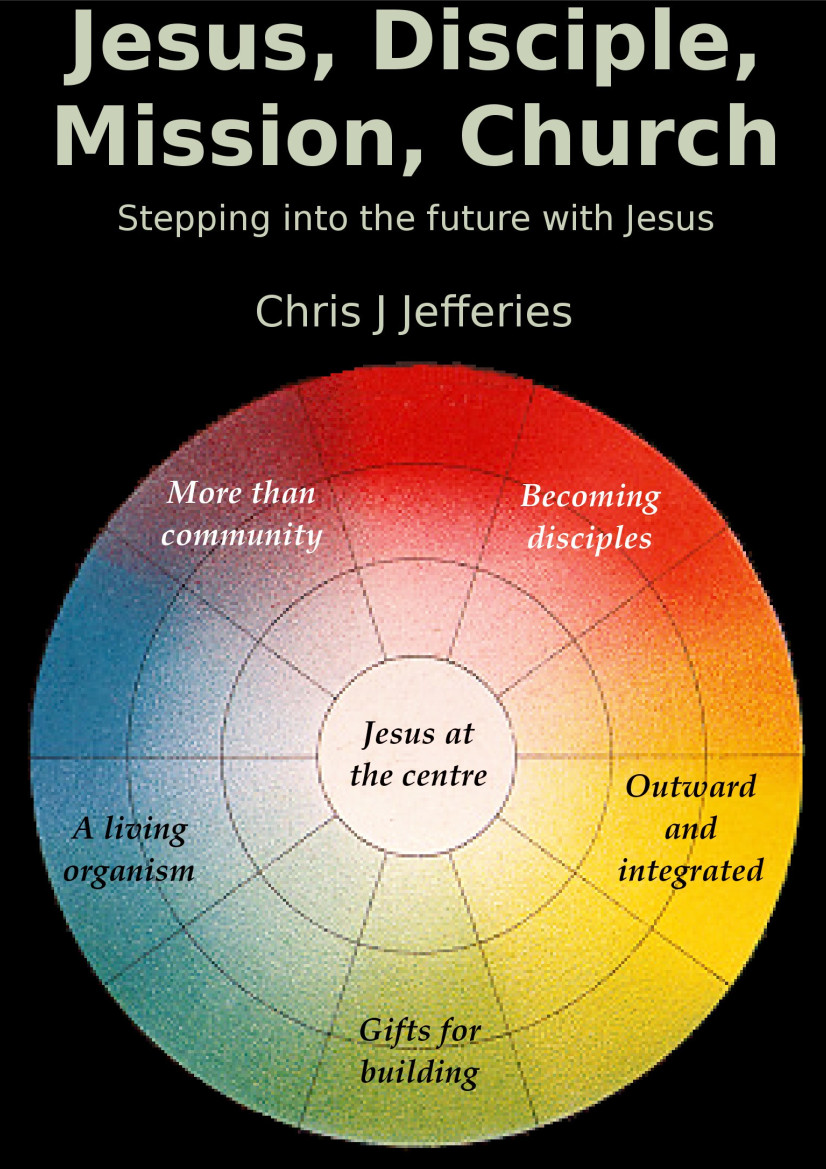
This article is an extract from my short book, Jesus, Disciple, Mission, Church (JDMC). The bite-sized piece below is roughly two percent of the book.
Deacons
JDMC cover
Sometimes, in the early years as communities of believers formed, individuals or small teams were given particular tasks, often when there was a specific need. The men and women who were given these tasks were called ‘deacons’ (Greek ‘diakonos’). The word at its root means ‘dust kickers’, people who would run errands. Over time it came to have a more general meaning in everyday Greek, servant’, ‘waiter’ or ‘administrator’. Deacons in the early church were about getting things done.
At their first mention (in Acts 6:1-6) they were responsible for giving out aid to Greek widows who had been previously overlooked, but the task could be anything else that needed regular and reliable attention. For more on deacons see 1 Timothy 3:8-13).
Think it through – Read some of the passages about deacons and consider the people who were chosen to do the work. Can you identify people doing some of these things in the church today? (They may or may not be called ‘deacons’.) Do deacons have command authority or knowledge and wisdom authority?
Pastors
Pastor is an old fashioned English word for ‘shepherd’. Read about the The shepherding gift in the section on The APEST gifts, JDMC page 42. Bear in mind that there are many people today called ‘pastor’ who are administrators, teachers and managers. This is not the same thing as the gift of shepherding.
Priests
Where does this title come from and what does it mean? In the Old Testament we read about priests and, in particular the ‘High Priest’ or ‘Chief Priest’ (2 Chronicles 19:11). The priests were members of a single family, descended from Aaron and his sons (Exodus 29:44). The men of this family were responsible for offering sacrifices on the altar, first in the Tabernacle and later in the Temple. An animal would be slaughtered and offered on behalf of the people when they had transgressed the law in some way. A sin offering was required for forgiveness (Leviticus 4:27-31). The priest acted as a go-between, taking the living animal and offering its life (the blood) in place of the sinner’s life, a substitutionary sacrifice.
Priests today are church leaders who offer the bread and wine on our behalf, a role that the New Testament clearly states is not required. All who believe in and follow Jesus are priests! (1 Peter 2:9) We offer Christ’s substitutionary sacrifice to all who will accept him. We are the go-betweens, and need no-one to bring us into the Presence of the Father, something Jesus has already done once and for all (John 14:9).
Consider – Were the priests helpful towards Jesus or a hindrance? (eg Matthew 16:21) How do you suppose the church made the mistake of thinking we still need this role today? Think about the role of Jesus as our Great High Priest and our role as a Royal Priesthood (Hebrews 4:14).
Bishops, elders, deacons, pastors and priests today
(Bishops and elders were considered in the previous post in this series.) Many denominations use these words in a different sense than the early church. Often they are used for organisational roles. But if we see church as a living organism rather than an organisation we will also need to understand these terms in living ways instead.
Consider – Do we need to identify certain people as bishops, elders and deacons? Paul identified them, think about how he saw them and why he regarded them as necessary and useful. Did he see them as functions of control or of service? How do we see them? And is there a role for pastors and priests?
This was extracted from Jesus, Disciple, Mission, Church (JDMC), pages 47 and 48. Download the whole thing or read it online – GetJDMC.scilla.org.uk
Useful? Interesting?
If you enjoyed this or found it useful, please like, comment, and share below. (If you don’t see those links, click the article’s title above the main photo and they will appear.) Send a link to friends who might enjoy the article or benefit from it – Thanks! My material is free to reuse (see conditions), but a coffee is always welcome and encourages me to write more often!
This index links to my posts on walking the Stroudwater and the Thames and Severn canals in Gloucestershire.
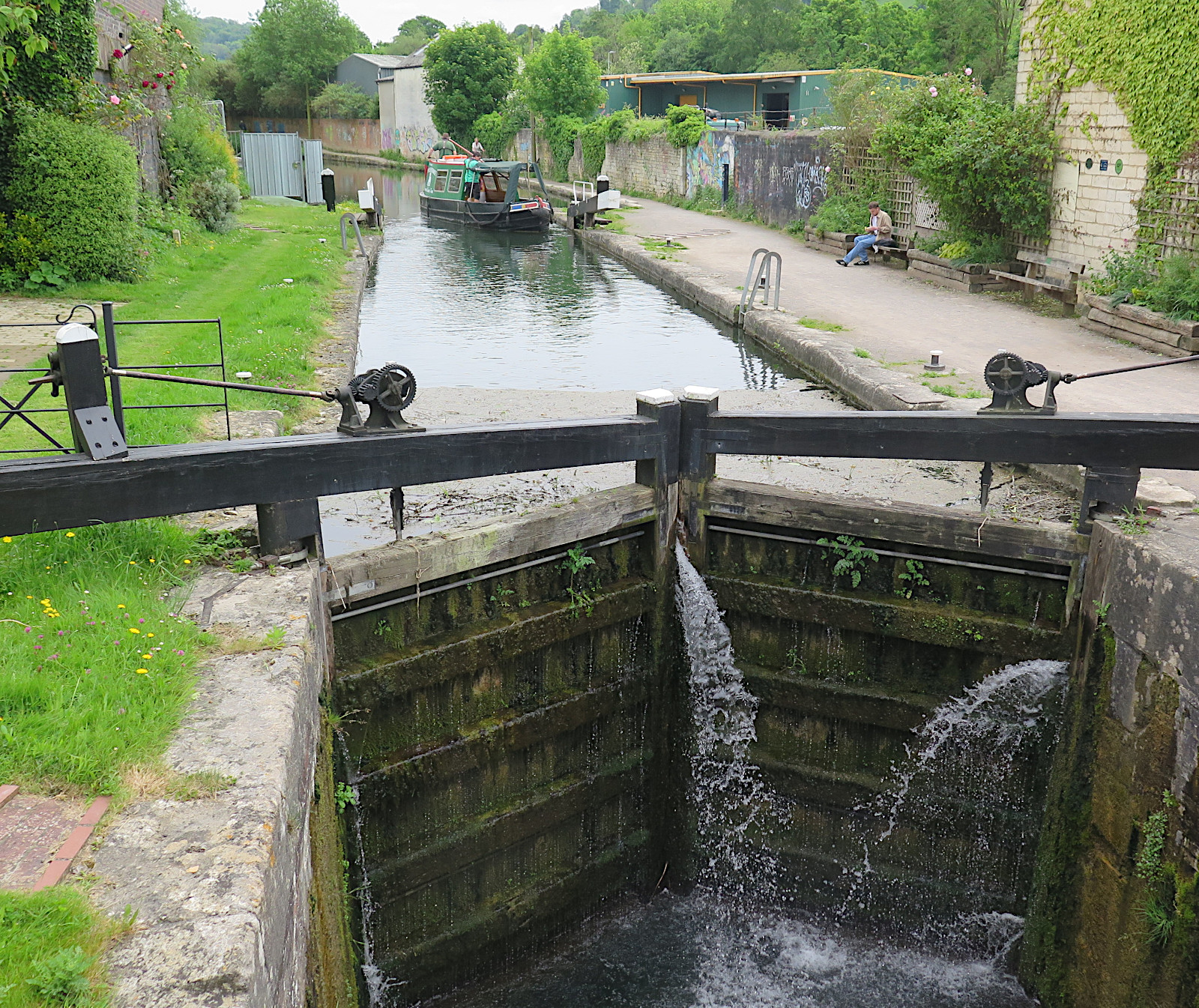
Wallbridge Lock, Stroud
The sections are short (up to three or four miles), but they can be concatenated to make whatever length might suit you best. And if you just want a short stroll, each article is divided into sub-sections; you can choose a part that you like and walk that smaller piece.
Chalford to Daneway is longer, but I plan to rewrite it as two parts.
Heading further south-east from Saul Junction there are several little pieces in good shape, and a lot of repair work ongoing. You can read all about that work right here in this second article.
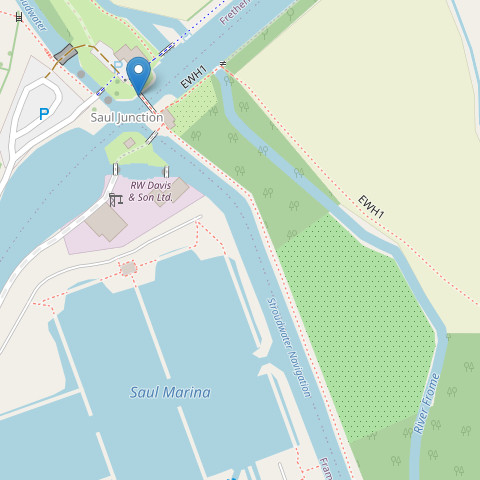
Saul Junction
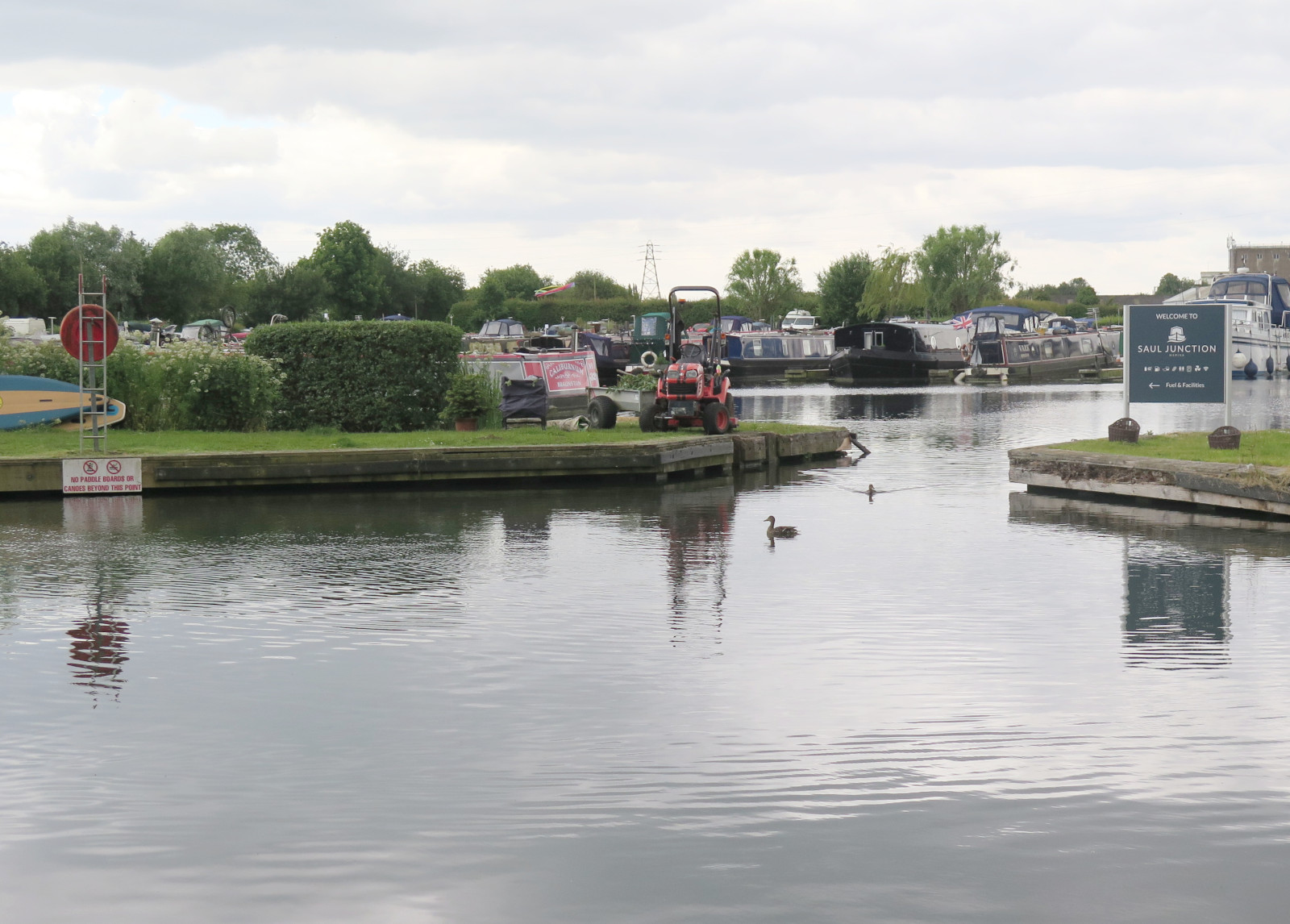
Saul Junction Marina
As mentioned in the previous article, the Stroudwater Navigation continues straight across the much larger Gloucester and Sharpness Canal. Looking south-east across the ship canal you can clearly see Stroudwater Navigation continuing, not only full of water, but still in use. We’ll cross the footbridge and follow it from that point. (Hint: Click the map icons for larger, draggable and scalable versions. Click the photos for full size, too.)
Walking south-east across the footbridge (see pointer on map) there is a right-hand bend and then an opening from the canal to a thriving marina.
The canal itself is very wide at this point and there are many moored boats alongside the towpath, The photo shows the widened Stroudwater Navigation in the foreground and the marina entrance. From here, the towpath continues to Walk Bridge.
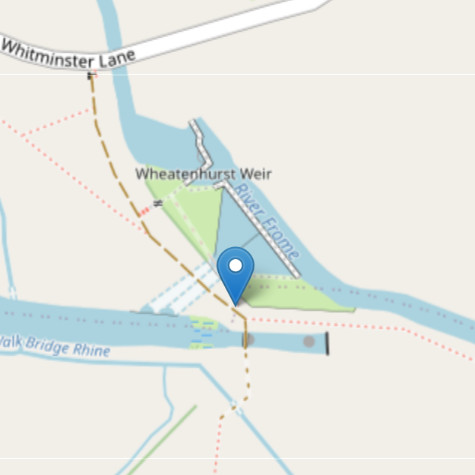
Originally built as a swing bridge, Walk Bridge was replaced by a concrete and brick constuction, so a new opening bridge must be constructed to replace it. Cross the road and it’s clear that the canal is still in water at this point, but there’s no towpath. Enter the field by the stile, turn left, and walk diagonally across the field to the far side leaving the canal behind and to your right.
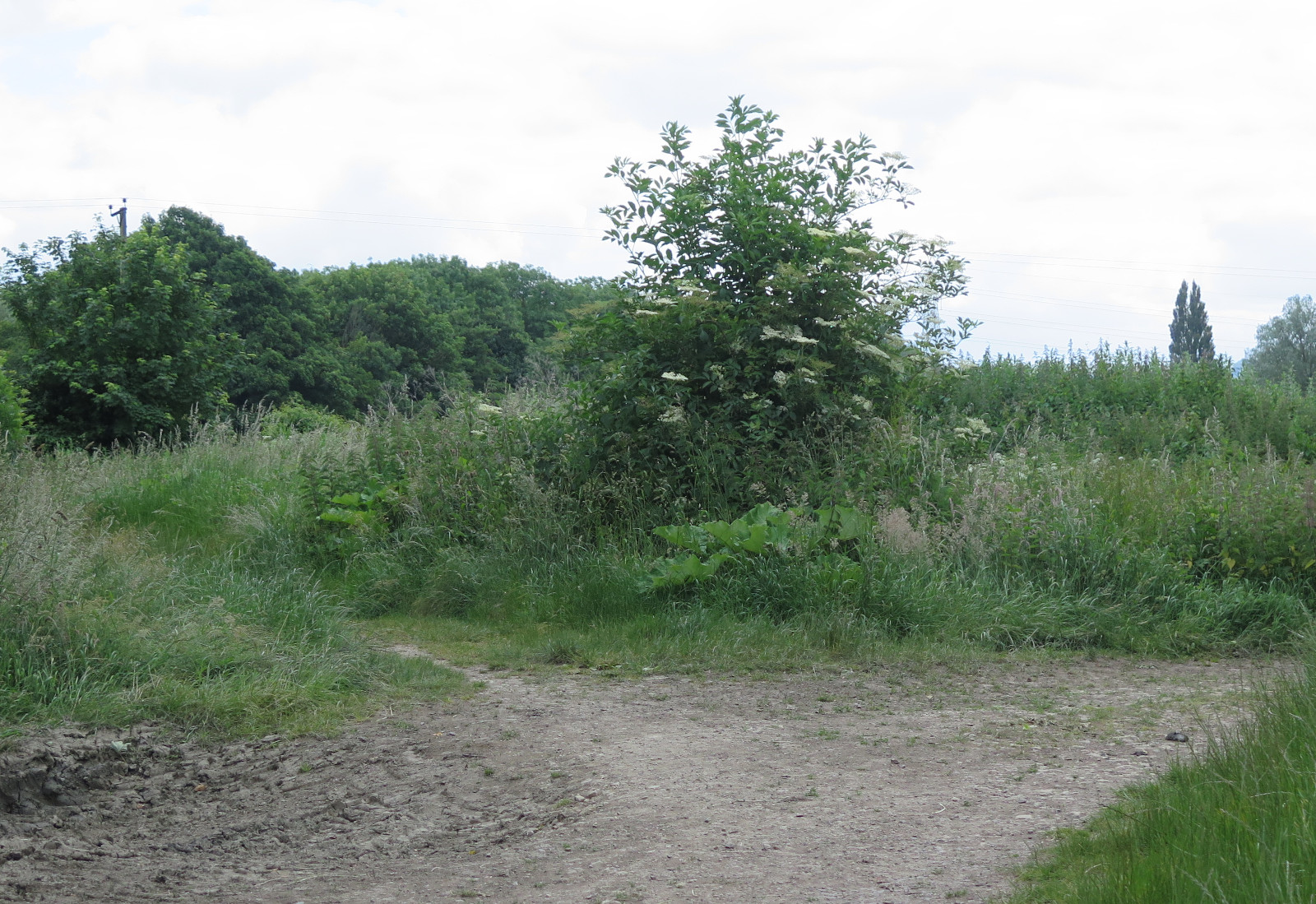
This brings us to Whitminster Bridge and Lock where there’s another glimpse of the canal’s remains. The photo below shows the point marked on the map. Turning a couple of metres right along the farm track will give you a view of the old canal lock. There was another swing bridge at this point.
Easy to go wrong here!
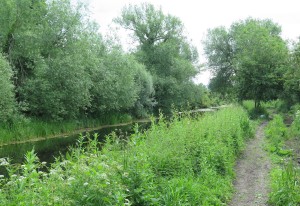
The small footpath to the left in the photo is part of the towpath and this is the route to take next. As you follow this path you’ll see the River Frome on your left. The canal has been filled in and would have been on the right.
The path and the river both bend to the right and then the path enters a strip of woodland along the river bank.
Through the wood
The path is poor, with large potholes filled with mud after prolonged rain. Care is needed and there are many roots that form real trip hazards, but the woodland doesn’t continue for very long (250 m or so) so slow and careful won’t reduce progress very much overall.
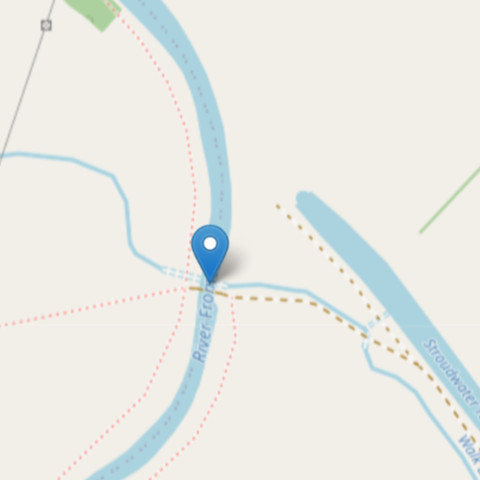
Once again, the river and footpath bend to the right, look for a concrete farm bridge (photo) across the river and take it, you’ll soon have the canal on your right. There was an aqueduct close to this point where the canal crossed over the river, but it no longer exists and the canal has been filled in for a short distance.
The map marker points to the bridge mentioned above; if you expand the map you can see the end of the woodland at top left and the canal section in water as well as the filled in part.
That looks more like a canal now!
The next major feature is a crossroads of tracks and footpaths, there’s a post here with a blue Cotswold Canals sign which you should follow. The canal is in water again at this point, stand on the track where it crosses the canal and you can see it for a long way in both directions. you’ll also have a clear view of the canal as you continue along the towpath (photo). At the time of writing dredging work is underway on some days. If you’re unlucky parts of the towpath will be closed and you’ll be redirected. But most likely it will be open (and is always open at weekends and on summer evenings).
On to the bridge and pillbox
The final section of this walk is quite straightforward – just keep following the towpath. There are some interesting things along the way though, and an unexpected treat at the end as well. On your way you may see evidence of the dredging work still active along this section.
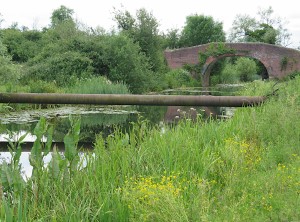
When you come to a stile, cross it into the next field and continue on the towpath. A little further and you’ll notice a large pipe acros the canal and just beyond it a brick-built bridge, this is ‘Occupation Bridge’. The pipeline was constructed during World War II, part of a network to carry aviation fuel for the RAF. It is still in use and will need to be diverted beneath the canal.
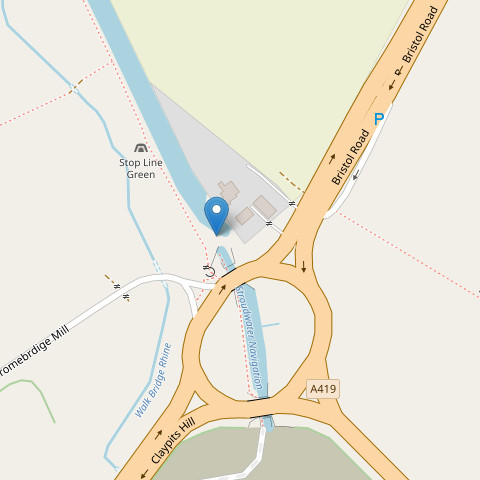
Beyond the bridge you’ll find a pillbox (also WW II) near the right bank of the waterway, and shortly afterwards you’ll arrive at the destination for this article, the A38 roundabout. Here comes the unexpected treat I mentioned earlier. Make your way through the galvanised steel gate and turn left, a short downhill scramble. Here you can pick up the towpath again and explore a newly built section of canal crossing the centre of the roundabout. So astonishing to see a newly built canal in the middle of a major intersection!
The canal here was built by National Highways who also constructed the roundabout. When you reach the far side you’ll see that the canal currently ends at this point. The ‘Missing Mile’ begins here and we’ll explore it in the next article, ‘Canal Walk 3’.
If you enjoyed this or found it useful, please like, comment, and share below. (If you don’t see those links, click the article’s title above the main photo and they will appear.) Send a link to friends who might enjoy the article or benefit from it – Thanks! My material is free to reuse (see conditions), but a coffee is always welcome and encourages me to write more often!
The field was a lovely thing to have, we and all our neighbours shared it and it became a place to relax, a sort of unofficial reserve at the end of the garden.
Notes from bygone years – Sing along to some crazy Junes Hint: Click on the thumbnails for larger images.
June 2023 (1 year before publishing this article)
Dunrobin Castle and gardens
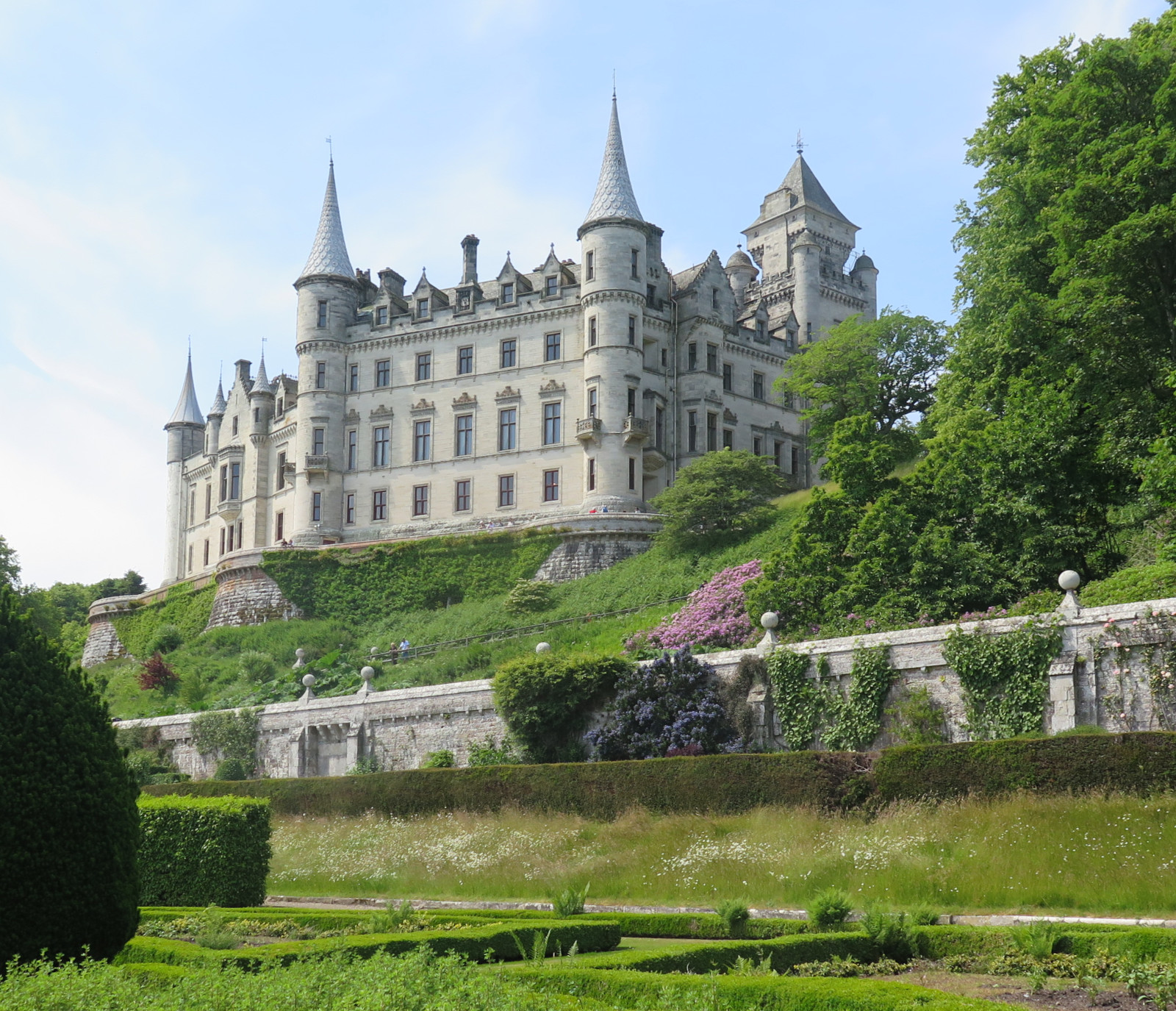
Donna and I had a Scottish holiday; we flew to Inverness Airport and took a hire car anticlockwise around the North Coast 500. It was an amazing journey! The photo is of Dunrobin Castle in Sutherland early on the road trip. We saw many interesting features in the towns and villages, the countryside, geology, and coastline. Definitely a holiday to remember.
We walked a section of the Cotswold Way with Donna’s brother Paul and his wife Vanessa.
This view is from a point near the old ‘Air Balloon‘ pub, now demolished to make way for road improvements. The view is north-west towards Gloucester; Crickley Hill is on the right and peeping up beyond it is Churchdown Hill. Coopers Hill rises from the horizon on the left of the image. Hazy in the far distance are the Malverns and Wales beyond.
World events: There was a G7 summit in Germany to discuss events in Ukraine; and a NATO summit was held in Madrid.
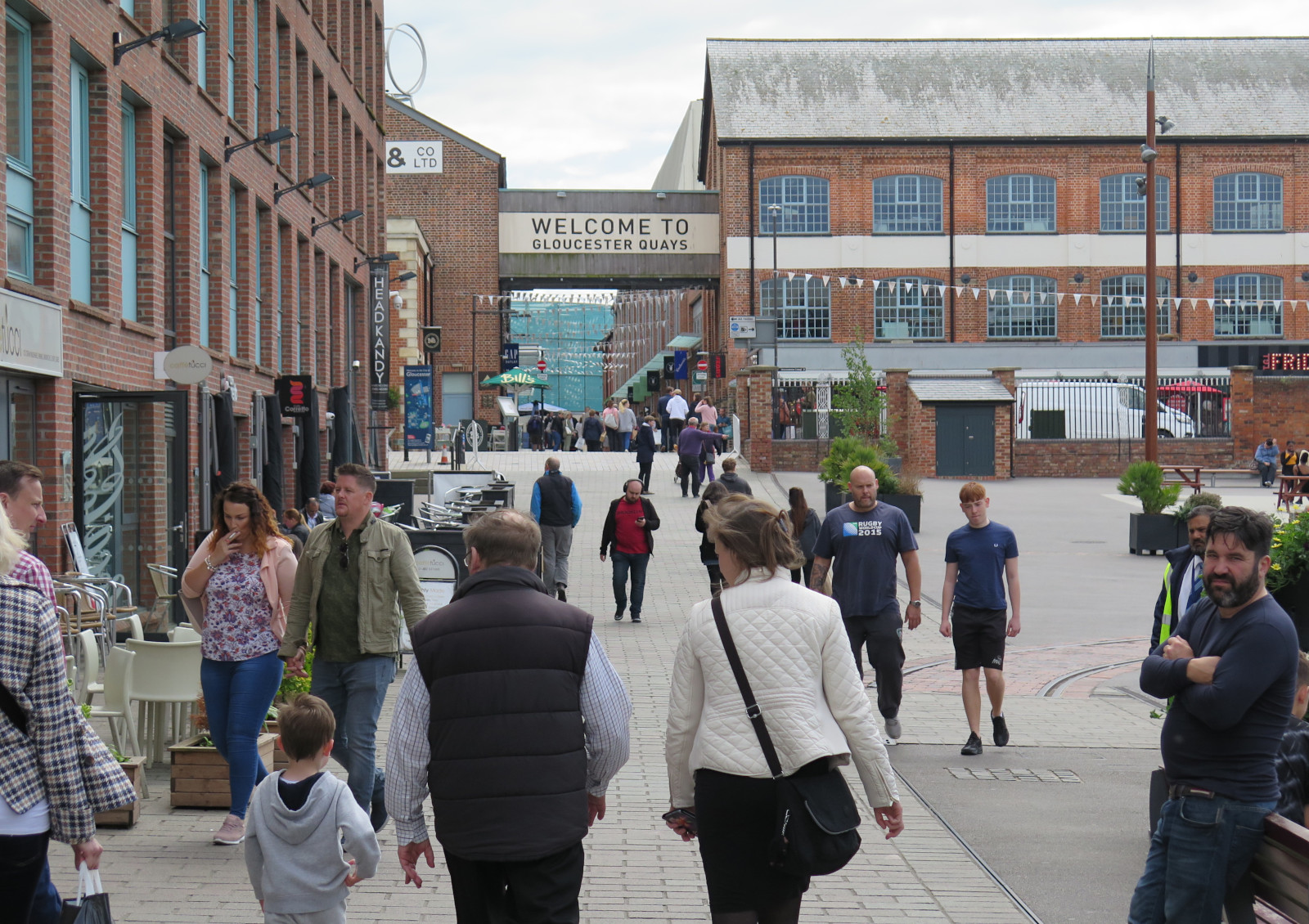
Vanessa was running in an event from Sharpness to Gloucester along the old ship canal. Paul, Donna and I made the same trip by car, stopping to watch her pass at several points along the way. After completing her run she joined us in the old docks area, now being redeveloped and including the Gloucester Quays shopping centre.
It was Aidan’s eighth birthday in June and he had an animal themed birthday with everyone able to hold and interact with many different creatures. The photo shows Meredith getting all wound up about a snake! Ten years ago all our grandchildren enjoyed themed birthday parties; and my word, didn’t we have some amazing themes!
We met our newest grandchild for the first time (that’s the one on the right in the photo). Verity was only a few days old, and it was lovely to see her already holding a philosophical conversation with her Dad. But seriously – new life is such a precious and wonderful gift.
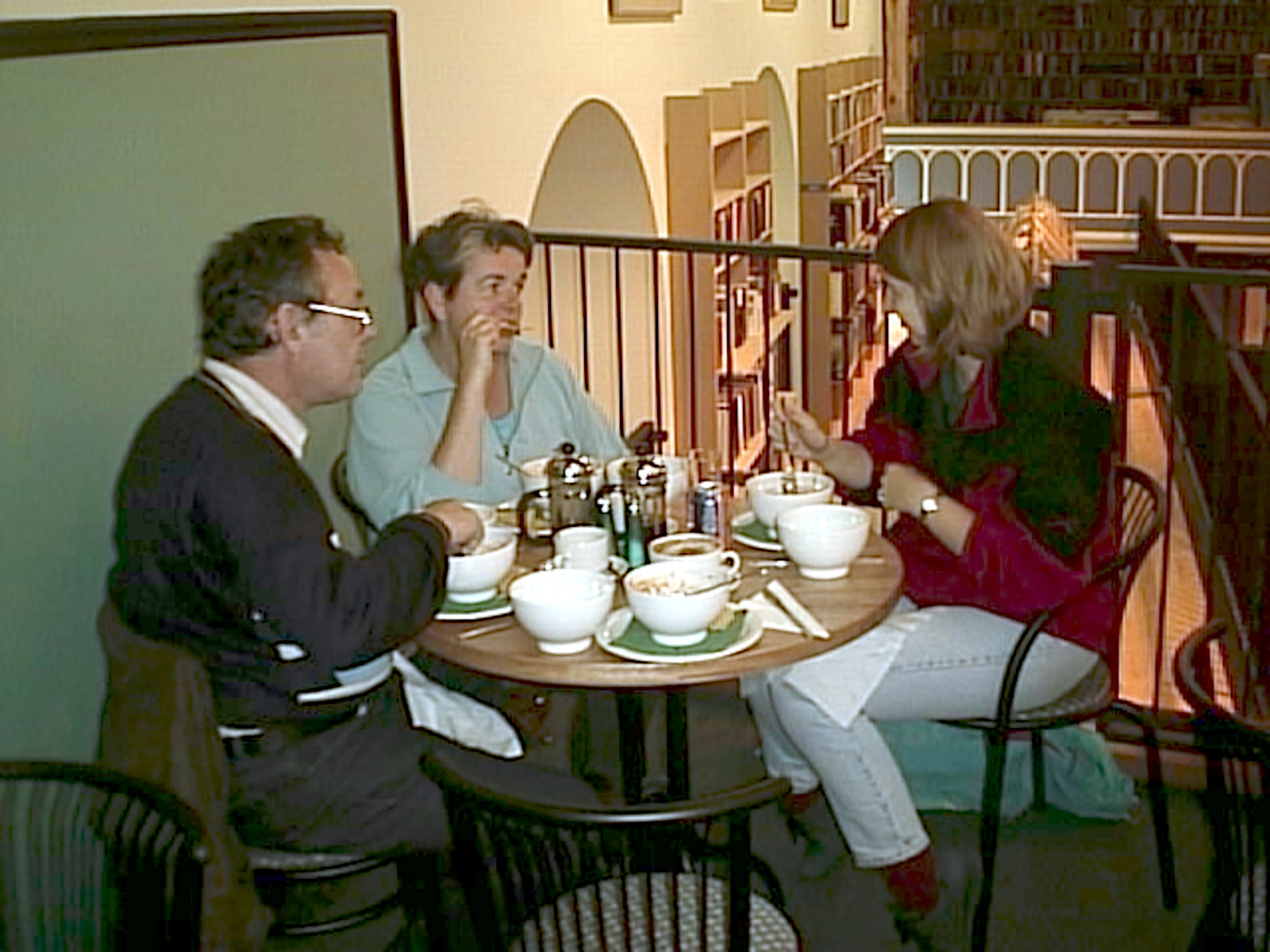
I bought my first electronic camera with 640 x 480 resolution, ie 0.3 megapixels! We had a week’s holiday in Scotland with our friends Rob and Jean, staying in a log cabin between Fort William and Loch Ness. The photo (taken on my new camera) shows Rob, Jean and Donna in Leakey’s, an Inverness second-hand bookshop.
Beth had bought a small kite when we went to the Bristol Kite Festival in Ashton Park, and here she’s flying it on a windy day in the field at the bottom of our garden in Stowey Road, Yatton. The field was a lovely thing to have, we and all our neighbours shared it and it became a place to relax, a sort of unofficial reserve at the end of the garden.
World events: The film, ‘The Lion King‘ was released by Disney; the last Russian troops left Germany; and MS-DOS was no longer supported by Microsoft.
Dad sold us his old car, a Volkswagon, and we drove to Cirencester in Jumbo to collect it. Here, Judy is about to travel home in Jumbo, and I followed shortly afterwards in the VW with Debbie and Beth. A little later we sold our old Marina for not very much; it had served us well, but was now near the end of its life.
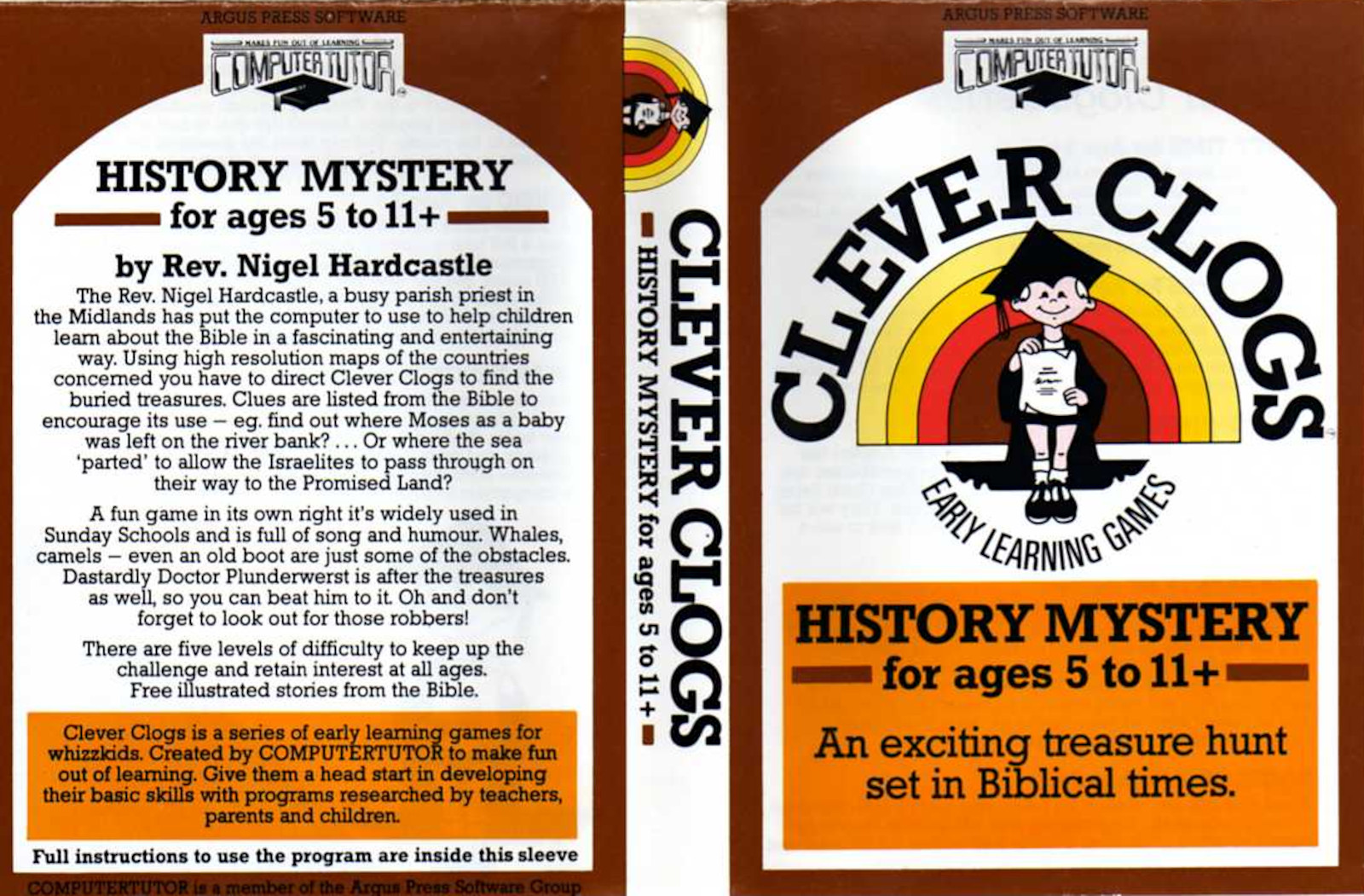
It was about this time that we waved goodbye to Computer Tutor and the Clever Clogs range of software. I wrote some simple educational games for the Sinclair Spectrum, just for my daughters to use; and brother-in-law, Peter, developed the concept as a viable business and extended the range considerably. By this time Peter had sold the business to Argus Press Software, and none of us remained involved.
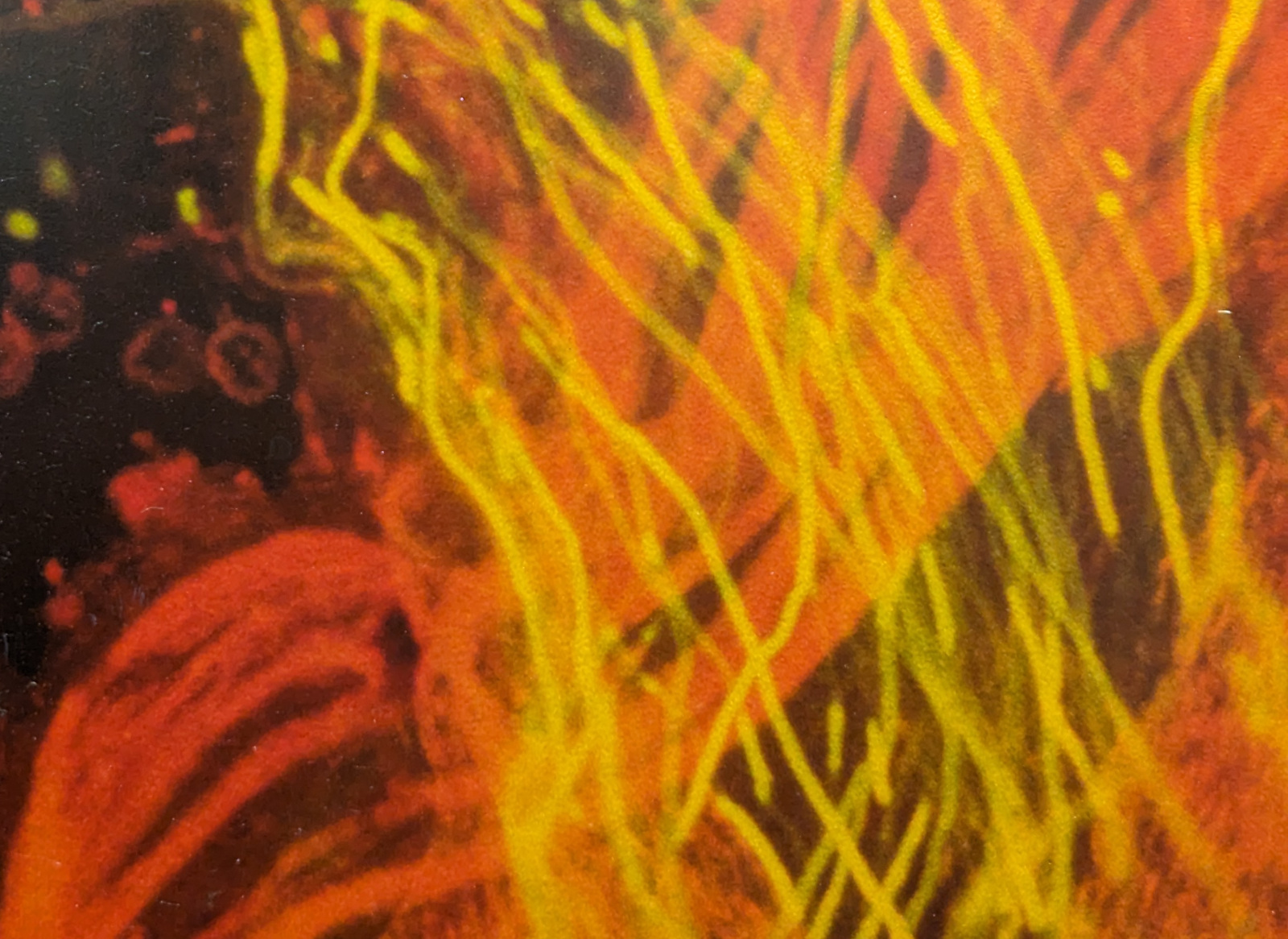
I was working on fruit pollination full time by now, having transferred to the Pomology and Plant Breeding Section at Long Ashton Research Station. I had a particular interest in temperature effects on pollen tube growth. By June I would be starting to study the samples I’d collected earlier in the season. The squiggly, yellow lines in the picture are pollen tubes.
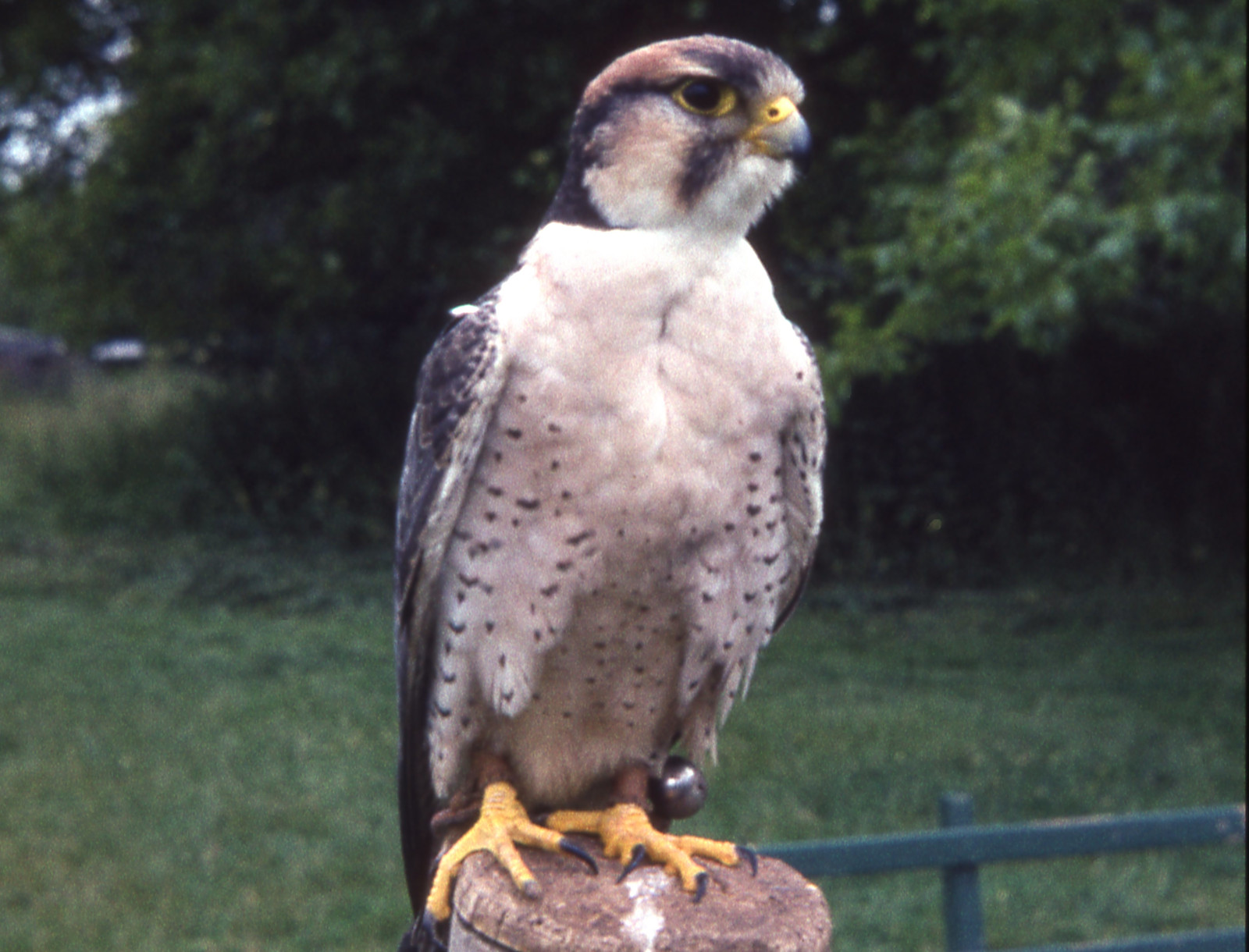
Judy’s parents and her brother, Frank, had a chance to visit the Falconry Centre at Newent in Gloucestershire. She took my camera with her and grabbed this lovely portrait during the trip. I needed to be at work that day so couldn’t join them. Work? Day out? No brainer, really, but it just wasn’t going to happen, sadly.
World events: A bomb exploded in Westminster Hall; and Isabel Perón was sworn in as the first female President of Argentina.
I was working on the final sandwich section of my Bath University Horticulture course. I’d been assigned to Long Ashton Research Station (LARS) near Bristol and worked for Eddie Catlow and Martin on the experimental farm team. This placement had the advantage that Judy and I were be able to meet up at weekends.
World events: There was a serious collision between an Australian aircraft carrier and a US destroyer; and Judy Garland died in her London home.
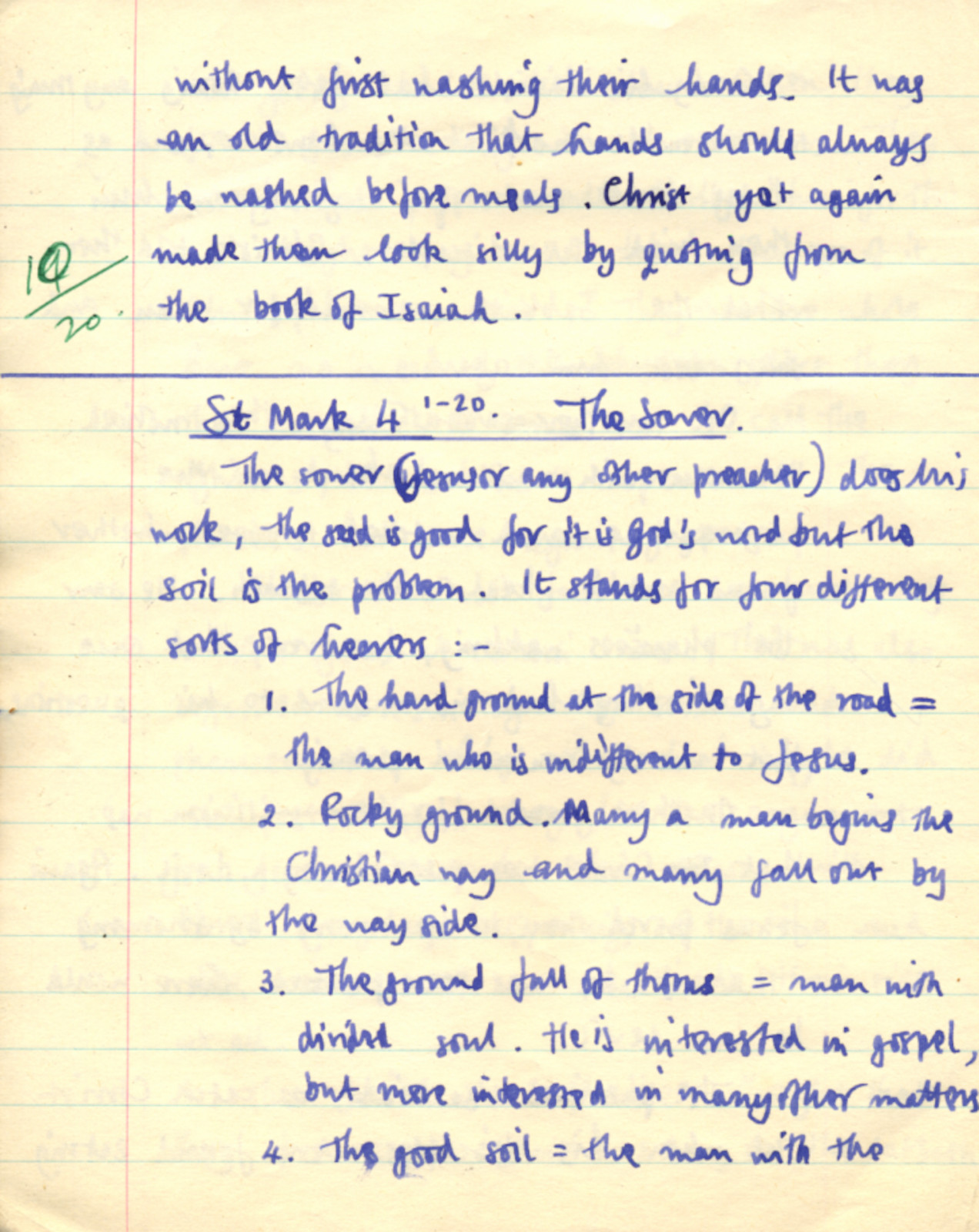
I was taking my O-level exams at Cirencester Grammar School. The photo shows a page from one of my exercise books (not related to an exam). ‘The happiest days of your life’, people told me. But I found exams a real trial, suffering with intense hay fever made far worse by everyone wanting the windows wide open because of hot weather.
World events: Greece rejected direct talks with Turkey over Cyprus; and Nelson Mandela was sentenced to life imprisonment in South Africa.
This month brought Rachael’s 2nd birthday, Ruth’s 3rd, Dad’s 33rd and Grandpa’s 80th, I was still 10 in June, nearly 11. We were living at Queen Anne’s Road in Cirencester, the photo shows me, Rachael, Cindy and Ruth playing in and around the blow up paddling pool in the back garden. Summers seemed to go on forever in those days!
In June I was enjoying the start of the long summer school holiday. I was still five-years-old (nearly six) so this was my first school summer holiday. I probably felt very grown up to think that when I went back in September I would be in the second year. Meanwhile I had time to play inside or out in the garden.
Dad had his 23rd birthday in June, but of course I was not yet storing long term memories so I don’t remember it. But at nearly eleven months I’m sure I joined in the fun and certainly would have appreciated cake if there was one! It’s likely I was able to stand if I had something to hold on to, and I might have been able to say a few words, but any notes Mum and Dad might have made have been lost.
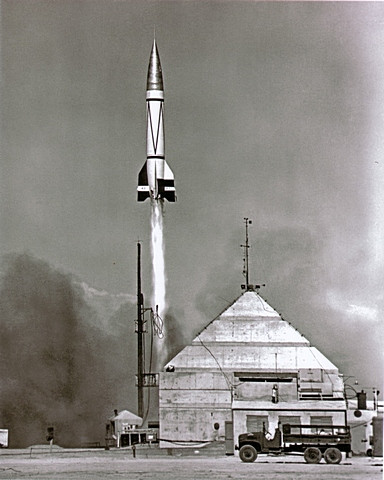
World events: A rhesus monkey, Albert II, was the first primate in space but died on return due to parachute failure; and the first TV Western, Hopalong Cassidy, aired in the USA.
Dad noted in his diary on his birthday (4th June) that the city of Rome had been taken. And on the 6th he wrote:
‘D. Day!! At last the second front has started. Was transferred to C. shed. Was on guard at 2 Site all night and spent pleasant evening in guard room. Listened to Montgomery and King on radio. Wrote to Phillip and Ronald. Letter from Nor.’
(Nor was his mother, and later my Granny).
At the end of the month he heard unofficially that he was to be posted to Yatesbury (a centre dedicated to radar training).
If you enjoyed this or found it useful, please like, comment, and share below. (If you don’t see those links, click the article’s title above the main photo and they will appear.) Send a link to friends who might enjoy the article or benefit from it – Thanks! My material is free to reuse (see conditions), but a coffee is always welcome and encourages me to write more often!











 Journeys of Heart and Mind


