We are to learn about love, fruitfulness, brokenness, restoration, and our place in this Universe, responsibility, culpability, truth, life and wisdom. We are to understand these things in our own lives, in one another, and also in and through Yahweh.
I recently listened to a podcast byTwo pastors in a pub (episode 55). I enjoyed the episode which was about the questions asked and statements sometimes made, to the effect that the presence of dinosaur remains in the fossil record demonstrates the Bible to be incorrect. All sorts of these points are examined and discussed during the podcast. But I think there’s a much more fundamental argument to be made – and it has nothing to do with dinosaurs.
The underlying questions, I believe, are:
‘What is the Bible for?’ That is, ‘What is it’s purpose?’
‘Why was it written?’
‘How was it written?’ and
‘How should I read it?’
What’s in a name?
The background to my answers to those questions is to say that I believe there’s a power of some kind invisible to us, external to the Universe yet responsible for its existence and its nature. We’ll come back to the questions soon, but first let’s go a bit further with the background.
Note first that there is no way I can prove this belief of mine to be true or false. It’s a matter of faith, not of proof and not of evidence. It’s simply something I believe to be true. The set of provable statements is limited to those within and about the Universe; this set does not, cannot, apply to anything exterior to the Universe.
I give this creating and sustaining Authority in which I believe, a name. I like to use the name ‘I am what I am’. It’s the name offered for use by Moses when he asked, ‘Who shall I say has sent me?’ In Hebrew, this enigmatic name is יהוה ie YHWH, the vowels being left out. It’s transliterated into English variously as ‘Yahweh’ or ‘Yahveh’, ‘Yahoveh’ or in the past frequently ‘Jehovah’.
You can read more about Moses and the name in Exodus 3.
Taking the trouble to use something akin to the name given to Moses makes it easier to think this through. A name implies a person; so let’s imagine this creating and sustaining authority as a person called Yahweh.
Back to the questions
What is the Bible for? What is its purpose?
First remember that this person called Yahweh is not here with us inside this Universe we inhabit. Yahweh is outside it, if I make something I cannot also be a part of the thing I made. Suppose I write a story and there are characters in my story, as the author I might want to communicate with the characters. I think that’s the simplest way to answer the question, ‘What’s the Bible for’. I suggest that it’s Yahweh’s way of communicating with us. By influencing people like Moses, but also many others down the long ages of history, Yahweh has encouraged them to write down accounts that explain so many things that we need to know. That is the purpose and function of the Bible. It’s a collection of writings from many times and places written by many different contributors, but all inspired by Yahweh’s character and nature. That inspiring process is so fundamental that we might even regard Yahweh as the author, working behind the scenes.
Why was it written?
If the Bible had not been written, we would know little or nothing about the author. The fact that Yahweh wants you and me and others to know is reason enough. We are to to learn about character, purpose and relationship in particular. We are to learn about love, fruitfulness, brokenness, restoration, and about our place in this Universe, responsibility, culpability, truth, life and wisdom. We are to understand these things in our own lives, in one another, and also in and through Yahweh.
There’s plenty of geography, poetry, history, story, wisdom and more in the Bible, yet it’s not a geography text, or a poetry text , or a history text. Instead, the Bible employs all these forms to put across the core message. When Jesus told the story of the good Samaritan, or the woman who lost a coin, they were not necessarily historical events or real people, the story was to clarify something deeper and far more important than mere, everyday fact. And everything in the Bible, including the Genesis creation account, is there for that kind of purpose. None of the accounts in the Bible is required to be true palaeontologically, that’s not their function. They are there to explain relationship, responsibility and a deeper kind of truth.
How was it written?
Little by little is one answer. The books of the Bible were written at different times, by the efforts of many diverse authors, and based both on the author’s knowledge of the ways and history of the times in which they lived, and on direct inspiration by Yahweh.
How should I read it?
As it was (and is) intended! Don’t go searching for scientific evidence, geographical facts, or historical analysis with supporting documentation. Expect to have flashes of understanding from time to time, particularly about the nature, purposes and character of Yahweh. Most importantly, try to understand Yahweh’s perspective in dealing with characters in stories both imagined and historical. And especially try to grasp and crystallise what you are being shown about yourself, particularly in terms of your relationships and attitudes to others and to Yahweh as well.
Dinosaurs
Given all of that, you should now be in a good place to see that dinosaurs in the fossil record contradict nothing in the Bible. There is good, geological and palaeontological evidence for creatures living on the land and in the oceans of Earth way back in the past. There’s good evidence too to show that they were reptiles and that some of them were very large. There’s further good evidence to reveal that they did not, after all, die out completely. One branch of the dinosaur line survived and gave rise to all the birds that still live in the world today.
But none of this in any way contradicts my personal faith in a power external to the Universe.
And finally
There’s just one more point to make. What I’ve written here is only the merest beginning. You’ll find more right here in Journeys of heart and mind. I suggest using the search box near the top of the right-hand column (you’ll have to scroll up to find it). Try searching for Yahweh or for Jesus. Alternatively begin with this post:
So, is Jesus the same person as Yahweh? I can only give you a weird answer – Yes, he is, and no he’s not! There’s a great deal more to be said about this, and I plan to write more soon. When I do, I’ll leave a link right here.
If you enjoyed this or found it useful, please like, comment, and share below. (If you don’t see those links, click the article’s title above the main photo and they will appear.) Send a link to friends who might enjoy the article or benefit from it – Thanks! My material is free to reuse (see conditions), but a coffee is always welcome and encourages me to write more often!
The dog in the photo was Chloe, a wire-haired fox terrier. Although it’s a fine day, the waves look fairly energetic suggesting strong winds across the Irish Sea.
What’s in an image? Sometimes quite a lot, more than meets the eye. I’m posting an image every few days.
Click to enlarge
This is a photo of my younger sister, Ruth. Bear in mind that I’ll be 77 this summer, and you can deduce right away that the photo is quite old! I took it on a beach in mid-Wales, I believe in 1963 so it’s worn well. Ruth was building a lovely sand castle; Mum and Dad were on the beach nearby, as were my other two sisters, the weather was sunny and warm, and all was well with the world. It usually is when you’re on holiday!
But what else can we learn from this image?
Well, you might notice it’s a bit blurry, that’s because it was taken with a cheap Kodak Starmite camera with no focus control and a cheap lens. But what you can’t see is that the original was poorly framed and had a sloping horizon so I had to crop it for a better composition. The original is a Kodachrome transparency on 127 roll film. It’s dusty and I had use GIMP to clean it up.
But there are other things we can see. The bucket is red plastic, but the spade has a wooden handle and a painted steel blade. That alone would give an approximate date, given that plastic buckets were a recent innovation while wood and steel spades would have been similarly replaced with plastic only a little later. The flags were paper with wooden sticks.
Just think of this from a waste point of view. Only the bucket in this image would have produced waste that could not recycle itself. The spade, the flags, the clothes Ruth is wearing, even her footwear, when discarded would gradually rust or be digested by soil bacteria. Most of it would be gone within a few decades, though the rubber soles might take a tad longer. But the plastic bucket will still exist in some form unless it was incinerated. Most likely it’s still in landfill somewhere near Cirencester as that’s where we lived at the time.
The dog in the photo was Chloe, a wire-haired fox terrier. Although it’s a fine day, the waves look fairly energetic suggesting strong winds across the Irish Sea.
I have other early photos, mostly on black and white emulsions of the Ilford FP series, but a few others in colour.
If you enjoyed this or found it useful, please like, comment, and share below. (If you don’t see those links, click the article’s title above the main photo and they will appear.) Send a link to friends who might enjoy the article or benefit from it – Thanks! My material is free to reuse (see conditions), but a coffee is always welcome and encourages me to write more often!
During a summer night, molecules of water in the air condense as droplets of water on leaves, we call it dew. But on a cold winter’s night the water condenses as ice and we call it frost.
What’s in an image? Sometimes quite a lot, more than meets the eye. I’m posting an image every few days.
Click to enlarge
It’s a pretty picture, isn’t it? Red berries in wintertime, covered with glistening ice crystals. I used this photo once for a Christmas card. The ice is very decorative, and it’s easy to understand why we talk about icing on a cake (frosting in the USA).
The ice crystals form as the air cools at night. Air can hold significant amounts of water in gaseous form, but the precise amount depends on the temperature of the air; warm air can hold much more water than cold air. That’s why water condenses on cold surfaces. Take something out of the fridge and leave it in a warm room, and five minutes later it will be covered in droplets of water. That water was in the air but you couldn’t see it or feel it because water vapour is a gas.
During a summer night, molecules of water in the air condense as droplets of water on leaves, we call it dew. But on a cold winter’s night the water condenses as ice and we call it frost. Hoar frost, or rime, forms slowly over a number of hours and the kind of ice crystals that form is dependent on humidity, pressure and rate of temperature change. It can be quite subtle (view ‘The snowflake designer’ below for the details).
If you enjoyed this or found it useful, please like, comment, and share below. (If you don’t see those links, click the article’s title above the main photo and they will appear.) Send a link to friends who might enjoy the article or benefit from it – Thanks! My material is free to reuse (see conditions), but a coffee is always welcome and encourages me to write more often!
There was a pre-decimal British coin carrying a picture of a wren on the reverse, still in use when I was a small child. There were four farthings in a penny … or 960 of them in a British pound sterling.
So, what bird might that be? Why, the Jenny Wren of course. If you live in Britain you’ll probably be familiar with this old term.
My son-in-law, Paz, sent me a link to a wonderful video of a Eurasian wren singing. Because the video has been slowed down, the sound is lower-pitched but also stretched out in time. As a result you can hear far more of the detail in this small bird’s singing performance. It’s truly amazing! But don’t take my word for it, watch and listen for yourself…
Paz is always amusing with his choice of titles; this time his email to me was entitled ‘Trogloclanger’. This is a portmanteau from Troglodytes (the Latin genus and species name of this wren), and The Clangers – fictitious inhabitants of space who made a whistling noise and figured in children’s stories. (You probably don’t want to watch an episode of The Clangers – but just in case, here’s one.)
It’s worth mentioning the Wikipedia article on the Eurasian wren because it provides a lot of detail about this little bird, and was also the source of the photo. Learn more about the ornithology and etymology from Wikipedia. There’s a separate article about the family Troglodytidae in general. Almost all species of wren live in the Americas, or islands in the region.
There was a pre-decimal British coin carrying a picture of a wren on the reverse, still in use when I was a small child. There were four farthings in a penny (‘four’ and the ‘far’ in farthing are cognate) or 960 of them in a British pound sterling. So you’d need just over 9½ farthings to make a decimal penny – that’s inflation for you!
At the time many people supposed that the smallest British bird was chosen for the reverse of the smallest British coin. But that is not the case as the goldcrest is our smallest bird.
If you enjoyed this or found it useful, please like, comment, and share below. (If you don’t see those links, click the article’s title above the main photo and they will appear.) Send a link to friends who might enjoy the article or benefit from it – Thanks! My material is free to reuse (see conditions), but a coffee is always welcome and encourages me to write more often!
If the discovery bears up under closer scrutiny (and I think that’s quite likely), it will go down as one of those great discoveries in the history of astronomy and science generally.
There have been rumours of life found on other planets circling other stars, sometimes presented on YouTube or elsewhere as amazing or even terrifying discoveries. But they were just sensationalist rumours. But now, for the first time, here’s something a bit more credible.
Watch the video below from Cambridge University, this is a brief presentation by Professor Nikku Madhusudhan on the probable discovery of a biomarker molecule DMS in a planetary system. Further work at Cambridge and elsewhere will throw more light on this soon, And yes, the pun was intended in this case!
It’s definitely exciting news, but I must emphasise that further checking and more data is essential. But if the discovery bears up under closer scrutiny (and I think that’s quite likely), it will go down as one of those great discoveries in the history of astronomy and science generally.
If you enjoyed this or found it useful, please like, comment, and share below. (If you don’t see those links, click the article’s title above the main photo and they will appear.) Send a link to friends who might enjoy the article or benefit from it – Thanks! My material is free to reuse (see conditions), but a coffee is always welcome and encourages me to write more often!
What’s in an image? Sometimes quite a lot, more than meets the eye. I’m posting an image every few days.
Click to enlarge
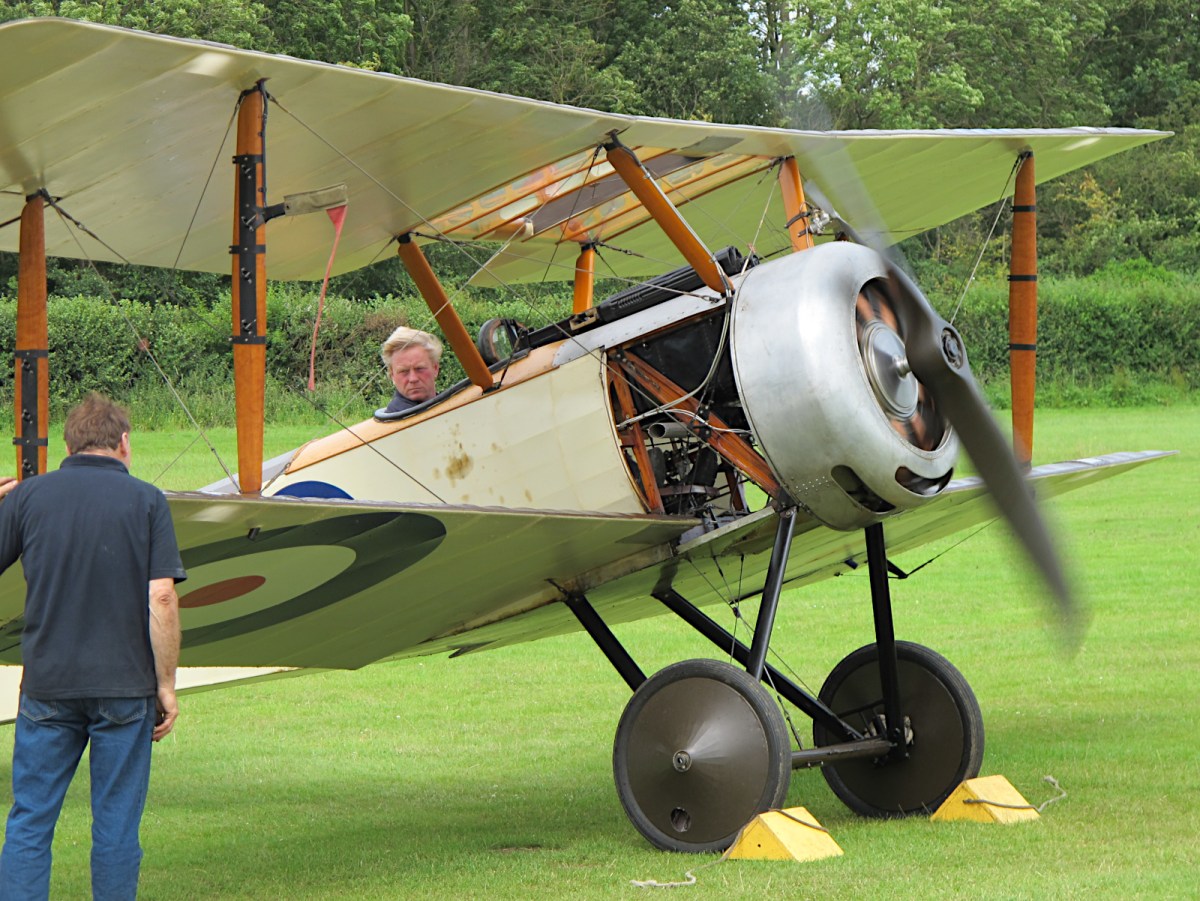
This lovely old aeroplane is a Sopwith Pup, as used by the Royal Flying Corp during the First World War. Sopwith was a major British aircraft manufacturer of the day. This aircraft is still flying from time to time in England where it’s based at Old Warden Airfield, itself a survivor of the First World War. This particular aircraft was built after the war and modified back to the fighter configuration.
In the photo the engine is being tested after maintenance, so a couple of side panels have been removed for inspection. The propeller was spinning, you can see the motion blur in the image.
Here’s the same aircraft in action.
Design and construction
Based on a smaller, earlier aircraft, Sopwith designed the larger Pup as a fighter in 1915 with the first prototype appearing in 1916. Both the navy and the army (the Royal Flying Corp was part of the army) ordered numbers of the planes and they served well until superseded and transferred for training purposes as newer, more effective fighting planes rapidly evolved.
This aircraft was much lighter than its German counterparts. It could take off and land on grass surfaces, in quite short distances. The Pup was very manoeuvrable, had a tight turning circle, and a high service ceiling for those times.
The Pups were replaced with Sopwith Camels during 1917.
Old Warden Aerodrome
Old Warden was a First World War air station, as already mentioned. It lies just north of Shefford and south-east of Bedford. Today it’s the home of the Shuttleworth collection of old aircraft and motor vehicles, a very fine and famous collection with a long history, originally as a private collection, but now open to the public. The old aircraft are frequently rolled out, and often one or more are performing in the air.
Everything that’s not active on a particular day is stored in a series of First World War hangers and those are all open to visit as a museum with informative explanatory material on display as well. There is active maintenance and restoration going on, and some of that may be on display too.
If you’re interested in this sort of thing, and are in the area, I highly recommend popping over for a visit.
If you enjoyed this or found it useful, please like, comment, and share below. (If you don’t see those links, click the article’s title above the main photo and they will appear.) Send a link to friends who might enjoy the article or benefit from it – Thanks! My material is free to reuse (see conditions), but a coffee is always welcome and encourages me to write more often!
Judy’s Biochemistry year at Aberystwyth made the long coach trip to Cambridge where they stayed in Churchill College and visited biochemistry labs at the university. (1970)
Jan 2025 (3 months before publishing this article)
Click to enlarge
On 2nd January we visited Batsford Arboretum, one of the places we like enough to revisit several times a year. Before it was an arboretum it was a family estate, the photo shows the interior of the private family church.
House repairs
The heat pump system we’ve been waiting for was finally installed towards the end of the month, it was all working throughout the evening and night of 31st and it was wonderful to began to feel warmer, the first time our radiators have been warm since the gas boiler failed back in October! We survived with our 5 kW gas fire in the lounge and a couple of electric convector heaters. We had other work done on the house during January as well, repairing a leak around our chimney and making further changes to a window. This completed the work begun in December.
I enjoy following progress in spaceflight – a lifelong interest – and January was a busy month. A Falcon 9 booster launched and landed for a record 25th flight, Blue Origin’s first launch of New Glenn reached orbit but failed to land, and Starship Flight 7 failed to reach orbital velocity, but the booster was caught successfully. The break-up of the orbiter made a spectacular light show over the Caribbean.
One of my accounts on the internet was hacked and several more compromised, it was stressful and took time to recover.
Donna started running quite seriously, spurred on by her brother, Paul, and his wife Vanessa. She did a Park Run with them in Tetbury on 12th, and then a 10k race at Westonbirt School on 17th. She’s at the run a bit, walk a bit stage, but improving all the time. I’m impressed!
Our garden cabin got painted, we paid a handyman to do it as it’s a big area to cover, and he sprayed Donna’s choice of Dulux Weathershield colour over a primer following pressure washing and sanding all the timber.
On the 5th we drove to Nottingham for a friend’s 80th birthday party, staying one night. It was a lovely occasion and we met a lot of old friends from our days in St Neots.
We visited Kelmscott Manor not far from Lechlade, where William and Jane Morris lived for some years and made many of their own furnishings. The wall-hanging in the photo was made by them in 1860 when they lived in Kent. As we explored the house we began to see what a gem this place is, full of original material from the Arts and Crafts movement of the time.
Paul and Vanessa (with the two dogs) came to visit for Donna’s birthday, we always enjoy seeing them. We didn’t go out, but split the time between our house and Isobel’s (Paul and Donna’s Mum), chatting and catching up.
Woodchester
Later in the month we visited another interesting old house, the never completed Woodchester Mansion. This is very unusual, it remained empty and unused when the funds ran out and is a frozen work in progress. The builders just downed tools and walked out!
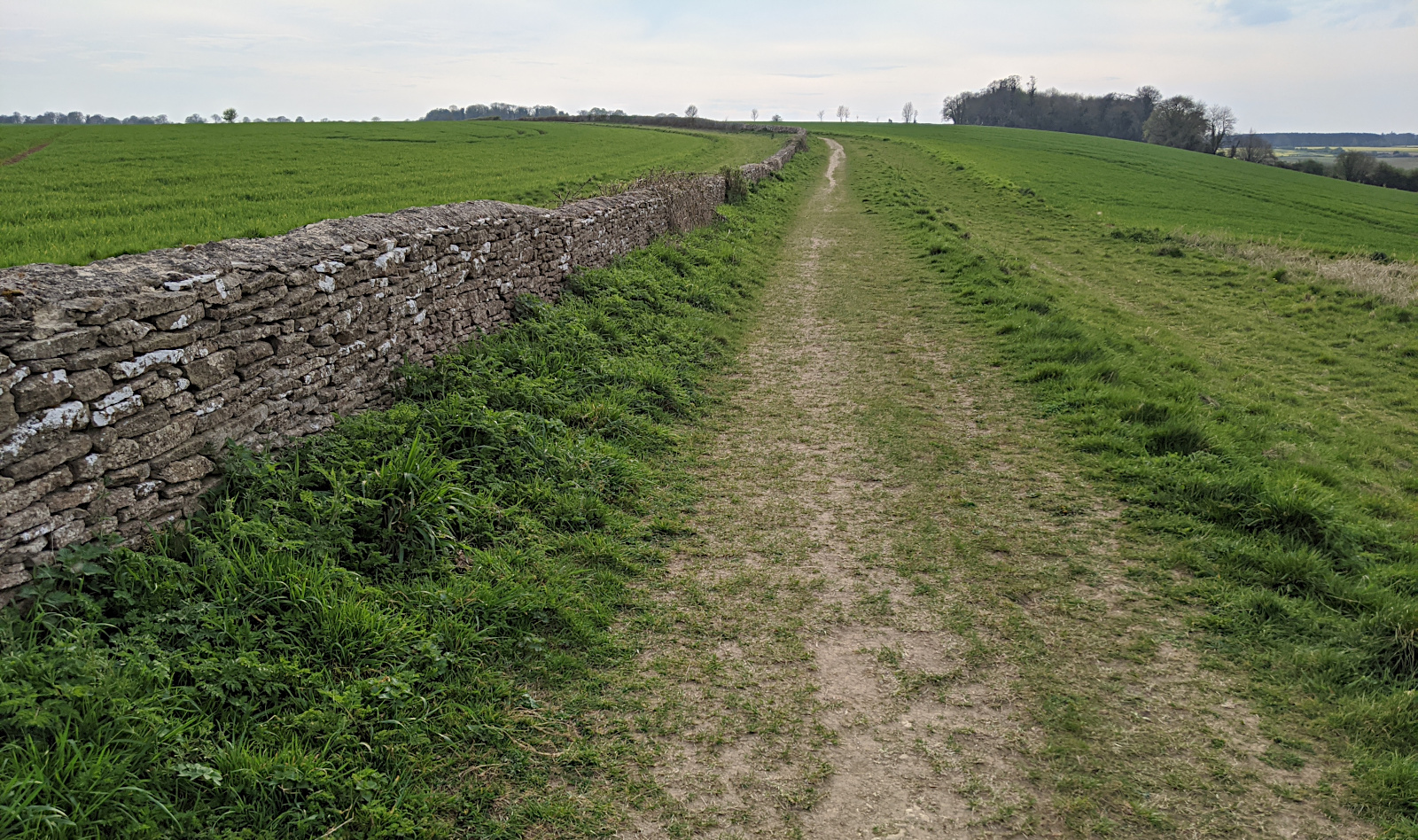
At the end of April I did a canal walk from Chalford to the tunnel entrance at Daneway.
Early in the month we visited Weston-super-Mare to look after the dogs while Paul and Vanessa explored Dartmoor. One day, Donna and her Mum wanted to shop at Cadbury Garden Centre so I took the opportunity of walking around the village of Yatton where I used to live. It’s changed a bit since I was last there and it was fun to walk around some of the old haunts. We visited Cheddar, Cheddar Gorge and Burrington Combe as well.
SS Great Britain
Debbie, Aidan and Sara came to visit in the middle of the month and I went with them to Bristol where we visited the SS Great Britain and did a walk around Roman Cirencester. The photo is the best I could manage, I struggled to predict where everyone would be and it was hard to get ahead for better photos! It was an interesting experience, and later Aidan got to visit his favourite football club, Bristol Rovers.
JHM: I posted more on groundbreaking; and on a delayed attempt to launch SpaceX’s Starship for the first time. World events: Finland joined NATO; and Starship launched for the first time on 20th April.
Donna’s Dad, Tony, was suffering a lot of pain in the mornings when we had to help him out of bed. But we were able to get carers in from a local hospice, Longfield, despite the COVID precautions. This was wonderful as otherwise he would have had to go into care and visiting was not possible during this time, it would have been an awful experience for him and for us, too. Paul, as a family member, was able to drive up from Weston-super-Mare to visit to see his Dad.
There were daily ministerial broadcasts about the pandemic. It was a strange time, I remember one day a queue of over 100 people was socially distanced all around the Tesco car park with a very long wait to get into the supermarket. Donna and I always looked forward to our one permitted daily walk, but the necessary restrictions were causing serious damage to the economy. I wrote a Haiku of Haikus about it all.
World events: The number of COVID cases worldwide passed 1 million on 2nd April and by 27th it passed 3 million; Donald Trump announced the US was suspending funding for the WHO.
We were in Beddgelert at the beginning of the month, visiting Paul and Vanessa in the cottage they were renting for the week. One day we travelled to Caernarvon and back on the Welsh Highland Railway, walking to and from Beddgelert Station.
Wightwick
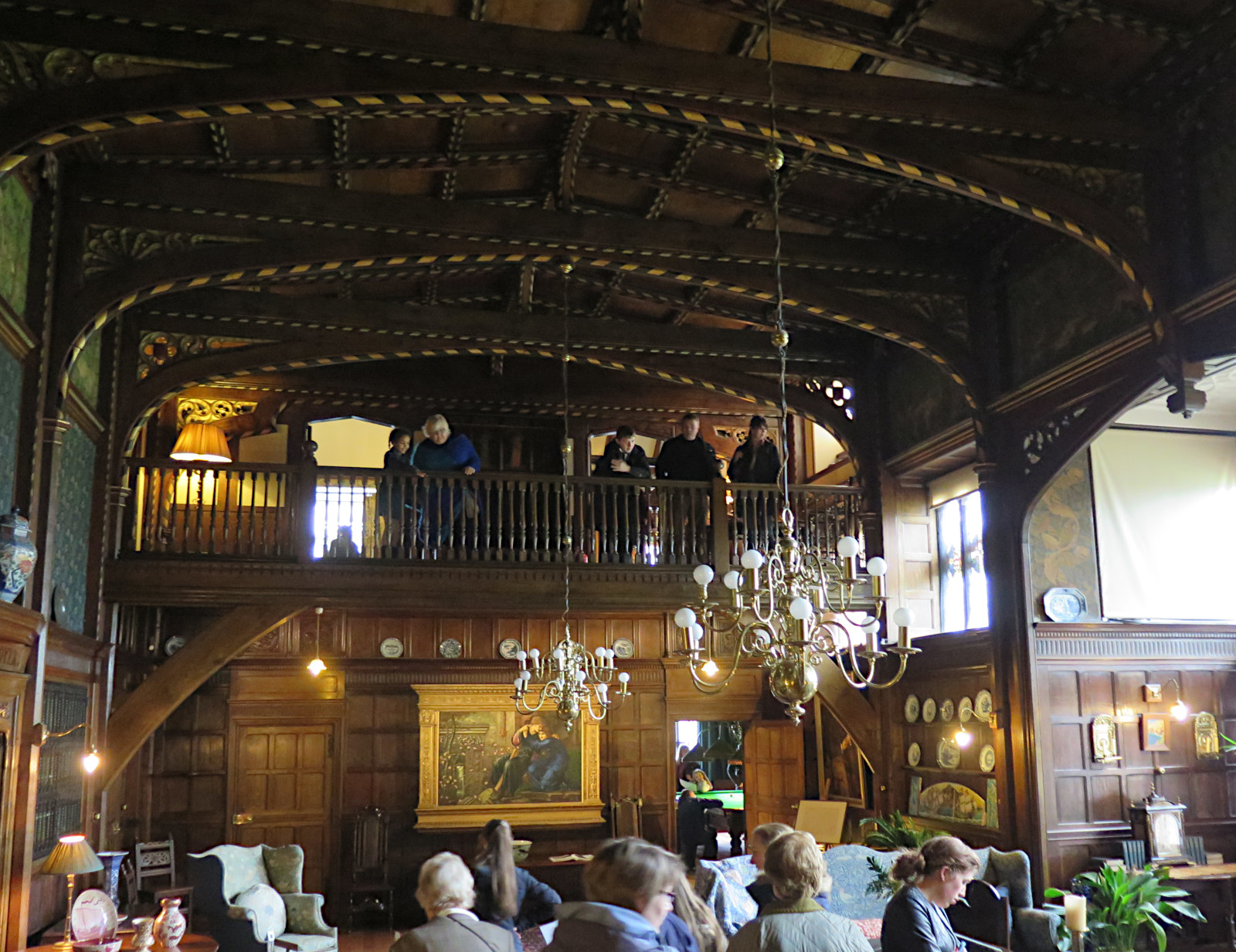
On our way home from Gwynedd we stopped to visit Wightwick Manor, a Victorian Manor House in Wolverhampton. This is Victorian style at its most intense, nothing here is simple, everything is ornate, the chimneys, the internal woodwork, the plaster ceilings – everything! If you are in the area, this National Trust property is well worth a visit.
JHM: I wrote on love and forgiveness. World events: The WHO declared Rubella had been eradicated from the Americas; and there was a serious earthquake in Nepal.
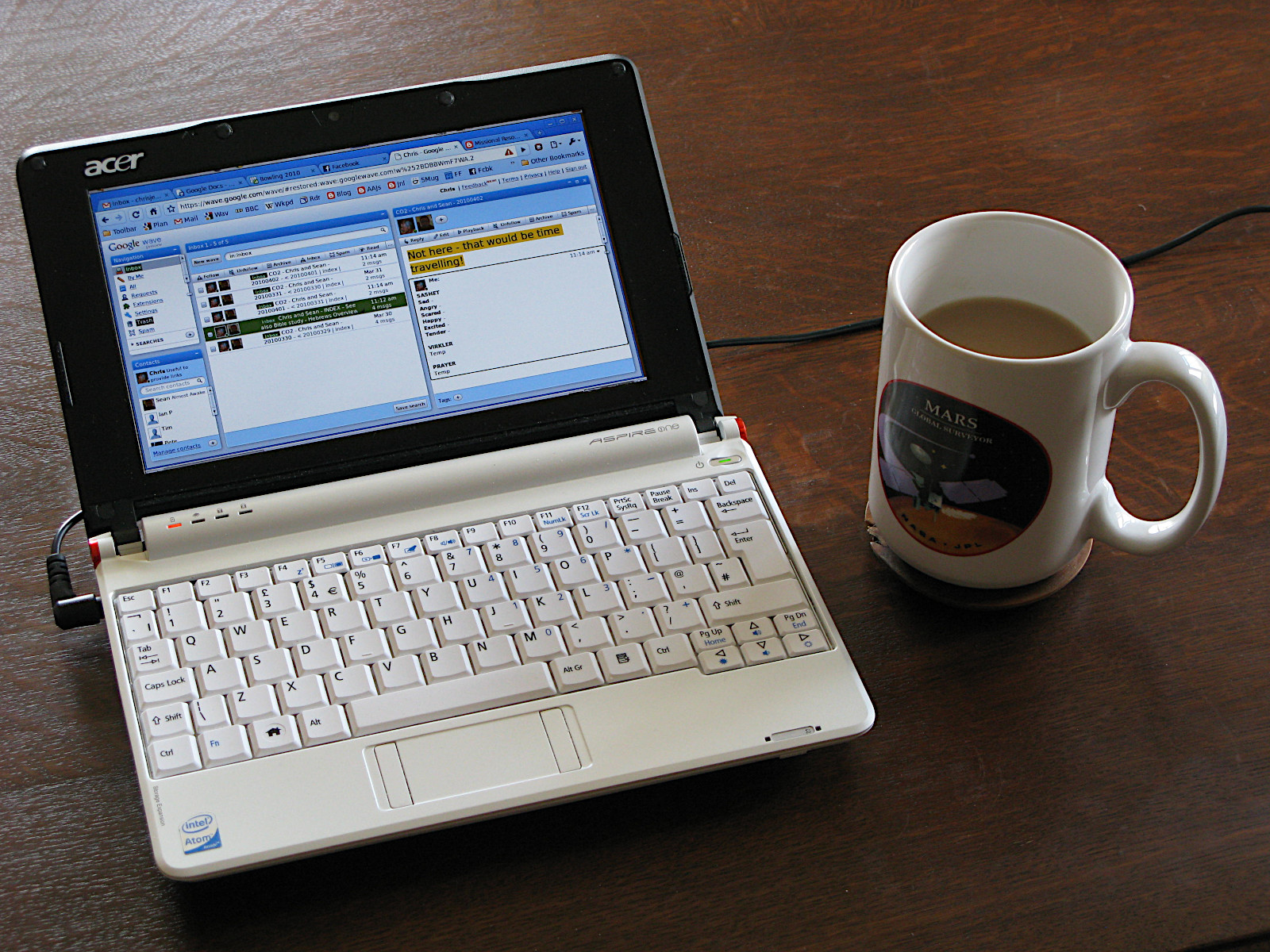
As I no longer had a Unilever work laptop, and my own device was a small netbook, I bought an Acer Aspire laptop at Tesco for use at home and continued with the netbook when I was out and about. I ran Linux Ubuntu on both. The photo shows the netbook with Google Wave active in the Chrome browser.
Duchess
We took the X-treme Camp children and some of their parents tenpin bowling on 6th and everyone seemed to enjoy the evening. And the Duchess of Gloucester came to St Neots to open the new Eatons Community Centre, a grand occasion for what became a very popular local venue for all sorts of social activities and events. Click the image for a larger view of her being greeted by young people on the day.
The Bougainvillea flowered abundantly in our conservatory and I bought a wireless Wi-Fi hub for use when I’m out of the house. It provided Wi-Fi connections for up to five devices at once.
On 2nd April I flew to Ford Lauderdale, Florida for the Koinonia Life Retreat, oganised at the Duncan Conference Centre by my friend Steph. I spent the first night at the home of her friends, Terry and Bill. On 4th I stayed with Steph and her husband Earl and on the 5th and 6th visited my cousin Jill and her partner Marcia. After that I spent more time with Steph, Earl, Terry and Bill before flying home on 11th. It was a great trip, and many of the people I met at the Retreat had already been online friends for some time. It was very good to meet them face to face.
At Unilever I was now working on the web Portal which seemed to me rather confusing and not well-designed for research teams. I felt I was pushing against the natural flow of a river of information. It was an uncomfortable experience.
World events: Prince Charles married Camilla Parker Bowles; and the first ever YouTube video was uploaded (watch it).
The most extreme floods we had seen so far in St Neots were in early April, peaking around the 4th and 5th. The river broke its banks and spilled across the floodplain. That is quite normal, but this year the water was exceptionally deep.
Kitchen
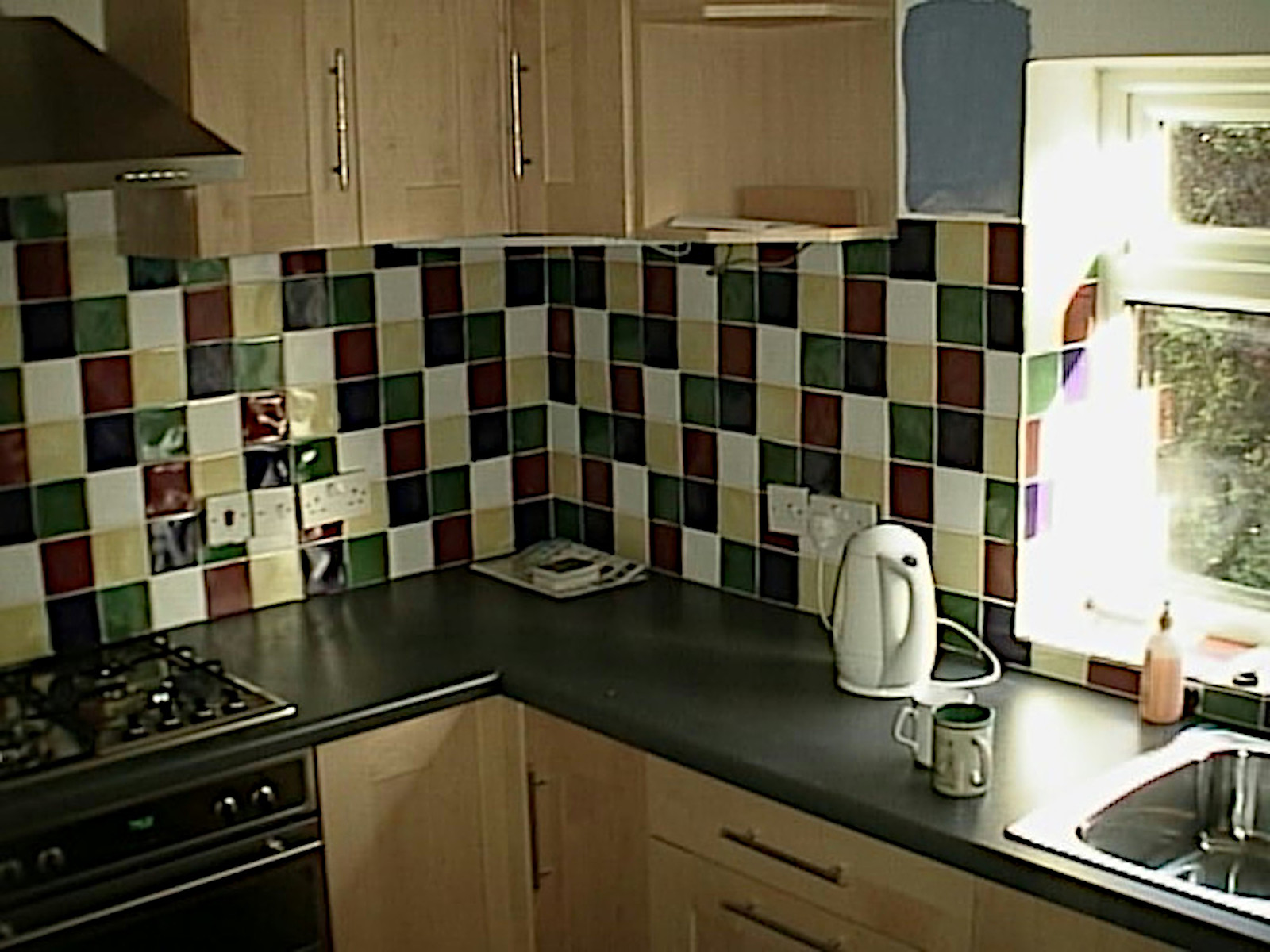
Our new kitchen was finished and we were able to put everything away and make the place tidy at last. This was a huge improvement since early March.
Debbie was working hard at the University of the West of England in Bristol. The photo shows her writing up an assignment at home in Yatton.
Judy continued day trips with Debbie and Beth, sometimes I’d go along as well, but often I’d be at work at Long Ashton. The photo below was taken by Debbie and shows Beth and Judy on the beach at Clovelly. I’m glad they were able to spend time with her while she was still fit and well. She lost her hair during a failed attempt at chemotherapy in autumn 1994, but her hair was growing back well by April as you can see.
Beth and Judy
It was probably in April or May that we began meeting with our friends Tony, Faith, Paul and Jenny again. I don’t know the precise date, but I think it would have been this time of year. They were great meetings when we prayed together and received so much in visions, words, interpreted tongues, Bible readings and much much more.
We got started again because I visited Tony and Faith first I think, and then Paul and Jenny, and suggested that we should give it a try even though things had been difficult for some years beforehand.
Judy was fully on board with all this too. And although we prayed for her healing sometimes, this was not the focus for us; instead we really wanted to hear what Father had to say to us and it was like drinking from a firehose!
World events: The Oklahoma City bombing killed 168 people; and the US government stopped funding NSFNET, making the Internet entirely independent of government control.
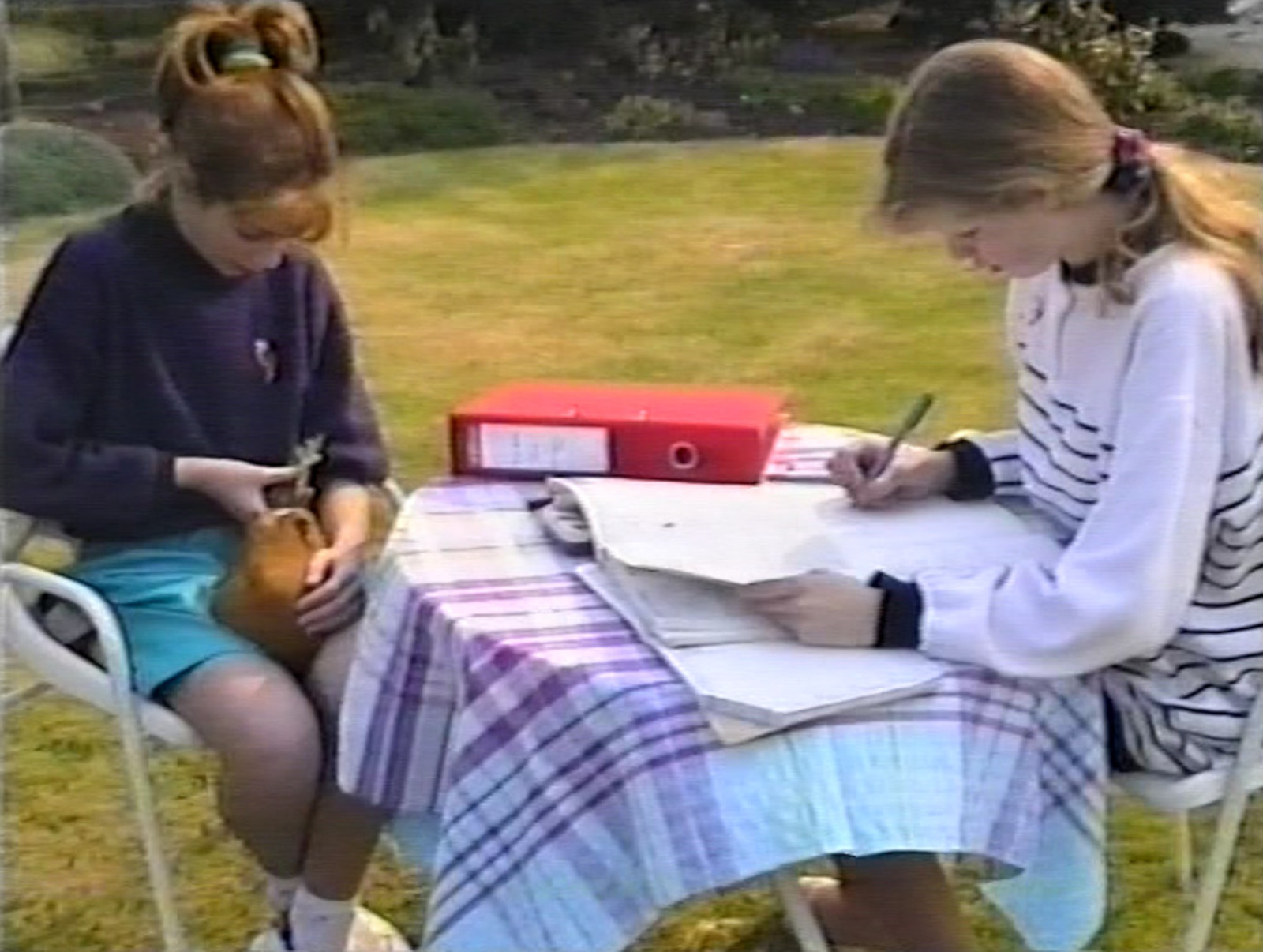
The beginning of April was warm, here Beth has a guinea pig on her lap and Debbie is working. They’re sitting out in the back garden at 80 Stowey Road in Yatton on 1st of the month.
Chew Valley
The 15th was much colder, by this time Debbie’s Bordeaux exchange student, Anne, had arrived and one of our trips was to Chew Valley reservoir. Our car at the time (in the photo) was ‘Karen’, so named by Debbie because it was a Volkswagen and karren is German for cart or barrow. This car had belonged to my Dad, when he replaced it he let us buy it at an advantageous price.
There’s little to say about this month, I haven’t found any photos. We were still living at 22 Rectory Drive in Yatton, Debbie was ten and Beth nearly seven.
I was working at Long Ashton Research Station, and Judy was teaching at Cotham Grammar School in Bristol.
World events: South Africa ended its ban on interracial marriages; and Coca-Cola released New Coke which was not well received.
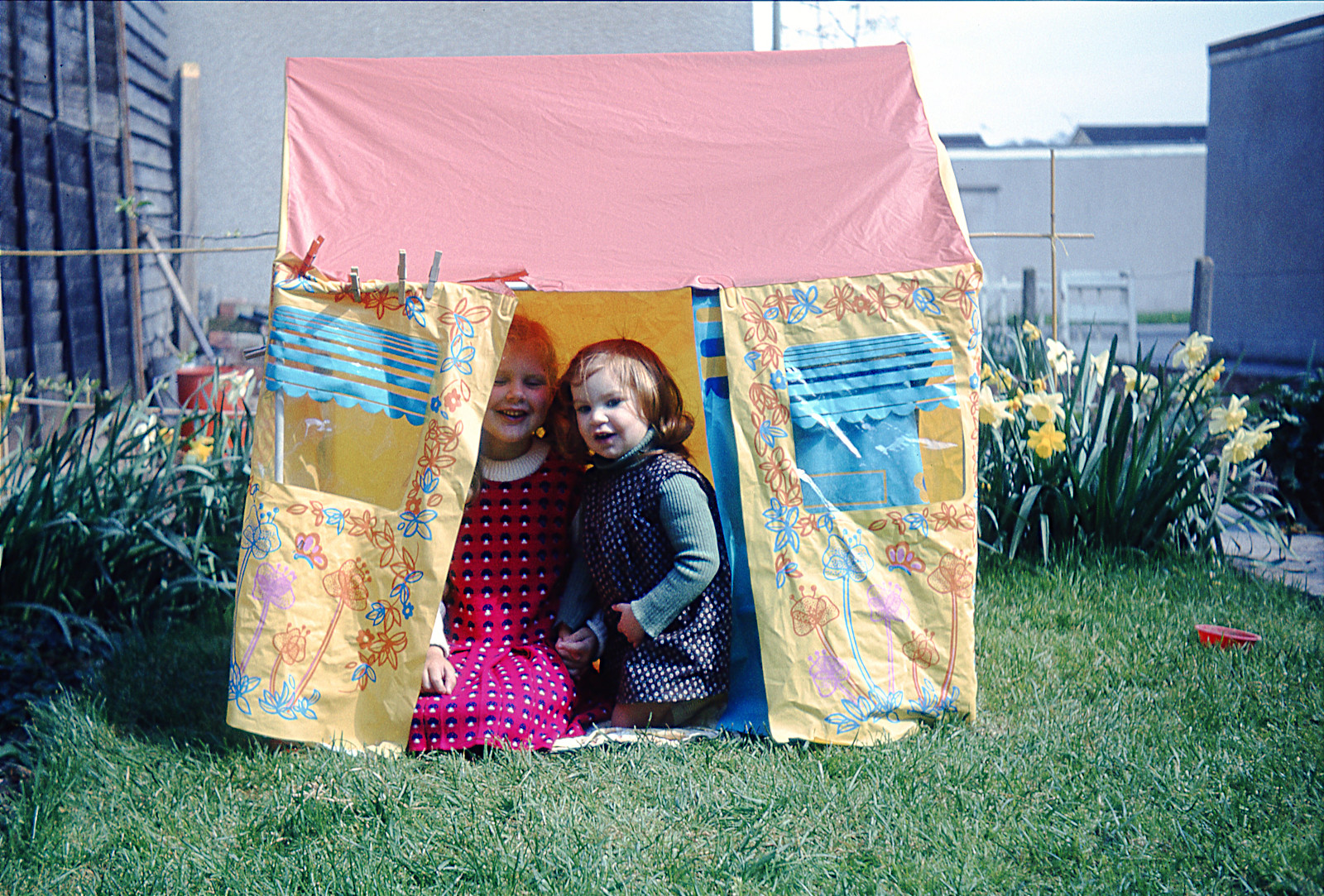
The photo shows Debbie and Beth in their Wendy House. It was becoming a bit the worse for wear at this stage and was held together by tape and clothes pegs! The back garden at Rectory Drive was small, but just big enough for playing in and to grow a small apple tree, a tiny veg patch, two even tinier gardens for Debbie and Beth, and a sand pit.
While the girls were small it was all we needed, and in any case we couldn’t afford a larger mortgage. We were no longer involved at Horsecastle Chapel at this point, an evangelical congregation meeting at the northern end of the village. We’d become friendly with a number of believers from a variety of backgrounds and were meeting in our own homes.
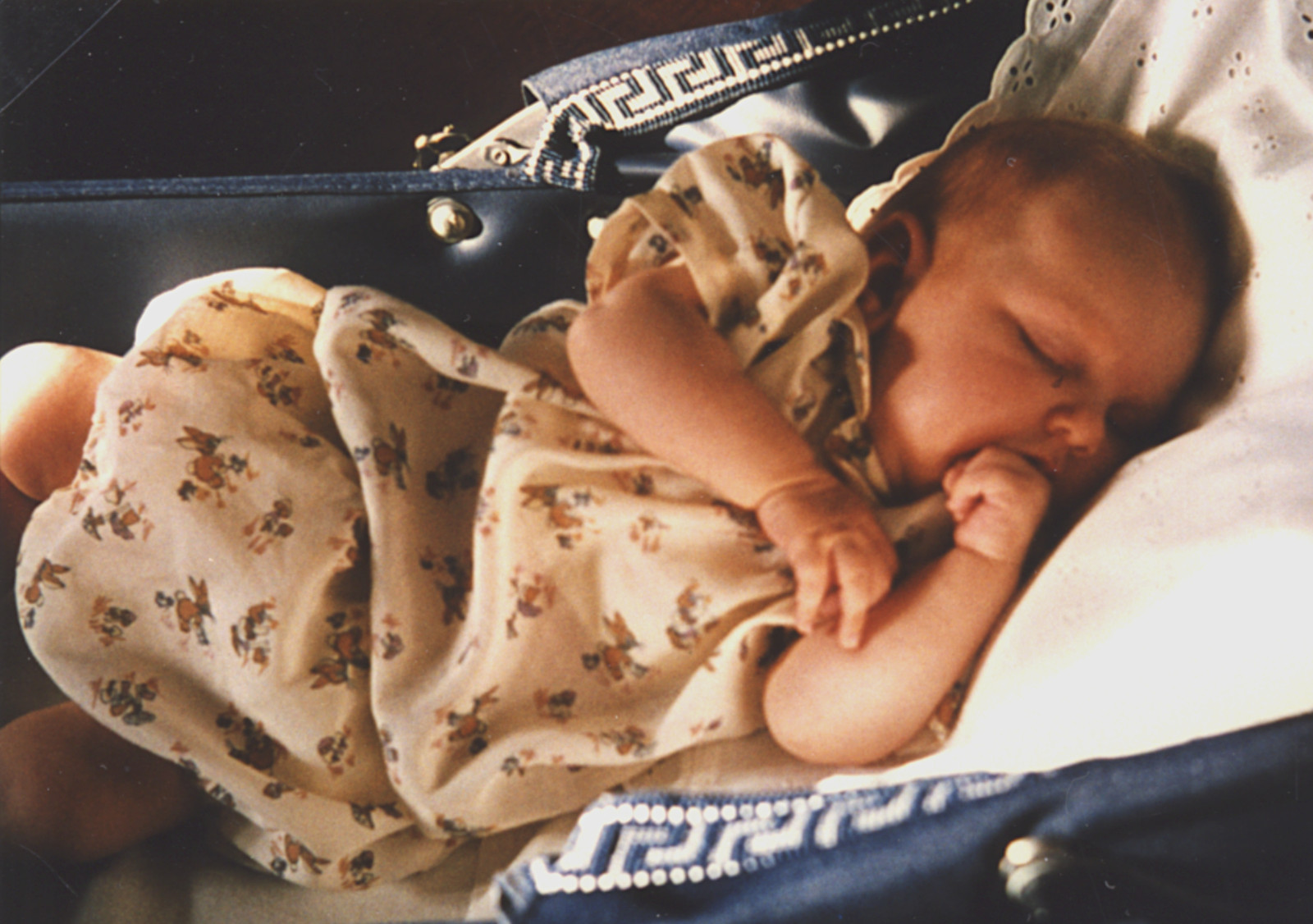
Debbie would sleep peacefully in her pram and Judy was able to catch up with other tasks and even take a photo or two like this one.
We were living in our flat at 20 Belmont Road in Bristol; ours was the middle flat with a musician (Gwyn) and his wife (Gladys) downstairs with access to the back garden. Gwyn played in the BBC training orchestra in Bristol and had a fine selection of classical music LPs. He copied a selection of tracks onto reel-to-reel tape for us. There was a landing halfway up the stairs to our flat and we kept our bikes there. I rode to work and back every day in Long Ashton.
World events: Bill Gates and Paul Allen founded Micro-soft (sic); and The Vietnam War ended with the Fall of Saigon.
This is 14 Belland Drive in Charlton Kings, Cheltenham where Judy lived with her brother, Frank, and their Mum and Dad. Judy was back here from University for a weekend in April and the photo shows the house from the back garden.
Huge room!
Also in April, Judy’s Biochemistry year at Aberystwyth made the long coach trip to Cambridge where they stayed in Churchill College and visited biochemistry labs at the university. She was mightily impressed by the size of the student rooms at Churchill, compared to those at Aber! They made a day trip from Cambridge to Unilever’s research lab at Colworth north of Bedford; and strangely enough I would work there much later after Donna and I were married in 1998.
World events:Paul McCartney announced that he had left The Beatles; and Apollo 13 was launched to the Moon.
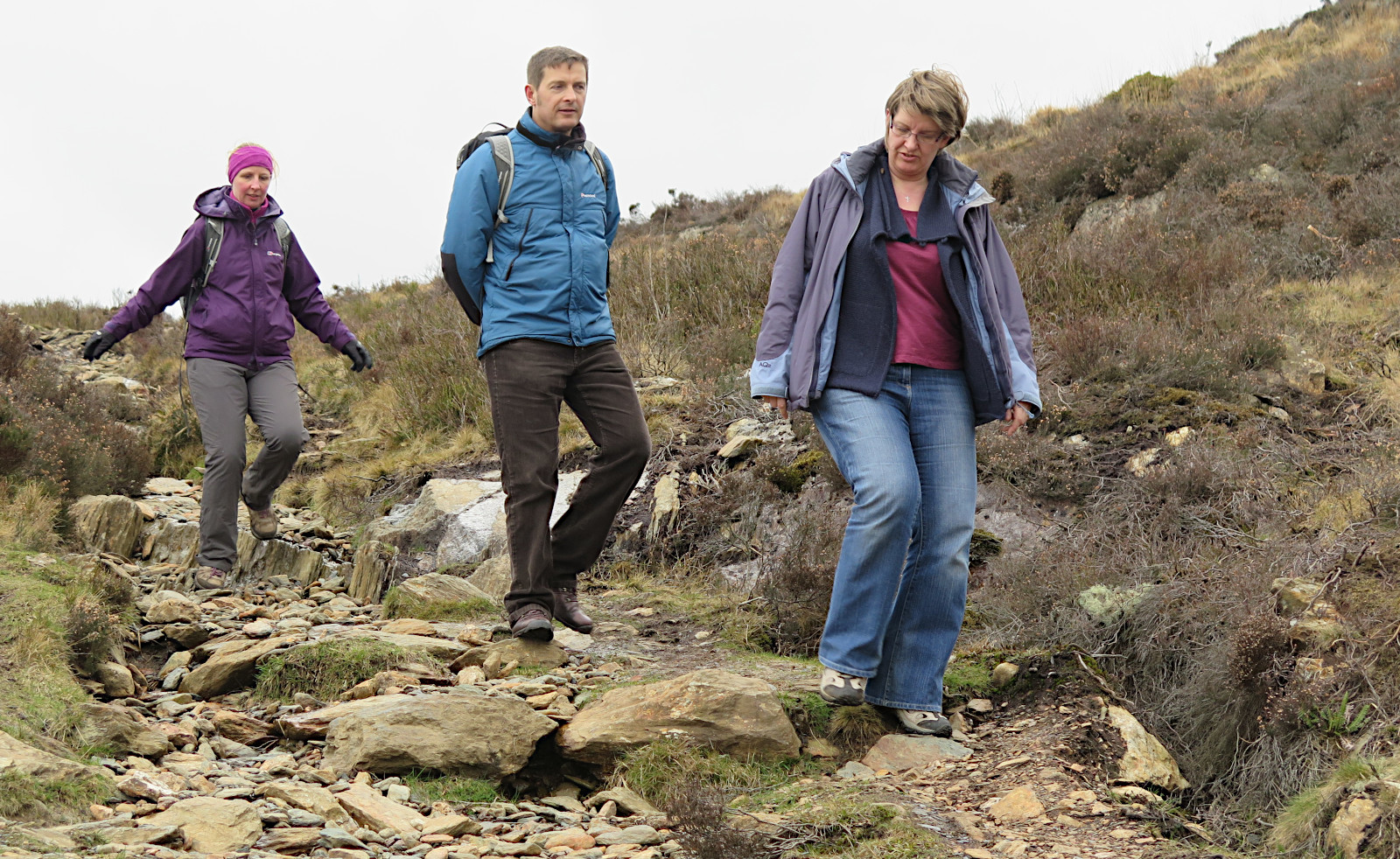
I travelled home from Brantwood in the Lake District, probably on 3rd April. I had a great time, there were people from a number of different schools. I think I was the only one from Cirencester. Dad drove me over to the course organiser’s home in Owlpen where we set off for the minibus journey north. We made several trips, walking to the top of Coniston Old Man and visiting the slate quarry on the way up. The slate quarry is now derelict, but was still working when we were there in 1965. We also travelled to the pebble beach near Barrow-in-Furness where we found seabird eggs hidden amongst the pebbles.
The summer term began after Easter, the final part of my year in the Lower Sixth at Cirencester Grammar School.
World events:Early Bird was launched, the first commercial telecommunications satellite; and The Pennine Way officially opened.
I was in Form 1B at Cirencester Grammar School. Here’s a section from my maths exercise book at the time. I remember the maths teacher was Mr Dyer, a kind and gentle person who was always helpful and positive.
World events: The USA launched the first weather satellite; and Brasilia became the new capital of Brasil.
We were living at 17 Queen Anne’s Road in Cirencester; the Summer term began at Querns School, the final term of my second year. Comics were the thing that occupied children in those pre-computer days. Instead of games and other apps on a phone, I was spending hours reading Swift or playing in the garden. Cindy was probably not yet quite old enough for a comic.
We spent time with the neighbourhood children too, especially our next door neighbours, the Watts. Linda was more or less my age, and Graham about Cindy’s age; I think we played well together, either in the house or in the garden.
I had a Tri-ang pedal-power American Jeep (the image is similar, but not identical) with a little, khaki jerry-can on the back. Cindy had a pull-along roundabout with four wooden figures with arms that swung out when it was revolving.
When we moved to our new home in Queen Anne’s Road, the garden was an area of rough soil, topsoil mixed with underlying layers, bits of concrete, and scattered building rubble.
Dad, of course, made a start on turning it into a proper garden, but before he had time to get very far with this, I was out there at the age of two in my little blue coat with its fur edged hood. One of the things that I found was a poker. Everyone had a poker by the sitting-room fire, essential for moving coal and logs around when necessary. Mum and Dad didn’t have a poker, so I was very pleased to find one.
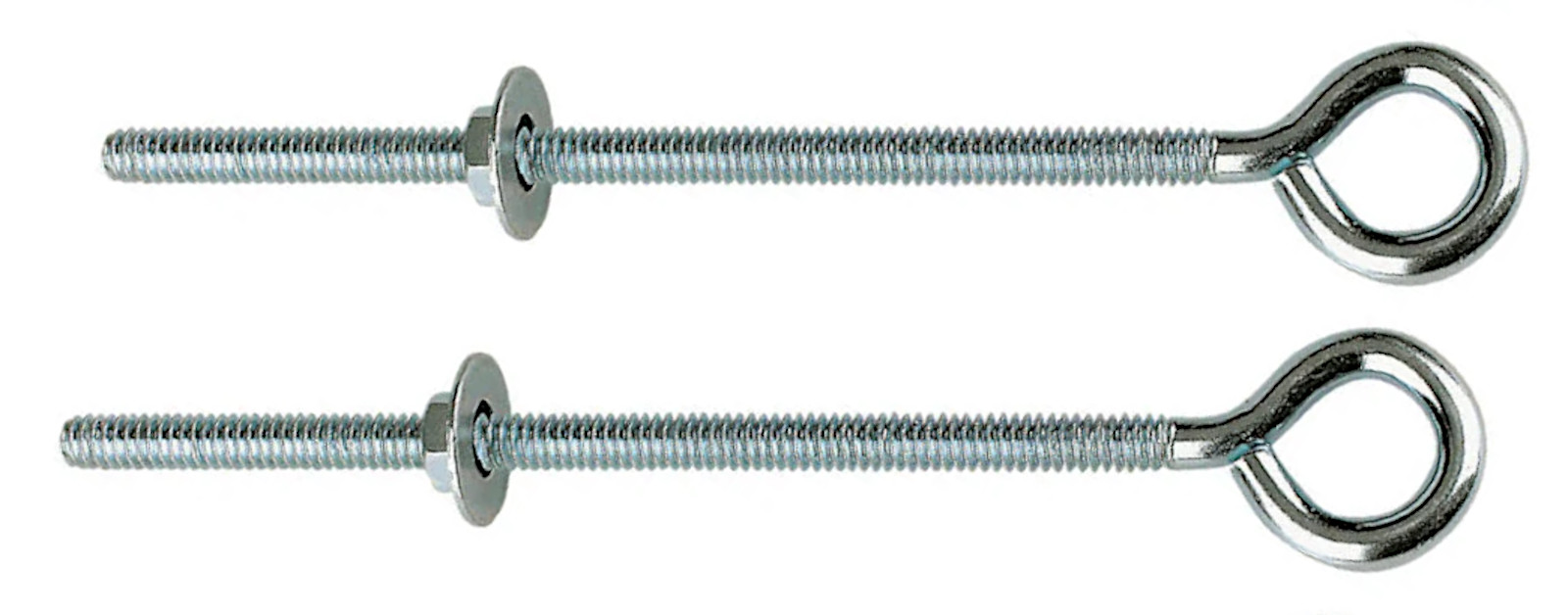
Years later I realised what it really was. It was a fence-wire strainer. It was made of galvanised steel with a loop at one end and a long section of screw thread on the other (a bit longer than in the photo). It would have been passed through a hole in a concrete fence post, fence wire attached, and a nut tightened on the thread to pull the wire taut. Mine had lost its nut and been discarded. It served as a poker for at least 25 years until I was quite grown up and had left home.
World events: The British comic Eagle was launched; and Britain formally recognised Israel.
Dad spent time with family and friends in and around Cirencester at the beginning of the month, travelling back to Skendleby by train on 7th. The constant exchange of letters with Mum in Coagh continued.
On 12th he noted that President Roosevelt had died but made no comment on the news. At the end of the month Dad learned he was to be billeted out in Skendleby and wrote in his diary that he had mixed feelings about it.
There’s not enough information to write something for every month in the 1940s. Dad’s diaries start in January 1943, so for January 1940 to December 1942 I’ll write about things I know, or draw on dated photos and documents. Sometimes I might use a photo or document with a guessed date.
Watermoor Church
Although my grandparents, Ted and Nor, usually went to the Parish Church in the Market Place on a Sunday morning, Watermoor Church was a similar distance to walk and it’s clear they sometimes went there instead.
They lived at Churnside, 37 Victoria Road. To reach the Parish Church they would walk north on Victoria Road, turn left onto Dyer Street and continue into the Market Place. To reach Watermoor Church they would cross Victoria Road, follow The Avenue, and turn left along Watermoor Road.
Here’s another experimental new section. It will contain material that I believe fits this range of dates.
Mop
This is a back-of-the-envelope pen and ink drawing by my grandfather, EA Jefferies (Ted or Guv), he made it for my Dad when he was a young child (five-years-old in 1931) and the colouring-in looks like the work of a child of that age, or maybe a year or so younger. The picture shows the Mop Fair that takes over Cirencester Market Place in October each year, so it might date to October 1930 or 1931.
This picture is very typical of the drawings and stories Grandpa produced. The characters are animals. Notice the smoke rising above the roundabout on the right, it was steam-powered, no diesel generators in those days! The Parish Church is clearly recognisable on the left of the picture. My Dad was given the nickname ‘Tigger’ (or just ‘Tig’ for short) because he was so bouncy when he was little.
If you enjoyed this or found it useful, please like, comment, and share below. (If you don’t see those links, click the article’s title above the main photo and they will appear.) Send a link to friends who might enjoy the article or benefit from it – Thanks! My material is free to reuse (see conditions), but a coffee is always welcome and encourages me to write more often!
The first step is hearing about the things Jesus did and said, discovering his nature and purpose.
There’s an idea out there among some people that the first step towards following Jesus is going to church, or developing a faith, or taking vows or something like that.
Click to enlarge
Nothing could be further from the truth!
The first step is hearing about the things Jesus did and said, discovering his nature and purpose, finding that he is a likeable, kind, and helpful person to everyone who gets to know him. Everything follows from that. It’s where the adventure begins!
Plants are available from garden centres and will grow happily in your garden given the right conditions. These plants belong to the buttercup family and are near relatives of the anemones.
What’s in an image? Sometimes quite a lot, more than meets the eye. I’m posting an image every few days.
Click to enlarge
This makes it three in a row for flower images. The pasqueflower (Pulsatilla vulgaris) grows wild in the Cotswolds on dry grassland areas open to full sunshine. It was once quite common, and although not actually threatened, is something of a rarity these days. There’s a Cotwold dry valley site near Cirencester where there’s a reasonably large colony, but to keep the plants safe, the location is not advertised. However, plants are available from garden centres and will grow happily in your garden given the right conditions. These plants belong to the buttercup family and are near relatives of the anemones.
Protecting endangered or rare species (both plants and animals) is of ever growing importance. There are several ways species come under pressure and we’ll look at those first.
Challenges to survival
Habitat loss is the primary cause of decline for many plants, including the pasqueflower. Land improvement, especially the use of fertilisers to increase crop yields, is an issue for plants adapted to poorer soils.
Physical removal of plants or hunting of animals is an issue too. Most species can cope with limited amounts of removal, but if population levels fall drastically, there are real dangers. The dodo died out on the island of Mauritius following hunting by European sailors. The flightless birds were unafraid as they had no natural predators, so they didn’t run away from their hunters. They were welcome fresh meat after weeks at sea on salt beef.
Ecological damage also causes harm, sometimes unexpectedly. After the dodo became extinct, a tree species mysteriously stopped reproducing. Gradually the population was reduced to only older trees. It turned out that the fruit contained toughly seeds with tough shells that would only germinate after passing through the gut of a dodo. Links like this between organisms can be critical.
Climate change is another danger, especially for plants. If climate change is slow organisms can change the range of places where they grow; if it’s fast, animals might adapt, but some plants may need an entire year to move a few metres.
Pollution is a further serious issue and can exacerbate the other problems already mentioned above.
Diseases of both plants and animals can become pandemic and risk extinction, especially when populations are already stressed by droughts, loss of habitat, or pollution.
Attitudes
Given all of the above, what should our attitude be to the current situation?
Some people will shrug their shoulders. – Perhaps they don’t understand the peril the world faces, or they don’t understand the need to help the natural world recover. Or maybe they just feel there is nothing they can do about it.
Others may understand enough of the science to realise there is a danger, to see that it can be reduced (if not entirely averted), and to take some personal actions to help.
Biologists, ecologists, nature enthusiasts, and climate scientists understand only too well what is happening. Usually, they will be trying to communicate the issues whenever and wherever they can.
Followers of Jesus, and people of other faiths will often understand that we should do all we can to protect this world we live in, and live in ways that will reduce the damage.
All of the groups mentioned here are either responding already, or need help to see and understand that the natural world needs our help and that every single one of us can make a difference. Education and commitment are the way forward, so please share this post with anyone you know who might be influenced by it.
If you enjoyed this or found it useful, please like, comment, and share below. (If you don’t see those links, click the article’s title above the main photo and they will appear.) Send a link to friends who might enjoy the article or benefit from it – Thanks! My material is free to reuse (see conditions), but a coffee is always welcome and encourages me to write more often!
17:13 – There’s so much in Jesus’ heart and mind as he completes the prayer for his immediate disciples. And there’s a lot for us to dig into and appreciate here too.
Do bear in mind throughout, that Jesus would have been speaking not only to the Father, but also wanted and expected his apprentices to overhear. His words are for them too, and through them passed on to you and me as well, in written form. Jesus intended you to read his words. It’s very personal!
Joy
Jesus wants his followers to have his own joy within them. What is Jesus’ joy? He doesn’t state it here, but surely what makes Jesus joyful is completing the work his Father sent him to do, returning to be in his Father’s presence again after living a life here in our broken world; and knowing that the Father himself is delighted and joyful that, despite unimaginable hardship, the task is completed and has broken the barriers that kept people from entering his Presence. Jesus has the same joy because he knows the same thing, the work is done, the goal is achieved, the way into Father’s presence is open to every Jesus follower, everyone doing Jesus’ own work. That work is love – love towards family, friends, neighbours, even enemies.
17:14 – Yahshua (Jesus) continues to speak to his Father about the situation, making four points.
He mentions that he has given them the Father’s word (not words, this is singular). Jesus is himself the Word spoken into physical existence.
The world has hated them.
The reason the world hates them is because they don’t belong to the world, and the world loves its own.
We are like Jesus, not belonging to the world.
One thing we should take away from this is that telling the Father things he already knows is perfectly acceptable. Our expressing them to him is neither pointless repetition nor trying his patience. We can do this too, we’re laying out the situation as we see it before we ask for help, guidance, comfort, encouragement, or action. The Holy Spirit may respond as we do this, showing us things we’d overlooked, pointing out the way forward, changing our perspective.
17:15-16 – Think about conversations between two friends perhaps over a coffee or sitting in the shade on a hot, summer’s day. A typical conversation might include saying hello (a greeting), checking how the other person is, asking questions, offering help, discussing mutual interests and more. Yahshua says we are no longer servants, but friends, and he says he and the Father are one. He told the disciples, ‘If you’ve seen me you have seen the Father’. So it’s more than OK to be on friendly terms with the Father, the Son, and the Spirit; all those things we might discuss with any friend are things we can discuss with the Father. It’s what he wants us to do!
Only after describing the situation does Jesus move on to asking for things. He begins with clarity about what he is not asking, and then he asks for their (and our) protection from the enemy. Think about it! You are following Jesus, and he has asked for the Father’s protection over you, personally. The prince of darkness is restrained from harming you. How far does this go? Well, let me assure you, it goes the entire way. Down the centuries many of Jesus’ followers have died, as he did, at the hands of bad or ignorant people – killed by lions in Roman arenas or hanged by Nazis in the Second World War like Dietrich Bonhoeffer or Martin Niemöller. But all of them were protected from the greater catastrophe of falling into the hands of a spiritual enemy.
Why do we get this special treatment? Because in following Jesus we become like him. Jesus is not of this world, and neither are we.
Sanctified
17:17-19 – This Greek word, ἁγίασον (hagiason), is specific in its meaning; its sense is the act or process of making a thing or a person holy, to consecrate, to set apart, or as here to sanctify. Greek versions of the Old Testament use the same word in explaining that the Tabernacle and later the Temple were holy, and the priests were holy (set apart to serve). Jesus used the word when talking about the Temple, and in the Lord’s prayer when he said ‘Hallowed be thy Name’. In modern English we might say, ‘Let your name be kept holy’.
Here, speaking to his Father, he uses the same word of his followers, ‘Make them holy by the truth, your word is truth’. If you are following Jesus, then know that he has made you holy and set you apart to serve him and him alone! He asks that we be made holy, set apart, by the truth. So what truth is this?
Elsewhere Jesus said, ‘I am the Way, the Truth and the Life’. He also said, ‘The truth shall set you free’. He says here in verse 17, ‘Your word is truth’. This makes perfect sense, Jesus himself is The Word, spoken into a broken world by the everlasting Father.
And finally, in verse 19, Jesus says very clearly that he has set himself apart for his Father’s use on our behalf, so that we, too, can be truly set apart for the Father’s use as well.
Don’t forget who you are
If you take away nothing else from these verses, take away the amazing truth that following Jesus demonstrates you are set apart, holy and fit to serve the Father, precious and special. Do not be hoodwinked into thinking you are not significant. And don’t for one moment think that you’re significant because of what you do. You are significant because of who you are! Jesus is your brother, you’ve been brought right into the family, welcomed and hugged and loved by the Trinity, no less.
If you enjoyed this or found it useful, please like, comment, and share below. (If you don’t see those links, click the article’s title above the main photo and they will appear.) Send a link to friends who might enjoy the article or benefit from it – Thanks! My material is free to reuse (see conditions), but a coffee is always welcome and encourages me to write more often!















 Journeys of Heart and Mind

.jpg)


