Is a rose with raindrops on its petals any less beautiful than a rose with dry petals? No, in fact many would say it looks even better with a few raindrops on it.
Image 96 – What’s in an image? Sometimes quite a lot, more than meets the eye. I’m posting an image every day or so.
Click to enlarge
‘What’s in a name? That which we call a rose, By any other name would smell as sweet‘
William Shakespeare, Romeo and Juliet
Juliet spoke these words of Romeo, his surname was a practical issue between rival families, but she loved him regardless.
Is a rose with raindrops on its petals any less beautiful than a rose with dry petals? No, in fact many would say it looks even better with a few raindrops on it. They emphasise its freshness, and they highlight its apparent fragility while revealing an unexpected robustness.
A rose in the rain is a lovely thing! I hope you like this one; I just had to take a photo. The cultivar is ‘Queen of Sweden’ and it was released in 2004 by David Austin.
When: 8th September 2024 Where: Anglesey Abbey, Cambridgeshire, England
If you enjoyed this or found it useful, please like, comment, and share below. (If you don’t see those links, click the article’s title above the main photo and they will appear.) Send a link to friends who might enjoy the article or benefit from it – Thanks! My material is free to reuse (see conditions), but a coffee is always welcome and encourages me to write more often!
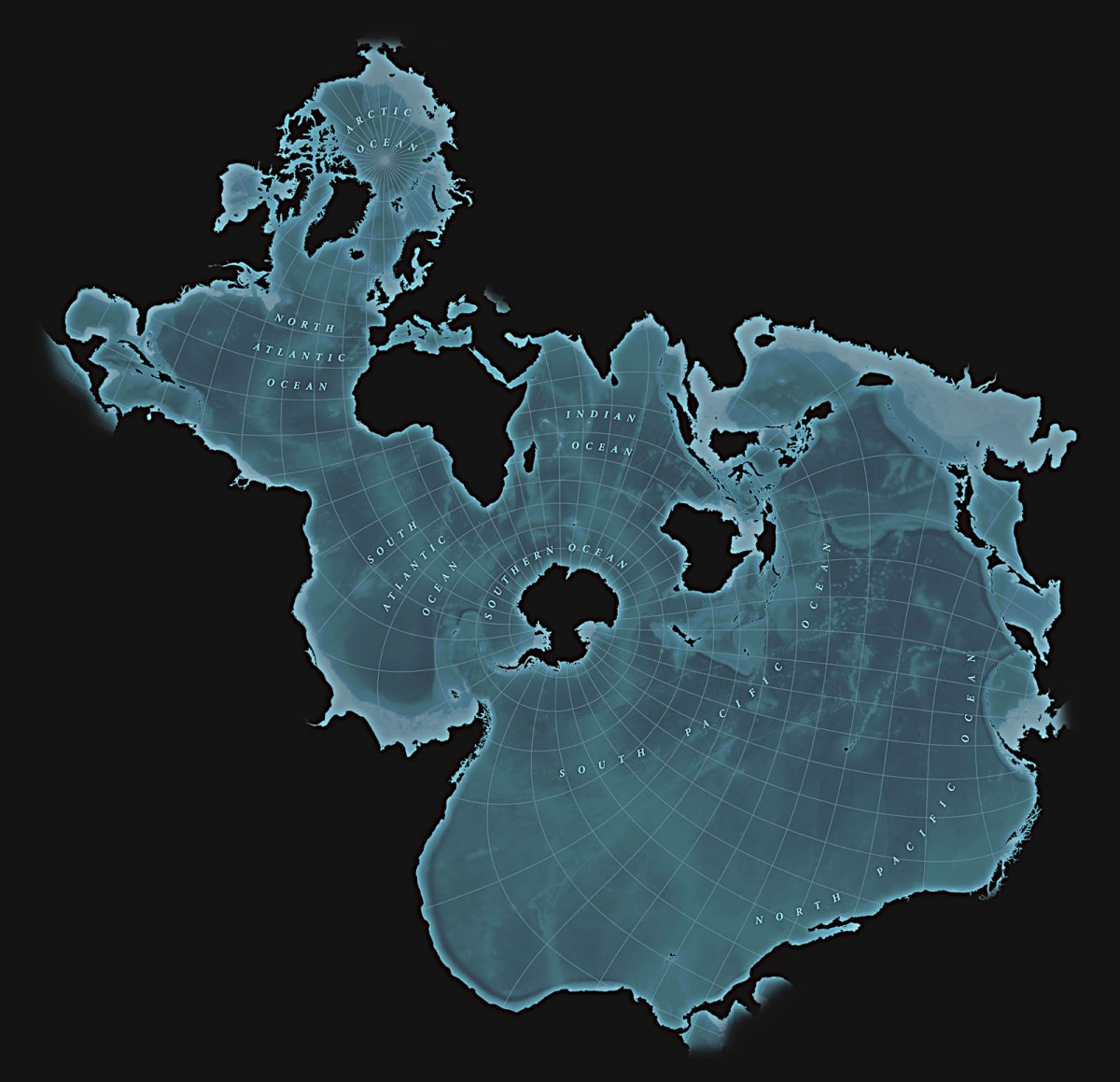
Sometimes, looking at things in a different way makes a world of difference (pun slightly intended).
This is a map projection much loved by oceanographers and other scientists researching related subjects such as marine life. It makes the world’s oceans the entire focus. Clever!
Athelstan Spilhaus invented this map projection; he was born in Cape Town in 1911 and worked at Woods Hole, Massachusetts, from 1936. In 1942 he began developing ways of mapping that would focus attention on the world’s oceans. This Spilhouse Projection is not the only result of his mapping work by any means, but it’s arguably the most impressive. Quite beautiful in it’s own right, it provides a holistic view rather than focusing on one ocean at a time.
When: 16th June 2023 From: NASA’s Scientific Visualization Studio
If you enjoyed this or found it useful, please like, comment, and share below. (If you don’t see those links, click the article’s title above the main photo and they will appear.) Send a link to friends who might enjoy the article or benefit from it – Thanks! My material is free to reuse (see conditions), but a coffee is always welcome and encourages me to write more often!
Image 94 – What’s in an image? Sometimes quite a lot, more than meets the eye. I’m posting an image every day or so.
Announcement – I’m making a few more changes, The image number is moving down so the title can be more relevant to the content, and I’m adding date and place for the image source.
Click to enlarge
The large white butterfly is the bane of vegetable gardeners. The adult females lay their eggs under the leaves of brassica crops – cabbages, cauliflowers, brussels sprouts and more. The caterpillars that hatch out feed voraciously on the plants, and as they grow larger they consume the leaves faster and faster, sometimes leaving just a stalk and nothing for the gardener to harvest.
The adult in the photo is feeding on nectar from a Buddleia inflorescence. Butterflies and bees home in on these. Although the photo’s one of my favourites, it’s technically poor as it’s enlarged from a small part of a shot taken back in September. Still – I like it and I want to share it.
When: 16th September 2024 Where: Hidcote Garden, Gloucestershire, England
If you enjoyed this or found it useful, please like, comment, and share below. (If you don’t see those links, click the article’s title above the main photo and they will appear.) Send a link to friends who might enjoy the article or benefit from it – Thanks! My material is free to reuse (see conditions), but a coffee is always welcome and encourages me to write more often!
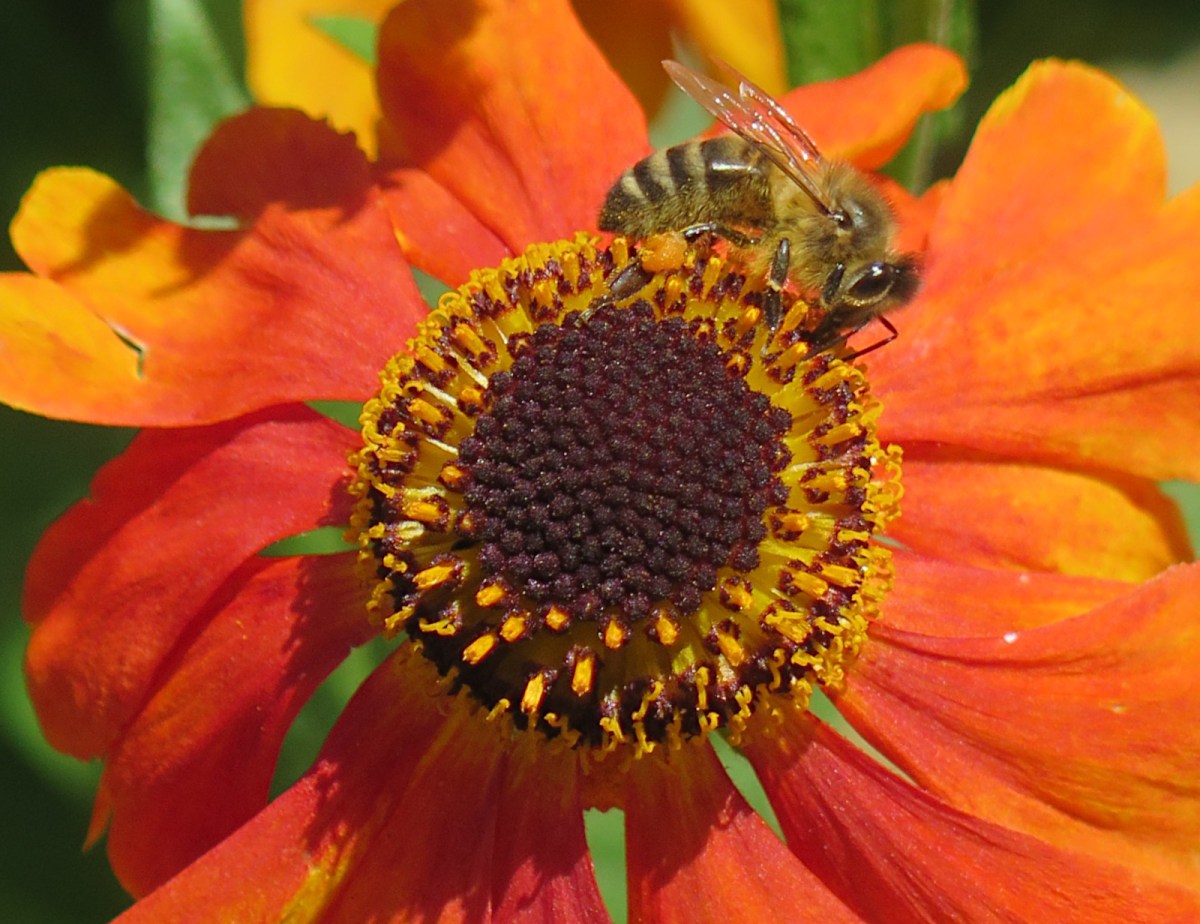
The worker honeybee in the photo is collecting pollen. Insect-pollinated plants have slightly sticky pollen that lodges on the bee’s hairy body. Bees visit flowers to collect nectar from the base of the petals, but get dusted with sticky pollen in the process.
What’s in an image? Sometimes quite a lot, more than meets the eye. I’m posting an image every two days or so.
Click to enlarge
Like all plants and animals, bees are pretty well suited to the actions they need to perform to live and reproduce. That’s what evolution does, it homes in on the best shape and size of wings, the optimum size for flight muscles, best arrangement of hairs on the legs to brush loose pollen towards the pollen sac for collection and transport, the best mouthparts for collecting nectar and so forth.
Quite a challenge, and an astounding achievement, but entirely doable by making small, random changes and selecting the best.
Here’s an example to make that bold claim clearer. If a random change enables the worker bees to carry on just a few days longer in the autumn, the hive will have slightly larger stores of honey for the coming winter. That hive will survive when a hive with less capable workers might not. And that’s enough. The new queens from the surviving hive will carry the altered gene and it’ll be present in the workers of the new colonies those queens create. The altered colonies will also survive in slightly colder places than before so will succeed at slightly higher altitudes and in slightly cooler climates.
The worker honeybee in the photo is collecting pollen. Insect-pollinated plants have slightly sticky pollen that lodges on the bee’s hairy body. Bees visit flowers to collect nectar from the base of the petals, but get dusted with sticky pollen in the process. Bees clean themselves like most insects (you’ve probably seen houseflies doing it, sweeping off particles of dust with one leg while standing on the others). When bees clean themselves, most of the pollen end up stuck together as a lump and lodges on a series of special hairs on the hind legs. Look closely and you can see this bee’s pollen load on its rear leg; an orange/yellow colour. Pollen is protein rich and the bees feed it to the bee pupae in the hive.
The plant feeds the bees nectar for energy and pollen for growing young bees; while the bees move pollen from flower to flower, and often from plant to plant over quite long distances, sometimes a mile or more. So the bees and the plants both benefit, it’s a useful co-operative effort.
Favourites
For convenience, here’s a list of my favourite images:
If you enjoyed this or found it useful, please like, comment, and share below. (If you don’t see those links, click the article’s title above the main photo and they will appear.) Send a link to friends who might enjoy the article or benefit from it – Thanks! My material is free to reuse (see conditions), but a coffee is always welcome and encourages me to write more often!
What’s in an image? Sometimes quite a lot, more than meets the eye. I’m posting an image every two days or so.
Click to enlarge
Anemones are simple flowers, but beautiful! I have strong childhood memories of the white version of these growing in my grandfather’s garden in Cirencester. They managed to grow in small cracks between the bottom of the house wall and the stone paving. The flowers stood nearly as tall as me so I suppose I might have been between five and seven years old at the time.
The flowers in the photo are at various stages of development:
On the stem just right of the centre you can see a few tiny leaves and a little, pale-green flower bud.
In the centre, near the top, is a much larger bud, about to open.
Right down at the bottom, a flower has opened but the petals are not yet full size and have not developed their final colour.
The flower on the left and just below the centre is fully open. There’s a little insect sitting on its centre.
Below and right of it is a more mature flower, the yellow anthers have shed their pollen and have shrivelled.
A little above and right again is an even older flower, the anthers are in worse condition and some of the petals are damaged around their margins.
The flower in the upper left has lost most of the anthers and the petals look tired and old.
In the upper-right you can see a flower with only two petals remaining.
And just above, the yellow globe is the remains of a flower that has lost all of its petals.
Although they look like pink petals, and I’ve called them that here, botanically speaking these are actually modified sepals. On most flowering plants, the sepals are small and green, normally hidden by the petals.
Patterns of development
The flowers on this Anemone are just one example of the kinds of patterns that come from anything that grows. We’re all familiar with the pattern in humans – fertilised egg, foetus, baby, toddler, pre-teen, young teen, adolescent, young adult, mature adult, early middle age, late middle age, elderly.
And you can trace stages of growth in cities, technology, philosophy, civilisation, language families, culture, stars, wars, galaxies, you name it. Such patterns of development are a fundamental part of the way things are in our universe. Time ticks by relentlessly, and all these patterns are patterns of change, in other words evidence of the passage of time.
If the Universe did not include time, nothing would change and there would be no patterns, no life, just stasis.
Favourites
For convenience, here’s a list of my favourite images:
If you enjoyed this or found it useful, please like, comment, and share below. (If you don’t see those links, click the article’s title above the main photo and they will appear.) Send a link to friends who might enjoy the article or benefit from it – Thanks! My material is free to reuse (see conditions), but a coffee is always welcome and encourages me to write more often!
What’s in an image? Sometimes quite a lot, more than meets the eye. I’m posting an image every two days or so.
Announcement – I need to reduce the time I’m spending writing JHM posts. To make this possible I plan to post images more often as they are quick to do, and I’ll put the time saved into fewer but hopefully better posts on other topics.
Click to enlarge
This is the view across the valley from Kiftsgate Court that I mentioned yesterday. You can see it from the swimming pool – what an amazing backdrop for a relaxing dip!
Only a minority of people have views from their back garden like this one. But we can all enjoy the photo, or visit Kiftsgate Court Gardens to admire it first hand.
If you enjoyed this or found it useful, please like, comment, and share below. (If you don’t see those links, click the article’s title above the main photo and they will appear.) Send a link to friends who might enjoy the article or benefit from it – Thanks! My material is free to reuse (see conditions), but a coffee is always welcome and encourages me to write more often!
Hidcote is an informally formal garden, if I can put it that way, while Kiftsgate is not formal at all. Both are full of surprises and delights at almost every turn.
What’s in an image? Sometimes quite a lot, more than meets the eye. I’m posting an image every two days or so.
Click to enlarge
Today’s photo was taken at Kiftsgate Court Gardens in the far north of Gloucestershire. The pool was designed for swimming, though today it’s just ornamental. Kiftsgate Court is a large house on the top of a local hill; the pool is below the house and has an amazing view across the valley to further hills beyond.
The people who lived here knew a thing or two about designing a wonderful garden. It’s right next to Hidcote, another marvellous garden and perhaps better known, but if you’re visiting one of them and have the time, try to see them both. They are both great but designed very differently, Hidcote is an informally formal garden, if I can put it that way, while Kiftsgate is not formal at all. Both are full of surprises and delights at almost every turn.
If you enjoyed this or found it useful, please like, comment, and share below. (If you don’t see those links, click the article’s title above the main photo and they will appear.) Send a link to friends who might enjoy the article or benefit from it – Thanks! My material is free to reuse (see conditions), but a coffee is always welcome and encourages me to write more often!
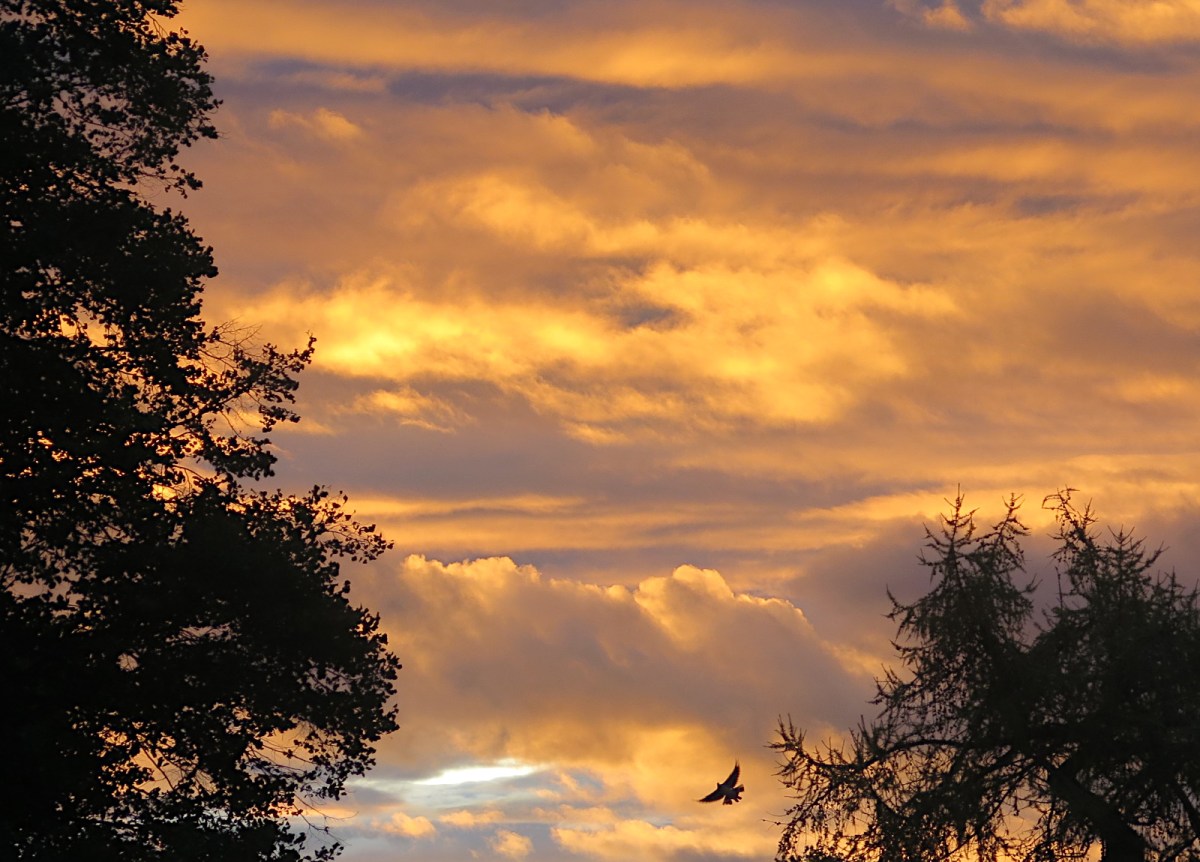
Quite by chance, as I clicked the exposure, a bird flew out of tree and the shot automagically composed itself! It looks like something from the Jurassic, a flying dinosaur with four wings.
What’s in an image? Sometimes quite a lot, more than meets the eye. I’m posting an image every two days or so.
Click to enlarge
For the next few photos, I’m going to leave the series on our Irish holiday, and the series on Cirencester, and instead just focus on images I love (pun only slightly intended).
Let’s start with this photo of a sunset seen from my study window. Quite by chance, as I clicked the exposure, a bird flew out of a tree and then shot automagically composed itself! It looks like something from the Cretaceous, a flying dinosaur with four wings, or a raptor that’s just snatched some unlucky feathered prey. Anyone have other opinions on ID?
The intended subject was the sunset, it was very spectacular and deserved to be recorded. The clouds were luminous, truly breath-taking and the photo fails to do them justice. In my experience that’s often the case with sunsets, the contrasts are too wide so details are lost both in the brightest and darkest areas; to show those details you have to compromise on the contrast – you really do need both. The Earth’s atmosphere scatters short wavelength blue light and that’s why the sky appears blue and is darker at higher altitudes (most of the air is below). While at sunset or sunrise the light takes a long, grazing path to your eyes and the blue scattering along that path leaves mostly oranges and reds.
Favourites
For convenience, here’s a list of my favourite images:
If you enjoyed this or found it useful, please like, comment, and share below. (If you don’t see those links, click the article’s title above the main photo and they will appear.) Send a link to friends who might enjoy the article or benefit from it – Thanks! My material is free to reuse (see conditions), but a coffee is always welcome and encourages me to write more often!
Images fade, especially if exposed to light, they are susceptible to damage by fire, water, mechanical action and so forth.
For some years now I’ve been transferring family photos, videos and documents to digital storage in an attempt to preserve the information. There are pros and cons to both physical storage and digital storage and we’ll discuss those in this article.
But first, lets take a look at an example photo.
An old photo from my collection – May 1969
The image above is from a 35 mm transparency. It shows my fellow students on the Bath University Horticulture degree course the year before we graduated. We were visiting a commercial horticultural business and there’s a TV personality in the image as well. (One of our lecturers, Peter Thoday, later became well known as the narrator in the TV series, The Victorian Kitchen Garden. He’s at the back of the group on the right in the photo, tall and with very dark hair.)
Details of the photos and how I manage them
Quite a few of the old photos I have are colour transparencies; these come in different sizes depending on the type of camera and film that were used. The majority are on 35 mm film stock, with sprocket holes along two sides; these engage with the film transport mechanism in the camera. After the film was processed and dried it was cut into individual frames and mounted in card or plastic frames. My film scanner can handle mounted and unmounted slides and saves them as digital image files.
Once I have the images in digital format I remove slides from their frames and check the frame numbers exposed on the film when it was manufactured. This makes it easy to get the slides into correct sequence as they may have been reordered accidentally or even deliberately when they were projected in the past. Having confidence that the photos are correctly in sequence makes it much more likely that I can eventually arrange the films into longer sequences based on events, people and places in the images. This is a work of reconstruction, sometimes easy, sometimes very difficult. I keep notes of what I have done and why, for my own reference and for anyone else who might find the information useful later. I’ve got better at doing this with experience.
Advantages and disadvantages of physical storage
The original negatives and transparencies contain more information than digital copies. For one thing, the dynamic range is greater and the resolution is always going to be a little higher. Scanning processes are very good indeed these days, but they’ll never be absolutely perfect.
On the other hand, originals deteriorate over long time periods. Images fade, especially if exposed to light, they are susceptible to damage by fire, water, mechanical action and so forth. And as each image is unique, if it’s lost or damaged there is no way to recover it.
And two final points – storing negatives, transparencies and prints takes a lot of space, more and more as the numbers increase. And viewing them becomes an issue, only a few people can view them at a time.
Advantages and disadvantages of digital storage
Digital copies of the images can be almost as good as the originals for most purposes, and digital processing can improve colours and remove blemishes when the originals are faded, scratched or have dust that is strongly attached to the surface. In these cases, the digital copy may be more acceptable than the original.
Digital storage is increasingly cheap and capacious, so a very large collection of photos can be stored on a cheap, tiny SD card. This in turn makes it possible to have multiple copies in multiple locations, providing security far beyond anything possible with the originals. Remote storage on Dropbox or similar facilities takes this a step further. Multiple copies and remote storage both make it possible for many people to be able to view the images independently and from wherever they happen to be.
Perhaps the biggest downside of digital storage is the need to constantly move images from old storage media to newer technology. How many of us have devices to read data from a floppy disk or an old CD? Remote storage helps again because the company offering the service takes on the task of managing data storage and retrieval and moving to newer technologies whenever necessary.
And there’s a hidden factor here too, the images need to be stored in a file format that is still readable on current devices. JPG and PNG are widely used and may be readable by future devices for a very long time, but nothing is certain and it may become necessary to re-save the images in a different file format in future. This would be a major task for a large image collection.
My approach to all this
I’ve thought about this a lot. Currently, everything is stored in high quality JPG format. Yes, I know there are very slight compression artefacts in JPG, but unless the images are repeatedly edited and re-saved this is not an issue in practical terms. I use an Epson Perfection V600 Photo scanner which for me is a good compromise between quality and price. The images are stored initially on my laptop and automatically to Dropbox, and I back up my laptop on an external hard drive at intervals. Other members of the family have their own copies of some of the data, though keeping this refreshed has been a problem.
Something I have not yet fully resolved is what happens when I’m no longer able to manage all this data. Of course, at that point the future of the images will no longer be of personal interest. Nonetheless, I’d like to have some kind of plan in place, perhaps handing on access to my Dropbox account would be a good way forward.
If you enjoyed this or found it useful, please like, comment, and share below. (If you don’t see those links, click the article’s title above the main photo and they will appear.) Send a link to friends who might enjoy the article or benefit from it – Thanks! My material is free to reuse (see conditions), but a coffee is always welcome and encourages me to write more often!








 Journeys of Heart and Mind
.png)