Large White

The adult in the photo is feeding on nectar from a Buddleia inflorescence. Butterflies and bees home in on these.

< Previous | Index | Next >

Image 94 – What’s in an image? Sometimes quite a lot, more than meets the eye. I’m posting an image every day or so.

Announcement – I’m making a few more changes, The image number is moving down so the title can be more relevant to the content, and I’m adding date and place for the image source.

Click to enlarge

The large white butterfly is the bane of vegetable gardeners. The adult females lay their eggs under the leaves of brassica crops – cabbages, cauliflowers, brussels sprouts and more. The caterpillars that hatch out feed voraciously on the plants, and as they grow larger they consume the leaves faster and faster, sometimes leaving just a stalk and nothing for the gardener to harvest.

The adult in the photo is feeding on nectar from a Buddleia inflorescence. Butterflies and bees home in on these. Although the photo’s one of my favourites, it’s technically poor as it’s enlarged from a small part of a shot taken back in September. Still – I like it and I want to share it.

When: 16th September 2024
Where: Hidcote Garden, Gloucestershire, England

See also:
Favourites

For convenience, here’s a list of my favourite images:

Anemone, Cloud, Honeybee, Hydrangea, Kiftsgate1, Kiftsgate2, Large White, Mugshot, Nelson, Robin, Rose, Spilhaus, Sunset1, Weston beach

Themed image collections

The links below will take you to the first post in each collection

Cirencester, Favourites, Irish holiday 2024, Roman villa

< Previous | Index | Next >

Useful? Interesting?

If you enjoyed this or found it useful, please like, comment, and share below. My material is free to reuse (see conditions), but a coffee is always welcome!

Image of the day – 93

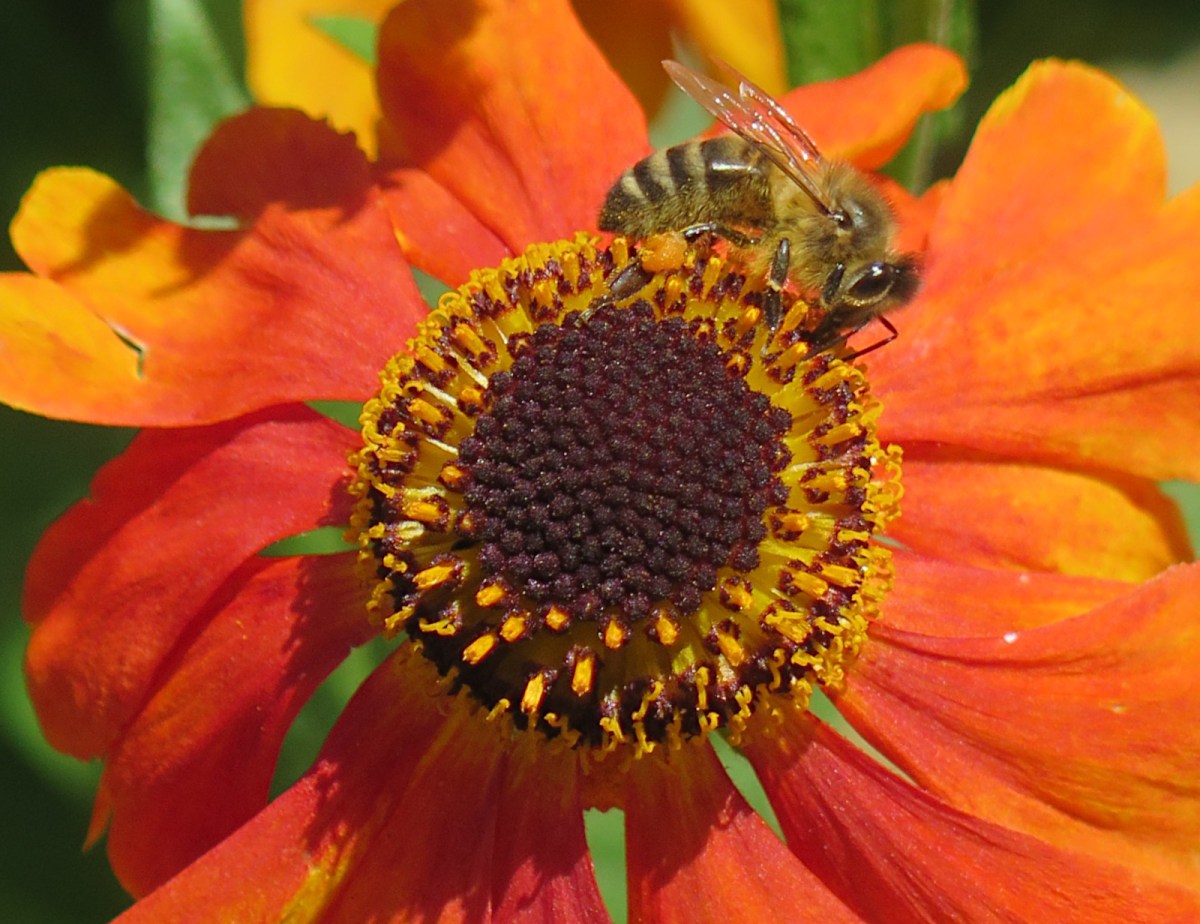
The worker honeybee in the photo is collecting pollen. Insect-pollinated plants have slightly sticky pollen that lodges on the bee’s hairy body. Bees visit flowers to collect nectar from the base of the petals, but get dusted with sticky pollen in the process.

< Previous | Index | Next >

What’s in an image? Sometimes quite a lot, more than meets the eye. I’m posting an image every two days or so.

Click to enlarge

Like all plants and animals, bees are pretty well suited to the actions they need to perform to live and reproduce. That’s what evolution does, it homes in on the best shape and size of wings, the optimum size for flight muscles, best arrangement of hairs on the legs to brush loose pollen towards the pollen sac for collection and transport, the best mouthparts for collecting nectar and so forth.

Quite a challenge, and an astounding achievement, but entirely doable by making small, random changes and selecting the best.

Here’s an example to make that bold claim clearer. If a random change enables the worker bees to carry on just a few days longer in the autumn, the hive will have slightly larger stores of honey for the coming winter. That hive will survive when a hive with less capable workers might not. And that’s enough. The new queens from the surviving hive will carry the altered gene and it’ll be present in the workers of the new colonies those queens create. The altered colonies will also survive in slightly colder places than before so will succeed at slightly higher altitudes and in slightly cooler climates.

The worker honeybee in the photo is collecting pollen. Insect-pollinated plants have slightly sticky pollen that lodges on the bee’s hairy body. Bees visit flowers to collect nectar from the base of the petals, but get dusted with sticky pollen in the process. Bees clean themselves like most insects (you’ve probably seen houseflies doing it, sweeping off particles of dust with one leg while standing on the others). When bees clean themselves, most of the pollen end up stuck together as a lump and lodges on a series of special hairs on the hind legs. Look closely and you can see this bee’s pollen load on its rear leg; an orange/yellow colour. Pollen is protein rich and the bees feed it to the bee pupae in the hive.

The plant feeds the bees nectar for energy and pollen for growing young bees; while the bees move pollen from flower to flower, and often from plant to plant over quite long distances, sometimes a mile or more. So the bees and the plants both benefit, it’s a useful co-operative effort.

Favourites

For convenience, here’s a list of my favourite images:

Anemone, Cloud, Honeybee, Hydrangea, Kiftsgate1, Kiftsgate2, Large White, Mugshot, Nelson, Robin, Rose, Spilhaus, Sunset1, Weston beach

Themed image collections

The links below will take you to the first post in each collection

Cirencester, Favourites, Irish holiday 2024, Roman villa

< Previous | Index | Next >

Useful? Interesting?

If you enjoyed this or found it useful, please like, comment, and share below. My material is free to reuse (see conditions), but a coffee is always welcome!

Image of the day – 92

If the Universe did not include time, nothing would change and there would be no patterns, no life, just stasis.

< Previous | Index | Next >

What’s in an image? Sometimes quite a lot, more than meets the eye. I’m posting an image every two days or so.

Click to enlarge

Anemones are simple flowers, but beautiful! I have strong childhood memories of the white version of these growing in my grandfather’s garden in Cirencester. They managed to grow in small cracks between the bottom of the house wall and the stone paving. The flowers stood nearly as tall as me so I suppose I might have been between five and seven years old at the time.

The flowers in the photo are at various stages of development:

  • On the stem just right of the centre you can see a few tiny leaves and a little, pale-green flower bud.
  • In the centre, near the top, is a much larger bud, about to open.
  • Right down at the bottom, a flower has opened but the petals are not yet full size and have not developed their final colour.
  • The flower on the left and just below the centre is fully open. There’s a little insect sitting on its centre.
  • Below and right of it is a more mature flower, the yellow anthers have shed their pollen and have shrivelled.
  • A little above and right again is an even older flower, the anthers are in worse condition and some of the petals are damaged around their margins.
  • The flower in the upper left has lost most of the anthers and the petals look tired and old.
  • In the upper-right you can see a flower with only two petals remaining.
  • And just above, the yellow globe is the remains of a flower that has lost all of its petals.

Although they look like pink petals, and I’ve called them that here, botanically speaking these are actually modified sepals. On most flowering plants, the sepals are small and green, normally hidden by the petals.

Patterns of development

The flowers on this Anemone are just one example of the kinds of patterns that come from anything that grows. We’re all familiar with the pattern in humans – fertilised egg, foetus, baby, toddler, pre-teen, young teen, adolescent, young adult, mature adult, early middle age, late middle age, elderly.

And you can trace stages of growth in cities, technology, philosophy, civilisation, language families, culture, stars, wars, galaxies, you name it. Such patterns of development are a fundamental part of the way things are in our universe. Time ticks by relentlessly, and all these patterns are patterns of change, in other words evidence of the passage of time.

If the Universe did not include time, nothing would change and there would be no patterns, no life, just stasis.

Favourites

For convenience, here’s a list of my favourite images:

Anemone, Cloud, Honeybee, Hydrangea, Kiftsgate1, Kiftsgate2, Large White, Mugshot, Nelson, Robin, Rose, Spilhaus, Sunset1, Weston beach

Themed image collections

The links below will take you to the first post in each collection

Cirencester, Favourites, Irish holiday 2024, Roman villa

< Previous | Index | Next >

Useful? Interesting?

If you enjoyed this or found it useful, please like, comment, and share below. My material is free to reuse (see conditions), but a coffee is always welcome!

Image of the day – 91

Only a minority of people have views from their back garden like this one. But we can all enjoy the photo.

< Previous | Index | Next >

What’s in an image? Sometimes quite a lot, more than meets the eye. I’m posting an image every two days or so.

Announcement – I need to reduce the time I’m spending writing JHM posts. To make this possible I plan to post images more often as they are quick to do, and I’ll put the time saved into fewer but hopefully better posts on other topics.

Click to enlarge

This is the view across the valley from Kiftsgate Court that I mentioned yesterday. You can see it from the swimming pool – what an amazing backdrop for a relaxing dip!

Only a minority of people have views from their back garden like this one. But we can all enjoy the photo, or visit Kiftsgate Court Gardens to admire it first hand.

See also:
Favourites

For convenience, here’s a list of my favourite images:

Anemone, Cloud, Honeybee, Hydrangea, Kiftsgate1, Kiftsgate2, Large White, Mugshot, Nelson, Robin, Rose, Spilhaus, Sunset1, Weston beach

Themed image collections

The links below will take you to the first post in each collection

Cirencester, Favourites, Irish holiday 2024, Roman villa

< Previous | Index | Next >

Useful? Interesting?

If you enjoyed this or found it useful, please like, comment, and share below. My material is free to reuse (see conditions), but a coffee is always welcome!

Image of the day – 90

Hidcote is an informally formal garden, if I can put it that way, while Kiftsgate is not formal at all. Both are full of surprises and delights at almost every turn.

< Previous | Index | Next >

What’s in an image? Sometimes quite a lot, more than meets the eye. I’m posting an image every two days or so.

Click to enlarge

Today’s photo was taken at Kiftsgate Court Gardens in the far north of Gloucestershire. The pool was designed for swimming, though today it’s just ornamental. Kiftsgate Court is a large house on the top of a local hill; the pool is below the house and has an amazing view across the valley to further hills beyond.

The people who lived here knew a thing or two about designing a wonderful garden. It’s right next to Hidcote, another marvellous garden and perhaps better known, but if you’re visiting one of them and have the time, try to see them both. They are both great but designed very differently, Hidcote is an informally formal garden, if I can put it that way, while Kiftsgate is not formal at all. Both are full of surprises and delights at almost every turn.

See also:
Favourites

For convenience, here’s a list of my favourite images:

Anemone, Cloud, Honeybee, Hydrangea, Kiftsgate1, Kiftsgate2, Large White, Mugshot, Nelson, Robin, Rose, Spilhaus, Sunset1, Weston beach

Themed image collections

The links below will take you to the first post in each collection

Cirencester, Favourites, Irish holiday 2024, Roman villa

< Previous | Index | Next >

Useful? Interesting?

If you enjoyed this or found it useful, please like, comment, and share below. My material is free to reuse (see conditions), but a coffee is always welcome!

Image of the day – 79

Thrive like an Irish Hydrangea, get rooted in surroundings and situations that bring out your very best.

< Previous | Index | Next >

What’s in an image? Sometimes quite a lot, more than meets the eye.

I’m posting an image every two days (or as often as I can). A photo, an image from the internet, a diagram or a map. Whatever takes my fancy.

Click to enlarge

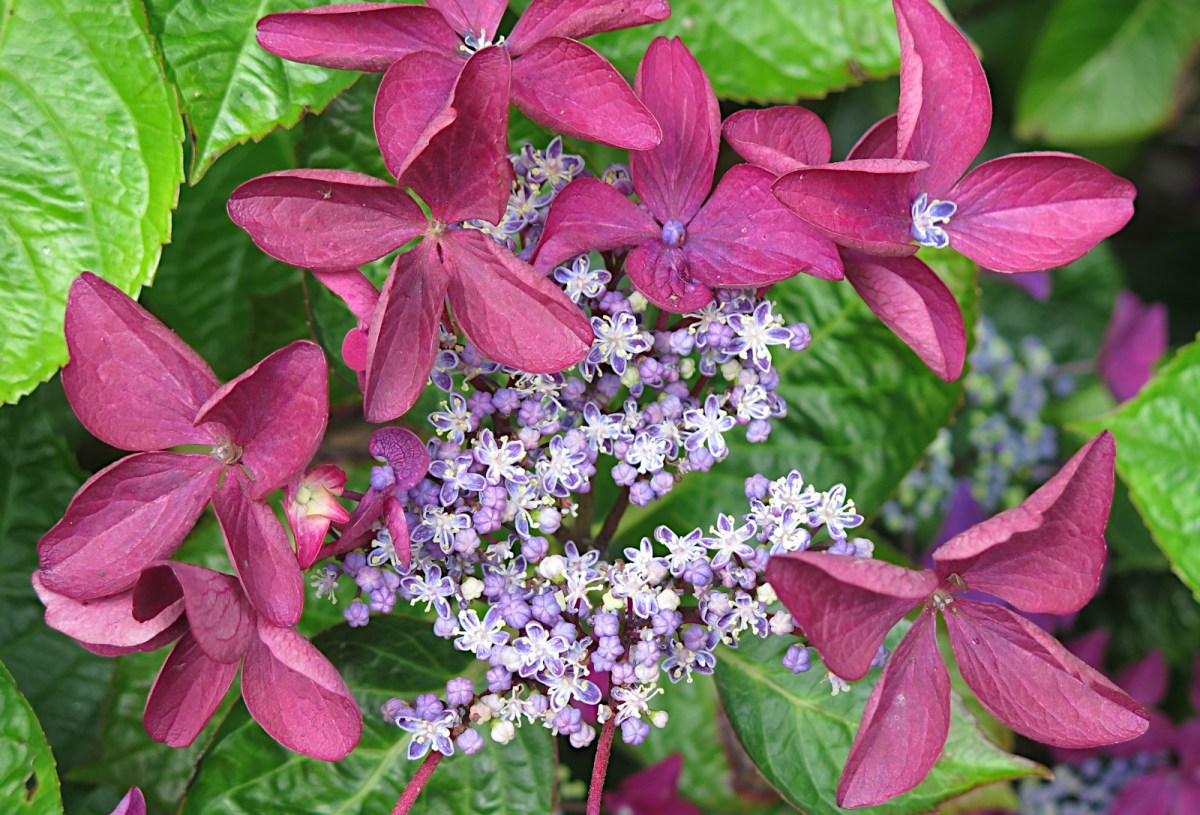
Irish gardens often have the most magnificent Hydrangeas, in striking colours, not just white, blue and pinks, but purples and very vivid blues as well as many kinds like the lacecaps where there are small inner flowers and large outer ones as in the photo.

It seems there’s something in the Irish soils or climate that cause Hydrangeas to thrive particularly well! We visited the Montalto Estate just south of Ballynahinch where I took this shot, but it’s typical of all the gardens we visited in our two weeks in Ireland.

Perhaps the same is true for people. Do we thrive best in particular places? Perhaps the cultural ‘soil and climate’ suit us best in the country we call home, or amongst people we know well. Some people are energised by good company and parties, others (like me) are energised by solo activities. I can walk for miles on my own and come home afterwards feeling calm, balanced, and ready for anything. Others I know are just the opposite, a long, solo ramble would be hard to endure.

Whatever the individual differences it’s good for all of us to spend time in the ways that are most comfortable to us. Thrive like an Irish Hydrangea, get rooted in surroundings and situations that bring out your very best. You deserve it! And the people around you deserve it too.


Images from our Irish holiday 2024

For convenience, here’s a list of all the Irish holiday images:

28th Jul – Welsh Botanic Garden, Robin, Fishguard
29th Jul – Wicklow Mts, Glendalough, Powerscourt, Rose, Greystones
30th Jul – Liffey, Temple Bar, St Patrick’s Cathedral
31st Jul – Newgrange, Battle of the Boyne
1st Aug – Monasterboice, Mourne, Thrift, Window
2nd Aug – Spelga Dam, Hydrangea, Pipework, Lough Neagh
3rd Aug – Coagh, Springhill, Portrush
4th Aug – Beach at Portrush
5th Aug – Giant’s Causeway, Carrick-a-Rede, Portrush

Themed image collections

The links below will take you to the first post in each collection

Cirencester, Favourites, Irish holiday 2024, Roman villa

< Previous | Index | Next >

Useful? Interesting?

If you enjoyed this or found it useful, please like, comment, and share below. My material is free to reuse (see conditions), but a coffee is always welcome!

Image of the day – 40

Nobody knows when rose breeding began, it may have been as far back as Greek or Roman times.

< Previous | Index | Next >

What’s in an image? Sometimes quite a lot, more than meets the eye.

I’m posting an image every day (or as often as I can). A photo, an image from the internet, a diagram or a map. Whatever takes my fancy.

A beautiful rose at Powerscourt Gardens

While we were at the Powerscourt Estate, Donna wanted to look at the rose garden; this photo shows a really beautiful example of the flowers on view. Looking at the image now I can almost smell the fragrance in my mind!

Roses like these are not part of the natural world; they’re the work of plant breeders crossing a range of wild species and selecting for characteristics they liked. Nobody knows when rose breeding began, it may have been as far back as Greek or Roman times, but was certainly underway in medieval Europe and perhps in the middle and far east as well.

I wrote an article four years ago that includes photos of a much more natural rose. Comparing the two images emphasises how plant breeding can make huge changes (the breeders might say ‘huge improvements’) to wild forms. The same is true for animal breeding, just compare any modern breed of dog with the wild, wolf ancestor for example!


Images from our Irish holiday 2024

For convenience, here’s a list of all the Irish holiday images:

28th Jul – Welsh Botanic Garden, Robin, Fishguard
29th Jul – Wicklow Mts, Glendalough, Powerscourt, Rose, Greystones
30th Jul – Liffey, Temple Bar, St Patrick’s Cathedral
31st Jul – Newgrange, Battle of the Boyne
1st Aug – Monasterboice, Mourne, Thrift, Window
2nd Aug – Spelga Dam, Hydrangea, Pipework, Lough Neagh
3rd Aug – Coagh, Springhill, Portrush
4th Aug – Beach at Portrush
5th Aug – Giant’s Causeway, Carrick-a-Rede, Portrush

Themed image collections

The links below will take you to the first post in each collection

Cirencester, Favourites, Irish holiday 2024, Roman villa

< Previous | Index | Next >

Useful? Interesting?

If you enjoyed this or found it useful, please like, comment, and share below. My material is free to reuse (see conditions), but a coffee is always welcome!

Image of the day – 39

Most of these old houses and their gardens are now enjoyed by much larger numbers of visitors than the original owners could possibly have imagined.

< Previous | Index | Next >

What’s in an image? Sometimes quite a lot, more than meets the eye.

I’m posting an image every day (or as often as I can). A photo, an image from the internet, a diagram or a map. Whatever takes my fancy.

National Geographic rated this as the third best garden in the World. It’s Powerscourt Gardens in Wicklow, Ireland. National Geographic is right, this is a very fine garden indeed. It’s spacious, well designed, full of interesting plants and landscape features, and very well maintained. We did spot a few small weeds here and there, but not very many; keeping a garden this large will require a lot of dedicated gardeners, either volunteers or paid staff (probably both). Most of the work has to be done manually, it will not be a cheap operation!

Of course, ordinary everyday people can’t manage a huge garden like this, nor afford to build a house as large as Powerscourt. A very tiny minority of the population could build and live in this kind of luxury either then or now. And even among the very wealthy, not everyone wants to.

But time moves on, and most of these old houses and their gardens are now enjoyed by much larger numbers of visitors than the original owners could possibly have imagined. Perhaps they’d have been horrified! But I, for one, am grateful for their beautiful legacies that I can visit and enjoy.

I have a final question for you, dear reader, and for myself too. What will you leave as a legacy for future generations? And what will I leave? Why not leave your thoughts below in a comment? There are no right or wrong answers.


Images from our Irish holiday 2024

For convenience, here’s a list of all the Irish holiday images:

28th Jul – Welsh Botanic Garden, Robin, Fishguard
29th Jul – Wicklow Mts, Glendalough, Powerscourt, Rose, Greystones
30th Jul – Liffey, Temple Bar, St Patrick’s Cathedral
31st Jul – Newgrange, Battle of the Boyne
1st Aug – Monasterboice, Mourne, Thrift, Window
2nd Aug – Spelga Dam, Hydrangea, Pipework, Lough Neagh
3rd Aug – Coagh, Springhill, Portrush
4th Aug – Beach at Portrush
5th Aug – Giant’s Causeway, Carrick-a-Rede, Portrush

Themed image collections

The links below will take you to the first post in each collection

Cirencester, Favourites, Irish holiday 2024, Roman villa

< Previous | Index | Next >

Useful? Interesting?

If you enjoyed this or found it useful, please like, comment, and share below. My material is free to reuse (see conditions), but a coffee is always welcome!

Image of the day – 34

With its protection, it’s been possible to nurture not just some tropical and semi-tropical plants, but entire biomes.

< Previous | Index | Next >

What’s in an image? Sometimes quite a lot, more than meets the eye.

I’m posting an image every day (or as often as I can). A photo, an image from the internet, a diagram or a map. Whatever takes my fancy.

Welsh National Botanic Garden

We enjoyed a holiday in Ireland from 28th July to 12th August and I’ll share some photos from our trip. I’ll return to more Roman villa photos later.

This first photo is from our journey out from Cirencester where we live. We took the M5 down to the Second Severn Crossing and then the M4 to its end in South Wales, stopping later at the National Botanic Garden of Wales for a light lunch and a break from driving.

The photo shows a view inside their amazing ‘Great Glasshouse’, the world’s largest single-span glasshouse. With its protection, it’s been possible to nurture not just some tropical and semi-tropical plants, but entire biomes. The exprience reminded us of Cornwall’s Eden Project. Although the Great Glasshouse is smaller, it is still very, very impressive.

If you had a greenhouse this big, what would you like to grow in it?


Images from our Irish holiday 2024

For convenience, here’s a list of all the Irish holiday images:

28th Jul – Welsh Botanic Garden, Robin, Fishguard
29th Jul – Wicklow Mts, Glendalough, Powerscourt, Rose, Greystones
30th Jul – Liffey, Temple Bar, St Patrick’s Cathedral
31st Jul – Newgrange, Battle of the Boyne
1st Aug – Monasterboice, Mourne, Thrift, Window
2nd Aug – Spelga Dam, Hydrangea, Pipework, Lough Neagh
3rd Aug – Coagh, Springhill, Portrush
4th Aug – Beach at Portrush
5th Aug – Giant’s Causeway, Carrick-a-Rede, Portrush

Themed image collections

The links below will take you to the first post in each collection

Cirencester, Favourites, Irish holiday 2024, Roman villa

< Previous | Index | Next >

Useful? Interesting?

If you enjoyed this or found it useful, please like, comment, and share below. My material is free to reuse (see conditions), but a coffee is always welcome!

Image of the day – 29

Tree roots probe small cracks and as they grow, heave even heavy structures aside.

< Previous | Index | Next >

What’s in an image? Sometimes quite a lot, more than meets the eye.

I’m posting an image every day (or as often as I can). A photo, an image from the internet, a diagram or a map. Whatever takes my fancy.

Silver birch

Today’s image shows a piece of ground lightly covered with silver birch; but the history of this area is interesting. During the war it was an RAF airfield (RAF Riccall) with runways, brick and concrete buildings, bomb stores and more. The airfield was in used from 1944 to 1958, and today the brick structures are collapsing, the runways have cracked and are mostly covered by layers of moss, grass and other low vegetation, and the other areas have become scrubland and lightly wooded areas as shown in the photo.

This clearly illustrates how much time and maintenance effort is required to hold back the natural world from recolonising our built infrastructure. What begins with the typical grass and weeds of cultivated ground soon becomes an impenetrable mass of brambles and young trees. As they grow larger, the trees shade out the brambles, and fallen leaves cover the concrete and tarmac and accumulate as fresh soil. Tree roots probe small cracks and, as they grow, heave even heavy structures aside. It’s a fascinating process. Skipwith Common, with the old airfield on its north-western edge, is representative of Yorkshire’s lowland heath ecology.

We think our built environment is solid and secure – not so! It’s easily overwhelmed once we stop maintaining it. Look at the land around the site of Chornobyl in Ukraine for another example of the speed of wildlife return to an area substantially left alone by humans.

< Previous | Index | Next >

Useful? Interesting?

If you enjoyed this or found it useful, please like, comment, and share below. My material is free to reuse (see conditions), but a coffee is always welcome!