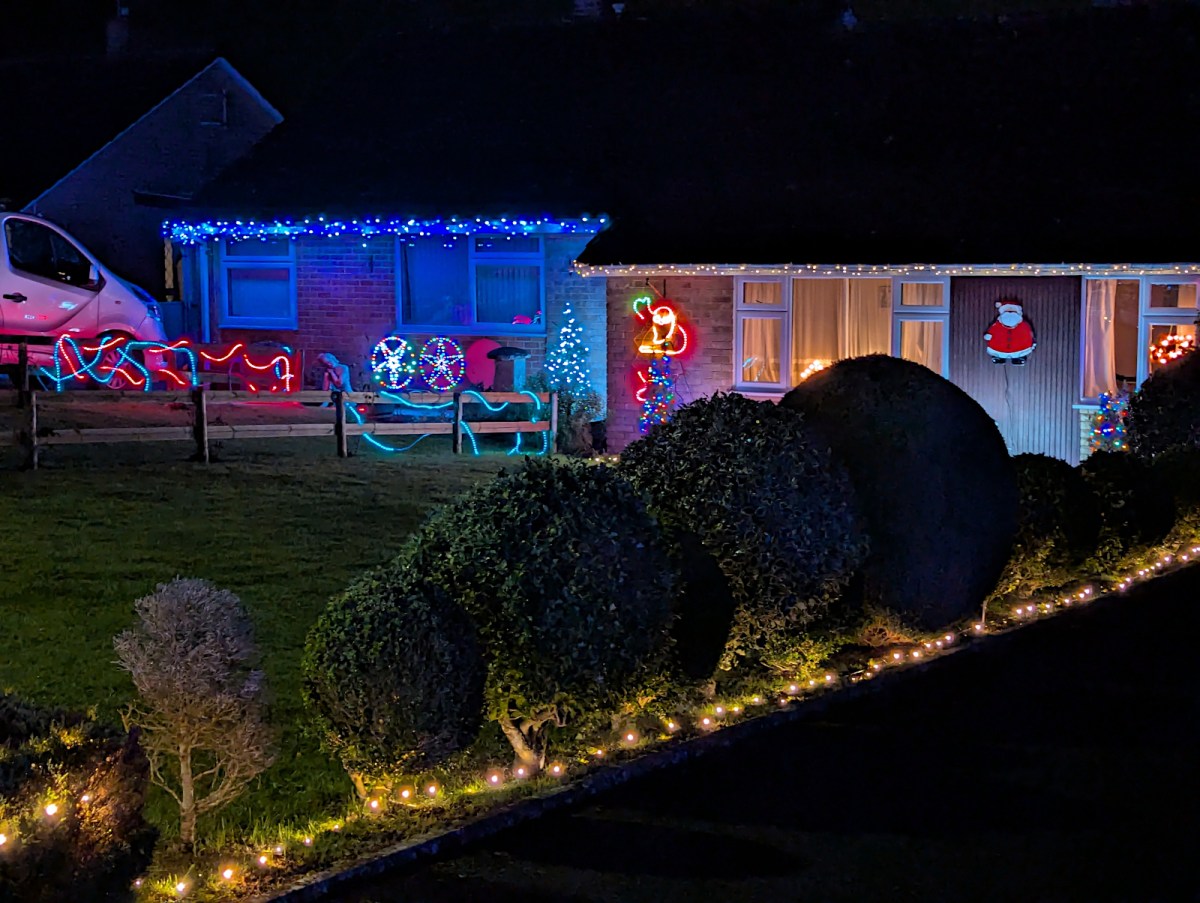
At Vale Road in Stratton on the northern edge of the Cotswold town of Cirencester, residents (and one in particular) put a lot of effort each year into decorating their homes and gardens with all sorts of coloured and illuminated decorations. And they invite the people who come to look to make a contribution to Macmillan Cancer Support.
What’s in an image? Sometimes quite a lot, more than meets the eye. I’m posting an image every few days.
Click images to enlarge
People love Christmas lights and decorations, and people hate illness particularly if there’s no cure. So can Christmas lights help people with incurable illness? Yes they can! But…how?
Well, one way is to use the Christmas decorations to raise money for charity, and that’s what one street in Cirencester has been doing every year for some time now.
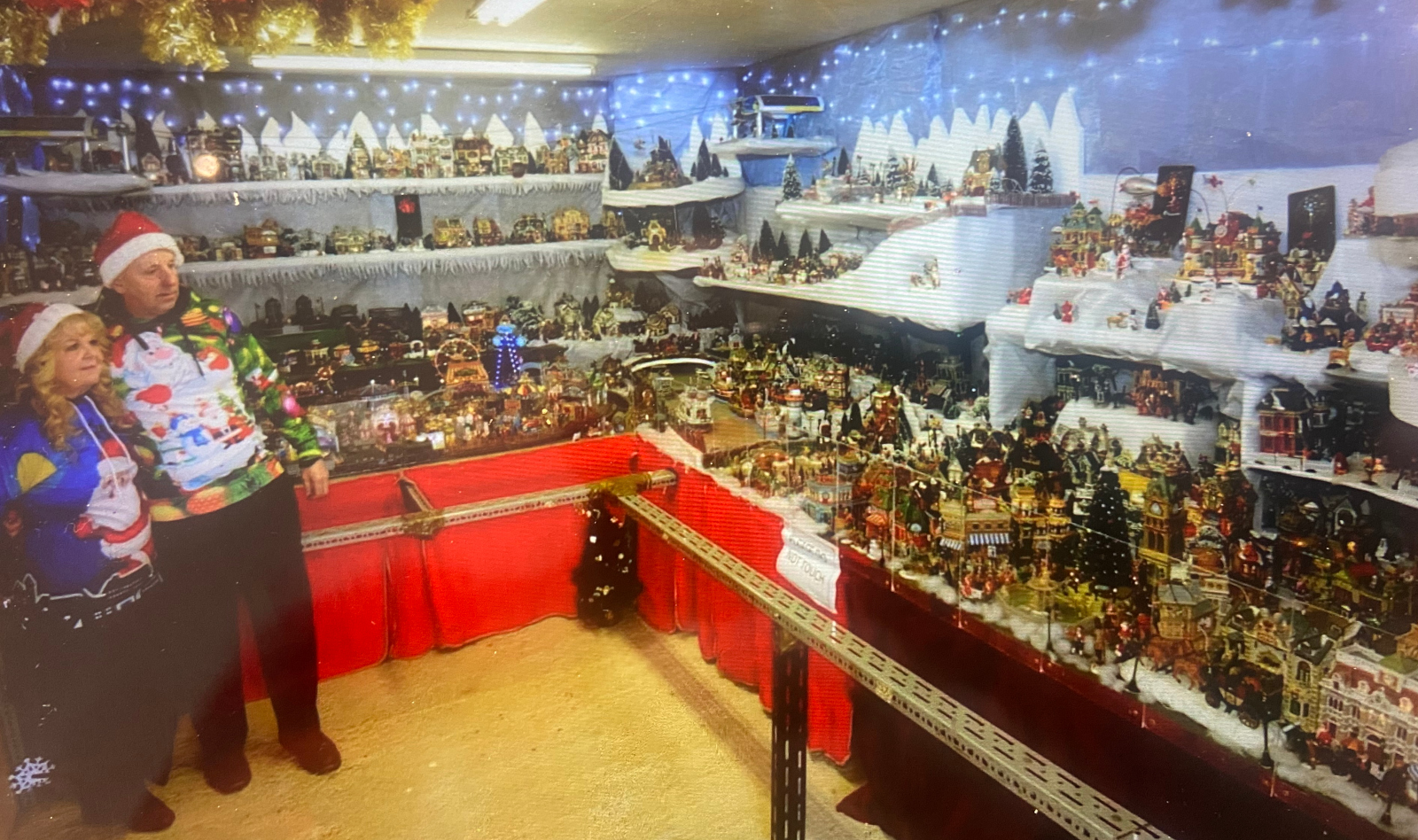
There’s more inside – a model village!
At Vale Road in Stratton on the northern edge of the Cotswold town of Cirencester, residents (and one in particular) put a lot of effort each year into decorating their homes and gardens with all sorts of coloured and illuminated decorations. And they invite the people who come to look to make a contribution to Macmillan Cancer Support. This charity provides care, help, nursing and support for cancer patients and their families right at the time when they need help most. They will help families care for a mum, a dad, or a grandparent at home.
The heart of the action
If you live in Cirencester or the local area, why not drive out to Vale Road and park in a nearby street like Vaisey Road, Tinglesfield or Park View? (But please don’t block any driveways or park near junctions.) Then walk the short distance to Vale Road. You can pay for a tour of the best of the lights, delight your children (or grandchildren), and help support a great cause all at the same time. What could be better than that?
If you enjoyed this or found it useful, please like, comment, and share below. (If you don’t see those links, click the article’s title above the main photo and they will appear.) Send a link to friends who might enjoy the article or benefit from it – Thanks! My material is free to reuse (see conditions), but a coffee is always welcome and encourages me to write more often!
Lead with Your Heart is my favourite musically, Halfway Home contains my favourite lyrics, and if I’m allowed a third choice it would have to be The legend of Dram Fools or Whisky River just for the mad joy and fun of it!
My nephew, Gavin Landless, was in the UK recently for a visit with his partner, Donna. They came to catch up with various friends and relatives and came over to see me and my Donna at our home in Cirencester. Gavin’s Mum, Cindy (my sister), came with them.
I’ve always liked Gavin, it’s interesting to chat with him as we do have several shared interests, and it was great to meet Donna as well. While he was with us he handed me a CD. For quite some time, Gavin and his friend Bob have been writing their own music and lyrics and performing locally in the part of upstate New York where they live, Syracuse. It occurred to Gavin that they had enough songs for a CD, Bob agreed, and Gavin, who once had a professional role in music production, set to work. They employed other musicians to enlarge the instrumental range and the CD, Dram Fools was released and seems to be doing well. It deserves to!
They try to define their style, writing on the website:
Think vocal-driven R&B-jazz-pop-Celtic-alternative and you’ll have, well, still no idea really. So it’s better to just follow them, listen to a few tracks, and find your favorite song!
So perhaps I’ll simply say that it’s hard to decide which is my favourite song because they are all really, really good. But I have to pick one or two, don’t I? – Lead with Your Heart is my favourite musically, Halfway Home contains my favourite lyrics, and if I’m allowed a third choice it would have to be The legend of Dram Fools or Whisky River just for the mad joy and fun of it!
Keep going Bob and Gavin, Dram Fools you may call yourselves, but you’ve got something good going here!
If you enjoyed this or found it useful, please like, comment, and share below. (If you don’t see those links, click the article’s title above the main photo and they will appear.) Send a link to friends who might enjoy the article or benefit from it – Thanks! My material is free to reuse (see conditions), but a coffee is always welcome and encourages me to write more often!
The business had phone extensions to each office but also, and very unusually, to each of the nurseries out in the countryside within and beyond the town. (1930s)
Blast from the past… 36
Similar exchange to The General Office Jump to 1930s
August 2025 (3 months before publishing this article)
Click pics to enlarge
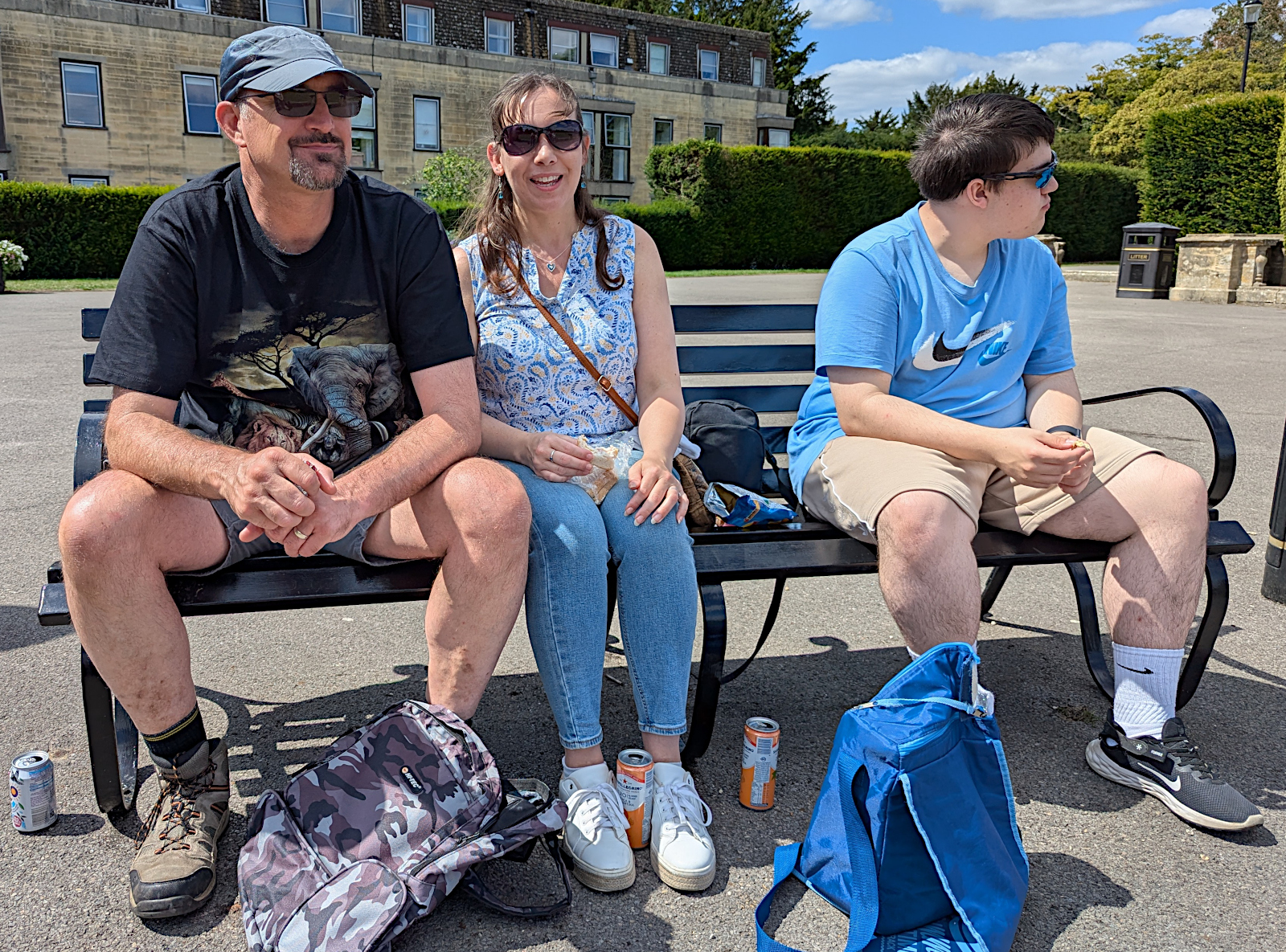
Kevin, Lariana, and Ruben
Kevin, Lariana, and her son Ruben (friends from St Neots) came to stay with us for a few days. They wanted to visit ‘The Farmer’s Dog’, so we sat outside and ate some of their excellent burgers.
Farmer’s Dog
We visited some of the Cotswold sights, walking in Cirencester, looking around Lower Slaughter and Bourton-on-the-Water.
Skiddaw and sheep
Later in the month we spent a week on our family holiday in the Lake District. We had a grand, old house in Braithwaite just west of Keswick and enjoyed the local countryside and some lovely places to eat and drink coffee right in some of the best spots in this lovely part of England. And towards the end of the month we stayed near Tiverton with Isobel for a week – it was a busy August with a lot of holiday one way or another.
JHM: I wrote about some very small Police stations; and added a fifth part to the series on my journey to faith. World events: OpenAI’s GPT-5 was released; and Donald Trump met Vladimir Putin in Alaska, to discuss a plan for resolving the conflict in Ukraine.
It was Fern’s 16th birthday in May, and she’s our youngest grandchild. Sara expects to begin A level courses in September. They are all so grown up now! At the end of term, Mero will complete her first year at university, and Aidan took a year out to travel in South America and will start at York University when the autumn term begins.
Paul and Isobel on the Weston seafront
At the end of the month we visited Donna’s brother Paul and his wife Vanessa in Weston-super-Mare, taking Isobel with us for the day. The entire summer seemed to have been fine and sunny, and sometimes just a little bit too warm.
It seemed like a good idea to rearrange my family history files by date instead of by topic, so I reordered everything and created virtual file and folder links for everything so that the data can be viewed in both ways. This seems to work well and will make it easier for other members of the family to find everything.
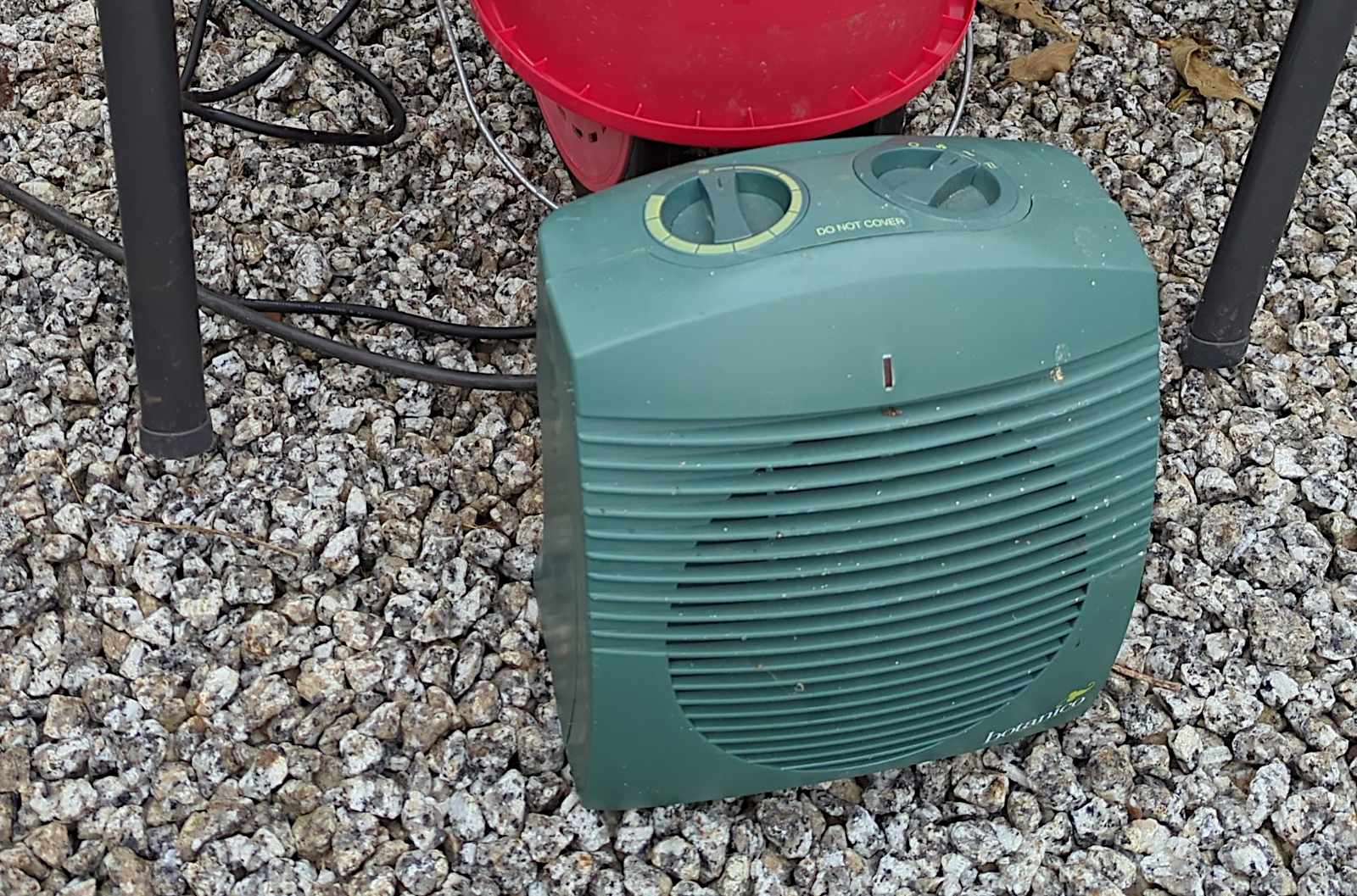
With colder weather on the way we needed to keep frost out of the greenhouse, so we ran an extension cable from the cabin to the greenhouse, put a plastic bucket over the reel to prevent water reaching it, and connected a heater set to just a few degrees above zero. This worked really well and even the more sensitive plants survived through the winter.
Donald Trump won the US Presidential Election, we found this hugely depressing and annoying. It seemed to us that at best he’s a loose cannon, and at worst he might become dictatorial. It’s not a great prospect so now we await February with some trepidation.
And we had water getting into our loft space from a leak around the chimney. It only happened in heavy, driving rain during storms from the south-west, at other times the roof space remained dry.
JHM: I wrote about the curious Spilhaus map projection; and a beautiful rose in the rain. World events: Justin Welby announced his resignation as Archbishop of Canterbury; and the spotted hyena (Crocuta crocuta) was rediscovered in southeast Egypt, 5,000 years after it had been though to have died out.
We drove over to Cotswold Airport for lunch at AV8, always a fun thing to do!
Ken Hudson’s funeral was on 15th, Ken was Donna’s Uncle, her Dad’s older brother. It was quite an occasion with a lot of family members turning up on the day.
SpaceX’s Starship had a good second test flight. It made significant progress over the first flight, with all 33 booster engines firing successfully for the full expected duration.
Erin
Donna’s cat, Erin, suffering with cancer, was still doing well on a second slow-release dose of steroids; this gave her a good and normal life for the time being. She was very much her old self, coming and going through the cat flap, and even play fighting with Donna again. A remarkable (and very welcome) thing to see.
JHM: I wrote about Chuck Pfarrer’s reporting on Russia’s war in Ukraine; and about Yaroslava Antipina’s very personal writing on the same topic. World events: The first AI Safety Summit was held in the United Kingdom, with 28 countries signing an agreement on how to manage the riskiest forms of artificial intelligence; and The Beatles released ‘Now and Then‘, the band’s last ever song.
We returned Tom Holme to Rugby for a scheduled MRI scan (he’d been living with us for a while) and we visited Westonbirt Arboretum on 12th, a sunny wintery day with some lovely autumn colours.
Meanwhile, Joe Biden was elected President of the USA.
Frost on nettle
Phil Reynolds and I did a long circular walk from Sapperton, taking in a nature reserve site where large blue butterflies are breeding successfully. I got a pretty photo of frost on stinging nettle leaves, and we also visited the Sapperton Portal of the Thames and Severn Canal tunnel.
We took a short holiday in Somerset in late October and early November We stayed in ‘Ian’s Cottage’, visited Tyntesfield House near Clevedon (and recently given to the National Trust) and the lovely old town of Frome. We visited Bristol as well.
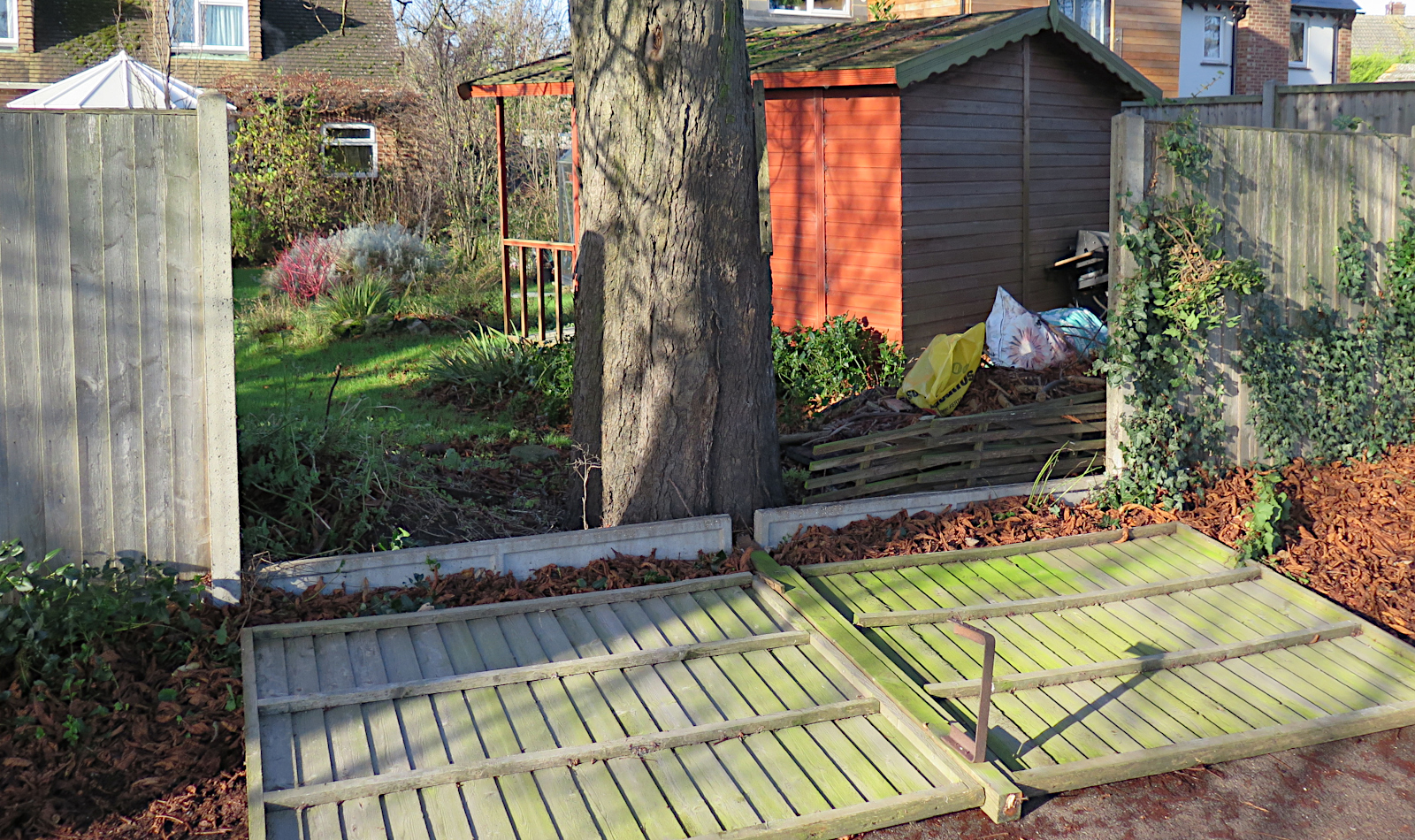
Wind damage
Our back fence blew down in strong winds, despite being sturdy and in quite good condition.
Newforms
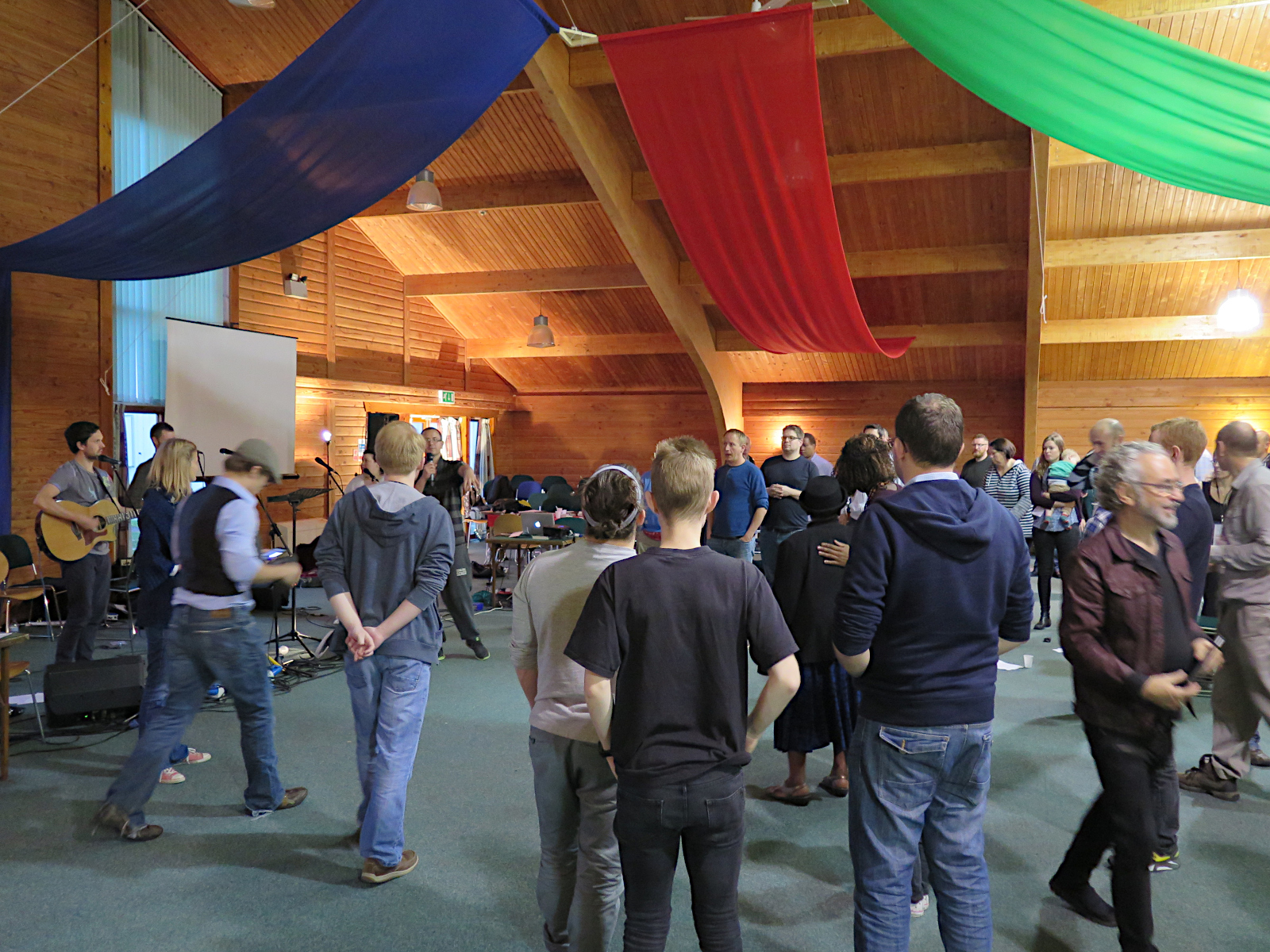
Over the weekend of 27th-29th I was at a Newforms Gathering in Lichfield’s Whitemoor Lakes Centre where I had a chance for a brief chat with Alan Hirsch. I don’t think I took full advantage of the opportunity, but he was kind and helpful despite being a bit jet-lagged (in the photo he’s just exiting on the right).
JHM: I wrote about science and religion. World events: Turkey shot down a Russian fighter jet on the Turkish–Syrian border; and COP21 was held in Paris.
The 4th Cornerstone Directors’ Meeting was held on 1st November. We considered ways to reduce food waste and increase profits. We decided to increase customer numbers in the mornings and afternoons, and advertise the meeting rooms. Paul reported gross takings of £2000 per week, he also feels the kitchen is too small and volunteer staff are leaving, the reasons being the cramped and dirty kitchen and the tiring workload. I agreed to make documents available in a single place and our MP, Jonathan Djanogly would unveil the plaque on 12th November.
The Circus arrived in St Neots on 3rd (see the photo above taken through the window from Cornerstone).
Sara and Debbie
We visited Yorkshire to see the family on 6th and 7th, going along to the fireworks display in Thorganby
JHM: I wrote about a wind-up torch; and fireworks and soup. World events: The G-20 summit was held in Seoul, South Korea. South Korea became the first non-G8 nation to host a G-20 leaders summit; and the European Union agreed to an €85 billion rescue deal for Ireland from the European Financial Stability Facility.
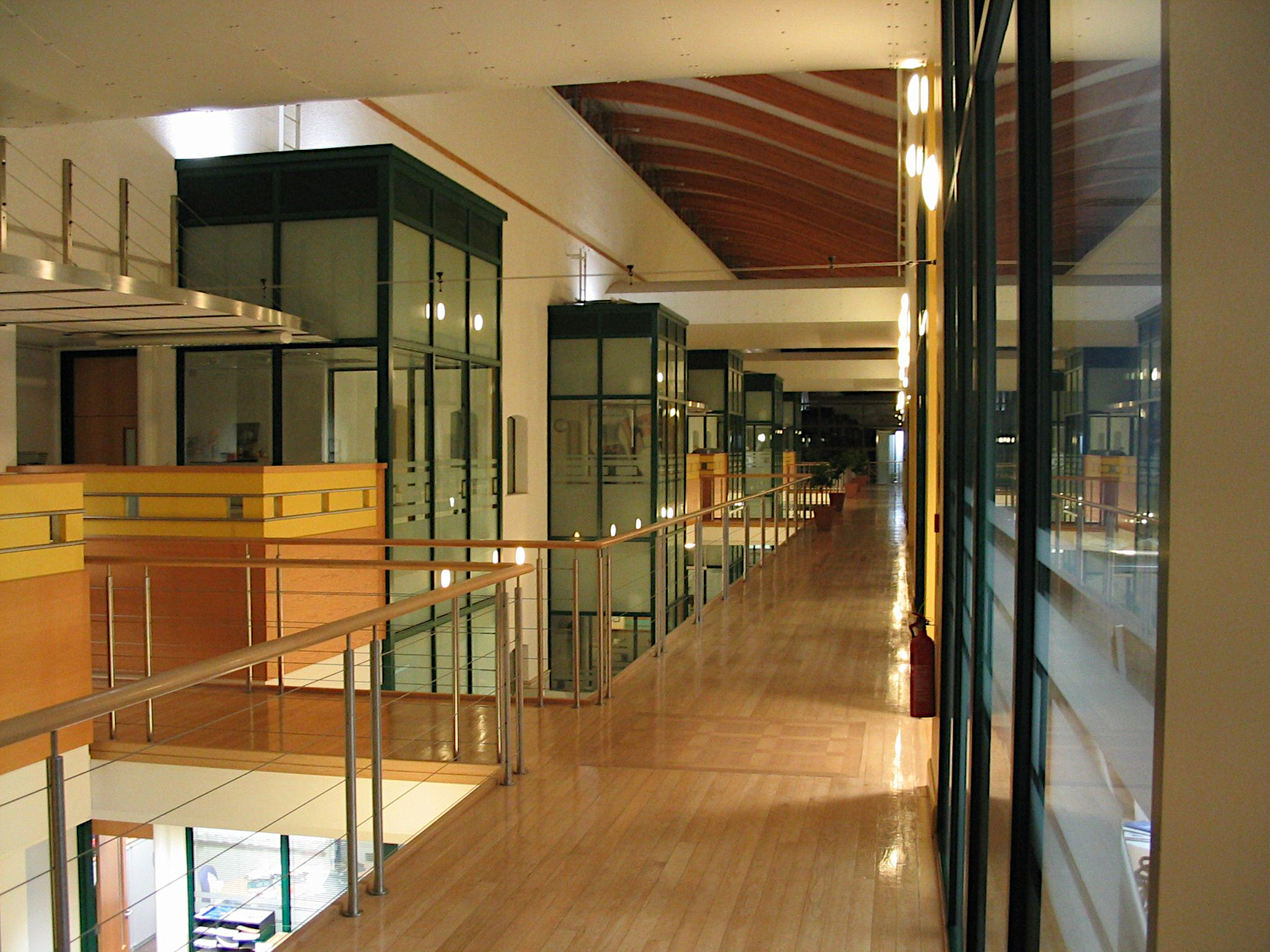
Unilever Colworth’s Knowledge Systems Group (KSG) had moved to a new office upstairs in the New Foods Building. As I was part of KSG I had a desk in the new office, inside the glass partition on the right of this photo. It was a lovely place to work, the main entrance at the front opened onto a short, paved road and a view onto the park’s lawn and trees with the rear of the old house visible on the far side. It was like working in a modern office on a National Trust site!
At this time, KSG was in the throes of migrating all our websites to pages and portlets on Unilever’s new Portal intranet site.
PCW magazine
I began moving my blog from Google’s Blogger platform to Squarespace, but in the end I didn’t get on well with the new software and reverted to Blogger. I redesigned the appearance in Blogger and was content with that new version until I made the switch to WordPress in July 2016. I was keeping up with current PC developments by buying PCW every month. Twenty years later all I need is a web browser!
I spent some time reading about Cirencester’s post-Roman history in the book ‘Town Origins and development in Early England’ by Daniel Russo. It seems that Romanised life might have continued here well after Roman forces were recalled from Britain.
On 19th we visited our friends Geoff and Dawn for dinner, other good friends were invited too, including Ken and Gayna seen in this photo. Geoff and Dawn were always very hospitable, and Geoff cooked amazing roast dinners.
Pete working on my computer.
We were both working for Unilever Research at their Colworth Laboratory in Sharnbrook, north of Bedford. Here, Pete Doe from the IT team is fixing something on my work desktop computer in Building 27, demolished later during my time at Colworth. My mobile phone and Psion palmtop are both visible on my desk, typical items of turn-of-the-century technology.
It was clear to all of our family and friends that Judy was nearing the end of her life. During November she was finding it hard to get downstairs, even with help. And her mind was being affected by the doses of morphine she was starting to take to control pain. This was sometimes quite amusing. One day I walked into the bedroom to find her tracing patterns of stems and leafy shapes on the duvet cover, talking about how they went round and round. Beth took her Oxford entrance exam on 13th, and when she had a letter confirming that she had a place as an undergraduate, Judy didn’t believe it, thinking instead that it had been forged by some of her school friends!
We had a lot of help from our friends, Tony and Faith, and Paul and Jenny, but also increasingly from our parents; my parents and Judy’s were both coming for a day once a week, making it far easier for me to get to work more often at Long Ashton.
Scott Russell at the University of Arizona, set up a mirror of my Microsopy web site on a sever there to reduce the load on the LARS server. I gave him FTP access to the folder on the LARS Windows NT box so he could set up a daily automatic file transfer.
At Long Ashton, we were considering a move to PC-TCP for networking our desktop PCs.
World events: The Indian government officially renamed the city of Bombay, restoring the name Mumbai; and Israeli Prime Minister Yitzhak Rabin was assassinated at a peace rally in Tel Aviv.
Judy’s Mum and Dad visited us on 10th November and we exchanged Christmas presents. We gave her Dad a copy of the giant book ‘Chronicle of the 20th Century’ and he said he’d ‘look forward to reading it in bed, a day a night’!
Sinclair QL
Our computing system at home was a Sinclair QL with a Sony green screen monitor, a basic ink-jet printer, and a twin 3½ inch floppy-disk drive. This was Sinclair’s follow-on from the Spectrum, it came with with a quite capable office software suite of word processor, spreadsheet, a functional database and a graphics package. I used it for programming and keeping track of finances, and we all used it for word processing.
I was working in the Plant Science Division at Long Ashton Research Station in a rather futile attempt to locate the plant hormone gibberellin in frozen sections of plant tissue. It had been my idea to make the attempt, but I’d made little or no tangible progress. Judy was thriving as a biology teacher at Cotham Grammar School in Bristol (now Cotham School), especially enjoying teaching A Level and running field trips, often to Slapton Ley National Nature Reserve.
Debbie was 10 and Beth was 7, and both were doing well at school in Yatton where we were living at 80 Stowey Road.
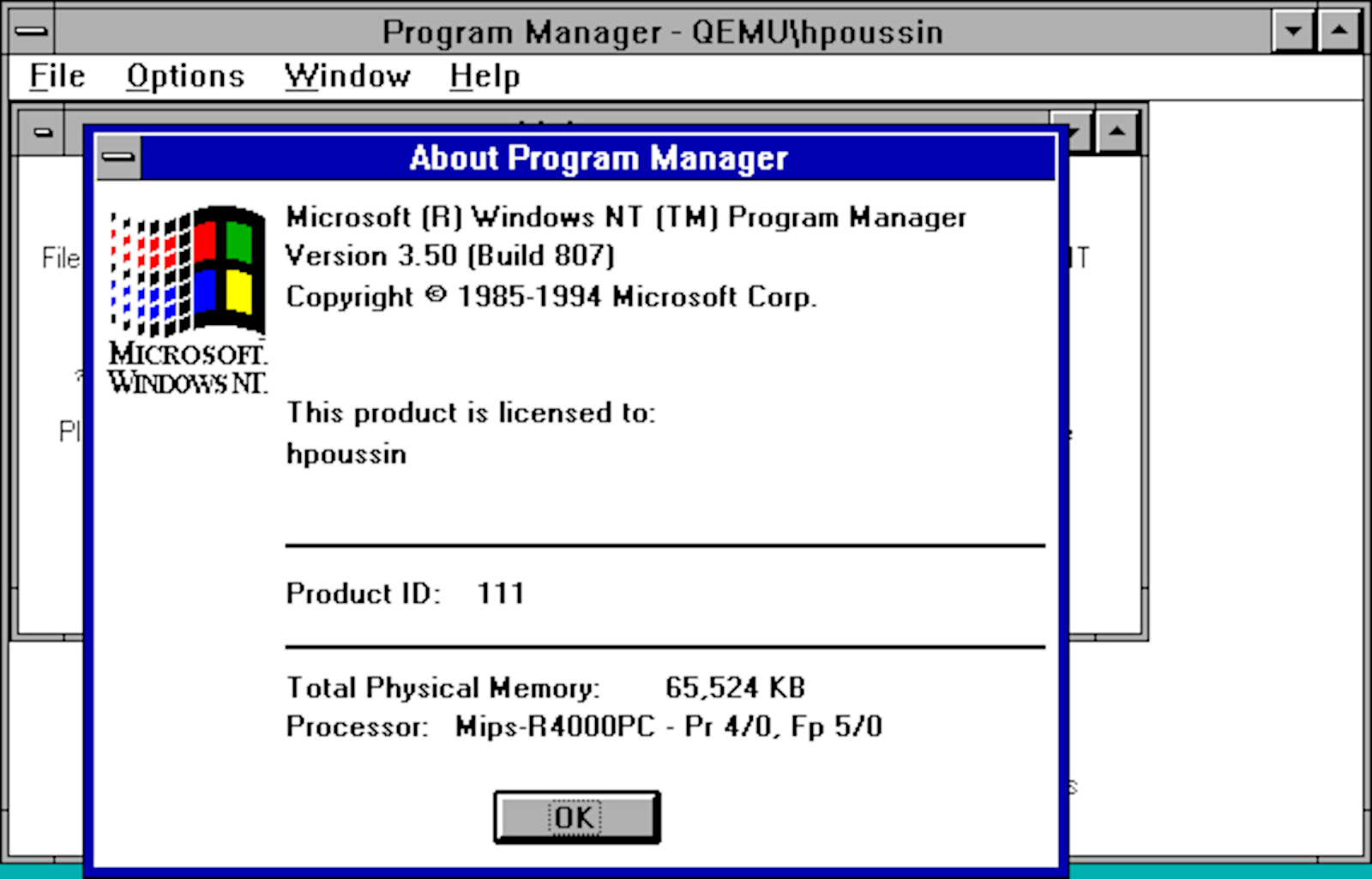
World events: U.S. President Ronald Reagan and Soviet Union leader Mikhail Gorbachev met for the first time; and Microsoft released Windows 1.0 in the USA.
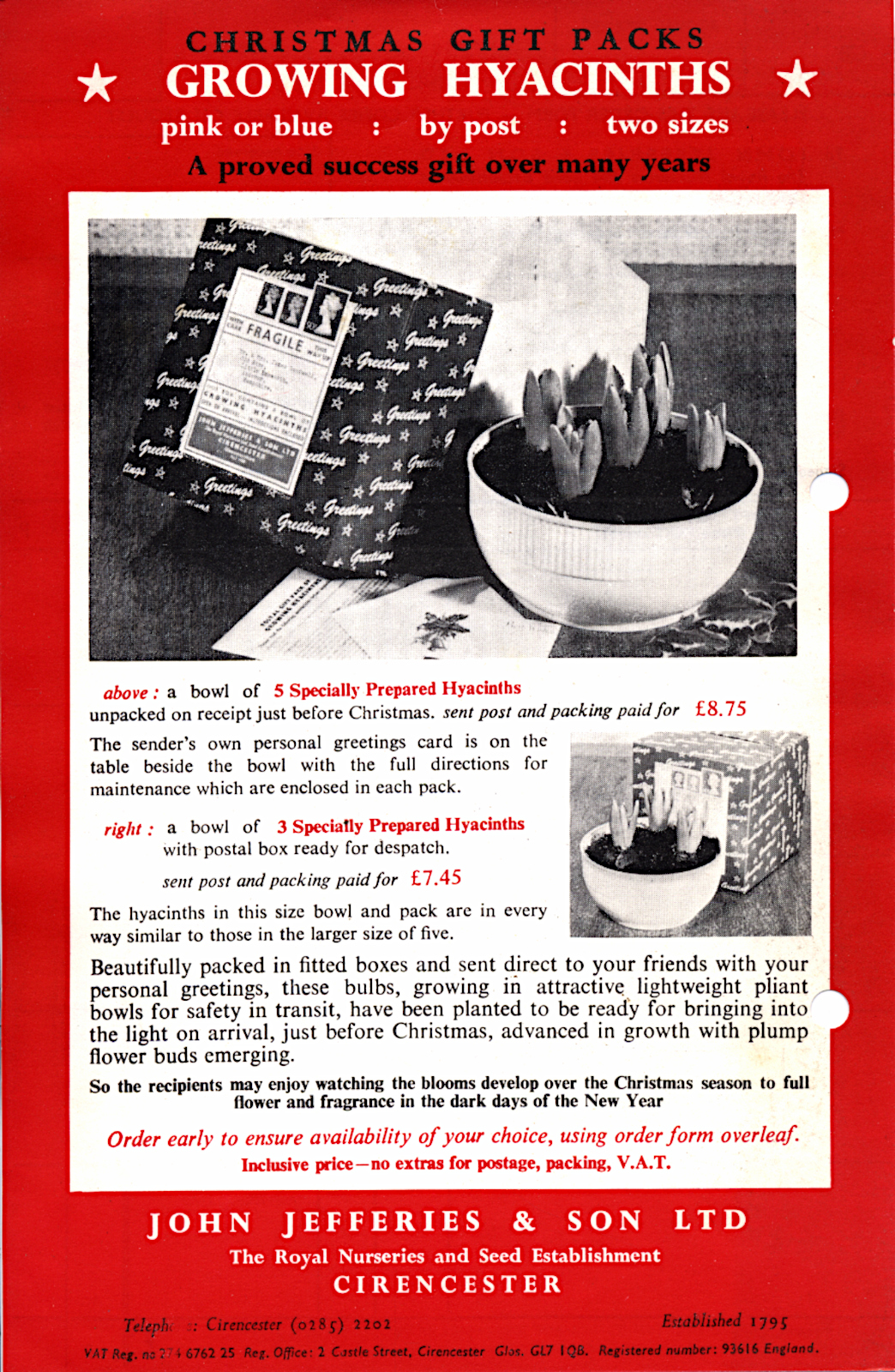
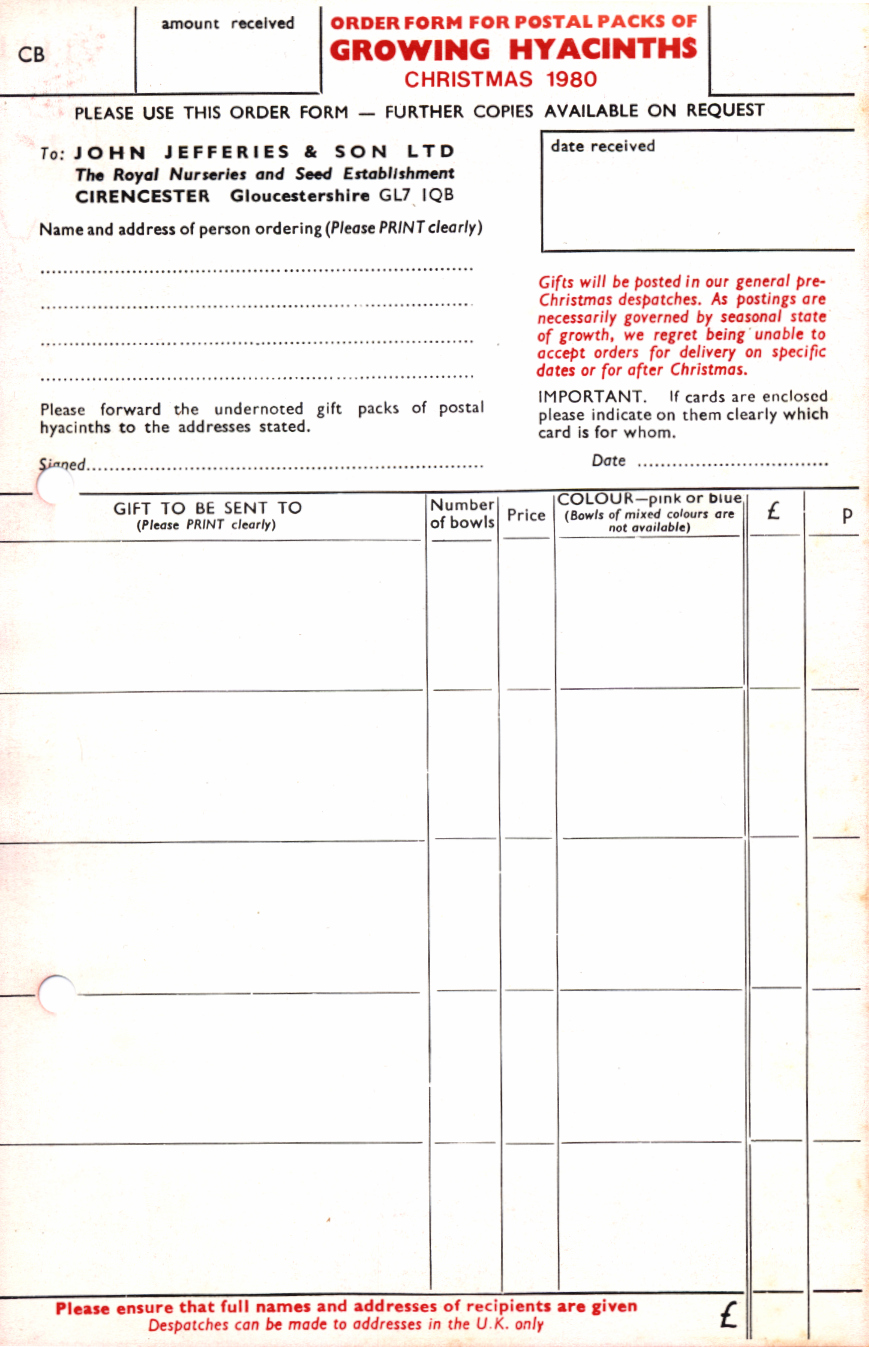
John Jefferies & Son published their Christmas Hyacinth Gift Pack leaflet and order form (one of the last few years before closing the shop and selling the garden centre to Country Gardens). Here’s the order form that was circulated with the leaflet.
We were living at 22 Rectory Drive, Yatton. Debbie was five and Beth was two. Judy was at home with the girls on weekdays and I was still researching pollen and pollen tube growth at Long Ashton Research Station. We still had no car at this stage and I was cycling or motor cycling to work during the week.
World events:Ronald Reagan of California defeated incumbent President Jimmy Carter and was elected the 40th President of the United States; and the NASA space probe Voyager I made its closest approach to Saturn.
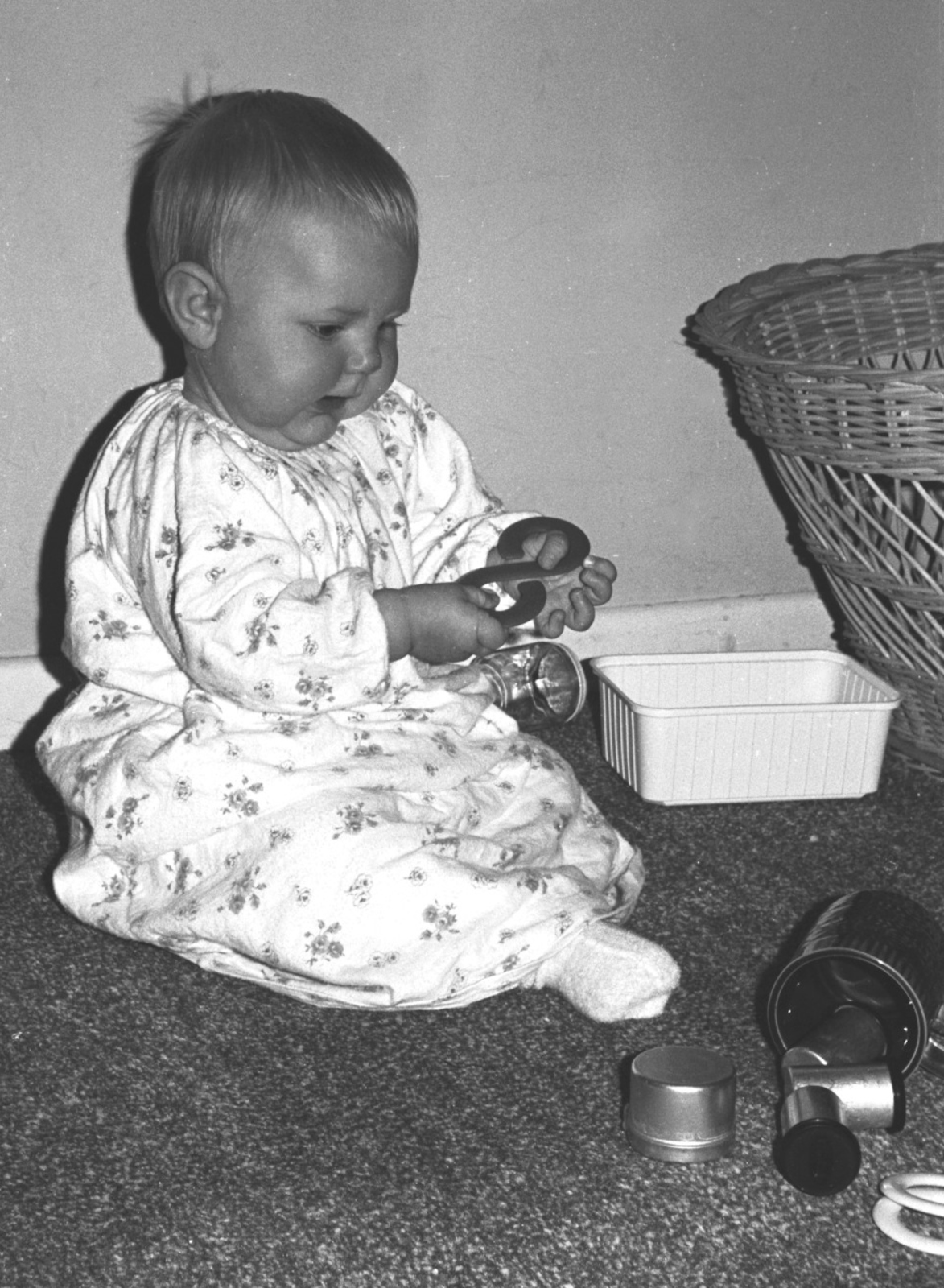
This photo of Debbie was taken on 1st November 1975. You can also see one end of the basketwork crib Judy made before Debbie’s birth, and the toys include film canisters, other jars, boxes and bottles, and some interlocking plastic shapes from Mothercare.
By this time, I was typing up the Horsecastle Chapel newsletter using waxed stencil sheets, and duplicating them on a hand-cranked Gestetner copying machine. This was a job previously done by one of our friends, Joe Stickland, and eventually we moved the machine to our loft to save moving it backwards and forwards.
Later, I began buying extra wax stencils and A4 paper and printing off copies of our own newsletter, ‘Community Spirit’, with announcements about Fountain engagements at local churches, larger meetings in the area that we wanted people to know about, and so on.
Making curtains
Judy often made her own clothes by buying patterns, buying the fabric and cutting out and sewing dresses to save money. In the photo she’s making curtains for our lounge/diner at 22 Rectory Drive in Yatton.
The photos are in black and white because colour film was expensive, but I could buy 35 mm B&W film in bulk, cut it to length, fit it into old film cassettes, and develop it myself to produce negatives. Then at work there was a darkroom with an enlarger so I could also buy photographic printing paper, processing chemicals and stay at Long Ashton in the evening after work to make enlargements at very little cost.
World events: The Treaty of Osimo was signed between Italy and Yugoslavia, resolving their dispute over Trieste. A majority of the land area and residents became Italian; and in the Madrid Accords, Spain agreed to hand over power of the Spanish Sahara to Morocco and Mauritania by the end of February 1976.
Dad’s radio and B&W TV licence fell due on 2nd November and I still have a copy of the new one. They wrote down his name incorrectly as Mr E J Jefferies, but the address is correct and the large fee of £6 was received (around £83 today). A colour TV licence would have been a lot more expensive.
During November we left Long Ashton and moved into our newly acquired bed-sit at 59 Linden Road in Bristol. It was a lovely part of the old city, an easy stroll from the front door to the glorious open spaces of the Downs. The bedroom had a comfortable double bed but I don’t recall what else was in that room. Presumably there was a wardrobe and a chest of drawers, and maybe some bedside cabinets.
Ken Stott was helping Ray Williams with his work on apple pollination, and I was interested in the fluorescence microscopy this entailed, so I started to take every opportunity to help with this where possible.
I mentioned the sitting room last month with its curious cupboard-cum-kitchen. I think there was a B&W TV set and Judy had brought along her reel-to-reel tape recorder so we could listen to music.
Opening the big cupboard doors in the sitting-room revealed the kitchen sink, a Baby Belling stove, and a range of storage cupboards as well as shelves in the doors themselves, so opening the doors until they stuck out into the sitting room at right angles provided a kitchen with ‘walls’ on three sides and a rectangular work area with a tiny worktop between the cooker and the sink. It was adequate – just. It was also fun because it was so weird.
The loo and bathroom were shared with the people in the bed-sit the other side of the stair well. We used the loo because, well, you have to. But we avoided the bath because the gas geyser puffed smutty blobs of soot into the bath. Instead we resorted to all-over flannel washes at the kitchen sink. It was not a great place to live, but it was all we could afford and we planned to move to an unfurnished flat as soon as we could afford it. Also in November, Judy began work at one of the department stores at Broadmead. This provided additional income and our finances began to improve little by little.
Our savings had all but vanished so the first week’s rent was a struggle and we had little to eat, but Judy was paid weekly while I was on a monthly salary so we survived on Judy’s income for four weeks and then the bank balance improved dramatically at the end of November with my first full month’s salary, and after that everything was hunky-dory.
At Long Ashton I was appointed in the first instance as an Assistant Scientific Officer (ASO) to help with growth studies in tree and basket willows. I worked with Christine Jago, (so two Chris Js doing the same work which was rather amusing). Mostly we took annual measurements of breast-height girth and height of the trees as these were standard forestry commission measures from which timber volume could be calculated. Our boss, Ken Stott, was interested in finding the willows and poplars that would put on the most volume annually. There were possibilities for using dried wood chips as a green energy source for electricity generation.
World events: The Soviet Union landed Lunokhod 1 (a surface rover) on the Moon; and The six European Economic Community prime ministers met in Munich to begin a programme of European Political Cooperation (EPC),.
Judy and I were completely devoted to one another by this time. We used to agree to meet up in town on Saturdays, often in Woolworths in Cricklade Street (now split in two as Mountain Warehouse and another shop next door). We would just happen to turn up at about the same time and would soon be in conversation while vaguely looking at gloves or possible Christmas presents for family members. The photo shows the famous PicknMix in 1975, ten years later than our visits.
I had not met Judy’s family yet, but she would often pop in to Churnside for tea and a biscuit after school before heading home on her bike. Sometimes she’d push the bike (or I would) and we’d walk up to Chesterton Park where she lived at number 69 with her parents and younger brother, Frank. I was never invited in at this stage though, I think she knew her Dad would joke about us and wanted to put that moment off as long as possible.
Granny’s 86th birthday was on 6th November, she seemed really old but was still fit and could walk from her flat to the Market Place or round to Churnside and back with no problem at all. As she walked back to her flat in The Avenue she would always turn round and wave at the corner between Victoria Road and The Avenue.
I was 17, Cindy was 14, Ruth and Rachael were 9 and 8 respectively, and I was becoming more confident driving except in heavy town traffic. At the time, Dad had use of an Austin Countryman belonging to the family business. It had a steering column gear shift which was unusual but not a problem to learn on.
World events: Martial law was announced in Rhodesia. The UN accepted the British intention to use force against Rhodesia (if necessary) by a vote of 82 to 9; and Craig Breedlove set a new land speed record of 600.6 mph (966.6 km/h).
Granny was had her 81st birthdy on 6th November, Mum and Dad were 32 and 34 years old, I was 12, Cindy was 9, Ruth was 4 and Rachael just 3. I was learning Latin for several lessons a week, definitely not my favourite subject. I was now in my second year, in Class 2B at Cirencester Grammar School. My favourite subjects at this time were maths, history, English grammar, chemistry and physics. Major dislikes in addition to Latin were English literature and PE.
There’s really little more to say about this month in my life. I took no photos that I’m aware of, and there are no diary entries or other documents in my collection.
World events: The US Democratic Senator John F. Kennedy was elected to become, at 43, the second youngest man to serve as President of the United States; and Belgium threatened to leave the United Nations over criticism of its policy concerning the Republic of the Congo.
Granny turned 76 and seemed to me to be very old indeed. As I write this I’m well on the way to 77½! I was aged 7 in 1955 and was in my second term of the third year at Junior School. We were living at 17 Queen Anne’s Road on the Beeches Estate.
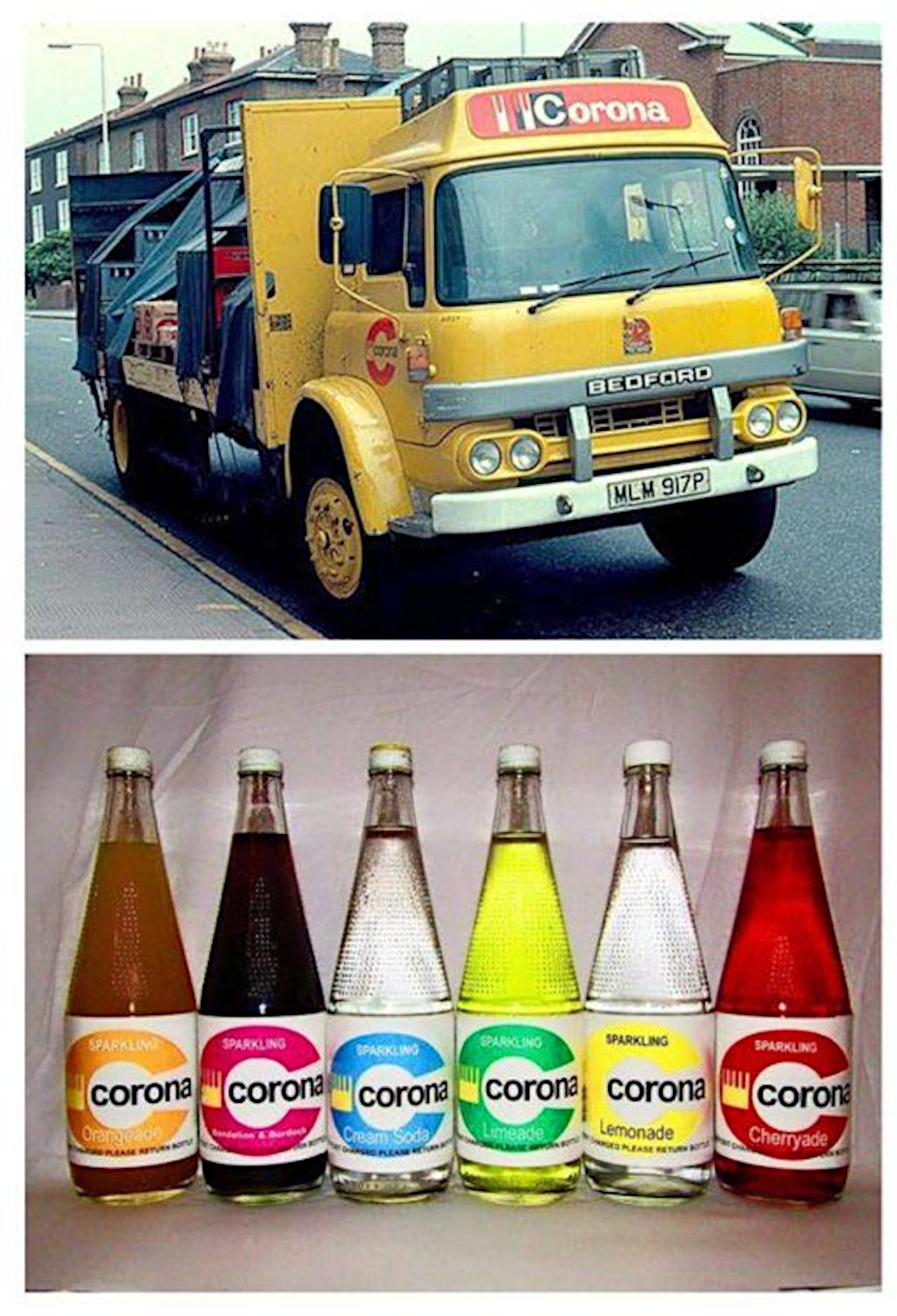
Although I have no photos or documents, I can write about some things that happened regularly in those days. The Corona lorry came round once a week with bottles of brightly coloured fizzy drinks. You could hand in empty bottles to get a small reward, perhaps just a penny, and we often bought three or four new bottles, especially in the summer months. I well remember the captive porcelain stoppers with a red rubber seal that hinged out on a spring steel wire mechanism and could be reconnected with a strong push at just the right angle. And I remember the ‘pop’ emitted when a new bottle was opened. (Later, bottles with screw caps replaced the captive porcelain stoppers. Also, I recall the glass hemispheres covering the upper, sloping part of the bottles, these always fascinated me as a child.
World events: C. Northcote Parkinson propounded ‘Parkinson’s law‘; and the British Governor of Cyprus declared a state of emergency on the island.
I’m sure I would have enjoyed my third Bonfire Night on 5th November. Maybe some of the loud bangs might have made me nervous, but the brightly coloured lights in the sky would have seemed amazing.
World events: There was an attempt to assassinate U.S. President Harry S. Truman; and a U.S. Air Force B-50 Superfortress bomber jettisoned and detonated a Mark 4 nuclear bomb over Quebec, Canada. The bomb was not fitted with its plutonium warhead.
Although Mike had been assigned to a lorry driving job, he also writes that he had a chance to operate a Type 22 mobile radar and took photos of an Avro Anson twin-engined RAF plane. He also watched a number of films and attended an ENSA show. Letter writing to and from the family in Cirencester continued, as well as regular letters to and from Lilias in Coagh, and some to his friend Joe.
There was an Armistice Day church parade on 11th November. He received his driving licence and was glad to hear the news that Joe and Dorothy were to be married.
On 15th he drove to Bombay and back, and he began meeting with others about the Christmas entertainment on the base. He got a 1½ hour flight in an Avro Anson near the end of the month.
World events: The first clock radio was marketed, the model 8H59 Musalarm; and the foundation of UNESCO (United Nations Educational, Scientific and Cultural Organization) was agreed at a meeting in London.
There’s not enough information to write something for every month in the 1940s. Dad’s diaries start in January 1943, so for January 1940 to December 1942 I’ll write about things I know, or draw on dated photos and documents. Sometimes I might use a photo or document with a guessed date.
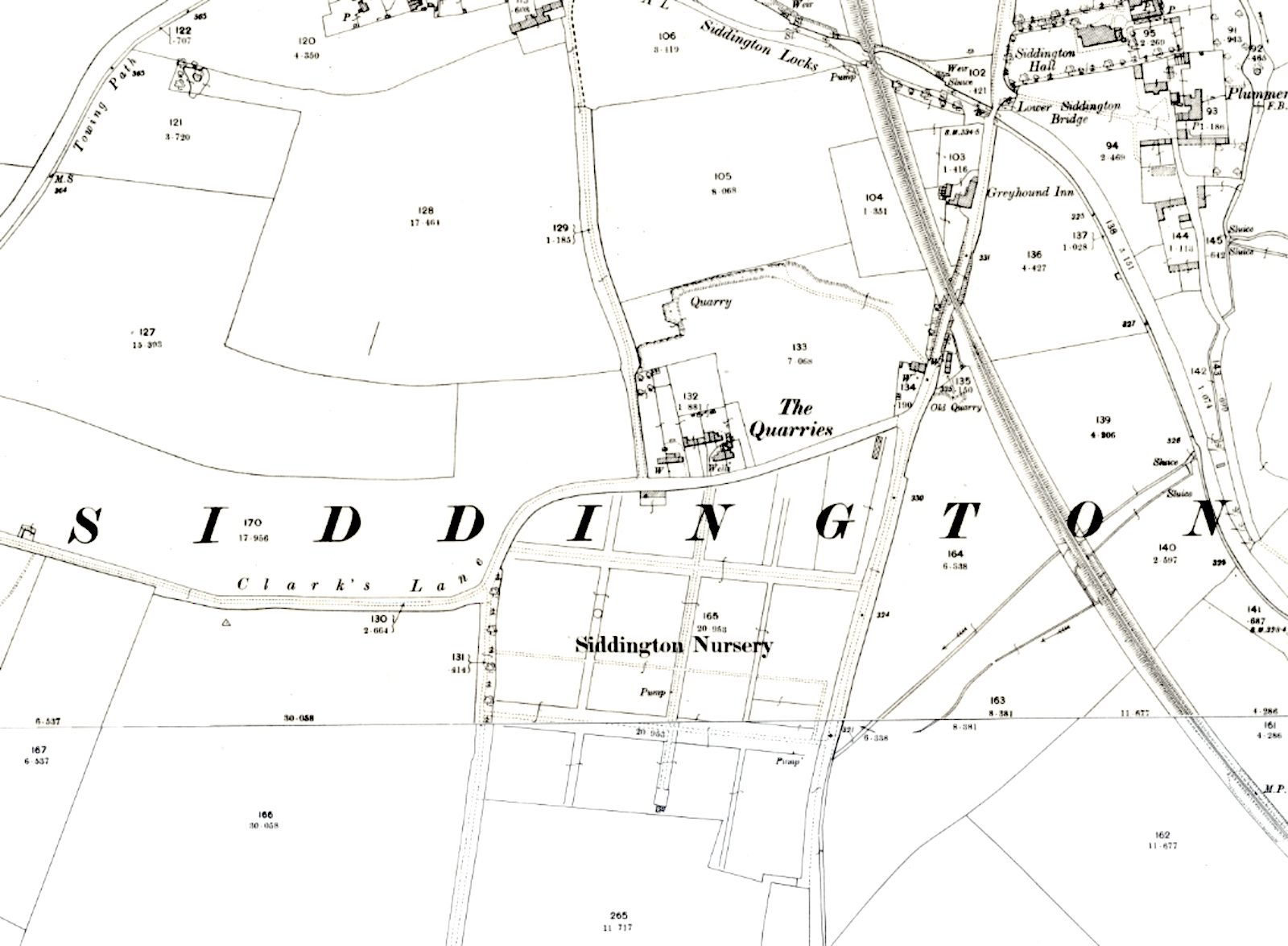
This time we should take a look at Siddington Nursery, just a few miles south of Cirencester and very close to a short ladder of locks on the old Thames & Severn Canal. It’s actually quite likely that trees and shrubs from Siddington Nursery would have been despatched to more distant customers by canal in the early 1800s before Cirencester’s railways became available.
You can see from the map (click it to enlarge) that the nursery was divided into three parts by wide east to west avenues and divided again roughly at right angles by three smaller tracks. The northernmost wide avenue was planted with large specimen ornamental trees. It’s badly overgrown in 2025, but some of these trees still live and can be identified. In the 1950s and 60s when I was a child much of the original planting was still clearly visible, not just trees and shrubs, but also large clumps of bamboo and spring-flowering fruit trees too.
The central north-south track was originally planted with demonstration beds of smaller shrubs and other specimen plants, beautifully maintained. When I was young it was just a workaday route for tractors and other equipment.
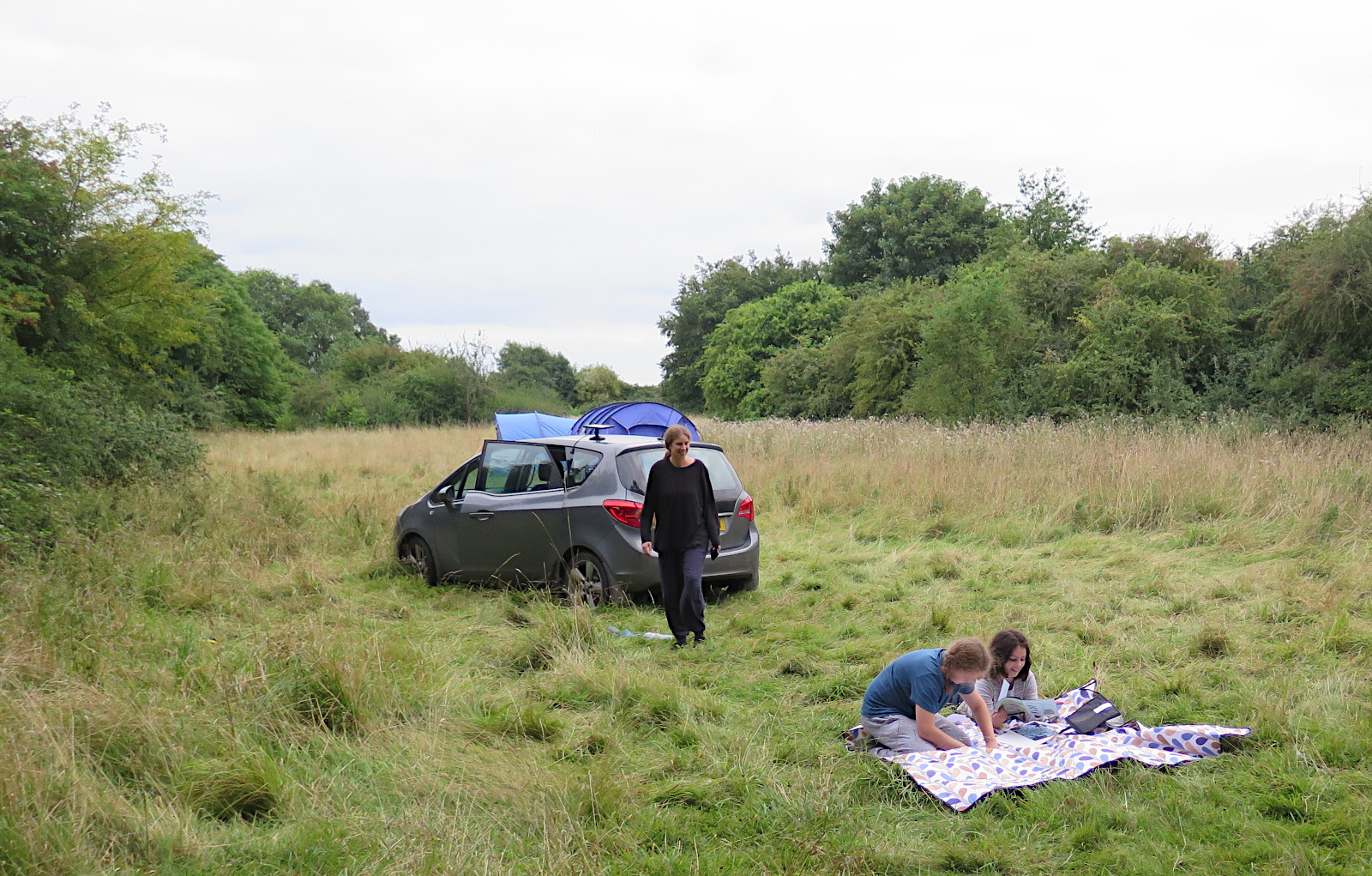
Siddington in 2021
There was a packing shed with a phone extension to the company shop and offices in Cirencester Market Place and I recall a large store of straw reaching up high, almost to roof level. My sister Cindy and I used to climb up this stack and slide back down. No doubt it was intended as packing material for the bare-rooted trees and shrubs that were produced at Siddington Nursery. And at the far end of the track at the southern end of the site was another shed for the grey Ferguson 35 tractor, a hand-guided ‘Hayter’ for cutting down long grass and weeds, as well as harrows and discs and a rotovator for connection to the tractor for cultivating land before planting.
World events: In the Battle of Elaia–Kalamas at Epirus, outnumbered Greek forces repelled the Italian Army; and the Royal Navy launched the first aircraft carrier strike in history, on the Italian battleship fleet anchored at Taranto.
Anything that appears in this section will have some connection with the 1930’s but may extend beyond the decade to follow a meaningful topic more fully.
Manual switchboard
Dad’s brother Richard had the final office on the first floor, next to the General Office. His office was quite small, and the old wooden desk was large. Richard (my Uncle Dick) kept paperwork, his basic filing system was that older items were stacked below newer ones, and as he never cleared his desk, a wall of old paperwork grew higher and higher. Eventually, opening the door to see if Dick was in his office became utterly pointless as he would be hidden by the high stacks of paperwork!
Read last month’s entry for more details of the switchboard. The browser’s back arrow will return you here afterwards.
World events (November 1935): After 11 years in exile, George II returned to Greek soil as King of Greece. (November 1930): a pathologist at the Sheffield Royal Infirmary in England, achieved the first recorded cure (of an eye infection) using penicillin.
As with the 1930s material, everything in this section will have a connection of some kind with these two decades.
Perhaps it’s time to meet some of the Cirencester Jefferies family from the first couple of decades of the 20th century.
John Jefferies
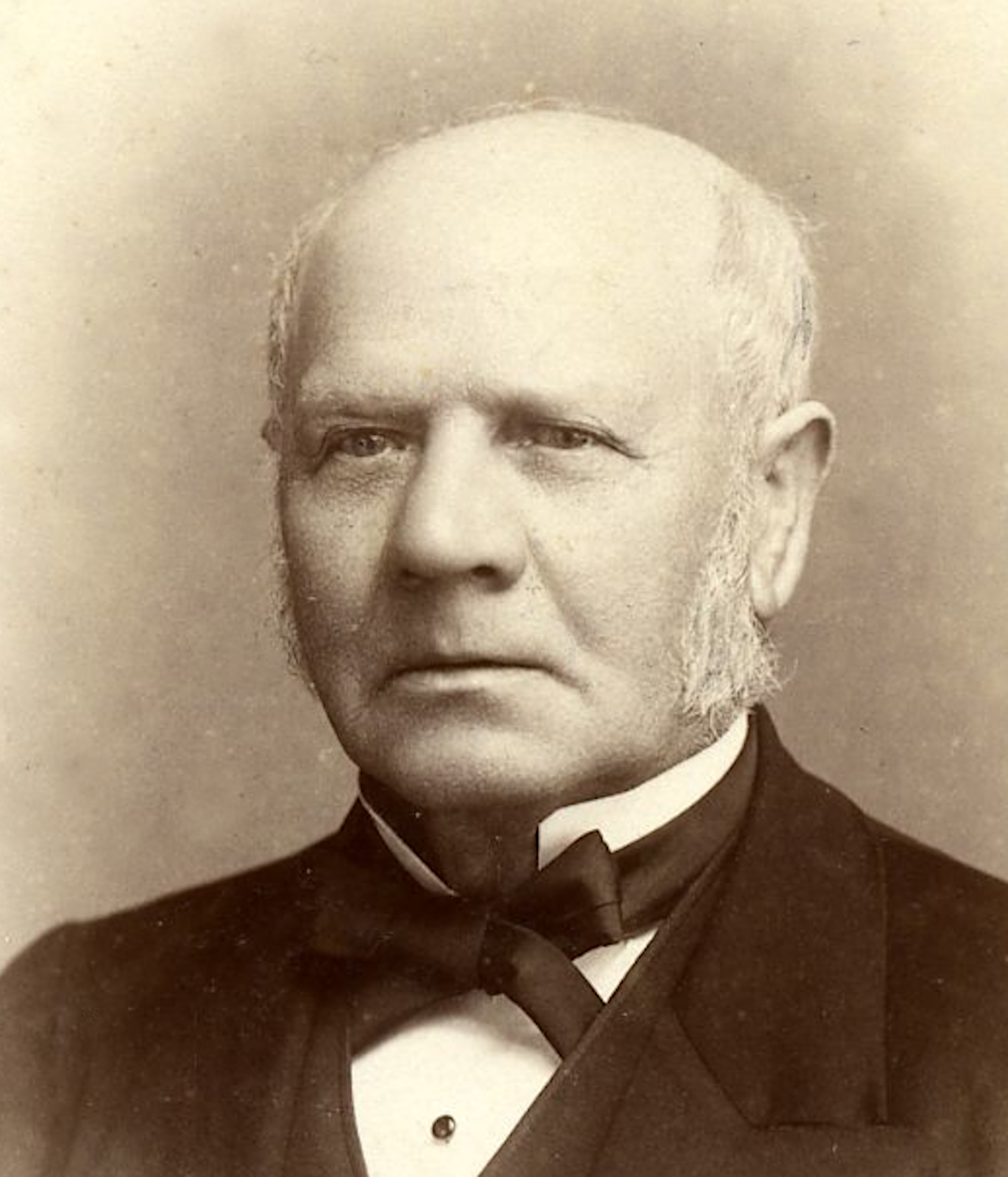
John Jefferies was born and baptised in Somerford Keynes in 1818 and grew up there as a child. I suggest this photo was taken in the late 1800s, perhaps when he was in his mid to late 60s. His older brother, Bradford, would have taken on the family farm in Somerford; so John needed to find work and he took a position with Richard Gregory in Cirencester. Richard Gregory’s father started the Nursery business in Cirencester in 1795, and John was appointed to help with the practical management. Richard Gregory lost money over a bad debt and had to leave the area; John Jefferies, seeking legal advice, was told he should continue running the business and wait to see what would happen. It turned out that he not only continued running the business, but also became the new owner.
John married Alice Freeth and they had a number of children. William John was born in 1844 in Cirencester, John Edwin in 1845, Alice Mary was born in 1847 at 7 Dyer Street, Edward was born on 13th May 1849, and Julia Anne was born on 2nd January 1851. John retired in 1892 and died in 1904; you can read his obituary online (click your browser’s back button to return here). His son, William John Jefferies, ran the business after John’s retirement and inherited it after his father’s death.
The story of John Jefferies does belong partly in 1900-1929 since he died in that period. But next month I’ll add a new section to cover 1800-1899.
Family connections
Parents – John Henry (called Edward) Jefferies and Mary Hawkes Siblings – Mary Half-siblings – Emma Diana, Jane Adelaide (John Henry married Diana Bowsher after the death of his first wife, Mary Hawkes) Children – William John, John Edwin, Alice Mary, Edward, Julia Anne
World events (November 1900):Herbert Kitchener succeeded Frederick Roberts as commander-in-chief of the British forces in South Africa. (November 1905): In a Moscow Uprising a Bolshevik-led revolt was suppressed by the army. (November 1910): The first air flight for commercial freight delivery took place in the USA. (November 1915): Albert Einstein presented part of his theory of general relativity to the Prussian Academy of Sciences. (November 1920): In London, The Cenotaph was unveiled and The Unknown Warrior was buried in Westminster Abbey.
If you enjoyed this or found it useful, please like, comment, and share below. (If you don’t see those links, click the article’s title above the main photo and they will appear.) Send a link to friends who might enjoy the article or benefit from it – Thanks! My material is free to reuse (see conditions), but a coffee is always welcome and encourages me to write more often!
Petal doubling makes flowers more showy, but often at the cost of the ‘doubled’ flowers being less interesting to pollinating insects. The additional petals may be modified stamens so less pollen is produced. Compare a wild rose to a garden rose and you’ll see what I mean.
What’s in an image? Sometimes quite a lot, more than meets the eye. I’m posting an image every few days.
Click images to enlarge
These autumn leaves are on a purple Cotinus coggygria bush, common name ‘smokebush’. Like many trees and shrubs at this time of year, Cotinus leaves change colour in autumn before falling to the ground. The shrub will produce fresh, new leaves in the spring. But look more closely and you may see something else.
The leaves in the image have developed interveinal patches of necrotic tissue, making the plant even more striking in autumn. I had never noticed this condition before moving to Cirencester, but there’s a Cotinus in the grounds of the Stratton House Hotel and Spa that does this annually. The shrub seems healthy in the spring and summer. For a week or two at the end of October this patterned necrosis makes the autumn leaves look even more spectacular.
Irregularities of this kind are common in both animate and inanimate natural systems and not infrequently appear as deliberate ‘enhancements’. Here are one or two notable examples:
Leaf variegation – Gardeners and plant breeders select and propagate from stable variegations. Normally plants with variegation grow more slowly because the efficiency of photosynthesis is compromised.
Petal doubling – This make flowers more showy, but often at the cost of the ‘doubled’ flowers being less interesting to pollinating insects. The additional petals may be modified stamens so less pollen is produced. Compare a wild rose to a garden rose and you’ll see what I mean. How often do you see bees working garden roses?
Variations in animal characteristics – amongst cats and dogs (and also budgerigars, canaries, parrots and chickens you’ll see size and shape changes as well as behavioural, colour and pattern modifications. Compare a Jack Russell with a retriever or a blue budgie with a green one and you’ll find plenty of differences to ponder.
Frost hardiness in plants. Frost sensitive species cannot survive winter in temperate or arctic conditions, so hardiness is a prized feature of many garden plants, and plant breeders pay attention to things like this. A Dahlia or Chrysanthemum that can flower for an extra week or two in the autumn may be worth a higher price, for example.
Fruit colour and flavour components. These days strawberries are much larger than when I was child, and they are often red inside, not just on the outer surface.
Many variations of this kind are deliberately selected for by plant and animal breeders.
Certain other changes have been caused deliberately, even in humans. Lower lip enlargement, neck ringing to generate extended neck length, foot binding, and forms of male and female circumcision have been required for a variety of religious and cultural reasons. Hair styling, removal, or transplantation, piercing of ears, noses and other body parts are common, and don’t forget tattooing. And in plants; pruning, clipping, or bonsai are widely employed.
In the world of rock and stone, coloured and uncoloured crystals may be prized as jewels and fetch fantastic prices. I wrote about an example of this, a geode I spotted in an ordinary, traditional, Cotswold dry stone wall.
If you enjoyed this or found it useful, please like, comment, and share below. (If you don’t see those links, click the article’s title above the main photo and they will appear.) Send a link to friends who might enjoy the article or benefit from it – Thanks! My material is free to reuse (see conditions), but a coffee is always welcome and encourages me to write more often!
The abbey’s construction was a huge project continuing throughout the 12th century. To fund the ambitious project, Henry I and his successors, Henry II and Richard I, granted the abbey revenues and privileges, such as exemption from tolls, access to commerce, and timber and stone for construction.
What’s in an image? Sometimes quite a lot, more than meets the eye. I’m posting an image every few days.
Click images to enlarge
In medieval times there was an Augustinian Abbey in Cirencester. Like so many abbeys and monasteries in the United Kingdom it was dissolved during the reign of King Henry VIII and afterwards demolished. The outline of the walls is marked in the Abbey Grounds with small, square paving slabs, and a few of the column bases are visible too, but that is all that remains above ground where the Abbey once stood. There are some additional carved stones and other items in the Corinium Museum.
The photo shows a Lego model of the Abbey, currently on display in the Parish Church. You can see a Lego tree in the garden within the cloisters, and part of the nave of the Abbey church. The model is complete with its tower although this doesn’t appear in the main photo, but it’s there in the image below.
Construction and history
The Abbey and tower
Some of the political and practical history of the founding and later dissolution of the abbey are well described in blog articles published by the Corinium Museum. These articles, and the Wikipedia article are well worth reading. They are linked below.
Long before the Abbey was built the land where it later stood was part of the Roman City of Corinium Dobunnorum; the River Churn (in those times named Kern, Kerin or Corin) had been divided into two, one part outside the city walls as a defensive feature, the other part within the city as a source of water for drinking, washing, for industry, building and so forth. The Saxons, moving West into the still Romano-British part of what is now South-West England, took control of the area, but had no use for a derelict Roman city. However, there was a Roman church building in the area where the abbey would later be founded, and a Saxon church was built over the Roman church.
Early in the 12th century, King Henry I founded St Mary’s Abbey, building the chancel on the site of the Roman and Saxon churches. About 1130, Abbot Serlo arrived with a community of canons to set up residence .
The abbey’s construction was a massive project continuing throughout the 12th century. To fund the ambitious undertaking, Henry I and his successors, Henry II and Richard I, granted the abbey revenues and privileges, such as exemption from tolls, access to commerce, and timber and stone for construction. Henry II allowed the abbey the revenues and control of the town (or ‘vill’) of Cirencester around 1155, initiating centuries of friction with the local townspeople. The abbey church was consecrated in 1176 in the presence of King Henry II and several bishops, but building work on the cloisters, refectory, dormitories, and the abbot’s house continued for many more years.
The result of all this effort was the most wealthy and influential Augustinian abbey in the Kingdom. The abbey flourished through its ownership of very large estates in the Cotswolds and an important role in the very profitable medieval wool trade.
Dissolution
The townspeople repeatedly asked the Crown to grant them a borough charter, but this was consistently and strongly opposed by the abbots. In the end, Henry VIII’s dissolution of the monasteries ended with the destruction of the abbey and the confiscation of much of its wealth and property. A Royal Commisioner, Robert Southwell arrived in the town on 19th December 1539 to receive the surrender from the last abbot, John Blake. There was no resistance, and the abbot and monks received pensions, but the buildings were torn down and everything of value was sold off.
Religion or faith?
As with so many JHM articles, as I write I am deeply struck by the huge gulf between religion (usually a very worldly affair as in the history of Cirencester Abbey) and faith (with its basis not so much in what we think as in who we are and how we live.) The distinction is essential if we are to live full lives, discovering who Jesus is and why he matters so much.
If you enjoyed this or found it useful, please like, comment, and share below. (If you don’t see those links, click the article’s title above the main photo and they will appear.) Send a link to friends who might enjoy the article or benefit from it – Thanks! My material is free to reuse (see conditions), but a coffee is always welcome and encourages me to write more often!