So let’s look at some examples… But do bear in mind that the retrieval process may be quite slow. Time travel takes time.
Time travel would be interesting, but we can be pretty sure it can’t be done. However, history lets us visit the past in a sense. And when it comes to the web, there’s always the amazing Wayback Machine.
The Wayback Machine archives websites and stores them for future use, and anyone can use it to see past versions of sites, or visit sites that are no longer available. Also, anyone can enter a web address and ask for it to be archived.
The Wayback Machine has had a torrid time with DDoS attacks and data theft over the last few weeks, but it’s all fixed and working again as of 14th October (though in read-only mode for the time being).
So let’s look at some examples. Click the links below to check them out, but do bear in mind that the retrieval process may be quite slow. Time travel takes time:
Why not explore some old websites for yourself? Just visit web.archive.org and search for a website you like or one that no longer exists.
What serious uses does it have?
The Wayback Machine (or Web Archive) serves a number of useful purposes beyond viewing old versions of websites for fun.
Historical research
For checking accountability
Verification
As legal evidence
Viewing websites that no longer exist
For further details, read the Wikipedia article on the Wayback Machine.
Useful? Interesting?
If you enjoyed this or found it useful, please like, comment, and share below. (If you don’t see those links, click the article’s title above the main photo and they will appear.) Send a link to friends who might enjoy the article or benefit from it – Thanks! My material is free to reuse (see conditions), but a coffee is always welcome and encourages me to write more often!
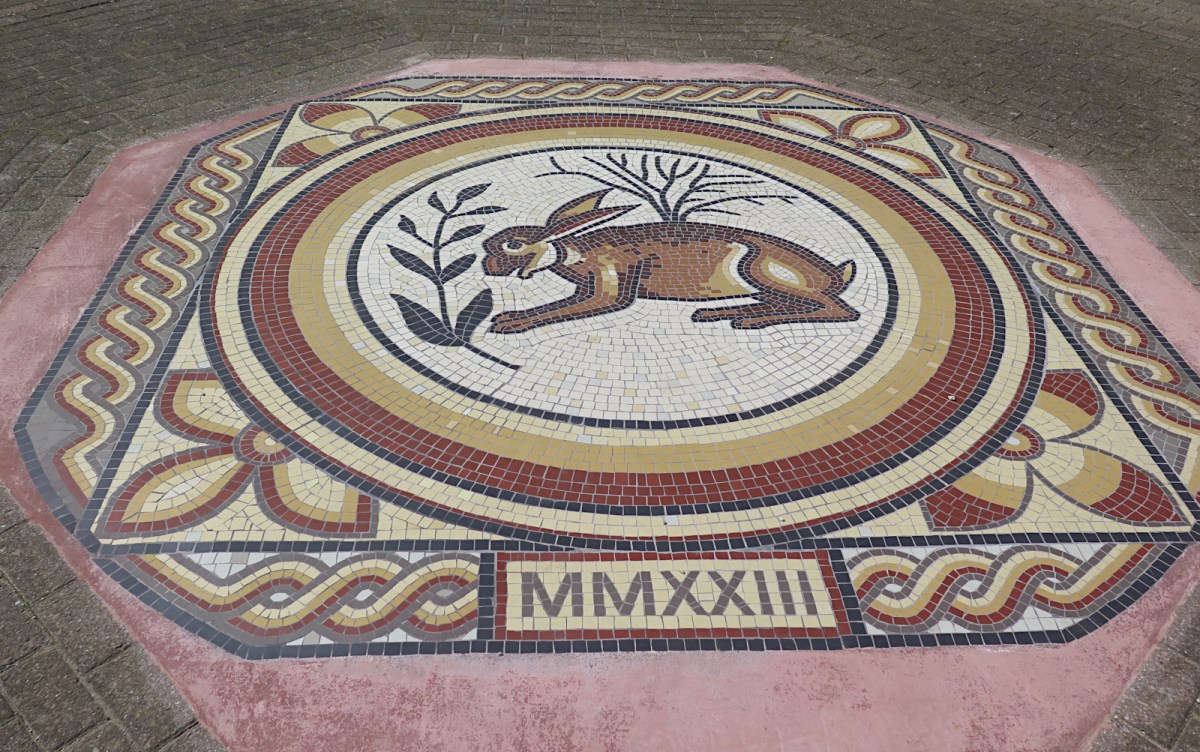
Living in Cirencester always gives me a sense of history and the slow but unstoppable passing of the years and centuries. Will the hare mosaic still be available to see 1700 years from now?
What’s in an image? Sometimes quite a lot, more than meets the eye.
I’m posting an image every two days (or as often as I can). A photo, an image from the internet, a diagram or a map. Whatever takes my fancy.
Click to enlarge
This is the same hare that we looked at in the previous Image of the Day, but this time it’s a modern interpretation of the Roman original, installed in a public space between Brewery Arts and Waterstones bookshop.
It’s great to have the hare mosaic out in the open for visitors to the town to discover as they explore; perhaps it will encourage some of them to visit the Corinium Museum to view the original as well. But I wonder what the owners of the town house where the mosaic was found would have thought about public display some 1700 years in their future!
Living in Cirencester always gives me a sense of history and the slow but unstoppable passing of the years and centuries. Will the hare mosaic still be available to see 1700 years from now, in the year 3724? Will the town even exist in 3724? What language will be spoken here in 3724? Certainly not 21st century English! Will we have cities on the Moon, Mars, and beyond by then? Deep time, both backwards and forwards, a fascinating topic to ponder!
If you enjoyed this or found it useful, please like, comment, and share below. (If you don’t see those links, click the article’s title above the main photo and they will appear.) Send a link to friends who might enjoy the article or benefit from it – Thanks! My material is free to reuse (see conditions), but a coffee is always welcome and encourages me to write more often!
Images fade, especially if exposed to light, they are susceptible to damage by fire, water, mechanical action and so forth.
For some years now I’ve been transferring family photos, videos and documents to digital storage in an attempt to preserve the information. There are pros and cons to both physical storage and digital storage and we’ll discuss those in this article.
But first, lets take a look at an example photo.
An old photo from my collection – May 1969
The image above is from a 35 mm transparency. It shows my fellow students on the Bath University Horticulture degree course the year before we graduated. We were visiting a commercial horticultural business and there’s a TV personality in the image as well. (One of our lecturers, Peter Thoday, later became well known as the narrator in the TV series, The Victorian Kitchen Garden. He’s at the back of the group on the right in the photo, tall and with very dark hair.)
Details of the photos and how I manage them
Quite a few of the old photos I have are colour transparencies; these come in different sizes depending on the type of camera and film that were used. The majority are on 35 mm film stock, with sprocket holes along two sides; these engage with the film transport mechanism in the camera. After the film was processed and dried it was cut into individual frames and mounted in card or plastic frames. My film scanner can handle mounted and unmounted slides and saves them as digital image files.
Once I have the images in digital format I remove slides from their frames and check the frame numbers exposed on the film when it was manufactured. This makes it easy to get the slides into correct sequence as they may have been reordered accidentally or even deliberately when they were projected in the past. Having confidence that the photos are correctly in sequence makes it much more likely that I can eventually arrange the films into longer sequences based on events, people and places in the images. This is a work of reconstruction, sometimes easy, sometimes very difficult. I keep notes of what I have done and why, for my own reference and for anyone else who might find the information useful later. I’ve got better at doing this with experience.
Advantages and disadvantages of physical storage
The original negatives and transparencies contain more information than digital copies. For one thing, the dynamic range is greater and the resolution is always going to be a little higher. Scanning processes are very good indeed these days, but they’ll never be absolutely perfect.
On the other hand, originals deteriorate over long time periods. Images fade, especially if exposed to light, they are susceptible to damage by fire, water, mechanical action and so forth. And as each image is unique, if it’s lost or damaged there is no way to recover it.
And two final points – storing negatives, transparencies and prints takes a lot of space, more and more as the numbers increase. And viewing them becomes an issue, only a few people can view them at a time.
Advantages and disadvantages of digital storage
Digital copies of the images can be almost as good as the originals for most purposes, and digital processing can improve colours and remove blemishes when the originals are faded, scratched or have dust that is strongly attached to the surface. In these cases, the digital copy may be more acceptable than the original.
Digital storage is increasingly cheap and capacious, so a very large collection of photos can be stored on a cheap, tiny SD card. This in turn makes it possible to have multiple copies in multiple locations, providing security far beyond anything possible with the originals. Remote storage on Dropbox or similar facilities takes this a step further. Multiple copies and remote storage both make it possible for many people to be able to view the images independently and from wherever they happen to be.
Perhaps the biggest downside of digital storage is the need to constantly move images from old storage media to newer technology. How many of us have devices to read data from a floppy disk or an old CD? Remote storage helps again because the company offering the service takes on the task of managing data storage and retrieval and moving to newer technologies whenever necessary.
And there’s a hidden factor here too, the images need to be stored in a file format that is still readable on current devices. JPG and PNG are widely used and may be readable by future devices for a very long time, but nothing is certain and it may become necessary to re-save the images in a different file format in future. This would be a major task for a large image collection.
My approach to all this
I’ve thought about this a lot. Currently, everything is stored in high quality JPG format. Yes, I know there are very slight compression artefacts in JPG, but unless the images are repeatedly edited and re-saved this is not an issue in practical terms. I use an Epson Perfection V600 Photo scanner which for me is a good compromise between quality and price. The images are stored initially on my laptop and automatically to Dropbox, and I back up my laptop on an external hard drive at intervals. Other members of the family have their own copies of some of the data, though keeping this refreshed has been a problem.
Something I have not yet fully resolved is what happens when I’m no longer able to manage all this data. Of course, at that point the future of the images will no longer be of personal interest. Nonetheless, I’d like to have some kind of plan in place, perhaps handing on access to my Dropbox account would be a good way forward.
If you enjoyed this or found it useful, please like, comment, and share below. (If you don’t see those links, click the article’s title above the main photo and they will appear.) Send a link to friends who might enjoy the article or benefit from it – Thanks! My material is free to reuse (see conditions), but a coffee is always welcome and encourages me to write more often!
My name is Patricius, I’m a sinner, a simple country person, and the least of all believers; I am looked down upon by many. My father was Calpornius, a deacon.
Patrick, or Saint Patrick as we normally think of him, had an interesting background and history. Of course, we know very little about him, but far more than we know about most other people who lived at that time.
What does the name, Patrick, mean? It comes from the Latin patricius, meaning “nobleman”, “of noble origin” or “patrician”. Patricians were the noble families in ancient Rome, a ruling class, and Patrick can be viewed as a Roman or perhaps a Romanised Briton. By 409 CE when all remaining Roman forces in Britannia were recalled to protect the Western empire against uncontrolled immigration across the Rhine, the distinction between Roman and Romano-Briton had pretty much vanished. Archaeological evidence makes it clear that Roman life continued well after the troops left, particularly in the west of Britain.
Patrick’s life
Patrick’s family lived in Roman style somewhere near the west coast in what is now northern England or southern Scotland (also possibly Wales). They would have been little affected by Angle and Saxon incursions into the far eastern regions of the British Isles, but raids from Ireland and northern Scotland were sometimes a problem. Farming life and indeed villa life and Roman town life would have carried on; no longer governed by the empire, but governed locally like a Roman province. Patrick was born around the time the Roman forces departed.
When he was sixteen he was captured by Irish pirates raiding the area where his parents lived. And he was sold in Ireland as a slave and had a hard life, outside in all weathers, herding sheep or pigs. He had been exposed to Christian ways as a child but had not believed in Jesus or made any attempt to follow him, but during his time in captivity he developed a faith. Spending times of great hardship as a herdsman slave, and living in the open air in all seasons, he must often have been wet and very cold. But spiritually it was a time of great growth and depth for him. He prayed incessantly and felt very close to his heavenly Father.
He made a dash for freedom when the opportunity arose, hearing a voice in his sleep telling him that a ship was waiting to return him home. He was recaptured, but escaped again and made it home successfully.
Later, sensing that his responsibility was to return to Ireland to share his faith with the pagan people there, he travelled back and began to share everything he knew of Jesus. People listened to what he told them and he started many local communities of believers. Later again, Patrick travelled back to northern Britain and spread his teaching about Jesus to the Irish and Welsh speaking Britons and also to the Saxons in the areas he visited. The Celtic church in Ireland and in Great Britain spread far and wide, even back into northern Europe. Celtic Christian monks journeyed singly or in small groups, spreading the good news and founding further communities and groups of believers.
His writings
At some point in his later life, Patrick authored books and letters, two have survived, and one of these is autobiographical in nature, telling the story of who he was and the events of his life. And that book (The Confessio) is why we know as much as we do about Patrick and the world he lived in. Here are his opening words:
My name is Patrick. I am a sinner, a simple country person, and the least of all believers. I am looked down upon by many. My father was Calpornius. He was a deacon; his father was Potitus, a priest, who lived at Bannavem Taburniae. His home was near there, and that is where I was taken prisoner. I was about sixteen at the time. At that time, I did not know the true God. I was taken into captivity in Ireland, along with thousands of others. We deserved this, because we had gone away from God, and did not keep his commandments. We would not listen to our priests, who advised us about how we could be saved. The Lord brought his strong anger upon us, and scattered us among many nations even to the ends of the earth. It was among foreigners that it was seen how little I was.
If you enjoyed this or found it useful, please like, comment, and share below. (If you don’t see those links, click the article’s title above the main photo and they will appear.) Send a link to friends who might enjoy the article or benefit from it – Thanks! My material is free to reuse (see conditions), but a coffee is always welcome and encourages me to write more often!
What’s in an image? Sometimes quite a lot, more than meets the eye.
I’m posting an image every two days (or as often as I can). A photo, an image from the internet, a diagram or a map. Whatever takes my fancy.
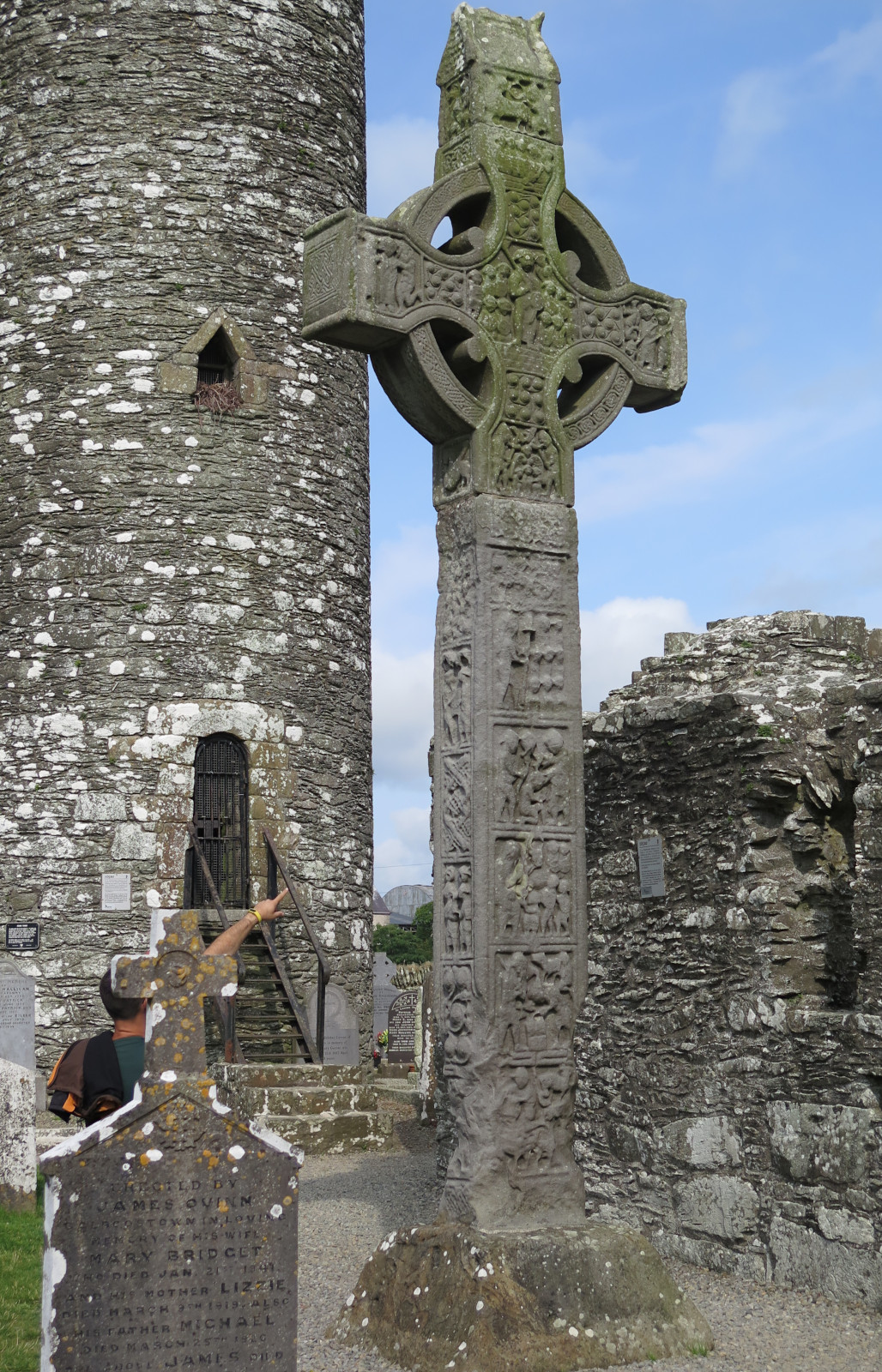
Stone high cross at Monasterboice
Irish monasteries had a number of features not found (or rarely found) in other parts of the British Isles. The round towers are one example, there are one or two in Scotland and the Isle of Man, but nowhere else outside Ireland. Stone high crosses are another example. These are found throughout the British Isles and parts of France. The ruined monastery of Monasterboice has a round tower similar to the one at Glendalough, but is particularly noted for several outstanding high crosses, one of these features in my photo.
The crosses are usually carved with traditional Celtic patterns, but often they have panels containing carved pictures that illustrate a story, perhaps a Bible story. They were clearly important to the people and communities that took so much care and effort to create them, and they are one of many strong reminders of the Celtic, and particularly the Irish Christian traditions that were significantly different in many ways from the later, Catholic traditions coming into south-eastern England in Saxon times.
The Catholic Church brought initially to Kent from the Continent introduced a hierarchical style, with church officials under the Pope, and fixed orders of service. The Celtic church that had developed from early, pre-Catholic traditions in Roman Britain, was based more on travelling teachers (often missionary monks) who were more flexible in style, without strict rules. They often took little with them but their learning, and depended on the people they taught to support them on their journeys.
Which of these two styles do you think followed the teachings of Jesus most closely?
Images from our Irish holiday 2024
For convenience, here’s a list of all the Irish holiday images:
If you enjoyed this or found it useful, please like, comment, and share below. (If you don’t see those links, click the article’s title above the main photo and they will appear.) Send a link to friends who might enjoy the article or benefit from it – Thanks! My material is free to reuse (see conditions), but a coffee is always welcome and encourages me to write more often!




 Journeys of Heart and Mind
