Teaching is not a bad thing, it’s an essential thing. A well-balanced community living in Jesus’ presence needs to receive truth from apostolic, prophetic, evangelistic, pastoral and teaching gifts.
A new family moved into the village and began to advise and work with Tony, Faith, Paul, Jenny and some of our friends from the next village, Claverham. During this time Judy and I began to feel that things were going a bit off-track. Judy actually wanted nothing to do with the new situation, I decided to go along to the meetings fairly often to keep in touch with our friends. I should add, right at the outset, that I don’t think there was any intention to derail the work that Father was doing amongst us, but rather to enrich it and bring additional knowledge and experience to the mix. But unintentionally this had the effect of changing track with a new focus on teaching that had not been there before. Teaching had never been a notable part of our meetings, we had always been guided mainly by prophecy, and by what we read in the Bible. We were exposed to teaching when we went to larger meetings (the pre-crusade rallies in Portishead for example and visits to Pip’n’Jay in Bristol or the meetings at Post Green), and from the popular books that were doing the rounds (books by Graham Pulkinhgham, Michael Harper, Colin Urquhart, David Watson and others) and we did a small amount of teaching when we were invited to visit local churches as ‘Fountain’. But in our own weekly and daily meetings there was little to no teaching. We were growing and learning together in our exciting faith journey. It was wonderful and extraordinary while it lasted.
But now Alan and Dorothy provided new songs (some of them truly excellent) and Alan taught regularly about how and when and where the meetings should take place as well as material about Jewish customs, feasts and celebrations. Alan and Dorothy came from a background of small gatherings in a different part of the UK (Blyth). So the Spirit-guided growth we had experienced gradually gave way to ideas and processes managed mainly by Alan. Something similar to this has happened over and over again throughout church history. Personally I learned a good deal by seeing it happen both from the outside (because I wasn’t directly involved in the events) and also from the inside (because I was at many of the meetings and had a ringside seat, so to speak). Sometimes I feel I should have shared my thoughts and feelings clearly, but Alan was experienced in meetings of this kind and I was not. I didn’t feel it was my place to interfere, nor was I part of what was happening. When I went along to a meeting I always felt I was accepted partly because I didn’t stir up trouble, but somehow seen as not quite making the grade. Everyone must have been aware that I had some doubts though I was careful not to express them too often or too forcefully. I was, however, grieving about the loss of the sense of direction we’d had together and the subtle shifts in emphasis.
A bad thing can sometimes spark good outcomes
What a strange heading, but it’s true! A few years later my wife Judy was diagnosed with bowel cancer and everything changed. Your friends are always your friends, through good times and bad, so at some point in late spring or early summer 1995 I think, I approached Tony and Faith with this really bad news and invited them to visit and pray with us. And because your friends are always your friends, they were not slow to respond. This coincided with a time when the meetings with Alan and Dorothy were proving rather difficult though I didn’t know that at the time.
Before long Tony and Faith, and Paul and Jenny were coming round for an evening visit at least once a week, and eventually two or even three times a week as Judy’s illness progressed. But what happened during those meetings was astounding and utterly unexpected. Jesus was palpably present every single time we met, and his Spirit was so active amongst us. We experienced prophecy, interpreted tongues, and deep coincidences between songs we were singing, what we were thinking and Bible readings that popped out in the moment. We knew we were right in Father’s presence every time we met. This was holy ground. None of us had experienced anything like it before. The cancer spread and I, for one, had no expectation of physical healing, but Judy and I were both blessed deeply by the renewed presence of our friends and by the experiences in the meetings. It’s fair to say we were all changed by these times together and I know that all of us who remain will never forget it. Judy died on 28th December 1995 and Paul is now no longer with us either. I’m sure all of us learned a lot through the shared experience of those times. Looking back from the perspective I have now, it seems that the change in the meetings following Alan and Dorothy’s arrival combined with the astounding times and experiences as we met again during Judy’s illness, starkly illuminated the difference between living and meeting in our own human wisdom and strength and the freedom we had in the pure presence of Jesus and his Spirit. There’s something further to say about this.
Teaching is not a bad thing, it’s an essential thing. A well-balanced community living in Jesus’ presence needs to receive truth from apostolic, prophetic, evangelistic, pastoral and teaching gifts. If any are missing or if there is an imbalance, any group, no matter how well-meaning, risks derailment in one form or another.
Winding down
After Judy’s death, the five of us continued to meet for a while, and sometimes we were joined by a couple from Clevedon, members of a new local church, and also by Donna (now my second wife) who was a work colleague from Long Ashton Research Station.
These meetings, too, were good but things were still changing. I remain in touch with Tony and Faith occasionally, though less so with Jenny. Donna and I were married a few years later and left the south-west for the east of England, but that’s another story and I’ll share my personal journey of faith there in the next part of this series. Paul and Jenny moved east as well to be closer to more of her family. Tony and Faith still live in the village of Yatton. Donna and I moved west again ten years ago and now live in Cirencester, Gloucestershire.
If you enjoyed this or found it useful, please like, comment, and share below. (If you don’t see those links, click the article’s title above the main photo and they will appear.) Send a link to friends who might enjoy the article or benefit from it – Thanks! My material is free to reuse (see conditions), but a coffee is always welcome and encourages me to write more often!
We didn’t see ourselves as a house church, more as a group of local believers from a range of denominations all wanting to be part of the exciting revival going on in the UK at the time, open to the gifts of the Spirit, but not wanting to become yet another splinter group.
Yatton, the village in Somerset where it all happened
Things were changing. We’d been fairly comfortable at Horsecastle Chapel in Yatton, and we’d learned a great deal and felt loved and made very welcome by the people there. But there were one or two niggles already mentioned in part two of this series. We felt it was not right, and rather unfortunate, that women were not able to take leading roles in meetings, that it was required that women wear hats (a minor thing, but an irritant nonetheless). It began to seem that some of these rules were made by people, not by our Father in heaven, and certainly not by his Son, Jesus. But the greater niggle was that we were not able to move in spiritual ways that were being revealed to us more and more as time went by.
An Anglican home group
For me it came into sharper focus when I went to an Anglican study group. Judy might have come to the same ideas in a different way, but she died in 1995 so I can’t check! I’m not sure we discussed it at the time, but we were moving on closely parallel paths, that I can say with certainty. I wanted to meet some of the Anglicans because I had the feeling there was supposed to be a single church, not a plurality of them. I couldn’t see any way that they could all be brought together, but I wanted to at least get to know some people of other denominations. Going along to the study group seemed a good way to approach this. I soon came to understand that the Holy Spirit was nudging me to go along, and rather quickly I discovered what he had in mind!
Friends and allies
The Anglican study group was held in the home of one of the St Mary’s congregation and was led by the Vicar, Revd Richard Acworth. I don’t remember what was discussed, but I very clearly remember the topic of humility coming up. There was a man in the group who protested, quite strongly, that he was not humble and didn’t intend to become so. I had the impression that he equated ‘humble’ with ‘impoverished’ or ‘weak’ or ‘demeaning’ or some other utterly unattractive idea. I think I was also a bit disappointed by the Vicar’s response.
Also in the group was a woman about my age and as we were leaving I mentioned the humility issue. She agreed quite enthusiastically and we had a brief conversation on the way home; her name was Faith. Judy and I would soon become good friends of Faith and her husband Tony. We shared a lot of views in common concerning Jesus, the Bible, and Church – and this excited me because we were from such different church traditions.
Meeting often
We began meeting quite regularly with Tony and Faith. We were like-minded on so many church matters, and some other things too. we both had young families so most often one of us would walk down to Tony and Faith’s house in Court Avenue in the evening while next time one of them would walk up to our house in Rectory Drive. We would do some Bible study, perhaps sing some of the Christian songs that were so common in those days, and we would pray together. But by far the most important thing we did was to listen to one another and to what the Holy Spirit seemed to be saying to us, sometimes in a whisper, sometimes rather loudly! We invited other people we knew to come and join us, especially Paul and Jenny who lived close as well, so four became six, and there were many other local people with us so on a weekly basis we took turns to host these larger meetings. Sometimes there’d be 20 people in our sitting room, on our sofa and armchairs or sitting on the floor. These were great times of blessing when all of us would feel the presence of the Holy Spirit right with us in every word read or spoken and in every song we sang. We were warned of the dangers we were facing by some of the elders at Horsecastle Chapel, we knew their hearts were in the right place and that the warnings were well-meant; but we knew we were following Jesus so we ignored the advice and warnings and carried on.
Music
Fountain at St Barnabas
Tony is a skilled bass guitarist, Paul was good on a steel-strung 12-string he had, And I would plonk along on a nylon-strung Spanish style acoustic guitar Judy and I had bought at a music shop in Park Street, Bristol while we lived in our flat in Belmont Road. This was an expensive instrument – I think it cost us £27 in 1970 or 1971 (around £540 today) and it replaced the two cheap, second-hand guitars we bought while at university. It seemed better to share one good guitar than to persevere with two older ones that were difficult to tune. Rather later, we were joined quite often by David and Mary Bolster, another couple living nearby. David worked for Scripture Union, and was usually busy with youth work of one kind or another. Judy and I went on a youth retreat with them one year at Wroughton near Swindon to help as assistant leaders, and visited them at a camp at Greatwood near Bridgewater in Somerset. The photo shows Fountain in the Church Hall at St Barnabas in Claverham (from left you can see Paul, Faith, me, Ian on flute, Jenny, Judy and Tony on bass). Ian joined us a little later but was a very useful addition providing a higher pitch in the mix and helping strengthen the melody line.
Tongues
One evening after walking down to Tony and Faith’s, Tony mentioned that he’d received the gift of tongues. We’d read about this in Acts and in some of Paul’s letters to the Greek churches. and we’d read about it in modern times too in books by Colin Urquhart, David Watson, Graham and Betty Pulkingham and others. On hearing this news from Tony I felt mild surprise, delight, frustration and envy all at the same time. So, of course I asked about how it had happened and what it was like. Tony told me he’d been having a bath so was very relaxed and he just started talking scribble. He felt warm and encouraged. As I walked home after that evening at Tony and Faith’s. I gave it a try – I talked some scribble words myself. I learned a valuable lesson right at that point. Was this a gift from the Holy Spirit or was it just me talking scribble and being really foolish. I realised right away that there was no way to tell. And I understood something that I’ve never forgotten since that evening. It’s not about me doing something or not doing something. Specifically, it’s all about Jesus doing something in me, and the only skill needed for that is the simple ability to listen to him and do what he wants, not what I want. This tiny revelation changed my entire life. Everything became real in that moment. In this journey with Jesus it’s not for us to do anything more than rest in his presence. If I do that one thing, consistently, he will do anything else that is necessary. My effort is not required, and life is often far better if I keep well out of the way, especially at moments when he’s touching someone else. My surprise and delight are in order, but never frustration or envy.
As the weeks and months went by, our home meetings grew in numbers, but more importantly in depth and in our appreciation of receiving gifts. We were being invited to bring music and teaching to local churches around the county of Avon and the northern areas of Somerset. We called ourselves ‘Fountain’, played all the latest choruses and songs, as well as some of our own songs and acted out little sketches to help people understand the charismatic revival that was taking hold all around us. Tongues and interpretation became normal for us in meetings, as did prophecy, but the most important things for me were the spirit of caring for one another that grew in our hearts and minds and the determination we all had to follow Jesus in everything.
Jesus provides gifts, but will we open them?
One of those sketches sticks in my mind so I’ll share it with you, Tony played the part of Jesus, and Paul was a typical church member. Tony had a cardboard box wrapped in colourful paper, perhaps with a ribbon tied in a bow. He gave the box to Paul, saying I have a special gift for you. Paul took it and made a point of thanking Tony several times, saying, ‘Oh it’s really lovely, thank you so much, but I don’t think I really deserve it’. He put it down on the table, walked round it, looked at it from all angles and carried on saying how lovely it was. Tony (Jesus) asked, ‘Aren’t you going to open it?’ I chose it specially for you, it’s just what you need, you know.’ Oh no, I couldn’t possibly open it,’ said Paul, ‘That would spoil it, it’s so beautifully wrapped, it would crumple that lovely paper. Jesus responded, but if you don’t open it you won’t find out what it is and you won’t be able to use it. I want you to open it’. And this went on for a while. Then we explained that Jesus has gifts for all of us, but we do need to open them and start using them. And without the gifts being unwrapped and used as intended, Jesus will find it a problem to help us do the work he has in mind for us. His work, building his church, growing his people involves him pouring his grace and love into us so that we can share those things with those around us. He does not want us to be timid. We must gratefully receive everything he has for us. It’s for his glory, not ours and we shouldn’t stand in his way.
Good News Crusade
Another thing we did around the same time was print a monthly local newsletter called ‘Community Spirit’ with details of forthcoming meetings at churches around the area, and any special events in the pipeline too. One of these was a Good News Crusade with a series of pre-Crusade rallies beforehand at a church in Portishead. I recorded many of these meetings on a portable stereo cassette machine, and I produced copies from the originals so they could be passed around the community as widely as necessary.
Not a house church
Eventually we would be hosting home meetings of up to twenty people once a week at our house, Tony and Faith’s, or Paul and Jenny’s and one or two other homes in the nearby village of Claverham. There were other similar house meetings going on (for example the Bank House Fellowship in Clevedon). We didn’t see ourselves as a house church, more as a group of local believers from a range of denominations all wanting to be part of the exciting revival going on in the UK at the time, open to the gifts of the Spirit, but not wanting to become yet another splinter group. Much of the leadership effort at the time was spent on starting new streams of churches, New Frontiers for example or Vineyard, or on the other hand bringing spiritual gifts into the established denominations – Anglican, Catholic, Methodist, Baptist and so on. Both of these efforts became successful and widespread, but from my perspective today I can see very clearly that we made by far the better, and perhaps more obedient choice. We thought the way forward was more about bringing people together in freedom to follow Jesus in flexible ways, while providing information, help and encouragement both in the established churches and chapels in our area, and amongst Jesus followers with no connections to established churches. We were also keen to encourage new and deeper spiritual growth in all the local churches, though our links with some of the larger places were more tenuous than those with the smaller and self-governing groups. I still feel privileged to see things this way – as if I had a narrow escape from taking a wrong path. I think we all had a narrow escape, Jesus was protecting us and whispering to us, ‘Not that way, this way, just follow me!’ Many of the churches and chapels we encouraged still exist and remain active, some of their websites are listed below under the See also: heading.
Prophecy
It wasn’t just Tony, as time went by we all found ourselves receiving spiritual gifts in a variety of ways. For me, visions and prophecy became the main gifts and I well remember the first time I became aware of it.
I was sitting on the floor in Tony and Faith’s front room, it was just the three of us. (so before Paul and Jenny became involved). In my mind I saw us as children playing on a building site. There were muddy puddles and stacks of bricks all around. We took some of the bricks and stacked them up to make little ‘houses’, four bricks for walls and another balanced on top to make a roof. We were happy playing with the bricks together, but just then the builder arrived and spotted us. He walked over and smiled, though we thought he’d be cross with us. Somehow I knew the the builder was a representation of Jesus. And he said to us, don’t play with the bricks but bring them to me because I know how to use them to build real houses. If you bring them to me you’ll save me time and I’ll be able to build faster.
So that’s what we did, and the first real house started to rise! It wasn’t much of a stretch to see that the real house represented the church, and our job was not to build something ourselves but to bring people into Jesus’ presence and watch while he builds the church.
It was an important lesson and a growth point for me personally and perhaps for all of us as a group. And I’ve been used that way in meetings ever since. Sometimes it’s been well received, sometimes not.
The Fisherfolk/Community of Celebration
Around this time we became aware of the Fisherfolk, a music ministry that wrote and recorded many new Christian choruses focusing on spiritual growth, and particularly the receiving and use of spiritual gifts. This was right up our street! We bought the music books with words and, most helpfully with keyboard score and guitar chords as well, we bought the LP recordings and avidly absorbed it all, practicing Fisherfolk and other songs as well as creating some of our own.
But then a special opportunity came up. We learned that a weekend of music, praise and worship was planned at a site in Dorset – Lytchett Minster. There was a field for camping, the Fisherfolk would be playing and there’d be a lot of like-minded people to discuss things with. We booked space for three tents and went along. It turned out to be a time of growth and learning, just as we’d hoped – hugely beneficial, confirming much that we were already doing and encouraging us to continue.
Impressed as we were by the community style of living demonstrated by the Community of Celebration, we briefly toyed with the idea of selling our three homes and buying an old farmhouse with some land around it, Faith, Paul and I thought this would be a great idea, but Judy, Tony and Jenny disagreed and we didn’t follow through on the plan. It was only an idea in the back of our minds, we didn’t even start to look into the practicalities. but without unanimity, it couldn’t get off the ground.
If you enjoyed this or found it useful, please like, comment, and share below. (If you don’t see those links, click the article’s title above the main photo and they will appear.) Send a link to friends who might enjoy the article or benefit from it – Thanks! My material is free to reuse (see conditions), but a coffee is always welcome and encourages me to write more often!
What’s in an image? Sometimes quite a lot, more than meets the eye. I’m posting an image every few days.
Click to enlarge
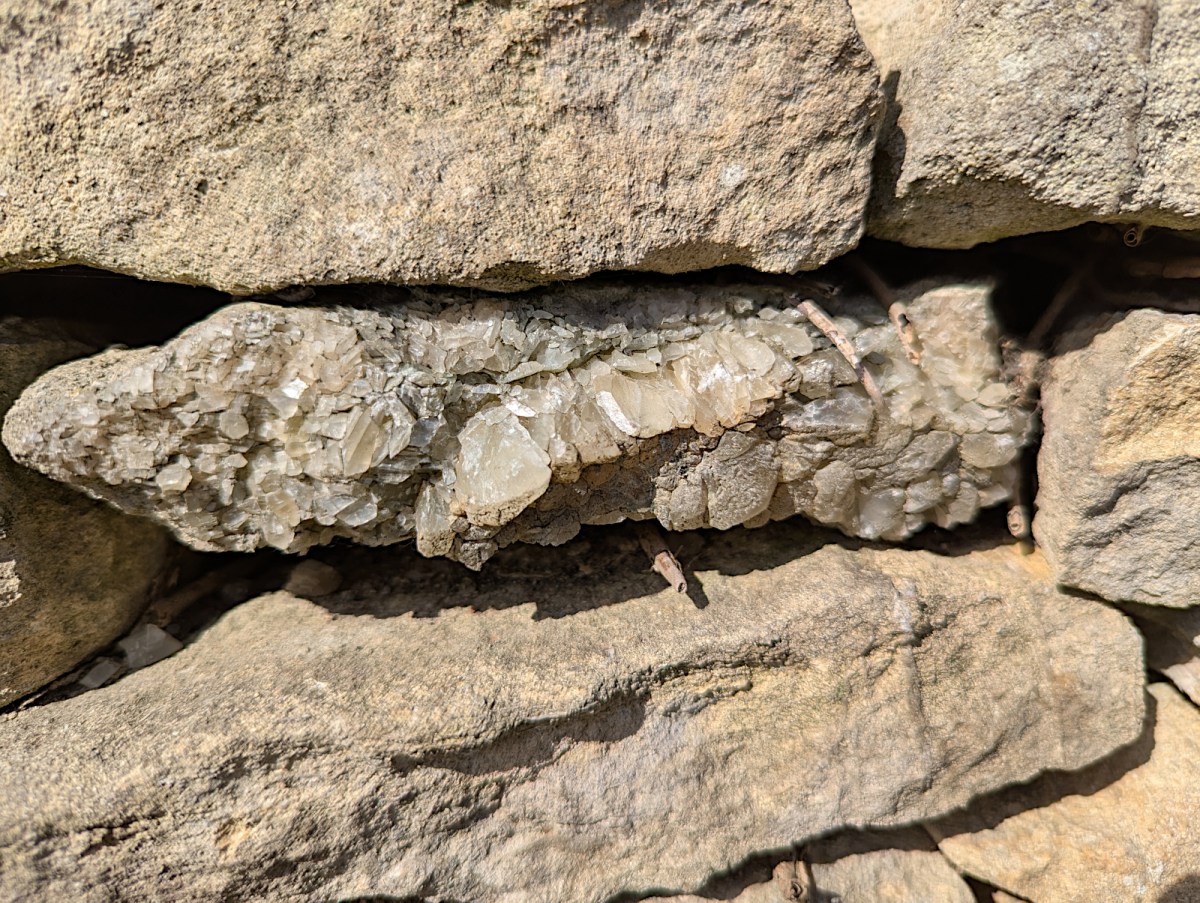
There’s a long stretch of dry stone Cotswold wall along the western edge of the Gloucester Road between Cirencester and Stratton. Walking along the footpath one day I was surprised to see the crystalline inclusions featured in this photo. The crystals look to me like a form of quartz (six-sided columns with six-faced prisms at both ends).
This might be part of a geode fractured open while quarrying the stone. There’s a small chance that the other side of the geode exists elsewhere in the same wall or in some other structure built around the same time. It seems that quartz geodes are not unusual in Oolitic limestone deposits. When they are stained purple purple the crystals are known as amethyst. The formation in the photo shows no hint of colour at all. The deposit must have formed from a particularly pure solution of quartz.
If you enjoyed this or found it useful, please like, comment, and share below. (If you don’t see those links, click the article’s title above the main photo and they will appear.) Send a link to friends who might enjoy the article or benefit from it – Thanks! My material is free to reuse (see conditions), but a coffee is always welcome and encourages me to write more often!
What’s in an image? Sometimes quite a lot, more than meets the eye. I’m posting an image every few days.
Click to enlarge
The land now occupied by Watermoor House and St Michael’s Park may once have been common land. But early large scale Ordnance Survey maps mark a much larger area, including that now occupied by the house and park, as a large nursery. It might have been owned at one time by Richard Gregory who was a Cirencester nurseryman in the 1790s.
The business (and probably the land) passed into the hands of John Jefferies at least by the early 1800s, and it seems that Randolph Mullings, a local solicitor, bought a substantial piece of it in order to build a large house in its own grounds. The details remain unknown, but Gregory, Jefferies and Mullings were known to one another, and Jefferies worked as a manager for Gregory on the nurseries. Gregory lost much of his money by providing surety for a friend’s loan, and Mullings advised Jefferies to continue managing the business and wait to see how things would work out.
Having acquired part of the land, Mullings engaged the architect William Jay to design the building; Watermoor House was constructed to Jay’s plan around 1827 in the Greek Revival style; and the garden and park were added to complete the property. The house is now grade II listed.
At some point Watermoor House became a private school until it closed in the 1950s or 60s. It may have had some other function following this, but today it is a residential care home.
I’ve cobbled this tale together from limited sources that may or may not be reliable. There are also many gaps. It would be good if the story could be properly researched by someone with the time and skills to undertake it.
If you enjoyed this or found it useful, please like, comment, and share below. (If you don’t see those links, click the article’s title above the main photo and they will appear.) Send a link to friends who might enjoy the article or benefit from it – Thanks! My material is free to reuse (see conditions), but a coffee is always welcome and encourages me to write more often!
What’s in an image? Sometimes quite a lot, more than meets the eye. I’m posting an image every few days.
Click to enlarge
At the top of the image you can see the rears of buildings on Cecily Hill in Cirencester. Their gardens contain the trunks and foliage of mature trees just beyond the wall. The wall separates those gardens from the water channel and may have been built specifically for that purpose. Some of the tree branches have grown across the top of the wall.
Near the base of the wall is a distinct line, brown below and much paler above. I think the brown part of the wall is often underwater. The water flow is strongly seasonal, high in wintertime and much, much lower in the summer. The River Churn divides at the Gloucester Road bridge, only a kilometre from this point. The major branch follows the outside of the Roman city wall and usually continues to flow all year round. But the branch in the photo is fed from the outflow of the long, narrow, supply pound for Barton Mill and this in turn is fed from the main flow of the River Churn. The water flows in the town are complex, this section is often known as Gumstool Brook, but it might also be regarded as a diverted part of the Churn.
The pipework at the bottom of this wall was there in the 1950s and 60s when I was a child. Most of it was hidden then by a low wall topped with flagstones, but today much of the structure has fallen away exposing the glazed pipes. Out of the photo a little further to the left, the water disappears underground, running south of Coxwell Street and reappearing at the surface further west in the Abbey Grounds.
It’s good to know that the Town Council and the Friends of Gumstool Brook are looking into ways of improving the flow of this watercourse by adjusting the sluice management rules. We might see the water flowing properly all summer in 2026.
If you enjoyed this or found it useful, please like, comment, and share below. (If you don’t see those links, click the article’s title above the main photo and they will appear.) Send a link to friends who might enjoy the article or benefit from it – Thanks! My material is free to reuse (see conditions), but a coffee is always welcome and encourages me to write more often!
Yaroslava Antipina lives in Kyiv, she writes often about Ukrainian culture and art, about the war, and always illustrates her letters with some great photography.
One of Yara’s photos
Verbatim – 1
A short introduction from me first, and then the text and images from Yara’s letter. I rarely post other people’s material verbatim, but this is an exception as Yara writes that it can be shared freely. If I can bring her even one more regular follower it will be worth sharing her letter here.
One of Yara’s photos
Yaroslava Antipina lives in Kyiv, she writes often about Ukrainian culture and art, about the war, and always illustrates her letters with some great photography. Her writing style is engaging and her objective is to help her readers understand what’s happening, how beautiful her country is, and give them some idea of how it feels to live through these events. She has a lot of loyal readers and followers.
Yara is the short form of her name; the name you’d use if you joined her for a coffee in Kyiv. Find her on Patreon, and see another recent letter with some photos of amazing dresses.
The full letter…
Friday Letter from Ukraine. Peace without security guarantees
Hi!
I didn’t plan to write today, but yesterday, while reading a magazine, I came across an article about the Kellogg–Briand Pact. Perhaps you know about it, but let me quickly summarise it, and then I will explain why I mentioned it. I promise this letter will be short.
On August 27, 1928, fifteen nations signed the Kellogg–Briand Pact at Paris; later, forty-seven more joined. France and the United States, represented by the Foreign Minister of France, Aristide Briand, and the Secretary of State of the United States, Frank Kellogg, were the leading initiators of the development and adoption of this document.
The signatories renounced war as a means of national policy towards other countries and pledged to settle disputes peacefully.
Frank Kellogg earned the Nobel Peace Prize in 1929 for his work on the Peace Pact.
In practice, the Pact was ineffective. In 1931, Japan began its occupation of Manchuria. Although Japan had signed the Pact, the combination of the global depression and a limited willingness to engage in war to protect China hindered the League of Nations and the United States from taking any action to enforce it. Later, Italy invaded Ethiopia, and the Soviet Union and Germany started to divide Eastern Europe. The Kellogg–Briand Pact was an example of how wars cannot be prevented by simply prohibiting them and signing a document.
Ukraine is now forced to make a peace deal with russia. Ukraine demands security guarantees. Without them, I see this peace agreement as a piece of paper where something like, ‘Okay, let’s end this war; enough is enough’ will be written.
Perhaps someone may even be awarded the Nobel Peace Prize for it (and you know who I mean).
Meanwhile, russia will take some time to rearm, revive its economy and become even stronger before it invades again. It may be only Ukraine or other neighbouring countries. That piece of paper with ‘enough is enough’ will greatly help russia as there will be no consequences for the new invasion. A big nothing except for worrying nods: ‘It is so bad’.
I know I am telling you very obvious things, and Ukraine constantly repeats and demands it.
I know I don’t decide anything.
I know that these guys in suits can do everything they want.
I know.
But we need to talk. We need to think critically. We need to reflect on the past and learn from history. We need to do even little something to avoid big nothing. Or this ⬇️
Serhii Kichay, Unchildlike Grief, 1943
Thank you for reading. This letter is public so that you can share it with anyone if you want. Commenting is reserved for my supporters as my gratitude for helping my words reach as many people as possible and my intention to keep at least this place safe (I had issues before).
The faded warm colour of the sky, the stark blackness of the skeletal trees, and rising mist make a scene I just had to capture. I had only my phone with me, but for wide-field, distant views that’s good enough.
What’s in an image? Sometimes quite a lot, more than meets the eye. I’m posting an image every day or so.
Click to enlarge
This photo was taken from the Gloucester Road, between Cirencester and the village of Stratton a mile to the north. It was the 15th of January 2025, at nearly five in the evening. The sun had already set so the air was cooling after a mild day with good sunshine and the moist air above the grass in the fields was condensing as mist.
The faded warm colour of the sky, the stark blackness of the skeletal trees, and rising mist make a scene I just had to capture. I had only my phone with me, but for wide-field, distant views that’s good enough. There’s a hint of mystery here too, we can only guess what might be hidden in the most misty areas.
And I couldn’t help thinking about the parallels with people. Before birth we are hidden, like the darkness before the dawn (you need to imagine a country dawn, not a city dawn, no streetlights, no artificial light). After birth we are visible to all and we change, growing in size, growing in knowledge, growing too in wisdom – hopefully. Most of our life is lived in the full light of day. We have a job, we raise a family, we interact with others as friends, or family, or perhaps sometimes even as enemies.
Lives, like days, begin, run their course, and then become evening. In the evening of life, the pace slows, there are memories that may be well-defined, or sometimes, like the mist, our memories hide things from us. The light fades, and when we die we enter darkness like the night.
Or do we? People have discussed what happens after death, every generation that has lived has wondered about this. Some people are certain that the darkness of death is the end of all sensation. And they are right, of course. But might there be other possibilities? Every generation has also held untestable ideas. Is there a God? If so, what is he/she like? Answers to untestable questions are not wrong, they are just not capable of being tested.
It has always seemed quite sensible to me to live my life as if what I do matters during the night of my life as well as during its day. But also, the teaching of Jesus is very logically sound, not testable but also, as far as I can see, internally coherent and free of self contradiction. That quality amazes me, I believe his claims to be true, testable or not. He has convinced me. Maybe he has convinced you too, or maybe not. We have that freedom, and we cannot persuade one another using the scientific approach, good as that is for studying more measurable and therefore testable matters.
If you enjoyed this or found it useful, please like, comment, and share below. (If you don’t see those links, click the article’s title above the main photo and they will appear.) Send a link to friends who might enjoy the article or benefit from it – Thanks! My material is free to reuse (see conditions), but a coffee is always welcome and encourages me to write more often!
The rest of the week we might have left-over meat from Sunday, often minced and made into cottage pie or shepherd’s pie. And we had non-meat days in the week as well, perhaps macaroni cheese, or kippers. or baked beans on toast, or cod.
What’s in an image? Sometimes quite a lot, more than meets the eye. I’m posting an image every day or so.
Click to enlarge
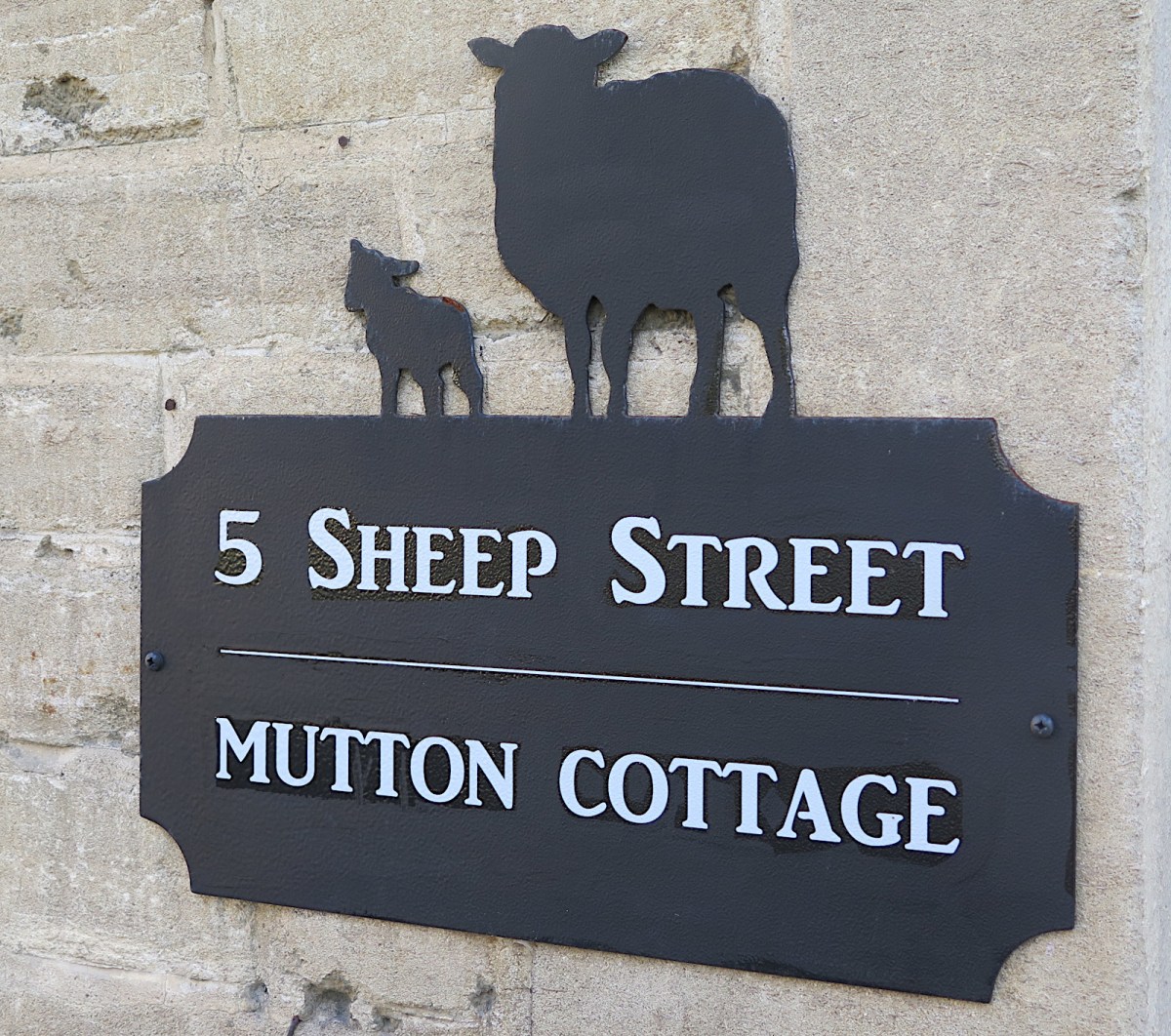
As a child I remember that we had a joint of meat on Sunday. And we usually had a fried breakfast on Sunday too, bacon, egg, fried bread, and perhaps a sausage as well. Sunday was a good day, a day to look forward to! The Sunday joint was sometimes mutton, sometimes pork, and just now and again, beef. But hardly ever chicken because chicken was too expensive. I also recall whale meat on at least one occasion. The rest of the week we might have left-over meat from Sunday, often minced and made into cottage pie or shepherd’s pie. And we had non-meat days in the week as well, perhaps macaroni cheese, or kippers. or baked beans on toast, or cod.
Today’s photo is from a house entrance in Cirencester’s Sheep Street. The house is not really a cottage at all. Hand sawn stone (known as ashlar) was an expensive material, so a genuine cottage would have probably have been built of undressed Cotswold stone straight from the quarry. Mutton (sometimes on a Sunday) is the meat of a mature sheep, tougher than lamb and needing more cooking time.
Why these references to sheep?
That’s easy to answer if you know something about the history of the Cotswolds! The land in this region is very good for farming sheep and in Medieval times wool was much in demand throughout Europe. Woollen cloth was still a major industry in early Victorian times, and the wealth created from the sale of unprocessed wool and woollen fabrics paid for many fine churches and merchant’s houses in towns across the region. Cirencester was no different, the famous Parish Church of St John the Baptist was built on wool money, and the many merchants’ houses in the centre of the town were funded in the same way. One of them, in Coxwell Street, still has its counting house attached.
That explains the references to sheep. You’ll find others, there’s the ‘Wool Market’, the ‘Fleece Hotel and Restaurant’, and Shepherd’s Way to name just three.
If you enjoyed this or found it useful, please like, comment, and share below. (If you don’t see those links, click the article’s title above the main photo and they will appear.) Send a link to friends who might enjoy the article or benefit from it – Thanks! My material is free to reuse (see conditions), but a coffee is always welcome and encourages me to write more often!
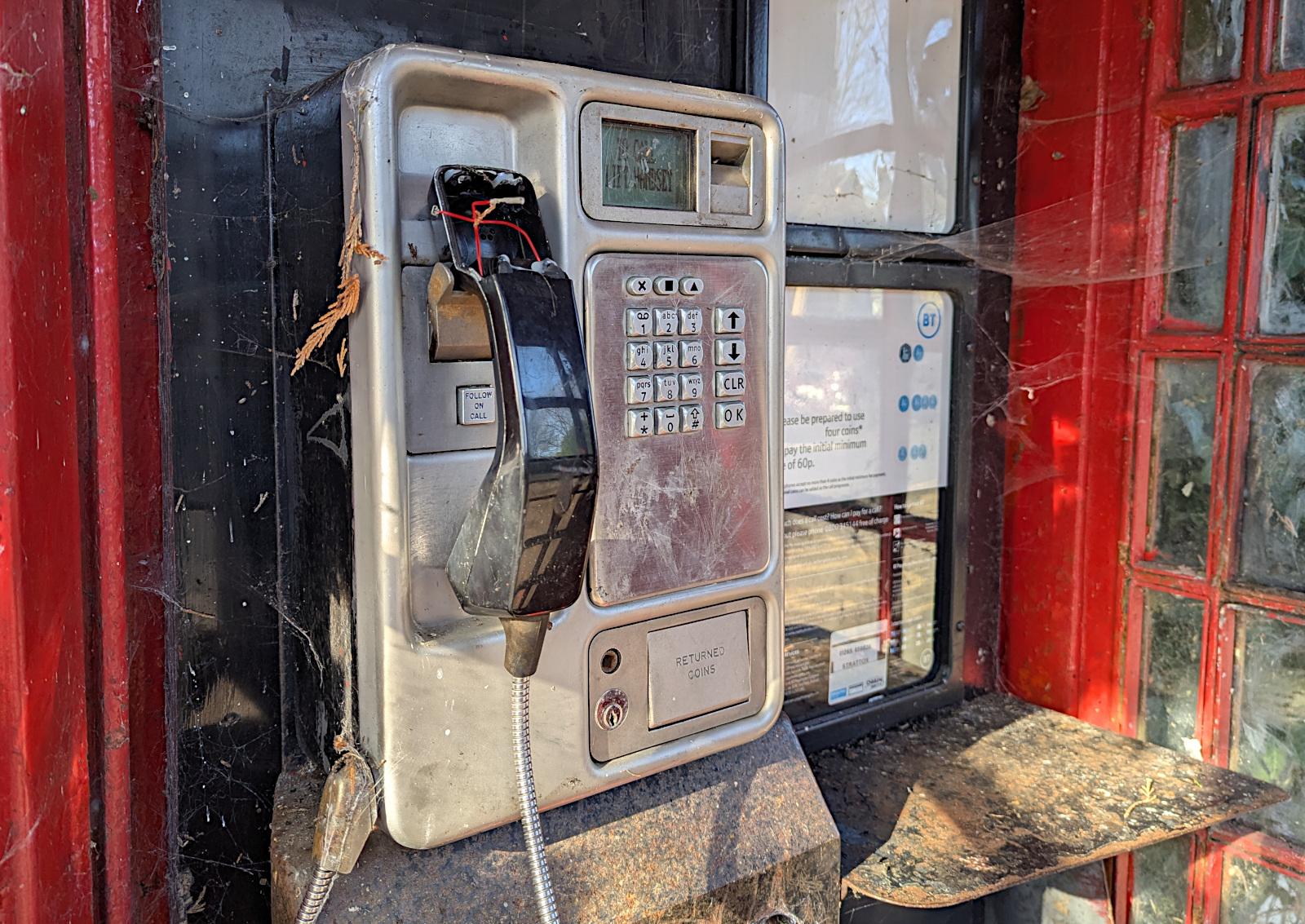
As mobile phones became more affordable and widely available the need for phone boxes vanished. This one was never removed and stands forgotten by the pavement, more or less unnoticed, draped in cobwebs, laden with layers of dust.
Image 136 – What’s in an image? Sometimes quite a lot, more than meets the eye. I’m posting an image every day or so.
Click to enlarge
Stone Age?
Well – Stone Age in terms of communications technology! A long time ago, way, way back in the 1980s, telephone kiosks like this one were widespread in the UK. You can see the red paint for which these phone boxes were so famous.
This particular box stands at the junction of the Gloucester Road and the Cheltenham Road in Stratton, where we live. It must have been quite busy when it was first installed. I well remember standing waiting at a box like this, sometimes there might even have been a queue of three or four people waiting to make a call.
And I remember the standard phone box smell as well. There was always a certain degree of dampness about them, often mixed with stale tobacco smoke. There was a little shelf containing a local residential directory and a yellow pages with business numbers and adverts.
This example of the British Telecom (BT) phone box has seen better days. It was converted with up-to-date equipment that must have replaced the original, black, bakelite handset with its black, enamelled, steel coin-box with Button A and Button B. But as mobile phones became more affordable and widely available the need for phone boxes vanished. This one was never removed and stands forgotten by the pavement, more or less unnoticed, draped in cobwebs, laden with layers of dust.
If you enjoyed this or found it useful, please like, comment, and share below. (If you don’t see those links, click the article’s title above the main photo and they will appear.) Send a link to friends who might enjoy the article or benefit from it – Thanks! My material is free to reuse (see conditions), but a coffee is always welcome and encourages me to write more often!
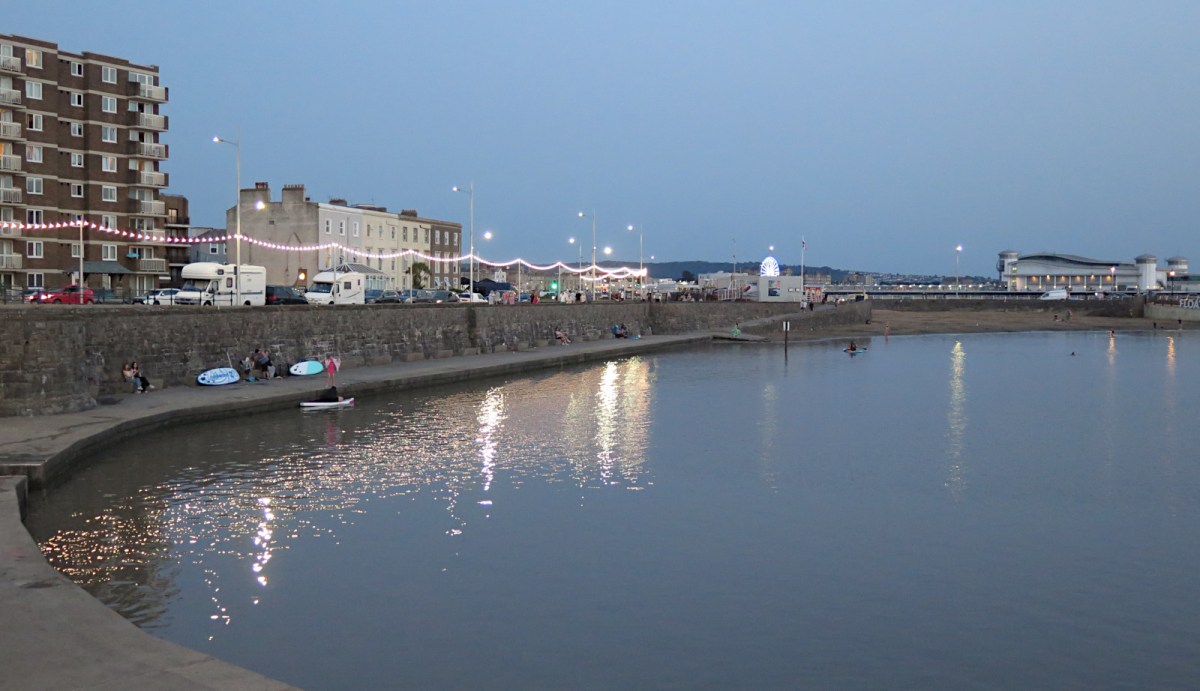
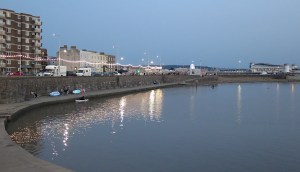
The Marine Lake was built in the 1920s and has just been dredged and refurbished. It’s free to use, and within the lake the tide never goes out, but on every high tide some of the water is replaced to keep it clean.
Image 135 – What’s in an image? Sometimes quite a lot, more than meets the eye. I’m posting an image every day or so.
Click to enlarge
This is one of the jewels of Weston-super-Mare – The Marine Lake. One feature of the coastline here is that it has one of the highest tidal ranges in the world (14.5 m), second only to the Bay of Fundy in Canada, I believe. The beach is very gently shelving as well, so at low tide the sea retreats between two and a half and 3 kilometres!
The Marine Lake was built in the 1920s and has just been dredged and refurbished. It’s free to use, and within the lake the tide never goes out, but on every high tide some of the water is replaced to keep it clean. It’s also large enough for a lot of people to use it at the same time, and it includes a large, sandy beach above the waterline. It’s also right in the heart of busy part of town, with plenty of cafes and restaurants, shops, the big wheel, the pier and much more just a stroll away.
My photo was taken late in the evening after sunset in September so there are few people using the Marine Lake. But believe me, in the middle of the afternoon on a sunny day in July it would be quite crowded. There’s a very long and wide sandy beach stretching north and south of Weston pier, and many people use that for sunbathing or making sandcastles regardless of the state of the tide.
The Marine lake is a marvellous feature. Without it, Weston would not seem like Weston at all!
If you enjoyed this or found it useful, please like, comment, and share below. (If you don’t see those links, click the article’s title above the main photo and they will appear.) Send a link to friends who might enjoy the article or benefit from it – Thanks! My material is free to reuse (see conditions), but a coffee is always welcome and encourages me to write more often!






 Journeys of Heart and Mind