What’s in an image? Sometimes quite a lot, more than meets the eye.
I’m posting an image every two days (or as often as I can). A photo, an image from the internet, a diagram or a map. Whatever takes my fancy.
Click to enlarge
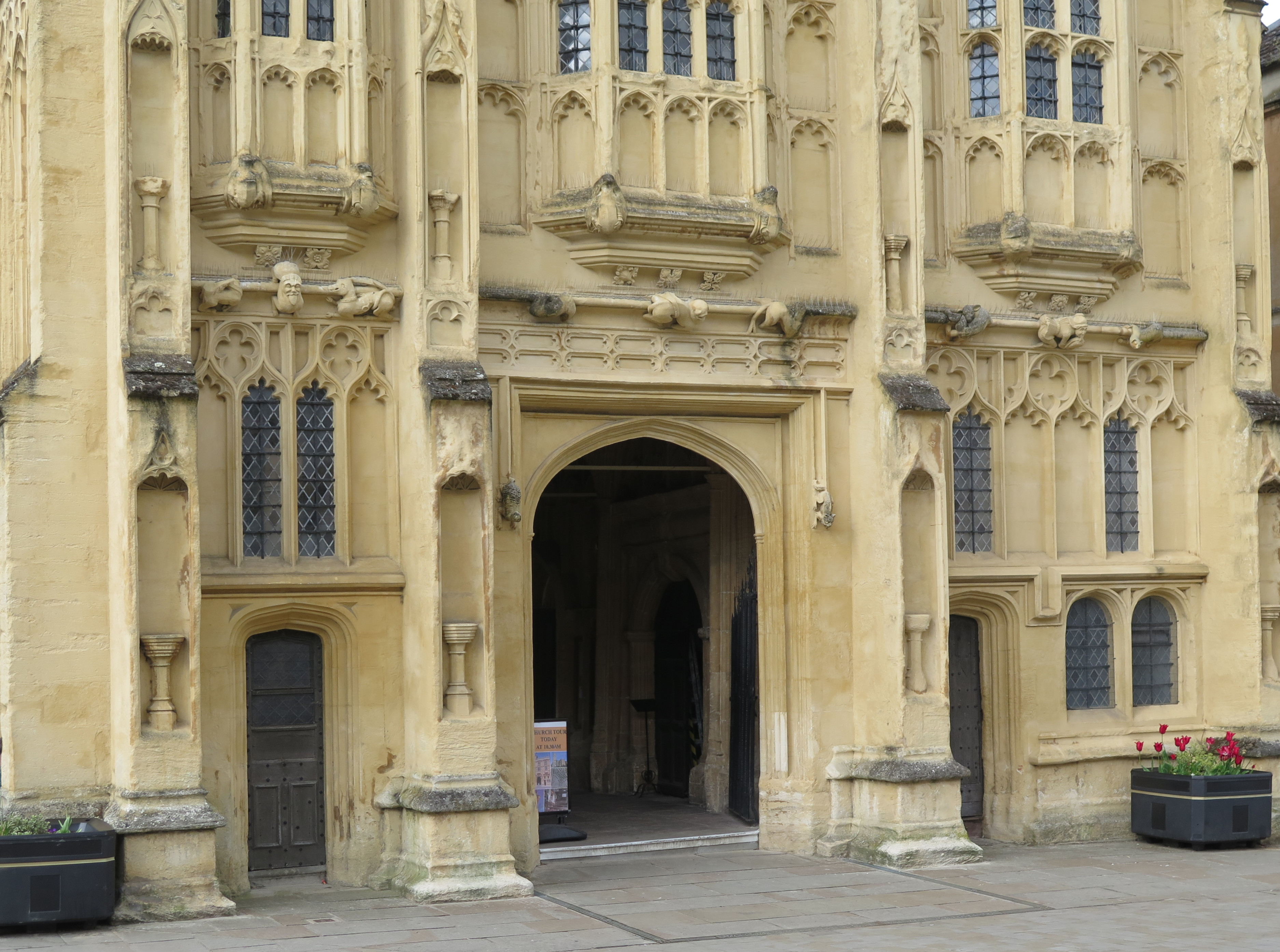
This is the porch of Cirencester’s Parish Church, St John the Baptist. It’s used as the main south entrance into the Church, and the door on the north side is also usually open, but the main West Door is kept closed and bolted. A three storey porch is a rarity, and in fact the two upper floors were once used as the Town Hall. But it seems the porch was built by the nearby Abbey as administrative offices and only attached to the Parish Church after the Abbey was dissolved.
This image shows the front detail, but I’ll post another photo soon showing the entire building. The architecture is interesting, with carved animals both real and imaginary, and niches for statues, now empty.
I think there’s something we can learn from this. There was an uneasy rivalry between the Abbott and the townspeople in medieval times. It’s thought that Cirencester was given a royal charter at one time, but the Abbot got hold of it somehow and destroyed it. Building the administrative centre right in front of the Parish Church makes me wonder about the motives involved in that, as well. Maybe there are other explanations I’m not aware of.
But we should always strive to get on well with those around us. It takes two to argue, but it also takes two to agree and agreement is usually better in the long run. In the uneasy relationship between abbey and town, the town had the last laugh when Henry VIII dissolved the abbey. And the town used the building in the picture and later gave it to the church to be added to the structure as perhaps the grandest church porch in all England!
Cirencester
For convenience, here’s a list of all the Cirencester area images:
If you enjoyed this or found it useful, please like, comment, and share below. My material is free to reuse (see conditions), but a coffee is always welcome!
To come away with a shining face you must first go into the place where the glory is, you must stand face-to-face with the One who is the Presence.
Reading Chris Dryden’s ‘Concepts’ post, I was aware that I should write about how Father deals with me face to face. He always does this when I’m least expecting it, but I always know it’s him.
When I was a child, back in the 1950s and early ’60s, I had one or two luminous toys, and later a luminous watch. I never tired of holding these up to the light at night time and then turning the light off and watching the weird, greenish glow fade slowly over the next few minutes.
Let’s begin by setting the scene. Here I was, married and with an infant daughter, living in a very modest house in a very modest street, Judy and I had to be careful with the little money we had. Second hand everything, no car, riding my bike to work. A very typical story in the early years of married life. We were friends with another couple just a street away and had been meeting with them to read the Bible, pray together, and explore what the Holy Spirit was doing at that time in our area. They were Anglicans, we were from the Evangelical chapel at the far end of the village, but differences like that seemed utterly irrelevant.
On one particular evening as we were praying, a picture came into my mind. We were children, playing with bricks from large piles stacked on the ground. We were making little houses with them, walls of a few bricks with a gap for a doorway, another gap for a window and a few more bricks balanced on the top for a roof. We’d made several of these tiny ‘houses’ when the builder arrived on the scene.
He strode towards us through the mud and puddles and looked down at us. We thought he’d be cross so we jumped up to run away; if we ran in different directions we might all get away! But he smiled down at us and said,
‘I’m here to build a real house. If you scatter the bricks around, it’ll slow down my work, but if you bring the bricks to where I’m working, you’ll save me time and the house will be finished sooner’. So we did exactly that, we ran around collecting bricks and stacking them at his feet, while he got on with the work of building the house. And up it went, it was magnificent.
What we understood from this
I shared this ‘picture’ with my friends, Tony and Faith. And we could all see what it meant right away. The house is the church – not Anglican, not Evangelical, just the church. And the bricks were people – us, our friends, anyone we could bring into the builder’s presence. And the builder, of course, was Jesus. He is the one who said, ‘I will build my church’. And what resulted over the next few years was that a number of people including us (the living stones) were built into something very special indeed. It was a body pulsing with spiritual life and energy, especially when we met, but overflowing into the world around us too. I can say that for me, having this foundation and experience changed how I viewed my life more generally – at work, at home, with my parents, with friends, with family.
So don’t build structures with the people who belong to Jesus, but assist him as he directs and builds. Chris Dryden, writing on his site Life with CD, wrote recently about Moses speaking face-to-face with Yahweh. Maybe you should read his post and then come back here afterwards…
…Reading the concepts article sparked a new thought in my mind. All those years ago in the mid 1970s I’d had face-to-face conversations with Father through the presence of his Spirit! That describes the way it felt (and still does).
Moses in the Presence
Chris Dryden wrote about Moses and the conversations he had with Yahweh, face-to-face, created-to-creator, follower-to-leader. That was a mighty privilege; it still is! And it left Moses with a glow on his face (and I imagine, a glow in his heart as well). Do I have a glow on my face after conversing with Jesus through the power and presence of his Spirit? Yes, I think I do. The connection and the conversation leave me changed in a way that people can see. Not a visible glowing, but a glowing heart and a face that relaxes and smiles in a new way as I describe the revelation to those around me. Really, I suppose, an awestruck and amazed face!
Have you witnessed the glowing hearts and faces of people who’ve been in the Presence, in conversation with the King of Kings? If you’ve spent time in meetings when the Holy Spirit is allowed in and there are prophesies and pictures and singing and dancing and arms raised – then yes, I bet you’ve seen those shining faces! There is nothing to beat face-to-face time. That’s true with family, with friends, and it’s true with Jesus as well. We come away encouraged, lifted up, newly informed – there is nothing like being in the Presence. We all come away with shining faces, you bet we do!
But, just like Moses, to come away with a shining face you must first go into the place where the glory is, you must stand face-to-face with the One who is the Presence. The Shekinah Glory is his and his alone. Our faces shine with an absorbed light, just like those luminous toys.
But what is even more precious is that going about, living my ordinary life, the Spirit often surprises me. I see something, hear something, think something, and suddenly in that moment I realise there’s a spark from him. He speaks face-to-face with me without any effort on my part. He lives within me even when I’m unaware!
Useful? Interesting?
If you enjoyed this or found it useful, please like, comment, and share below. My material is free to reuse (see conditions), but a coffee is always welcome!
If Jesus builds something, then he may ask us to help – but he will be in charge. He will teach us how to build, he will give us tasks he knows we can do.
What did Jesus mean when he said, ‘I will build my church’? And what are the implications for us in our attempts to follow him? Here are some thoughts on the word ‘church’ and the action of building.
Aramaic is similar to Hebrew and was probably spoken at home and in the villages in Galilee in Jesus’ day, it was a widely used language in the region and even today is still used in a few areas of, for example, Syria. Jesus would have been taught Hebrew, as all Jewish boys were; this was the language of the Old Testament and was used in the Synagogues. There were some Greek towns and villages in the region, as there were throughout the Mediterranean more generally, so Jesus likely understood Greek. He might have known some Latin as well because that would have been spoken in imperial government and military circles.
In a conversation with his follower, Peter, he may have used an Aramaic word or possibly the Greek equivalent, ekklesia (church); and that’s how it’s recorded in the New Testament (Matthew 16:13-20). As a word it seems to have its roots in daily life; the village or town elders would have gathered as a local council to discuss and manage local affairs. As people meeting together more or less regularly, groups of people following Jesus may have been been given the same label – a gathering, therefore an ekklesia.
In the conversation described by Matthew, Jesus asks his followers, ‘Who do people say the Son of Man is?’ Of all of them, Peter was the most outspoken and would offer an opinion when the more cautious held back. Peter didn’t seem to worry about the risk of giving a wrong answer and looking foolish. So several of them gave the answer to the easy question – ‘Who do people say I am?’. But it was Peter who responded to the much more tricky question – ‘Who do you say I am?’
What Jesus says next seems ambiguous, at any rate the way Matthew describes it is ambiguous. Some people think he’s saying that Peter is the rock that he’ll build his church on. Others think the rock is the truth Peter expressed, the truth that Jesus is the Messiah, the Son of the Most High. Personally, I take the second view.
Jesus says that he will build his ekklesia, his church.
If Jesus builds something, then he may ask us to help – but he will be in charge. He will teach us how to build, he will give us tasks he knows we can do, but he remains the top man, the boss, the giver of instructions. We can’t just build what we want in the way that we want, call it church, and expect him to approve!
So let’s start by asking Jesus to show us what he wants us to do. And then when we each do our part, let’s keep checking with him that what we’re doing or saying is in line with his design. And then, as the job progresses, we’ll be able to gasp with astonishment saying, ‘Wow! This is far more amazing than anything I’d dreamed or imagined!’
It all starts with Jesus. The next step is that we have to learn to follow, to be Disciples. That will will steer us into Mission. And out of the results of mission we will see Church appear and grow.
If you enjoyed this or found it useful, please like, comment, and share below. My material is free to reuse (see conditions), but a coffee is always welcome!
There is a synergy, a sparking of abundant life that comes from the interdependence of the parts.
A page from the book
This is a slightly modified copy of an article I wrote in 2014. I’m republishing it because I think it is still useful and deserves another airing. Perhaps it hints at some things we are liable to forget.
The book, Simple Church: Unity Within Diversity, contains twenty-four chapters. Each one discusses a positive aspect of church, something that is an essential part of the whole. Reading from the book I was deeply impacted by Chapter 22 from Kathy Escobar; the chapter is entitled A church that restores dignity where it’s been lost.
She writes:
Jesus calls [Lazarus] out of the tomb, but then he looks to the people around him – his community, friends, and advocates – and says to them ‘unbind him’. Unbind him. Unwrap him. Take off his graveclothes.
I think God calls us to participate in this uncovering-unwrapping-unbinding with each other through healing community.
And it struck me that although church is much more than the sum of its parts, all of the parts need to be actively present. There is a synergy, a sparking of abundant life that comes from the interdependence of the parts. Church is a person, the Bride of Christ.
Like all people, you and I are much more than the sum of hands, ears, spleen, heart, lungs and all the rest. But if any of these were missing we would either die or be unable to fully function. And it’s just the same with the church.
Just consider some of the other chapter themes. The church cherishes Jesus Christ, exhibits personal holiness, counts every member as key, assembles for mutual edification, and knows eternal life is free. Imagine all of those being true in a church that fails to restore dignity where it’s been lost. It would be a church without the active compassion necessary to unbind those who so desperately need it.
Or consider a church that clings to scriptural truth, is most notable for its love and is united in Christ but doesn’t follow the lead of the Holy Spirit. This would be a church that failed to hear where to go and what to do and did everything in its own strength.
Or what about a church that was composed of peacemakers, viewed itself as a people, restored dignity but failed to proclaim the gospel clearly?
The chapters of this book all stand alone and can be read alone. But they often overlap so that there are echoes and glimpses of them in one another. Yet taken together, with no part missing or inactive, they describe a holistic church, a wholesome church and a church that is alive and active and effective in the world. There are other aspects that are not explicitly covered in the book, prayer for example. But these are implied throughout in a variety of ways.
Church is as complex as any living organism, and just like a living organism it is not only complex but also multi-faceted, and astonishingly well constructed. The church is also alive with the life of Christ. And every part contributes!
If you enjoyed this or found it useful, please like, comment, and share below. My material is free to reuse (see conditions), but a coffee is always welcome!
The videos are by turn funny, gripping, informative, and very, very useful.
Paul Young (sometimes William P Young) wrote The Shack for his children and it unexpectedly became a very famous best-seller and much later a movie.
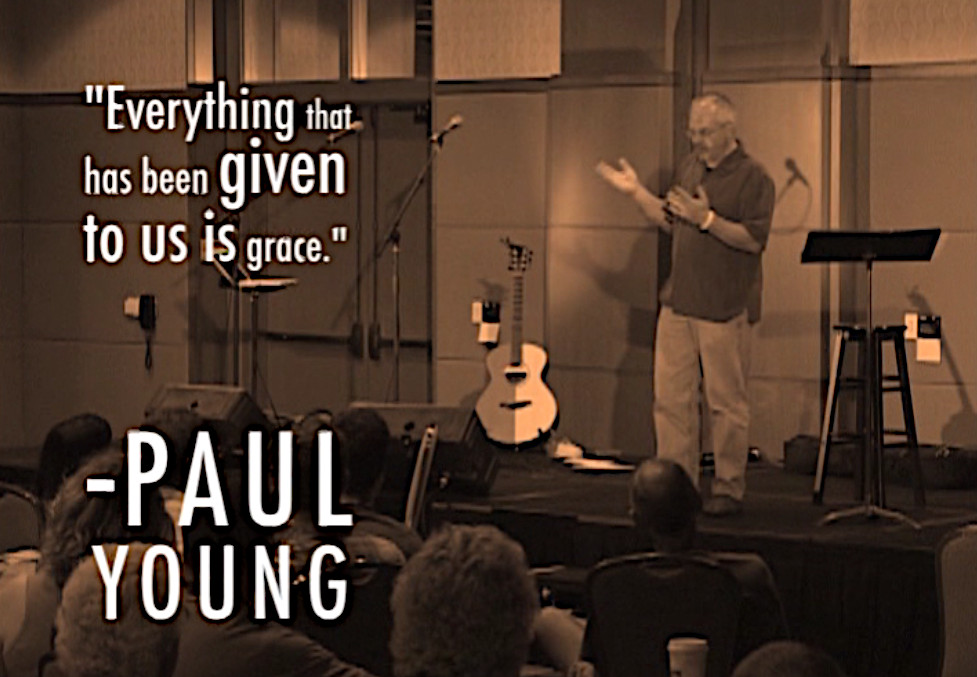
Here he speaks to a House2House (H2H) conference in 2008, explaining how our traditions can trip us up and mislead us, how he came to write the book, and how Father’s grace can take any one of us and make the impossible possible.
Paul Young, speaking on the topic ‘Grace’
I’ve put the three YouTube videos into a playlist. The video is low quality as it was recorded in 2008 using the standards available at the time, but the sound is clear enough. Copyright for all three videos is with House2House and I have their permission to share the videos here.
Click the playlist link and watch away. These videos have, I suspect, changed many people’s lives – in a good way. They open up truths that have been hidden for some, for others they will confirm what they already thought. The videos are by turn funny, gripping, informative, and very, very useful today just as much as in 2008. Truth doesn’t change.
So for you, and your friends, it may be transformational or it may be confirming. Either way, my prayer for you is that you will be blessed and encouraged by listening.
Some background
The conference was over three days, the first day was for leaders; Paul spoke on Grace and covers how and why The Shack came to be written. In his opening remarks he notes that he’s in an environment that he’s not familiar with. However, he was very well received.
The second topic, Tradition, was presented to the full conference. In it, Paul discusses the fall and the interactions between Yawheh, Ish, Isha, and Lucifer. (We often think of Ish as ‘Adam’ and Ishah as ‘Eve’, Paul explains the distinction.)
The third topic, Soul, was again to the full conference. This time Paul explains his background and life story very frankly.
Useful? Interesting?
If you enjoyed this or found it useful, please like, comment, and share below. My material is free to reuse (see conditions), but a coffee is always welcome!
The word ‘worship’ isn’t here, but David does mention ‘praise’ in verses 5 and 6.
I was struck by the thought that perhaps we don’t often consider the basics. We use expressions like ‘The Worship Team’ or ‘The Worship Band’, and sometimes we call it ‘praise’. So what is the connection between worship and praise and music?
Are praise and worship synonyms? If not, how they are they different? At last week’s Small Group meeting in Stratton we read Psalm 63 and thought through the questions provided by CBC. The psalm is quite short, only 11 verses, I suggest you read it now before returning to the rest of this article.
Defining our terms
It’s immediately clear from Psalm 63 that ‘praise’ and ‘worship’ might not actually be synonymous. The word ‘worship’ isn’t here, but David does mention ‘praise’ in verses 5 and 6.
The dictionary definition of the English word ‘worship’ as a noun is ‘the feeling or expression of reverence and adoration for a deity’, and as a verb, ‘show reverence and adoration for a deity’ So we can summarise it as ‘feeling or expressing reverence and adoration’.
We also use the word ‘worship’ in non-religious ways. People might say, ‘He worships that woman, or ‘She worships her cat’, and perhaps tellingly, we might even say, ‘He worships his car’. A feeling of reverence and adoration indeed!
Praise is easier to pin down; we use this word in everyday life quite often. You might praise a child for doing well in exams, or for working hard. You might praise a coffee shop for excellent coffee or good service.
So what’s the difference?
I think it’s clear that worship is about valuing something (or someone) very highly, whereas praise is saying that something is good or was well done. Saying that a car is good, well-designed, or reliable is to praise the car and, perhaps, the designer and manufacturer as well. But worshipping the car is saying it’s the most important thing in your life! You can’t live without it, you are dedicated to polishing it, and everything else in your life has less value and importance to you than the car.
Clearly, we should be very careful about who or what we worship. But we should pour out praise on everyone and everything that merits it. If I praise you because you have done well in some way, that is more than OK. It’s kind, it’s encouraging, it’s thoughtful, and it might make you even more eager to do well in future. But if I worship you, you would do well to try your utmost to stop me. Or just walk away – fast!
To put it another way, specifically for people who follow Jesus – we can worship only one person, or more accurately three people, the Father, Jesus and the Spirit that flows from them. We can praise them too, but we can also praise other people and even inanimate objects. And those worship bands that I mentioned at the start? Well, they make music, often very praiseworthy music. And the people listening are doing what, exactly? I’ll let you decide, leave me a comment and tell me what you make of all this. Thanks!
It might be useful to look at the Hebrew and Koine Greek words commonly translated ‘worship’ or ‘praise’. I’m not going to pursue that here, but I might come back to it some other time.
Useful? Interesting?
If you enjoyed this or found it useful, please like, comment, and share below. My material is free to reuse (see conditions), but a coffee is always welcome!
I’ve just read this short but truly excellent article by Chris Dryden, aka CD, aka DaManCD.
In his inimitable way, he captures the difference between typical church as most people know it, and the living organism of ekklesia as Jesus intends it. There’s an absolute chasm between the two, and Chris clarifies that.
I have given them the glory that you gave me, that they may be one as we are one – I in them and you in me – so that they may be brought to complete unity.
We consider priorities expressed by three church personalities and ask, ‘What is the most important objective for the church? What will most please Papa? What is the Spirit urging? How does Jesus want us to respond?’
A polychotomy?
Shattered glass
We are being tugged in many directions in our lives as believers, we have become a polychotomy. The word literally means ‘many cut apart’. The church looks like shattered glass; oneness turned into shards. There are voices telling us to believe the right things, say the right things, do the right things. Let’s take a look at some of them and ask ourselves the question, ‘What is the greatest priority?’
An article by Sam Hailes (no longer available) started me thinking about this. Sam interviewed Peter Farmer from Nottingham, Tony Goddard from Peterborough, and Beresford Job from Chigwell. These three men have different ideas on the main priority – mission and multiplication (Peter), making an impact and caring (Tony), following Biblical principles (Beresford). If we cast the net wider we will find many more groups with other insights and emphases. Every denomination and group has its own ideas about what is most important.
So who is right?
To answer this question we need to turn to the Bible. But where should we look?
Guidance from the Source
I suggest that the most important and fundamental guidance will come from carefully hearing what Jesus said. In particular, his prayer just before his arrest must be the best of all sources for what is essential.
Think about it for a moment. Yahshua knows that his whole life has brought him to this place of sacrifice. The burden upon him is enormous, his heart is heavy and he cries out to the Father. Surely what he asks at this moment will be the most important thing of all. So what does he say?
In John 17; Yahshua prays for his disciples, and there is much here that we need to take on board. But then he prays explicitly for you and me. And this is what he asks. Read it carefully – this is Jesus praying for you!
My prayer is not for [my disciples] alone. I pray also for those who will believe in me through their message, that all of them may be one, Father, just as you are in me and I am in you. May they also be in us so that the world may believe that you have sent me.
I have given them the glory that you gave me, that they may be one as we are one – I in them and you in me – so that they may be brought to complete unity. Then the world will know that you sent me and have loved them even as you have loved me.
Father, I want those you have given me to be with me where I am, and to see my glory, the glory you have given me because you loved me before the creation of the world. ‘Righteous Father, though the world does not know you, I know you, and they know that you have sent me. I have made you known to them, and will continue to make you known in order that the love you have for me may be in them and that I myself may be in them. (John 17:20-26)
He wants us to be one, united, not split apart. The Messiah himself prays to the Father that we may be one ‘just as you are in me and I am in you’. He wants us all to be ‘in us’ (the Father and the Son) so that the world may believe the Father has sent the Son.
More than that, Jesus has given us (you and me) the glory that the Father gave him. What?! Read that again. He’s given you and me his glory! Why? So that we may be one. Then the world will know.
And he prays that we may be where he is and see his glory.
There’s just no escaping this fundamental truth, that when the chips are down Jesus prays his heart out to his Father and asks that we may be one so that the world may believe.
What is the most striking thing about the church in our day? What does the world see when it looks at church? It sees multiple organisations, church is divided into myriad groups and denominations, often seeming to point to different things as being the most important. We are a broken, shattered people and the heart of Christ is broken when he sees us in this state. His heart is for us to be one just as he and the Father are one. And he wants to include us in their oneness and community.
Peter Farmer is not wrong about mutiplication and mission. Tony Goddard is not wrong about making an impact and caring for people. And Beresford Job is not wrong about following Biblical principles. But those are not the main things.
Becoming and remaining one
Above all, we now need to learn to be one. We need to accept we have differences, learn from one another. There is no single right belief, right speech, or right action. His children all shine with the light of his presence. If we are to be part of the answer to his prayer we need to learn from one another and grow together in love, building one another up, encouraging one another, helping one another to focus on every good thing. We need to grow up into Christ. Paul understood this well, see what he wrote to the Ephesian church.
As a prisoner for the Lord, then, I urge you to live a life worthy of the calling you have received. Be completely humble and gentle; be patient, bearing with one another in love. Make every effort to keep the unity of the Spirit through the bond of peace.
There is one body and one Spirit, just as you were called to one hope when you were called; one Lord, one faith, one baptism; one God and Father of all, who is over all and through all and in all.
Christ himself gave the apostles, the prophets, the evangelists, the pastors and teachers, to equip his people for works of service, so that the body of Christ may be built up until we all reach unity in the faith and in the knowledge of the Son of God and become mature, attaining to the whole measure of the fullness of Christ.
Then we will no longer be infants, tossed back and forth by the waves, and blown here and there by every wind of teaching and by the cunning and craftiness of people in their deceitful scheming. Instead, speaking the truth in love, we will grow to become in every respect the mature body of him who is the head, that is, Christ. From him the whole body, joined and held together by every supporting ligament, grows and builds itself up in love, as each part does its work. (Ephesians 4:1-6 and 11:16)
I am not suggesting that anyone is wrong, or that some are more right than others. I am simply observing that we remain shattered and that we are not yet perfectly formed into the one bride for whom Christ died and will return. Let us all strive to forge fresh bonds of peace. Paul called the Ephesians to keep the unity of the Spirit. Today we need to do more than that, we need to regain the unity of the Spirit.
Addendum
The above is a repost, only slightly changed, of an article I wrote way back in 2012. After 12 years, I think it’s worth repeating. If church has any purpose, any value, it springs from Jesus’ prayer for you and for me. Will I let him place the little fragment that I am into a shared oneness with my brothers and sisters? Will you? Last night I was privileged to be part of a Small Group meeting with friends in one of our homes – and this oneness, and sharing, and presence of the Spirit of Christ, and care for one another and the wider world was tangible amongst us. That is so refreshing, so encouraging, so good!
The analysis excited me, Henry Drummond confirmed what I already knew to be true – this new life in Christ is all about love.
Here’s a modern English version of Henry Drummond’s ‘The Greatest Thing in the World’. His wonderful essay on love was originally created in 1884, and it analyses Paul’s famous chapter 13 of 1 Corinthians.Well worth a read!
Why have I gone to the trouble of translating this essay into modern English? Basically, because it deserves a wider audience. Years ago The Greatest Thing was often reprinted as a booklet and was very popular. I remember buying a copy in Wesley Owen’s on Park Street in Bristol back in the 1970s when the language was still less than 100 years out of date. It was a great read and it helped to change my life. The analysis excited me, Henry Drummond confirmed what I already knew to be true – this new life in Christ is all about love. At the same time the little book challenged me and drew me on.
This great essay is no longer widely known or read. It deserves better. It will speak to readers today just as it always did. Read it!
Acknowledgements
And finally, I just want to thank the family members and friends who read my early drafts and made helpful suggestions, pointed out errors, or were just encouraging. You know who you are.
Licencing
Copyright in the original has expired while the new version comes with a Creative Commons licence. So please feel free to print or republish either version and distribute it as widely as you like.
Notes from bygone years – Julys duly remembered Hint: Click on the thumbnails for larger images.
A year ago
On 7th July 2022 I noted that ‘the Conservative party is in a state of confusion right now’. Not a lot has changed in the last twelve months; it seems the Conservative ship is still foundering. I included a picture of a sinking ship in my article, here it is again. I also argued for a general election as soon as possible and we’re still waiting on that one! So the big question now is, ‘Will the Conservatives still be in power in July 2024?’ Hard to say, isn’t it! In my judgement it’s very unlikely, but we’ll have to wait and see. The last possible date for the next general election is 28th February 2025. (See the original post.)
Starship’s first launch, 20th April 2023 – Image from Wikimedia
In July 2021, SpaceX‘s Superheavy Booster 3 was being tested at Boca Chica in Texas. They continue to develop and build boosters (and Starships too) at a prodigious rate, and have already launched the full stack on it’s first test flight. That flight failed to reach orbit, and caused serious damage to the launch mount but, following repairs, they are very nearly ready for a second attempt and have made a lot of changes following lessons learned from flight 1.
In July 2018 I shared an extract from my short guide, JDMC. I emphasised the work of the Holy Spirit in church life and looked at ways we can recognise and value his activity.
I didn’t want JDMC to be only about what we do, but more significantly about what Jesus does. (Read the original article)
Research shows we are often in situations where we’re amongst people we recognise, but know almost nothing about. In July 2013 I was thinking about this and how I might notice and engage with such people. (Read the original article)
In July 2008 I wrote about the famous Welsh hymn, ‘Dyma gariad fel y moroedd’ or in English ‘Here is love vast as the ocean’. Read about the hymn’s origins and listen to it in the original article.
July 2003 saw us meeting at home to listen to what the Spirit would say and watch what he would do. And of course, we were not disappointed. Afterwards I posted ‘Fallen and lifted up‘ to capture something of that evening.
In July 1998 we visited Kimbolton, just a short distance from our home in Tilbrook. Although it’s a village, Kimbolton always seemed much more like a small town with a market place and Kimbolton Castle, now a private school.
In July 1993 Judy, Debbie and Beth went to see a Sealed-Knot re-enactment of a Civil War battle. I didn’t go to this as I was probably at work at the time.
In July 1988 My Mum was sixty and we had a party at The Catherine Wheel pub in Bibury. Here she is unwrapping a present – a Mickey Mouse landline telephone. She had always wanted one of these!
In July 1983 my mathematician friend, Phil, and I had a scientific paper published. Phil built a mathematical model for the effect of temperature on apple pollen tubes. This was based on experimental measurements I’d made in spring 1982.
In July 1978 Beth was just two months old (whoops, I think I just gave her age away). We were living in a terraced house in Yatton and I was working on plum and apple pollination.
In July 1973 I inspected the base for a greenhouse with my father-in-law, Ron Hill. Here we are, having a good look. As you can see, Ron’s garden in Charlton Kings was beautifully maintained.
In July 1968 I celebrated my 20th birthday. I don’t remember the occasion, but it would have involved a bit of a party with my Mum and Dad, my three sisters, Judy, and possibly her parents and brother too. From my current perspective it seems a very long time ago!
In July 1963 I was 14 years old and we might have been on holiday, but more likely it would have been August. In any case, here’s my Dad taking a photo of the family on the beach on the coast of Ceredigion, Wales.
In July 1953 I was four, turning five and hadn’t yet started school. Mum, Dad, my little sister, Cindy, and I lived in Queen Anne’s Road on the Beeches estate in Cirencester.
July 1948 was the month I was born. I was one of the first two children to be delivered at Cirencester’s new maternity hospital. It’s now the main building of today’s Cirencester Hospital.