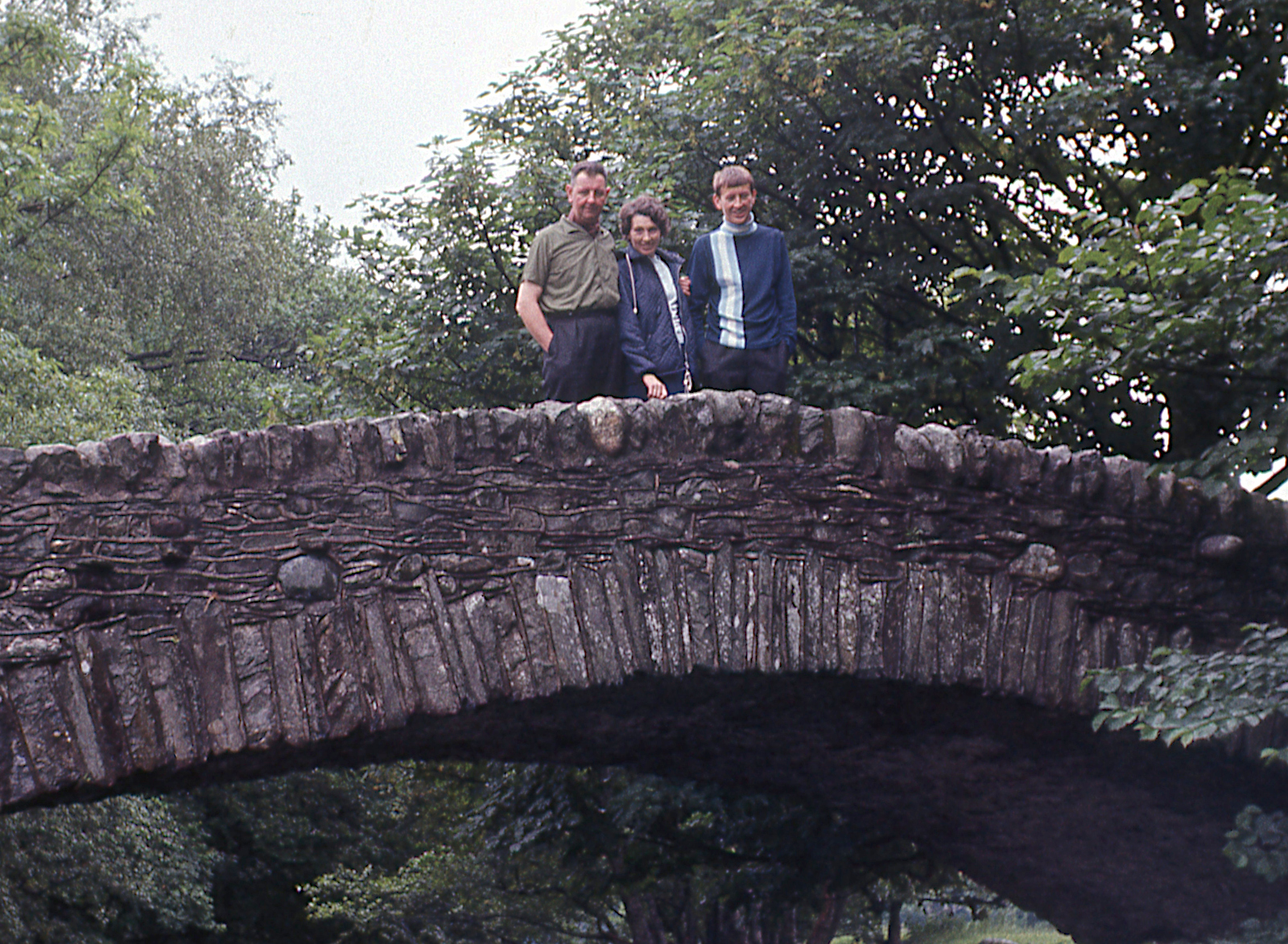
Yatton, the village in Somerset where it all happened
3 – developing faith

Moving on
Things were changing. We’d been fairly comfortable at Horsecastle Chapel in Yatton, and we’d learned a great deal and felt loved and made very welcome by the people there. But there were one or two niggles already mentioned in part two of this series. We felt it was not right, and rather unfortunate, that women were not able to take leading roles in meetings, that it was required that women wear hats (a minor thing, but an irritant nonetheless). It began to seem that some of these rules were made by people, not by our Father in heaven, and certainly not by his Son, Jesus. But the greater niggle was that we were not able to move in spiritual ways that were being revealed to us more and more as time went by.
An Anglican home group
For me it came into sharper focus when I went to an Anglican study group. Judy might have come to the same ideas in a different way, but she died in 1995 so I can’t check! I’m not sure we discussed it at the time, but we were moving on closely parallel paths, that I can say with certainty. I wanted to meet some of the Anglicans because I had the feeling there was supposed to be a single church, not a plurality of them. I couldn’t see any way that they could all be brought together, but I wanted to at least get to know some people of other denominations. Going along to the study group seemed a good way to approach this. I soon came to understand that the Holy Spirit was nudging me to go along, and rather quickly I discovered what he had in mind!
Friends and allies
The Anglican study group was held in the home of one of the St Mary’s congregation and was led by the Vicar, Revd Richard Acworth. I don’t remember what was discussed, but I very clearly remember the topic of humility coming up. There was a man in the group who protested, quite strongly, that he was not humble and didn’t intend to become so. I had the impression that he equated ‘humble’ with ‘impoverished’ or ‘weak’ or ‘demeaning’ or some other utterly unattractive idea. I think I was also a bit disappointed by the Vicar’s response.
Also in the group was a woman about my age and as we were leaving I mentioned the humility issue. She agreed quite enthusiastically and we had a brief conversation on the way home; her name was Faith. Judy and I would soon become good friends of Faith and her husband Tony. We shared a lot of views in common concerning Jesus, the Bible, and Church – and this excited me because we were from such different church traditions.
Meeting often
We began meeting quite regularly with Tony and Faith. We were like-minded on so many church matters, and some other things too. We both had young families so most often one of us would walk down to Tony and Faith’s house in Court Avenue in the evening while next time one of them would walk up to our house in Rectory Drive. We would do some Bible study, perhaps sing some of the Christian songs that were so common in those days, and we would pray together. But by far the most important thing we did was to listen to one another and to what the Holy Spirit seemed to be saying to us, sometimes in a whisper, sometimes rather loudly! We invited other people we knew to come and join us, especially Paul and Jenny who lived close as well, so four became six; and there were many other local people with us. On a weekly basis we took turns to host these larger meetings. Sometimes there’d be 20 people in our sitting room, on our sofa and armchairs or sitting on the floor. These were great times of blessing when all of us would feel the presence of the Holy Spirit right with us in every word read or spoken and in every song we sang. We were warned of the dangers we were facing by some of the elders at Horsecastle Chapel, we knew their hearts were in the right place and that the warnings were well-meant; but we knew we were following Jesus so we ignored the advice and warnings and carried on.
Music

Tony is a skilled bass guitarist, Paul was good on a steel-strung 12-string he had, And I would plonk along on a nylon-strung Spanish style acoustic guitar Judy and I had bought at a music shop in Park Street, Bristol while we lived in our flat in Belmont Road. This was an expensive instrument – I think it cost us £27 in 1970 or 1971 (around £540 today) and it replaced the two cheap, second-hand guitars we bought while at university. It seemed better to share one good guitar than to persevere with two older ones that were difficult to tune. Rather later, we were joined quite often by David and Mary Bolster, another couple living nearby. David worked for Scripture Union, and was usually busy with youth work of one kind or another. Judy and I went on a youth retreat with them one year at Wroughton near Swindon to help as assistant leaders, and visited them at a camp at Great Wood in the Quantock Hills, Somerset. The photo shows Fountain in the Church Hall at St Barnabas in Claverham (from left you can see Paul, Faith, me, Ian on flute, Jenny, Judy and Tony on bass). Ian joined us a little later but was a very useful addition providing a higher pitch in the mix and helping strengthen the melody line.
Tongues
One evening after walking down to Tony and Faith’s, Tony mentioned that he’d received the gift of tongues. We’d read about this in Acts and in some of Paul’s letters to the Greek churches. and we’d read about it in modern times too in books by Colin Urquhart, David Watson, Graham and Betty Pulkingham and others. On hearing this news from Tony I felt mild surprise, delight, frustration and envy all at the same time. So, of course I asked about how it had happened and what it was like. Tony told me he’d been having a bath so was very relaxed and he just started talking scribble. He felt warm and encouraged. As I walked home after that evening at Tony and Faith’s. I gave it a try – I talked some scribble words myself. I learned a valuable lesson right at that point. Was this a gift from the Holy Spirit or was it just me talking scribble and being really foolish. I realised right away that there was no way to tell. And I understood something that I’ve never forgotten since that evening. It’s not about me doing something or not doing something. Specifically, it’s all about Jesus doing something in me, and the only skill needed for that is the simple ability to listen to him and do what he wants, not what I want. This tiny revelation changed my entire life. Everything became real in that moment. In this journey with Jesus it’s not for us to do anything more than rest in his presence. If I do that one thing, consistently, he will do anything else that is necessary. My effort is not required, and life is often far better if I keep well out of the way, especially at moments when he’s touching someone else. My surprise and delight are in order, but never frustration or envy.
As the weeks and months went by, our home meetings grew in numbers, but more importantly in depth and in our appreciation of receiving gifts. We were being invited to bring music and teaching to local churches around the county of Avon and the northern areas of Somerset. We called ourselves ‘Fountain’, played all the latest choruses and songs, as well as some of our own songs and acted out little sketches to help people understand the charismatic revival that was taking hold all around us. Tongues and interpretation became normal for us in meetings, as did prophecy, but the most important things for me were the spirit of caring for one another that grew in our hearts and minds and the determination we all had to follow Jesus in everything.
Jesus provides gifts, but will we open them?
One of those sketches sticks in my mind so I’ll share it with you, Tony played the part of Jesus, and Paul was a typical church member. Tony had a cardboard box wrapped in colourful paper, perhaps with a ribbon tied in a bow. He gave the box to Paul, saying I have a special gift for you. Paul took it and made a point of thanking Tony several times, saying, ‘Oh it’s really lovely, thank you so much, but I don’t think I really deserve it’. He put it down on the table, walked round it, looked at it from all angles and carried on saying how lovely it was. Tony (Jesus) asked, ‘Aren’t you going to open it?’ I chose it specially for you, it’s just what you need, you know.’ Oh no, I couldn’t possibly open it,’ said Paul, ‘That would spoil it, it’s so beautifully wrapped, it would crumple that lovely paper. Jesus responded, but if you don’t open it you won’t find out what it is and you won’t be able to use it. I want you to open it’. And this went on for a while. Then we explained that Jesus has gifts for all of us, but we do need to open them and start using them. And without the gifts being unwrapped and used as intended, Jesus will find it a problem to help us do the work he has in mind for us. His work, building his church, growing his people involves him pouring his grace and love into us so that we can share those things with those around us. He does not want us to be timid. We must gratefully receive everything he has for us. It’s for his glory, not ours and we shouldn’t stand in his way.
Good News Crusade
Another thing we did around the same time was print a monthly local newsletter called ‘Community Spirit’ with details of forthcoming meetings at churches around the area, and any special events in the pipeline too. One of these was a Good News Crusade with a series of pre-Crusade rallies beforehand at a church in Portishead. I recorded many of these meetings on a portable stereo cassette machine, and I produced copies from the originals so they could be passed around the community as widely as necessary.
Not a house church
Eventually we would be hosting home meetings of up to twenty people once a week at our house, Tony and Faith’s, or Paul and Jenny’s and one or two other homes in the nearby village of Claverham. There were other similar house meetings going on (for example the Bank House Fellowship in Clevedon). We didn’t see ourselves as a house church, more as a group of local believers from a range of denominations all wanting to be part of the exciting revival going on in the UK at the time, open to the gifts of the Spirit, but not wanting to become yet another splinter group. Much of the leadership effort at the time was spent on starting new streams of churches, New Frontiers for example or Vineyard, or on the other hand bringing spiritual gifts into the established denominations – Anglican, Catholic, Methodist, Baptist and so on. Both of these efforts became successful and widespread, but from my perspective today I can see very clearly that we made by far the better, and perhaps more obedient choice. We thought the way forward was more about bringing people together in freedom to follow Jesus in flexible ways, while providing information, help and encouragement both in the established churches and chapels in our area, and amongst Jesus followers with no connections to established churches. We were also keen to encourage new and deeper spiritual growth in all the local churches, though our links with some of the larger places were more tenuous than those with the smaller and self-governing groups. I still feel privileged to see things this way – as if I had a narrow escape from taking a wrong path. I think we all had a narrow escape, Jesus was protecting us and whispering to us, ‘Not that way, this way, just follow me!’ Many of the churches and chapels we encouraged still exist and remain active, some of their websites are listed below under the See also: heading.
Prophecy
It wasn’t just Tony, as time went by we all found ourselves receiving spiritual gifts in a variety of ways. For me, visions and prophecy became the main gifts and I well remember the first time I became aware of it.
I was sitting on the floor in Tony and Faith’s front room, it was just the three of us. (so before Paul and Jenny became involved). In my mind I saw us as children playing on a building site. There were muddy puddles and stacks of bricks all around. We took some of the bricks and stacked them up to make little ‘houses’, four bricks for walls and another balanced on top to make a roof. We were happy playing with the bricks together, but just then the builder arrived and spotted us. He walked over and smiled, though we thought he’d be cross with us. Somehow I knew the the builder was a representation of Jesus. And he said to us, don’t play with the bricks but bring them to me because I know how to use them to build real houses. If you bring them to me you’ll save me time and I’ll be able to build faster.
So that’s what we did, and the first real house started to rise! It wasn’t much of a stretch to see that the real house represented the church, and our job was not to build something ourselves but to bring people into Jesus’ presence and watch while he builds the church.
It was an important lesson and a growth point for me personally and perhaps for all of us as a group. And I’ve been used that way in meetings ever since. Sometimes it’s been well received, sometimes not.
The Fisherfolk/Community of Celebration
Around this time we became aware of the Fisherfolk, a music ministry that wrote and recorded many new Christian choruses focusing on spiritual growth, and particularly the receiving and use of spiritual gifts. This was right up our street! We bought the music books with words and, most helpfully with keyboard score and guitar chords as well, we bought the LP recordings and avidly absorbed it all, practicing Fisherfolk and other songs as well as creating some of our own.
But then a special opportunity came up. We learned that a weekend of music, praise and worship was planned at a site in Dorset – Lytchett Minster. There was a field for camping, the Fisherfolk would be playing and there’d be a lot of like-minded people to discuss things with. We booked space for three tents and went along. It turned out to be a time of growth and learning, just as we’d hoped – hugely beneficial, confirming much that we were already doing and encouraging us to continue.
Impressed as we were by the community style of living demonstrated by the Community of Celebration, we briefly toyed with the idea of selling our three homes and buying an old farmhouse with some land around it, Faith, Paul and I thought this would be a great idea, but Judy, Tony and Jenny disagreed and we didn’t follow through on the plan. It was only an idea in the back of our minds, we didn’t even start to look into the practicalities. but without unanimity, it couldn’t get off the ground.
See also:
- Streamcross Community Church (was Claverham Evan)- Website
- Community of Celebration – Website
- Horsecastle Chapel – Website
- New Frontiers – Website
- Scripture Union – Website
- St Barnabas Church, Claverham – Website
- St Marys Church, Yatton – Website
- Vineyard – Website
- Yatton Methodist Church – Website
Useful? Interesting?
If you enjoyed this or found it useful, please like, comment, and share below. (If you don’t see those links, click the article’s title above the main photo and they will appear.) Send a link to friends who might enjoy the article or benefit from it – Thanks! My material is free to reuse (see conditions), but a coffee is always welcome and encourages me to write more often!