Science is the study of the natural world, covering matter, energy and the multitude of interactions they can be involved in. Technology draws from scientific results to create useful tools and processes.
So, for example, astronomy is scientific, but space flight is technological; geology is scientific but creating a building with stone is technological.
It may become possible to train a robot by simply showing it a task and correcting it when it makes mistakes. This would be far quicker than having to program the actions in the traditional way.
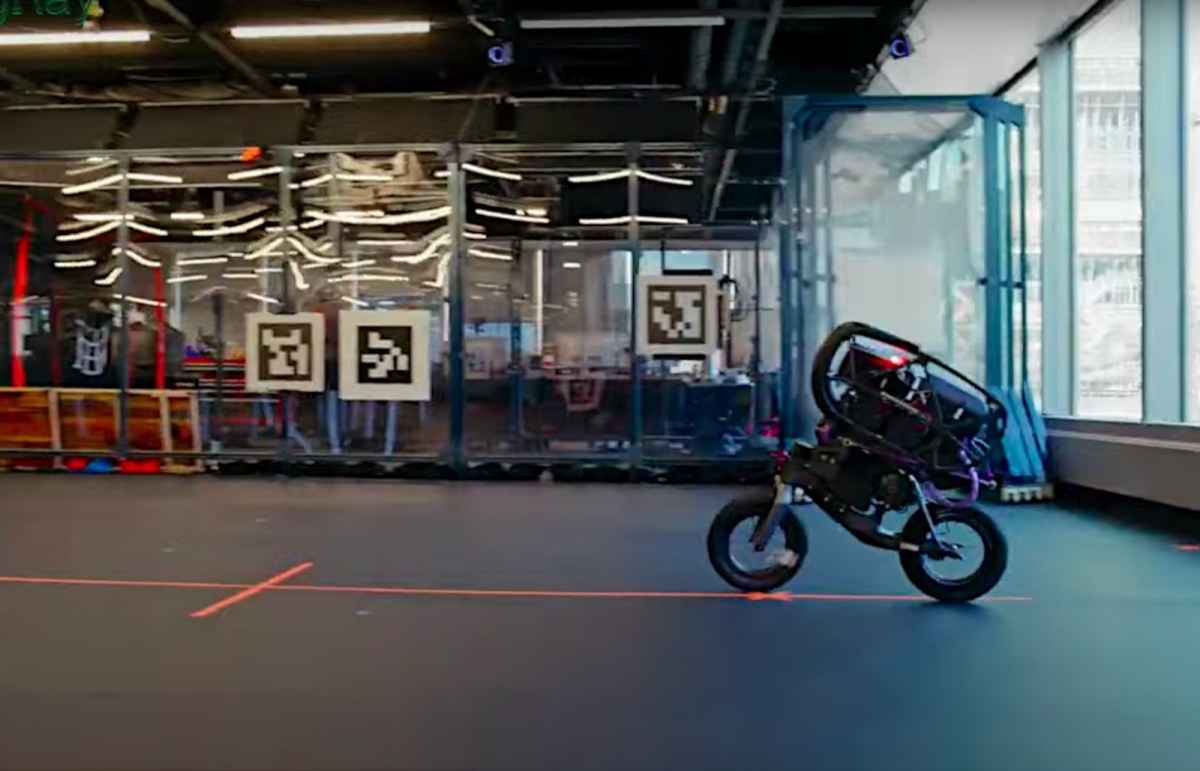
Here’s a robot doing the kinds of things well-programmed robots can do. You might think nothing of it, we’ve all seen videos of robots dancing, jumping and performing difficult tasks and manipulations. But this bike-balancer is a bit different. It has an AI system with a feedback mechanism that learns how to balance better and better with practice. This is how all animals with nervous systems learn new behaviours and improve their performance at practical tasks and skills. It’s still nowhere near Artificial General Intelligence (AGI) but it might be a small step along the way.
With this achievement under their belts, the developers will undoubtedly try the same method to develop robots that can handle tasks like juggling, sorting items, removing incorrect objects from a moving belt, or bolting two items together using a spanner. It may become possible to train a robot by simply showing it a task and correcting it when it makes mistakes. This would be far quicker than having to program the actions in the traditional way. It would probably be impossible to know how the robot makes decisions on the best movements to get a particular job done, but that’s true with training people to do jobs too. Very often, the how is not important providing the result is reliable and effective.
If you enjoyed this or found it useful, please like, comment, and share below. (If you don’t see those links, click the article’s title above the main photo and they will appear.) Send a link to friends who might enjoy the article or benefit from it – Thanks! My material is free to reuse (see conditions), but a coffee is always welcome and encourages me to write more often!
What’s in an image? Sometimes quite a lot, more than meets the eye. I’m posting an image every few days.
Click to enlarge
Here’s something you may never have seen, unless you’re a farmer or a vet – a calf suckling from its mother. When we lived in St Neots, there was a footpath running past our back gate in Eaton Ford and running very straight to the churchyard of St Mary’s in Eaton Socon. The path led past a large field, Bedfordia Meadows, and sometimes cows were kept in this field.
On one particular day in 2012 I was using the footpath and this cow and her calf were close up against the fence. I was able to take the photo without even stepping off the path. I’ve been working my way through my photos from July 2012 recently, looking for images for articles like this one. And it seemed to me that many of you might like to see this moment from a summer’s day 13 years ago.
For the cow and the calf this is a matter of life and death. Without the mother’s milk a new-born calf would not survive long. Milk contains the water and all the nutrients needed for the calf to grow and become capable of drinking water and eating grass for itself. In the wild, like all mammals, the cow would stop producing milk once the calf stopped needing it. But domesticated cattle have been bred to produce milk for much longer and a cow would quickly be in pain and in danger of serious infection if not regularly milked twice a day.
Mammals provide milk, birds lay eggs
Both dinosaurs and mammals developed from early reptiles. At the time of the Cretaceous extinctions caused by the impact of the famous asteroid, when all the large dinosaurs died out, there had long been early mammals and some of the smaller kinds survived. One branch of the dinosaurs survived as well and we are all familiar with them, they are called birds! A number of small reptiles and amphibia survived too so today we have toads and frogs as well as crocodiles, alligators, lizards and the snakes. But most air-breathing vertebrates in the world today are either mammals providing milk to their young, or the egg-laying birds.
If you enjoyed this or found it useful, please like, comment, and share below. (If you don’t see those links, click the article’s title above the main photo and they will appear.) Send a link to friends who might enjoy the article or benefit from it – Thanks! My material is free to reuse (see conditions), but a coffee is always welcome and encourages me to write more often!
We can be sure there’s trouble ahead and we can imagine some of the long term issues. The authors of this article are putting out a broad warning and setting out the probable longer term dangers.
Recommended – 2
In this series I recommend articles or other work I’ve seen that I really like and want to share with my readers.
Click to enlarge
A quick summary follows, but I encourage you to read the original with its much deeper analysis.
It’s very difficult to analyse the long-term effects of actions that began only three months ago, and may continue for some time; we can only guess how long this process will last and what new forms it might take in future months or years. It’s as if the captain of a large vessel had ordered a hard turn to starboard and the crew was scrambling to put the order into effect. With the ship’s rudder now clearly turning and signs of a change in course, what can possibly be concluded?
The ship will start to lean a little, some loose objects will slide around, these immediate effects are predictable. But what about the longer term? Will there be a catastrophic collision with another ship? Will we run aground? It’s clear there are dangers but it’s too soon to make detailed predictions.
That’s the situation US science finds itself in today. We can be sure there’s trouble ahead and we can imagine some of the long term issues. The authors of this article are putting out a broad warning and setting out the probable longer term dangers.
Damage caused by the Trump administration, science-policy experts warn, could set the United States back for decades. “So many of the damaging impacts are going to be extremely difficult to reverse and are going to take a very long time to recover from,” says John Holdren, a science adviser to former US president Barack Obama.
The authors begin by summarising what’s been done in the first three months and pointing out that it’s just a start; cuts of up to half seem likely. Reader surveys by Nature show well over 90% are troubled by the cuts.
About half the US science budget goes on defence-related programs and more than a quarter on health. The cuts are being presented as necessary to combat waste, corruption and propaganda, but no evidence has been offered to back up these claims. An assumption is being made that private sector research will shoulder the burden, though that is most unlikely for fundamental studies.
Another aspect of budget cuts is the resulting loss of skilled and knowledgeable staff, an immediate loss that will take a long time to rebuild. Indeed, the damage done in a few months will take decades to recover. It seems likely that Congress will be unable (or unwilling) to resist the probable budget cuts for 2026 and the situation is not likely to be alleviated by the various political demands being made of universities by the Trump administration. The USA seems already to be suffering loss of reputation and is less appealing for foreign scientists, not only are fewer international staff and students planning to work in the USA, but American scientists are starting to look abroad for work.
There are worries that other nations will advance beyond what the US can do in years ahead, and putting broken US science together again will be very difficult and expensive to achieve.
The article also contains helpful links for additional reading on the topics discussed.
If you enjoyed this or found it useful, please like, comment, and share below. (If you don’t see those links, click the article’s title above the main photo and they will appear.) Send a link to friends who might enjoy the article or benefit from it – Thanks! My material is free to reuse (see conditions), but a coffee is always welcome and encourages me to write more often!
Once it was realised that a letter could be coded as any other letter except itself, even this tiny clue could help point the cryptographers in the right direction.
What’s in an image? Sometimes quite a lot, more than meets the eye. I’m posting an image every few days.
Click to enlarge
Why is this old computer enigmatic? Some of you will know, some might guess correctly, others may have no idea. I took the photo in July 2012 at the Museum of Computing at Bletchley Park where highly secret work was done during the Second World War to break the German Enigma code as well as other enemy codes and ciphers.
This is a working replica of the famous Colossus computers used to crack those very difficult codes. And computer power alone couldn’t do it, it required clever minds to look for little hints that could make the ‘unbreakable’ code breakable. As an example, once it was realised that a letter could be coded as any letter other than itself, even this tiny clue could help point the cryptographers in the right direction. And there were always cribs that could help, the knowlege that a particular operator always began with the same phrase was an enormous help.
No original Colossus machines exist, after the war ended, Churchill gave strict orders that they should all be dismantled and the parts broken into small pieces.
The idea behind Colossus was the brainwave of Alan Turing, a mathematical genius who worked at Bletchly Park during the war. The Bombe that preceded it was originally designed and built by Polish engineers. Turing and his team designed and built a British version, physically different but doing the same job.
CSO (then based at Bletchly, now at GCHQ) intercepted the coded messages, while teams produced the German plain text, translated it into English and passed it to the British government and military planners.
If you enjoyed this or found it useful, please like, comment, and share below. (If you don’t see those links, click the article’s title above the main photo and they will appear.) Send a link to friends who might enjoy the article or benefit from it – Thanks! My material is free to reuse (see conditions), but a coffee is always welcome and encourages me to write more often!



 Journeys of Heart and Mind
