APEST in Jesus

Since Jesus is the best example of all five APEST gifts, it makes good sense to look to him for guidance in using them. I’d say read the gospels and notice the things he did and the things he said. Pay particular attention to the way people responded and try to work out in each case which of the five gifts were active.

APEST in Jesus

< PreviousIndex – Next>

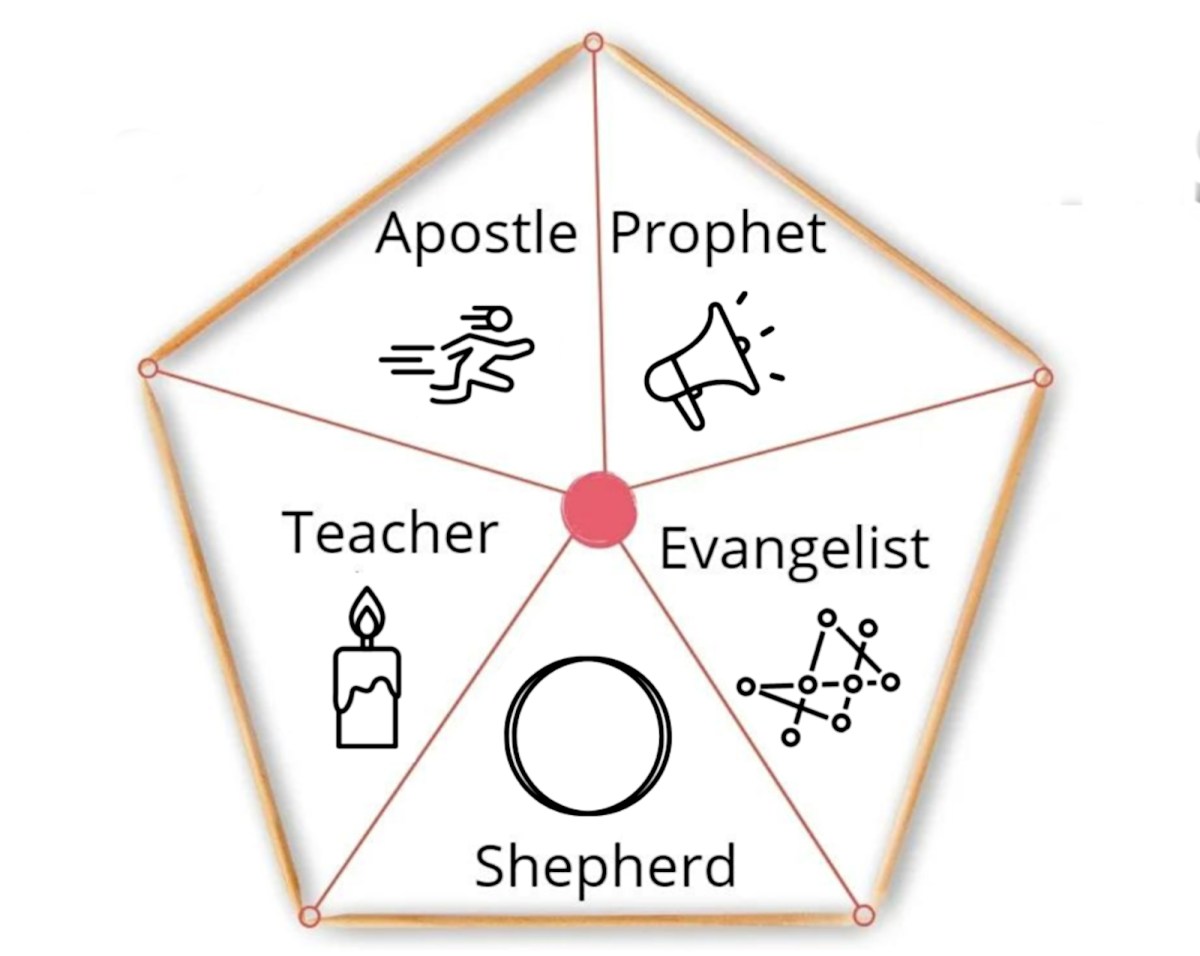
APEST (Diagram from What is APEST) – Click images to enlarge

Having looked at each of the gifts of service individually, we’ll check them one by one to see if we can find them active in the life of Yahshua (Jesus). Does Jesus himself demonstrate these gifts, and if so how? Let’s also bear in mind that if he worked through these special gifts 2000 years ago, we can be quite confident that he still does today. His character doesn’t change; he is the same yesterday, today and forever (Hebrews 13:8).

Each section begins with an Alan Hirsch quote which we then examine in the light of the character and nature of Christ himself. But before we do that, I want you to understand that all these gifts are equally important and equally valuable. There’s no hierarchy here, though there is a sequence. Apostles prepare the ground for prophets, who prepare the ground for evangelists, who prepare the ground for shepherds, who finally prepare the ground for teachers. At this point, the young gathering (or church) will be ready to begin sending out apostles and the cycle repeats.

You’ll find the quotes on Alan’s What is APEST? page. The tests are not expensive and I recommend them for both leaders and anyone with an interest in the topic.

Apostle

APOSTLES extend the gospel. As the “sent ones,” they ensure that the faith is transmitted from one context to another and from one generation to the next. They are always thinking about the future, bridging barriers, establishing the church in new contexts, developing leaders, networking trans-locally. Yes, if you focus solely on initiating new ideas and rapid expansion, you can leave people and organizations wounded. The shepherding and teaching functions are needed to ensure people are cared for rather than simply used.

Is Jesus an Apostle? He did not merely extend the gospel; he originated it! Was he a ‘sent one’? He was and remains the Sent One, bringing faith and truth from the presence of the Father sharing it freely here in the physical realm of Earth. If that is not transmitting faith from one context to another, I don’t know what is! Did he think about the future and bridge barriers? Just think of the old picture of Jesus as a bridge or plank crossing the gap between heaven and earth.

Did he establish the church? (I will build my church). He developed leaders (his disciples) and he networked trans-locally (the Samaritan woman at the well, healing the Centurion’s servant, raising Jairus’ daughter, calling Lazarus out from the tomb, and discussing truth with the Roman Governor, Pontius Pilatus). It would be really hard to argue that Jesus is not apostolic!

Prophet

PROPHETS know God’s will. They are particularly attuned to God and his truth for today. They bring correction and challenge the dominant assumptions we inherit from the culture. They insist that the community obey what God has commanded. They question the status quo. Without the other types of leaders in place, prophets can become belligerent activists or, paradoxically, disengage from the imperfection of reality and become other-worldly.

So, is Jesus also a prophet? Most certainly! Does he know the will of the Father? Way better than anyone else in history (you’d better believe it.) Is he particularly attuned to Yahweh and his truth for today? Most emphatically! Does he bring correction and challenge the dominant assumptions of his culture and of our own? He insisted (and still insists) that we obey what the Father commands. When did he not challenge the status quo? Certainly he does these things fully, wholeheartedly, and tirelessly. Jesus is, indeed, the greatest prophet of all time – by far.

Towards the end of his ministry, Jesus is clear that the temple will be destroyed and he foretells the misery and horror of those days, this done privately, just speaking with the disciples, but when these events unfolded in 70 AD under the Roman commander Titus they would have remembered his description and would have been confirmed and encouraged that he had the same prophetic spirit as the old testament prophets themselves. (Luke 21)

And Jesus had the same upward connection to the mind of the Father as well as the horizontal concerns about justice in the world that the old testament prophets regularly displayed.

Evangelist

EVANGELISTS recruit. These infectious communicators of the gospel message recruit others to the cause. They call for a personal response to God’s redemption in Christ, and also draw believers to engage the wider mission, growing the church. Evangelists can be so focused on reaching those outside the church that maturing and strengthening those inside is neglected.

Jesus is a recruiter par excellence. He called and worked intensely with a small group of close followers, he spoke to multitudes, but closely taught just a few. He is the evangelist, calling for a personal response from many individuals and not merely growing the church, but founding it in every sense worth considering. If you want to know what an evangelist is like, check out Jesus!

By the time Jesus teaching was complete and the time came for his death, resurrection, and a return to the Father’s presence, his disciples had understood him clearly and fully enough that the four gospel accounts could be written from what had lodged in their memories. They may not agree in every detail or always have precisely the same sequence, but that makes the four accounts more real and no less believable.

Shepherd

SHEPHERDS nurture and protect. Caregivers of the community, they focus on the protection and spiritual maturity of God’s flock, cultivating a loving and spiritually mature network of relationships, making and developing disciples. Shepherds can value stability to the detriment of the mission. They may also foster an unhealthy dependence between the church and themselves.

In what sense is Jesus a shepherd? He’s rightly described as ‘the great Shepherd of the sheep’. He is strong on nurturing and protecting; that was true as he moved among the people in first century Israel, Galilee and Samaria, healing the sick, feeding hungry crowds with abundant fish and bread from almost nothing (making very little stretch a very, very long way). He cared about wine running short at a wedding. He was the greatest of caregivers for his community.

He protected his followers, shielding them by giving everything he had, even his life. And he taught them to bring them to spiritual maturity so that after he returned to the Father, they’d be able to carry on his work once they had received his Spirit from above.

Jesus had a wide network of followers well beyond the eleven men that he closely trained. There were so many that he touched and discipled amongst Samaritans, Romans, Greeks, even members of the Sanhedrin. He valued stability, but not to the detriment of his mission.

Teacher

TEACHERS understand and explain. Communicators of God’s truth and wisdom, they help others remain biblically grounded to better discern God’s will, guiding others toward wisdom, helping the community remain faithful to Christ’s word, and constructing a transferable doctrine. Without the input of the other functions, teachers can fall into dogmatism or dry intellectualism. They may fail to see the personal or missional aspects of the church’s ministry.

And it’s not just a matter of explaining things more clearly or studying the meaning of Hebrew or Greek terms. It’s much more helping people through those ‘I just don’t get it’ moments until they suddenly cry out, ‘Oh, now I see!’ The teaching gift sparks revelation. It’s very clear in the gospels that his disciples had these moments of revelation, over and over again as Jesus taught them. He understood the truth and he understood their difficulties in grasping it. He communicated truth and wisdom more fully than anyone else could ever do. He is the teacher of teachers – quite literally. He did it by explaining, by asking difficult questions, by highlighting mistakes as they occurred, and by telling good stories. He also taught without words, by setting good examples.

Jesus taught his disciples, but he also taught the crowds. Here too his teaching went way beyond words and ideas, often he’d share a parable like the Good Samaritan that reached directly into minds where words alone failed to penetrate. This kind of teaching gift cuts through misconceptions and breaks into parts of our being that seem to be based somewhere other than the grey matter in our brains. There are facts and there is understanding; they’re two different things. Jesus cared deeply about both.

And when the wealthy, or the Pharisees, or the Temple priests needed a bit more than a word to pitch them over the edge from not comprehending to fully understanding, Jesus would show them what the Father’s heart was like – ‘Don’t stand on street corners praying where everyone can see you, go quietly into your own room where only the Father sees you and pray there.’ And sometimes there’d be a spark of comprehension. It might only be one person amongst a group of proud scoffers, but it’s so worth it when even one person sees the light and understands a previously hidden truth for the first time.

In the round

Since Jesus is the best example of all five APEST gifts, it makes good sense to look to him for guidance in using them. I’d say read the gospels and notice the things he did and the things he said. Pay particular attention to the way people responded and try to work out in each case which of the five gifts were active, sometimes it may be more than one. Sometimes it’s obvious, sometimes harder to discern.

You’ll see the gifts working (and described) in the New Testament letters as well, look out for them there as well.

See also:

< PreviousIndex – Next>

You might also like:

Useful? Interesting?

If you enjoyed this or found it useful, please like, comment, and share below. (If you don’t see those links, click the article’s title above the main photo and they will appear.) Send a link to friends who might enjoy the article or benefit from it – Thanks! My material is free to reuse (see conditions), but a coffee is always welcome and encourages me to write more often!

Understand and explain

Jesus taught his disciples, but he also taught the crowds. Sometimes his teaching went way beyond words and ideas, often he’d share a parable like the Good Samaritan that reached directly into minds where words alone failed to penetrate.

Students and teacher (Wikimedia)

< PreviousIndexNext>

9 – activating church

Students and teacher (Wikimedia) -Click images to enlarge

The final APEST gift we need to consider is the gift of teacher. Just like the other gifts, the teaching gift is there for the building of the church, does not act in a controlling way, but is a life-bringing and helping function in the life of the church and the individual parts of it.

Where a teaching gift is active there will be a clarifying service at work. Confusion and misunderstandings will be swept aside. Decades, even centuries and millenia of mistakes and misunderstandings will be exposed and brought out for fresh examination. Teachers cannot sit still or take a back seat where they detect error of any kind.

What is the most fundamental definition of a teacher? It must be something along the lines of:

A teacher is a person who helps younger or less experienced people to grasp and excel in an idea or a process that they have not previously met or mastered.

The photo at the head of this post, and my words in italic above may make you feel the teaching gift is about extending knowledge. But that’s not quite what the gift of teaching is all about. The distinction is critically important so read this carefully… The spiritual gift of teaching has little to do with imparting knowledge, it has everything to do with growing character.

I just don’t get it!

And it’s not just a matter of explaining things more clearly or studying the meaning of Hebrew or Greek terms. It’s much more helping people through those ‘I just don’t get it’ moments until they suddenly cry out, ‘Oh, now I see!’ The teaching gift sparks revelation. Hold on to that thought as you continue reading.

Jesus taught his disciples, but he also taught the crowds. Sometimes his teaching went way beyond words and ideas, often he’d share a parable like the Good Samaritan that reached directly into minds where words alone failed to penetrate. This kind of teaching gift cuts through misconceptions and breaks into parts of our being that seem to be based somewhere other than the grey matter in our brains. Often, we express this as heart even though that’s biologically incorrect. But our languages are full of heart-based expressions – heartfelt, avoir le cœur sur la main, heart-stopping moment, sich ein herz fassen, good hearted or a heartless act. There are facts and there is understanding; they’re two different things, we tend to think of facts being in our heads and understanding being in our hearts.

When the wealthy, or the Pharisees, or the Temple priests needed a bit more than a word to pitch them over the edge from not comprehending to fully understanding, Jesus would show them what the Father’s heart was like – ‘Don’t stand on street corners praying where everyone can see you, go quietly into your own room where only the Father sees you and pray there.’ And sometimes there’d be a spark of comprehension. It might only be one person amongst a group of proud scoffers, but it’s so worth it when even one person sees the light and understands a previously hidden truth for the first time.

As always, community really matters

It’s still like that in the church today. There are many who don’t see the truth but now and then a light comes on for someone – Ding! Anyone with a teaching gift loves it when that happens. Understanding is like a staircase, each step makes the next one possible when the right time comes. The teaching gift enables the teacher to recognise that right moment and drop in the necessary grain of truth so that it makes a deep and long-lasting difference.

Look again at the photo at the top of this article, these are not strangers interacting, they are people who know one another, a teacher and his pupils, they care about one another, they are engaged in conversation, they are happy and comfortable together, the entire class is a kind of community. In the church environment we should all be learning from one another every time we meet. Some people have a gift for making things clear. Make sure you encourage them as much as possible.

Building the body of Christ

Jesus told his followers, ‘I will build my church’. He doesn’t want you and me to build it, but he does pour out gifts upon us so that we, together, can contribute something essential and useful. There’s an abundance of brotherly/sisterly love amongst us when we all pool our different gifts. And that in itself is a secret that has been lost during church history. We need to fully grasp that secret – we all have gifts and we do far better when we share them, recognising them in one another and encouraging one another by saying what we see. This will never happen if we keep thinking only in terms of individual people and individual gifts. We, together, are the body of Christ.

Don’t think in terms of a tyre here and a seat there. A gear lever and a rear view mirror. Understand that thinking about a car is very different from merely thinking about the different parts of a car. You can travel quickly over long distances if you have a car, but if you have only a tyre and a seat you’ll go nowhere. Building a car means recognising the pieces and putting them together in right relationship. Building community and church needs exactly the same skills and understanding.

A big mistake

There is one big mistake frequently made in mainstream churches today, OK, there are many mistakes made, but I want to highlight this one in particular because it’s very widespread and very harmful. It’s also an easy and natural mistake to make.

Many well-intentioned teachers don’t teach Jesus, instead they teach the Bible. Jesus is very much present throughout the Old and New Testaments. But teaching people to memorise or study verses may do little to help them grow in character or grace. Instead we need to bring Jesus himself into one another’s hearts and minds and be changed by his presence. We need to grow in love and in joyfulness, we need to be rooted in his peace, reflect his patience and great kindness and goodness, become faithful as he is faithful and develop the kind of self-control that never criticises and never directs anger or disappointment at the brothers and sisters.

We simply cannot be built on the foundation of Christ unless we come to know him well, so we’re not looking for technical knowledge of Greek and Hebrew, or deep Bible studies. Instead we need to know Jesus as our dependable, older brother, to recognise that he is always present and how to help one another find him again when we lose sight of him. We need to learn that the fruit of the Spirit is more fundamental than the gifts of the same Spirit, but that we need both to function as Jesus fully intends his church to do. ‘I will build my church’.

That’s it for this part of the series. Next time we’ll consider Jesus, the source of these gifts of service. Can we see all five APEST gifts at work in him? What can we learn from him in this regard?

See also:

I wanted to provide links or articles about the topic, just as I do in most of my posts, I looked at a load of stuff but nothing seemed to jump out for me, I didn’t hear Jesus whispering, ‘Yes, put that item in’. In the end I felt there were two videos I should include. Neither of them is specifically about the gift of teaching (though they both mention this gift in passing. Both of them are about the five APEST gifts as a whole. They are both interviews. Alan Hirsch and Neil Cole have both pretty much dedicated themselves to studying , teaching, and writing about APEST. My feeling is that I should link to these two interviews, so here they are.

I’ve met and spoken briefly with both Alan and Neil, and and I’ve heard them both speak in meetings several times. And I trust them to reveal something useful to you, so have a listen.

  • APEST, Interview with Alan Hirsch – YouTube (Follow Baptist Church)
  • APEST, Interview with Neil Cole – YouTube (Cynthia Anderson)

< PreviousIndexNext>

You might also like:

Useful? Interesting?

If you enjoyed this or found it useful, please like, comment, and share below. (If you don’t see those links, click the article’s title above the main photo and they will appear.) Send a link to friends who might enjoy the article or benefit from it – Thanks! My material is free to reuse (see conditions), but a coffee is always welcome and encourages me to write more often!