In this image you can see bending in several directions over just a few hundred years – 300 or 400 hundred at most. Look out for similar effects in old town and city streets, castles, churches and cathedrals.
What’s in an image? Sometimes quite a lot, more than meets the eye.
I’m posting an image every two days (or as often as I can). A photo, an image from the internet, a diagram or a map. Whatever takes my fancy.
Click to enlarge
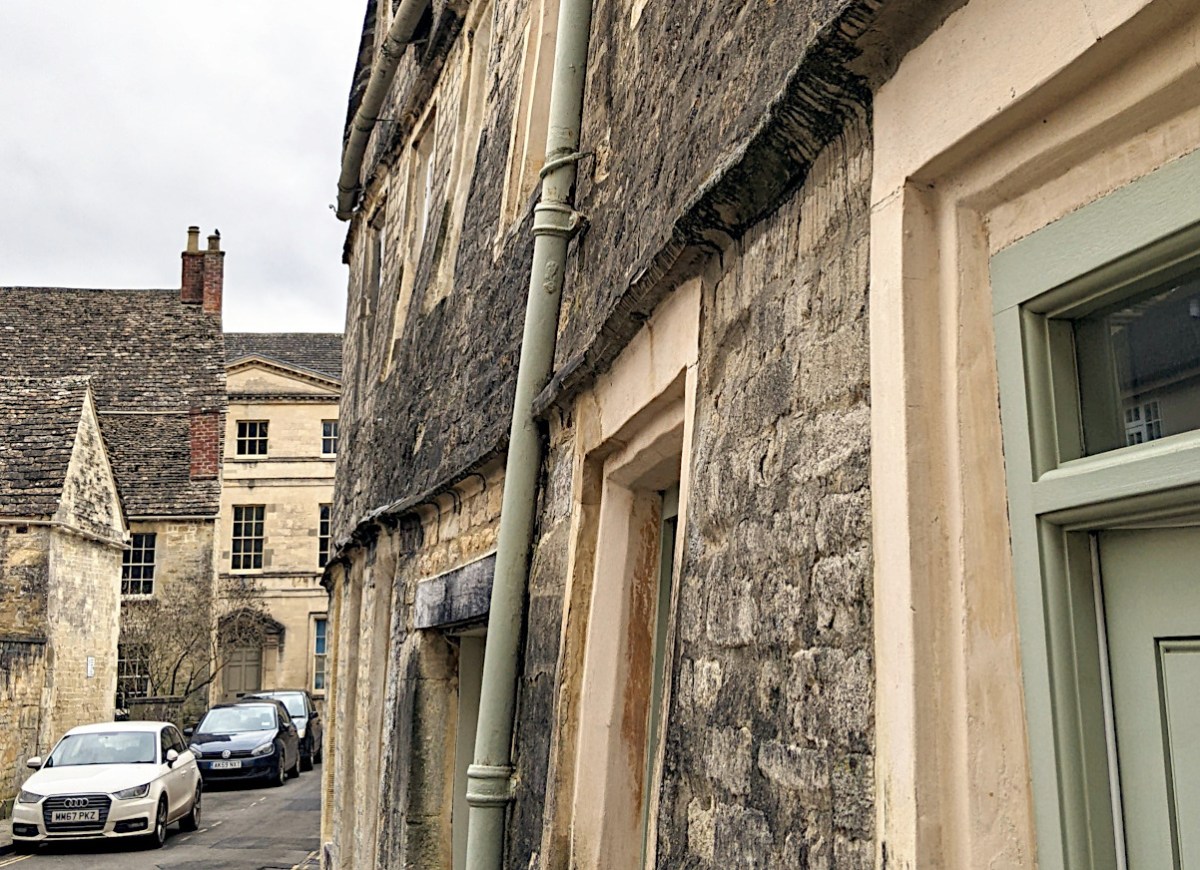
How about another wonky house? This picture shows a stone-built structure here in Cirencester’s Coxwell Street. Unlike timber, stone doesn’t warp or bend in changing climatic conditions; however it does respond to persistent pressure over long periods of time by gradually distorting.
This is often seen in geological formations where sedimentary rock layers may be curved in large, wavy patterns even though they were completely horizontal when deposited millions of years ago. The same can happen in masonry, but foundations (if any) and the mortar between stones may also deform and contribute to the effect.
In this image you can see bending in several directions over just a few hundred years – 300 or 400 hundred at most. Look out for similar effects in old town and city streets, castles, churches and cathedrals.
Look out for bent stone on a much larger scale in cliffs and quarries.
Cirencester
For convenience, here’s a list of all the Cirencester area images:
If you enjoyed this or found it useful, please like, comment, and share below. (If you don’t see those links, click the article’s title above the main photo and they will appear.) Send a link to friends who might enjoy the article or benefit from it – Thanks! My material is free to reuse (see conditions), but a coffee is always welcome and encourages me to write more often!
I don’t know the age of this house, but it is clearly a timber-framed structure and some of those main timbers have adjusted comprehensively to the action of gravity over several centuries.
What’s in an image? Sometimes quite a lot, more than meets the eye.
I’m posting an image every two days (or as often as I can). A photo, an image from the internet, a diagram or a map. Whatever takes my fancy.
Click to enlarge
Here’s Cirencester’s wonkiest house – well, one of them. Until the 18th century, many buildings would have been constructed of timber, and we all know that timber is prone to warp even after seasoning, and it also responds to pressure and stress by slowly changing its shape.
Modern engineered wooden products generally avoid these issues. For example, plywood is in layers with the grain running in different directions from layer to layer. A thin sheet of wood is weak along the line of the grain, in that direction it will split easily when bent. But it will resist bending and splitting if rotated 90°. So multiple sheets glued together can be strong in all directions.
A timber-framed house
I don’t know the age of this house in Dollar Street, but it is clearly a timber-framed structure and some of those main timbers have adjusted comprehensively to the action of gravity over several centuries. Look at the glazing in the windows, for example, compare the windows with their fellows, side-by-side and up and down. See what I mean? At some point a layer of render was added to hide and protect the timbers so these are no longer visible.
The building is unoccupied at present, but I imagine it’s safe enough. Imagine how the new owners in due course will struggle to make right-angled furniture fit into walls and floors at odd angles
What about us?
Are we sometimes a little bit like this house? Do the pressures of life, sustained over years, even decades, cause us to be a little distorted? Is it difficult for other people with their right-angled opinions and requirements to fit into our expectations given our out-of-true alignments? Is the truth about us sometimes plastered over and hidden from view?
Or might it be the other way around? Am I, are you, straight and true and the fault lies with everyone else?
Cirencester
For convenience, here’s a list of all the Cirencester area images:
If you enjoyed this or found it useful, please like, comment, and share below. (If you don’t see those links, click the article’s title above the main photo and they will appear.) Send a link to friends who might enjoy the article or benefit from it – Thanks! My material is free to reuse (see conditions), but a coffee is always welcome and encourages me to write more often!
Images fade, especially if exposed to light, they are susceptible to damage by fire, water, mechanical action and so forth.
For some years now I’ve been transferring family photos, videos and documents to digital storage in an attempt to preserve the information. There are pros and cons to both physical storage and digital storage and we’ll discuss those in this article.
But first, lets take a look at an example photo.
An old photo from my collection – May 1969
The image above is from a 35 mm transparency. It shows my fellow students on the Bath University Horticulture degree course the year before we graduated. We were visiting a commercial horticultural business and there’s a TV personality in the image as well. (One of our lecturers, Peter Thoday, later became well known as the narrator in the TV series, The Victorian Kitchen Garden. He’s at the back of the group on the right in the photo, tall and with very dark hair.)
Details of the photos and how I manage them
Quite a few of the old photos I have are colour transparencies; these come in different sizes depending on the type of camera and film that were used. The majority are on 35 mm film stock, with sprocket holes along two sides; these engage with the film transport mechanism in the camera. After the film was processed and dried it was cut into individual frames and mounted in card or plastic frames. My film scanner can handle mounted and unmounted slides and saves them as digital image files.
Once I have the images in digital format I remove slides from their frames and check the frame numbers exposed on the film when it was manufactured. This makes it easy to get the slides into correct sequence as they may have been reordered accidentally or even deliberately when they were projected in the past. Having confidence that the photos are correctly in sequence makes it much more likely that I can eventually arrange the films into longer sequences based on events, people and places in the images. This is a work of reconstruction, sometimes easy, sometimes very difficult. I keep notes of what I have done and why, for my own reference and for anyone else who might find the information useful later. I’ve got better at doing this with experience.
Advantages and disadvantages of physical storage
The original negatives and transparencies contain more information than digital copies. For one thing, the dynamic range is greater and the resolution is always going to be a little higher. Scanning processes are very good indeed these days, but they’ll never be absolutely perfect.
On the other hand, originals deteriorate over long time periods. Images fade, especially if exposed to light, they are susceptible to damage by fire, water, mechanical action and so forth. And as each image is unique, if it’s lost or damaged there is no way to recover it.
And two final points – storing negatives, transparencies and prints takes a lot of space, more and more as the numbers increase. And viewing them becomes an issue, only a few people can view them at a time.
Advantages and disadvantages of digital storage
Digital copies of the images can be almost as good as the originals for most purposes, and digital processing can improve colours and remove blemishes when the originals are faded, scratched or have dust that is strongly attached to the surface. In these cases, the digital copy may be more acceptable than the original.
Digital storage is increasingly cheap and capacious, so a very large collection of photos can be stored on a cheap, tiny SD card. This in turn makes it possible to have multiple copies in multiple locations, providing security far beyond anything possible with the originals. Remote storage on Dropbox or similar facilities takes this a step further. Multiple copies and remote storage both make it possible for many people to be able to view the images independently and from wherever they happen to be.
Perhaps the biggest downside of digital storage is the need to constantly move images from old storage media to newer technology. How many of us have devices to read data from a floppy disk or an old CD? Remote storage helps again because the company offering the service takes on the task of managing data storage and retrieval and moving to newer technologies whenever necessary.
And there’s a hidden factor here too, the images need to be stored in a file format that is still readable on current devices. JPG and PNG are widely used and may be readable by future devices for a very long time, but nothing is certain and it may become necessary to re-save the images in a different file format in future. This would be a major task for a large image collection.
My approach to all this
I’ve thought about this a lot. Currently, everything is stored in high quality JPG format. Yes, I know there are very slight compression artefacts in JPG, but unless the images are repeatedly edited and re-saved this is not an issue in practical terms. I use an Epson Perfection V600 Photo scanner which for me is a good compromise between quality and price. The images are stored initially on my laptop and automatically to Dropbox, and I back up my laptop on an external hard drive at intervals. Other members of the family have their own copies of some of the data, though keeping this refreshed has been a problem.
Something I have not yet fully resolved is what happens when I’m no longer able to manage all this data. Of course, at that point the future of the images will no longer be of personal interest. Nonetheless, I’d like to have some kind of plan in place, perhaps handing on access to my Dropbox account would be a good way forward.
If you enjoyed this or found it useful, please like, comment, and share below. (If you don’t see those links, click the article’s title above the main photo and they will appear.) Send a link to friends who might enjoy the article or benefit from it – Thanks! My material is free to reuse (see conditions), but a coffee is always welcome and encourages me to write more often!
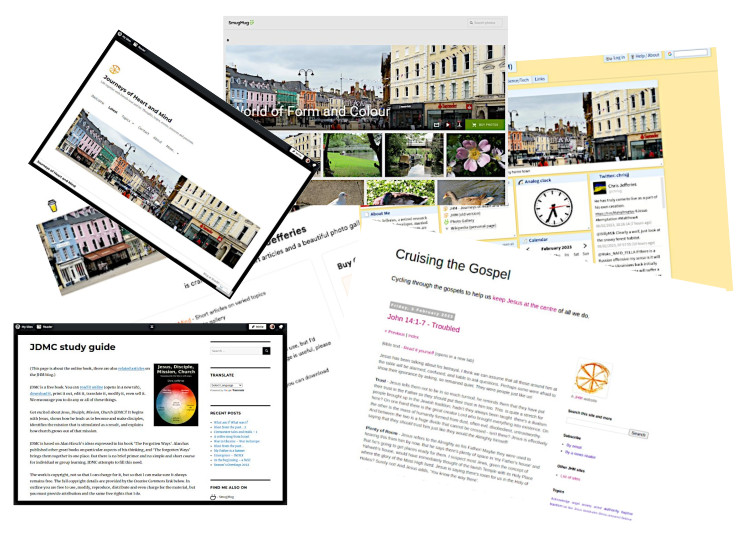
I sum these topics up on my Twitter profile as biology, web, science, technology, family, faith, history, and travel.
Having recently restarted blogging after a long pause, I’ve been thinking through how best to move forward – what should I change, what should I drop, and what should I keep?
Today’s post explains some of this, I’ll share what I’m doing and what I plan to do next. I’ll consider any comments you may leave, either here on the blog, or on Twitter or Facebook. But here’s how I see things right now.
Buy me a coffee
I’m offering everything I publish for free, but will always be delighted to receive a small gift, especially if you have sold or republished something (though even then it’s optional). Details are at coffee.scilla.org.uk .
Cruising the Gospel
This is a moribund blog that I’m in the process of restarting. I’m not sure yet whether to continue it in its present form, or to roll it into Journeys of Heart and Mind (JHM) as a topic in its own right. Currently I’m inclined to keep it as it is, and perhaps generate some PDFs from each book I complete. See it at gospel.scilla.org.uk .
Gateway
My Gateway site is mainly for my own use, but it’s full of links about Cirencester (my home town in England), local time and weather, some Christian links, local and national news, science and technology links and so forth. Some of you might like to take a peek. If so, head to gate.scilla.org.uk .
JDMC
JDMC stands for Jesus, Disciple, Mission, Church and is an introduction to Alan Hirsch’s Forgotten Ways. To learn more and download a copy to print (or read online), visit jdmc.scilla.org.uk . I need to update this booklet and plan to when I have time, unfortunately the web links in the PDF open OK, but using the browser to return take you back to the title page; I’ve been unable to fix this so far. If you open the links in a new tab you’ll be OK, but it’s easy to forget.
Journeys of Heart and mind
I intend to continue with this more or less as it stands. That means a mix of topics will appear here, articles about all of the things that motivate me as they occur to me (so in no particular order). I sum these topics up on my Twitter profile as biology, web, science, technology, family, faith, history, and travel. Others include photography, astronomy, spaceflight, archaeology and a few more. One thing I will add is a way of seeing just posts on one of these topics at a time, I think that will be useful; not everyone wants to see everything. You’re reading on this site at the moment.
Photos
I use Smugmug to display my photos and will continue with this, but I need to rearrange things in topic folders to make it more usable. Visit photos.scilla.org.uk to browse my all time favourites.
Twitter
My main Twitter account is ChrisJJ, but I have a second account, JHM. I haven’t used the JHM account for a long while, but might post tweets about faith topics there, and everything else on ChrisJJ. My mind is far from made up on this as there are quite a few pros and cons.


 Journeys of Heart and Mind