If you enjoyed this or found it useful, please like, comment, and share below. (If you don’t see those links, click the article’s title above the main photo and they will appear.) Send a link to friends who might enjoy the article or benefit from it – Thanks! My material is free to reuse (see conditions), but a coffee is always welcome and encourages me to write more often!
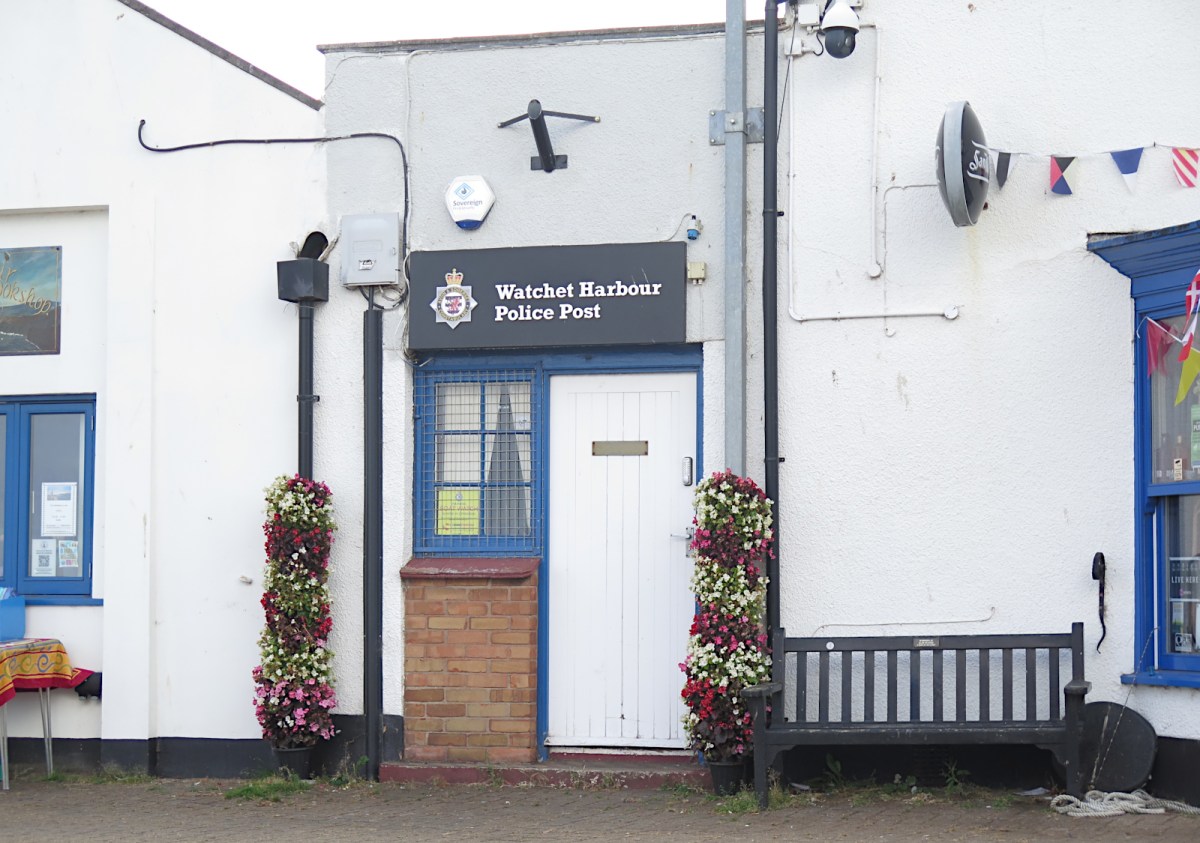
At Watchet Harbour on the north coast of Somerset stands possibly the smallest Police Station in the world. Certainly I’ve never seen one this tiny before. It’s just a door and a small window wide and has the grand title ‘Watchet Harbour Police Post’. If you know of a smaller police building anywhere in the world, please let me know in the comments section below.
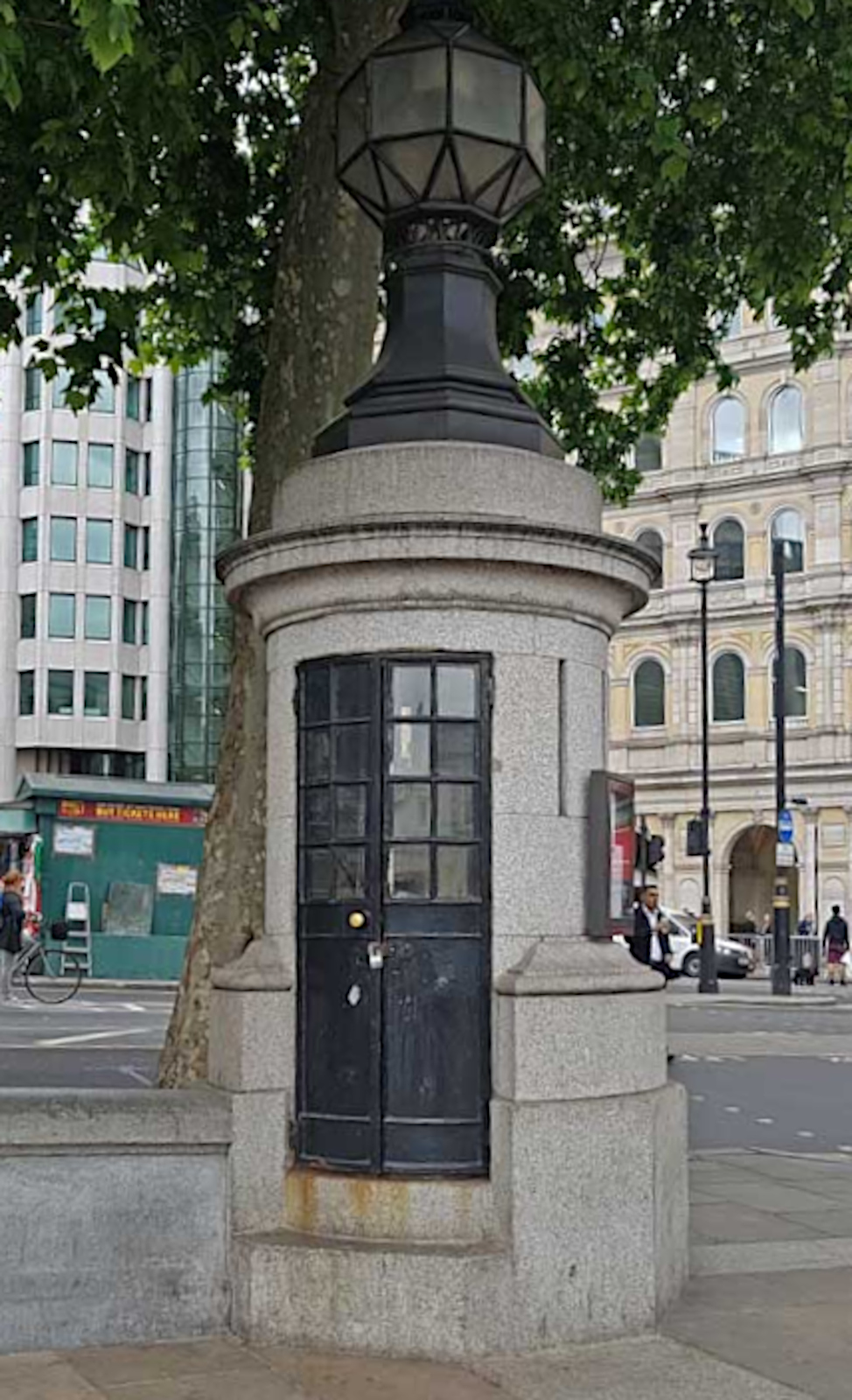
However, a quick Google search turned up an even smaller one in Trafalgar Square, London. So Watchet has already lost its brief claim to fame! Read more about the Trafalgar Square example. However, the London claimant is no longer used by the Police, so Watchet might still claim to have the smallest working police station in the UK.
International claimants
Florida also has a claim to the smallest working police station and it’s certainly much smaller than the police post in Watchet. Like the London version, Florida’s is sheltered by a tree.
I suppose it’s possible there’s a smaller one somewhere else in the world, but if so it must be so tiny that you’d need a smaller than average police officer to occupy it.
This is a bit different. You can’t measure a church in terms of how wide or long it is. Churches are measured in terms of how many people are meeting. Jesus once said, ‘Wherever two or three are gathered in my name, I’ll be there with them’. So the smallest church must be a meeting of two people (three if you include Jesus). That’s because church is not a building at all (although we often call a place where followers of Jesus meet ‘a church’. Is it still a church if the people have all gone home? No. Why? Because church is a community, not a building. Two people is the smallest possible community. We don’t always think of church as a community, but we should. If it’s not a community can it really be church at all?
If you enjoyed this or found it useful, please like, comment, and share below. (If you don’t see those links, click the article’s title above the main photo and they will appear.) Send a link to friends who might enjoy the article or benefit from it – Thanks! My material is free to reuse (see conditions), but a coffee is always welcome and encourages me to write more often!
If you enjoyed this or found it useful, please like, comment, and share below. (If you don’t see those links, click the article’s title above the main photo and they will appear.) Send a link to friends who might enjoy the article or benefit from it – Thanks! My material is free to reuse (see conditions), but a coffee is always welcome and encourages me to write more often!
What’s in an image? Sometimes quite a lot, more than meets the eye. I’m posting an image every few days.
Click to enlarge
This is the same river as the previous post, the River Great Ouse. That previous image captured a view from St Neots in Cambridgeshire; this one is from further upstream in Bedford.
The swans you see here are doing what swans do. They pair for life, but they also congregate in larger social groups (known as a bevy). When a swan dies and leaves a lonely partner, the remaining swan will often bond with a new mate.
In this sense swans are very like humans; we usually form lasting male/female pairs and in the same way, if one partner dies, the other will often (sooner or later) find a new partner. But there is a significant difference: swans act on instinct. We do too, but in humans there are additional layers. I can think of at least two – culture and reasoning.
Culture
Human culture is habitual behaviour; it may differ greatly from population to population. It’s easy to find differences between a Western wedding, an Indian wedding, an Afghan wedding, and a Japanese wedding. We could easily extend that list. There are also differences (though more subtle) between a French wedding, a US wedding, and a Polish wedding. And there will be still other differences between Anglican, Catholic, Baptist and Pentecostal weddings. Swans have nothing remotely like this, in fact they don’t have weddings at all. All of the foregoing is cultural; it’s a human layer overlying the instinctive animal processes of bonding, producing offspring and helping them grow safely to adulthood. There’s some evidence for elements of culture in certain birds, and some primates, and in some whales and dolphins – but well below the levels seen in human populations.
Reasoning
This is another layer but again, it’s mostly limited to human populations. It’s reasoning that enables us to have governments, science, technology of almost unlimited variety from farming and construction to ships, railways, aircraft and computers. Reasoning involves observation, drawing conclusions, finding ways of persuading others, differentiating between what works and what does not, making choices, and planning ahead. Again, you can see glimmerings of reasoning in some birds, some mammals, and in the octopus.
Faith
Faith seems to have no place whatsoever for swans, chimps, or any other creature on the planet. Faith draws on elements of both culture and reasoning, yet it’s not defined by either and is not dependent on either. It’s unique to humans. You’ll find quite lot on this website concerning faith one way or another; I won’t write about it further here, but I’ll leave a few suggested links below.
Conclusion
From observing a group of elegant birds on a river, we have thought about things that groups of people and groups of animals have in common, and how our abilities rise to at least two higher planes above the level attained by almost all other animals.
If you enjoyed this or found it useful, please like, comment, and share below. (If you don’t see those links, click the article’s title above the main photo and they will appear.) Send a link to friends who might enjoy the article or benefit from it – Thanks! My material is free to reuse (see conditions), but a coffee is always welcome and encourages me to write more often!
What’s in an image? Sometimes quite a lot, more than meets the eye. I’m posting an image every few days.
Click to enlarge
Before moving to Cirencester in April 2017, we lived for many years in St Neots, Cambridgeshire. One of the things I miss most (and there are several) is the River Great Ouse passing right through the centre of the town. This photo was taken from the town bridge; while looking ninety degrees to the right would reveal the Market Square, just a hundred metres away.
I like this photo because it has so much interest packed into one scene. You might not see the geese at first; they form a small in-line flotilla at the bottom right. The reflections in the water are lovely, and the surface rippled enough to add a sense of movement. The willow on the bank is typical of the trees in the Riverside Park which is out of sight but stretches behind and to the left from this position. The tree also divides the buildings along the river bank; they stand where the medieval priory once was, and the modern building to the left of the tree is ‘The Priory Centre’, the town’s major meeting and activity centre where Open Door Church used to meet on Sunday mornings. In the far distance you can just make out the Marina.
From priory to a new church building
While we’re thinking about the medieval Priory and the modern Priory Centre we might also think about the way church has changed since the year 313 AD. Prior to that year, the expectation was that church meant people gathering in homes without formal leaders like bishops, deacons, elders, pastors, popes, priests, rectors or vicars. There were informal leaders, confusingly with some of the same words being used to describe them – apostles, deacons, elders, evangelists, prophets, shepherds and teachers. But Christianity was illegal, persecuted, and therefore often hidden from public view.
When Christianity was legalised in 313 AD, and made the state religion in 380 AD, everything changed. It’s possible that by that time, burgeoning, even explosive growth in Christianity had reduced worship in the Classical Greco-Roman temples to a low ebb. The buildings were expensive to maintain, and the solution would have seemed obvious, legalise Christianity, hand over the buildings for Christian use, let them modify them for their new function, pay the maintenance costs, and manage the administration. Problem solved for the Roman state.
If you enjoyed this or found it useful, please like, comment, and share below. (If you don’t see those links, click the article’s title above the main photo and they will appear.) Send a link to friends who might enjoy the article or benefit from it – Thanks! My material is free to reuse (see conditions), but a coffee is always welcome and encourages me to write more often!
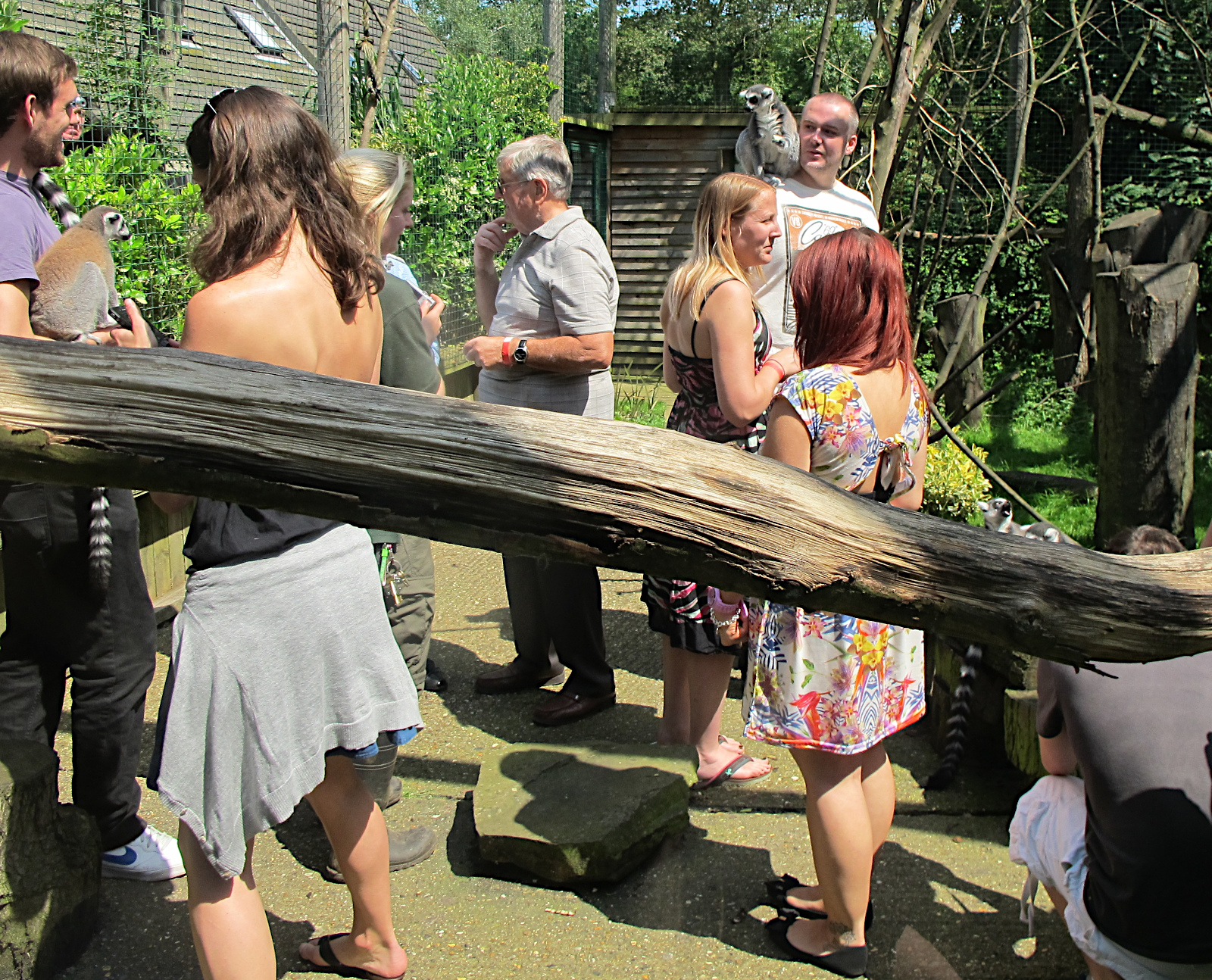
It was an opportunity for Donna to feed the lemurs and see them up close, and for me it was an opportunity to take some photos in a very unusual setting!
What’s in an image? Sometimes quite a lot, more than meets the eye. I’m posting an image every few days.
Click to enlarge
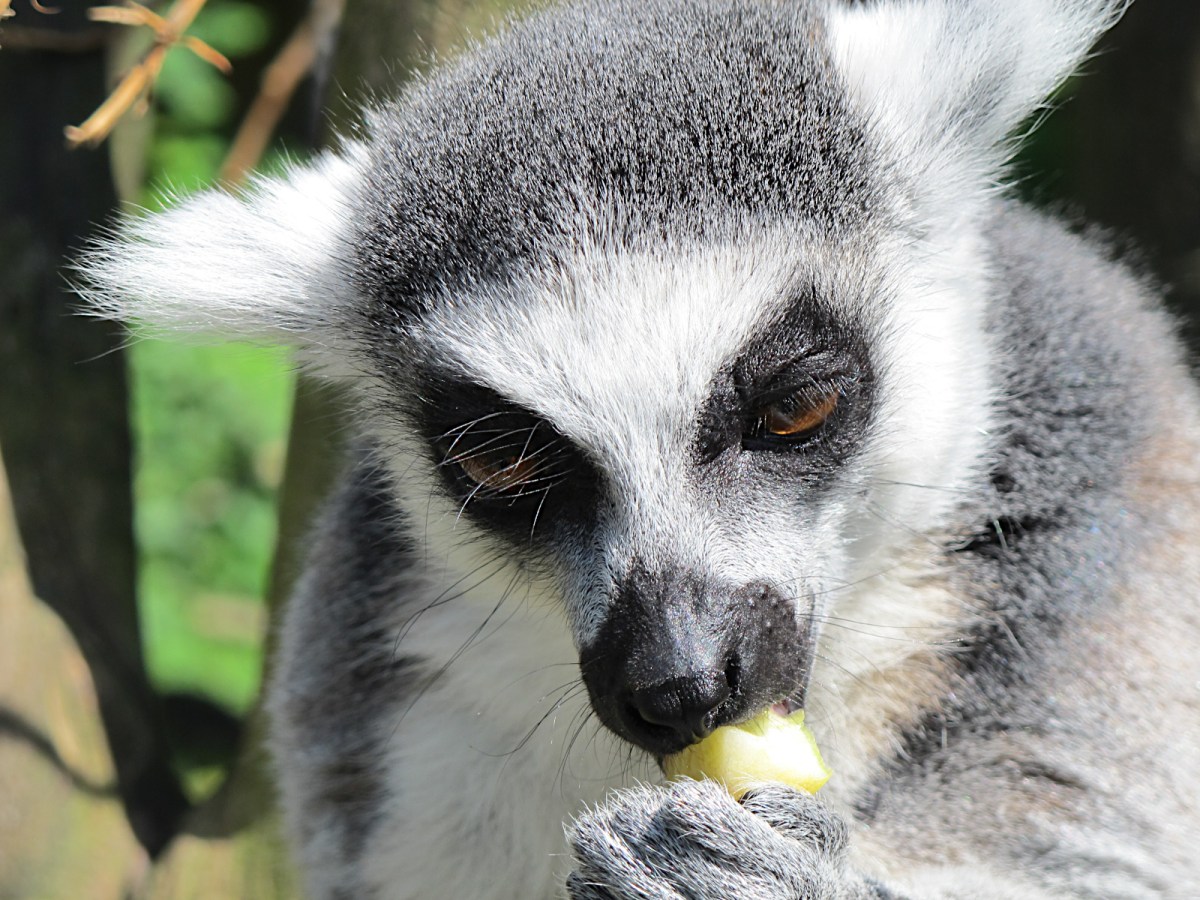
I have another animal photo for you today, this is a fairly close shot of a ring-tailed lemur taken from inside the enclosure.
Donna had booked a visit to Paradise Wildlife Park near Broxbourne (now Hertfordshire Zoo), signing up for an opportunity to enter the lemur enclosure with staff, armed only with slices of apple. The lemurs are not tame, but they are habituated to people. They are visited often by parties such as ours so they are used to people, and nobody has harmed them or frightened them and they are very fond of sliced apple so they will happily approach, even sit on your shoulder, take the proffered apple and eat it.
Visiting the lemurs
It was a wonderful opportunity for Donna to feed the lemurs and see them up close, something she’d wanted to do for some time so a dream fulfilled. And for me it was an opportunity to take some photos in a very unusual setting! I have to say, it was quite an amazing experience.
Habituation
All animals (including humans) can become habituated to many kinds of stimulae. For example, someone who is scared of spiders, if exposed to very small spiders regularly, will react less and less to their presence because the small spiders have never done them any harm. Then it may be possible to graduate to slightly larger kinds of spider.
If you live near an airport you will probably be habituated to the sound and appearance of low-flying, large aircraft. Your visitors may be alarmed, but for you it’s an everyday experience and you hardly notice it.
And of course it’s easy to become habituated to situations and behaviours that might be harmful, for example driving too fast. If you’re habituated to something inherently unsafe, you probably need to think it through logically and carefully.
If you enjoyed this or found it useful, please like, comment, and share below. (If you don’t see those links, click the article’s title above the main photo and they will appear.) Send a link to friends who might enjoy the article or benefit from it – Thanks! My material is free to reuse (see conditions), but a coffee is always welcome and encourages me to write more often!
What’s in an image? Sometimes quite a lot, more than meets the eye. I’m posting an image every few days.
Click to enlarge
Here’s something you may never have seen, unless you’re a farmer or a vet – a calf suckling from its mother. When we lived in St Neots, there was a footpath running past our back gate in Eaton Ford and running very straight to the churchyard of St Mary’s in Eaton Socon. The path led past a large field, Bedfordia Meadows, and sometimes cows were kept in this field.
On one particular day in 2012 I was using the footpath and this cow and her calf were close up against the fence. I was able to take the photo without even stepping off the path. I’ve been working my way through my photos from July 2012 recently, looking for images for articles like this one. And it seemed to me that many of you might like to see this moment from a summer’s day 13 years ago.
For the cow and the calf this is a matter of life and death. Without the mother’s milk a new-born calf would not survive long. Milk contains the water and all the nutrients needed for the calf to grow and become capable of drinking water and eating grass for itself. In the wild, like all mammals, the cow would stop producing milk once the calf stopped needing it. But domesticated cattle have been bred to produce milk for much longer and a cow would quickly be in pain and in danger of serious infection if not regularly milked twice a day.
Mammals provide milk, birds lay eggs
Both dinosaurs and mammals developed from early reptiles. At the time of the Cretaceous extinctions caused by the impact of the famous asteroid, when all the large dinosaurs died out, there had long been early mammals and some of the smaller kinds survived. One branch of the dinosaurs survived as well and we are all familiar with them, they are called birds! A number of small reptiles and amphibia survived too so today we have toads and frogs as well as crocodiles, alligators, lizards and the snakes. But most air-breathing vertebrates in the world today are either mammals providing milk to their young, or the egg-laying birds.
If you enjoyed this or found it useful, please like, comment, and share below. (If you don’t see those links, click the article’s title above the main photo and they will appear.) Send a link to friends who might enjoy the article or benefit from it – Thanks! My material is free to reuse (see conditions), but a coffee is always welcome and encourages me to write more often!
Once it was realised that a letter could be coded as any other letter except itself, even this tiny clue could help point the cryptographers in the right direction.
What’s in an image? Sometimes quite a lot, more than meets the eye. I’m posting an image every few days.
Click to enlarge
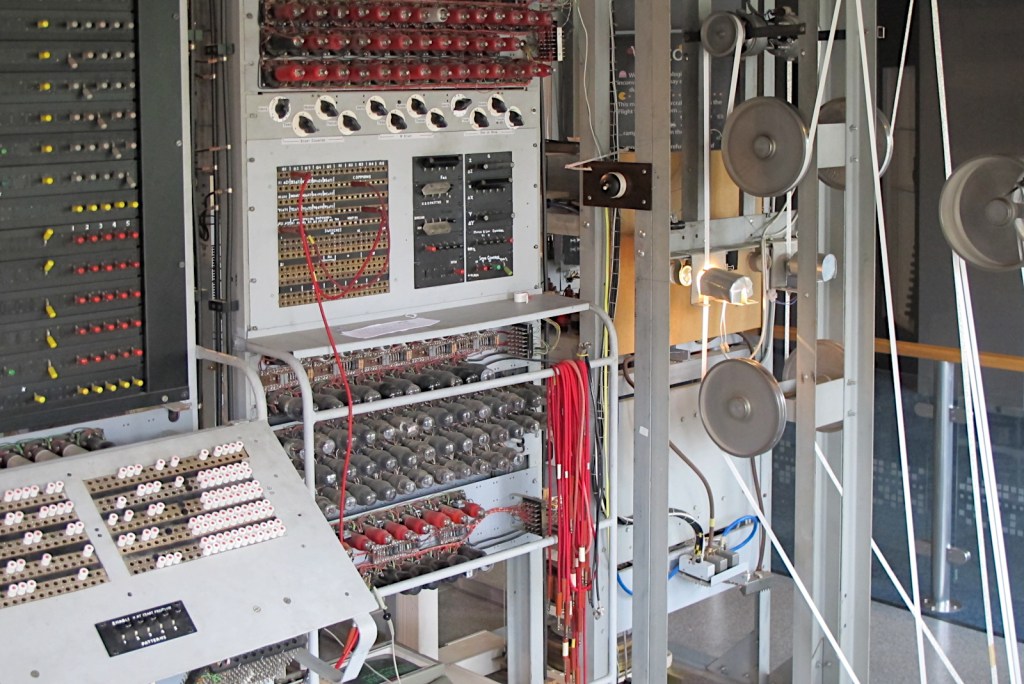
Why is this old computer enigmatic? Some of you will know, some might guess correctly, others may have no idea. I took the photo in July 2012 at the Museum of Computing at Bletchley Park where highly secret work was done during the Second World War to break the German Enigma code as well as other enemy codes and ciphers.
This is a working replica of the famous Colossus computers used to crack those very difficult codes. And computer power alone couldn’t do it, it required clever minds to look for little hints that could make the ‘unbreakable’ code breakable. As an example, once it was realised that a letter could be coded as any letter other than itself, even this tiny clue could help point the cryptographers in the right direction. And there were always cribs that could help, the knowlege that a particular operator always began with the same phrase was an enormous help.
No original Colossus machines exist, after the war ended, Churchill gave strict orders that they should all be dismantled and the parts broken into small pieces.
The idea behind Colossus was the brainwave of Alan Turing, a mathematical genius who worked at Bletchly Park during the war. The Bombe that preceded it was originally designed and built by Polish engineers. Turing and his team designed and built a British version, physically different but doing the same job.
CSO (then based at Bletchly, now at GCHQ) intercepted the coded messages, while teams produced the German plain text, translated it into English and passed it to the British government and military planners.
If you enjoyed this or found it useful, please like, comment, and share below. (If you don’t see those links, click the article’s title above the main photo and they will appear.) Send a link to friends who might enjoy the article or benefit from it – Thanks! My material is free to reuse (see conditions), but a coffee is always welcome and encourages me to write more often!
What’s in an image? Sometimes quite a lot, more than meets the eye. I’m posting an image every few days.
Click to enlarge
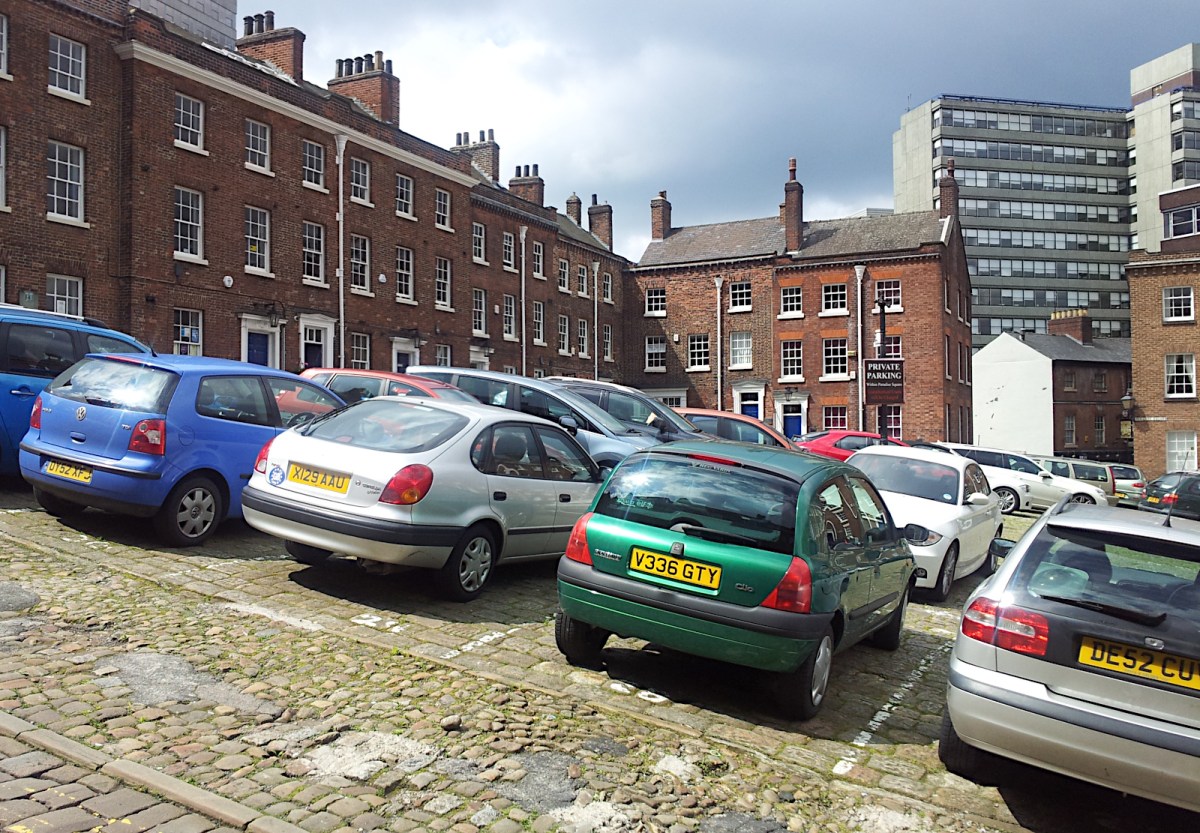
Today’s photo is slightly giddying. This is Paradise Square in Sheffield; I took it in July 2012 when we were visiting family there. Here’s an amusing thought, but perfectly true – more car parking spaces are available in Paradise Square than had it been on level ground! But that doesn’t mean it’s a car parking paradise. Make sure your handbrake is firmly on and if your car has a manual gearbox, perhaps leave it in gear for added safety. Be careful when opening the door, too. I wonder if car insurance is more expensive if your address is on Paradise Square?
And consider the poor removals staff when it comes to picking up or delivering a whole houseful of furniture. Those hydraulic lifts at the back of the vehicle, usually so helpful, would be almost worse than useless! Would it be best to park across the slope? Or would facing uphill or downhill be better?
This must be one of the steepest car parks in the world. If you’re aware of one with an even steeper slope than Paradise Square, leave a comment. Thanks! (I found one, linked below, but I bet there are more.)
If you enjoyed this or found it useful, please like, comment, and share below. (If you don’t see those links, click the article’s title above the main photo and they will appear.) Send a link to friends who might enjoy the article or benefit from it – Thanks! My material is free to reuse (see conditions), but a coffee is always welcome and encourages me to write more often!
The dog in the photo was Chloe, a wire-haired fox terrier. Although it’s a fine day, the waves look fairly energetic suggesting strong winds across the Irish Sea.
What’s in an image? Sometimes quite a lot, more than meets the eye. I’m posting an image every few days.
Click to enlarge
This is a photo of my younger sister, Ruth. Bear in mind that I’ll be 77 this summer, and you can deduce right away that the photo is quite old! I took it on a beach in mid-Wales, I believe in 1963 so it’s worn well. Ruth was building a lovely sand castle; Mum and Dad were on the beach nearby, as were my other two sisters, the weather was sunny and warm, and all was well with the world. It usually is when you’re on holiday!
But what else can we learn from this image?
Well, you might notice it’s a bit blurry, that’s because it was taken with a cheap Kodak Starmite camera with no focus control and a cheap lens. But what you can’t see is that the original was poorly framed and had a sloping horizon so I had to crop it for a better composition. The original is a Kodachrome transparency on 127 roll film. It’s dusty and I had use GIMP to clean it up.
But there are other things we can see. The bucket is red plastic, but the spade has a wooden handle and a painted steel blade. That alone would give an approximate date, given that plastic buckets were a recent innovation while wood and steel spades would have been similarly replaced with plastic only a little later. The flags were paper with wooden sticks.
Just think of this from a waste point of view. Only the bucket in this image would have produced waste that could not recycle itself. The spade, the flags, the clothes Ruth is wearing, even her footwear, when discarded would gradually rust or be digested by soil bacteria. Most of it would be gone within a few decades, though the rubber soles might take a tad longer. But the plastic bucket will still exist in some form unless it was incinerated. Most likely it’s still in landfill somewhere near Cirencester as that’s where we lived at the time.
The dog in the photo was Chloe, a wire-haired fox terrier. Although it’s a fine day, the waves look fairly energetic suggesting strong winds across the Irish Sea.
I have other early photos, mostly on black and white emulsions of the Ilford FP series, but a few others in colour.
If you enjoyed this or found it useful, please like, comment, and share below. (If you don’t see those links, click the article’s title above the main photo and they will appear.) Send a link to friends who might enjoy the article or benefit from it – Thanks! My material is free to reuse (see conditions), but a coffee is always welcome and encourages me to write more often!
































 Journeys of Heart and Mind