How life begins

The gap has been closing little by little from both the astronomical and biological sides. But though it’s narrower now than ever before, it’s still a gap.

How did life begin? It seems possible, even very likely, that simple chemistry has the potential to generate life given the right conditions and plenty of time.

There’s always been a big puzzle over the origin of life here on Earth. Life is everywhere and in a vast array of forms. From the simplest archaea and bacteria, to the giant redwood and the humble grass in the field, the blue whale down to the smallest mite. So rich in variety, so wide in its presence from the deepest oceans to the highest mountains. Life is amazing!

The processes of evolution are well understood and impossible to deny; so puzzles over the many forms of life, its adaptability, and changes in the forms we see coming and going over deep time are clearly understood and well explained by biologists. (When did you last see a dinosaur?)

But how did it all start?

Ah! That has always been the unexplained mystery. Once we have a simple, replicating form of life on the planet we can see it might thrive, spread and grow in complexity.

There are various proposals. Perhaps it arrived in an asteroid kicked off Mars or somewhere else. But that does no more than move the origin to a different place in the Solar System. Maybe it all began at mid-ocean ridges where hot mineral-laden springs flow from hot rock layers below the surface. Perhaps, yes.

We know that many of the precursors for life exist out among the stars. Here in the Solar System, comets and asteroids are often richly endowed with amino acids, ribonucleotides, and all sorts of smaller precursors. These are the building blocks of proteins, RNA, DNA and so forth. We understand how these precursors can form spontaneously given simpler materials like water, methane, ammonia, compounds including atoms of phosphorus, sulphur and so forth. It just takes chance interactions, time, and a source of energy like ultraviolet light. The basic ingredients are there in the gas clouds that condense to form new stars and the material orbiting in disks around them.

All of these things are fairly well understood, but there’s a gap in our understanding between the presence of the components and the presence of life. The gap has been closing little by little from both the astronomical and biological sides. But though it’s narrower now than ever before, it’s still a gap.

Life in a computer?

Well, yes! And, no.

Some clever work by Blaise Agüera y Arcas, a Google vice-president of engineering, has uncovered an intriguing process. Setting a very simple ‘machine’ running random code (no meaningful program whatsoever) and waiting for something to happen, shows that eventually some very simple self-replicating code will appear in the system, and once it exists it replicates very quickly and then slowly increases in complexity. It’s not biological life of course, but it has all the qualities that we would recognise as lifelike. It replicates itself, different forms of replicating code compete with one another, they evolve, and they grow more and more complex. This doesn’t show us in any detail how biological forms got started, but it demonstrates that self-replication could happen in principle, and given enough time that it’s almost inevitable.

For the detail and background you should listen to Sean Carroll interviewing Blaise, the conversation is absolutely fascinating.

See also:

Useful? Interesting?

If you enjoyed this or found it useful, please like, comment, and share below. My material is free to reuse (see conditions), but a coffee is always welcome!

Human origins

Theorists can move forward again – and the picture seems a little more complicated than we thought.

Where did we come from, and how? We’ve long thought in terms of an evolutionary ‘tree’, but our origins in Africa are more like a braided channel. This idea provides a better fit to the data.

Based on fossil evidence alone, studies of human evolution have long agreed that modern humans evolved in east Africa and radiated out from there. But with the development of cheap, fast and reliable DNA evidence from modern populations, and DNA from fossil teeth and bone samples, it’s becoming clear that theorists can move forward again – and the picture seems a little more complicated than we thought.

Human dispersion, events described in the article all took place in Africa – Image from Wikimedia

On 17th May, Ragsdale and others published a research paper in Nature; ‘A weakly structured stem for human origins in Africa’; their evidence suggests evolutionary connections in populations that were separated for a while before recombining. So instead of an evolutionary tree (which most people were expecting) it seems that our human past is more like a set of braided channels.

Previous views on human evolution proposed a tree structure (branching but not recombining). However, the new ‘weakly structured stem’ model fits the data better than a tree model. It also explains the diversity of genetic forms in modern human populations, and shows that there is no single place in Africa where humans ‘originated’. After this process within Africa, humans spread out as show in the map.

See also:

Early steps towards life

Imagine an RNA molecule that can replicate … this is already quite life-like.

I have a really exciting story for you today, especially if you are interested in the origin of life and evolution.

RNA
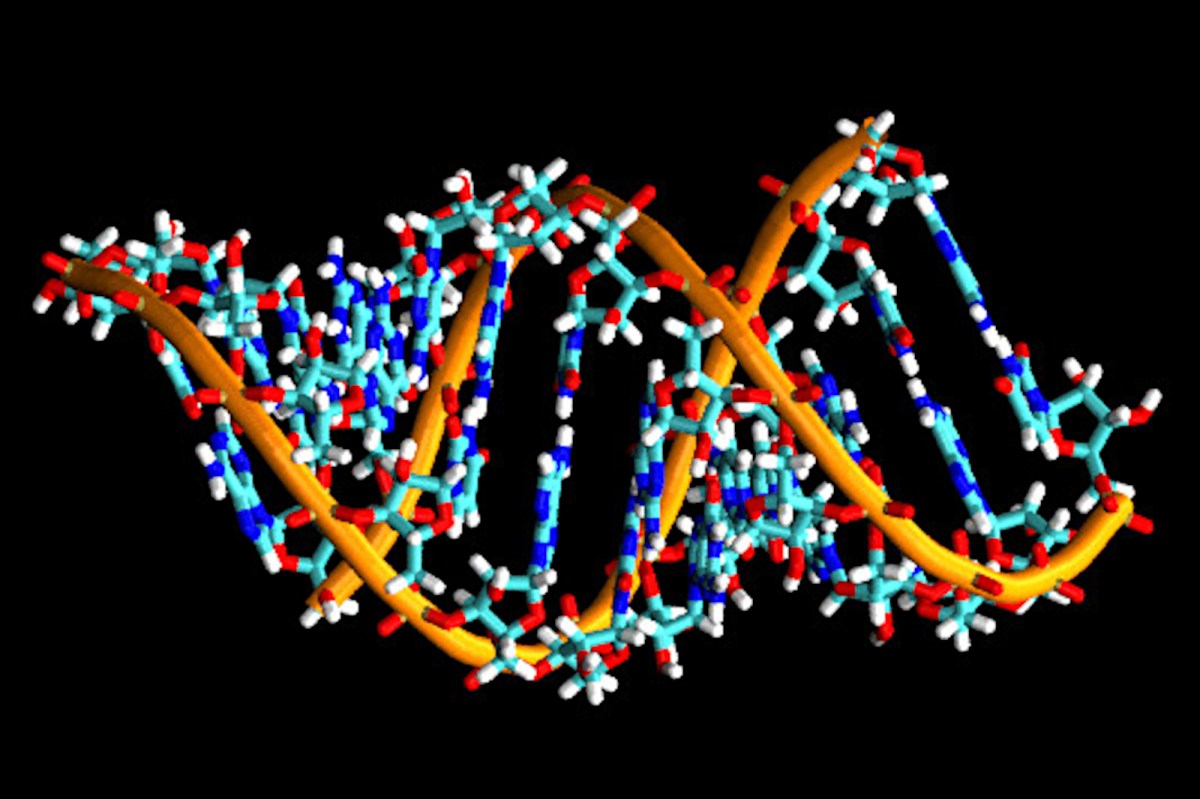
A section of double-stranded RNA

A recent article in the magazine Science reports that Thomas Carell, a chemist at Ludwig Maximilian University in Munich, Germany, has outlined a process that can generate all four of the building blocks of RNA from compounds and conditions present on the pre-biotic Earth.

Why is this significant?

To understand, we need to grasp the importance of RNA. Its cousin, DNA, is the molecule used by most living things on Earth to store the genetic information that controls their form and function. RNA is also capable of storing genetic information, and some viruses use it in exactly this way. RNA is also essential in all living forms because it acts as a go between in the production of proteins from the DNA genetic material. RNA is less stable than DNA and copying errors are more likely. For this reason, DNA is a better long-term genetic store than RNA, but RNA is more dynamic. Think in terms of DNA as a library of printed recipe books, while RNA is like hand-copied notes on scraps of paper that enable the recipes to be taken to the kitchen.

But RNA has additional tricks up its sleeve. Not only can this molecule store genetic information, it can also catalyse biochemical reactions, including the synthesis of simple proteins. RNA is a bit of an all-rounder, and it’s not so hard to imagine that quite soon after being randomly synthesised by Carell’s process, RNA molecules might be formed as the dissolved RNA bases came into contact with tiny rock templates that could act to stabilise the process.

RNA also has the potential to self-replicate. Imagine an RNA molecule that can replicate (albeit with occasional errors). This is already quite life-like. Now image the population growing in places where the Carell process was providing reliable supplies of the four bases. Some of those RNA molecules will have errors, sooner or later an error, or a combination of errors will provide a version that replicates more efficiently, or gets trapped inside a lipid membrane that protects it from breakdown, or catalyses the production of a protein that makes the RNA more efficient in some way. If all of those things happen you have something that might be regarded as an early living form – an enclosed lipid membrane with a self-replicating genetic system that can mutate and evolve. Nothing more than that would be needed to kick of an expanding array of related forms.

Voila!

The story as I describe it here is not complete and likely incorrect in many ways. I accept that. But though it’s a simplistic view, it’s also likely to be broadly correct as a bare outline. Over the next few years and decades I expect much more detail will become clear, especially detail about what is or is not possible. And I expect to see many of the steps to be experimentally demonstrated. Watch this space…