What’s in an image? Sometimes quite a lot, more than meets the eye. I’m posting an image every few days.
Click to enlarge
This is the same river as the previous post, the River Great Ouse. That previous image captured a view from St Neots in Cambridgeshire; this one is from further upstream in Bedford.
The swans you see here are doing what swans do. They pair for life, but they also congregate in larger social groups (known as a bevy). When a swan dies and leaves a lonely partner, the remaining swan will often bond with a new mate.
In this sense swans are very like humans; we usually form lasting male/female pairs and in the same way, if one partner dies, the other will often (sooner or later) find a new partner. But there is a significant difference: swans act on instinct. We do too, but in humans there are additional layers. I can think of at least two – culture and reasoning.
Culture
Human culture is habitual behaviour; it may differ greatly from population to population. It’s easy to find differences between a Western wedding, an Indian wedding, an Afghan wedding, and a Japanese wedding. We could easily extend that list. There are also differences (though more subtle) between a French wedding, a US wedding, and a Polish wedding. And there will be still other differences between Anglican, Catholic, Baptist and Pentecostal weddings. Swans have nothing remotely like this, in fact they don’t have weddings at all. All of the foregoing is cultural; it’s a human layer overlying the instinctive animal processes of bonding, producing offspring and helping them grow safely to adulthood. There’s some evidence for elements of culture in certain birds, and some primates, and in some whales and dolphins – but well below the levels seen in human populations.
Reasoning
This is another layer but again, it’s mostly limited to human populations. It’s reasoning that enables us to have governments, science, technology of almost unlimited variety from farming and construction to ships, railways, aircraft and computers. Reasoning involves observation, drawing conclusions, finding ways of persuading others, differentiating between what works and what does not, making choices, and planning ahead. Again, you can see glimmerings of reasoning in some birds, some mammals, and in the octopus.
Faith
Faith seems to have no place whatsoever for swans, chimps, or any other creature on the planet. Faith draws on elements of both culture and reasoning, yet it’s not defined by either and is not dependent on either. It’s unique to humans. You’ll find quite lot on this website concerning faith one way or another; I won’t write about it further here, but I’ll leave a few suggested links below.
Conclusion
From observing a group of elegant birds on a river, we have thought about things that groups of people and groups of animals have in common, and how our abilities rise to at least two higher planes above the level attained by almost all other animals.
If you enjoyed this or found it useful, please like, comment, and share below. (If you don’t see those links, click the article’s title above the main photo and they will appear.) Send a link to friends who might enjoy the article or benefit from it – Thanks! My material is free to reuse (see conditions), but a coffee is always welcome and encourages me to write more often!
What’s in an image? Sometimes quite a lot, more than meets the eye. I’m posting an image every few days.
Click to enlarge
Before moving to Cirencester in April 2017, we lived for many years in St Neots, Cambridgeshire. One of the things I miss most (and there are several) is the River Great Ouse passing right through the centre of the town. This photo was taken from the town bridge; while looking ninety degrees to the right would reveal the Market Square, just a hundred metres away.
I like this photo because it has so much interest packed into one scene. You might not see the geese at first; they form a small in-line flotilla at the bottom right. The reflections in the water are lovely, and the surface rippled enough to add a sense of movement. The willow on the bank is typical of the trees in the Riverside Park which is out of sight but stretches behind and to the left from this position. The tree also divides the buildings along the river bank; they stand where the medieval priory once was, and the modern building to the left of the tree is ‘The Priory Centre’, the town’s major meeting and activity centre where Open Door Church used to meet on Sunday mornings. In the far distance you can just make out the Marina.
From priory to a new church building
While we’re thinking about the medieval Priory and the modern Priory Centre we might also think about the way church has changed since the year 313 AD. Prior to that year, the expectation was that church meant people gathering in homes without formal leaders like bishops, deacons, elders, pastors, popes, priests, rectors or vicars. There were informal leaders, confusingly with some of the same words being used to describe them – apostles, deacons, elders, evangelists, prophets, shepherds and teachers. But Christianity was illegal, persecuted, and therefore often hidden from public view.
When Christianity was legalised in 313 AD, and made the state religion in 380 AD, everything changed. It’s possible that by that time, burgeoning, even explosive growth in Christianity had reduced worship in the Classical Greco-Roman temples to a low ebb. The buildings were expensive to maintain, and the solution would have seemed obvious, legalise Christianity, hand over the buildings for Christian use, let them modify them for their new function, pay the maintenance costs, and manage the administration. Problem solved for the Roman state.
If you enjoyed this or found it useful, please like, comment, and share below. (If you don’t see those links, click the article’s title above the main photo and they will appear.) Send a link to friends who might enjoy the article or benefit from it – Thanks! My material is free to reuse (see conditions), but a coffee is always welcome and encourages me to write more often!
This index links to my ad hoc posts, they may be on more or less anything. These posts are reactions to something I have seen, read, or heard recently, things that I want to deal with individually and usually within a few days.
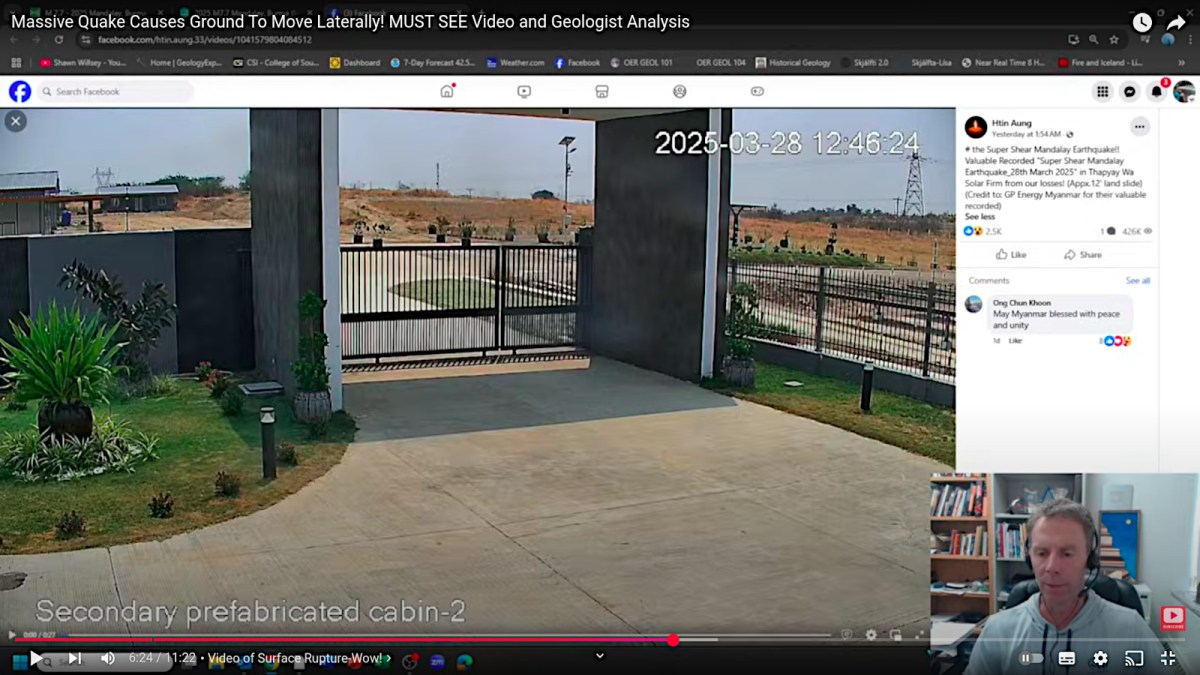
Here’s something very rare, in fact so far it’s unique; a tectonic plate movement caught on video!
The photo is a screen shot from my laptop, I was watching an astounding section of video from a security camera on a property in Thailand, a couple of hundred miles south of the damaging earthquake in Myanmar in March 2025. You may remember this being in the news at the time. Watch from the beginning if you want to see the entire thing (highly recommended). If you just want to see the earth move, skip to 6m 22s.
You’ll see the movement most clearly by watching the ground just outside the fence on the right hand side of the video, but there’s a great deal more to see if you listen to the narration.
In simple terms, the ground this side of the fence is supported on one tectonic plate, and the ground on the far side of the fence is supported on a different plate. The plates are slowly moving past one another but rocks are quite strong and lock in place, resisting the sliding motion. The stresses in the rocks increase year on year until they’re powerful enough to fracture even the strongest of materials. So at some point the underlying rock gives way and years and years of potential movement all occurs in a couple of seconds as the rocks move several metres all at once. And at that point, stresses slowly begin to build up again until many years later there’s another earthquake and another sliding motion releasing the stresses once again. And the cycle repeats over and over again.
I hope you enjoyed watching this video as much as I did!
If you enjoyed this or found it useful, please like, comment, and share below. (If you don’t see those links, click the article’s title above the main photo and they will appear.) Send a link to friends who might enjoy the article or benefit from it – Thanks! My material is free to reuse (see conditions), but a coffee is always welcome and encourages me to write more often!
Feb 2025 (3 months before publishing this article)
Click to enlarge
It was really nice to have a warm house at last. The heat pump was working well for us, but there were a few little wrinkles that still needed to be ironed out.
Donna and I were shocked at the way Donald Trump was behaving as the new US President. He was making sweeping changes, apparently without care or consideration for the disruption he was causing. And Musk was raising mayhem as well, closing departments and sacking staff to save money. At the end of the month Zelensky was very badly treated by Trump and the Vice President, JD Vance and it seemed almost the entire world was horrified by their behaviour.
Paper birds
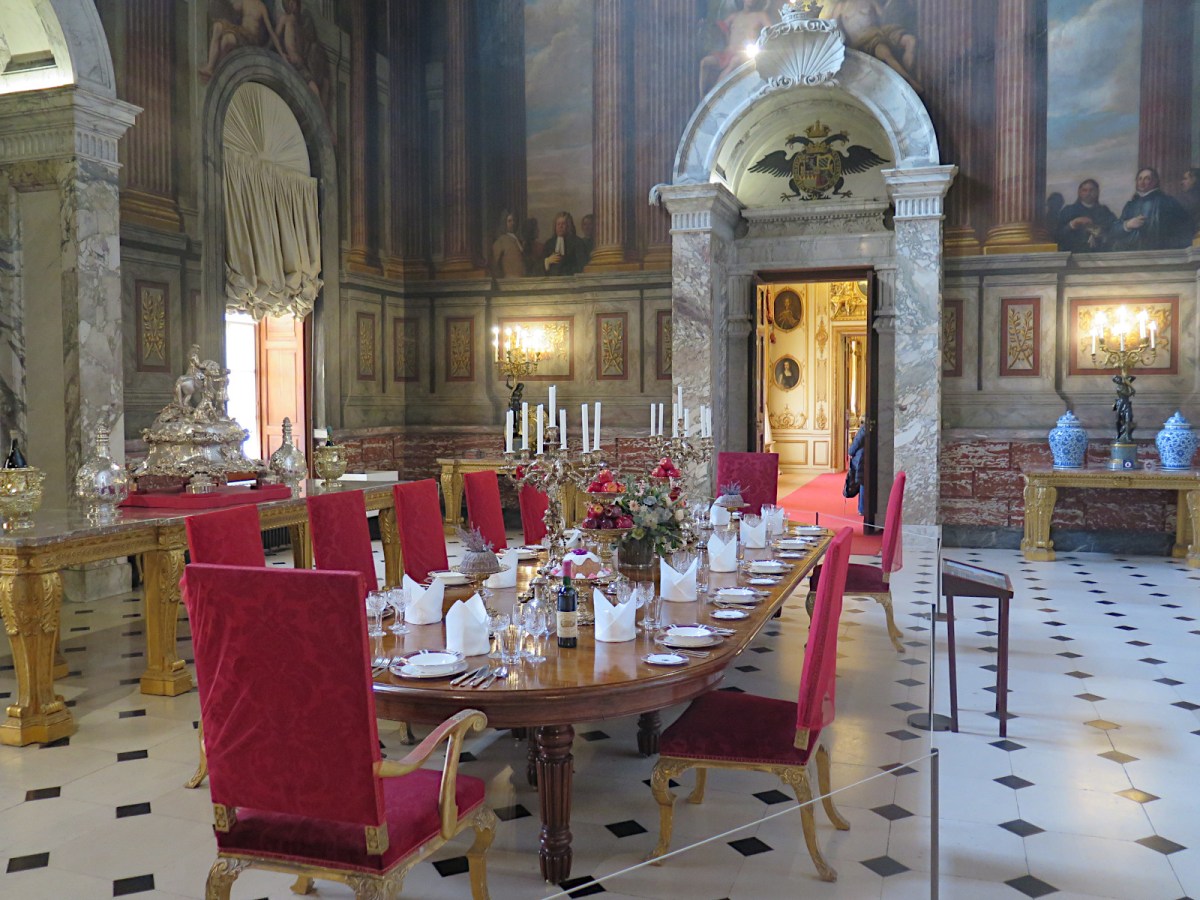
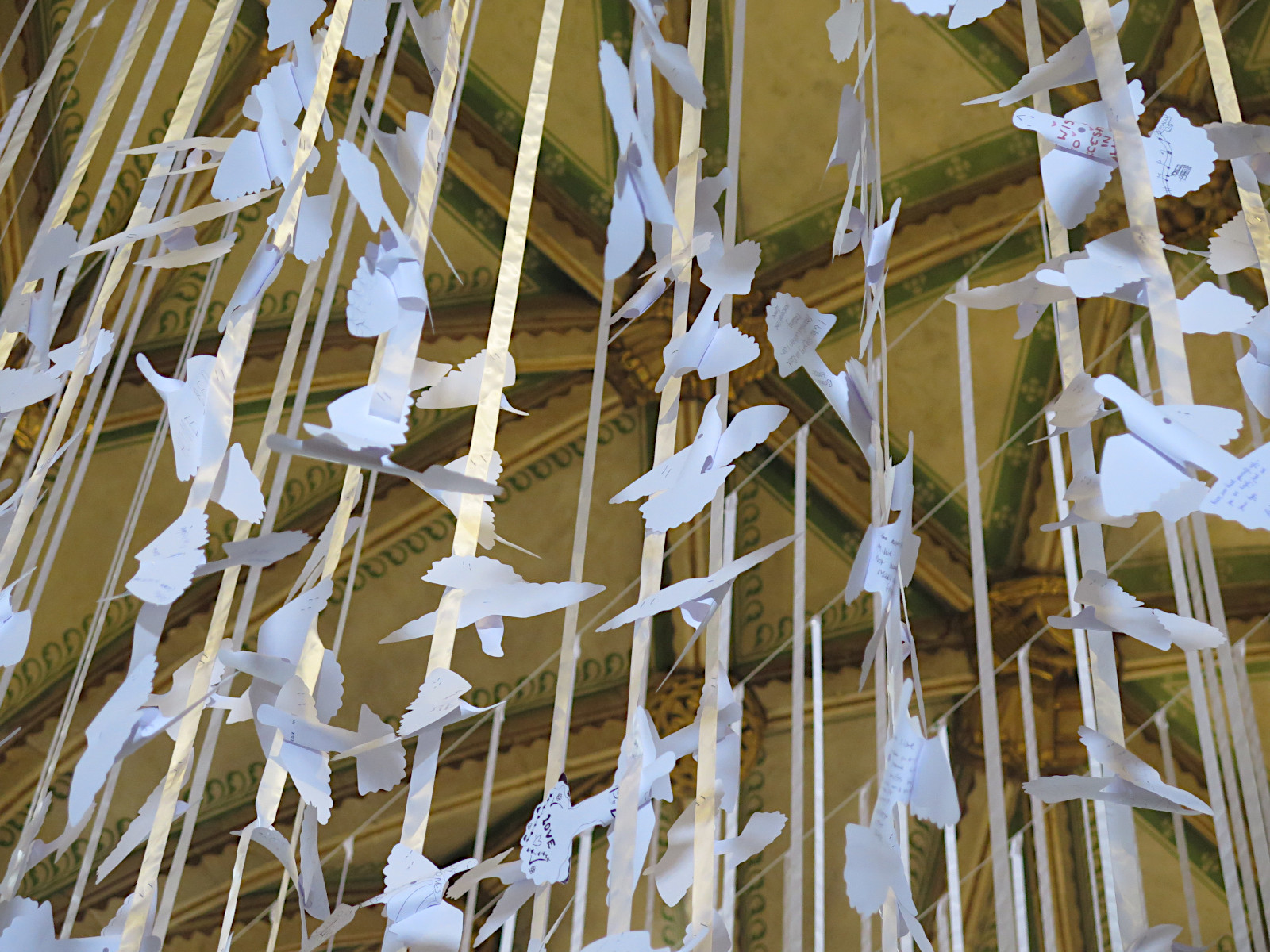
We visited Blenheim Palace and Tewkesbury Abbey during the month. The main image at the top of this post shows the sumptuous dining room at Blenheim, and the paper birds were hanging from the nave ceiling in Tewkesbury Abbey. There were, probably literally, thousands of them.
I had my laptop cleaned internally, and got the 2 TB hard drive replaced with a 2 TB solid state drive (SSD); as a result it runs cooler, has better battery life, and is also a good deal faster. It’s five years old now, but this should extend its useful life for quite some time.
The mornings and evenings were drawing in and that makes opportunities for twilight photos while the shops are still open. I finished my tax return and told myself to do it earlier next year (again).
On 6th I wrote in my journal, ‘What a nightmare – it seems that Donald Trump has the US election in the bag. It’s a gloomy prospect for the world, for the USA, for Europe, the UK and Ukraine. It’s a bad outcome for democracy itself, although brought about by the democratic process. It’s bad for freedom of trade. There is some benefit for Putin, for Kim Yong Un, and for misinformation, untruth and bad behaviour.’ Looking back, that seems prophetic.
We had a surveyor visit from Octopus Energy on 11th the first step towards installing a heat pump. The Long Table shop, Monastery, opened in the Market Place recently and we went there for a quick initial look. They’re doing an amazing job. Our chimney developed a leak and dripped through my study ceiling.
Christmas Market
And at the end of the month we had a visit from friends in St Neots and the Christmas Market filled the Market Place. It was a busy month but on the whole a good one.
Donna and I walked along the canal towpath through Chalford, and enjoyed exploring this pretty hillside village. We ate lunch at Felt Cafe and visited the Long Table at Brimscombe.
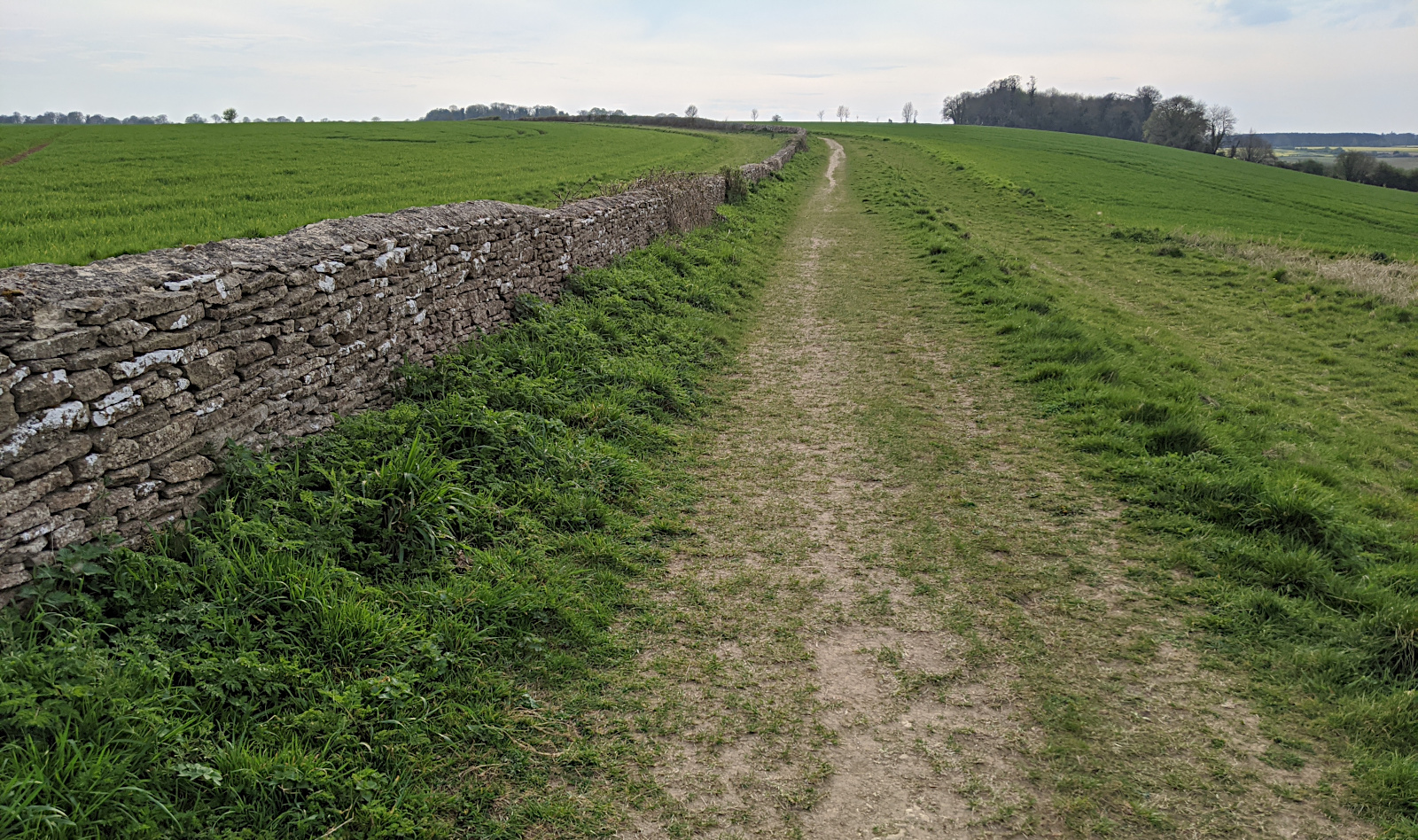
Little by little I’d been clearing ivy from the dry stone wall along the west side of the Gloucester Road. There was now a section of about 500 m completely clean and looking much better. I only did ten or twenty minutes at a time, usually when I was walking back from town. I like things like that, slow progress over a long period adding up to a large effect.
Ebley Mill
On 16th I walked another long section of canal, from Chalford all the way to Stonehouse, parts of this are really pretty. An expedition to The Newt with Paul and Vanessa was a great day out, too.
We took Donna’s Mum, Isobel, for a short break at a Warners Hotel at Holme Lacy near Hereford. While staying there we were able to visit Hereford and explore the city centre including a look inside the lovely old cathedral. Donna and I also managed a country walk one morning while Isobel sat in the sunshine at the hotel. We visited the National Trust garden at The Weir overlooking the River Wye. It’s beautiful countryside and an interesting site with a south facing walled garden on a south-facing slope with no southern wall so that cold air can slide downhill to reduce winter frosts.
Our friend Kevin was in the process of moving from Gamlingay to Little Paxton. He also told me about a new friend he’d made, Lariana. They were getting on very well together and now, two years later, they are married and living in St Neots! That’s a story with a very happy ending.
King Charles III was crowned on 6th May, only the second coronation of a British monarch during my lifetime. It was a grand event and we followed the TV coverage with great interest. I particularly noticed that the floor coverings in Westminster Abbey were yellow and blue – the colours of the Ukrainian flag. It’s impossible to know if this was a deliberate statement of royal support for Ukraine, but I like to think it might have been. It seems gold and blue were also used at Queen Elizabeth’s coronation in 1953.
LARS System
I found a working copy of the old LARS System that I created while working at Long Ashton Research Station in 1994. It was a virtual machine copy on one of my backup drives, I imported the hard disk image and it ran with no issues in Virtual Box. I was delighted to find this. It brought back a lot of memories!
For the first time since COVID lockdown we were allowed to meet with a friend, providing it was out-of-doors and we stayed at least 2 m apart.
Donna’s Dad, Tony, deteriorated during the month and died in the evening of 26th, her brother Paul was able to visit twice, once for two nights and then again just nine days before Tony passed away. We had been able to get carers in from a local hospice, Longfield, despite the COVID precautions. This was wonderful as otherwise he would have had to go into care and visiting was not possible during this time. It would have been an awful experience for him and for us, too.
Gratitude
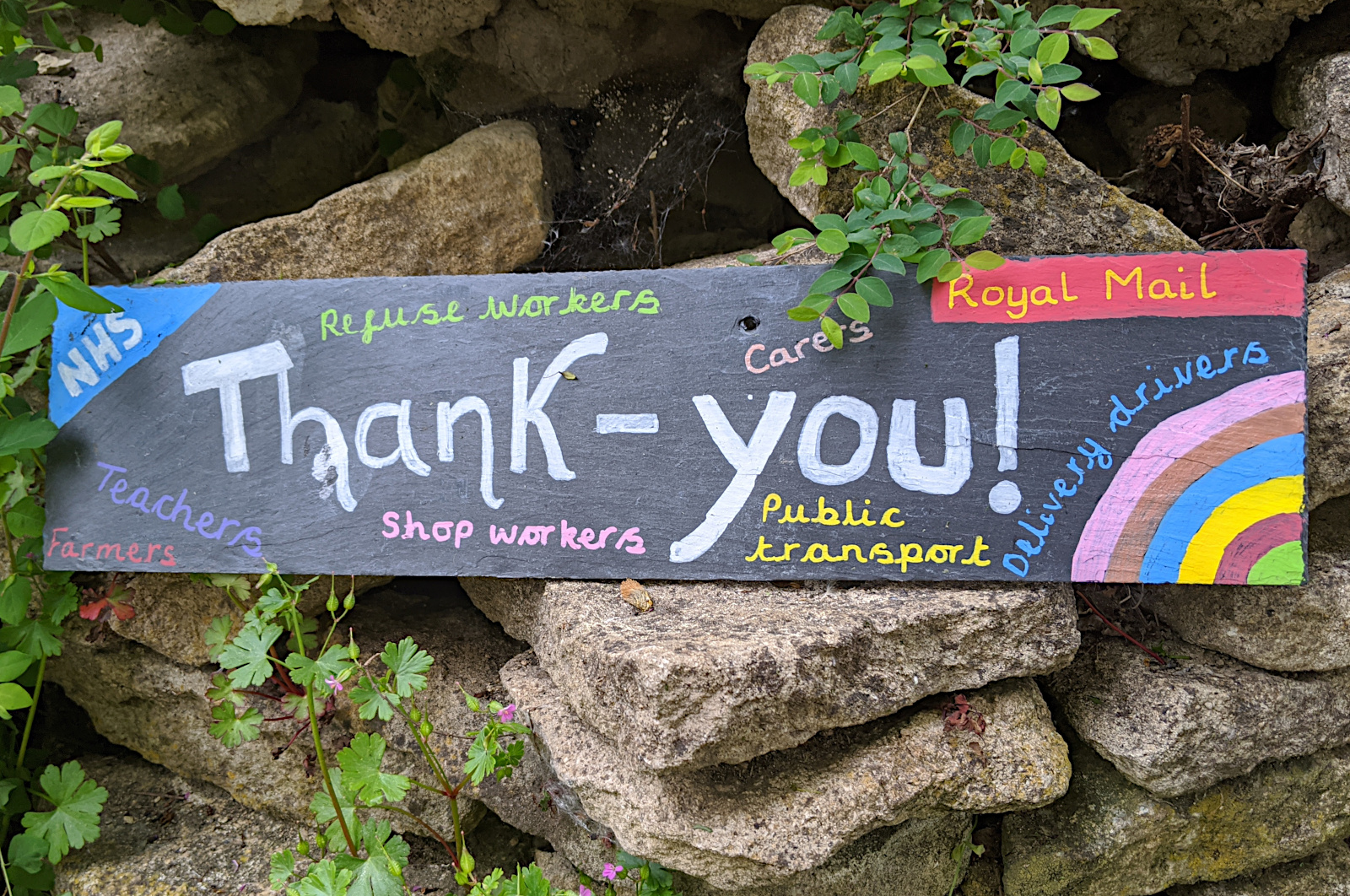
There were daily ministerial broadcasts about the pandemic. It was a strange time, I remember one day a queue of over 100 people was socially distanced all around the Tesco car park with a very long wait to get into the supermarket. People were grateful for the support they were getting and showed it in a variety of ways. Donna and I always looked forward to our one permitted daily walk, but the necessary restrictions were causing serious damage to the economy. I wrote a Haiku of Haikus about it all.
World events: The number of COVID cases worldwide passed 5 million on 21st May; and the first crew flew on a SpaceX Dragon vehicle.
We drove to York and visited Thorganby and Fulford to spend time with my daughters and the grandchildren. It’s always good to see everyone; in the photo Aidan and Verity (now Fern) are working on some Lego. Ten years later, Aidan is travelling in South America and Fern is taking GCSEs.
Our garden
Here’s a shot of our old garden in St Neots. It was fully mature by this time, and big enough for entertaining. We used to do this often and our home became known as ‘the party house’. We had plenty of room indoors, a summerhouse, and garden ‘rooms’ so people could sit and chat or stroll around talking.
World events: The 2015 UK General Election produced the first Conservative majority in 18 years; and ISIS captured the ancient city of Palmyra in Syria.
I started seeing flashing lights whenever I turned my head or flicked my eyes from side to side; I was concerned about a detached retina. The walk-in clinic’s GP sent me to Addenbrooke’s Hospital in Cambridge for a proper check and they decided I had detachment of the vitreous, a normal occurrence involving the retina as we age, and with similar symptoms.
I went to the Starfish Vision Unconference in Helsinki, and was made very welcome by my hosts, who collected me from the Airport and gave me a room in their home. There was an emphasis on rapid, bursting growth and new life. There were 50 or 60 people present from church in mostly Nordic countries, but other parts of Europe too. The photo shows delegates relaxing outside during a break. I felt Finland was a beautiful country, and the people were kind and helpful.
Near Ballachulish
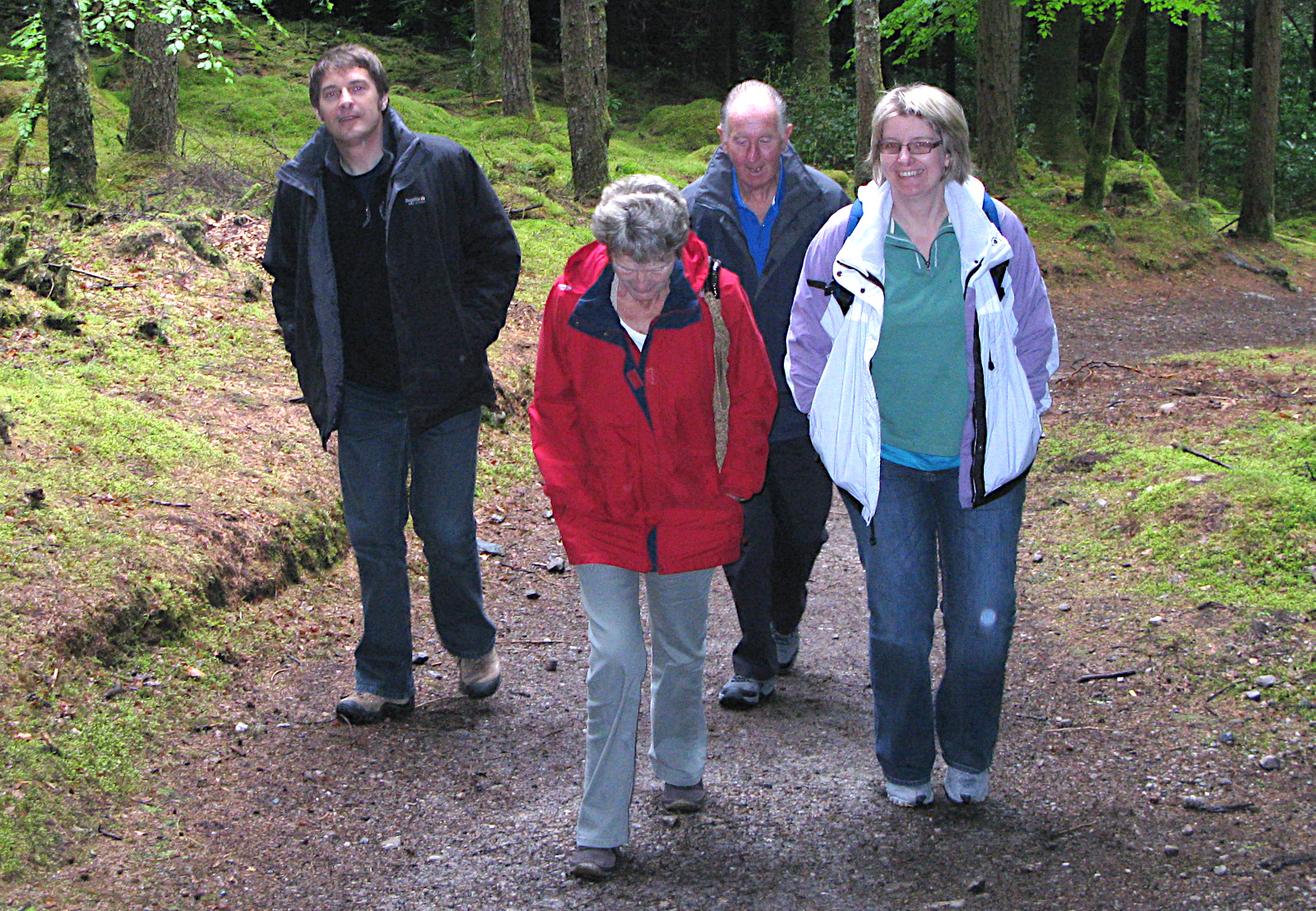
We visited Scotland with Donna’s parents and her brother for a family wedding in Glasgow. But we made a week of it by booking a holiday home in Ballachulish near Oban. The photo shows Paul and Donna with Tony and Isobel in the middle of the group.
I visited Mum and Dad at Churnside in Cirencester and spent most of the day with them, driving down to arrive mid-morning and travelling back in the evening. The house and garden haven’t changed much from one visit to the next, the place was pretty much as they wanted it and they were in no hurry to alter anything.
Dad
Dad had not stopped being a nurseryman! His little greenhouse was full of things he’d propagated and he often supplied me and my sisters with pots of this or that for our gardens. Once a plant propagator, always a plant propagator. One of the first books I bought as a student at Bath University was ‘Plant Propagation’ by Hartman and Kester. Dad was so interested in it that I later bought him his own copy.
Donna and I were both working at Unilever in Sharnbrook, north of Bedford. The Web Team that I worked for were happy that we’d had no Y2K (year 2000) issues, it had involved a lot of work in 1999; the photo shows me at my desk.
scilla.org.uk
I registered scilla.org.uk as an internet domain that Donna and I could use for email, a website, ftp and other functions. We called it scilla as it’s suitably short for an address and is a genus of squill, related to the bluebell. We have bluebells in our front garden in St Neots.
Mum & Dad
Donna’s parents visited us on 13th and mine came on 27th to stay for a few days. The house was in a state of upheaval because we were decorating the lounge and had squeezed the sofas into the small dining room.
World events:India’s population reached 1 billion; and the Millennium Force roller coaster opened, in Ohio, the world’s tallest and fastest.
Beth was working hard on her upcoming A levels and working towards her Biology project, helped along by her Mum who sometimes took her out on field trips at weekends.
Meanwhile Debbie was driving her new car at this time, quite an exciting change for her and increasing her mobility and independence enormously.
World events: The Vaal Reefs mining disaster involved a locomotive falling into a mine shaft; and Russia expanded its Mir space station by adding Spektr.
In May we visited Ophrys House, Tim and Deirdre’s home in Siddington, to meet my cousin Jill and her partner Marcia who were on holiday there from the USA (they lived in West Virginia at that time). Tim wanted to demonstrate the dentition of one of his goats, the goat got annoyed and gave his fingers a nip! In the photo are Judy, Marcia, Debbie and Beth.
Dad at work
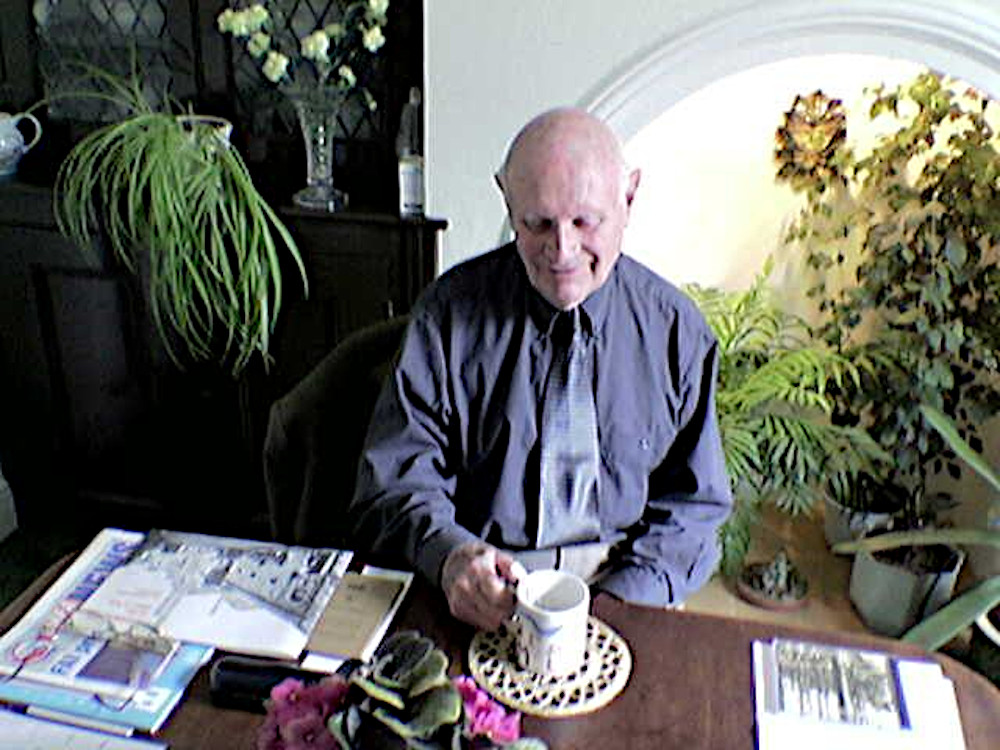
The same weekend I went to visit Dad while he was working at the Kingsmeadow Garden Centre in Cirencester, now the site of Tesco Extra’s car park. He was busy in the little office, cashing up at the end of the day. These days customers swipe their cards and the daily totals appear automatically.
World events: Latvia declared independence from the USSR; and The WHO removed homosexuality from its list of diseases.
The 19th was Beth’s 7th birthday and the weather was kind so she had friends round for a party in the back garden.
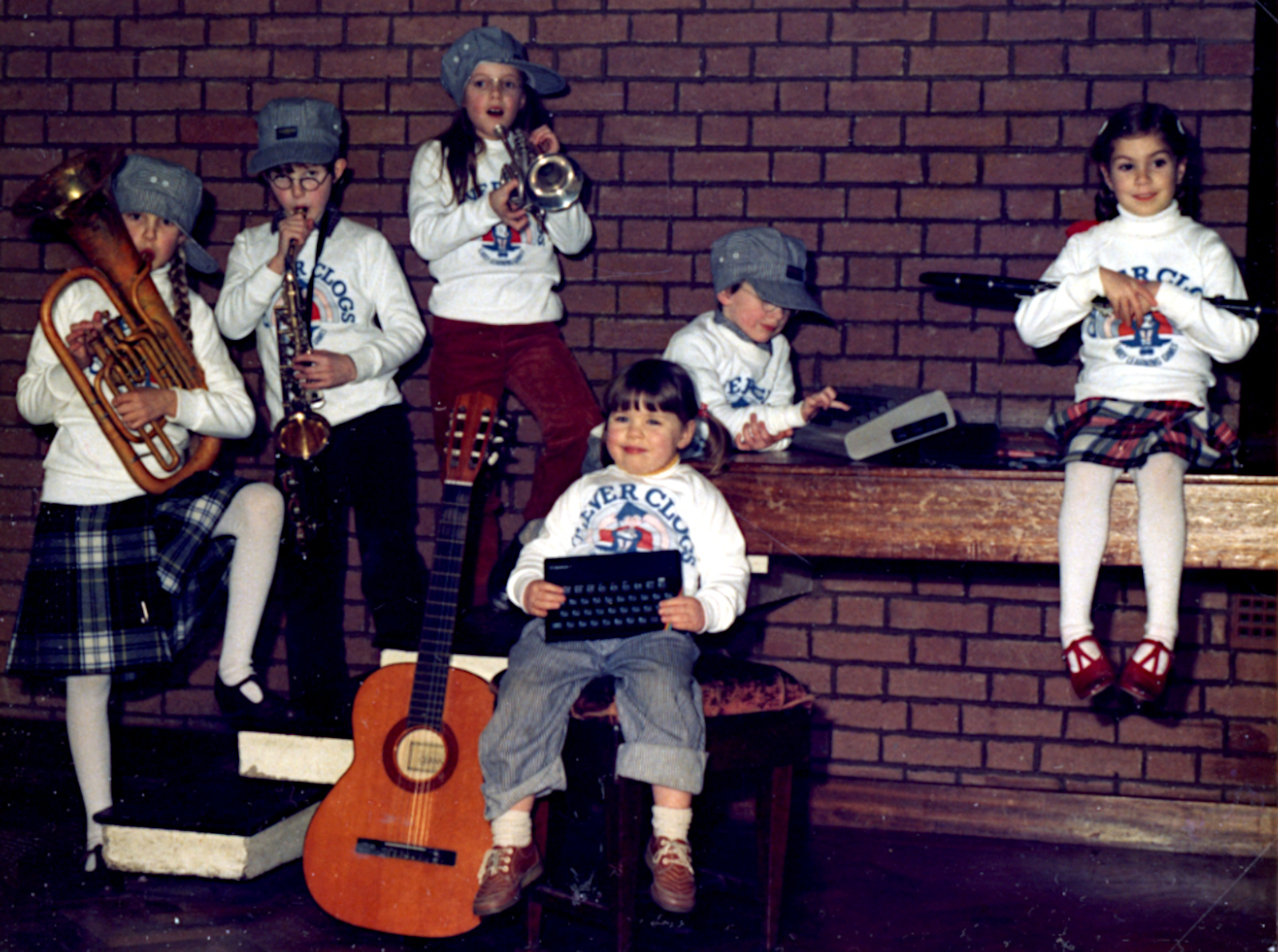
It was about this time that we drove down to Rachael and Peter’s home in Eaton Socon, St Neots, for a Clever Clogs’s photographic session for advertising material for the educational software we were helping to develop. I wrote some of the early software for the ZX81 and the Spectrum, and Peter turned it into a profitable business and marketed it. We rose to the giddy heights of selling the games via a range of retail outlets, including WH Smiths.
Clever Clogs team
I was working at Long Ashton Research Station, and was the Computer Rep for the Plant Sciences Division. Judy was teaching Biology GCSE and A Level at Cotham Grammar School in Bristol.
World events: UK scientists announced the discovery of the ozone hole; and the Heysel Stadium disaster killed 39 football spectators in rioting.
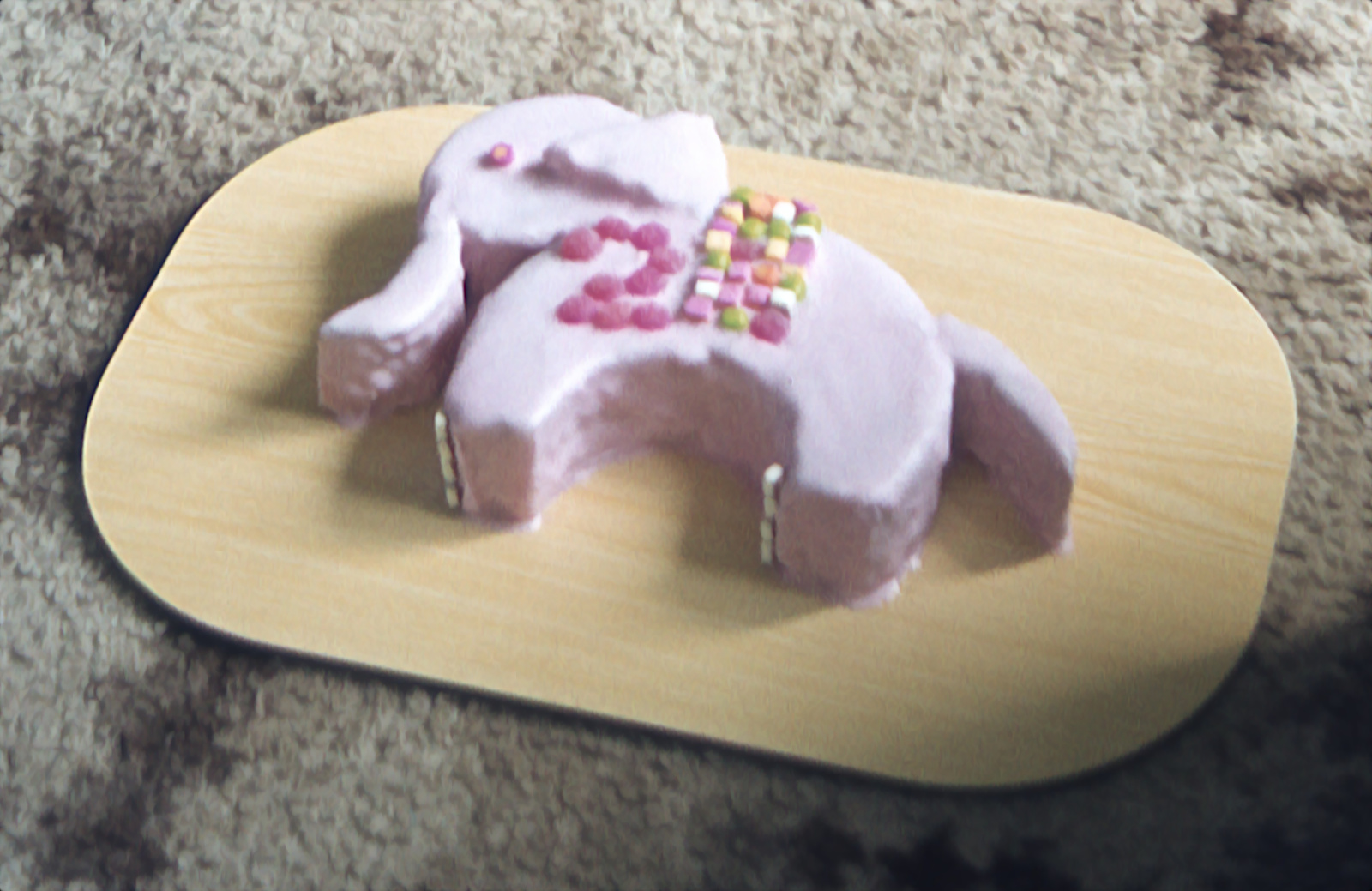
Beth was two-years-old and she enjoyed her cake and presents. I’m assuming the party would have been just family, either one or both sets of grandparents coming down for the day.
She sat for a long time investigating all the presents thoroughly and was very focused of each one. Judy had baked a circular cake and cleverly cut it into pieces to make up an elephant shape. She then iced it and decorated it with a number two.
The cake
Meanwhile Debbie, already five-years-old, was expecting to start school in the autumn, but that was still an entire summer away!
Debbie was eight-weeks old around the middle of the month, and we were getting closer to deciding on a house; we’d secured a mortgage in principal and I had life assurance in place too . We’d considerd St Werburgh’s as we could afford the homes there and it would provide easy access to town, but it was not a great area and a nearby village looked better. The Claverham/Yatton area was more to our liking but was also more difficult to afford.
We looked at some properties in Yatton, and found one we liked but couldn’t really afford in Rectory Drive. We put in a low offer that we thought would be too high, but worth a try, only to have it accepted immediately! So the legal process got under way sooner than we’d expected.
We were still living in our flat at 20 Belmont Road in Bristol, but we contacted the landlord to give notice in principal (although we couldn’t yet provide a firm moving date).
World events:Junko Tabei became the first woman to reach the summit of Everest; and there was a serious coach crash near Grassington, North Yorkshire.
Judy and I were both in our final year at university. I was at Bath studying Horticulture in year 4, she was at Aberystwyth studying Biochemistry in year 3. We were both approaching our finals and working really hard.
We were looking forward to finishing our studies, graduating (hopefully) and then on October 3rd, getting married – oh, and finding work!
The World Gliding Championships came to South Cerney Airfield, just south of Cirencester, and opened on 29th May. This was a huge event for somewhere the size of Cirencester, let alone South Cerney!
The photo shows a Slingsby Capstan glider with one of the South Cerney wartime hangers in the background. The airfield was very familiar to us as Dad was a keen aeromodeller and we used to visit South Cerney often to fly our models, sometimes on our own but often with other members of the Cirencester club.
I was in my final term of the first form at Cirencester Grammar School, though it seems not much maths had lodged in my brain yet! (Click the image.)
It was around this time, perhaps, that we moved from our council house, 17 Queen Anne’s Road, on the Beeches Estate. We moved into my grandparent’s old home ‘Churnside’ at 37 Victoria Road. I was somewhat peeved at not being able to take part in the move, but I was required to go to school instead. It was so exciting to ride my bike the short distance to the new house and find the rest of the family busy sorting everything out, and then joining in.
World events: An American spy plane was shot down over the USSR and its pilot, Gary Powers, captured; and Sputnik 4 was launched into orbit by The USSR.
I was close to the end of my second year at Querns School and although I probably wasn’t thinking about the summer holidays yet (and no doubt late June would have seemed an interminable wait) but by the end of May it would have been just a matter of a few weeks.
The photo shows part of the front of the school and the side entrance. The playground and field were further down that way. I remember playing rounders in the little field at the bottom of the school playground. I understand now that both the playground and the ‘field’ would seem shockingly small if I could visit them today! This was, after all, just a largish urban house and back garden pressed into service as a very small junior school; but at the time they seemed big. And I remember Martin Kinch who always seemed able to hit the ball harder than anyone else, run faster than anyone else, and was just physically superior to the rest of us.
A few things have changed, but this side entrance is still very recognisable.
World events:West Germany became a sovereign country and joined NATO; and Austria became a sovereign, neutral country.
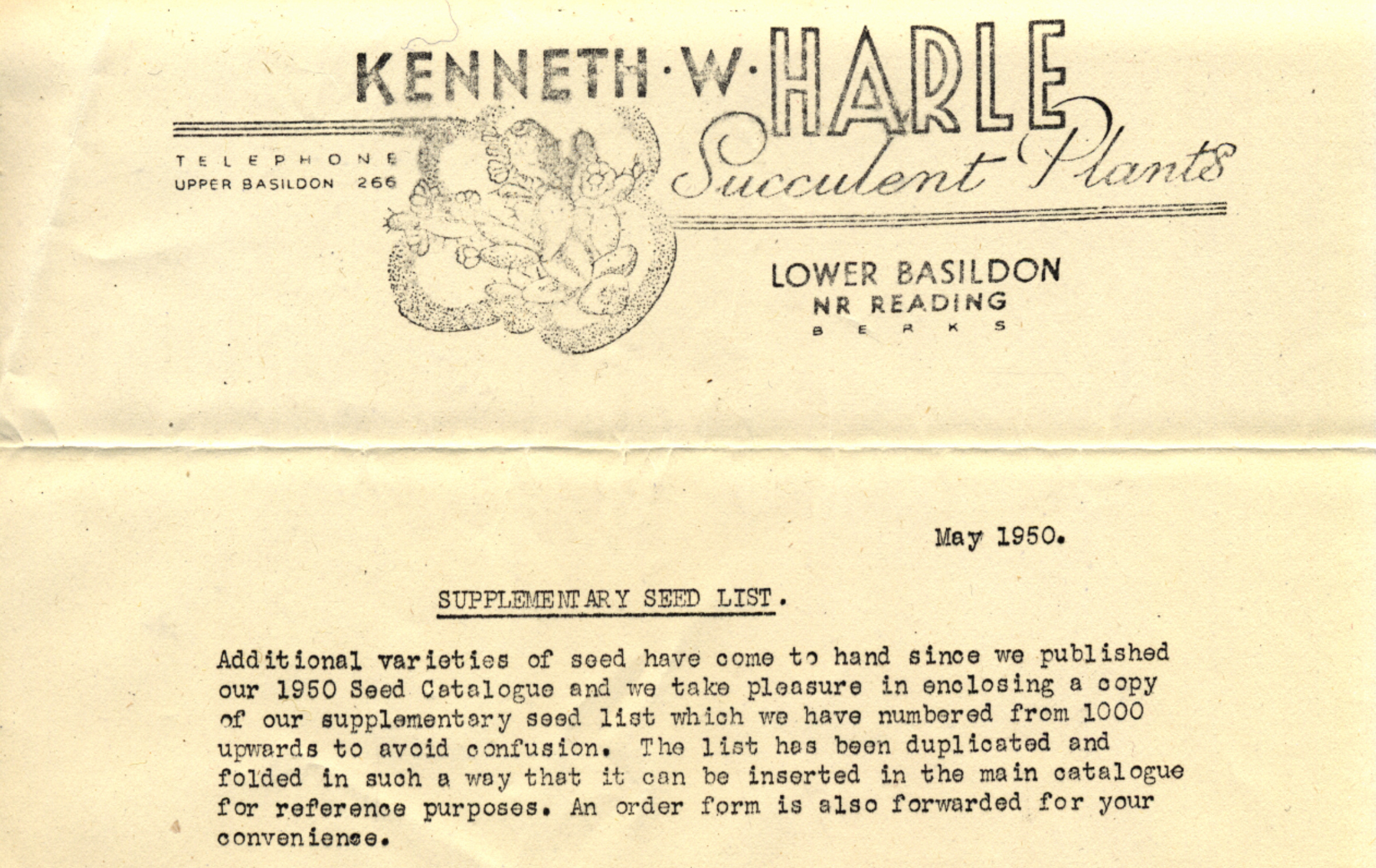
Dad was working for the family business, John Jefferies & Son Ltd. The photo shows part of the front page of a seed catalogue from a company they may have used from time to time.
I’ll describe something I used to do at this age, in our new house at Queen Anne’s Road. This is not something I remember, as I was still not yet two-years-old in May 1950. But Mum and Dad told me about this much later in my life.
Our new home had a door on the right, just as you stepped through the front door from the garden. Straight ahead was a short corridor, and a second door leading to the kitchen. And on the left, stairs led up to the bathroom and three bedrooms, one of them very tiny. On the ground floor, taking that door on the right brought you into the sitting room (nobody had lounges in those days). Turning left, another door led to the dining-room, and turning left again brought you to the kitchen with the back door. Finally, turning left yet again brought you back into the hall, facing the front door at the far end.
It seems this arrangement fascinated my young brain and I spent a lot of time going round and round and round. It was a novelty for me, because this was not possible at my grandparents home where we had lived previously.
World events:Tollund Man was discovered in Denmark; and Britain formally recognised Israel.
On 1st May Dad wrote in his diary ‘Hitler dies!!!‘. Clearly a red-letter day for the Allies. On 2nd he reported that the Germans surrendered in Italy and that Berlin fell. On 4th he heard that German forces in Holland and Denmark had also surrendered.
On 7th Germany surrendered unconditionally to the Allies and the war was over in Europe. On the same day Dad received more good news, his promotion came through to Aircraftman First Class (AC1) from Leading Aircraftman (LAC). And he also had permission to visit Ireland on leave. What an amazing day!
8th May was declared VE Day. The photo shows Field Marshall Keitel signing the document of unconditional surrender.
World events:Wernher von Braun and 120 members of his team surrendered to U.S. forces; and the Schuman Declaration was the spark that resulted later in the forming of the EU.
There’s not enough information to write something for every month in the 1940s. Dad’s diaries start in January 1943, so for January 1940 to December 1942 I’ll write about things I know, or draw on dated photos and documents. Sometimes I might use a photo or document with a guessed date.
I remember the family business in the mid 1950s and it would not have changed a great deal since 1940. There were several plant nurseries with an annual rhythm to the seasonal tasks that needed to be followed. By May all of the lifting, packing and despatch of trees and shrubs would have finished and tasks like hoeing and weeding would have come to the fore.
During wartime this pattern was, no doubt, disrupted. Although normal business would have gone on at a reduced level, I imagine much of the land would have been pressed into service to produce as much wheat, barley and oats as possible, as well as potatoes and vegetable crops, apples, pears and plums, as well as strawberries, raspberries, blackcurrants and gooseberries. All these would have been propagated for sale as plants during peacetime, but perhaps some of them would have been allowed to grow larger to provide fruit for market as well.
Dad would have been approaching his 14th birthday in May 1940, and still at school, probably at Rendcomb College, but perhaps still at Cirencester Grammar School. Mum was still eleven-years-old, living and at school in Coagh in Northern Ireland.
Anything that appears in this section will be material that I believe belongs in this decade. Items will not be in sequence within the decade, but where I can make a good guess of the date I will do so.
Birthday clue
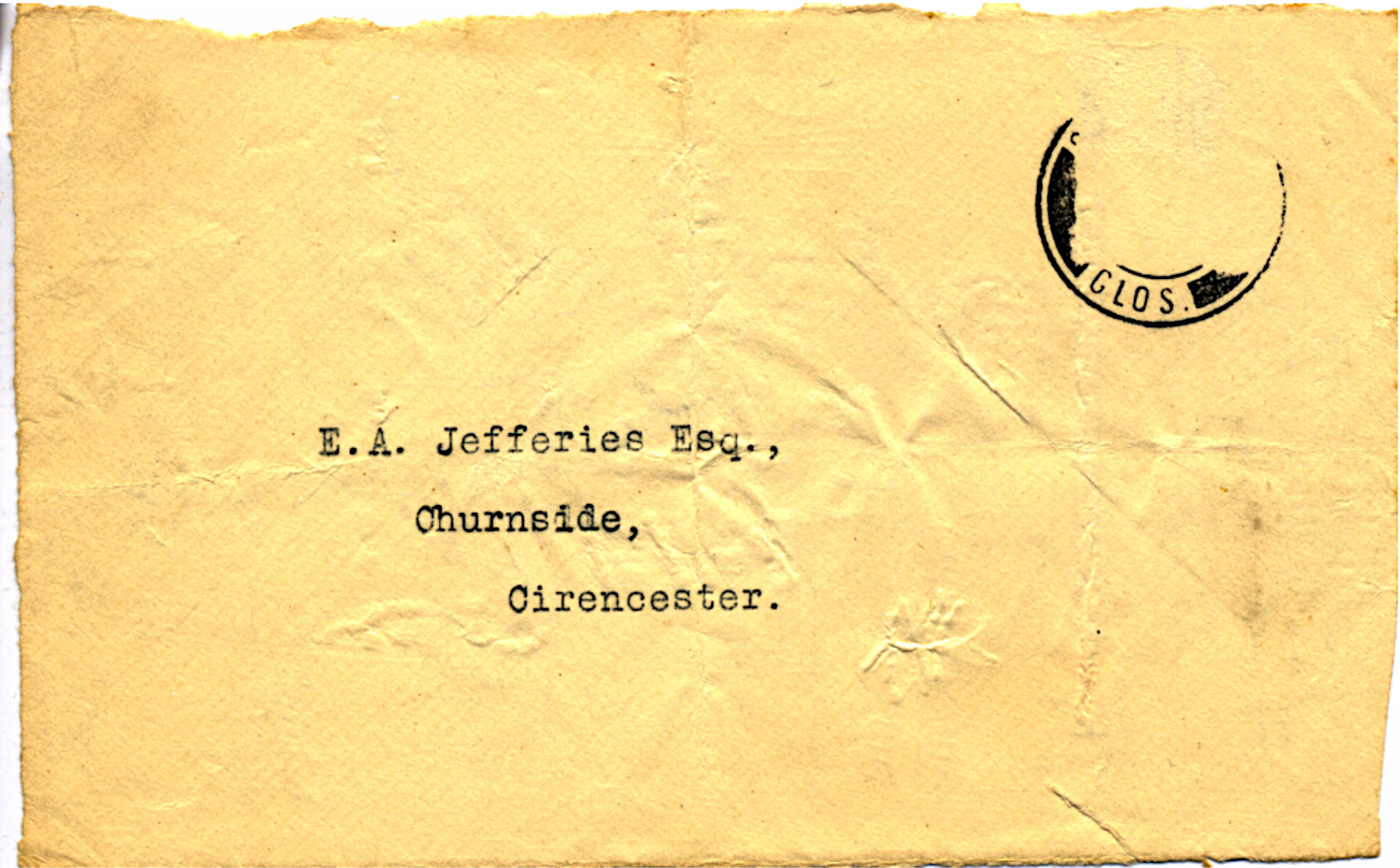
Here’s an envelope that tells a tale. E.A. Jefferies was my grandfather, Edward Arthur Jefferies. He lived at ‘Churnside’, 37 Victoria Road in Cirencester, how the postman was supposed to know where to deliver the letter is a bit of a mystery!
Clearly, though, it was delivered successfully. The fact that the stamp is missing is interesting. It seems my grandfather used to like to steam the stamps off letters, and my Mum told me that if a stamp had been missed by a badly aimed franking mark, he would glue it onto another letter to save on postage!
If you enjoyed this or found it useful, please like, comment, and share below. (If you don’t see those links, click the article’s title above the main photo and they will appear.) Send a link to friends who might enjoy the article or benefit from it – Thanks! My material is free to reuse (see conditions), but a coffee is always welcome and encourages me to write more often!
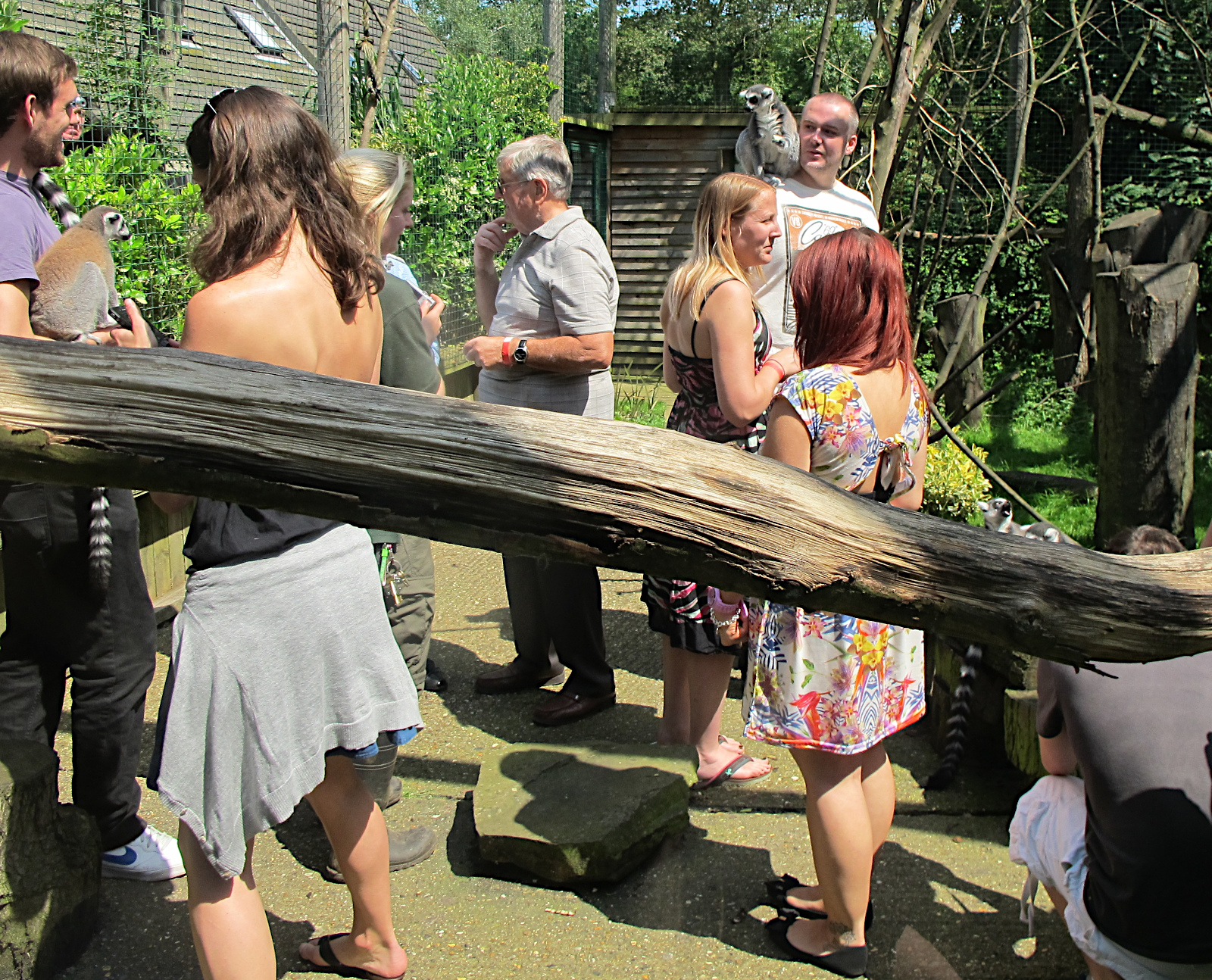
It was an opportunity for Donna to feed the lemurs and see them up close, and for me it was an opportunity to take some photos in a very unusual setting!
What’s in an image? Sometimes quite a lot, more than meets the eye. I’m posting an image every few days.
Click to enlarge
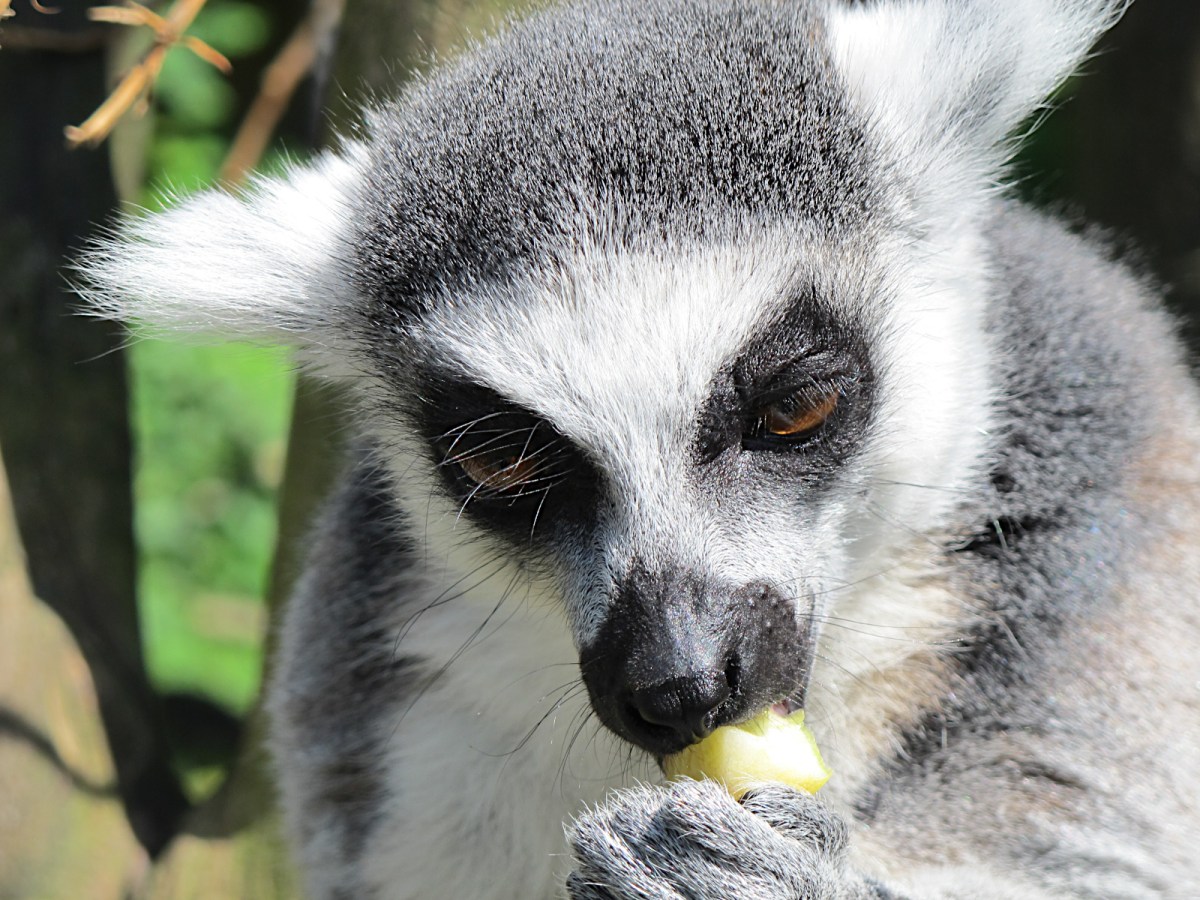
I have another animal photo for you today, this is a fairly close shot of a ring-tailed lemur taken from inside the enclosure.
Donna had booked a visit to Paradise Wildlife Park near Broxbourne (now Hertfordshire Zoo), signing up for an opportunity to enter the lemur enclosure with staff, armed only with slices of apple. The lemurs are not tame, but they are habituated to people. They are visited often by parties such as ours so they are used to people, and nobody has harmed them or frightened them and they are very fond of sliced apple so they will happily approach, even sit on your shoulder, take the proffered apple and eat it.
Visiting the lemurs
It was a wonderful opportunity for Donna to feed the lemurs and see them up close, something she’d wanted to do for some time so a dream fulfilled. And for me it was an opportunity to take some photos in a very unusual setting! I have to say, it was quite an amazing experience.
Habituation
All animals (including humans) can become habituated to many kinds of stimulae. For example, someone who is scared of spiders, if exposed to very small spiders regularly, will react less and less to their presence because the small spiders have never done them any harm. Then it may be possible to graduate to slightly larger kinds of spider.
If you live near an airport you will probably be habituated to the sound and appearance of low-flying, large aircraft. Your visitors may be alarmed, but for you it’s an everyday experience and you hardly notice it.
And of course it’s easy to become habituated to situations and behaviours that might be harmful, for example driving too fast. If you’re habituated to something inherently unsafe, you probably need to think it through logically and carefully.
If you enjoyed this or found it useful, please like, comment, and share below. (If you don’t see those links, click the article’s title above the main photo and they will appear.) Send a link to friends who might enjoy the article or benefit from it – Thanks! My material is free to reuse (see conditions), but a coffee is always welcome and encourages me to write more often!
Science is the study of the natural world, covering matter, energy and the multitude of interactions they can be involved in. Technology draws from scientific results to create useful tools and processes.
So, for example, astronomy is scientific, but space flight is technological; geology is scientific but creating a building with stone is technological.
It may become possible to train a robot by simply showing it a task and correcting it when it makes mistakes. This would be far quicker than having to program the actions in the traditional way.
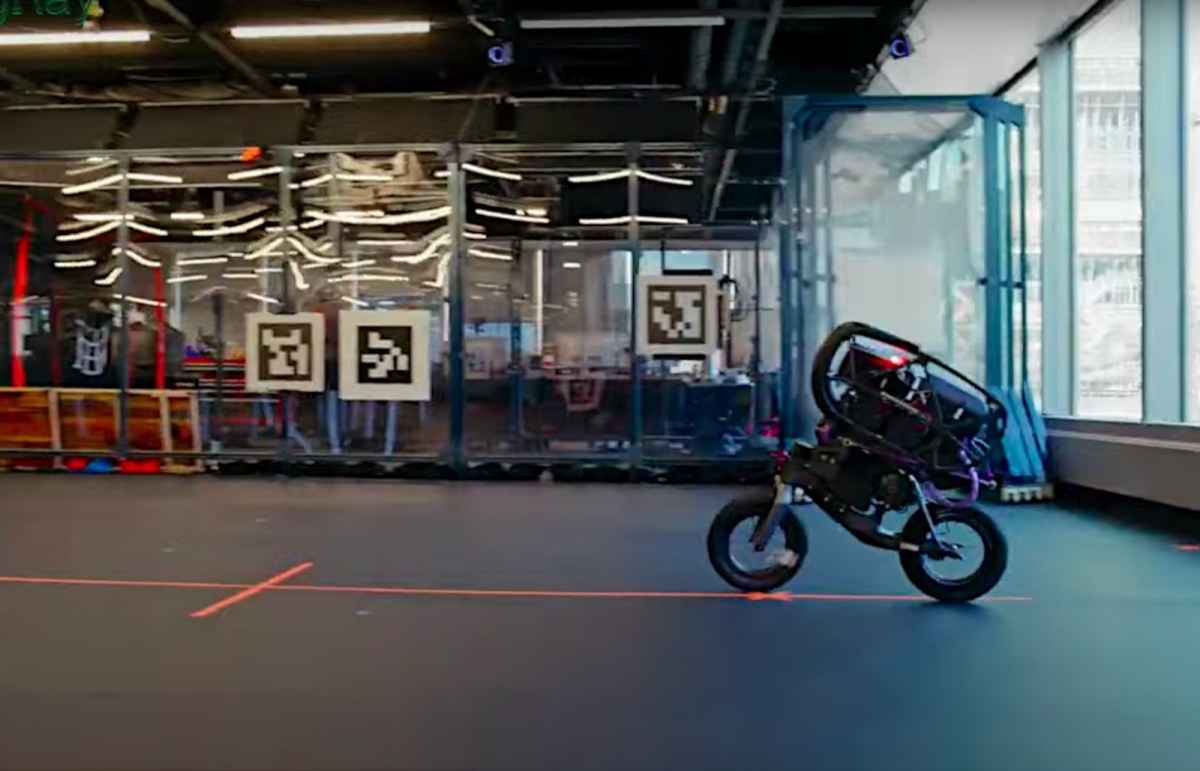
Here’s a robot doing the kinds of things well-programmed robots can do. You might think nothing of it, we’ve all seen videos of robots dancing, jumping and performing difficult tasks and manipulations. But this bike-balancer is a bit different. It has an AI system with a feedback mechanism that learns how to balance better and better with practice. This is how all animals with nervous systems learn new behaviours and improve their performance at practical tasks and skills. It’s still nowhere near Artificial General Intelligence (AGI) but it might be a small step along the way.
With this achievement under their belts, the developers will undoubtedly try the same method to develop robots that can handle tasks like juggling, sorting items, removing incorrect objects from a moving belt, or bolting two items together using a spanner. It may become possible to train a robot by simply showing it a task and correcting it when it makes mistakes. This would be far quicker than having to program the actions in the traditional way. It would probably be impossible to know how the robot makes decisions on the best movements to get a particular job done, but that’s true with training people to do jobs too. Very often, the how is not important providing the result is reliable and effective.
If you enjoyed this or found it useful, please like, comment, and share below. (If you don’t see those links, click the article’s title above the main photo and they will appear.) Send a link to friends who might enjoy the article or benefit from it – Thanks! My material is free to reuse (see conditions), but a coffee is always welcome and encourages me to write more often!
What’s in an image? Sometimes quite a lot, more than meets the eye. I’m posting an image every few days.
Click to enlarge
Here’s something you may never have seen, unless you’re a farmer or a vet – a calf suckling from its mother. When we lived in St Neots, there was a footpath running past our back gate in Eaton Ford and running very straight to the churchyard of St Mary’s in Eaton Socon. The path led past a large field, Bedfordia Meadows, and sometimes cows were kept in this field.
On one particular day in 2012 I was using the footpath and this cow and her calf were close up against the fence. I was able to take the photo without even stepping off the path. I’ve been working my way through my photos from July 2012 recently, looking for images for articles like this one. And it seemed to me that many of you might like to see this moment from a summer’s day 13 years ago.
For the cow and the calf this is a matter of life and death. Without the mother’s milk a new-born calf would not survive long. Milk contains the water and all the nutrients needed for the calf to grow and become capable of drinking water and eating grass for itself. In the wild, like all mammals, the cow would stop producing milk once the calf stopped needing it. But domesticated cattle have been bred to produce milk for much longer and a cow would quickly be in pain and in danger of serious infection if not regularly milked twice a day.
Mammals provide milk, birds lay eggs
Both dinosaurs and mammals developed from early reptiles. At the time of the Cretaceous extinctions caused by the impact of the famous asteroid, when all the large dinosaurs died out, there had long been early mammals and some of the smaller kinds survived. One branch of the dinosaurs survived as well and we are all familiar with them, they are called birds! A number of small reptiles and amphibia survived too so today we have toads and frogs as well as crocodiles, alligators, lizards and the snakes. But most air-breathing vertebrates in the world today are either mammals providing milk to their young, or the egg-laying birds.
If you enjoyed this or found it useful, please like, comment, and share below. (If you don’t see those links, click the article’s title above the main photo and they will appear.) Send a link to friends who might enjoy the article or benefit from it – Thanks! My material is free to reuse (see conditions), but a coffee is always welcome and encourages me to write more often!
We can be sure there’s trouble ahead and we can imagine some of the long term issues. The authors of this article are putting out a broad warning and setting out the probable longer term dangers.
Recommended – 2
In this series I recommend articles or other work I’ve seen that I really like and want to share with my readers.
Click to enlarge
A quick summary follows, but I encourage you to read the original with its much deeper analysis.
It’s very difficult to analyse the long-term effects of actions that began only three months ago, and may continue for some time; we can only guess how long this process will last and what new forms it might take in future months or years. It’s as if the captain of a large vessel had ordered a hard turn to starboard and the crew was scrambling to put the order into effect. With the ship’s rudder now clearly turning and signs of a change in course, what can possibly be concluded?
The ship will start to lean a little, some loose objects will slide around, these immediate effects are predictable. But what about the longer term? Will there be a catastrophic collision with another ship? Will we run aground? It’s clear there are dangers but it’s too soon to make detailed predictions.
That’s the situation US science finds itself in today. We can be sure there’s trouble ahead and we can imagine some of the long term issues. The authors of this article are putting out a broad warning and setting out the probable longer term dangers.
Damage caused by the Trump administration, science-policy experts warn, could set the United States back for decades. “So many of the damaging impacts are going to be extremely difficult to reverse and are going to take a very long time to recover from,” says John Holdren, a science adviser to former US president Barack Obama.
The authors begin by summarising what’s been done in the first three months and pointing out that it’s just a start; cuts of up to half seem likely. Reader surveys by Nature show well over 90% are troubled by the cuts.
About half the US science budget goes on defence-related programs and more than a quarter on health. The cuts are being presented as necessary to combat waste, corruption and propaganda, but no evidence has been offered to back up these claims. An assumption is being made that private sector research will shoulder the burden, though that is most unlikely for fundamental studies.
Another aspect of budget cuts is the resulting loss of skilled and knowledgeable staff, an immediate loss that will take a long time to rebuild. Indeed, the damage done in a few months will take decades to recover. It seems likely that Congress will be unable (or unwilling) to resist the probable budget cuts for 2026 and the situation is not likely to be alleviated by the various political demands being made of universities by the Trump administration. The USA seems already to be suffering loss of reputation and is less appealing for foreign scientists, not only are fewer international staff and students planning to work in the USA, but American scientists are starting to look abroad for work.
There are worries that other nations will advance beyond what the US can do in years ahead, and putting broken US science together again will be very difficult and expensive to achieve.
The article also contains helpful links for additional reading on the topics discussed.
If you enjoyed this or found it useful, please like, comment, and share below. (If you don’t see those links, click the article’s title above the main photo and they will appear.) Send a link to friends who might enjoy the article or benefit from it – Thanks! My material is free to reuse (see conditions), but a coffee is always welcome and encourages me to write more often!



















 Journeys of Heart and Mind


