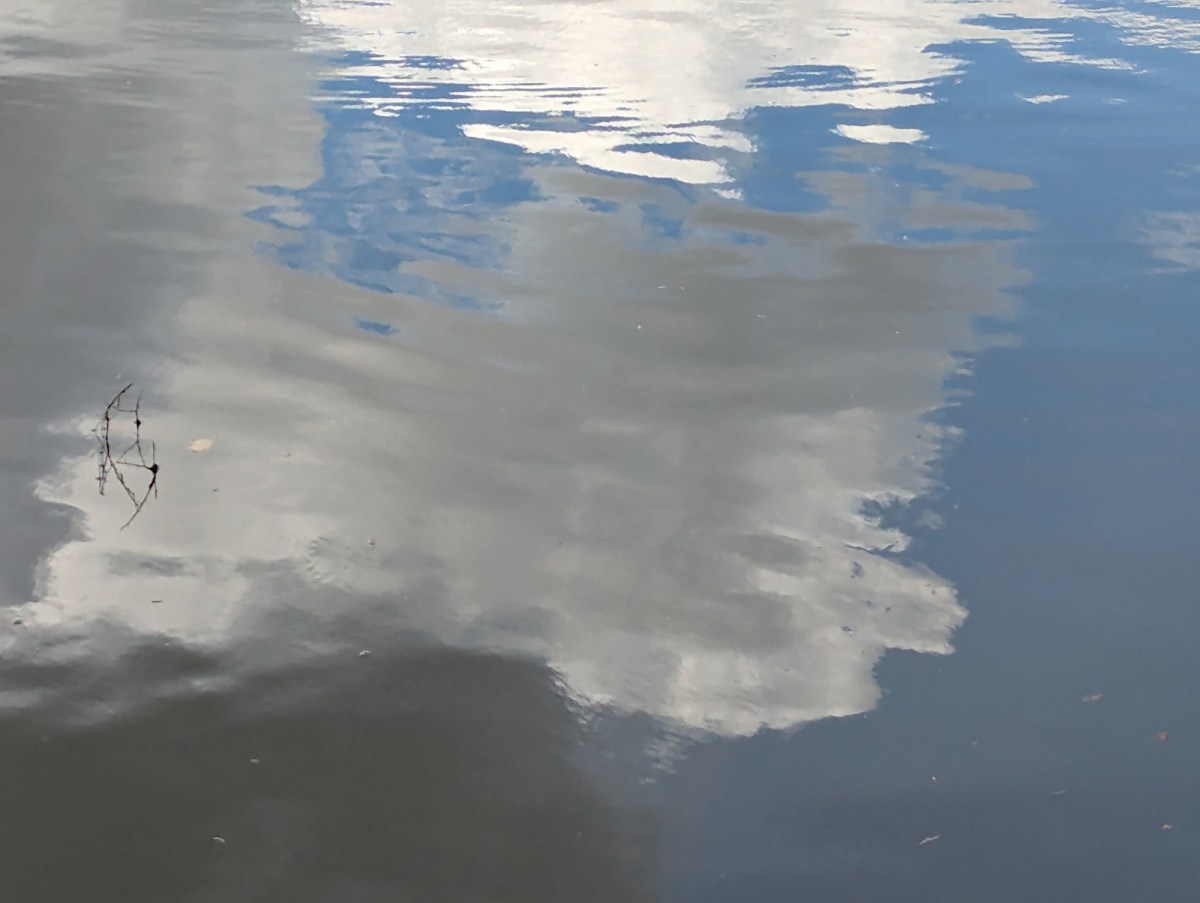
Cloud reflection

Just from this image the brain understands there are ripples on the surface of the water and from past experience will also know that these ripples will be moving.

< Previous | Index | Next >

Image of the day – 176

What’s in an image? Sometimes quite a lot, more than meets the eye. I’m posting an image every few days.

Click to enlarge

Sometimes we see things indirectly, and our brains are capable of retrieving far more information than you might at first think. It’s true of all our senses – hearing, touch, taste, smell and all the rest. The senses provide information but the brain makes much more of it all.

What do we see in this image? It’s just a pattern of coloured patches reflected from a water surface. That’s what the eye sees. But the brain tells us there are clouds in the sky above and there are ripples on the water. Then the brain compares this basic information with what it recalls from past experience and it can construct two narratives, one for the clouds and another for the water.

The clouds

There is a dark cloud and it’s the closest one to us, it threatens a shower of rain. A second image taken a few seconds later would be enough for the brain to decide the direction of movement of the cloud and predict whether the rain might fall here or somewhere else. Paler clouds, white clouds and blue sky suggest there’s some sunshine around as well so although there might be a brief shower, it won’t turn into ongoing steady rain. All of that from from a few colour patches.

The water

Because of the way the cloud reflections are distorted, the brain can infer the water is neither heavily disturbed not completely calm. Just from this image the brain understands there are ripples on the surface of the water and from past experience will also know that these ripples will be moving. The same brain will realise that there are two likely causes; either there is a light breeze blowing or perhaps a boat has passed recently. Once again, past knowledge in memory is necessary to arrive at these conclusions. There are some large ripples and, near the top of the image, some much smaller ones too. There was a small disturbance in the water further away as these small ripples seem to form an expanding circle of which we see only a small part.

Here and there things are floating on the water, small leaves, perhaps? If so, there must be trees nearby, perhaps with branches overhead. What a lot the brain can reconstruct on the basis of prior knowledge! And all of these conclusions come from some patches of colour in a still image. And what about the little sticks emerging from the water on the left-hand side? It’s the remains of vegetation of some kind. Was there a plant growing in the water? Did a strong wind break twigs off an overhead tree branch?

And one last point – it was not raining at the moment the photo was taken. The water would have been covered with dozens of circular disturbances if rain was falling. That’s a lot of information that your eyes and brain can glean from a single fragment of time trapped by my camera!

We are, as the Bible expresses it, fearfully and wonderfully made (Psalm 139:14).

See also:

< Previous | Index | Next >

Useful? Interesting?

If you enjoyed this or found it useful, please like, comment, and share below. Send a link to friends who might enjoy the article or benefit from it – Thanks! My material is free to reuse (see conditions), but a coffee is always welcome and encourages me to write more often!

You might also like:

Comet G3 (Atlas)

[This] image featured in NASA’s Astronomy Picture of the Day for 25th January 2025. Visit the website and have a browse around, there are so many fine images here!

< Previous | Index | Next >

Image 131 – What’s in an image? Sometimes quite a lot, more than meets the eye. I’m posting an image every day or so.

Enlarge
(NASA)

This might be the most striking photo you’ll ever see of a comet. OK, I dare say there will be better images out there, but this one is still pretty amazing.

The image featured in NASA’s Astronomy Picture of the Day for 25th January 2025. Visit the website and have a browse around, there are so many fine images here!

If you look closely (click the thumbnail and expand it as far as it will go) you’ll see plenty of stars in the image, too. Of course, they are way, way in the background far beyond the Solar System whereas the comet is right here inside the system along with the Sun, Planets, Moon, me and you.

See also:

< Previous | Index | Next >

Useful? Interesting?

If you enjoyed this or found it useful, please like, comment, and share below. Send a link to friends who might enjoy the article or benefit from it – Thanks! My material is free to reuse (see conditions), but a coffee is always welcome and encourages me to write more often!

Lichens

Lichens are the main food source for a variety of animal species from small mites and insects to the remarkably large reindeer. They tend to be protein-poor but may be rich in carbohydrates.

< Previous | Index | Next >

Image 130 – What’s in an image? Sometimes quite a lot, more than meets the eye. I’m posting an image every day or so.

Enlarge

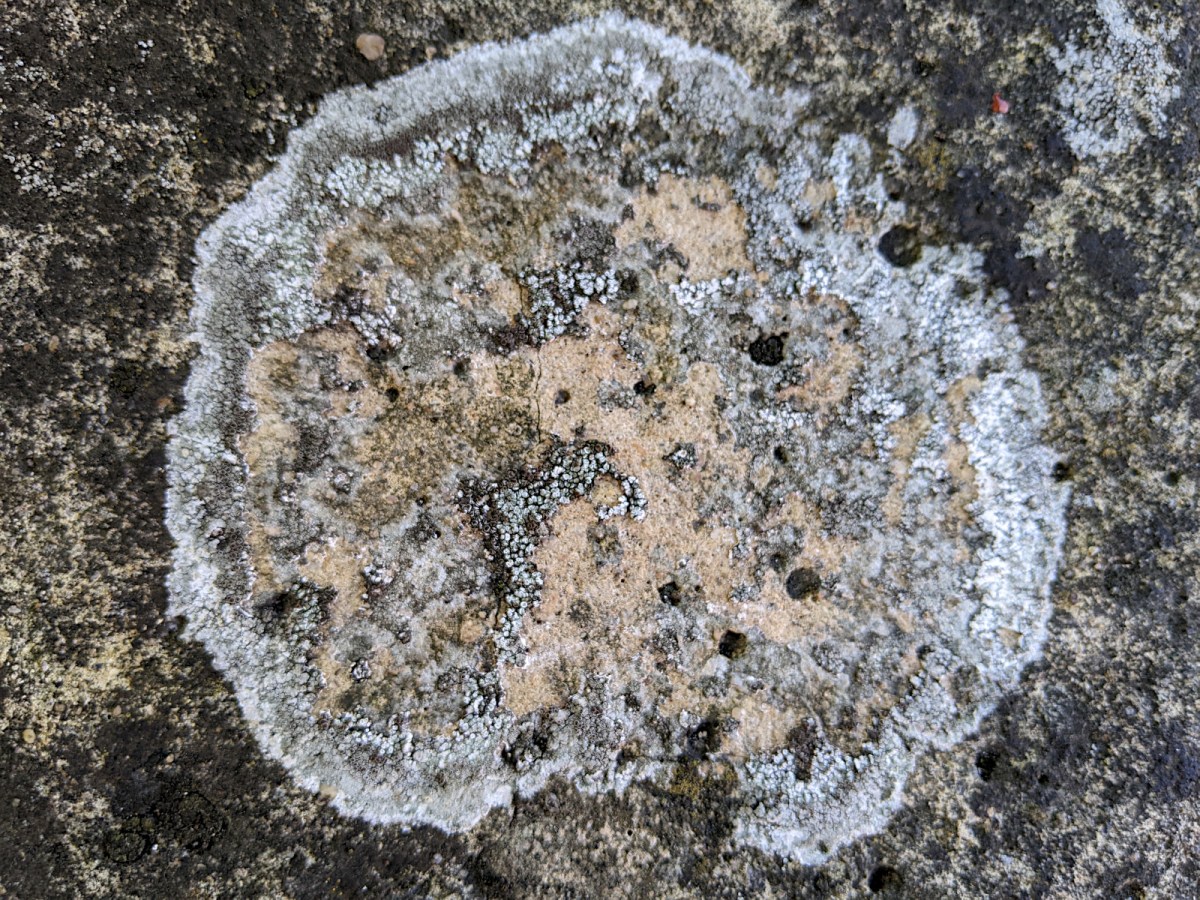
Lichens are amazing. They’re always small, they grow in slowly expanding colonies, and they consist of cooperating fungi and algae. A number of different species of fungi can grow like this, combined with various yeasts and bacteria. The assemblage often looks like a simple plant, often almost flat, but sometimes filamentous, branching or in the form of flakes. Circular forms like the one in the image are common. The Wikipedia article listed below has photos of a range of different forms.

The grey colony in the photo has grown out from the centre ‘cleaning’ other life forms from the surface of the underlying limestone and spreading out further around the perimeter. The black lichen was destroyed as the grey lichen crossed over it, but new colonies of the black lichen have established on the clean rock left behind. The situation is dynamic, but very slow. Return for another photo a month later and little will have changed.

Lichens are the main food source for a variety of animal species from small mites and insects to the remarkably large reindeer. They tend to be protein-poor but may be rich in carbohydrates.

See also:

< Previous | Index | Next >

Useful? Interesting?

If you enjoyed this or found it useful, please like, comment, and share below. Send a link to friends who might enjoy the article or benefit from it – Thanks! My material is free to reuse (see conditions), but a coffee is always welcome and encourages me to write more often!

Really?

Professor J P Hudson offered a prize to anyone who could submit a paper for publication without … a spelling mistake, or a punctuation error, or an unclear phrase. And I don’t think he ever had to pay out the prize.

< Previous | Index | Next >

Image 129 – What’s in an image? Sometimes quite a lot, more than meets the eye. I’m posting an image every day or so.

Enlarge

I was amused when I saw this in a local shop window a couple of years ago. Sometimes we’re not quite as good with words as we should be, and right at the start I admit that I’m just as bad as anyone else. But this one did give me a chuckle. It just begs the question,

‘So.. er… What would unconscious eating be, exactly?’

Just my silly sense of fun!

I think what happens, ever so easily, is that I word something in a way that’s not clear and then cannot, myself, spot the issue. It needs a fresh eye, a fresh mind to spot mistakes like this.

When I worked at Long Ashton Research Station in the 1970s, the Director, Professor J P Hudson, offered a prize to anyone who could submit a paper for publication without him spotting a spelling mistake, or a punctuation error, or an unclear phrase. And I don’t think he ever had to pay out the prize (£5 I think, quite a lot in those days).

Sometimes we need to see what we have written from a new perspective in order to fix or avoid simple mistakes. And sometimes we need the same fresh look at our habits, likes and dislikes, relationships with others, understanding of science, what we believe about the world, the people we meet, and not least, what we believe to be true about spiritual things.

It’s far too easy to go along familiar pathways in our lives without seeing the need to question what we think and say and do.

When: 25th September 2023
Where: Cirencester

See also:

< Previous | Index | Next >

Useful? Interesting?

If you enjoyed this or found it useful, please like, comment, and share below. Send a link to friends who might enjoy the article or benefit from it – Thanks! My material is free to reuse (see conditions), but a coffee is always welcome and encourages me to write more often!
A quarter of a million miles

The horizon is, perhaps, 2 km away, you can see buildings and trees out there, they give a good clue to scale. Some of the clouds might be a bit further away.

< Previous | Index | Next >

Image 128 – What’s in an image? Sometimes quite a lot, more than meets the eye. I’m posting an image every day or so.

Enlarge

This is a view of the local neighbourhood, you can only see a short distance – little more than 380 000 km or about 250 000 miles.

Uh?!

Can you see why I wrote about seeing 380 000 km? Is there something you missed in the photo? Look more closely…

The horizon is, perhaps, 2 km away, you can see buildings and trees out there, they give a good clue to scale. Some of the clouds might be a bit further away. But that little white dot near the centre of the photo is the Moon, the furthest thing you can see in this picture.

The scale of our universe is nothing short of astonishing! The Moon is just our nearest neighbour in terms of the Solar System. All of the other planets are much, much further away than our friendly little Moon. Then consider that the entire Solar System is just a little speck in terms of our galaxy, The Milky Way. And if you travelled the Milky Way from end to end you’d still have seen only a very, very, very insignificant fraction of everything else that’s out there. My goodness this is a big place!

If you want to get a feel for this, try Scale of the Universe. It starts with things of everyday size and you can slide left (smaller) or right (larger).

When: 10th September 2025
Where: Cirencester

See also:

< Previous | Index | Next >

Useful? Interesting?

If you enjoyed this or found it useful, please like, comment, and share below. Send a link to friends who might enjoy the article or benefit from it – Thanks! My material is free to reuse (see conditions), but a coffee is always welcome and encourages me to write more often!

Cirencester Gasworks

With the coming of the railways coal could be delivered more cheaply by steam train, delivered to the gas work’s private siding from the nearby Watermoon Station.

< Previous | Index | Next >

Image 127 – What’s in an image? Sometimes quite a lot, more than meets the eye. I’m posting an image every day or so.

Enlarge

Cirencester Gasworks had its heyday before homes, offices and industries had electricity supplies. The gas was manufactured near this building on a site alongside the canal. Coal was brought in by barge and heated to create what was called ‘coal gas’ or ‘town gas’, coke, a sticky, bituminous liquid called ‘coal tar’, and ammonia. The coke was sold as fuel for industry and for domestic boilers. The gas was stored under pressure in huge, squat gas-holders floating on, and sealed by water; the stored, pressurised gas was fed to homes and businesses through underground pipes. Coal tar was good for surfacing roads, preserving timber, waterproofing buildings and boat hulls, and many other purposes. Ammonia was used as a cleaning agent.

The building in the photo, now a private residence, housed the gas company’s offices, I believe. Its curved end mimicked the shape of the gas holders nearby. This was an industrial part of the town. With the coming of the railways coal could be delivered more cheaply by steam train, delivered to the gas work’s private siding from the nearby Watermoon Station. The canal became less and less profitable as more and more transport migrated to rail.

When: 26th September 2023
Where: Watermoor, Cirencester

See also:
Cirencester

For convenience, here’s a list of all the Cirencester area images:

A417 roadworks, Advent Market, Bishops Walk, Baunton, Canal 1, 2, Castle Street, Christmas lights 1, 2, Church 1, 2, 3, 4, 5, 6, Churn flood, Countryside, Fallen tree, Fleece, Gasworks, Gloucester Street, Hare 1, 2, Hospital, Market Place 1, Phoenix Fest, Riverside Walk, Stone plaque, Stratton Meadow, Tank traps, View, Wonky 1, 2, Yellow Iris

Themed image collections

The links below will take you to the first post in each collection

Cirencester, Favourites, Irish holiday 2024, Roman villa

< Previous | Index | Next >

Useful? Interesting?

If you enjoyed this or found it useful, please like, comment, and share below. Send a link to friends who might enjoy the article or benefit from it – Thanks! My material is free to reuse (see conditions), but a coffee is always welcome and encourages me to write more often!

Sunset sky over sheds

Everything on this planet is recycled sooner or later, if not by us, then eventually by nature. Even city buildings, bridges, roads and all of out technologies will go the same way in the end.

< Previous | Index | Next >

Image 126 – What’s in an image? Sometimes quite a lot, more than meets the eye. I’m posting an image every day or so.

Enlarge

The sun is setting over these old sheds in more than one sense, not only is the sun getting lower in the sky, but the sheds themselves are no longer useful, have been roped off as they’re unsafe, and will fall down completely in the next few years or decades.

There must have been a time when these structures were a handy place to store farm equipment, maintain and repair things, perhaps make tea or eat lunch before starting the afternoon’s jobs. At a guess it might have started as a smaller building, extended over the years as more space was required. It had glazed windows (though some of the glass has fallen out) and must have been weatherproof earlier in its existence. Perhaps it was even painted, though more likely creosoted.

The corrugated iron roof is rusty and most likely lets in the rain. Various fungi and bacteria will be attacking the timber. Assuming nobody dismantles what remains and removes it, what will happen as the years go by?

Everything will return to the earth from which it originally came. Iron will rust and crumble to powdery iron oxides of one kind or another, the corrugated roof, nails and screws holding the timbers together, door and window hinges, they’ll all go the same way. If there are any brass fittings they will last a lot longer, but eventually they’ll end up as oxides of copper and zinc. Glass will last a very long time (many thousands of years) but will be ground down to smaller and smaller sizes with any disturbance. The putty used to hold the window glass in place will also crumble away to clay as the remnants of oil it contains are digested and metabolised by bacteria. And the commonest material used to build the structure will be one of the fastest to decay; all the timber in the framework, walls, floors, doors and window frames will be digested away and crumble to dust as well.

We ourselves will end the same way whether simply buried in the ground after death or turned to ash by cremation. It’s true for all living things, we develop from one cell, become many cells working together, and die through accident or disease or else of old age. Everything on this planet is recycled sooner or later, if not by us, then eventually by nature. Even city buildings, bridges, roads and all of our technologies will go the same way in the end.

We don’t look forward to our inevitable dissolution of course; but the awareness of it, whether we are young or old, should encourage us to do what we can in life to help others, care for the sick, give good advice to those who seek it, and be kind and generous in everything we do.

When: 27th September 2023
Where: Cirencester

See also:

This YouTube video discusses what would happen to our various structures in the most unlikely event that everyone suddenly vanished for no apparent reason:

< Previous | Index | Next >

Useful? Interesting?

If you enjoyed this or found it useful, please like, comment, and share below. Send a link to friends who might enjoy the article or benefit from it – Thanks! My material is free to reuse (see conditions), but a coffee is always welcome and encourages me to write more often!

Photos the old way

I have a lot of old negatives and colour transparencies, and little by little I’m scanning these on an Epson Perfection V600 Photo scanner. It gives excellent results.

< Previous | Index | Next >

Image 125 – What’s in an image? Sometimes quite a lot, more than meets the eye. I’m posting an image every day or so.

Enlarge

My digital photo collection is growing – in two ways.

On the one hand I have my Pixel 7 phone and take many photos with that, and I also have an old Canon G16 with basic telephoto zoom capabilities that provides much better results than the phone can manage in some circumstances. Unlike the phone it can’t fit in my pocket. Horses for courses.

On the other hand I’ve been copying old photos from years past. My photograpic hobby began when I was nine-years-old, I was given a Kodak Brownie and a roll of black and white (B&W) 127 format negative film (probably an Ilford film). Later I used a Kodak Starmite with flash and two aperture settings, and used it for my first colour shots as well as B&W, also on 127 format. When I was sixteen I graduated to 35 mm format using a Kodak Retinette camera with a range of apertures and shutter speeds available. And finally, of course, I moved to a single lens reflex camera.

As a result, I have a lot of old negatives and colour transparencies, and little by little I’m scanning these on an Epson Perfection V600 Photo scanner. It gives excellent results.

Today’s photo shows some of the 35 mm transparencies in a storage box. The different designs of mount (some plastic, some card) come from several different film manufacturers. Things were so different back then. You had to buy a film from a chemists or from a photographic shop, load it in the camera, and expose the photos. Usually a film would provide 8 or 12 photos (127 roll film) or 24 or 36 photos (35 mm film). It was a costly hobby because film wasn’t cheap and there were development costs to consider as well. As a result,you might make a film last for weeks or even months.

The exposed film had to be taken for development to a local chemist, or sent back to the manufacturer for 35 mm processing. And then – finally – you could check the results.

When: 9th October 2023
Where: At home

See also:

< Previous | Index | Next >

Useful? Interesting?

If you enjoyed this or found it useful, please like, comment, and share below. Send a link to friends who might enjoy the article or benefit from it – Thanks! My material is free to reuse (see conditions), but a coffee is always welcome and encourages me to write more often!

Mixed mushrooms

Cook them with a good sprinkling of freshly ground black pepper.

< Previous | Index | Next >

Image 110 – What’s in an image? Sometimes quite a lot, more than meets the eye. I’m posting an image every day or so.

Mushrooms are such a useful cooking ingredient, they add a lot of savoury flavour to any dish. Cook them with a good sprinkling of freshly ground black pepper and a little olive oil (or butter if you prefer) and tip them onto hot toast – mmm… Try this search for mushroom recipe ideas.

When: December 2023
Where: At home, Cirencester

< Previous | Index | Next >

Useful? Interesting?

If you enjoyed this or found it useful, please like, comment, and share below. Send a link to friends who might enjoy the article or benefit from it – Thanks! My material is free to reuse (see conditions), but a coffee is always welcome and encourages me to write more often!

Fog…

If you can see further than a kilometre it’s mist, less than a kilometre and it’s fog .

< Previous | Index | Next >

Image 109 – What’s in an image? Sometimes quite a lot, more than meets the eye. I’m posting an image every day or so.

Here’s a foggy day about a year ago, captured by my camera. When warm, moist air mixes with cold air – this is the result. Some of the moisture condenses into tiny droplets, distant objects are obscured, and closer object lose much of their contrast and colour. Everything looks washed out and grey.

Everything is still (even a light breeze will sweep away any hint of fog). The world seems mysterious because so much is hidden from view. Do you know the difference between fog and mist? it’s all about what is hidden from view; if you can see further than a kilometre it’s mist, less than a kilometre and it’s fog (technically). But in everyday life it’s normal for the cut-off to be much closer, around 180 metres.

Time for a Haiku, perhaps?

Winter fog and mist
Hidden heavy blanketing
Cold and damp and grey

When: 6th December 2023
Where: Cirencester Park, Gloucestershire

See also:

Mist, fog and haze– Met Office

< Previous | Index | Next >

Useful? Interesting?

If you enjoyed this or found it useful, please like, comment, and share below. Send a link to friends who might enjoy the article or benefit from it – Thanks! My material is free to reuse (see conditions), but a coffee is always welcome and encourages me to write more often!