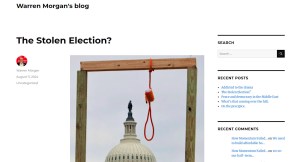
This analysis of the situation during and following these last few days of voting in the USA is something of a must read. Is the future really as bleak as Warren Morgan suggests? I think it may well be.
Mr Trump has a terrible track record, we should not expect better this time around. Have a read… Leave a comment…
I’d like to invite my readers to watch this Times Radio video of US ex-General Ben Hodges giving an opinion.
I’m not going to write very much or give any thoughts here, though I might come back in a few days to review and comment on feedback from my readers. If so, I’ll share some of my own thoughts at that time.
Instead, I’d just like to invite you to watch this Times Radio video (less than 14 minutes) of US ex-General Ben Hodges giving an opinion on what is going on with Donald Trump as we draw very close to the US Presidential Election.
So here we go; watch the video and please do leave your thoughts in a comment.
And in case you want to check on the word ‘fascism’, here’s the Wikipedia article on that topic.
Useful? Interesting?
If you enjoyed this or found it useful, please like, comment, and share below. (If you don’t see those links, click the article’s title above the main photo and they will appear.) Send a link to friends who might enjoy the article or benefit from it – Thanks! My material is free to reuse (see conditions), but a coffee is always welcome and encourages me to write more often!
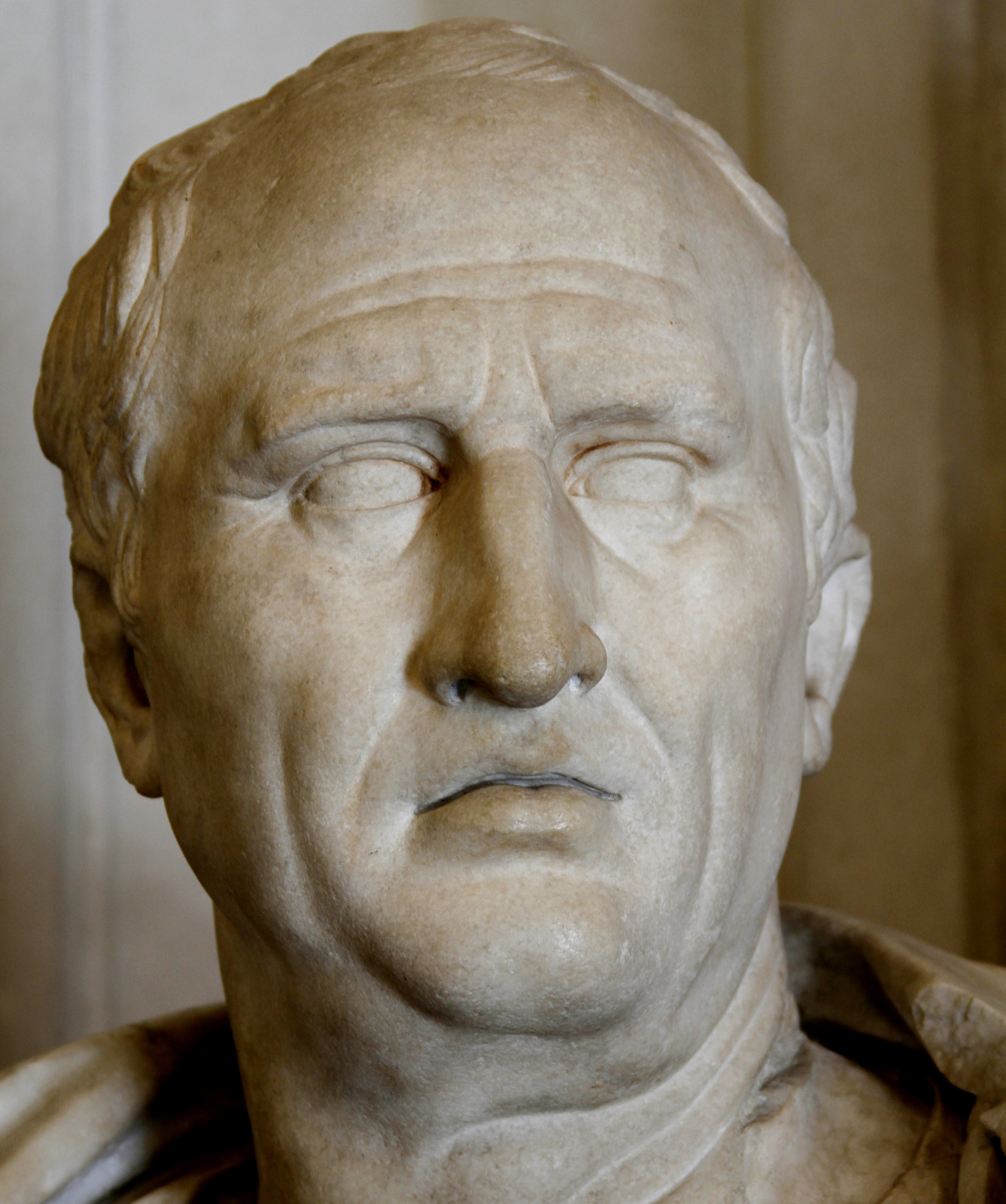
Cicero pointed all this out most eloquently. As a philosopher he thought things through carefully and deeply and then expressed his ideas clearly, giving plenty of reasons and examples.
The great Roman orator, lawyer, politician, philosopher and author, Cicero has left us a great legacy. He wrote on many topics that are as relevant today as they were when he dictated them to his trusted slave, Tiro.
Tiro was a gifted and hard working person in his own right – he invented a form of shorthand and left a good deal of written material that has survived. He was given his freedom by Cicero but chose to continue working for him. One piece of work dictated by Cicero concerns the good and bad motives people may have. He considered how becoming feared and becoming liked can both bring benefits, but the first is dangerous while the second is not.
When a person is feared, they may find a wide circle of supporters to do their bidding. Think in terms of Vladimir Putin, generally the people around him do his bidding because they do not wish to fall from a high window or drink poisonous tea. There are plenty of people who have died or nearly died because they have crossed Putin in some way – from Sergei Skripal to Yevgeny Prigozhin. Many political opponents have died while imprisoned. Examples like these cause others in Putin’s circle to be carefully obedient. Yet Putin himself is always in danger and must live under a permanent cloud, fearful that at any moment he will be toppled from power and most likely be murdered in the process.
On the other hand, live a life in which you are surrounded by friends who love you because of your kindness and thoughtfulness, and you will also have a wide circle to work with you and for you, but you will have far fewer anxieties, fears, and sleepless nights.
Cicero pointed all this out most eloquently. As a philosopher he thought things through carefully and deeply and then expressed his ideas clearly, giving plenty of reasons and examples. What Cicero must have realised (but did not express) is that most of us, most of the time, are feared by some yet liked by others. Cicero himself was no exception. He had political enemies and was murdered by the roadside as he attempted to flee from Italy.
There are three ways to learn more about Cicero, and it’s well worth doing so. Many of his arguments are as interesting and useful today as they were two thousand years ago (we would write 2000, Tiro would have written MM).
One way is to read Cicero’s writings for yourself. Much has been lost no doubt, but much has been preserved too – often thanks, in part, to Tiro. A second way is to read what historians and commentators have written about him. The third way, and perhaps the one that is most fun, is to read Robert Harris’s famous and fascinating Cicero trilogy. Yes, it’s fiction; but it’s skillfully woven around what we know of the characters portrayed.
Nobody can predict when the crash will come. But I believe General Hodges is right when he suggests that current events in Kursk are unlikely to be the only surprise.
What is going to happen next in Russia’s war against Ukraine? We don’t know, we’ll have to wait and see. But it’s possible to make some broad predictions even without knowing the facts.
General Ben Hodges, speaking about Vladimir Putin and the Russian Army’s current floundering against Ukraine, quoted Ernest Hemingway :
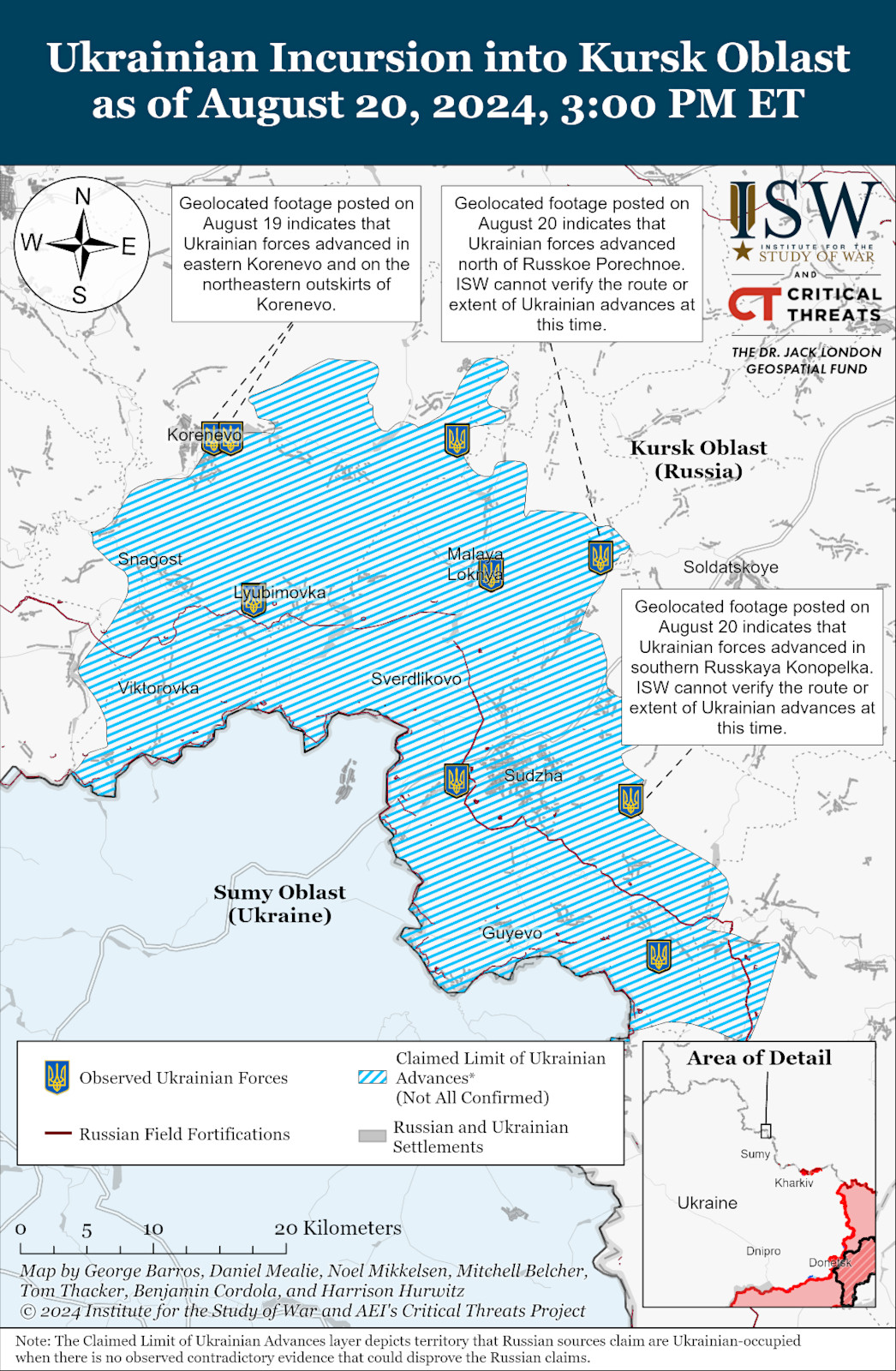
This is certainly true of Russia, they are wasting their soldiers, wasting their equipment, the economy is sliding out of control, and the population is now beginning to hear the very bad and disturbing news from Kursk Oblast (click the map for a larger version).
And it’s just as true for Putin personally. His moral bankruptcy in Russia and in the world at large is going to catch up with him. Abraham Lincoln’s famous words are relevant here: ‘You can fool all of the people some of the time, and some of the people all of the time, but you can not fool all of the people all of the time.’
The truth has a way of coming out, and it often chooses very bad moments to do so!
Nobody can predict when the crash will come. But I believe General Hodges is right when he suggests that current events in Kursk are unlikely to be the only surprise Ukraine will spring on all of us, perhaps in the near future or maybe a little while later.
We’re still in the ‘gradually’ stage. But for Russia and for Putin the ‘suddenly’ phase will surely follow.
Watch the interview with Ben Hodges
Kyiv Post interview with General Ben Hodges
The Kyiv Post interviewed Ben Hodges on 21st August 2024, answering a series of questions about Ukraine’s recent activity in Russia’s Kursk Oblast, as well as some more general questions.
Useful? Interesting?
If you enjoyed this or found it useful, please like, comment, and share below. (If you don’t see those links, click the article’s title above the main photo and they will appear.) Send a link to friends who might enjoy the article or benefit from it – Thanks! My material is free to reuse (see conditions), but a coffee is always welcome and encourages me to write more often!
If only the government had stood firm on the lines it was starting to follow! Instead of succumbing to creatures who were not seeking its reform at all, but its total obliteration.
Below is a passage from Cicero’s work ‘On Duties’. We need a bit of background before I quote him. Cicero had been a lawyer, arguing cases for prosecution or defence, and he had a good deal of success in these endeavours. After a successful legal career he went into politics, working his way into the Senate, and then eventually being elected Consul.
But now the political process in Rome has changed, and instead of the Senate and other elected offices of state ruling Rome, the democratic element such as it was has been swept aside, first by a group of three and finally by the Dictatorship of Julius Caesar. Prior to this, a Dictator would be appointed for a limited time in case of great need. But now Caesar has taken the temporary role and made it permanent. (This brief summary leaves out a great deal, for more detail read the Wikipedia articles on Cicero and Caesar.)
The democracy of Senatorial Rome has ended. The dictatorship of Imperial Rome has begun. Cicero clearly understands the danger, and warns against it. Here is what he writes:
As long as our country was still governed by men it had voluntarily elected as its rulers, I was delighted to dedicate all my efforts and thoughts to national affairs. But when the entire government lay under the domination of a single individual, no one else but he any longer had the slightest opportunity to exert statesmanlike influence in any way whatever. Besides, I had lost the friends who had worked with me in the service of the State; and great men they were. When they were gone, I refused to give way to my distress – if I had not resisted by every possible means it would have overwhelmed me. Nor, on the other hand, did I just abandon myself to a life of pleasure; to do that would have been unworthy of an educated man.
If only the government had stood firm on the lines it was starting to follow! Instead of succumbing to creatures who were not seeking its reform at all, but its total obliteration. If things had gone better I should never have been devoting my attention to writing, as I am now. No, I would have been delivering public addresses, as I used to in the days when we still had a government: and if I wrote anything it would have been those speeches – just as I always wrote down and published my speeches after I had delivered them – it would not have been these essays I am engaged in now. Every scrap of my energy, attention and care used to go to politics. So when there was no such thing as politics any more, it was inevitable that my voice should be heard in the Forum and Senate no longer.
Does this sounds a little bit familiar? It should! We can identify democracies in our own times. Germany was a democracy before Adolf Hitler and the National Socialist Party seized power. Russia was a democracy under Boris Yeltsin until the presidency was transferred to a younger Vladimir Putin.
And what about the democracies of the USA and the UK today? They are still democracies for the time being, but how long will they last?
Adolf Hitler and Vladimir Putin came to power in democracies, but then tweaked the rules to give themselves additional powers and longer terms in office. Do we see the same kinds of manoeuvring by Donald Trump and the extreme right in the USA and by right wing politicians like Boris Johnson and Nigel Farage in the UK? So far, people like these have not been able to change electoral processes, but Trump has tried and so far failed, while Johnson and others may have used distortion and misrepresentation.
Intimidation and violence were used as levers of political change in Rome, and those methods are also being employed in our own day. Look at the words and actions of the far right across the world in recent years. We should all be concerned, some of today’s best and most moderate politicians have been elbowed aside – notably in USA’s Republican Party and the UK’s Conservative Party. And the same trend seems to exist everywhere in the wider West.
Just like Cicero, we should be alarmed, and careful, and work against the slide towards authoritarianism and power in the hands of individuals. A very great deal depends on the survival and flourishing of democratic government or we risk sliding into a new dark age of untempered authoritarianism.
Useful? Interesting?
If you enjoyed this or found it useful, please like, comment, and share below. (If you don’t see those links, click the article’s title above the main photo and they will appear.) Send a link to friends who might enjoy the article or benefit from it – Thanks! My material is free to reuse (see conditions), but a coffee is always welcome and encourages me to write more often!
What’s in an image? Sometimes quite a lot, more than meets the eye.
I’m posting an image every day (or as often as I can). A photo, an image from the internet, a diagram or a map. Whatever takes my fancy.
Tank traps
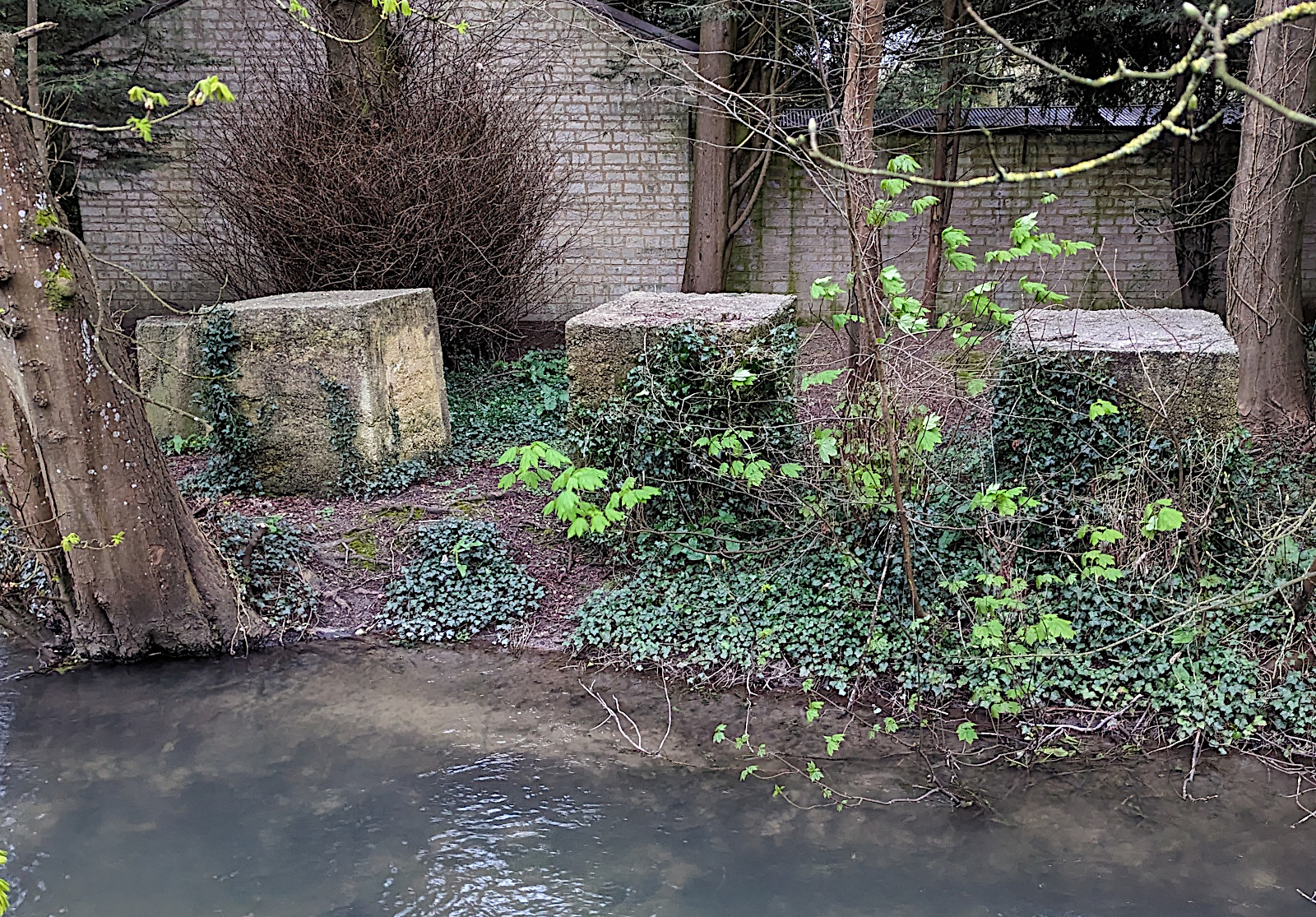
We have some history today. The river is the Churn and it runs in several different channels through the Cotswold town of Cirencester. On the bank you will notice three, large, concrete blocks; there’s also a fourth, partly hidden by the block on the left. The blocks were placed here during the Second World War to slow down German armour in the event that Britain was invaded. German failure to win the Battle of Britain in the air war prevented the invasion, but at the time the blocks were cast and put in place invasion remained a real threat.
The trees in the photo and the wall in the background are more recent than the blocks. The river bank led to an open field with the grounds and gardens of Abbey House beyond at that time, with the centre of the town on the other side of the gardens. The town would have been very vulnerable to attack from this direction.
Similar tank traps have been used along the front lines by both sides in the ongoing Russian invasion of Ukraine. The main difference is that modern, concrete traps are pyramidal (‘Dragon’s Teeth‘, not cubic. The sloping sides use less concrete and are more effective against tanks, but concrete cubes were also commonly used in the 1940s.
It pays to anticipate problems. But wars are rarely anticipated years in advance; political differences can boil over into actual conflict quite suddenly. And once they have started it can be very difficult to bring them to an end.
NOTE: These blocks can be seen from Grove Lane in Cirencester, quite close to the Norman Arch. From inside the Abbey Grounds, walk through the arch and turn right along the footpath for just a few yards. Look across the river, and there they are! A piece of Cirencester history that you can see for free.
If you enjoyed this or found it useful, please like, comment, and share below. (If you don’t see those links, click the article’s title above the main photo and they will appear.) Send a link to friends who might enjoy the article or benefit from it – Thanks! My material is free to reuse (see conditions), but a coffee is always welcome and encourages me to write more often!
What’s in an image? Sometimes quite a lot, more than meets the eye.
I’m posting an image every day (or as often as I can). A photo, an image from the internet, a diagram or a map. Whatever takes my fancy.
England and Ukraine flags flying at Uphill
Uphill is a village just south of Weston-super-Mare in North Somerset. At the top of a prominent hill is a partially ruined church and on the tower is a flagpole. Currently there are two flags flying, the red cross on a white ground of England, and the Blue and yellow of Ukraine.
There are many Ukraine flags flying in England, on flagpoles in small cottage gardens, to those on official buildings. England (and indeed the rest of the United Kingdom) supports Ukraine’s valiant battle against conquest by her belligerant and bullying neighbour, Russia. The UK has helped with military and civil aid, and has often led the way in extending the range of weapons supplied, as well as the uses to which it may be put.
We have given Ukraine arms and ammunition, and also permission to use it as they wish.
Slava Ukraini!
Themed image collections
The links below will take you to the first post in each collection
If you enjoyed this or found it useful, please like, comment, and share below. (If you don’t see those links, click the article’s title above the main photo and they will appear.) Send a link to friends who might enjoy the article or benefit from it – Thanks! My material is free to reuse (see conditions), but a coffee is always welcome and encourages me to write more often!
What’s in an image? Sometimes quite a lot, more than meets the eye.
I’m posting an image every day (or as often as I can). A photo, an image from the internet, a diagram or a map. Whatever takes my fancy.
I really do not see the signal…
Still in Weston-super-Mare, this whimsical statue stands overlooking the sea. I suspect it represents Lord Nelson during the Battle of Copenhagen. He received a flag signal ordering him to perform some action that he knew would result in failure. He put his telescope to his blind eye, and remarked, ‘I really do not see the signal’. And he won the battle! Hence the expression, ‘Turning a blind eye’.
If you enjoyed this or found it useful, please like, comment, and share below. (If you don’t see those links, click the article’s title above the main photo and they will appear.) Send a link to friends who might enjoy the article or benefit from it – Thanks! My material is free to reuse (see conditions), but a coffee is always welcome and encourages me to write more often!
I’m not going to add any comment of my own here; both videos speak for themselves, they are eloquent.
Please watch these two videos, one from Times Radio, the other from Anna who publishes a daily video about events in Ukraine as it struggles against the continuing Russian invasion and partial occupation of its land. Watch them to the end, and pass on the link to this article or to the videos themselves. Let family members, friends, and local politicians see this for themselves. Thank you.
First the news and discussion on Times Radio:
And next, an impassioned plea from Anna:
I’m not going to add any comment of my own here; both videos speak for themselves, they are eloquent. It is, I believe, well beyond time for the collective West to face down the evil regime in the Kremlin much more directly, much more effectively, and with greater and growing determination.
The actions ordered daily by Russian political and military leaders are not acceptable in any way.
Nobody asks your permission or opinion, and suddenly people and places you love are injured and damaged by bombs and missiles.
Today I want to bring you news from Ukraine. I’m going to do this by giving you a glimpse through the eyes of Yaroslava Antipina who lives in Kyiv; if you want to know about a topic, the best sources always include local people.
The image above shows one of Yara’s pages on the web, here (and elsewhere) she writes regularly to inform her readers about the war, but also about Ukraine and Ukrainians. She shows us the architecture, the places she visits, the art galleries and museums and cathedrals and much, much more. Like all Ukrainians, and like my parent’s generation in the UK, Yara knows what it’s like to be thrust unwillingly into armed conflict. Nobody asks your permission or opinion, and suddenly people and places you love are injured and damaged by bombs and missiles.
But that’s enough from me today. I’m simply going to re-post Yara’s latest Sunday message to her followers. I recommend and urge you to read more of her material, you can find her in various places.
–oOo–
Hi!
I am writing to you from sunny Kyiv. The weather is mild and gentle, and on such days, it is hard to believe that the war is walking heavily somewhere on our land.
The situation in Kyiv is not so bad compared to frontline or near frontline territories. If you come here, you will see a city that tries hard to live. And you even feel this tension, this strong desire to show everyone, especially the enemy, that we are alive and our spirit is strong.
I have just got this thought…
Do you also feel that my letters are like conversations between two people? I hope so.
Okay, in this letter, you will see photos of Ukrainian artists from the so-called Samarkand era. Samarkand is a city in Uzbekistan. From 1941 to 1944, this city became a home for many Ukrainian artists. I will briefly tell you about this era a bit later in the letter. And the photos are from the exhibition I visited this week.
Petro Sulymenko (1914-1996), Sher-Dor, 1942
Some explanation: Sher-Dor Madrasa is a 17th-century madrasa (Islamic school) in the historical centre of Samarkand.
Let’s talk about the war. I rarely tell you about the situation on the frontline. It is a topic better explained by war experts or military personnel. But this week, I heard and read a lot about it, especially Chasiv Yar, so I decided to figure out why Chasiv Yar is so important for the russians.
So, Chasiv Yar is a city in Donetsk Oblast. About 13,000 people lived here, but as of early April, about 700 remained. It is the highest point for hundreds of kilometres around. The city stands on hills that protect it from the east and south like defensive walls.
Chasiv Yar is the ‘gateway’’ to the cities of Kostiantynivka (7 km to the west) and Kramatorsk (25 km to the northwest). If the russian forces manage to capture Chasiv Yar, they will have the opportunity to launch an offensive on them and other settlements of Donetsk Oblast, which still are controlled by Ukraine. You can read a short review in Politico or a detailed explanation of the importance of Chasiv Yar in The New York Times.
I want to add a few lines about the situation in Chasiv Yar now. Of the 700 people still living in the city, 80-85% are older people who refused to evacuate. Their main argument is that this is their home, and they want to stay here till the end.
Since February 2023, Chasiv Yar has had no gas and water supply, electricity, and poor mobile phone connection. Those who have stayed here rely on generators and water from wells to keep themselves alive.
All high-rise buildings in Chasiv Yar have been damaged by shelling; 80% of the damages are critical.
–oOo–
There are four more images of beautiful paintings and more informative text, but I want to encourage you to see those on Yara’s site… Thank you!




 Journeys of Heart and Mind
_-_Palazzo_Nuovo_-_Musei_Capitolini_-_Rome_2016.jpg)