Image 94 – What’s in an image? Sometimes quite a lot, more than meets the eye. I’m posting an image every day or so.
Announcement – I’m making a few more changes, The image number is moving down so the title can be more relevant to the content, and I’m adding date and place for the image source.
Click to enlarge
The large white butterfly is the bane of vegetable gardeners. The adult females lay their eggs under the leaves of brassica crops – cabbages, cauliflowers, brussels sprouts and more. The caterpillars that hatch out feed voraciously on the plants, and as they grow larger they consume the leaves faster and faster, sometimes leaving just a stalk and nothing for the gardener to harvest.
The adult in the photo is feeding on nectar from a Buddleia inflorescence. Butterflies and bees home in on these. Although the photo’s one of my favourites, it’s technically poor as it’s enlarged from a small part of a shot taken back in September. Still – I like it and I want to share it.
When: 16th September 2024 Where: Hidcote Garden, Gloucestershire, England
If you enjoyed this or found it useful, please like, comment, and share below. (If you don’t see those links, click the article’s title above the main photo and they will appear.) Send a link to friends who might enjoy the article or benefit from it – Thanks! My material is free to reuse (see conditions), but a coffee is always welcome and encourages me to write more often!
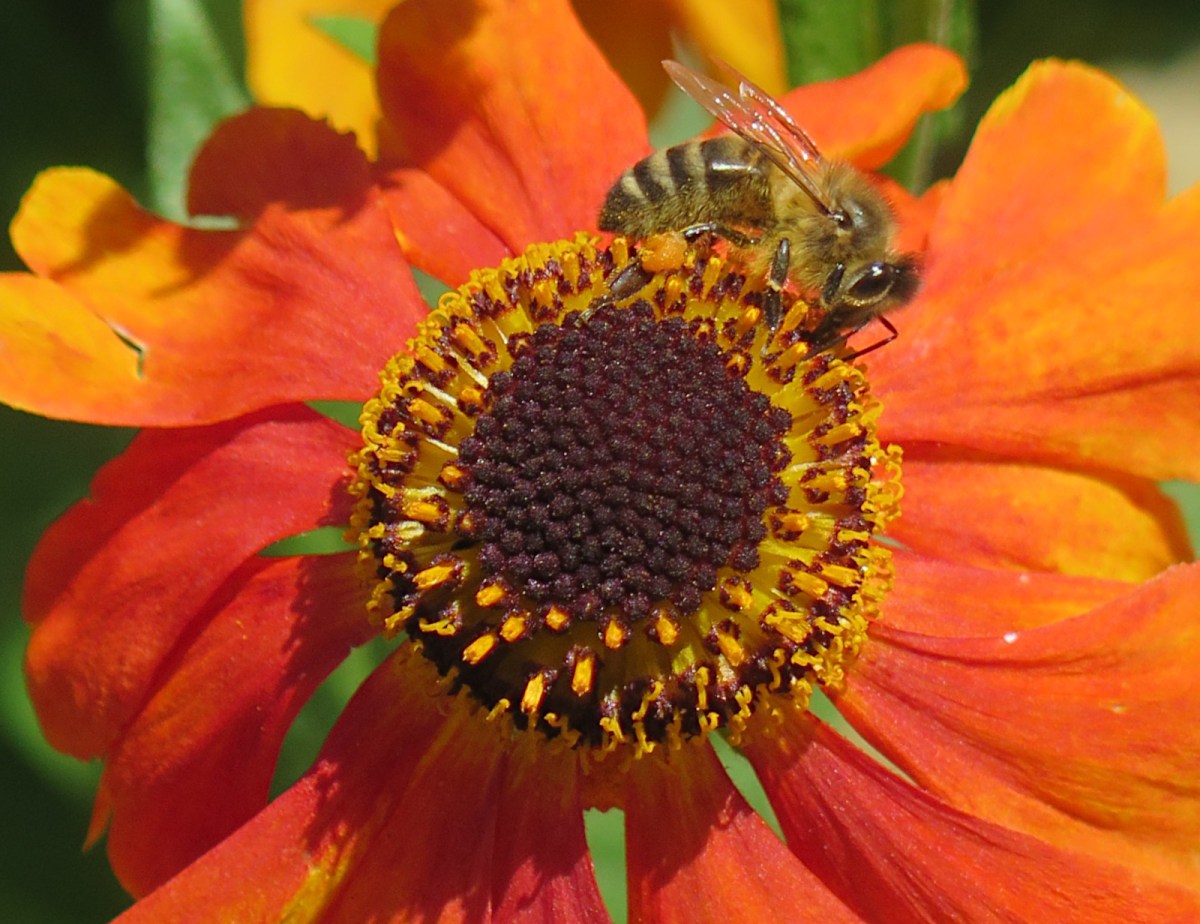
The worker honeybee in the photo is collecting pollen. Insect-pollinated plants have slightly sticky pollen that lodges on the bee’s hairy body. Bees visit flowers to collect nectar from the base of the petals, but get dusted with sticky pollen in the process.
What’s in an image? Sometimes quite a lot, more than meets the eye. I’m posting an image every two days or so.
Click to enlarge
Like all plants and animals, bees are pretty well suited to the actions they need to perform to live and reproduce. That’s what evolution does, it homes in on the best shape and size of wings, the optimum size for flight muscles, best arrangement of hairs on the legs to brush loose pollen towards the pollen sac for collection and transport, the best mouthparts for collecting nectar and so forth.
Quite a challenge, and an astounding achievement, but entirely doable by making small, random changes and selecting the best.
Here’s an example to make that bold claim clearer. If a random change enables the worker bees to carry on just a few days longer in the autumn, the hive will have slightly larger stores of honey for the coming winter. That hive will survive when a hive with less capable workers might not. And that’s enough. The new queens from the surviving hive will carry the altered gene and it’ll be present in the workers of the new colonies those queens create. The altered colonies will also survive in slightly colder places than before so will succeed at slightly higher altitudes and in slightly cooler climates.
The worker honeybee in the photo is collecting pollen. Insect-pollinated plants have slightly sticky pollen that lodges on the bee’s hairy body. Bees visit flowers to collect nectar from the base of the petals, but get dusted with sticky pollen in the process. Bees clean themselves like most insects (you’ve probably seen houseflies doing it, sweeping off particles of dust with one leg while standing on the others). When bees clean themselves, most of the pollen end up stuck together as a lump and lodges on a series of special hairs on the hind legs. Look closely and you can see this bee’s pollen load on its rear leg; an orange/yellow colour. Pollen is protein rich and the bees feed it to the bee pupae in the hive.
The plant feeds the bees nectar for energy and pollen for growing young bees; while the bees move pollen from flower to flower, and often from plant to plant over quite long distances, sometimes a mile or more. So the bees and the plants both benefit, it’s a useful co-operative effort.
Favourites
For convenience, here’s a list of my favourite images:
If you enjoyed this or found it useful, please like, comment, and share below. (If you don’t see those links, click the article’s title above the main photo and they will appear.) Send a link to friends who might enjoy the article or benefit from it – Thanks! My material is free to reuse (see conditions), but a coffee is always welcome and encourages me to write more often!
What’s in an image? Sometimes quite a lot, more than meets the eye. I’m posting an image every two days or so.
Click to enlarge
Anemones are simple flowers, but beautiful! I have strong childhood memories of the white version of these growing in my grandfather’s garden in Cirencester. They managed to grow in small cracks between the bottom of the house wall and the stone paving. The flowers stood nearly as tall as me so I suppose I might have been between five and seven years old at the time.
The flowers in the photo are at various stages of development:
On the stem just right of the centre you can see a few tiny leaves and a little, pale-green flower bud.
In the centre, near the top, is a much larger bud, about to open.
Right down at the bottom, a flower has opened but the petals are not yet full size and have not developed their final colour.
The flower on the left and just below the centre is fully open. There’s a little insect sitting on its centre.
Below and right of it is a more mature flower, the yellow anthers have shed their pollen and have shrivelled.
A little above and right again is an even older flower, the anthers are in worse condition and some of the petals are damaged around their margins.
The flower in the upper left has lost most of the anthers and the petals look tired and old.
In the upper-right you can see a flower with only two petals remaining.
And just above, the yellow globe is the remains of a flower that has lost all of its petals.
Although they look like pink petals, and I’ve called them that here, botanically speaking these are actually modified sepals. On most flowering plants, the sepals are small and green, normally hidden by the petals.
Patterns of development
The flowers on this Anemone are just one example of the kinds of patterns that come from anything that grows. We’re all familiar with the pattern in humans – fertilised egg, foetus, baby, toddler, pre-teen, young teen, adolescent, young adult, mature adult, early middle age, late middle age, elderly.
And you can trace stages of growth in cities, technology, philosophy, civilisation, language families, culture, stars, wars, galaxies, you name it. Such patterns of development are a fundamental part of the way things are in our universe. Time ticks by relentlessly, and all these patterns are patterns of change, in other words evidence of the passage of time.
If the Universe did not include time, nothing would change and there would be no patterns, no life, just stasis.
Favourites
For convenience, here’s a list of my favourite images:
If you enjoyed this or found it useful, please like, comment, and share below. (If you don’t see those links, click the article’s title above the main photo and they will appear.) Send a link to friends who might enjoy the article or benefit from it – Thanks! My material is free to reuse (see conditions), but a coffee is always welcome and encourages me to write more often!
What’s in an image? Sometimes quite a lot, more than meets the eye. I’m posting an image every two days or so.
Announcement – I need to reduce the time I’m spending writing JHM posts. To make this possible I plan to post images more often as they are quick to do, and I’ll put the time saved into fewer but hopefully better posts on other topics.
Click to enlarge
This is the view across the valley from Kiftsgate Court that I mentioned yesterday. You can see it from the swimming pool – what an amazing backdrop for a relaxing dip!
Only a minority of people have views from their back garden like this one. But we can all enjoy the photo, or visit Kiftsgate Court Gardens to admire it first hand.
If you enjoyed this or found it useful, please like, comment, and share below. (If you don’t see those links, click the article’s title above the main photo and they will appear.) Send a link to friends who might enjoy the article or benefit from it – Thanks! My material is free to reuse (see conditions), but a coffee is always welcome and encourages me to write more often!
Hidcote is an informally formal garden, if I can put it that way, while Kiftsgate is not formal at all. Both are full of surprises and delights at almost every turn.
What’s in an image? Sometimes quite a lot, more than meets the eye. I’m posting an image every two days or so.
Click to enlarge
Today’s photo was taken at Kiftsgate Court Gardens in the far north of Gloucestershire. The pool was designed for swimming, though today it’s just ornamental. Kiftsgate Court is a large house on the top of a local hill; the pool is below the house and has an amazing view across the valley to further hills beyond.
The people who lived here knew a thing or two about designing a wonderful garden. It’s right next to Hidcote, another marvellous garden and perhaps better known, but if you’re visiting one of them and have the time, try to see them both. They are both great but designed very differently, Hidcote is an informally formal garden, if I can put it that way, while Kiftsgate is not formal at all. Both are full of surprises and delights at almost every turn.
If you enjoyed this or found it useful, please like, comment, and share below. (If you don’t see those links, click the article’s title above the main photo and they will appear.) Send a link to friends who might enjoy the article or benefit from it – Thanks! My material is free to reuse (see conditions), but a coffee is always welcome and encourages me to write more often!
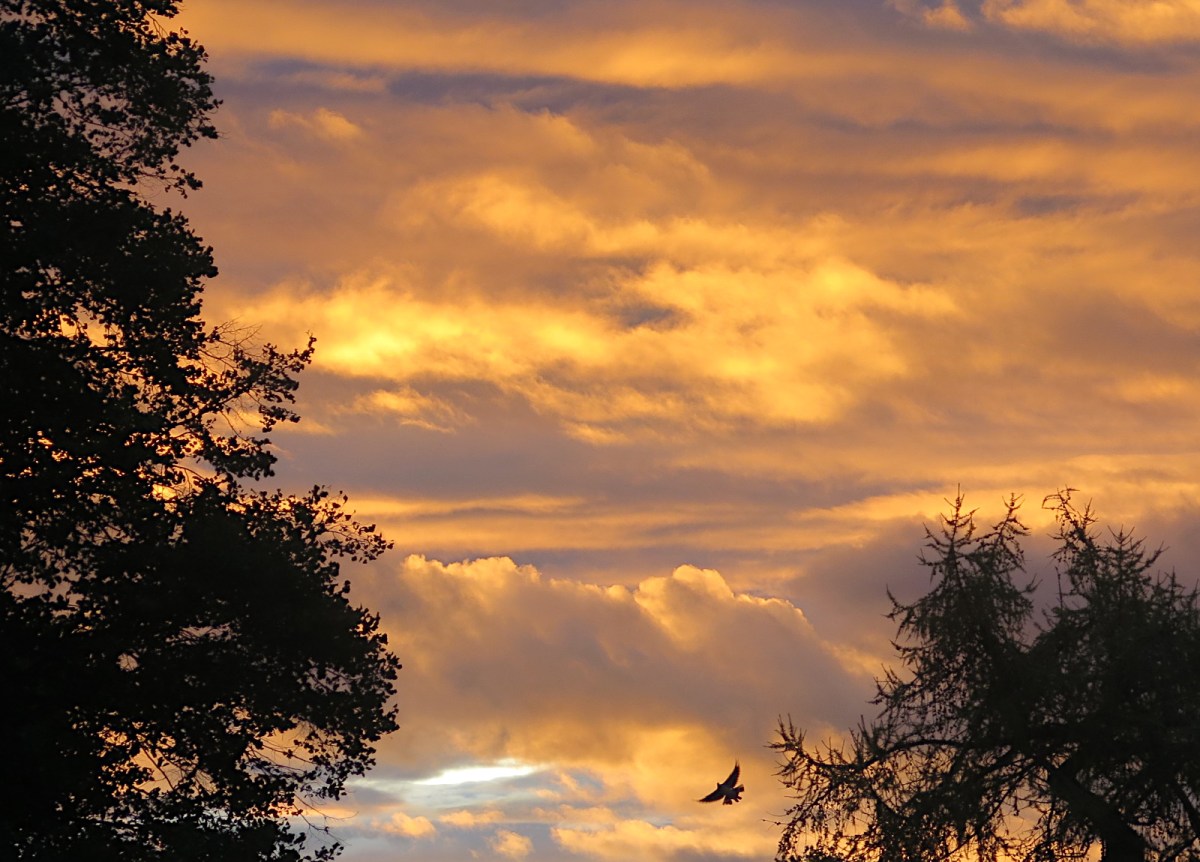
Quite by chance, as I clicked the exposure, a bird flew out of tree and the shot automagically composed itself! It looks like something from the Jurassic, a flying dinosaur with four wings.
What’s in an image? Sometimes quite a lot, more than meets the eye. I’m posting an image every two days or so.
Click to enlarge
For the next few photos, I’m going to leave the series on our Irish holiday, and the series on Cirencester, and instead just focus on images I love (pun only slightly intended).
Let’s start with this photo of a sunset seen from my study window. Quite by chance, as I clicked the exposure, a bird flew out of a tree and then shot automagically composed itself! It looks like something from the Cretaceous, a flying dinosaur with four wings, or a raptor that’s just snatched some unlucky feathered prey. Anyone have other opinions on ID?
The intended subject was the sunset, it was very spectacular and deserved to be recorded. The clouds were luminous, truly breath-taking and the photo fails to do them justice. In my experience that’s often the case with sunsets, the contrasts are too wide so details are lost both in the brightest and darkest areas; to show those details you have to compromise on the contrast – you really do need both. The Earth’s atmosphere scatters short wavelength blue light and that’s why the sky appears blue and is darker at higher altitudes (most of the air is below). While at sunset or sunrise the light takes a long, grazing path to your eyes and the blue scattering along that path leaves mostly oranges and reds.
Favourites
For convenience, here’s a list of my favourite images:
If you enjoyed this or found it useful, please like, comment, and share below. (If you don’t see those links, click the article’s title above the main photo and they will appear.) Send a link to friends who might enjoy the article or benefit from it – Thanks! My material is free to reuse (see conditions), but a coffee is always welcome and encourages me to write more often!
I walked out to the harbour and enjoyed the sounds and smells of the sea as well as a glorious sunset. Looking south from the harbour there are some great views of the town.
What’s in an image? Sometimes quite a lot, more than meets the eye.
I’m posting an image every two days (or as often as I can). A photo, an image from the internet, a diagram or a map. Whatever takes my fancy.
Click to enlarge
Returning to Portrush at the end of the day we ate a good meal in the holiday house, with a view over the harbour and the west beach.
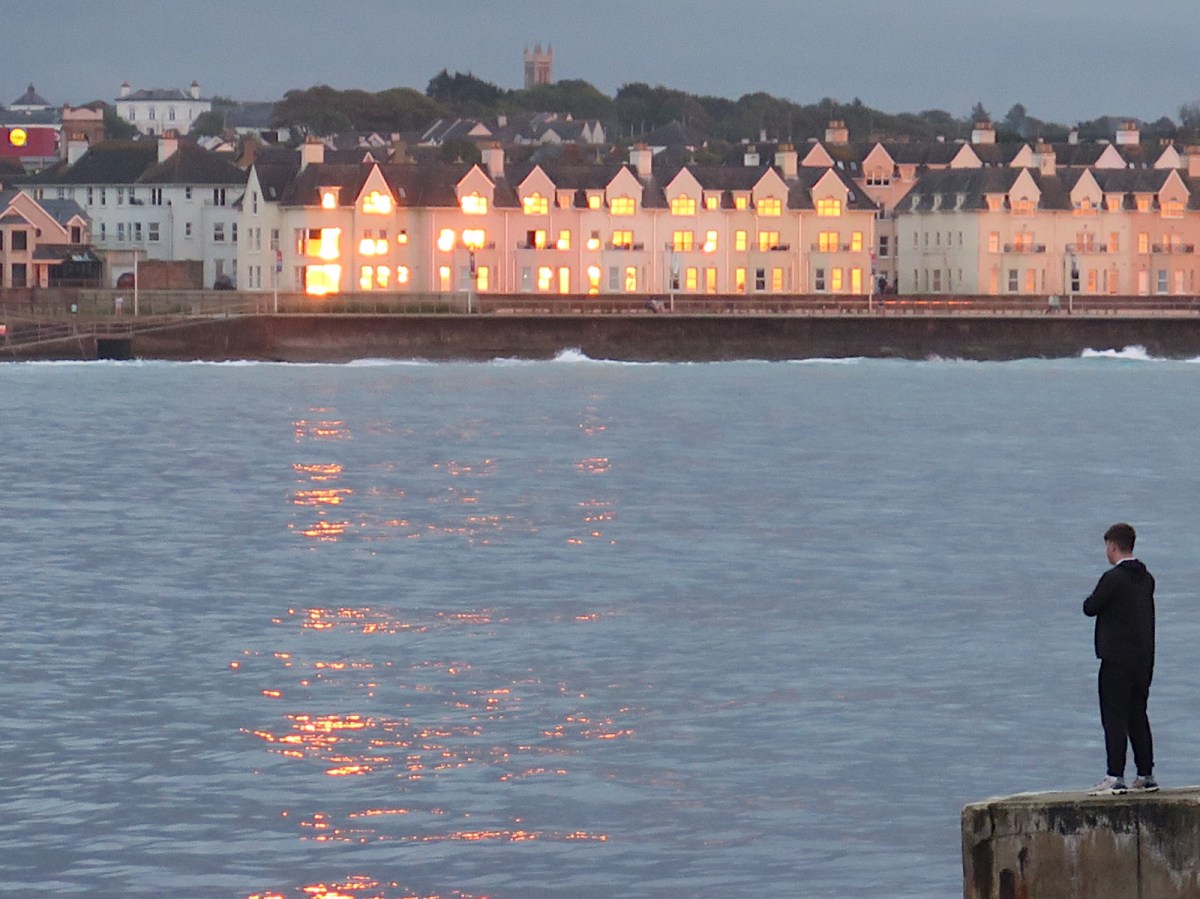
Later in the evening I walked out to the harbour and enjoyed the sounds and smells of the sea as well as a glorious sunset. Looking south from the harbour there are some great views of the town and its seafront and I managed to get this shot with the setting sun and orange clouds reflecting in the windows of properties just beyond the shore. You can even see reflections on the water of reflections from the windows! Third-hand sunlight!
And I was reminded of something else. Jesus told his followers, ‘I am the light of the world’. And sometimes it’s said that as his followers we will reflect something of his grace and light into the lives of the people we meet in our daily lives. I hope I sometimes do that, I’d certainly like to.
But we don’t often realise, perhaps, that the people who receive that second-hand light reflected by us, also reflect his character and nature yet again to others.
What a responsibility we bear! The better we reflect Jesus into the world, the better others may be enabled to reflect him too. Jesus is the light. If you follow him be the best reflector you can be – others may depend on it! Not that we can change anyone, only he can do that, but sometimes he does use us as mirrors to reflect his presence and nature into our world.
Images from our Irish holiday 2024
For convenience, here’s a list of all the Irish holiday images:
If you enjoyed this or found it useful, please like, comment, and share below. (If you don’t see those links, click the article’s title above the main photo and they will appear.) Send a link to friends who might enjoy the article or benefit from it – Thanks! My material is free to reuse (see conditions), but a coffee is always welcome and encourages me to write more often!
What’s in an image? Sometimes quite a lot, more than meets the eye.
I’m posting an image every two days (or as often as I can). A photo, an image from the internet, a diagram or a map. Whatever takes my fancy.
Click to enlarge
After a good look at the Giant’s Causeway, we drove on to Carrick-a-Rede to see the famous rope bridge. The bridge connects the mainland cliff with the nearby small island where fishermen traditionally trapped salmon making their way to the rivers Bann and Bush for spawning. That industry is now abandoned as the numbers of salmon have dwindled.
The bridge has been replaced many times over the years and is currently owned and managed by the National Trust. It’s quite an interesting walk, and very smelly in places due to the seabirds nesting on the cliff face. Definitely a ‘strong pong’!
The island itself is interesting too, there’s a small house, no doubt built and used by the fishermen, and old machinery and a place to tie up boats. And there’s a great view out to sea, of course. If you’re visiting this part of the Irish north coast, the bridge is well worth a visit.
If you enjoyed this or found it useful, please like, comment, and share below. (If you don’t see those links, click the article’s title above the main photo and they will appear.) Send a link to friends who might enjoy the article or benefit from it – Thanks! My material is free to reuse (see conditions), but a coffee is always welcome and encourages me to write more often!
What’s in an image? Sometimes quite a lot, more than meets the eye.
I’m posting an image every two days (or as often as I can). A photo, an image from the internet, a diagram or a map. Whatever takes my fancy.
Click to enlarge
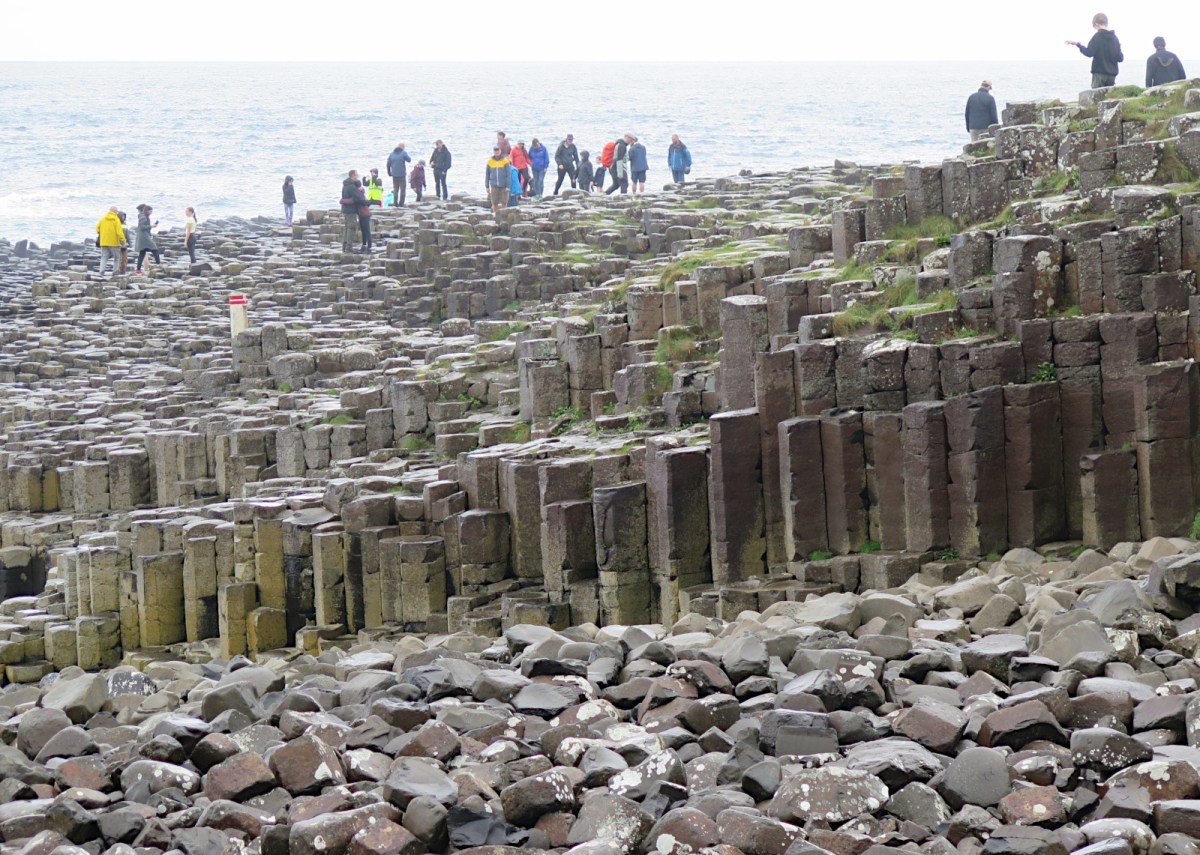
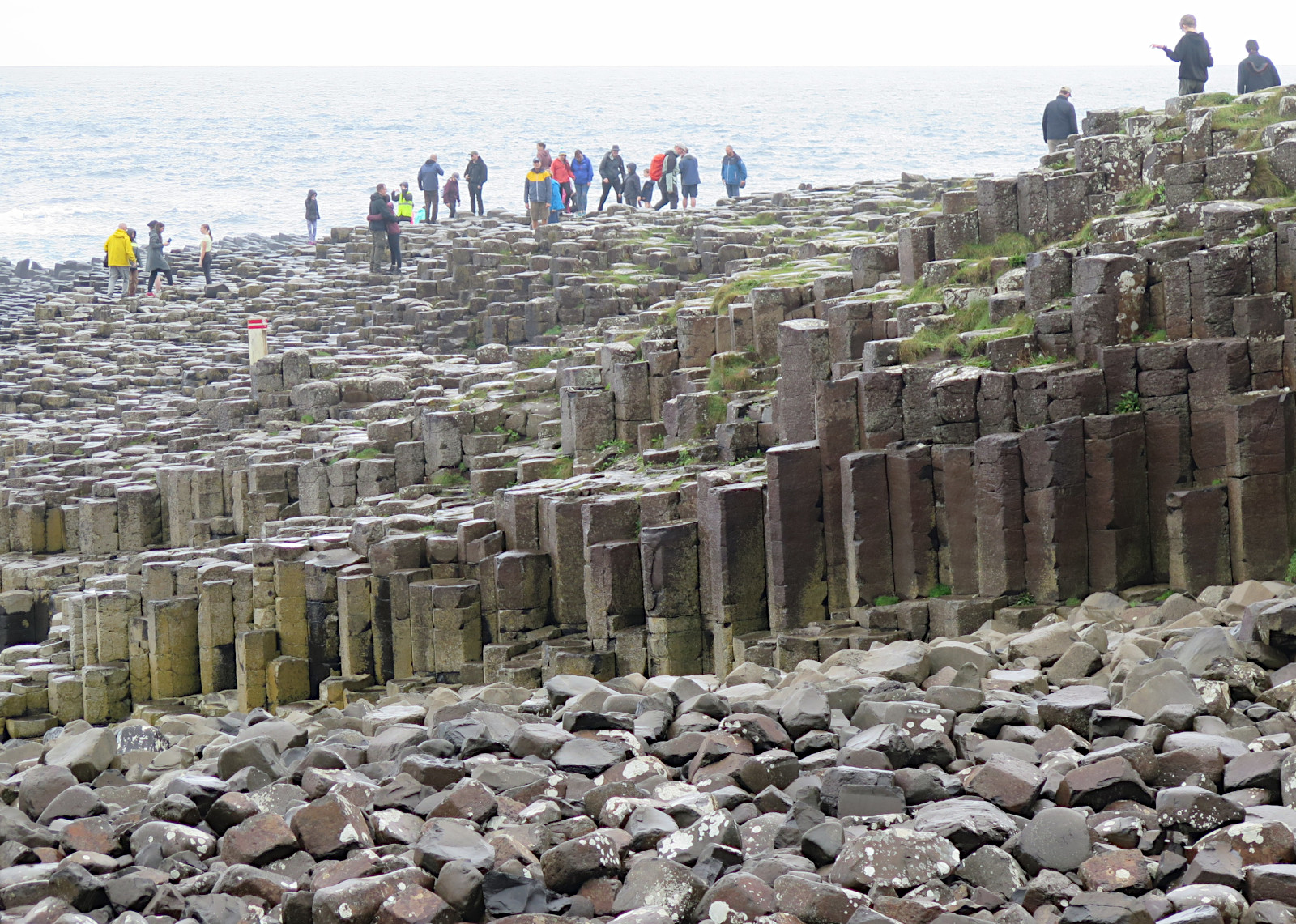
After our first night in the holiday house at Portrush we were ready to explore in earnest. We drove to the Giant’s Causeway, and the photo shows how many people turn out to see this geological feature, even on a damp and breezy day. It is an incredible sight, with the famous hexagonal basalt columns taking on a multitude of forms. In places they are weathered down to appear like an almost flat pavement (the legendary giant’s work in building a causeway between Ireland and Scotland). In other places they rise vertically like organ pipes, and in yet others they are still capped at the top by overlying sediments deposited above them.
As with the sandy beaches at Portrush, the coast trends east-west and faces north. What a place, rugged, very unusual and most impressive. It is deservedly famous! UNESCO declared it a World Heritage Site, it is a Northern Irish National Nature Reserve, and it was voted the fourth-greatest natural wonder in the United Kingdom
The Wikipedia article listed below gives a good explanation for the volcanic origins of the ’causeway’.
If you enjoyed this or found it useful, please like, comment, and share below. (If you don’t see those links, click the article’s title above the main photo and they will appear.) Send a link to friends who might enjoy the article or benefit from it – Thanks! My material is free to reuse (see conditions), but a coffee is always welcome and encourages me to write more often!
Judy’s Dad turned 70-years-old on the tenth and she made him a cake decorated with emblems representing his life so far. We met at their house in Charlton Kings, Cheltenham, with her brother Frank and his family. (1994)
Notes from bygone years – November (Remember, remember). Hint: Click images to enlarge them.
November 2023 (1 year before publishing this article)
Bristol Boxkite at Bristol Museum
We drove to Bristol to take Donna’s saxophone in for a service at Headwind and then spent the rest of the day in the city. We visited the museum and spent some time in the art gallery there. The main lobby still has the Bristol Boxkite hanging from the ceiling, reminding visitors of Bristol’s long and continuing contribution to the aerospace industry. We also walked down Park Street in the rain, investigated Bristol Guild, ate at a student cafe, and looked around the cathedral briefly. A good day out!
Erin (our cat) responded very well to steroid treatment and was fit and happy for the first half of the month, but towards the end of November she was becoming very unwell again and there was nothing more that the vet could do to help her.
JHM: I posted an article about Chuck Pfarrer and his maps of the Ukraine war; and another about Yara who lives in Kyiv. World events: An AI safety summit was held in the UK; and global average temperatures exceeded 2° C above pre-industrial times.
The Christmas cactus was in great form in November, and a couple of Streptocarpus as well.
We had a visit from two friends from the St Neots area, Jim and Kevin. Jim’s wife, Pam, couldn’t make it this time, and Kevin is living on his own. I took them down to Cirencester and we visited the Corinium Museum. Jim was suitably impressed by the tesselated pavements, and Kevin (a fitter by trade) was intrigued by Roman lock mechanisms and the workmanship of these items.
We were meeting at the Baptist Church in Bibury for a while to help encourage them with some changes and fresh ideas. I was involved in other meetings as well, and we were helping Donna’s Mum and Dad with decorating and getting about (though that was becoming harder).
I went to the election hustings where our local MP, Sir Geoffrey Clifton-Brown was booed and heckled a lot. I certainly wasn’t inclined to support him.
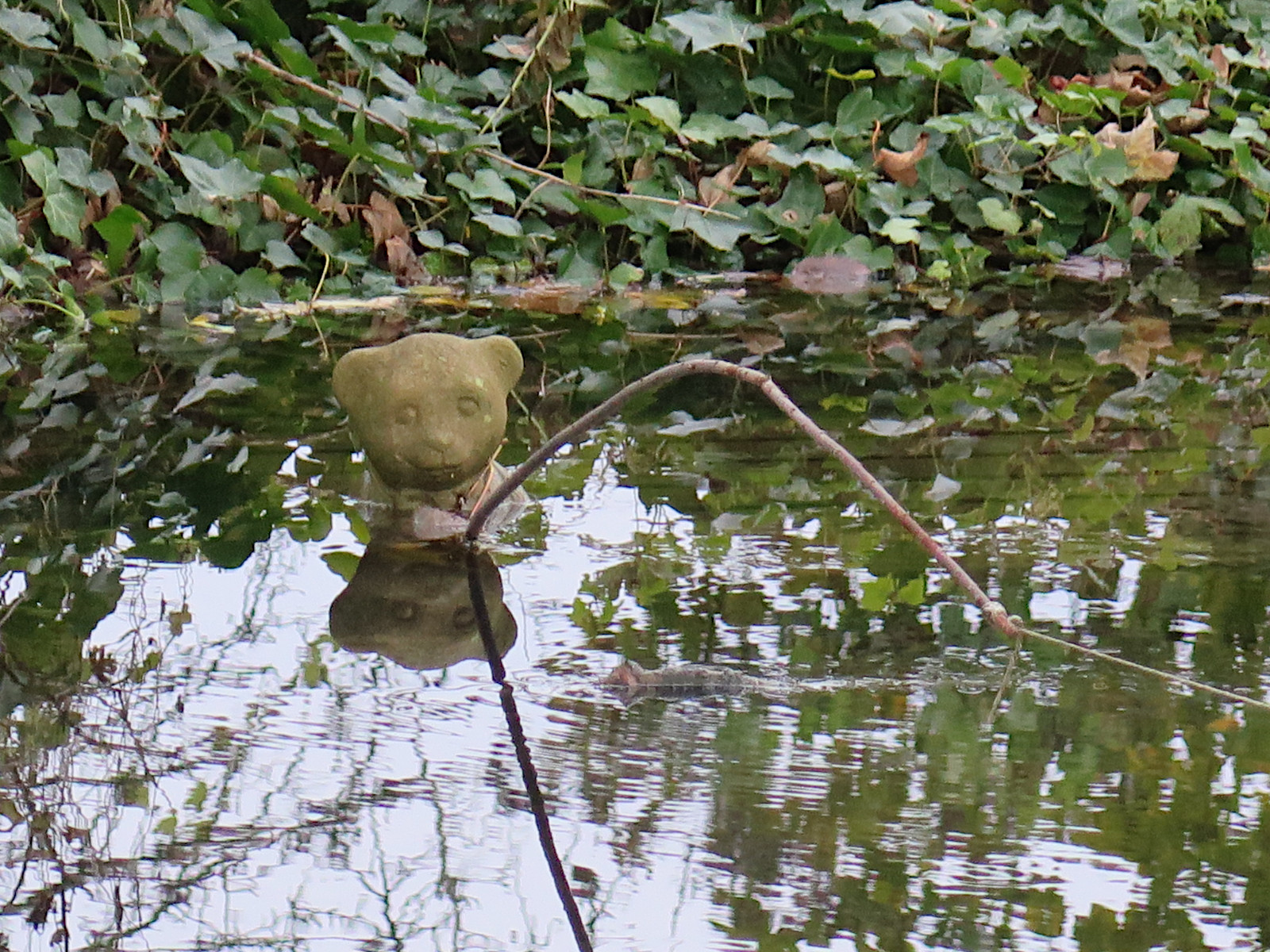
There was quite a lot of rain this month, and a dusting of snow as well. As a result there was some flooding. There’s a concrete bear (a garden ornament) on a wooden platform on the edge of Riverside Walk in Cirencester, and the bear is our water level gauge. As we walk past we see him sitting with his fishing rod on a dry platform (usually). But the photo shows him during the flooding, still clutching his rod and line.
Donna was training as a teacher but was having some second thoughts because of unruly and difficult kids, she also wanted to spend less time running the Open Door Small Group since the teaching work gave her much less available time. Meanwhile I put in a claim for my state pension and we helped some friends move house.
John, one of the guys I’d met at Caffe Nero, was grasping spiritual truths really quickly. He was asking a lot of questions and understanding everything quite deeply. I found this very exciting and immensely encouraging.
I was meeting frequently with different people, there was the Open Door small group once a week, coffee shop meetings with some friends in town, and meetings with my friends Jim, Sean and Kevin rotating around our three homes. It was all good and seemed useful, but three such different groups! Another friend, Chris, was working through Revelation and we met for coffee to discuss this too.
I took my coffee shop friends Matt and Kev to the Newforms Gathering at Kidderminster at the end of the month (photo).
I wrote a short note on the old family dining table we’d been using. It came originally from one of my Dad’s relatives and we’d used it when Judy and I lived in Yatton in the 1980s and 90s. Now we no longer needed it as we required something a good deal larger; we decided it should go to one of my daughters (assuming one of them wanted it).
We had new next door neighbours, Annette and Jerry moved into number 126. And there were major changes taking place in Unilever’s IT organisation that would affect us at Colworth where I was working.
Mum and Dad booked two adjacent holiday villas at Ross-on-Wye and the whole family spent the weekend together. It was a lovely time, a great way to keep in touch, typical of Mum and Dad to organise something like this. They were both closer to the end of their lives than any of us could have imagined, so it’s a special memory for all of us.
Mum had no idea there was an alien spacecraft hovering above her head! Click the photo for a better view.
We had a new gas heating system installed in our home – boiler, radiators, hot tank – everything. The preexisting system was old, decrepit and very inefficient, so high time to replace it.
On 4th November I flew to Schipol for Unilever business at Rotterdam.
And we had a new permanent house guest, Truffles the cat. She was a gift from friends who had more than enough cats, and Truffles preferred being a bit of a loner (though very affectionate with humans).
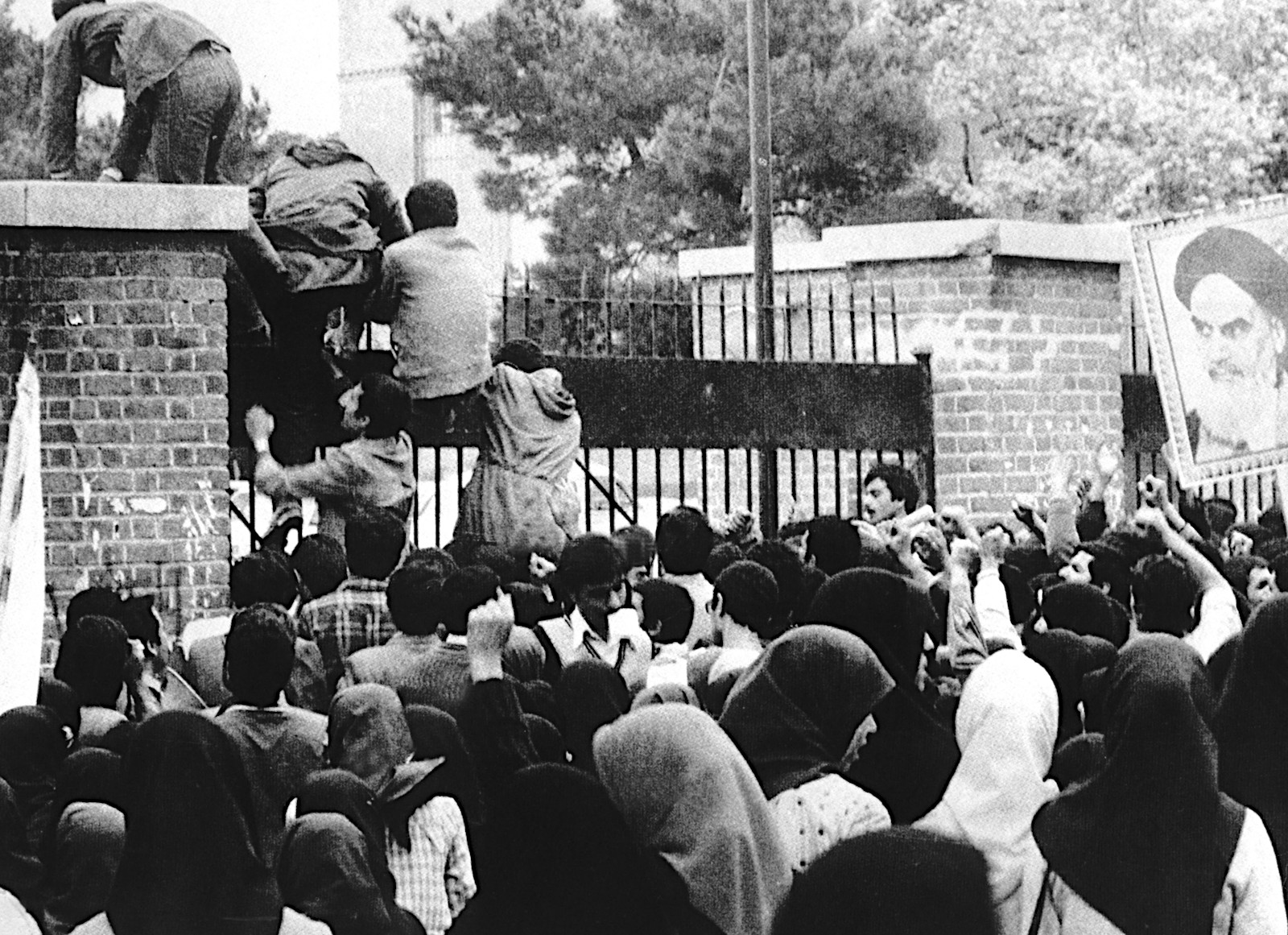
JHM: View the predecessor website at this time. World events: Australia decided to keep the Queen as head of state; and Kuwait revoked a 1985 law that granted women’s suffrage.
Judy was getting stronger after the problems with the attempted chemotherapy. She was out of danger and out of hospital too during November. She had lost her hair and was wearing a hospital wig, but new hair was already starting to grow and the wig would be only a temporary measure.
Judy’s Dad turned 70-years-old on the tenth and she made him a cake decorated with emblems representing his life so far. We met at their house in Charlton Kings, Cheltenham, with her brother Frank and his family.
In November I bought a new video camera to replace the one stolen in August while were on holiday. This time I bought one of the new, higher resolution Hi-8 cameras. The photo of Beth was made from a VHS copy of a Hi-8 original.
Debbie was probably playing clarinet around this time, but I don’t recall if they ever attempted a piano/clarinet duet!
World events: Dial-up internet was introduced in the USA; while the East German communist government resigned and the Berlin Wall came down.
I developed a DECO database for the Plant Science Division at Long Ashton Research Station to improve the processing and storage of bibliographic information.
This month we had a bit of a breakthrough. My boss at Long Ashton, Ken Stott, put us in touch with a friend of his who was a bank manager; we were then offered good terms on a mortgage.
During the interview we had to hide the fact that Judy was pregnant, as her income had been taken into account.
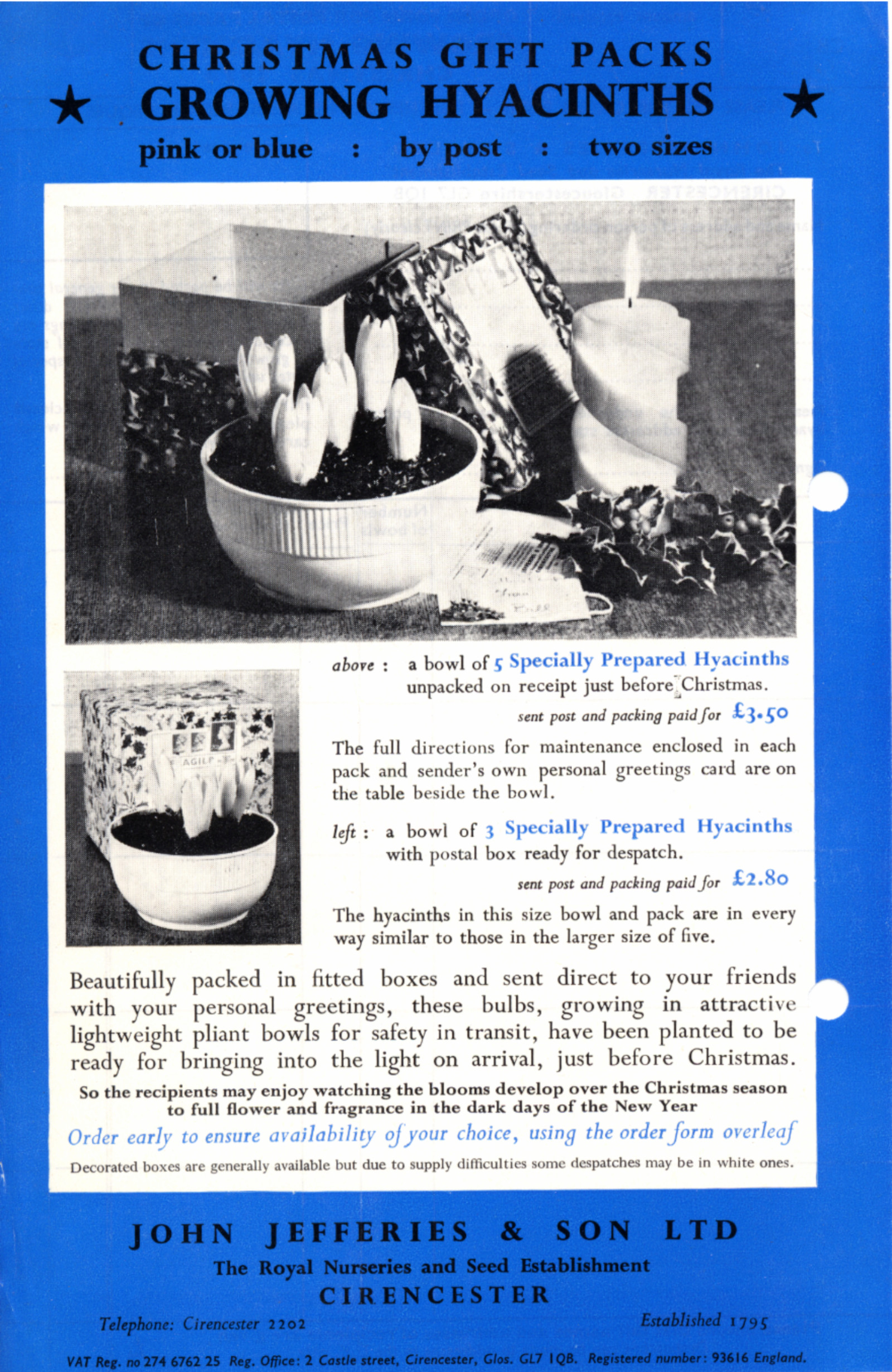
John Jefferies and Son Ltd published their Christmas bulb offer (see the full details, but don’t place an order – they’ve sold out!)
My Granny (Nor) celebrated her 80th birthday and the family gathered for photos and a short celebration at Uncle John’s house, 4 Tower Street, Cirencester.
In the photo – Back row: Cousin Tim, me, Uncles Bob, John and Dick, cousin Jeremy, and my Dad. Middle row: Judy, Aunty Betty (Bob’s wife), Pippa (Jeremy’s wife), My Mum, and Deirdre (Tim’s wife). Front row Aunty Jo (John’s wife), Nor, and Aunt Millicent (Dick’s wife).
Bonfire Night on 5th November was always an important calendar date when I was a child, and indeed right up until recently. It’s gradually been replaced by Halloween over the last ten or twenty years.
This triple Roman candle was the prize firework item in my parent’s back garden in 1964. I took a time exposure on a tripod while this one ran its course, and the photo came out remarkably well. I was 16-years-old and in the Lower Sixth at Cirencester Grammar School.
World events: NASA launched Mariner 4 to Mars; and France tested an atomic bomb underground in Algeria.
I was still in my first term at Cirencester Grammar School. My classroom was in the southernmost of the three Prefab Classrooms; the first year forms 1A, 1B and 1X had these three rooms, perhaps because they were a little way away from the classrooms for the older pupils.
It was an easy walk to the playground where the tuckshop was (it’s important to get important details sorted out as early as possible).
World events: The first section of the M1 Motorway opened; and the MOSFET transistor was invented in the USA.
I was in my second year at Querns School, and half way through the first term. I think that we had Miss Hourihane as our teacher for this second year as well as my first year, although I can’t be sure about that.
I joined the Trex Club, Mummy helped and I remember being a bit puzzled by the whole process, frankly! If you’d like to join, here are the full details.
World events: The first Godzilla film premiered in Tokyo; and a four-kilogram piece of the Hodges Meteorite crashed through a roof injuring a woman.
There’s little to say about this month, as in October I was 1¼-years-old, life went on, and we were still living in my grandparents house in Victoria Road, Cirencester. Dad continued working on the nurseries, part of the old family business.
World events: Oil was discovered beneath the Caspian Sea; and Winston Churchill supported the idea of a European Union.
Mum and Dad briefly talked about the idea of one day being married, and Dad bought a postcard of Cirencester Parish Church in the village shop in Coagh! They visited Uncle Samuel and Aunt Annie in Belfast on 23rd. On the 29th, Dad heard he was soon to be posted away from Northern Ireland, they were both very sad at this unwelcome news.
If you enjoyed this or found it useful, please like, comment, and share below. (If you don’t see those links, click the article’s title above the main photo and they will appear.) Send a link to friends who might enjoy the article or benefit from it – Thanks! My material is free to reuse (see conditions), but a coffee is always welcome and encourages me to write more often!













 Journeys of Heart and Mind


