The need to accept one another as beloved brothers and sisters will start to seem more important than having this or that position accepted. The body will work together better, there will be less confrontation and more building going on.
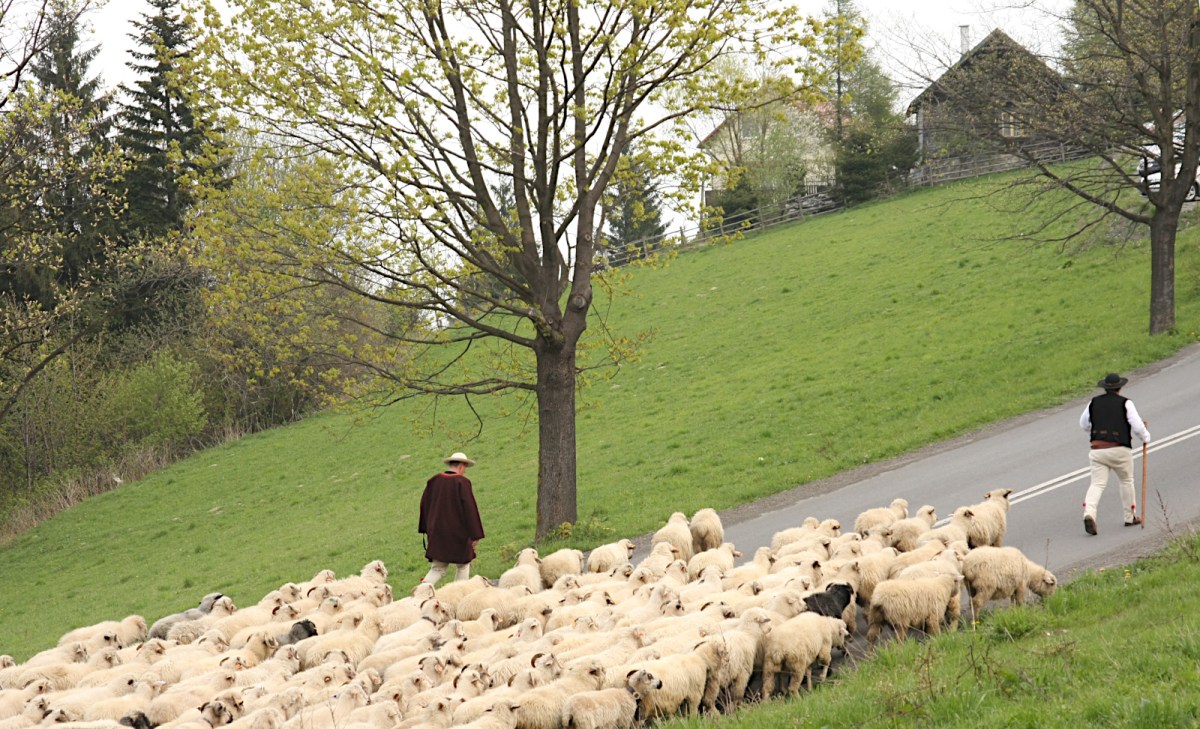
Shepherd and sheep (Wikimedia) -Click images to enlarge
Continuing the flow of church life and growth, where evangelists have been at work there will be a gathering of people following Jesus to the best of their ability; some will be absolute beginners. There are bound to be some difficulties and rough edges: some may come off track, stop coming to meetings and drift away. There may be disagreements, even angry arguments. There will certainly be differences of opinion and misunderstandings; friction and differing perspectives. And there may be some who will say, ‘Don’t go that way, come this way, it’s a much easier path.’
Where there is someone with a strong shepherding gift, all of these issues will be addressed, usually in straightforward, kind and helpful ways. People will be encouraged to understand alternative points of view even though they may strongly disagree. Those who wander away will be visited, given an opportunity to explain difficulties, ask questions and be encouraged even if they decide not to return. The need to accept one another as beloved brothers and sisters will start to seem more important than having this or that position accepted. The body will work together better, there will be less confrontation and more building going on.
Although Paul’s greatest gifting may have been apostolic and he was strong also in the prophetic, you can see the shepherd in him as he shows concern for the Corinthians who were losing their way. And I can imagine James, speaking about the widows and orphans saying, ‘Hey, these people need your help and love too. You’re watching them suffer and doing nothing to show them you care about them.’ Shepherds are always alert and ready to intervene when there’s a need.
We’re at a strong disadvantage here in Britain, our agricultural history has shepherds but no tradition of leading sheep. Instead our custom is to round them up and drive them in the way we want them to go. We use sheepdogs to help us frighten the sheep into submission. Take a look at the photo in this article, the shepherd is in front and the sheep are following, that would not happen in the UK, or in France, the USA, Australia or New Zealand. The photo is from Poland where some shepherds work like the traditional pastoralists in Israel and Arab nations. When Paul writes about the gift of a shepherd he’s not thinking about rounding up or driving a herd of anxious and scared sheep with the help of a descendent of the wolf family! There may be difficult moments where someone with a shepherd gift has to act very firmly to protect someone else from continuing unkind, selfish or unthinking behaviour, but hopefully these will be rare exceptions.
Why follow?
So why do sheep follow a shepherd? It’s because the shepherd knows what the sheep need, and the sheep know that the shepherd knows what they need. What do sheep need? They need grass to eat, water to drink, and safety from predators. Sheep are far from stupid, they soon learn that the shepherd will take them to green pastures, streams of living (ie flowing) water, and if a predator comes close the shepherd will drive it away.
And that, my friends, pretty much describes the gift of Shepherd in the life of the church. If you are a gift of Shepherd in the church nobody will be afraid of you. They will know from experience that your habit is to lead them to places where they will be able to thrive and grow in peace and safety. Places where they will be fed truth and have access to the living water, and that every kind of predator will either be won over or chased off.
Do you have this gift?
Yes, as with apostle, prophet and evangelist, we all have this gift to some degree. You cannot be like Jesus without having some level of shepherd about you. Jesus is the origin and source of all the gifts we’re discussing in this series. If you believe him and follow him then Christ is in you. And if the perfect Shepherd is in you then you are going to reflect that at some level.
Psalm 23
This famous Psalm sums it up really well. If you have a well-developed and deep gift of shepherd you will be a living example of Psalm 23 in action. The psalm describes how you will make the people around you feel.
How the gift of shepherd has been misunderstood
In the 20th and 21st centuries the word ‘pastor’ has been used (or misused) to identify people who may (or may not) have a shepherding gift. Often it is used to mean something like a manager or director – as if church is a sort of business enterprise. A Pastor in this sense is heavily loaded with many duties. He is the person where the buck stops – financially and managerially. He (for it’s usually a man) is expected to fix every problem, and solve every issue. The Pastor may have a team under him, often described as elders, people he can delegate to, call on for help when needed, and share the responsibilities with. Neither the pastor nor the elders will necessarily be shepherds in the sense I’ve outlined in this article. Some of them might be, but much of their time and effort is likely to be spent on management tasks.
Meanwhile any true shepherds in the congregation may not be identified, and might struggle to fulfil the role Jesus has bestowed on them. It’s a double-bind, in which shepherds and those who need the care of a shepherd are both frustrated.
Check the Daily Meditations link below to see some of the thoughts of a shepherd’s heart. Next time, we’ll take a look at the gift of teacher, that will round off APEST for us:
Apostle Prophet Evangelist Shepherd Teacher
After thinking about the teaching gift, we’ll take a look at how all five APEST gifts can be seen in the nature and teaching of Jesus himself.
If you enjoyed this or found it useful, please like, comment, and share below. (If you don’t see those links, click the article’s title above the main photo and they will appear.) Send a link to friends who might enjoy the article or benefit from it – Thanks! My material is free to reuse (see conditions), but a coffee is always welcome and encourages me to write more often!
We talked with Matt and learned a bit about him, but left him there in the bus station. At home I discussed the situation with Donna and we decided to drive over to the bus station in the morning and bring him home. Matt was not as easy as Emily or Ash, but much less of a problem than either of the Davids.
Twice while we were living in Yatton, Judy and I had invited people to come and live with us, coincidentally they were both called David.
One David (Davey) was trapped in a bad relationship with another man in Bristol. He was also a drug addict, but he was mild mannered. I don’t recall how we met him, I think he might have phoned our number as we had a second entry in the phone book as the contact number for Horsecastle Chapel. Davey was hoping a church in a village outside the city of Bristol might help him break free of his difficulties and move on from his past. He was at least looking in the right direction (church) and I took him several times to meetings at a house nearby where some of our old friends were meeting regularly. It didn’t end well for Davey, although he was with us for a number of weeks, perhaps even a month or two, and although he was interested in hearing about Jesus and trying to follow him, in the end his past life had a stronger call on him and one day he just disappeared, we thought to return to the bad situation in Bristol that he’d wanted to break free from. There was nobody in our little circle of friends in Yatton who had the experience or knowledge to really help him.
The second David (Dave) was from Newcastle, he was an unkind, mocking kind of person, very demanding and uncompromising. After a short stay with us, he made it very clear that in his opinion we were rather deficient by comparison with the church in Newcastle that he had left. In the end he began an affair with one of our friends. She and Dave left the area, her husband ended up having to work full time as well as looking after the children and the family home. This was a disastrous failure for which Judy and I felt at least partly to blame. I phoned the pastor of the Newcastle Church (which turned out to be Pentecostal); he was sympathetic but told me that Dave was a very difficult challenge and had left under a bit of a cloud. After these two experiences I was not inclined to invite people to come and stay again for some years, though aware that as followers of Jesus we are supposed to be willing to help people who are lost, hungry or without shelter. But Papa had other plans and found ways of easing me into inviting people to stay.
St Neots
After Judy’s death, marrying Donna, and beginning a new job in a different part of the country, when a New Zealand friend (another David) decided to return to New Zealand earlier than planned, Donna and I were happy to give a room to his daughter Emily. She needed to live in the UK just a few more weeks to finish her A levels and qualify for UK citizenship and this in turn would allow her to work later anywhere in the EU. Emily got her citizenship so has that dual nationality – British and New Zealand. But her hopes to return for work in Europe were later shattered by Brexit. Emily was an absolute delight as a house guest; she is now married, has a medical degree, and is living and working in New Zealand.
The next house guest was Ash and later his three children from time to time for short visits. Ash’s marriage had fallen apart and he was in a difficult and stressful situation. He met one of our Small Group members through an on-line dating site and when we heard he was looking for somewhere to stay and had to leave his flat near the Welsh border at short notice, Donna and I offered to help. I met Ash and his Dad who had also driven up to provide more car space and between us, we got everything into the three cars. Ash proved to be resourceful, he quickly found temporary work that he could do from home to cover his costs and soon enough found a full time job. He moved into our Small Group friend’s flat and they later married, but things went very pear-shaped in the end. Ash had a very tough time but he never lost his willingness to work hard and do whatever was necessary to win through in every situation. Ash was another success story and a pleasure to share our home with. Emily and then Ash were two people used by Papa to draw me back into a willingness to invite others. Donna also enjoyed their presence in our home so she was also ready and willing to consider more.
The next house guest was Matt. On 5th January 2014, my friend Sean and I had taken hot soup and bread rolls into Huntingdon and found Matt in the bus station there, it was a popular haunt for the homeless as it was well heated and out of the rain. We talked with Matt and learned a bit about him, but left him there in the bus station (along with a flask of soup and the remaining bread rolls). At home I discussed the situation with Donna and we decided to drive over to the bus station in the morning and bring him home. Matt was not as easy as Emily or Ash, but much less of a problem than either of the Davids. At this time I was learning about the APEST gifts to the church and was involved in some of the Newforms meetings organised by Peter Farmer in Nottingham. I had begun writing JDMC as an APEST primer text and I took Matt and another friend, Kevin, to one of the Newforms meetings. After some difficulties Matt eventually left us, but continued to be involved in the coffee shop meetings I’d started. He brought us a mix of difficulties with some hopeful and helpful aspects from time to time.
On 21st August 2015, Peter and Dadka came to stay with us, using our spare bedroom. Donna and I already knew Dadka from the Open Door Small Group we were part of, sometimes meeting at our house. Peter and Dadka were Slovakians and Dadka’s mother also lived in St Neots. They were still with us when we sold our house in order to move across the country to Cirencester in the Cotswolds. In the end we pretty much had to throw them out in order to redecorate their bedroom, they were very reluctant to leave but push really had come to shove. They’d known for a long time that we needed to empty the house, but were not good at dealing with deadlines. Dadka had been a heroin addict but very much to her credit decided to give up the habit and was determined enough to succeed. We helped by providing all the necessary aids, and we also managed to get them an offer to stay at a nearby Emmaeus Community facility in Carlton, not far from St Neots. However, they turned the offer down at the last moment. In the end they returned to Slovakia and we’ve lost touch with them.
We learned a lot through making these attempts of welcoming strangers with a variety of needs into our home. Donna and I are wiser now (it comes through experience) and I understand that welcoming people with difficulties will always work better for a community of, say, ten or more people than it will for a single household. The early church held everything in common and supported one another socially, financially, and in dealing with difficulties. That depth of support was something we lacked and I do believe the community aspect is something we need to recover if we’re to be truly successful in following Jesus. We need to demonstrate and model community in a world that is largely forgetting what that looks like.
Making a start with APEST
This was an important time in my church journey during which I began to understand much more about the patterns of life and ministry within church. The practical aspects were being lived by Peter and Marsha Farmer and their friends in Nottingham and around the UK, much of the background theory was being understood and taught by Alan Hirsch and others in the USA and elsewhere. I’d already learned a great deal from people like Alan, Michael Frost, Tony and Felicity Dale, an online email community called the Koinonia Life Discussion Forum, Paul Young (author of ‘The Shack’), Peter and Marsha Farmer (Newforms) and many other people trying their best to live church community life more fully including the Community of Celebration and the Fisherfolk. Taking all of this together along with what I was experiencing in St Neots and previously in Yatton was illuminating, very encouraging and, frankly, character-building.
After reading a number of books about the topic and trying some things out in practical ways, I felt the need for an accessible, lightweight and introductory study guide to help people work through the basic ideas together in small communities. I called it Jesus, Disciple, Mission, Church or JDMC. It’s a free download from Journeys of heart and mind. It’s still being downloaded regularly, perhaps 10 or 12 times a week on average. Visit the article JDMC in the See also: section below if you’d like to read it or use it in a study group. The title is the pattern followed in the early church, though today we often change the sequence. We tend to begin with a church that is already established, send out missions, usually in other parts of the world, and feel we should ‘disciple’ the church members (even though disciple is not a verb, but a noun) and all too often we forget to include Jesus. The correct sequence is to share the great news about who Jesus is and what he does among the many people in our society who do not yet know him, show them how to join us in following him (becoming disciples), help them to fulfil the same mission (going out into the world telling people about Jesus and helping them make more disciples), and then get the new believers meeting and living as communities of Jesus followers. It begins with Jesus, and it ends with church. The free use of spiritual gifts (and the APEST gifts in particular) is essential for this process to succeed.
A mix of patterns
The Open Door Small Group we were in towards the end of our time in St Neots was a real example of this kind of community. We didn’t live together, but we cooperated a lot and not just one day a week, we were all good friends and accepted our differences as mostly positive things, recognising that our different strengths and weaknesses complemented one another so where one had a lack another might fill it. This experience too, added to the mix of discovered and lived patterns that I now believe to be truly essential for a deep and true walk through life in company with Jesus and a group of his followers. It’s something the church has a desperate need for, but rarely understands. It’s really something we have forgotten over the eighty or so generations since Jesus called his first disciples on the shore of Galilee. We need to get it back, and because we live in a time of civilizational churn and change we need to get it back urgently.
How did we lose it? By processes of dilution, encrustation, lack of imagination, a lost sense of purpose, and a grasping after power over simple love, and of position over simple gifting, and trusting ourselves more than we trust Jesus and his Spirit. We haven’t thrown it all away, at least not just yet. But we’ve rejected a lot of precious truth and replaced it with our best attempt to find ways that are less demanding and make it possible for us to swap challenging situations for more comfortable ones, to replace struggle with laziness. And, perhaps most damaging of all, we have accepted easy lives where we don’t even have to think daily about our motives or our willingness to follow Jesus in both attitudes and actions.
We have learned to judge as a form of self-defence because we don’t like being judged, and we’ve learned to run from effort because like lazy schoolchildren we prefer to avoid the work required.
Cirencester
And so the time came to move from St Neots to Cirencester. We packed our stuff, Donna drove over first with our cat, Erin. I saw the final items loaded on the removals van and then drove to the new house in our small, second car. Donna and Erin were already there, and we used the enclosed porch as a catlock: open the front door and enter the porch, check the cat hasn’t snuck in as well; after depositing her back into the house or confirming her absence from the porch, open the door to either the back garden or the street and leave the house. Pretty soon we discovered Cirencester Baptist Church and decided it was the best choice in town. We looked at the Small Group options as well but found our first option was not meeting during the summer and would be unavailable until September. In the meantime I began meeting with another CBC Small Group and became quite friendly with some of the people there, but it was frustrating for me to be so immersed in Bible study and prayer but with little or no opportunity to use spiritual gifts or talk about APEST and other matters. It felt like playing a piano with most of the black keys missing so being able to play in at most two or three keys. Very limiting.
In the autumn we joined the original group we’d had in mind, but Donna dropped out over time and for several years I was involved with both groups as one met on Tuesdays while the other met on Thursdays. More new friends and a bit more freedom in the meetings this time, I felt; so I stuck with the second group and still meet with them most Tuesdays. But I still want to use my gifts more fully and I’m not entirely sure how to move forward. But I know that Jesus knows and will lead me in whatever direction he chooses for me. I must wait to see what that will be.
So, what does Jesus think?
This is where the chickens come home to roost. If we asked Jesus about church today in Britain (or indeed, almost anywhere) what would he say about it? Would he commend us? In most cases, I don’t think so. He might ask us where we think he fits in to all that we are doing. He might re-commend us to pay attention to what he has commanded us. He might re-command us to go out and do everything he commanded the disciples, to teach people everywhere to fulfil everything he commanded us (and them) to do.
Then Jesus came to them and said, ‘All authority in heaven and on earth has been given to me. Therefore go and make disciples of all nations, baptise them in the name of the Father and of the Son and of the Holy Spirit, and teach them to obey everything I have commanded you. And surely I am with you always, to the very end of the age.’ (Matthew 28:16-20)
Where are we failing? Everywhere! We do none of the things he wants us to do. At best we watch while priests, vicars, pastors and elders do these things while the rest of us are spectators. The standard church seating arrangement announces and ensures that; but Jesus is our authority and we are all called by him to go, make, baptise and teach.
When did we lose our way?
Almost at the very beginning. Think about Paul’s letters to the Corinthians, the people there were already a derailment of what Jesus taught and commanded. Paul wrote to try to get them back on track. We, too, are a bit of a train-crash. We need to hear what Paul says, and especially we need to hear what Jesus says. Sometimes it seems almost too late for us. But it’s not too late, despair is not the way forward for us, obedience is. The only part of the train that still stands on the tracks is Jesus himself, all the carriages and trucks lie scattered and broken where they fell. We need to repair and rebuild according to the original design and plan, then get everything properly back onto the track behind Jesus and every part connected to him and to one another. And then, when Jesus moves we will all move in the right direction because the track is firm and ensures that the entire Matthew 28:16-20 train follows him, moving in the right direction.
Signals and points
Railways also need signals and points (switches if you’re North American). Sometimes the train should pause to avoid a collision, and sometimes we need a change of direction. The Holy Spirit, (the Spirit of Christ) provides both control and direction. Once the train’s back on the track and moving we must pay attention to the Holy Spirit for both safety and direction. He will tell us, ‘Wait a moment, I’ll tell you when to start moving again’ or he’ll say, ‘The track divides here, we’re heading left (or right)’. We ignore his guidance at our peril. Having been restored following a train-crash, believe me – you do not want to provoke another one.
If you enjoyed this or found it useful, please like, comment, and share below. (If you don’t see those links, click the article’s title above the main photo and they will appear.) Send a link to friends who might enjoy the article or benefit from it – Thanks! My material is free to reuse (see conditions), but a coffee is always welcome and encourages me to write more often!
Think of an evangelist as first and foremost a ‘people person’. They get their energy from being in the crowd. They love to talk, they smile and laugh a lot, they’re fun to be around, they tend to be party people.
A street party (Wikimedia) -Click images to enlarge
When apostles and prophets have done their stuff it’s high time for evangelists to join in. I don’t want to push the idea of a sequence too far; ideally we should be aiming for a situation where all the APEST gifts are operating simultaneously and abundantly, all at the same time. I’ve been using the analogy of building a house where apostles lay foundations and prophets make sure the structure is straight and true, but it should be very clear from Paul’s letters to the Corinthian church that all of the gifts need to work continuously. Unlike a house, when foundations are laid once and the stonework is raised once, for church to function as Jesus intended these are ongoing requirements. It’s not just urgent repair work as in Corinth, but it’s a living process of constant adjustment and calibration.
Following the apostle and prophet articles, the focus this time is on the gift of an evangelist – what it looks like, how it arises, how it affects a person who is expressing it, and how the rest of us can relate to it, support it, and, as an expression of church, benefit from it. Next time we’ll examine the gift of a shepherd in much the same way.
No room for wriggling
We all have this gift to some degree. You cannot be like Jesus without having some level of evangelist about you, so you can’t wriggle out of it completely. Jesus is the origin and source of all the gifts we’re discussing. If you believe him and follow him then Christ is in you. And if the perfect evangelist is in you then you are going to reflect that at some level. You may or may not be evangelical, but you will most certainly be somewhat evangelistic in character and nature.
We need to know how to recognise an evangelist, and that’s really not too difficult, but before I consider that I’d like to clear up a common misconception that can cause some confusion. There’s a (mistaken) understanding among many Christians that evangelists go out and convert people from whatever they currently believe. But that’s not quite right. It’s apostles who are called to go out and start new churches, very much following in Paul’s footsteps. But evangelists have a slightly different role. The Greek word is euangelion (εὐαγγέλιον). It’s a word of two parts εὐ which means ‘good’ hence a eulogy is a good word, and αγγέλιον or angelion meaning ‘messenger’, we get our words ‘angel’ and ‘angelic’ from this same Greek origin. So an evangelist is a ‘bringer of good news’, not only in the narrow sense of someone who preaches the good news but more in the sense that an evangelist is someone who is good news.
Think of an evangelist as first and foremost a ‘people person’. They get their energy from being in the crowd. They love to talk, they smile and laugh a lot, they’re fun to be around, they tend to be party people. Hence this article’s title Partying with an evangelist. Evangelists draw people in – ‘Come and have a drink with us.’Have you tried this amazing dessert?’ ‘Fantastic dog, what breed is it?’ ‘You’re looking really happy, it’s so good to see that’. They like to tell stories and will probably have everyone in stitches, and if you have a story they will want to hear it and will find comfortable ways to draw it out if they can. People gather around evangelists in a very natural way, and before long an evangelist will be telling them about things Jesus did in their lives, or asking them if they’ve ever met him in a meaningful way themselves.
An undemanding and comfortable gift
Where the gift of evangelist is operating, you’ll find a group of people who are both engaging and engaged. That’s why it’s such an important gift for joy, balance, and growth of the church (ekklesia) the called-out community of Jesus in a place. If we could only grasp and use this gift more fully, church would be the popular, local place for everyone to gather (not just believers). As always, Jesus has all of the gifts in a fullness we can never completely express. In part, that’s why the crowds followed him everywhere he went in Judea and Galilee – he was and remains really, really Good News! But I think I’ll leave Jesus as the fullest expression of the APEST gifts for a later article after we’ve worked through shepherd and teacher.
For now it’s enough to grasp that evangelists are about good news, not only in the message they bring but also in who they are (remember, who you are is far more fundamental than what you do).
On the more serious side
But there’s more to be said about the gift of evangelist. This gift to the body is not just about fun and being attractive and welcoming. Evangelistic people have a heart to welcome people, but they know the welcome should have the purpose of bringing people into Christ’s presence. They are passionate about this goal, but they also know they must bridge the huge gap that exists between ekklesia and the prevailing culture of the society beyond (and often it seems beyond the reach of) the church. But they also know that their particular gift can reach across that divide far more easily than the rest of us might think. Because the first step in reaching a person is to become a trusted friend.
The evangelist is propelled forward by a desire to see people come to know and trust Jesus and every opportunity to communicate the truth spurs them on. The evangelist may become impatient with slow processes and tend to be stronger at drawing in new believers than they are at discipling or teaching, those processes are not where their strengths lie.
In conclusion
One of the take-home messages from this article on the gift of evangelist is that we need to lighten up in church life and activity. We need a reputation of being the best and most sought after place and community in town! If this is not the way of things you may be lacking the gift of one or more evangelists. They’re there among you, but perhaps they’re regarded as lightweights, not learned enough, not Bible scholars or great preachers, not serious. Yet one of the reasons ordinary people avoid church is that it seems to be far too serious, dull, boring, a place for serious, dull, boring people. If this is how people see your church (or your small group), maybe you need to find the evangelists and apologise for suppressing them. Instead, invite them to lead a meeting or two, ask them to show you how you, too, could lighten up a bit. And if visitors are among you, for whatever reason, give the evangelists a bit of freedom.
This may not be the easiest of messages to hear, particularly because it is so rarely expressed or understood. Church was never meant to be a dull, hushed and deadly serious endeavour. Party food smells a great deal better and more exciting than the polish on Victorian church pews!
If you enjoyed this or found it useful, please like, comment, and share below. (If you don’t see those links, click the article’s title above the main photo and they will appear.) Send a link to friends who might enjoy the article or benefit from it – Thanks! My material is free to reuse (see conditions), but a coffee is always welcome and encourages me to write more often!
Gratitude demands taking hold of whatever is being offered, unwrapping it, and finding out what it is for and how it works. It also involves actually trying it out, taking it for test runs, expressing it, seeing how others react to it.
We considered the gift of an apostle last time, so now we’ll look at the gift of a prophet. And let’s be clear, once again I’m not writing about an individual person here, we’re going to focus on the gift itself – what it looks like, how it arises, how it affects a person who is expressing it, and how the rest of us can relate to it, support it, and, as an expression of church, benefit from it. Next time we’ll take a look at the gift of evangelist in the same way.
Making it real
As with each of the service gifts, let’s begin by reminding ourselves that we all have this gift to some degree. You cannot be like Jesus without having some level of the prophetic. Some will have a high level of this gift, some may have it at a relatively minor level. And in all of us it will exist alongside various mixtures of the other four APEST gifts. But whatever the level – low, medium or high – the source remains the same, it always springs from the nature and heart of Christ himself. He provides all of the gifts as he thinks fit. Make this real for yourself, personally. Jesus has carefully chosen and bestowed these five gifts on you in whatever proportions will enable you to play your part in his ekklesia, his called and appointed community. He is special, but he has made you special too; whatever happens in your life, never forget that.
Remember that a gift requires activity from both the giver and the receiver. A gift that is offered but not taken is no gift at all; it never fulfils it’s purpose. Gratitude demands taking hold of whatever is being offered, unwrapping it, and finding out what it is for and how it works. It also involves actually trying it out, taking it for test runs, expressing it, seeing how others react to it. And to properly receive it you should also hug the giver, tell them how much you love their thoughtful gift and tell them how much you love them, the giver, too. That’s not a big ask when Jesus is the giver!
Seeing and hearing are words we focus on when we think of the gift of a prophet. But these words can easily mislead us as they have to do with eyes and ears whereas the prophetic gift is much more to do with spiritual awareness. Because of this it might help to think in terms of prophets communicating Papa’s thoughts and nature to anyone who will listen. Sometimes that’s about Father’s character, sometimes it’s about his heart or his will, or his purpose. It might sometimes involve a message from him to the church, to a particular person, or to the world in general. Prophecy tends to be declaratory. Because they are in touch with the heart of the Father, prophets are often very sensitive to wrong attitudes; things that he hates will be things the prophet also detests.
A demanding and uncomfortable gift
Prophets are highly sensitive to and outspoken about unjust behaviour, unjust words, unkindness and untruthfulness. They always point up to the Father too, to his character and nature and presence. They declare peace and long to see brothers and sisters living in peace. They want all people to be at peace with the Father in heaven and with one another. Prophets can make people feel uncomfortable, too much truth can be hard to assimilate and difficult to deal with. A prophetic person may seem to be over-demanding, pointing church towards Jesus too firmly, insisting on change right now. A half-hearted prophet is a contradiction in terms, they want to see change and they want it right away, not tomorrow or next week! So where a prophet is at work, and the hearers pay attention, people should be growing more Christlike in their thoughts and actions towards one another, towards Father, and towards the world. And because Jesus is sacrificial in nature, a growing willingness to be sacrificial will grow in and among the community that is church as well.
We should also think about how the gift of prophet fits with the gift of apostle that we considered before. First apostle, then prophet, wrote Paul. We saw previously that Apostle comes first, not in importance but in sequence, so in what sense does the gift of prophet come next? Well, if an apostle has been at work there will be an excellent foundation laid upon which church may be built. And the prophetic gift helps us build straight and true; standing firmly on the foundation already laid. In the early days of church construction it would be easy to come unstuck, a lot of people might be doing the best they can but without the ability to distinguish between what seems good (but might be unhelpful) and what is truly in line with Father’s vision and purpose. Having a prophet or two acting like plumblines and right-angled set-squares reveals where a wall is not quite vertical or a corner not at ninety degrees. And these details will matter as the structure grows in height and complexity, so prophets do indeed come after apostles though both are of equal (though different) importance and value.
Now you are the body of Christ, and each one of you is a part of it. And God has placed in the church first of all apostles, second prophets, third teachers, then miracles, then gifts of healing, of helping, of guidance, and of different kinds of tongues. Are all apostles? Are all prophets? Are all teachers? Do all work miracles?Do all have gifts of healing? Do all speak in tongues? Do all interpret?(1 Corinthians 12:27-30)
Notice that the quote from 1 Corinthians above is different from the list in Ephesians 4 that we looked at in the post on apostles. There’s a reason for that and we’ll investigate it later, but the first two items in the list are the same. Apostles first, then prophets. The paragraph below is copied from the previous part of this series. It bears repeating because it is so important.
Our mistake is to think that these are special roles that most of us are not called to. But the truth is subtly different. All of us have all five of these gifts, but to varying degrees. I might be strong in one and you might be strong in another. Most of us are reasonably strong in one or two, few of us are strong in all five. So what does that imply for his locally gathered people, the ekklesia (church) in a particular place. It implies that any gathered group of believers will have all five of the gifts in differing amounts – we will lack nothing! But it’s the togetherness in the church that ensures we lack nothing. We all need to do our bit.
So let’s get on with the process
Think again about the process of building a house, and how all the building skills and trades are required for success. We need apostles, prophets, evangelists, shepherds, and teachers to build a local expression of church. And all are present wherever people are meeting regularly with Jesus and hearing his call to go and make disciples, baptise them, and teach them to do everything that’s needed for the next generation. All five are present, but sometimes they are not active. And that’s usually because we don’t provide room for them.
Remember that ‘Church’ on Sunday and ‘Small group’ on another day are both fully ekklesia, they are both communities of people called out and following Jesus. All five of these gifts of service should be fully present and working every day in every size of community. If they are not, something is seriously wrong and we need to rethink our paradigms and change our approach. We are all required to carry out Jesus’ orders in the great commission and we will need all five gifts to be active in order to fully hear that commission, let alone carry it out.
If I’m not expressing something of all these gifts, and if I’m not hearing and seeing them all in others, regularly and often, then I’m either in a deficient environment or I’m not paying proper attention. I need to examine and change either my position or my activity (or both). Assuming apostles and prophets are being heard we now have a straight and true structure of living stones standing firmly and safely on a foundation called Jesus the Messiah. It’s ready for use, it’s fit for purpose, but it’s empty inside. In other words it’s fit and ready for the gift of an evangelist, the third in Paul’s list of the five gifts of service. (Eph 4:11-13)
Why are Paul’s two lists of gifts different?
I mentioned earlier that we’d investigate this puzzle. Since apostle and prophet are the first two in both lists, it hasn’t begun to matter yet, but soon it will. It will help to read Ephesians 4 in its entirety to remind yourself of the context in which Paul mentions these five gifts of service.
Evangelist is next in Paul’s list because the empty structure needs to be filled with people. Paul’s list in 1 Corinthians is about the community after it’s been filled with people, it’s more about the gifts needed to keep things on track, an important list for an ekklesia that seems to have been in danger of derailment followed by a serious crash. Paul compiles a different list because there’s a different need, these are gifts for keeping things going and correcting errors. These people needed the apostolic and the prophetic to straighten and strengthen the existing structure. Then they need teaching, they need a bit of a miracle and they need healing and helping and guidance. Paul wrote his letter to them to provide these very things, but he knows that all the resources needed are right there in the spiritual gifts of the Corinthians themselves too, if only they will stop squabbling and pay proper attention to one another.
Perhaps this is why Paul doesn’t mention the gift of evangelist in the Corinthian list. The ekklesia in Corinth doesn’t need filling with more new believers, it needs straightening out first and it needs recalibrating. It never hurts to ask ourselves the same questions, does our church or our small group need straightening out and/or recalibrating?
A new house
The photo at the top of this article shows an empty house, here it is again. This is a second-hand house as it happens, not a newly built structure. But that doesn’t matter, you don’t need a brand new build to feel the excitement and hope of moving into a new place and converting it to a home where the family can live and love, work and play, eat and drink, and invite visitors.
See also:
I have struggled to find much that I can recommend on the gift of prophet in the church today, there is certainly a good deal of nonsense out there. So instead of some links, here’s a video of Alan Hirsch speaking about the fivefold APEST gifts (including the prophetic gift). Have a listen, see what you think. It’s short, less than five minutes.
If you enjoyed this or found it useful, please like, comment, and share below. (If you don’t see those links, click the article’s title above the main photo and they will appear.) Send a link to friends who might enjoy the article or benefit from it – Thanks! My material is free to reuse (see conditions), but a coffee is always welcome and encourages me to write more often!
We use the word ‘see’ in two very different ways – seeing with our eyes, but also seeing with our understanding. Do you see what I mean? And in that latter sense all believers have ‘seen’ Christ. Jesus himself made this clear to his disciples when he commissioned them in Matthew 28:19–20.
I’ve been thinking recently about who I am and what I do and I’ve been writing about those themes here on Journeys of heart and mind as you’ll know if you’ve been reading along.
The articles are not particularly about myself, but more about the principles. And if you’ve been reading the blog for quite a long time you probably also know that I’ve written elsewhere about the so-called APEST gifts – apostle, prophet, evangelist, shepherd, and teacher. These are not so much gifts to particular people, they are better described as gifts of people to the church. And in that sense I feel it’s high time I tried to convey more fully to my readers the nature of these gifts and the people who carry them and use them in the work of building and sustaining church life. As the church has aged over the 2000 years since Jesus was leading his disciples around Galilee and Judea, much has changed. Some of the original nature of church has been lost through a process of the encrustation of traditions and the discovery of ‘better’ ways of doing things. The APEST gifts have been one of the greatest of those losses.
We can’t do without these gifts, church doesn’t function well without them, yet most of the people who consider themselves to be part of church don’t understand them, don’t recognise them when they’re active and don’t value them. How can we value something we don’t understand?
So I’m going to attempt a pen portrait of each of these gifts, starting with apostle. And let’s be clear, I’m not proposing to write about an individual person here, I plan to write about the gift itself – what it looks like, how it arises, how it affects a person who is expressing it, and how the rest of us can relate to it, support it, and, as an expression of church, benefit from it. And next time we’ll take a look at the gift of prophet in the same way.
I used the ChatGPT AI to collect and organise some background information before writing this article. You can see the information it provided if you wish.
AI can do some great spadework, but it can’t think or make judgements, and it cannot respond to the Holy Spirit, so now we need to draw our own conclusions. I’ll explain what I think, and why.
First we need to give some thought to the difference, already mentioned, between the thinking, judging and responding to the Spirit that’s unavailable to AI. Also, AI has no experience of what it’s like to be in a church environment. Paul said that the gifts of people to the church involve first apostles, then prophets, evangelists, shepherds and teachers. (Ephesians 4:11-13)
In particular, let’s consider the idea that an apostle is someone who has seen the risen Christ, been directly commissioned by him and is sent to found and oversee communities. Does this allow for people in our generation to be apostles?
The answer to that, in turn, depends on what we mean by ‘seen the risen Christ’. We use the word ‘see’ in two very different ways – seeing with our eyes, but also seeing with our understanding. Do you see what I mean? And in that latter sense all believers have ‘seen’ Christ. Jesus himself made this clear to his disciples when he commissioned them. We are to do what the original twelve were told to do.
Therefore go and make disciples of all nations, baptising them in the name of the Father and of the Son and of the Holy Spirit,and teaching them to obey everything I have commanded you. And surely I am with you always, to the very end of the age. (Matthew 28:19–20)
Notice particularly that Jesus says ‘teaching them to obey everything I have commanded you’. The word ‘everything’ here includes going, making disciples, baptising them and teaching them to do everything I commanded you’. This is a down the generations command, we can’t escape, we shouldn’t want to escape, this is Jesus’ command to us, to you, to me.
So are we all apostles? The shocking answer is yes, we should all be prepared to be apostles.
So Christ himself gave the apostles, the prophets, the evangelists, the pastors and teachers,to equip his people for works of service, so that the body of Christ may be built upuntil we all reach unity in the faith and in the knowledge of the Son of God and become mature, attaining to the whole measure of the fullness of Christ. (Ephesians 4:11-13)
Our mistake is to think that these are special roles that most of us are not called to. But the truth is subtly different. All of us have all five of these gifts, but to varying degrees. I might be strong in one and you might be strong in another. Most of us are reasonably strong in one or two, few of us are strong in all five. So what does that imply for his locally gathered people, the ekklesia (church) in a particular place. It implies that any gathered group of believers will have all five of the gifts in differing amounts – we will lack nothing! But it’s the togetherness in the church that ensures we lack nothing. We all need to do our bit.
Why does Paul say first apostles – most important perhaps? No, we are all important. Think about the process of building a house. First you need the skills and knowledge of foundation makers, then you need bricklayers, next roofers for the roof structure and then tilers to make the roof water tight. Then double-glazing people for the windows and external doors, carpenters to fit internal doors and partitions, kitchen fitters, plumbers, electricians and so on. Which of those are most important? The foundation layers?
No! You need them all to build a house, And in the same way you need apostles, prophets, evangelists, shepherds, and teachers to build a local expression of church. And all are present wherever people are meeting regularly with Jesus and hearing his call to go and make disciples, baptise them, and teach them to do everything that’s needed for the next generation. All five are present, but sometimes they are not active.
What does an apostle look like?
Don’t expect apostolic people to look different from anyone else; to identify the apostolic person you need to watch what they do and what drives them. Apostles are all-rounders, and for very good reason. Because they are driven to go out they need to have some level of competence at all five of the gifts of service. Until a new community of Jesus-followers has been formed the other gifts will not be available, so as the one who goes out and teaches people to follow Jesus, the apostle has to provide a bit of prophecy, evangelism, shepherding and teaching. You can see this clearly in Paul’s life. As you read through Acts, Paul stops in one new town after another, acting in all these ways. But one of the things he is doing is noticing the gifts in other people and encouraging them to start using those gifts themselves.
One identifying feature of apostolic people is that they go out, start something in one place, then go out again and start somewhere else. They have very itchy feet! And that’s usually because we don’t provide room for them. They build churches, then move on. They’re not interested in making the house cosy and comfortable, they don’t bother with carpets or furniture, the newly built house (or church) has inhabitants who will do all of that. So you could say an apostle is about structure, nor decor. But because good structure is important to them they’ll often come back for visits, to check things are still on track. Paul did that a lot.
Aiding and encouraging apostles
These people need support, sometimes in terms of money or practical help, and definitely in terms of encouragement. It’s good to ask them where they have been, who they’ve been meeting with, and what they plan to do next.
Listening to apostles
They’re here to help you grapple with problems concerning church structure and difficulties that may arise. Apostolic people can be very forthright in pointing out issues a local church may not have noticed, consider how Paul intervened when widows or orphans were not getting the help they needed or when he saw people gossiping or not focusing on things in the right way. Apostles tend to be sensitive to things that are not quite right, sometimes they may seem a little rude or pushy, but hear them out and take what they say seriously.
People shopping (Click images to enlarge)
The photo at the top of this article shows shoppers in Western-super-Mare, here it is again; few of these people are followers of Jesus Christ, most of them are unaware of him or follow other faiths. Many are too busy to talk. What are we doing to reach them or engage them? We need to find effective, apostolic ways to do it – try the links below for some ideas.
If you enjoyed this or found it useful, please like, comment, and share below. (If you don’t see those links, click the article’s title above the main photo and they will appear.) Send a link to friends who might enjoy the article or benefit from it – Thanks! My material is free to reuse (see conditions), but a coffee is always welcome and encourages me to write more often!













_05.jpg)
.jpg)