
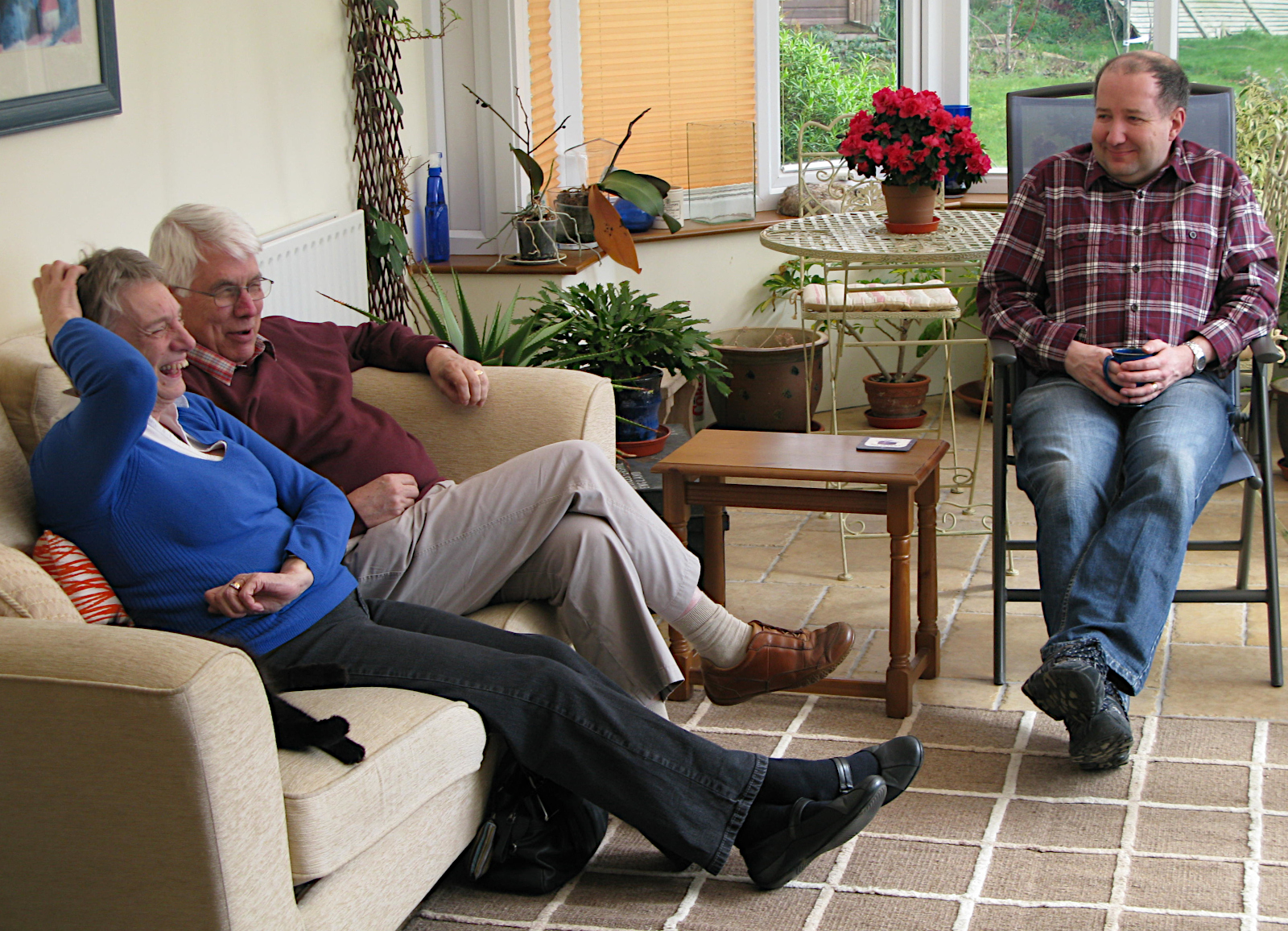
Part of a Small Group meeting
5 – developing faith
Yatton to St Neots
Donna and I were married in 1998 and Tony was my best man; Donna’s best friend, Jane, was her chief bridesmaid. Donna had taken a new job with Unilever Research at their research site a little north of Bedford. She bought a cottage in the village of Tilbrook and when we were married I moved into the cottage with her and Unilever offered me a job on their intranet web team, initially to create a website that could be duplicated for each of their research sites – two in the UK, one in the USA and one in the Netherlands.
Donna was keen to find a church in the nearby town of St Neots, or if necessary in Bedford.
We soon found the cottage was far too small, and moved to a four-bedroom property in Eaton Ford, part of St Neots. The internet had barely hit its stride in the late ’90s, so it wasn’t nearly as easy to find a church (or anything else) as it would be today.
One weekend before we were married, I was visiting Donna , and on the Sunday I said, ‘Come on , let’s drive into St Neots and see what we can find’. She said, ‘No, you’ll never find anything that way’. But we jumped into the car and I prayed very briefly to be shown where to go – and off we went. We drove through the middle of the town and out towards Eynesbury but saw nothing of interest, then I turned right and down a couple of streets and coming to a secondary school we spotted an A-board welcoming people to ‘Open Door Church’. We followed the sign, parked the car, and made our way into ‘Ernulf School’ and there we were – Open Door Church! It turned out to be a lively, welcoming place, just what Donna was looking for. Over the next week or so she got to know some of the people and was invited to join a cell group run by Rob and Jean and a couple from France who were planning to return home in a few weeks time. And that was that! By the time I was working at Unilever and had moved into the cottage full time, Donna was well-established at Open Door, the French couple had moved back to France, and Rob and Jean were running the cell group on their own. They quickly became good friends, we even had a holiday in Scotland with them one year.
A wrong step
How easily we do this! Wanting to support Donna, I was happy to go along to the Sunday meetings at Open Door and, far more to my taste, join in with the weekly cell meetings every Wednesday or Thursday. But there was a fly in the church ointment. It was expected that people taking part regularly would ‘join’ the church and sign the membership book. This also involved promising to give your allegiance to Open Door. That was something I found hard – a step too far, a very big ask. My allegiance was to Jesus and him alone. But I did want to support Donna in her new membership of Open Door and it seemed to be something couples were expected to do together. So I put my doubts to one side and signed up – that was a major wrong step!
Trying to right the wrong
What’s the best thing to do if you take a wrong turning? Usually the best thing is to retrace your steps to the point of the mistake and take a different path. As the weeks went by it became clearer and clearer to me that I was in a bad place. I had agreed to be guided by the leaders of Open Door Church but knew that my only guidance should come through Jesus and his Spirit working in me and in my brothers and sisters.
So I wrote to the elders, explaining my mistake and asking to be released from membership and the promise of allegiance I had made. Nothing like this had happened before and they really had no idea what to do. They invited me to visit the lead elder’s (Tony’s) house, and when I went along he had also invited another elder, Brian. They asked me to explain what I meant. I told them, as gently as I could, that in my view all followers of Jesus should follow him alone. I added that this did not mean I wanted to leave Open Door. The reaction surprised me, almost as if I had decided to follow Islam, Hinduism or Buddhism. They were cold, even a bit frosty, and it was very clear that they felt I was rejecting their authority in some rather dangerous way. It was as if they felt that following Jesus implied following the elders. I was left feeling, ‘Hang on, this is my life in which I can follow anyone I wish, and I’ve chosen Jesus. Do you think he will lead me to cause problems for you?’
They wanted to talk again the following week, and this time told me that they’d heard my point of view and now wanted me to hear the conditions under which I might continue to come to Open Door meetings. The main point was that they wanted to be assured that if I said or did anything in a meeting that they objected to, and they asked me to stop, that I would do so. And so, on those terms, I was allowed to continue to meet with them on Sunday mornings and for weekday cell group meetings.
Meeting again with other friends
Although I continued to meet at Open Door for some time, I felt unable to contribute freely on Sunday mornings. Sometimes I would share something prophetic, or a vision, but I didn’t want to upset Tony or the elders so I was always quite careful. And now and again I’d sing in the Spirit and others would join in, or I’d speak in a tongue and someone would interpret and that always felt safe enough because the interpretation was not through me! Or I’d dance, usually near the back of the room.
Rob and Jean, however, were personal friends and also seemed to have no issues over anything I said or did either on Sundays or at cell group sessions, but rather welcomed the input. Over the years the group leaders were changed repeatedly but I was still allowed the same freedom almost all of the time we lived in St Neots.
Meeting at home
All of this left me feeling that life in St Neots was poorer in some ways than life in Yatton. I missed my friends, but above all I missed the spiritual depth and intensity of meeting completely freely, guided by the Holy Spirit alone and allowing him to speak to each one through the way he was using all the others. I missed the kind of community I’d experienced in Yatton. I knew it didn’t depend on particular people being involved, but instead, what it required was that all those present intended to rely only on Jesus. ‘I can do all things in Christ who strengthens me’ (Philippians 4:13) and ‘Without Christ I can do nothing’ (John 15:5).
Where was I to find these people? I can’t be sure of the details at this point – who was involved first or how we got started. But my sister Rachael was involved very early on, as were various St Neots friends, my friends Jody and Peter from Unilever, and eventually many more from a wide area in Cambridgeshire, Northhamptonshire and Bedfordshire.
For eleven years I kept a list of meetings and now I can refer to that list to pick out the first time we met at each new location, and that will give a feeling for how the meetings spread and grew. There were rarely more than 10 people at a meeting, but I knew how these small gatherings worked (from long experience in Yatton). There were no rules, but we encouraged everyone to feel free to contribute in any way providing they felt it was from the Spirit and aligned with the way Jesus would contribute. So there was usually a sense of openness and freedom. Almost always there would be tongues with interpretation, Bible readings or at least a few quotes, prayer for guidance and for any needs expressed by those present, prophecy, and plenty of peaceful silence for thought and processing of what others had contributed. The meetings were never boring, and more often than not we could identify a theme that had come together little by little as we met. Most times we’d begin with coffee and a chat.
- Dec 2002 – Eaton Ford
- May 2006 – Rugby
- Nov 2006 – Eaton Socon
- Mar 2007 – Great Doddington
- Feb 2008 – Little Paxton
- May 2010 – Brampton
- Jun 2010 – Hinchingbrooke
- Jul 2010 – Letchworth
- Jul 2010 – Eynesbury
- Aug 2010 – Cornerstone, St Neots
- Sep 2010 – Watton-at-Stone
- Oct 2010 – Corby
- Feb 2011 – Offord d’Arcy
- Apr 2011 – Moggerhanger
- Apr 2011 – Costa, St Neots
- Nov 2011 – Earls Barton
- May 2012 – Oundle
As you can see, things got under way slowly but spread in an accelerating manner. And in addition to these meetings all around the area, some of us were involved in other things, we had larger celebration meetings when we’d invite other friends along and there’d be music, singing, dancing and the praise and worship would be free and enthusisastic. For me these little meetings were encouraging and exciting – just as in Yatton there was a feeling that Father was pouring his nature and character out amongst us. Jesus was with us.
Donna meanwhile continued with Open Door and the cell group meetings (later renamed Small Group). I drifted away from Open Door’s Sunday meetings as I found it difficult to contribute and disagreed with a fair proportion of the teaching on offer. There was far more freedom in the Small Group environment.
The Eatons
Some time in the past, St Neots Evangelical Church had planted an offshoot called ‘The Eatons’ in Eaton Ford and Eaton Socon (once Bedfordshire villages but by this time absorbed as districts of the growing town of St Neots). Over time, the number of people meeting each week had fallen significantly and only a handful remained. I don’t recall how I heard about this situation, but I felt the Holy Spirit nudging me to go along one Sunday morning to meet them, and specifically to encourage them.
So I began to meet with them every Sunday morning and they were encouraged. I explained why I was there, and that encouraged them too. A turning point for me was that some of the members would go into another room to pray with whoever had been chosen to speak that morning. Sometimes there would be a visiting speaker, other times it would be one or two of the group. One day, only one person, Jim, went out to pray so I followed him out and joined in the prayer. He was touched by this I think, and we struck up a friendship which has lasted right up to the present day.
The Eatons reminded me very much of Zetland Road Church and Horsecastle Chapel (see part 2 of this series), they were just the same kind of traditional, independent, evangelical gathering. The Eatons had made a bargain with Jesus, they had ‘laid out a fleece’. They had stated that if two or three new families joined them by the end of the current year they would continue, but if not they would close down the meetings and wrap up the finances and the organisation. They counted my appearance as a step in the right direction, but I explained gently that I was not a permanent feature but had been told to come and encourage them. I was even invited to speak to them one Sunday morning which I did, though I’m not a great public speaker – far from it! I don’t recall what I spoke about but it was politely and kindly received. In due course The Eatons did close down but I had made some new friends. Not just Jim and his wife Pam, but some others too including Sean. Jim and Sean became involved in some of the home meetings mentioned earlier.
A longer perspective
From my longer perspective today at seventy-seven years old I can see that what seemed a minor difference between me and the Open Door elders is in truth a yawning gulf. It’s not just that I took a misstep, but that the entire edifice of following Jesus (Church almost everywhere and throughout history) took an enormous misstep at some point in its past development. Do we follow Jesus and Jesus alone? Or do we follow people who have structured what began as a simple community into a series of organisations that often disagree with one another on the details of what to think, what to believe, and how to behave?
The change may have been kickstarted by the Roman Empire making Christianity the official religion of the Empire in the 300s CE. Or it may go back even before that. But whatever the origins, it’s a misinterpretation and misrepresentation of what Jesus and the early church intended and practised. That all are equal under one head (Jesus), that all are filled with and empowered by his Spirit, and structures of stone or of management are not required or permitted. Church is community, a structure of children, women and men organised and motivated by the Same Holy Spirit and following only one master – Jesus!
See also:
- Open Door Church – Website
- St Neots – Wikipedia
- St Neots Evangelical Church – Website
- Tilbrook – Website
Useful? Interesting?
If you enjoyed this or found it useful, please like, comment, and share below. (If you don’t see those links, click the article’s title above the main photo and they will appear.) Send a link to friends who might enjoy the article or benefit from it – Thanks! My material is free to reuse (see conditions), but a coffee is always welcome and encourages me to write more often! 





 Journeys of Heart and Mind