January 2025
< Dec 2024 (2) | Index | Next >

(Wikimedia)
It’s time for another look at the war, to see where things stand in January 2025 and where they may go next. Donald Trump has now taken office as President of the USA and the only thing we can be sure about is that his policies for America’s actions will be different from those of his predecessor, Joe Biden.
Meanwhile, in Russia, there are economic, political and military considerations in play and all of them seem problematic for Vladimir Putin (to say the least).
Ukraine continues to take a battering but resistance remains stubborn and determined. For both the population and the armed forces a combination of tiredness, resolve and good morale are all clearly detectable. They are a long way from giving up and a long way from being defeated.
The fighting
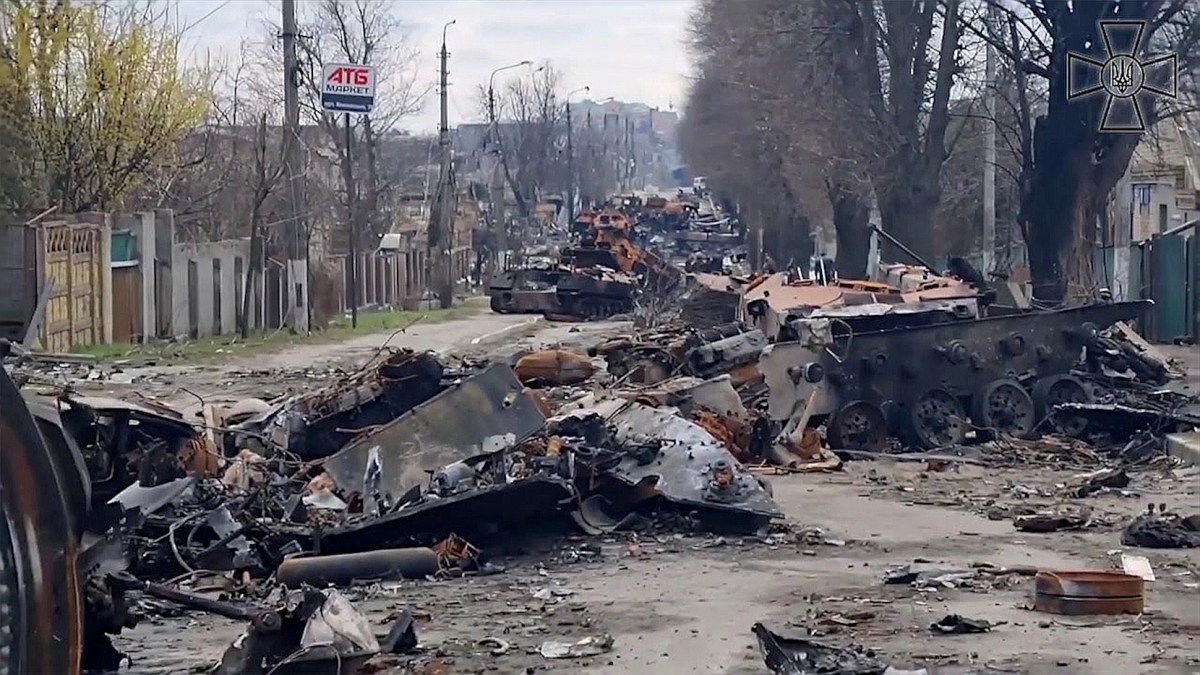
Russia and Ukraine have very different approaches to events on the frontline. Putin has demanded a heavy-handed approach, losing an enormous number of troops and huge quantities of equipment, currently throwing wave after wave of infantry at well defended Ukrainian positions (and now some North Korean infantry as well). Russian forces have been ignoring the rules of war, sometimes shooting prisoners, using chemical weapons and so forth.
Ukraine has lost men and equipment too, but on a far smaller scale. Their stubborn resistance along 1200 km of front line has prevented Russian forces from breaking through and although the forward momentum has been in favour of Russian forces it has also been momentum of a very slow, creeping kind. Ukraine has acted entirely within Geneva Convention rules.
On the missile and drone warfare there is a similar difference in approach between the two sides. Russia has targeted residential areas of towns and cities, even hospitals, schools, shopping centres and cultural treasures along with critical infrastructure, especially electricity power stations and local distribution transformers. Again, most of these targets are illegal under international laws and agreements, Russia being a signatory to many of them.
Ukraine has focused on military targets – command and control centres, airfields, naval dockyards and ships, army training camps, troop concentrations, oil production and storage facilities, arms factories, ammunition storage facilities, radar equipment, bridges, railways and roads feeding military traffic to the frontlines.
The effects so far
There have been small, creeping movements along the frontline, mostly in Russia’s favour, although the trend has been slower and slower over the past month and now Ukraine is beginning to make small advances as well from time to time, usually by means of well-planned and well-executed actions when good opportunities arise.
Economic considerations
The Russian economy is showing serious and dangerous strain. The rouble has lost a lot of value against western currencies. Interest rates are high as the central bank has used this as an effective tool to restrict inflation; but the increased borrowing costs have killed industrial investment. Unemployment is very low and Putin has claimed that as a great success, though the reason for it is that military casualties are in excess of 800 000 men and even larger numbers have fled the country to avoid being sent to the frontlines. Most industries are seriously short-staffed; skilled professionals are particularly hard to find.
By defeating Russia in the Black Sea, Ukraine has been able to continue her grain exports whereas Russia’s income from sales of oil and natural gas have fallen due to western sanctions as well as Ukrainian strikes on depots, production and transport facilities.
Military production
Russia is still producing new drones, missiles, ammunition, aircraft, tanks and other armoured vehicles, but at a slower rate than the losses inflicted by Ukraine. Stocks of all these essential items have therefore dwindled away and now appear to be in short supply.
Ukraine has also ramped up production of military hardware and consumables and is now in a position to continue fighting even if supplies from the West diminish.
Innovation
Russia has made progress with drone development, and has recently been making more use of FPV drones controlled via optic cable since this cannot be blocked by radio jamming.
However, Ukrainian production and scale of use of advanced drones far outstrips Russian developments. Recently, Ukrainian sea drones have been fitted with both machine guns and ground to air missiles and have downed helicopters sent to destroy them. This is a major new technological achievement.
And the future?
The balance has been shifting in Ukraine’s favour in so many ways, and the best predictions suggest the Russian economy will collapse, most likely slowly, then suddenly. It’s impossible to know precisely when ‘suddenly’ will come, but it will be devastating when it does. And economic collapse will likely mean military defeat and political upheavals as well.
My opinion based on what I have read and heard, is that the end may come during 2025 or 2026, but it might also happen very much sooner. It’s likely to be a surprise and it will almost certainly end the war, with Ukraine being the survivor.
Militarily too, Ukraine seems to be getting the upper hand. I think it’s very likely that things will go more and more Ukraine’s way in this war in the next few months. There are many unknowns of course, but on balance I expect Russia to eventually lose the war, probably through a combination of economic and military failure, and quite possibly by a Russian decision to withdraw from the conflict altogether. This could happen either as a decision from Putin following pressure internally or by a change of government. These details are not remotely predictable, however.
We in the West should do our part by continuing to apply political and economic pressure, and by continuing and extending our support for Ukraine.
See also:
- Putin is finished in long term – Silicon Curtain
- Russian war economy – Silicon Bites
Useful? Interesting?
If you enjoyed this or found it useful, please like, comment, and share below. (If you don’t see those links, click the article’s title above the main photo and they will appear.) Send a link to friends who might enjoy the article or benefit from it – Thanks! My material is free to reuse (see conditions), but a coffee is always welcome and encourages me to write more often! 


 Journeys of Heart and Mind

.jpg)
_01.jpg)