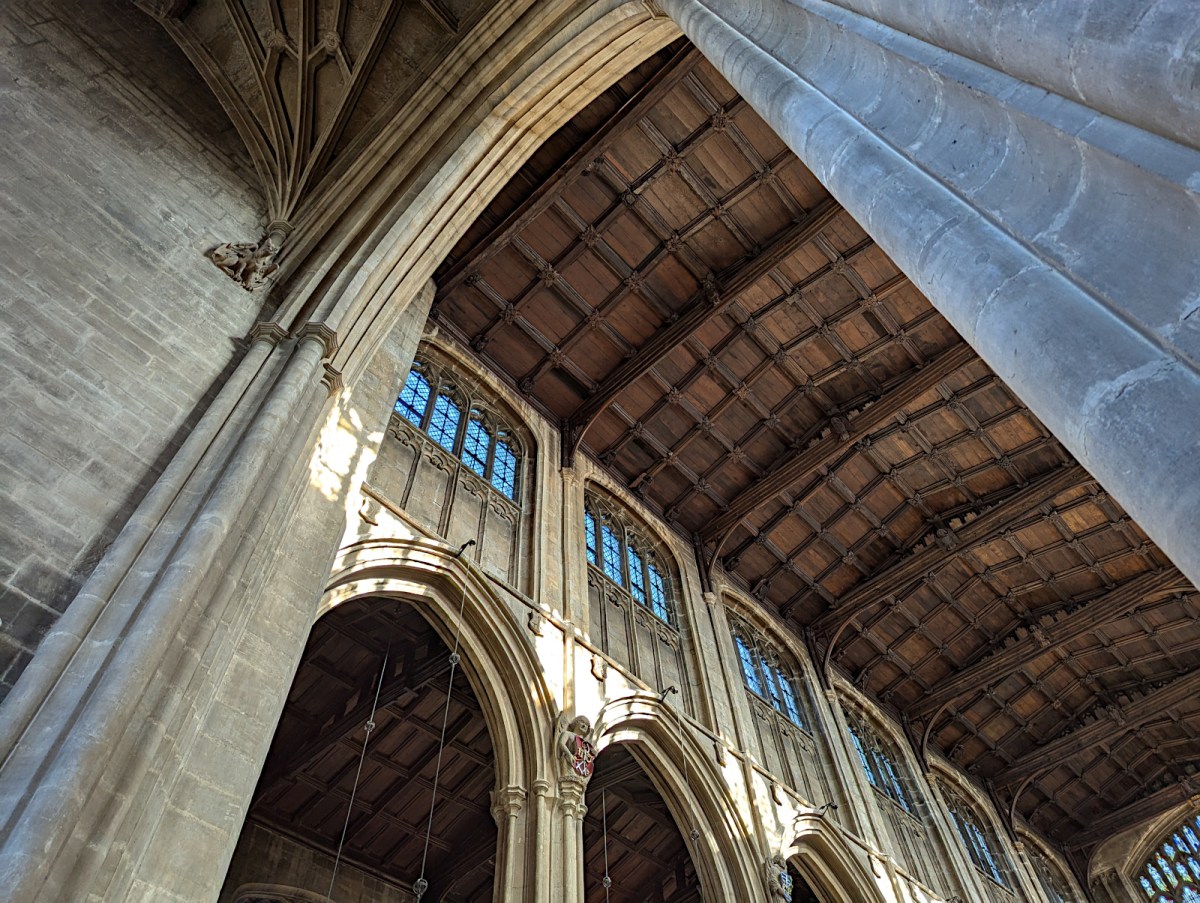
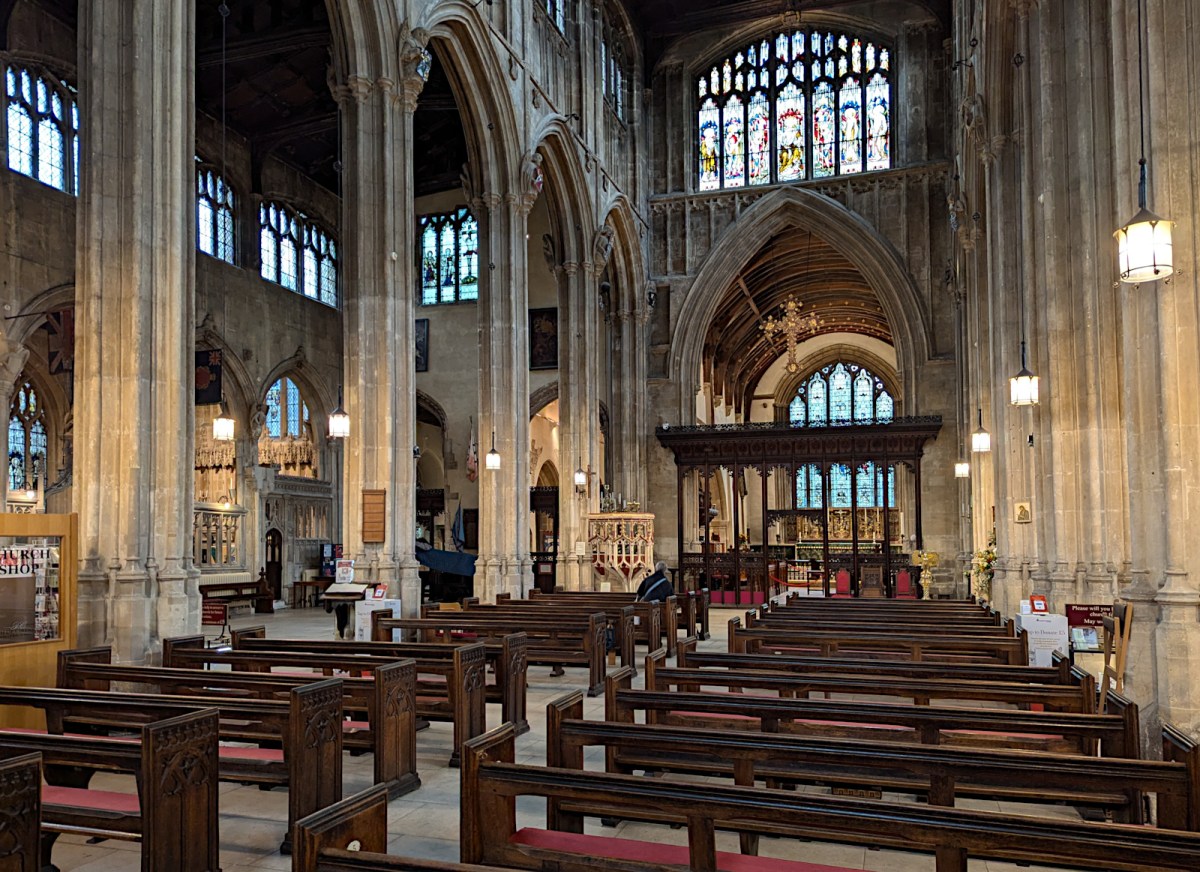
The Parish Church was built beginning in the 12th century, near the site of an earlier Saxon church…It’s by far the largest building in the Market Place and dominates the space.
What’s in an image? Sometimes quite a lot, more than meets the eye.
I’m posting an image every two days (or as often as I can). A photo, an image from the internet, a diagram or a map. Whatever takes my fancy.
Click to enlarge
In an earlier image we saw details of the Parish Church porch. This time we have a view of the entire church, with the porch in the lower right. It appears paler than the rest of the building because it’s had a protective stone paint applied to prevent further weathering; the colour is a good match when the unpainted parts are freshly cleaned.
The Parish Church of St John Baptist was built beginning in the 12th century, near the site of an earlier Saxon church; the tower was added in the 15th century and is the most recent structure. It’s by far the largest building in the Market Place and dominates the space.
Cirencester
For convenience, here’s a list of all the Cirencester area images:
If you enjoyed this or found it useful, please like, comment, and share below. My material is free to reuse (see conditions), but a coffee is always welcome!
Today, a lot of high street shops have closed as the retail trade has moved more and more towards business online. The future of high streets and shopping arcades is now in doubt.
What’s in an image? Sometimes quite a lot, more than meets the eye.
I’m posting an image every two days (or as often as I can). A photo, an image from the internet, a diagram or a map. Whatever takes my fancy.
Click to enlarge
Towns are always continuing their growth and development to make them more suitable for the current inhabitants. The photo shows Bishops Walk, a covered shopping area linking Cricklade Street with the Brewery car park and the pedestrian space containing the modern version of the hare mosaic. It was opened in 1990, thirty-four years ago.
Today, a lot of high street shops have closed as the retail trade has moved more and more towards business online. The future of high streets and shopping arcades is now in doubt, I wonder if Bishops Walk will still be here in a further thirty-four years. Perhaps it will find alternative uses, or perhaps it will be replaced by some new structure.
For the time being it seems safe enough, shopping under cover is possible in all weathers; and some of the businesses in Bishops Walk appear to be thriving. I wish this place all the best for the future.
Cirencester
For convenience, here’s a list of all the Cirencester area images:
If you enjoyed this or found it useful, please like, comment, and share below. My material is free to reuse (see conditions), but a coffee is always welcome!
Living in Cirencester always gives me a sense of history and the slow but unstoppable passing of the years and centuries. Will the hare mosaic still be available to see 1700 years from now?
What’s in an image? Sometimes quite a lot, more than meets the eye.
I’m posting an image every two days (or as often as I can). A photo, an image from the internet, a diagram or a map. Whatever takes my fancy.
Click to enlarge
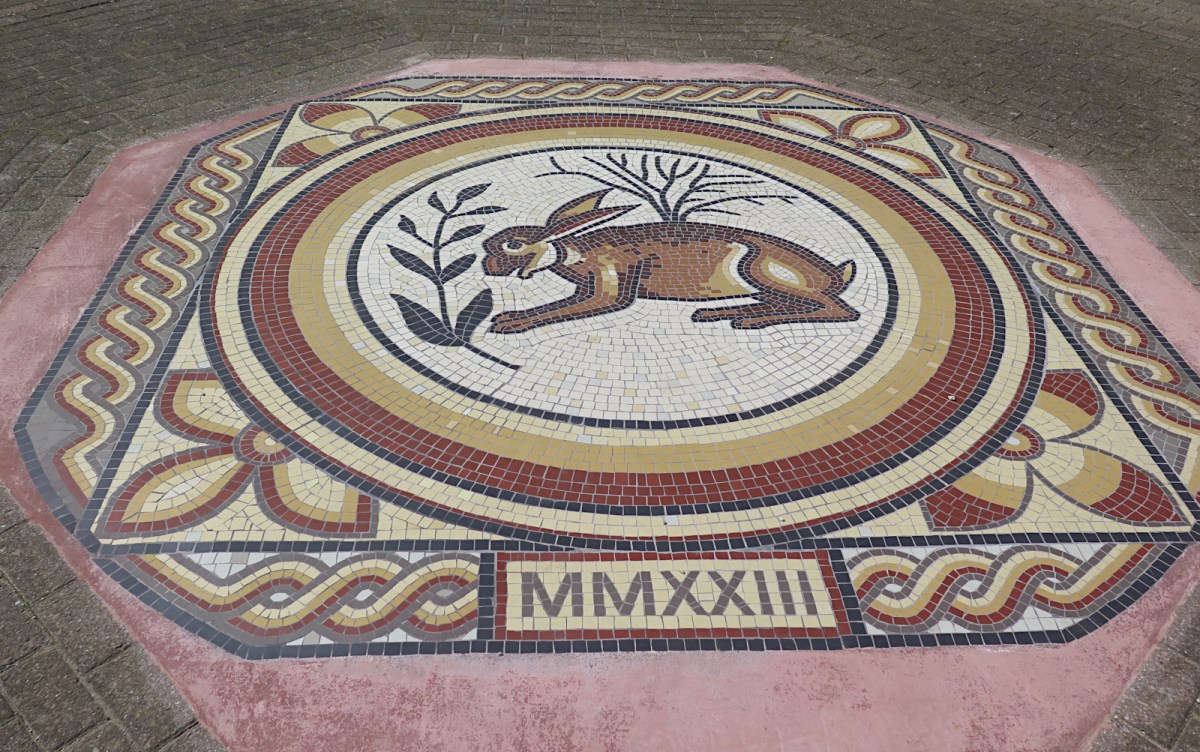
This is the same hare that we looked at in the previous Image of the Day, but this time it’s a modern interpretation of the Roman original, installed in a public space between Brewery Arts and Waterstones bookshop.
It’s great to have the hare mosaic out in the open for visitors to the town to discover as they explore; perhaps it will encourage some of them to visit the Corinium Museum to view the original as well. But I wonder what the owners of the town house where the mosaic was found would have thought about public display some 1700 years in their future!
Living in Cirencester always gives me a sense of history and the slow but unstoppable passing of the years and centuries. Will the hare mosaic still be available to see 1700 years from now, in the year 3724? Will the town even exist in 3724? What language will be spoken here in 3724? Certainly not 21st century English! Will we have cities on the Moon, Mars, and beyond by then? Deep time, both backwards and forwards, a fascinating topic to ponder!
If you enjoyed this or found it useful, please like, comment, and share below. My material is free to reuse (see conditions), but a coffee is always welcome!
What’s in an image? Sometimes quite a lot, more than meets the eye.
I’m posting an image every two days (or as often as I can). A photo, an image from the internet, a diagram or a map. Whatever takes my fancy.
The photo shows one of a number of beautifully painted hares around the town. This example stands at the southern end of Riverside Walk where it joins Thomas Street.
A hare featured in a Roman mosaic floor discovered just inside the eastern city wall, part of a very impressive town house. The hare mosaic is now in the Corinium Museum and hares have become something of a feature in the town. Recently the hare tradition has spread to the Cotswolds more generally too.
The mosaic was covered over by an underfloor heating system and a new floor laid on top. The new floor did not survive, but the old floor did, protected as it was by the stonework laid above it.
You might like to watch this video about the hare mosaic, published by the Museum.
If you enjoyed this or found it useful, please like, comment, and share below. My material is free to reuse (see conditions), but a coffee is always welcome!
What’s in an image? Sometimes quite a lot, more than meets the eye.
I’m posting an image every two days (or as often as I can). A photo, an image from the internet, a diagram or a map. Whatever takes my fancy.
Click to enlarge
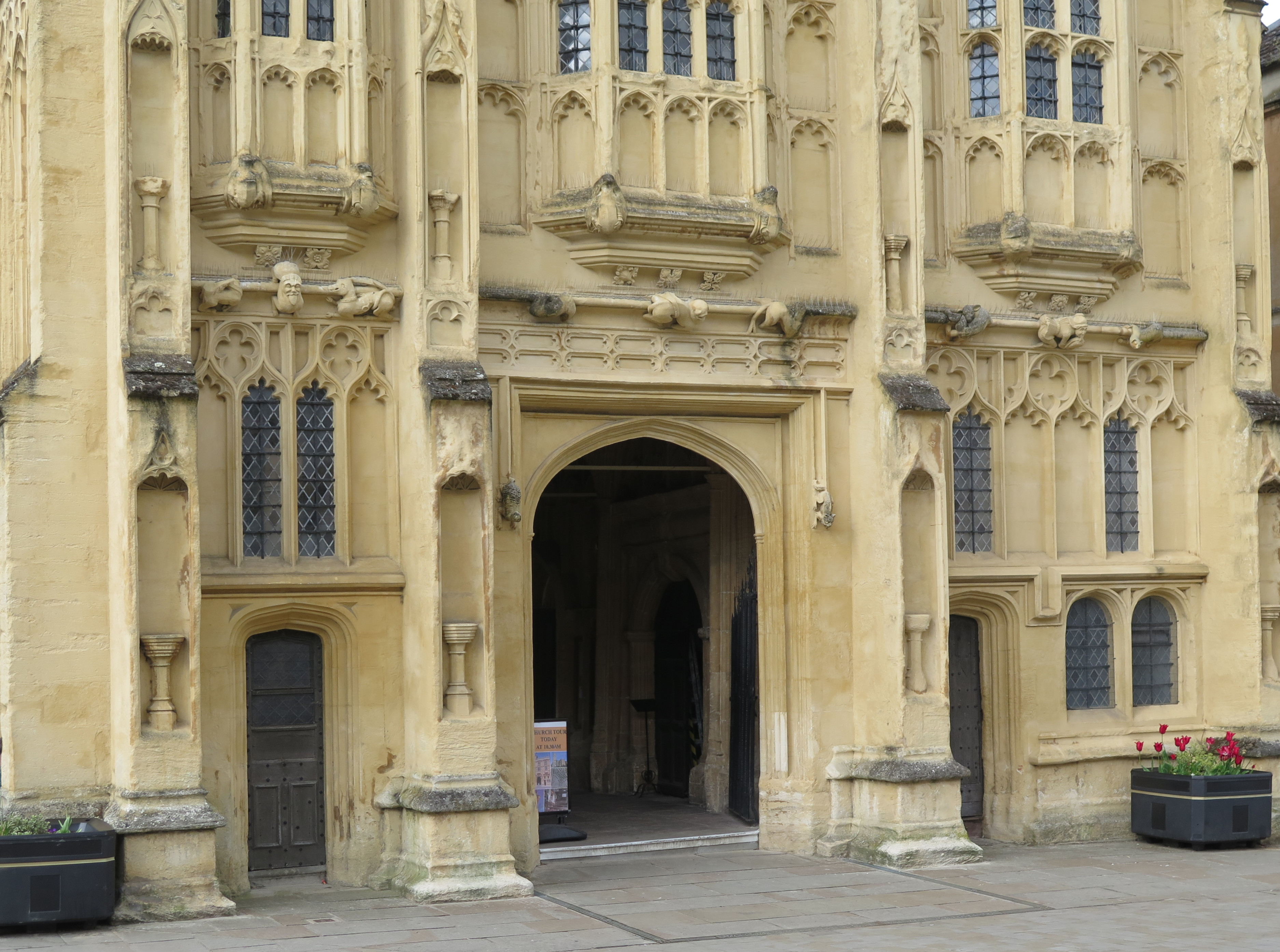
This is the porch of Cirencester’s Parish Church, St John the Baptist. It’s used as the main south entrance into the Church, and the door on the north side is also usually open, but the main West Door is kept closed and bolted. A three storey porch is a rarity, and in fact the two upper floors were once used as the Town Hall. But it seems the porch was built by the nearby Abbey as administrative offices and only attached to the Parish Church after the Abbey was dissolved.
This image shows the front detail, but I’ll post another photo soon showing the entire building. The architecture is interesting, with carved animals both real and imaginary, and niches for statues, now empty.
I think there’s something we can learn from this. There was an uneasy rivalry between the Abbott and the townspeople in medieval times. It’s thought that Cirencester was given a royal charter at one time, but the Abbot got hold of it somehow and destroyed it. Building the administrative centre right in front of the Parish Church makes me wonder about the motives involved in that, as well. Maybe there are other explanations I’m not aware of.
But we should always strive to get on well with those around us. It takes two to argue, but it also takes two to agree and agreement is usually better in the long run. In the uneasy relationship between abbey and town, the town had the last laugh when Henry VIII dissolved the abbey. And the town used the building in the picture and later gave it to the church to be added to the structure as perhaps the grandest church porch in all England!
Cirencester
For convenience, here’s a list of all the Cirencester area images:
If you enjoyed this or found it useful, please like, comment, and share below. My material is free to reuse (see conditions), but a coffee is always welcome!
What’s in an image? Sometimes quite a lot, more than meets the eye.
I’m posting an image every two days (or as often as I can). A photo, an image from the internet, a diagram or a map. Whatever takes my fancy.
Siddington canal bridge
Cirencester and its surroundings have changed dramatically over the years. This old bridge in Siddington takes a country lane over the old Thames and Severn canal. Although the canal is derelict, looking down from the bridge you get a clear view of the ladder of locks that used to be here. The good news is that the canal is being restored and is already in water again through Stroud. It will be reconnected to the national canal network within the next three years or so. Work has also started at the Cotswold water park, repairing the section from the spine road to Latton, and in Lechlade where it joins the Thames.
Sadly, there is no plan to restore any part of the Cirencester Arm of the canal, but it’s possible to trace the route of the towpath almost the entire way from Siddington to the bottom of Querns Hill where Cirencester Wharf used to see the loading and unloading of cargo.
Cirencester
For convenience, here’s a list of all the Cirencester area images:
If you enjoyed this or found it useful, please like, comment, and share below. My material is free to reuse (see conditions), but a coffee is always welcome!
What’s in an image? Sometimes quite a lot, more than meets the eye.
I’m posting an image every two days (or as often as I can). A photo, an image from the internet, a diagram or a map. Whatever takes my fancy.
Yellow flag Iris
These beautiful, water tolerant, native Irises pop up every year in the waterways in and around Cirencester. The photo was taken at the junction of Riverside Walk and Gloucester Street right by Abbey Way Services. The photo was taken in May, just as they were reaching their best.
Although our natural environment is struggling to cope with the many pressures we put on it, some species manage to do quite well. This is one of them. But there are many others that are in danger. Some of these, plants and animals, are fairly stable or even recovering in and around the Cirencester area with careful conservation management. Examples include the lovely snakeshead fritillaries that flower abundantly in North Meadow just south of Cricklade, pasqueflowers in a strong colony to the north of the town near the Stow Road, and the large blue butterfly on a reserve west of the town and on common land near Stroud.
NOTE: If you visit any of these sites, please treat them with respect. Stay on marked paths if they’re available, avoid trampling on plants, stay out of restricted areas, and definitely don’t dig anything up. Pay attention to signs and notices. Thanks!
Other species, once rare but now much more common include red kites, you’ll see these frequently in the skies around Cirencester, often flying very low, even over housing estates. Back along Riverside Walk you may be lucky enough to see a heron, a kingfisher, or a little egret.
Cirencester
For convenience, here’s a list of all the Cirencester area images:
If you enjoyed this or found it useful, please like, comment, and share below. My material is free to reuse (see conditions), but a coffee is always welcome!
What’s in an image? Sometimes quite a lot, more than meets the eye.
I’m posting an image every two days (or as often as I can). A photo, an image from the internet, a diagram or a map. Whatever takes my fancy.
Christmas lights
This is Cirencester Market Place on 5th January 2021, still in its decorated-for-Christmas state. In the 17th century this space was full of buildings and narrow streets. Roughly where the red car stands, imagine an old inn with a street either side, and beyond it two rows of buildings, Butter Row and Butcher’s Row, so three streets at that point. Many old buildings were destroyed in town improvement schemes over the years. If they still existed today they would attract preservation orders.
If you could visit the Market Place in 1500 you would struggle to recognise anything other than the Parish Church. All the fine, Cotswold stone buildings were constructed more recently than that, the shops and dwellings at that time would have been timber framed with overhanging upstairs floors. The entire look and feel of the place would be different. At that time the Abbey was thriving with the Abbey Church behind the existing Parish Church. The entirety of what is now the Abbey Grounds would have been busy with monks on errands and at work in the gardens, at the fishing lake (still there today), in the mill and bakery and so much more. It was almost a walled town within a town.
In the year 1000, shortly before the Norman invasion, some of Saxon Cirencester may still have been outside the old Roman walls, but there was a Saxon church in the area of the Abbey Grounds and it’s likely that other parts of the Roman City would have been cleared and put to use.
And in the year 500 the Romans had left only 100 years earlier. The city would have been more or less intact, but derelict. Initially, Saxon settlers lived outside the old city walls. Some of those walls would still have been standing, at least in places, and the larger buildings inside the city would have been identifiable – the Basilica, the Forum, and probably Baths and a Theatre (now lost). The Saxons built timber framed houses and farms initially outside the walls. Piles of rubble and stone, no doubt ridden with extensive and impenetrable growths of brambles and trees, would have seemed far less useful than the arable land outside the old walls.
Go back another five hundred years and the area where the town now stands consisted of a flood plain with low gravel banks and the River Churn meandering through. There would have been yellow iris, water mint, alder and willow in wetter areas with other trees on higher ground. The waterways would have been easily forded and the local Dobunni people likely fished in the area and farmed on higher ground nearby. The Roman army constructed the Fosse Way from Exeter to Lincoln and built a timber fort in the eastern part of modern Cirencester. It’s likely that a trading settlement grew up near the fort and the town was officially recognised in 75 CE. By the later Roman period it had become the second largest city in Britain (London was the largest).
All of this took place in and around the area we know today as Cirencester Market Place.
Cirencester
For convenience, here’s a list of all the Cirencester area images:
If you enjoyed this or found it useful, please like, comment, and share below. My material is free to reuse (see conditions), but a coffee is always welcome!
What’s in an image? Sometimes quite a lot, more than meets the eye.
I’m posting an image every two days (or as often as I can). A photo, an image from the internet, a diagram or a map. Whatever takes my fancy.
Stone plaque, Cirencester
This intriguing carved, stone plaque is in Cirencester’s West Market Place, close to the Parish Church. The Latin inscription ‘VIRTUTE ET INGENIO’ is interesting; ‘VIRTUTE’ can mean ‘virtue’, ‘courage’, ‘strength’ or ‘power’; ‘ET’ is ‘and’; while the word ‘INGENIO’ means ‘wit’ in the sense of cleverness, not humour. So the best I can offer is ‘strength and cleverness’, the English expression ‘brawn and brains’ sums it up quite well.
The shield above contains a rampant lion with two tails, holding up what looks like a rose. And on either side is a shoot of ivy, each with one ivy flower cluster. Do those two tails refer to the idea of something twofold, perhaps the need to be strong in both action and thought, body and mind?
Maybe someone in Cirencester knows the meaning and history of this interesting artefact. But meanwhile I’ll just take it as very sound advice that we need to think things through properly, and then act on whatever conclusion we might come to. Action without thought is usually a waste of effort, thought without action is ineffective. Thinking it through and then doing it is the way to go!
Cirencester
For convenience, here’s a list of all the Cirencester area images:
If you enjoyed this or found it useful, please like, comment, and share below. My material is free to reuse (see conditions), but a coffee is always welcome!
Notes from bygone years – September after September after September. Hint: Click on the thumbnails for larger images.
September 2023 (1 year before publishing this article)
From time to time we visit Donna’s brother Paul and his wife Ness in Weston-super-Mare, and their two Labradors (pictured). They are sisters, but they have different temperaments, just like people. On this visit, Paul and Ness were heading off for a holiday so Donna and I looked after the dogs for the week.
One of our favourite walks is to take the dogs to the beach for exercise and then to Stones Cafe, a seafront place where we like the breakfasts, so we get a treat before walking home. If we just take Maizi, she gets a dog sausage as well, but fatty foods are a problem for Marple.
We finished our family holiday in the Pennines, and drove home on 2nd September. And the very next day we set out again to drive to the village of Llantisilio in Pembrokeshire for a week with Paul, Ness, Isobel and the dogs.
It was during our stay that we heard about the death of the Queen and the accession of Charles III.
One day we drove to Tenby to look around and visit the indoor market, and we unexpectedly bumped into some friends that we’d made a few years ago in Cirencester, who have since moved to Yorkshire. And here they were in Tenby!
World events: The G7 Imposed a price cap on Russian oil exports; and Liz Truss was appointed Prime Minister of the United Kingdom.
The fencing around our back garden was finished, and we were very pleased with it.
I was working on some decorating in Tony and Isobel’s new house, next door but one to ours; having them living close would make it far easier for Donna to help her Mum cope as Tony deteriorated (he had Parkinson’s). A local builder made some alterations for them, including bricking up an unwanted door.
JHM: I wrote an index for articles on my family’s old business. World events: In the UK, Thomas Cook went bankrupt; and in the USA an impeachment inquiry began against President Donald Trump
Donna started her teacher training at the college in Stewartby; and at a Small Group meeting in St Neots she read out Ezekiel 47 and asked, ‘How deep are we prepared to go?’ This led to some good discussion. She was also helping with the Food Bank at this time.
I was meeting with my friends Matt, Kev, John, and Mo, we’d been reading the Bible together and trying to follow Jesus better. Meanwhile, the BBC reported the grim news that Islamic State had beheaded a British aid worker in Iraq.
We visited York to see Debbie, Beth and their families, Sara was six this month.
I flew to the USA for the House2House Conference in Dallas over the weekend of 2nd-6th. From there I flew to West Palm Beach to stay with Steph and Earl, then on to Boston on 14th to join up with Donna for a holiday, returning home via Gatwick on 26th.
We drove down to the RHS Garden at Wisley and spent a good part of the day there exploring. There’s a lot to see! Donna managed to get this picture of me while we were there.
We’d been invited to a party in St Neots in the evening, but we still had enough time to look around quite thoroughly before driving home and getting ready for the evening event.
JHM:I posted meeting notes on Touch and seasons. World events:Chechen rebels took 1,128 people hostage; and West Sulawesi became the 33rd province of Indonesia.
We had a house-warming barbecue on 12th at our new home in St Neots, with a mix of guests from Unilever, Open Door Church and some neighbours.
On 17th we set off for a holiday in Sorrento. The photo shows the remains of a bakery in Pompeii, the grey devices are flour mills and you can see a brick-built oven in the background. Pompeii and Herculaneum were both amazing to see.
During surgery to remove Judy’s colon tumour, metastases were found in her liver. She was offered a course of chemotherapy (5-fluorouracil) but although this was likely to give her a few more years, it would not be a cure.
This was a shock to the whole family, I have few photos, documents, or notes for the year following Judy’s surgery.
World events: Britain lifted the Northern Irish broadcasting ban on Sinn Féin and paramilitaries; and the Taliban movement was founded in Kandahar, Afghanistan..
Due to lack of rainfall and a hot summer, the water levels in Chew Valley Lake fell to the lowest we could remember. The photo shows a road crossing the River Chew over a stone-built bridge, all of which would normally be under water.
World events: An IRA bomb exploded at the Royal Marine School of Music in Deal, killing 11 people; and Hurricane Hugo devastated the Caribbean and the southeastern USA.
It’s always fun to do something unusual. Here are Debbie and Beth eating outside in the sunshine, it was lunchtime judging by the direction of the shadows.
There are fully grown apples on the tree beyond the table, but unpicked so presumably not quite ripe at the time of the photo.
At this time we were busy with faith meetings of various kinds. Our band, Fountain, played and Judy spoke at Pill Baptist Church around 16th, and on 21st Colin Urquhart spoke at Portishead URC where I recorded his address in support of the coming Good News Crusade.
We visited Blenheim Palace, possibly with Judy’s Mum and Dad. It was a fine, early autumn day with a blue sky and strong sunshine.
Judy was pregnant at the time, we had no way of knowing whether to expect a boy or a girl (no ultrasound scans in those days), but in the event it would turn out to be Debbie. A highly satisfactory outcome!
Judy’s 21st birthday was 10th September and we were all invited to Cheltenham for her party. I think this was at 18 Hales Close, and Judy’s brother Frank must have taken the photo. We were both about to head back to University for our final year, me to Bath and Judy to Aberystwyth.
Our Irish holiday continued into the beginning of September. This is the River Bann at Toome Bridge just north of Lough Neagh. Granda was a water bailiff on the Lough, protecting the eel fishery from poaching. The boat he took us out in is the one in the bottom-right corner.
World events: The Forth Road Bridge opened in Scotland; and the Beatles refused to play to a segregated audience in Florida.
After my Grandpa’s death and the funeral, Granny (Nor) went to Kent for a holiday in the area where she grew up, and visited places she remembered and was fond of. Perhaps she had friends or family to visit as well, I don’t know. What I do know is that this card had a long strip of conceretina-folded photos with other views that you could pull out. However, this has not survived.
World events:Luna 2 became the first human-made object to crash on the Moon; and the Xerox 914, the first plain paper copier was introduced.
We were on holiday at Muddiford, near Christchurch 0n the south coast of Hampshire. I was six at this time and Cindy was three, and Dad decided to send a postcard to Ireland on our behalf. His message on the back seems a bit cheeky, though, recommending Muddiford over Portrush! I wonder what Granny-in-Ireland thought about that? (view the card)
It was Mum and Dad’s second wedding anniversary at the end of September, and I was 14 months old. I was likely becoming more confident at both walking and talking. Possibly I’d have been doing unhelpful things as well, like trying to climb the stairs! Keeping a young child safe gets harder as they try new things.
Dad’s Uncle Herbert died (he’d been ill for some time). Dad continued working with radar at the Ballinderry RAF site, and visiting Coagh to spend time with his new friend Lilias. And on 6th September Dad reported hearing ‘awe inspiring drumming’ in Coagh.
By the end of the month Lilias was feeling she was falling in love with Dad, but in his diary he wrote that this was ‘a pity’. I’m glad he changed his mind later!
World events: II: In Operation Market Garden airborne landings began in the Netherlands and Germany; and the first V-2 rocket was used to attack London.
If you enjoyed this or found it useful, please like, comment, and share below. My material is free to reuse (see conditions), but a coffee is always welcome!