What’s in an image? Sometimes quite a lot, more than meets the eye. I’m posting an image every few days.
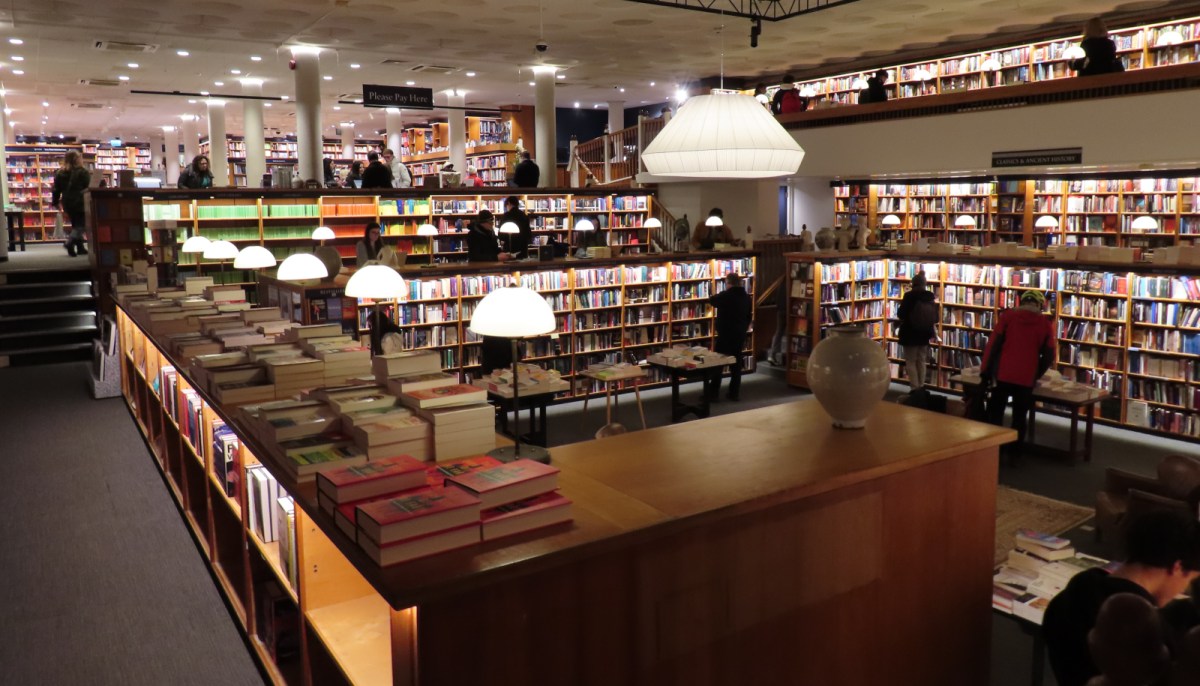
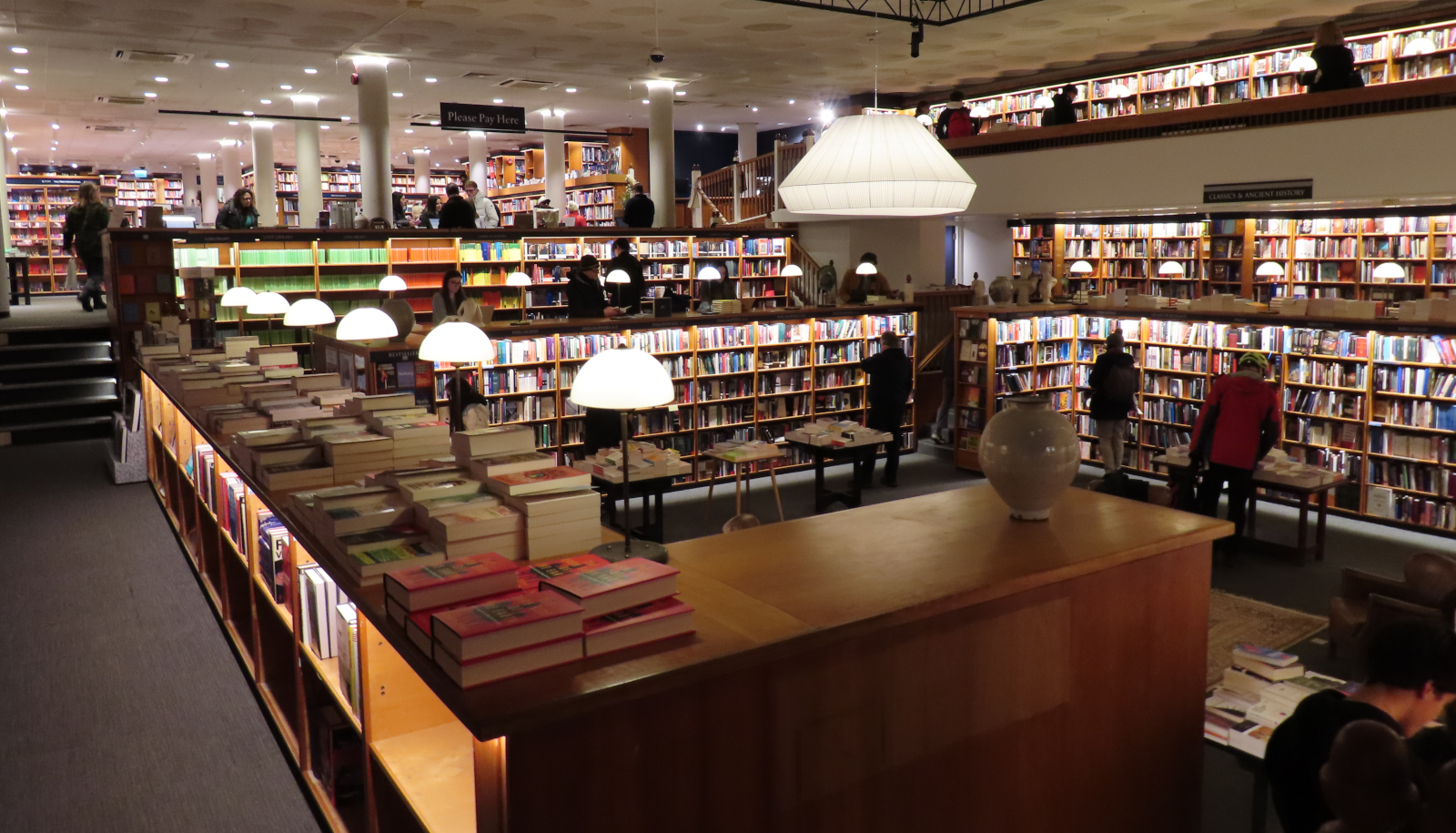
The Norrington Room (Click to enlarge)
The photo shows the basement of Blackwell’s Bookshop in the centre of Oxford, the famous university town in the UK.
Blackwell’s Bookshop in Oxford is huge
You can get a good idea of size from the photo, there are four or five floors above the basement, large but not as open; the upper floors are smaller and have no long views like this one as the line of sight is broken up by countless units of shelving.
Map centred on Blackwell’s
This was where the original Blackwell’s bookshop was, but it has grown larger and larger over the years. The basement, shown in the photo, is known as The Norrington Room and has five kilometres of bookshelves in it, containing 200 000 books. Blackwell’s in Oxford also hosts a Caffè Nero on the first floor. The map (opens in a new tab, click to resize and drag it) is centred on the bookshop in the very heart of Oxford.
Some history
The current bookshop in Broad Street opened in 1879, though it was much smaller in those days, at a mere 4 m square. The first bookshelf unit is still in use, at the top of the stairs to the first floor. The shop soon expanded, incorporating the cellar and the first floor as well as several adjacent shops. There was an earlier Blackwell’s bookshop, also in Oxford, that opened in 1846.
Blackwell’s had an online presence from 1995, selling books worldwide. It also opened retail outlets in many other cities and towns across the UK. As a company it remained independent until the business was bought in 2022 by Waterstones, another major British book retailer.
If you enjoyed this or found it useful, please like, comment, and share below. (If you don’t see those links, click the article’s title above the main photo and they will appear.) Send a link to friends who might enjoy the article or benefit from it – Thanks! My material is free to reuse (see conditions), but a coffee is always welcome and encourages me to write more often!
Entering the long gone wooden gate you would have seen the potting shed on the left and beds edged with lightweight breeze blocks and filled with crushed clinker on the right. This was the standing area for the Alpine plants propagated at Watermoor. (1940)
July 2025 (3 months before publishing this article)
Click pics to enlarge
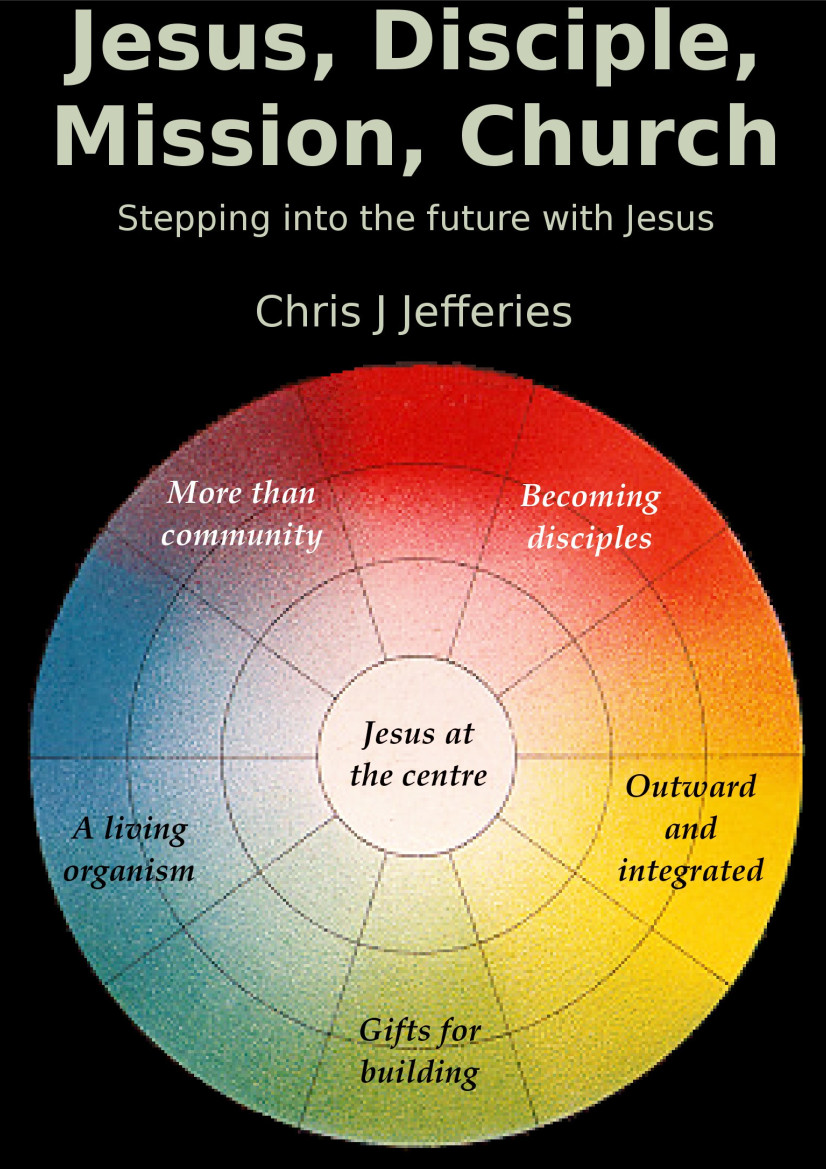
Book cover
I was invited to share some material from my short book ‘Jesus, Disciple, Misson, Church’ (JDMC) with the Small Group I meet with on Tuesday evenings. This is a discussion group belonging to Cirencester Baptist Church (CBC). On 1st July we worked through the first two sections of the introduction, ‘Working together in six ways’. And the following week we worked through the third and fourth parts. Everyone seemed to think this was a useful exercise and I found it most encouraging.
Most weeks, Donna and I visited our neighbour, George, in Dursley Hospital. We also took Donna’s Mum, Isobel, for a four-day break at a Warners Hotel near Hereford (Holme Lacy House Hotel). And we bought a second-hand electric car which we’re calling ‘Erik’. All our cars get a name, and because this one is a Nissan Leaf the connection is ‘Leif Erikson‘.
Thames
We went for a walk along the Thames near Lechlade, starting from Buscot Weir. It was a pleasant stroll on a really nice day. Not an adventure or a long walk, but a lovely ramble. The river meanders a lot here, and so does the footpath as it stays close to the river all the way.
JHM: I wrote on the apostolic gift; and an old house in Cirencester. World events: Israeli aircraft struck the Presidential Palace and the General Staff headquarters in Syria; and a strong earthquake off the coast of Kamchatka, triggered tsunami warnings in Japan and Hawaii.
One day, walking into Cirencester along the busy Gloucester Road, we spotted this cinnabar moth having a rest on the footpath. It had no idea how much danger it was in. We might easily have stepped on it, so we moved it on and it fluttered around and settled on a nearby lime tree where it would be safe.
This was the moth’s second danger recently. It seems to have brushed against a spider’s web. The grey mass behind its head looks like tangled, sticky spider silk, so perhaps two lucky escapes in one day.
The Old Prison
We took Donna’s Mum out for coffee and a light meal at The Old Prison at Northleach. And we met Paul and Vanessa at Frampton on Severn for a circular walk. Their two black Labradors, Marple and Maizi are too old to join in these days, but they’re OK to be left sleeping at home for a few hours.
And at the end of the month we took Isobel to a hospital appointment in Gloucester and while she was waiting Donna and I visited Gloucester Docks nearby.
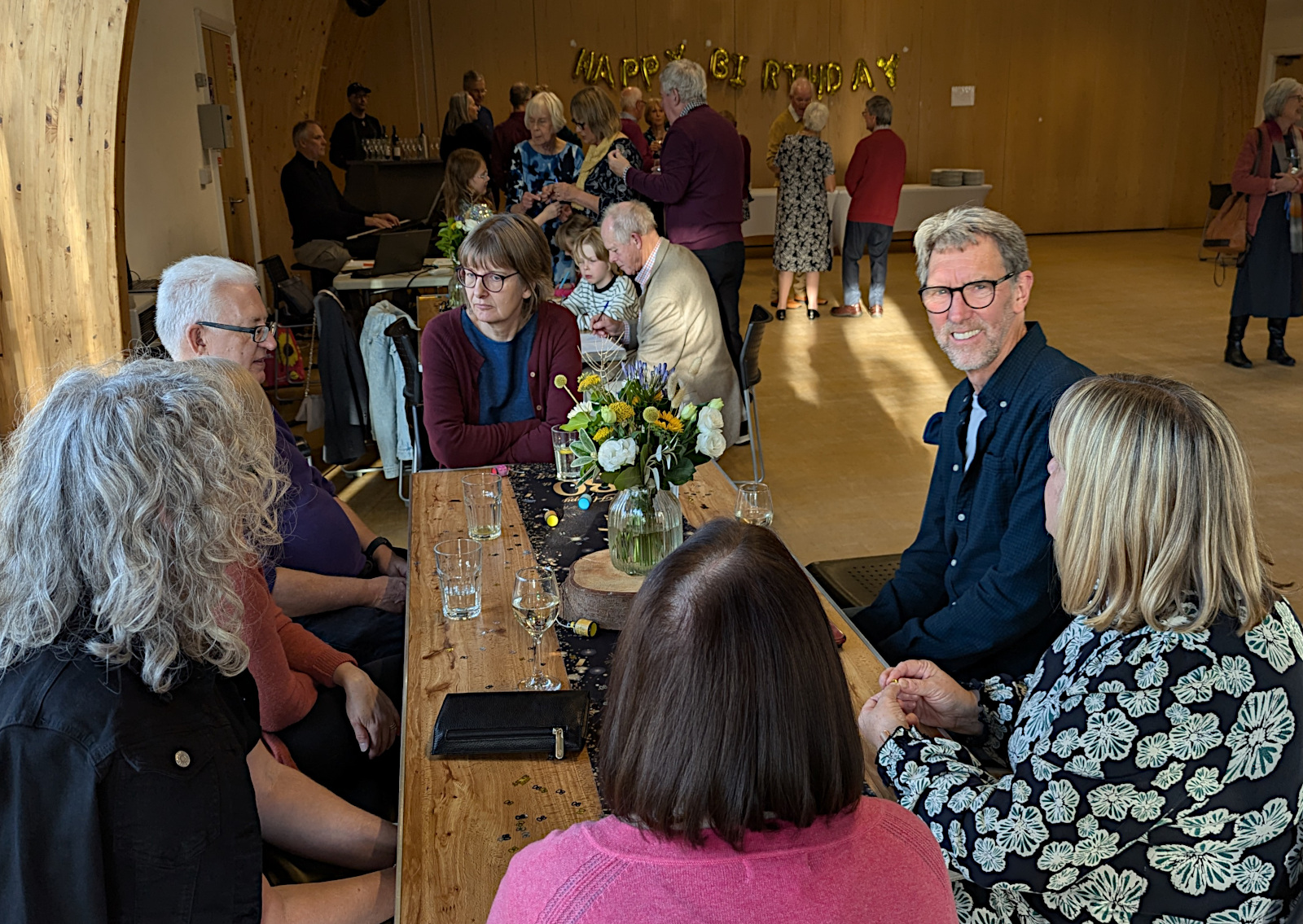
I had my flu and COVID jab early this month. We drove to Nottingham for Roger Owen’s 80th birthday party, Roger and Carolyn are good friends from our time in St Neots. There were many old friends from the Small Group that they ran and it was fun to meet everyone again.
It was disppointing to hear that the Internet Archive went down because of a denial of service attack. Why would anybody do that? it soon returned for searches, but it was a few weeks before data could be uploaded again. Our gas heating boiler failed towards the end of the month and would have cost almost £1000 to repair so we decided to buy a heat pump instead as there’s still a good government grant available.
Rafflesia in flower
Beth and Paz came down for an overnight visit, lovely to see them as always. At the end of the month we spent a day in Oxford, and, the Oxford Botanic Garden had a Rafflesia in flower ‘Stinking corpse flower’, though thankfully it was not in its stinking phase. The only other time I’ve seen one of these was during a forest walk in Thailand.
JHM: I wrote about the Spelga Dam in the Mountains of Mourne; and the need to go out and deep as Jesus did. World events: Iran attacked Israel with ballistic missiles; and The Europa Clipper spacecraft was launched to investigate Europa, an icy moon of Jupiter.
I started walking regularly with two friends, Al and Phil, in part this was an exercise (no pun intended) to help Al improve his fitness. On 19th we walked near Miserden in pouring rain and muddy conditions, but thoroughly enjoyed it.
Mop fair
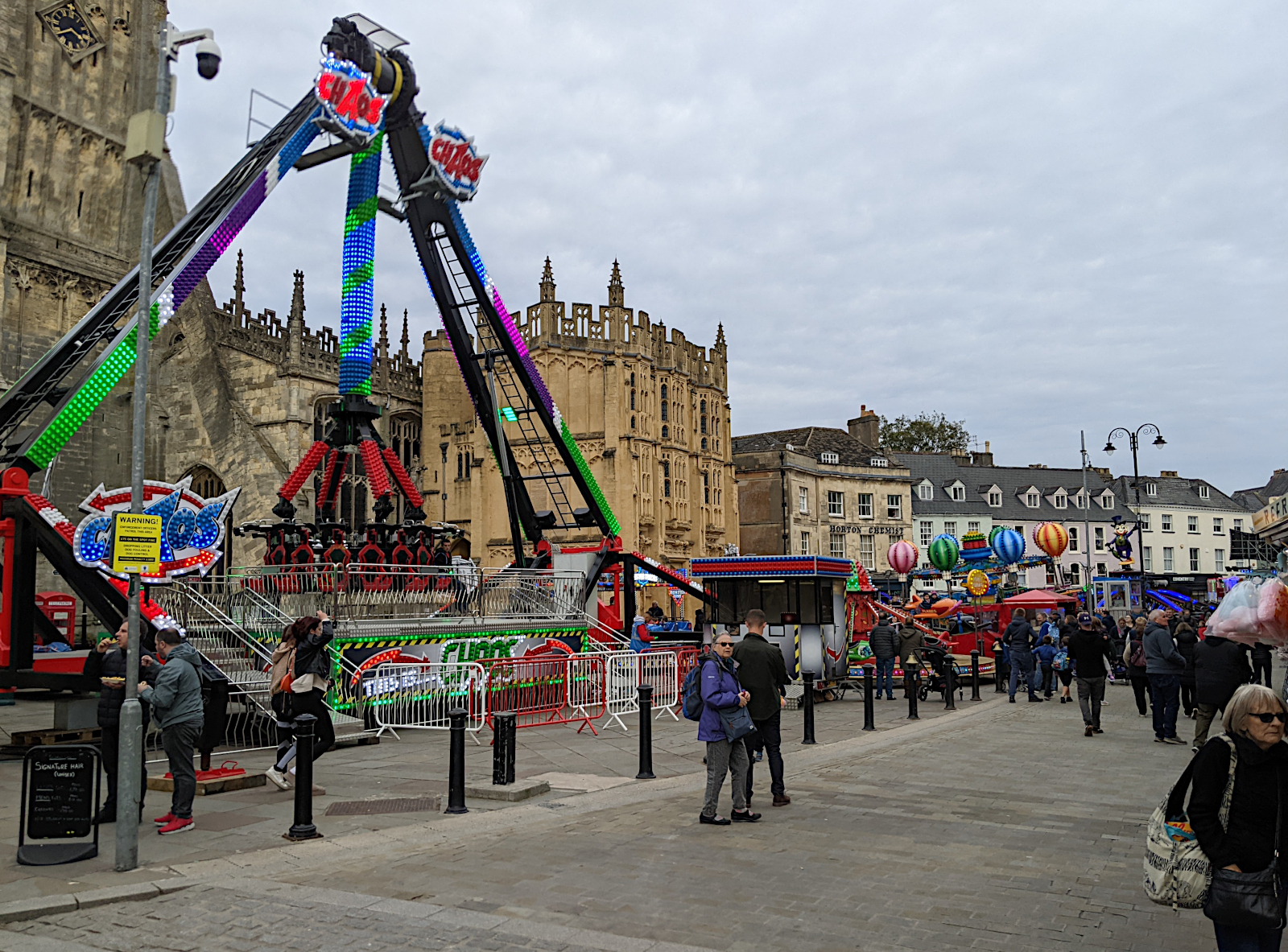
The annual Mop fair came to Cirencester as it does every October, the streets in and around the Market Place are filled with rides, stalls, people, noise and colour as well as the familiar and evocative aroma of diesel generators, candy floss and close-packed crowds. I remember Mop as a child when warmth from the thousands of incandescent light bulbs was tangible. The name ‘Mop’ goes back to the days long ago when it was the annual hiring fair. It would have been the time and place to engage domestic servants or staff for businesses; and people would have gathered to look for work.
Donna’s Uncle Ken died this month after a long battle with Parkinsons. This left Donna’s Mum with only two remaining close family members, her daughter (Donna) and her son (Paul).
Paul and Vanessa went to Bath for a weekend break so we drove down to Weston-super-Mare with Isobel to look after the two dogs. Maizi and Marple were young in 2020 and were very ambitious in picking up sticks to carry home. As they aged later in their lives they chose smaller and smaller sticks, eventually seeming perfectly happy with a short twig.
Walking with Phil and Judith
We drove to Bibury and met our friends Phil and Judith for a short walk. We followed a stone track to Oxhill Wood, then turned right to come out near Bibury Court Hotel. Afterwards we had coffee and a bite to eat at the tent restaurant by the trout farm. COVID is getting more manageable, for example the possibility of walking with friends and eating out in well ventilated places. Businesses are beginning to explore way of working with the remaining restrictions in place.
There was a heavy hailstorm on 28th October, some of the hailstones were the largest I’ve ever seen.
Peter and Dadka were living in our spare bedroom, sharing our kitchen and shower. They were both Slovakian and had been struggling financially and in other ways as well. But things brightened for them a bit as Peter had just obtained a job driving a ready-mix cement wagon. It was hard work, but it was a secure job and reasonably well paid too. Hopefully it seemed their financial position might start to improve and they could look for a bed-sit or a small flat of their own.
East Anglia Regiment
On 20th October, the East Anglia Regiment visited St Neots to receive the freedom of the town; the band and a small group of soldiers marched with rifles and fixed bayonets from Huntingdon Street and along the High Street into the Market Square for the ceremony. I took some photos on my phone and there was cheering and clapping from the townsfolk.
JHM: I posted an article on Stone Ivy. World events: A series of suicide bombings killed at least 100 people at a peace rally in Ankara, Turkey; and Hurricane Patricia became the most intense hurricane ever recorded in the Western Hemisphere.
Donna and I went along to some of the meetings at The Father’s Heart Conference at the King’s Arms Church in Bedford. There were some good things, but overall I didn’t find it particularly useful. It reminded me once more about the difficulties faced by ‘big’ church and the events that people get excited about. But life is not so much about big events as it is about the humbler things in life. All sorts of things fit this humbler category, including the very tiny garden snail moving along a matchstick in the photo with a £2 coin for scale. Click the image for a larger view, so amazing!
Meeting friends at Cornerstone
At the third Cornerstone Directors Meeting, there was a lot of talk about high costs and food wastage, and about staff requirements. Paul was rather defensive, promising that several requirements were in the pipeline but not yet fully achieved. Most of us felt everything was a bit out of control.
I helped some friends from New Zealand move house in Southgate, London. They’ve been in the UK for quite some time now and plan to return soon, some older, grown up, children live in New Zealand but a younger son and daughter are here in the UK.
We visited Southwold on the Suffolk coast. It’s a lovely little town and our friends Ken and Gayna had a house not far away in the village of Yoxford (though they lived at the time in Perry, not very far from St Neots). Athough Southwold is a delightful little seaside town with some lovely features, I always feel a little disoriented on the east coast; being western born and bred I expect the sun to set over the sea, not rise over it in the mornings!
Intranet site archives
At Unilever Colworth, I was busy archiving all the Web Team’s servers as everything was being migrated to new systems that we would not be managing ourselves. It seemed a good precaution to capture everything on long term storage first, so if there were any issues we could easily repair them. I don’t think we ever needed those archive disks.
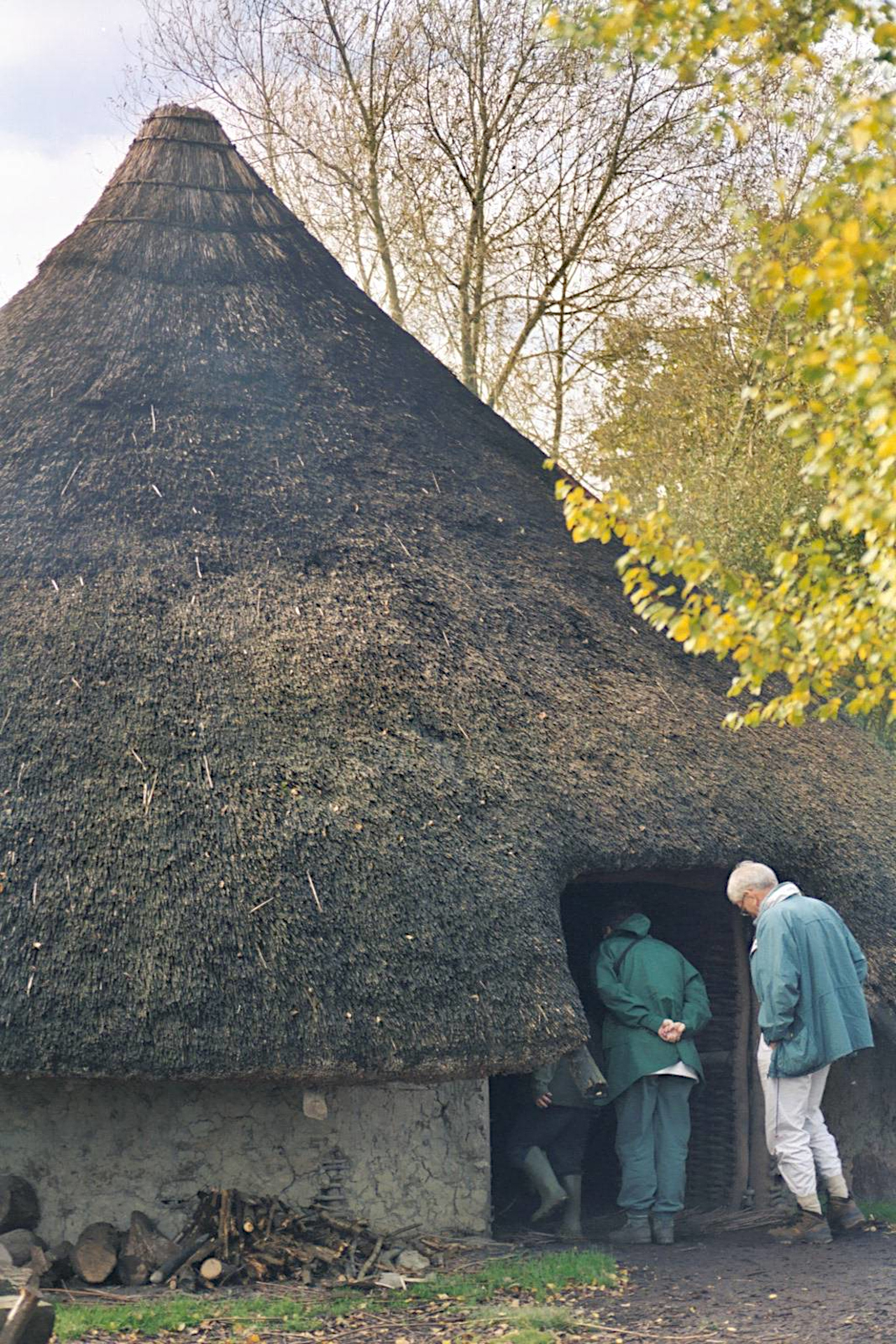
We dropped in to see my Mum and Dad on our way to visit Beth and Paz who were living in Axbridge at the time. Paz and I went out to look around Shapwick Heath National Nature Reserve where there’s a replica section of the Sweet Track and some Iron Age buildings.
Iron Age roundhouse
An Iron Age roundhouse was easy to build but very effective in Britain’s wet, temperate climate. A series of stout poles inserted into the soil supported the walls and roof, the walls were woven from willow or hazel and then plastered with mud and straw, and smoke from the central firepit escaped through the thatch (you can see this in the photo, click the thumbnail for a clearer view).
World events: Mass demonstrations in Belgrade led to Slobodan Milošević‘s resignation; and an Intercity 225 express train derailed in Hatfield, killing four and injuring many others.
Judy was facing several issues. She was clearly retaining fluids and her feet were swollen and puffy. She was receiving great care from her GP at Yatton Surgery (today, Mendip Vale Medical Practice). I was beginning to feel she needed someone around more of the time so was planning to ask for more time away from work. Our 25th wedding anniversary fell on 3rd so we had visits from both sets of parents. Paul, Jenny, Tony and Faith came to visit too and we talked about Alan and Dorothy joining us on 6th to pray for Judy and anoint her with oil. In the end they didn’t appear, but did so at a later date.
On 12th, Judy began taking small doses of morphine to help her sleep more comfortably and there were signs of her liver struggling a bit, blood albumin levels were low as a result.
Things were difficult in the LARS Computing Section too. We were overworked, needing to get Windows 95 out to the users and working correctly with the NT server. The Institute of Arable Crops Research (IACR), of which Long Ashton Research Station (LARS) was a part, wanted to take control of our computing facilities; but LARS was also the Department of Agriculture of Bristol University, and they were offering us a different route for our networking needs.
World events: The discovery was announced of the planet 51 Pegasi b, the first confirmed extrasolar planet around an ordinary main-sequence star; and O. J. Simpson was found not guilty of double murder in a criminal trial.
Mum and Dad drove to Yatton to visit us for the day, bringing four nieces and nephews with them (Gavin, Rebecca, Dan and Rosie). We went with them to Bristol’s Museum of Transport and enjoyed a good look around, inside and out. The weather was reasonable too and it was a great day out together.
Cleaning the run
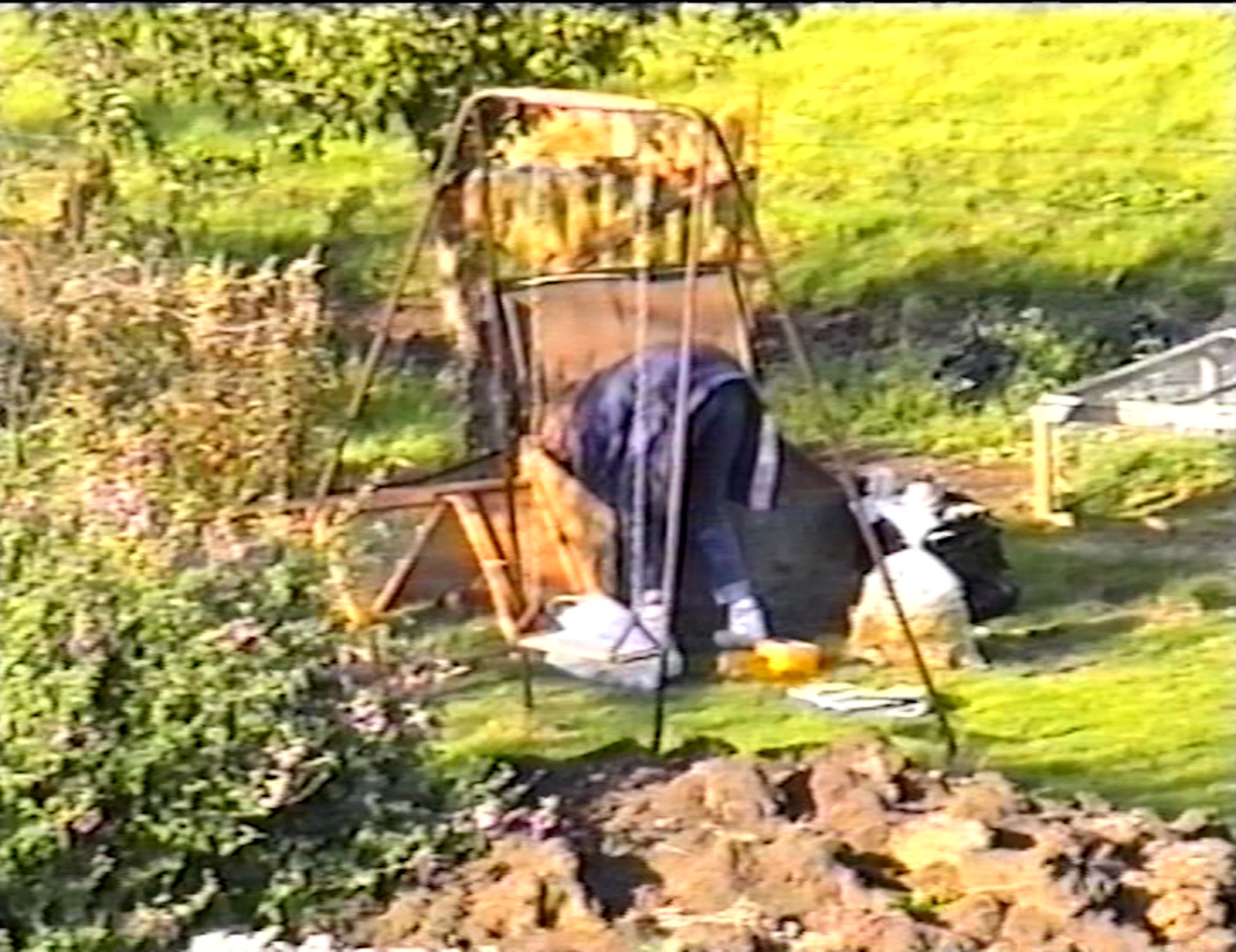
But life is not all museum visits with friends and family, there are always chores to be done as well. Debbie and Beth were always very good about this aspect of having pets. We all did our bit; Guinea pigs (Debbie and Beth), hamsters (Beth), cockatiel (Beth), budgies (Judy and me), cat – mostly feeding and grooming (Judy, Debbie, Beth). In the second photo Beth is cleaning out the guinea pig run.
World events: Tim Berners-Lee began building the World Wide Web; and the first McDonald’s restaurant in Mainland China opened in Shenzhen.
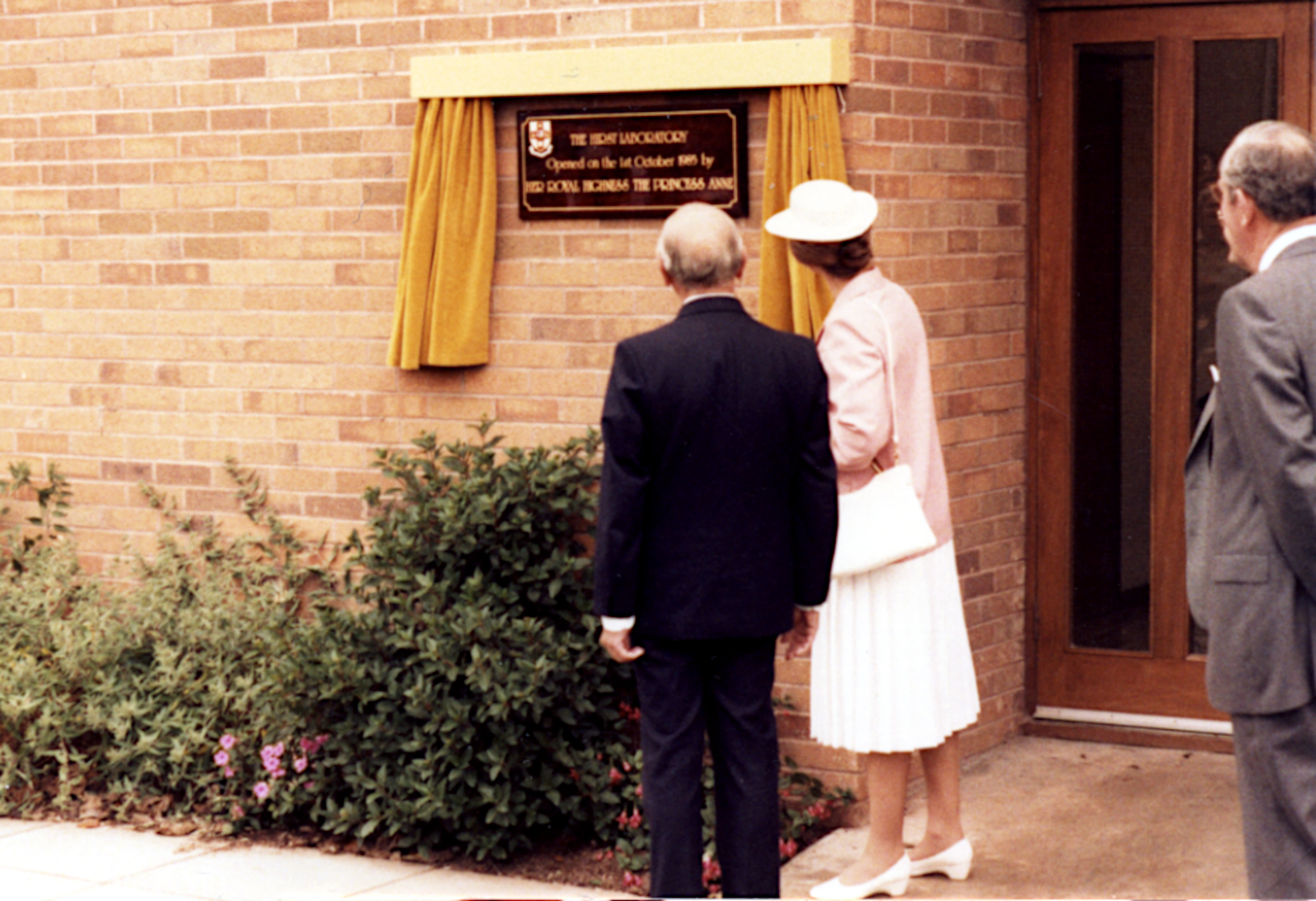
The event of the month, if not of the entire year, was Princess Anne’s visit to Long Ashton Research Station (LARS) to officially open the new Hirst Laboratory. I had an office in this building as Microcomputing Manager towards the end of my time at LARS. The photo shows an equerry or some other functionary, Princess Anne, and Professor Hirst, the retired Director after whom the Lab was named. His replacement, Professor Treharne, was out of the shot further to the right.
Part of the crowd
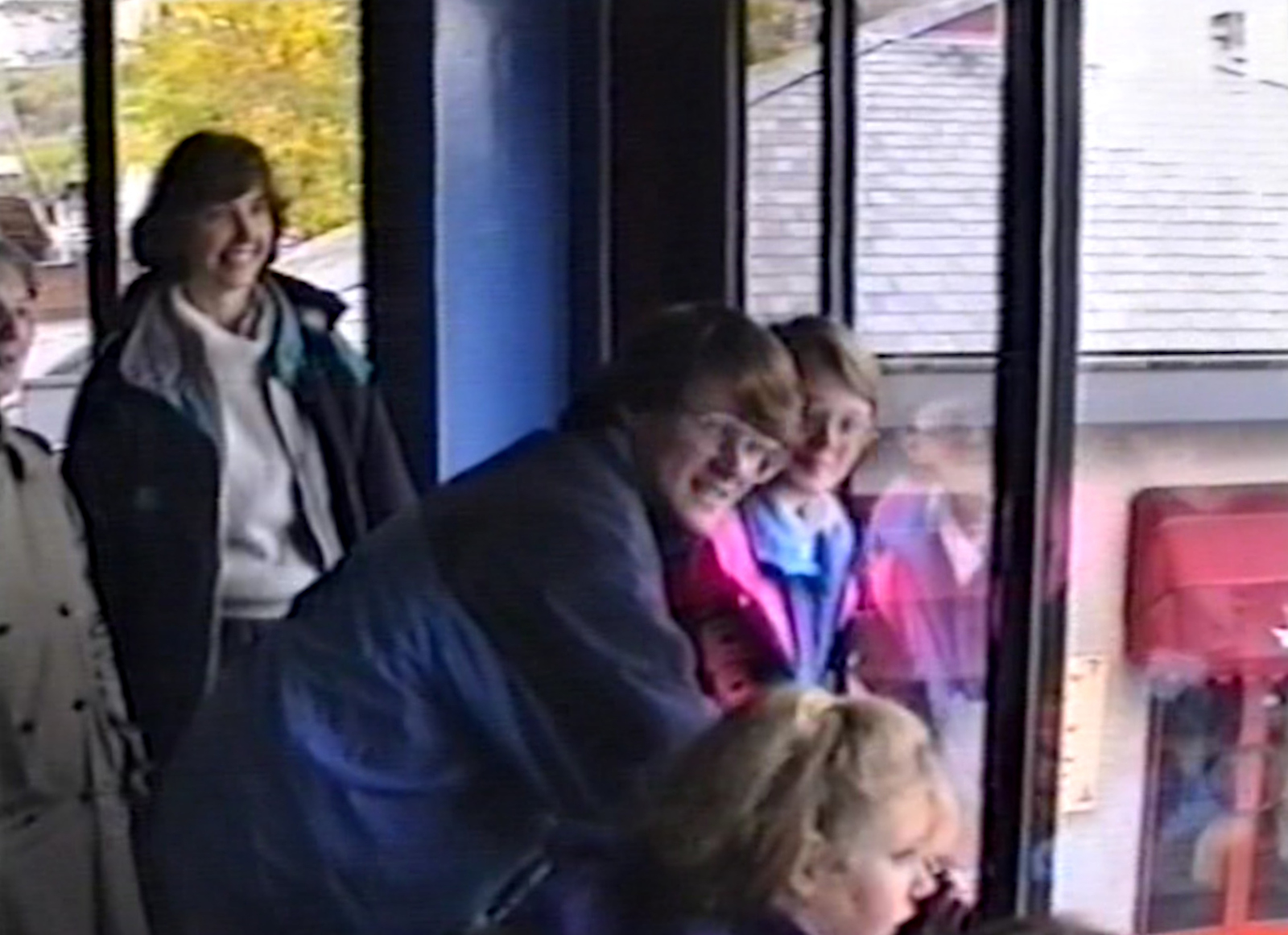
The second photo shows onlookers, a mix of LARS staff and their families as well as some people from the village. Debbie and Beth are in this shot too.
World events: The cruise ship Achille Lauro was hijacked in the Mediterranean by Palestinian terrorists; and NASA’s Space Shuttle Atlantis flew for the first time.
Mum and Dad bought a painting by Adrian Hill, these days it hangs in Beth and Paz’s home in York; unfortunately I don’t have a good photo of it to use here, but I do have a copy of the receipt so I can say that they bought it in October 1980 in Chedworth and this is the business card of the supplier.
I have very little material for this month. Judy and I were living at 22 Rectory Drive, Yatton. Debbie was five and Beth was two. Judy was at home with the girls on weekdays and I was researching pollen and pollen tube growth at Long Ashton Research Station. As I recall, we had no car at this stage and I was cycling or motor cycling to work during the week.
World events:Jim Callaghan announced his resignation as leader of the Labour Party; and the most recent atmospheric nuclear weapons test to date was conducted by China.
We visited Mum and Dad in Cirencester a little after our fifth wedding anniversary and I took a little time out to walk around the town with my camera. This is the front of the old Cirencester Workhouse, no longer in use at that time, of course. Today it’s used as the District Council offices. The photo dates to 26th October 1975 and is one of a stereo pair.
Judy and Mary
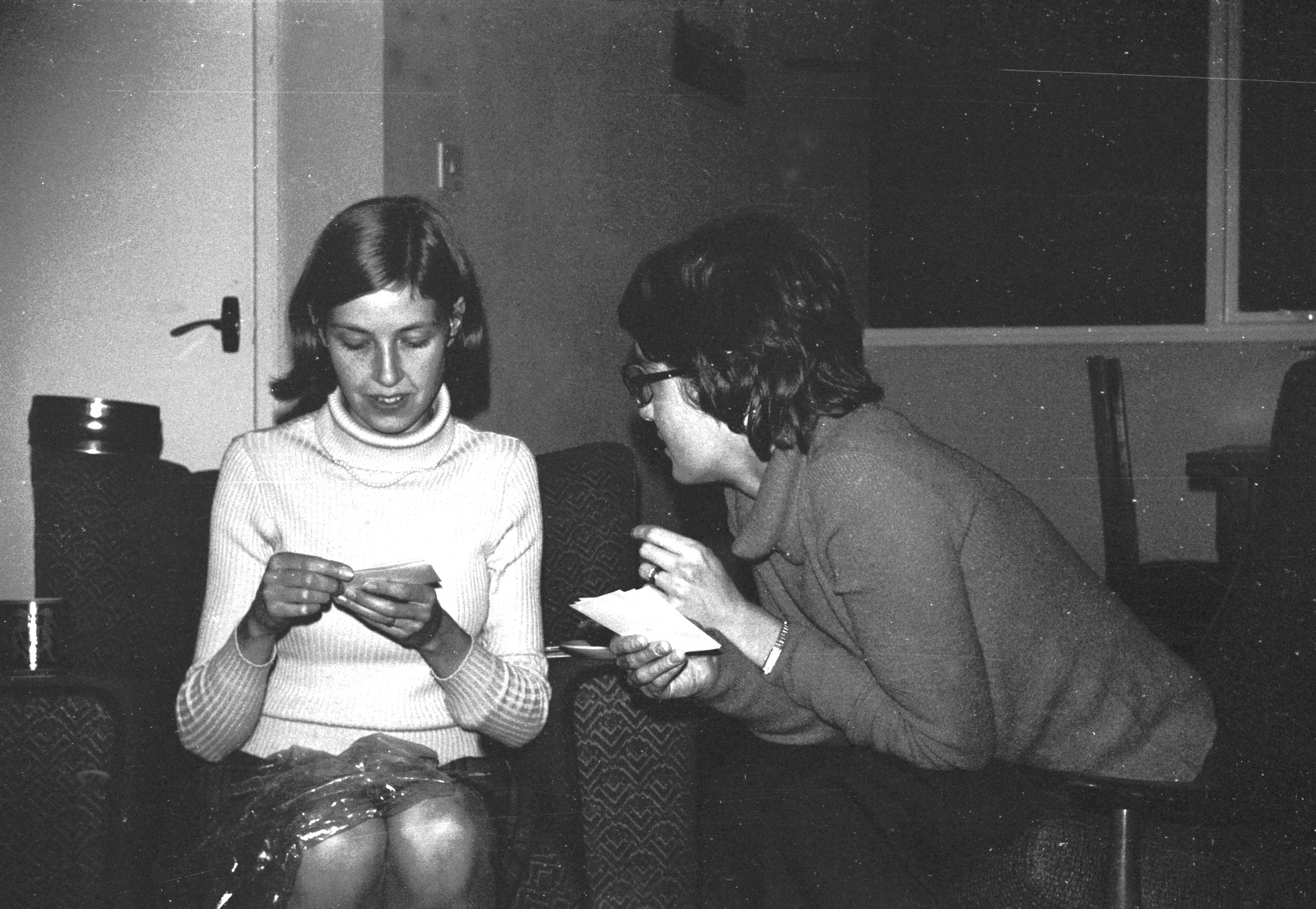
Our next door neighbours in the end-of-terrace house next to us were Mike and Mary Low, In the photo Judy and Mary are looking through some photos together.
Our wedding went well on 3rd October; I regret not being able to share a photo or two, I have them safely somewhere but I’m quite unable to locate them at present.
I can share a funny story from that day, however. We had avoided getting our car ‘decorated’ by our college friends by parking it some distance away and getting Judy’s Dad to drive us to the car after the reception. So we were already heading off for our honeymoon well before anyone was able to locate the car. With confetti down our necks and scattered all around, it seemed like a good idea to pop in to Churnside in Cirencester, let ourselves in (everyone was still in Cheltenham), get rid of the confetti, and then continue to Bournemouth where we planned to stay for a week. Unfortunately I forgot to pick up my car keys as we left the house.
I borrowed a ladder from Brian Bennett at Bennett’s Garage just a few steps along the road, got back into the house through my bedroom window, picked up the keys, returned the ladder, and we were back on the road in short order.
There was no need to book in advance in those days. We simply drove into Bournemouth until we spotted a guest house we liked the look of with a ‘Vacancies’ sign displayed. We went in, they showed us a room and gave us a price, we asked what their best price would be if we took the room for a week, and that was it. Simple! It wouldn’t work today, would it?
Corfe Castle
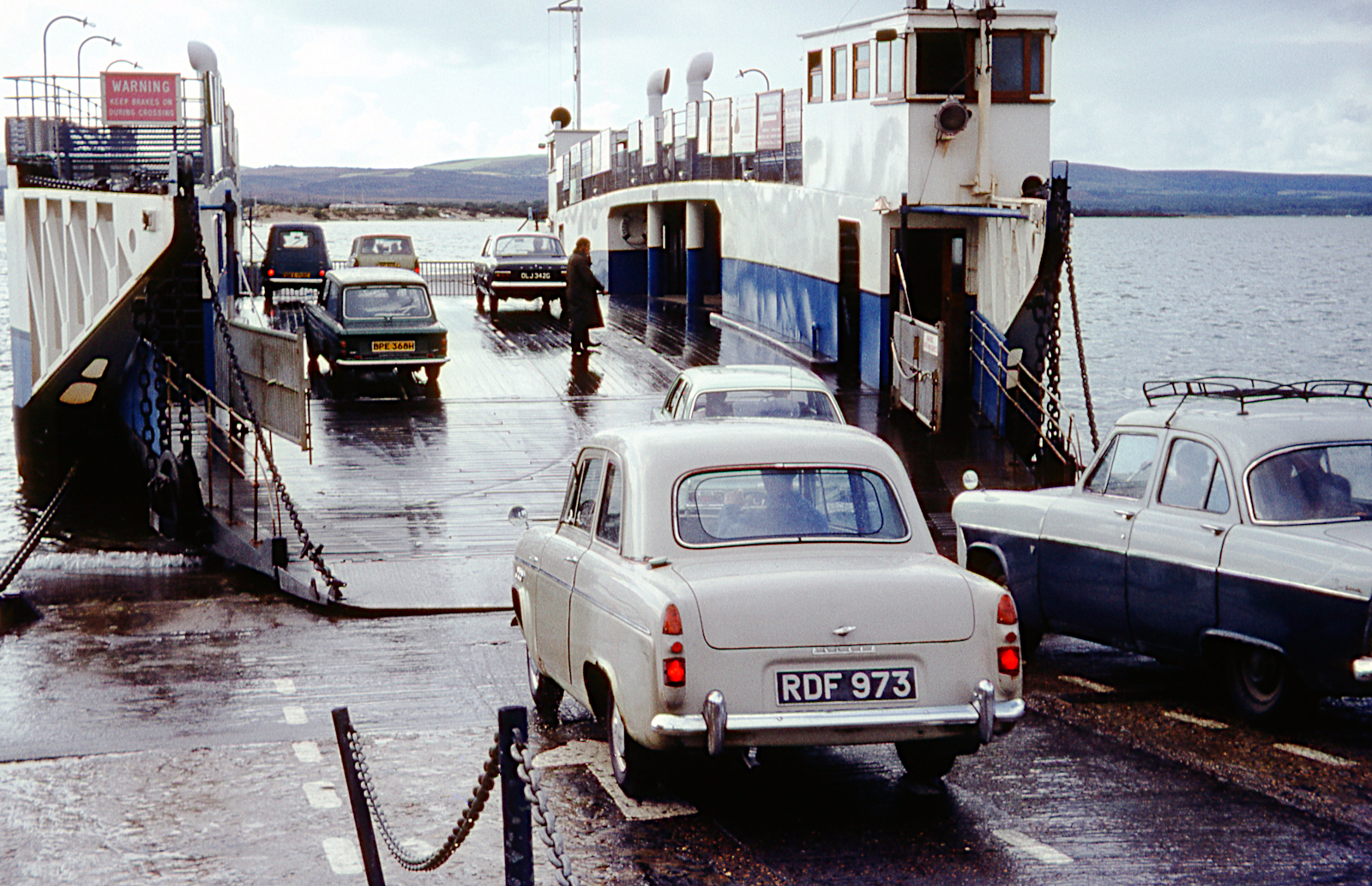
We explored Bournemouth fairly thoroughly, visited the famous Beaulieu car museum, spent a day on the Isle of Wight (Judy took the photo above while I was driving our car onto the ferry), and looked at Corfe Castle.
I had a message during the week to phone Long Ashton Research Station and they offered me a job in the willow department; starting on the following Monday, that was an enormous relief. So after our honeymoon, we drove to Bristol (visiting Salisbury and Avebury on the way) and visited Long Ashton on the Sunday evening. I rang the bell of the house where I’d lived with a bunch of other students during my industrial sandwich period in 1969. My old landlady opened the door and gave me a big smile when she saw who it was, but she also told me that they’d stopped taking guests. However, she kindly offered to give us a room for a few days while we looked for a bedsit in Bristol. Another big relief!
I began my first full-time job on Monday morning, while Judy took the car into Bristol to start looking for a bedsit. After drawing a series of blanks, an agency in Park Street said they had a suitable place up on the Downs, it was a big, three story house on Linden Road, number 59 I think. It was two rooms on the first floor with a bathroom and loo shared with a similar pair of rooms on the same floor. It was vacant so we took it and were able to move over from Long Ashton right away. I still remember the landlord, a Mr Bird; he came to collect the rent once a week. We had a furnished bedroom and sitting room, a big cupboard that opened out to reveal a tiny kitchen, a car, and I had a monthly salary. We felt great, and excited for the future.
Within a few days Judy had found a temporary job working at one of the Broadmead department stores, either Lewis’s or Jones’s. They needed extra staff over Christmas and the New Year period. The extra income made a big difference to our finances and we began saving, knowing that we would need a deposit for a mortgage eventually. During the next few weeks she began looking for a job as a newly graduated biochemist and soon found work as a lab assistant at Bristol University Biochemisty Department in Woodland Road to start in the spring term. Dr Tanner (Mike Tanner) was studying one of the proteins in the human erythrocyte membrane.
World events: A Khmer Republic was proclaimed in Cambodia, escalating the Civil War ; and the Soviet Union launched the Zond 8 lunar probe.
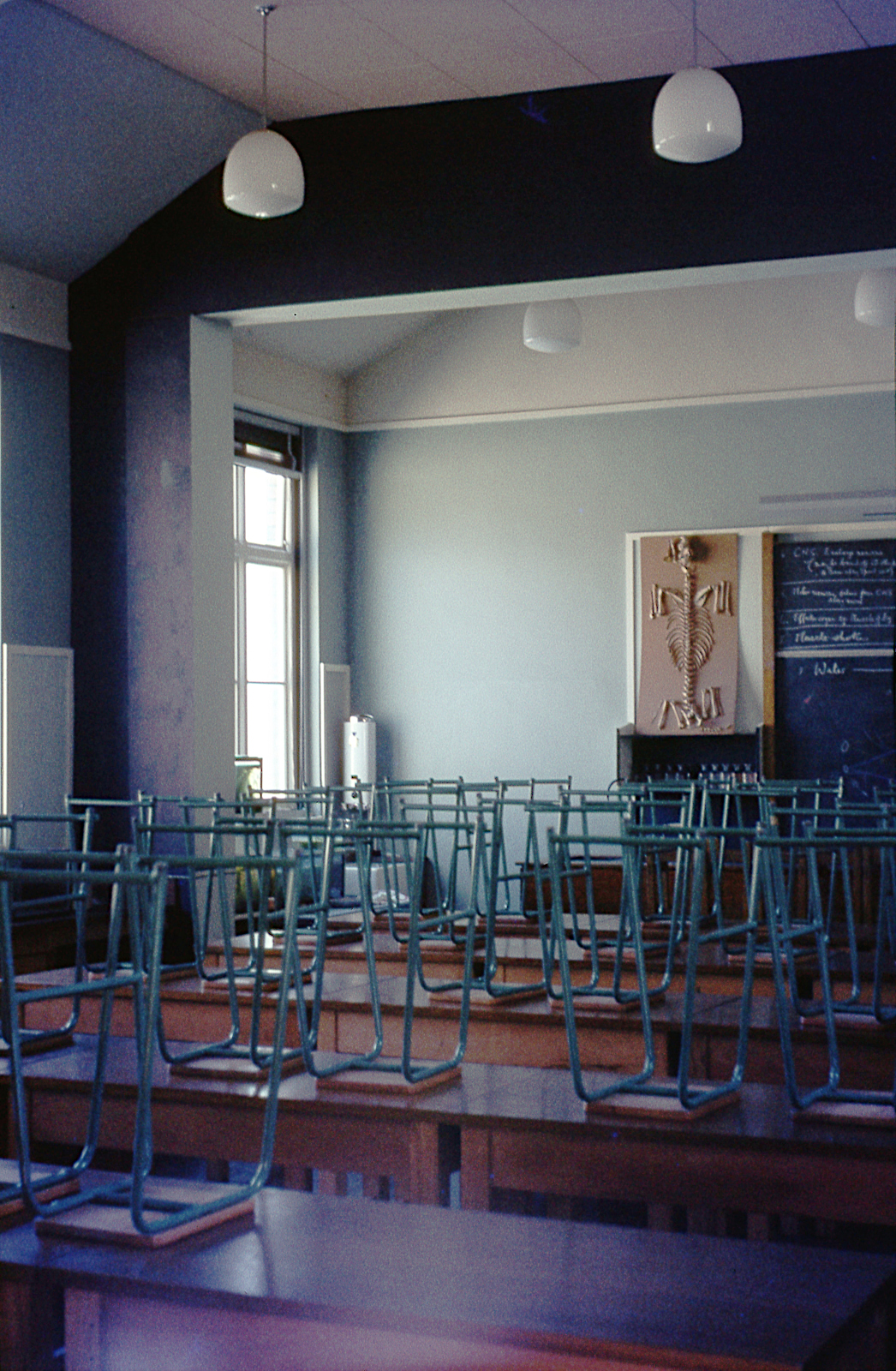
I was in the lower sixth form at Cirencester Grammar School (CGS) and it was interesting to make a start on Chemistry, Physics, and Biology A levels. I had not been able to cover Biology at O level so had some catching up to do, Physics became more mathematical than I’d expected, and Organic Chemistry was way harder than the inorganic studies at O level. But my teachers were good, especially ‘Pop’ Green who taught us Biology. He stood no nonsense, but he was a lot of fun and very helpful to anyone who wanted to learn and showed a real interest in the subject. I took these photos in 1966, but everything looked just the same in 1965.
My sister Cindy turned 14-years-old at the beginning of the month, Ruth and Rachael were 9 and 8 respectively, and I was already 17 and taking my first steps in learning to drive. It was easy in those days, I applied for a provisional driving licence and received it quite quickly, then we put L plates on the car and Dad took me out to the disused Chedworth Airfield to learn the first steps of clutch, accelerator, footbrake and steering and once he felt I was safe enough, he took me on quiet roads to get used to traffic. Meanwhile I studied the Highway Code to learn the theory aspects, the meanings of various road signs, stopping distances and their relationship to road speed and so forth.
CGS Sports Field
Judy and I continued to grow closer and spent a lot of time in free periods talking about every imaginable topic, in cold weather we would lean on one of the radiators in the Wooden Corridor to stay warm while we talked. We didn’t hold the same views on everything, but that just made it more interesting. I was also reading about science, buying the monthly magazine ‘Science Journal’ which was a UK publication similar in many ways to the American magazine ‘Scientific American’. I was very interested in electronics and the early computers, also the American and Russian space programs as well as European efforts to build a launcher. The European Launcher Development Organisation (ELDO) was trying to cobble together the British Blue Streak ballistic missile, the French Coralie as the second stage, and a smaller German vehicle as the third stage to reach low Earth orbit (LEO). This programme proved unsuccessful.
Judy introduced me to classical music, something that had passed me by before we met. When I was younger, Dad was into jazz, particularly the piano solos of Jelly Roll Morton, Earl Hines and most of all, those of Fats Waller. He played many of them rather well on the upright piano we had at home. And Mum liked much of the popular music of the day, especially anything by Danny Kaye. But neither of them had been into classical stuff. Judy and I both enjoyed some of the popular groups (not ‘bands’ in the 1960s) of our own day. I was very much into The Shadows and, to be perfectly honest, I still am.
World events: Fidel Castro announced that Che Guevara had resigned and left Cuba; and the 7 Fundamental Principles of the Red Cross and Red Crescent were adopted at the XX International Conference in Vienna, Austria.
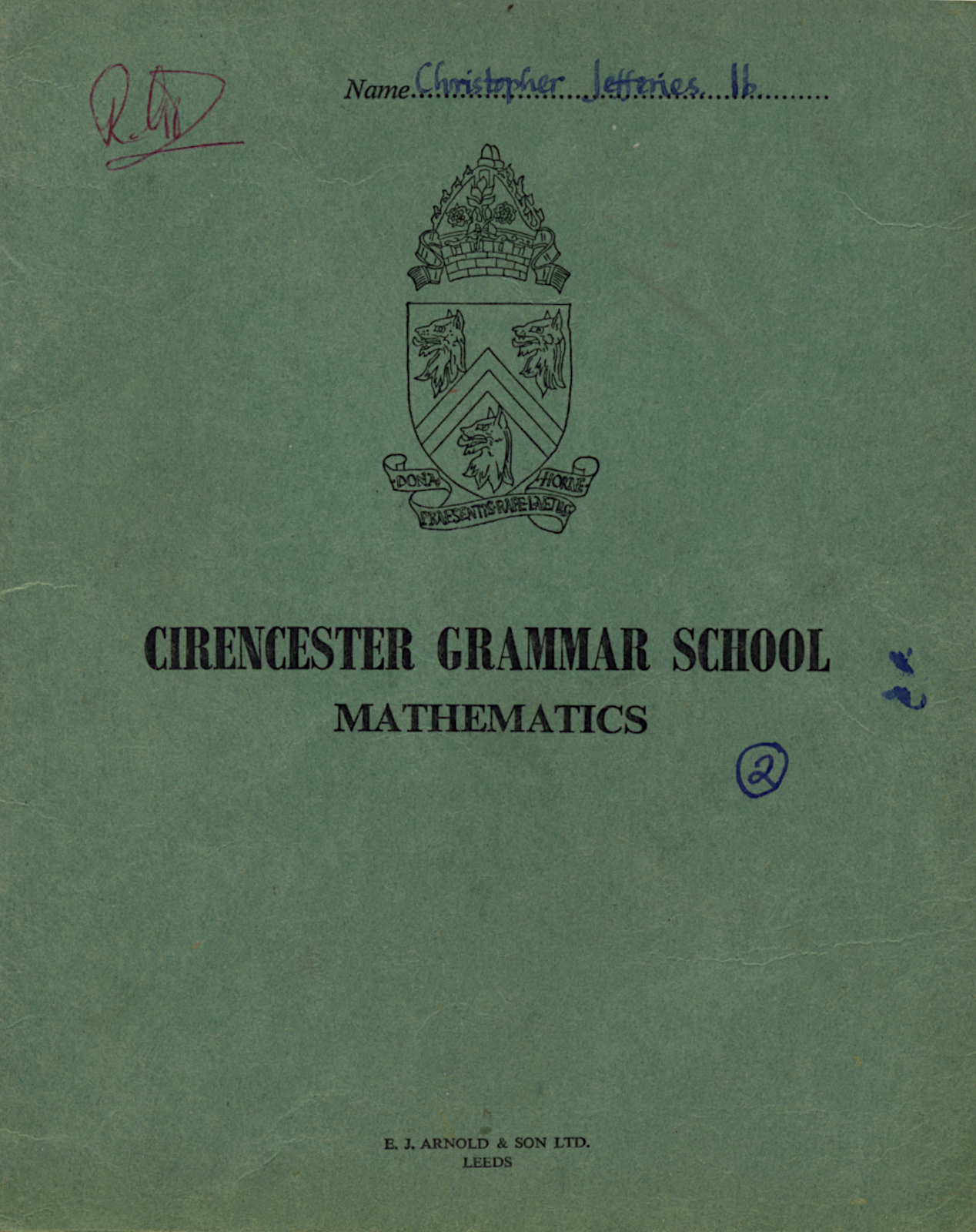
This was the start of my second year at Cirencester Grammar School, my sisters were younger than me and still at junior school. The exercise book was from my first year, carries the Grammar School Crest, and the book’s been initialled by my maths teacher to show it’s full; the school office issued new books, but only if they’d been initialled by a teacher. Click the image for a closer look.
The exercise books were coloured to indicate the subject, this one is green for maths, rough books were dark blue, geography was orange, history was a dark maroon and so on.
World events:Nigeria became independent from the United Kingdom and the 99th member of the UN; and a large rocket exploded on the launch pad at the Baikonur Cosmodrome, killing at least 92 staff of the Soviet space program.
My sister, Cindy, turned four at the beginning of the month, and at seven-years-old I had already begun my third year at Junior school. We were advancing to more challenging tasks, taking dictation was one of these and although the vocabulary remained simple, there were potential pitfalls. I remember being puzzled when having been careful to use a capital E for a person’s name, it was crossed out as being wrong. The sentence was something like, ‘The fair was coming to town and he had thought of little Else all day.’ Surely if her name was ‘Else’ she deserved a capital?
Jill’s message
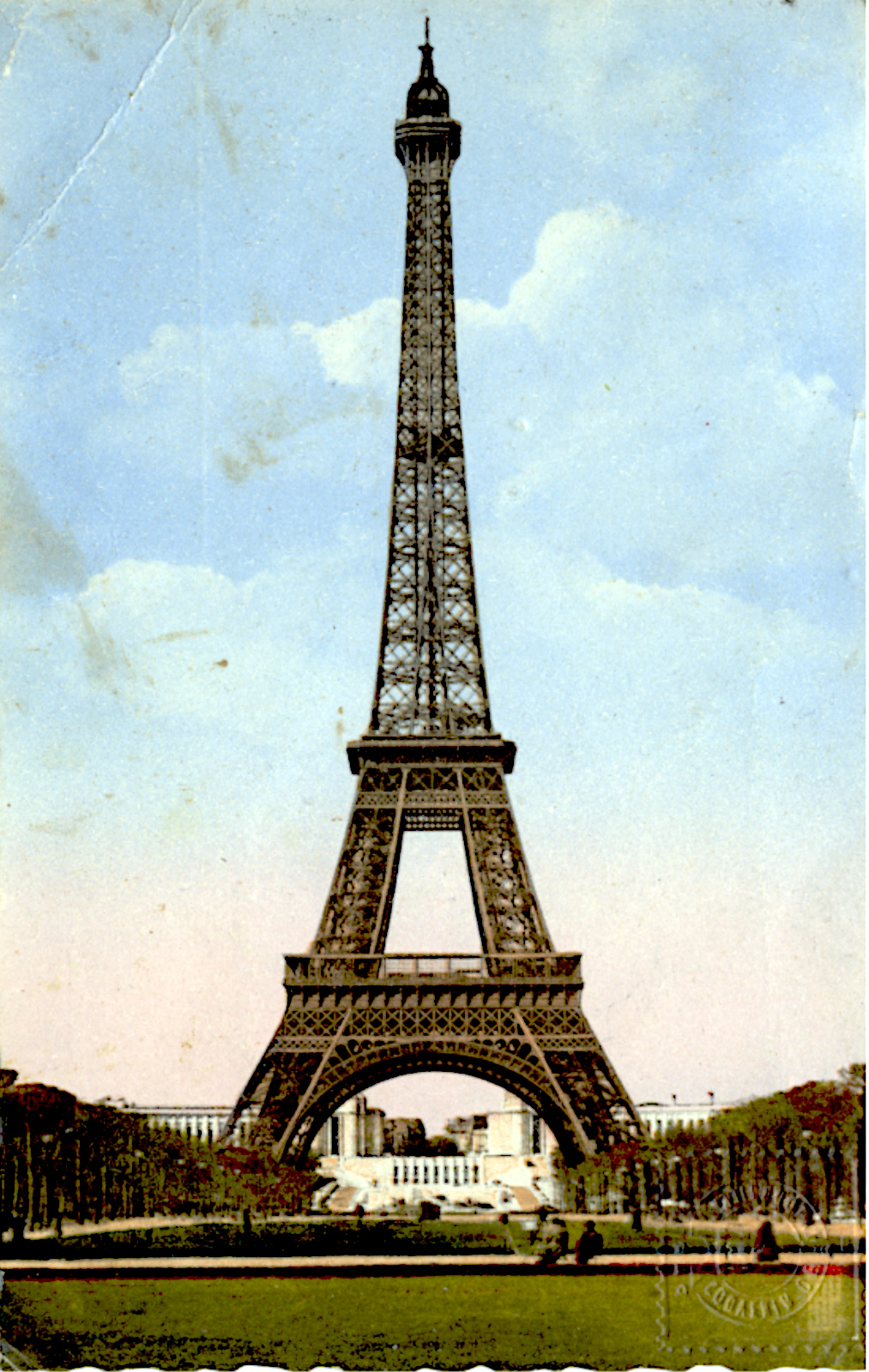
The images show the front and back of a postcard from my cousin (also my godmother), Jill. She was grown up, about 18 or so at this time, and was teaching English to the daughter of a French family in Morocco. They were visiting Paris and she thoughtfully sent me the postcard. (Click the images to enlarge them.) (I have no images from October, the card is probably from August.)
World events:Sun Myung Moon was released from prison in South Korea; and 70-mm film was introduced for cinema projection, with the release of Rodgers and Hammerstein’s musical, Oklahoma!.
This photo is from the Facebook ‘Old Ciren’ group (it’s definitely October and must be a year not far from 1950). Local people, especially children and young adults, look forward to the fair and certainly have a good time. As you can see, Mop takes over the entire Market Place. My memories of Mop as a child include the sound of diesel generators, warmth from the many light bulbs in use, the mixture of smells (diesel fumes, candy floss, fried onions and so on, the noise of the crowds and the shouts of the people managing the attractions (Roll up, roll up).
I probably didn’t witness Mop in 1950, I was only 2¼ years old, but I might have been carried down or taken in the pram by Mum and Dad.
World events: China began the process of annexing Tibet, beginning by invading across the Jinsha River and seizing the border town of Chamdo; and the USA’s FCC issued the first license to broadcast television in colour.
Mike received inoculations and then visited Bombay (Mumbai) with some friends and was emphatically unimpressed. He met a sergeant he’d known from his time at Ballinderry in Northern Ireland. The toing and froing of letters with Lilias and with Dad’s family in Cirencester continued, and he had photos taken at a booth in the bazaar and sent one to Lilias.
On 10th he had a bad headache, felt rotten on 11th, and reported sick on 12th. By 14th he was feeling normal apart from some mouth ulcers that persisted for several days. He left hospital on 18th despite a temperature of 100 F (37.8 C).
Santa Cruz
On the 19th he was given work as a lorry driver – Driver Mechanical Transport (DMT). Then on 21st he was posted to Santa Cruz, a nearby RAF airfield where he met someone he knew from Ashton Keynes as well as someone from Stroud and a man from Sampson’s Nurseries! He was seeing films at the station cinema, and practising cricket while waiting to start his new role. His first driving practice was taking a 3-ton Chevrolet around the airfield perimeter track on a meals run. By the end of the month he was driving quite regularly and teaching himself to change down to a lower gear correctly.
So that was a fairly slow-paced start to Dad’s RAF service in India, and a strange way to employ an experienced radar operator!
There’s not enough information to write something for every month in the 1940s. Dad’s diaries start in January 1943, so for January 1940 to December 1942 I’ll write about things I know, or draw on dated photos and documents. Sometimes I might use a photo or document with a guessed date.
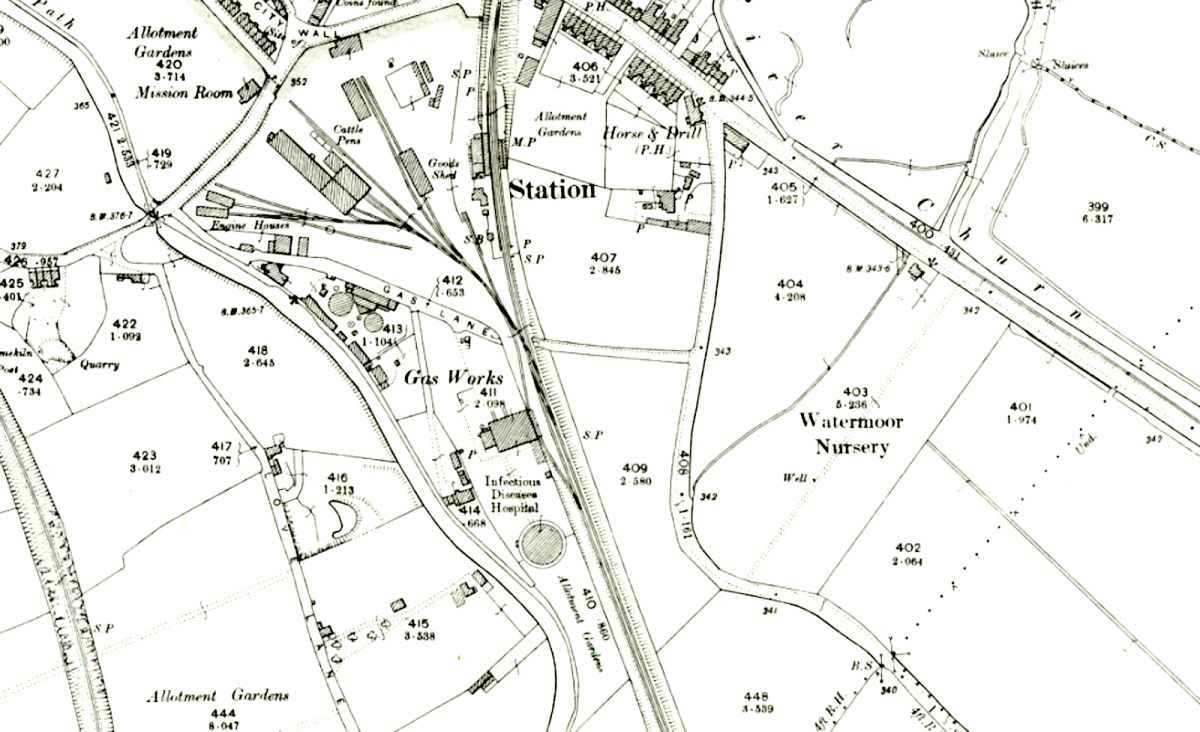
Continuing the nursery theme, this time I’ll describe Watermoor Nursery. When I was growing up Watermoor was the place where Dad spent most of his time, he was the foreman at Watermoor during those years, before taking on responsibility for all of the nurseries in due course. What do I remember about Watermoor in those days? I suspect it had changed very little from 1940 until the 1950s when I first remember it.
Perhaps the first thing to say is that before Cirencester’s ring road was built in the 1980s, Watermoor Road used to continue along what is now Watermoor End, heading south-east towards Cricklade and, eventually Swindon and Marlborough. This was the line of the old Roman Ermin Street. If you visit Watermoor End and walk right down to the Ring Road (Bristol Road at this point) you’ll notice the old pub on the right at the end stands at a strange angle (it’s marked on the map as ‘The Horse & Drill’). Cricklade Road, now the other side of Bristol Road, continues along the line of the Roman Road and you can follow it, straight as a die, past Tesco Extra and on beyond Tesco where it’s fenced off. It’s still a footpath so walk through the fence and continue. All of this was once known as the Swindon Road. You can see the details on the map.
Returning to that old pub at an odd angle, it was built to respect the line of Watermoor Road, a junction to the right off what is now Watermoor End. You can follow the old Watermoor Road from the southern side of Bristol Road, and when you reach Rose Way on your left you are more or less at the old entrance to what was once Watermoor Nursery. Entering the long-gone wooden gate you would have seen the potting shed on the left and beds edged with lightweight breeze blocks and filled with crushed clinker on the right. This was the standing area for the Alpine plants propagated at Watermoor. The main track ran ahead from the gate to the Swindon Road gate at the far end. Both sides of this track (especially the left hand side) were filled with row after row of herbaceous perennials which would be lifted and split in the winter months, packed in moist soil and straw for insulation, wrapped in sacking, and sold as bare-rooted plants to be collected from the nursery or despatched by road, rail or post to distant customers, or delivered by van along with other plants, cut flowers, wreaths, seeds, garden sundries and chemicals in Cirencester and the local villages, often by my Dad.
On the left of the track, at the Swindon Road end, was the carter’s cottage. Up until the end of the Second World War a horse and cart were used for local deliveries. The Horse was stabled at Tower Street Nursery. There was a story that the carter sometimes stopped at a pub for refreshment on his long delivery round, and that if he drank too much he would doze off afterwards while driving, but the horse knew the customary route and would plod along without any need for guidance. Companies like Tesla and Waymo are trying to perfect vehicles than can drive themselves, perhaps they just need a well-trained horse! I suppose you’d need a different horse for each route, so that might be an insurmountable issue. The carter’s cottage was still there when I moved back to Cirencester in 2016; it’s since been demolished to make way for several new houses. The carter’s vegetable garden made it a reasonable-sized building plot. You can see the cottage and its garden on the map, in the northern corner of the nursery.
I remember Miss Brown (Rosemary, I think) who was Dad’s assistant at Watermoor. And in the calm, warm days of summer time I remember thousands of butterflies making the most of the flowers on the herbaceous stock plants. The air seemed to shimmer with them – large and small tortoiseshells, painted ladies, red admirals, peacocks and much, much more. In the summer, our house always had vases of flowers, cut at Watermoor and brought home by Dad.
You can view the map in full online, the area was surveyed and mapped by Ordnance Survey between 1892 and 1947.
Siddington in 2021
World events: Adolf Hitler made a Berlin Sportpalast speech declaring that Germany would make retaliatory night air raids on British cities and threatening invasion; the Blitz began on 7th September and although tough for civilians and ruinous to cities, it probably saved the RAF from collapse and an invasion of Britain never became feasible.
Anything that appears in this section will have some connection with the 1930’s but may extend beyond the decade to follow a meaningful topic more fully.
This time I thought I might take a more general look at the Jefferies family living in Cirencester in the 1930s. The family hub was ‘Churnside’, an Edwardian semi-detatched property at 37 Victoria Road. My grandparentswere Mr and Mrs Edward Arthur Jefferies, my grandmother was born Norah Monger and had two sisters. They had the house built, probably shortly before they were married, living in the right hand part and renting out the left half. I remember Mrs Morgan who lived there when I was a child, and later Mr and Mrs Handy and their family. I believe the house was built on land once belonging to Cirencester Abbey which owned a good deal of agricultural land around the town. It might later have been owned by the Chestermaster family and/or the Bathurst estate before being sold for town expansion. Before New Road was built (later renamed Victoria Road) the land was probably used as grazing for sheep, cattle, and perhaps horses. It was low lying land with the River Churn running along the eastern edge (hence the name ‘Churnside’). When Purley Road was built in the 1920s or ’30s, the fact that ‘Churnside’ was beside the River Churn became a great deal less obvious, but the name stuck. As far as I know, this semi-detached pair of homes was one of the first properties built on this side of New Road. My grandfather, Ted or the Guv’ner, and my grandmother Nor, were quite well off. I remember they had a black Wolsley car and a chauffer, Cooper, to drive it. They also had a live-in maid to help with the household chores and not only did they have a reasonably large garden, but also a further plot, the ‘Lower Garden’ in Purley Road was purchased for use as tennis courts and later, during World War 2, a chicken run and then finally a fruit and vegetable garden. I remember helping Grandpa feed the chickens. That gives you some idea of the Jefferies family and their lifestyle in the 1930s.
Cleaning the office
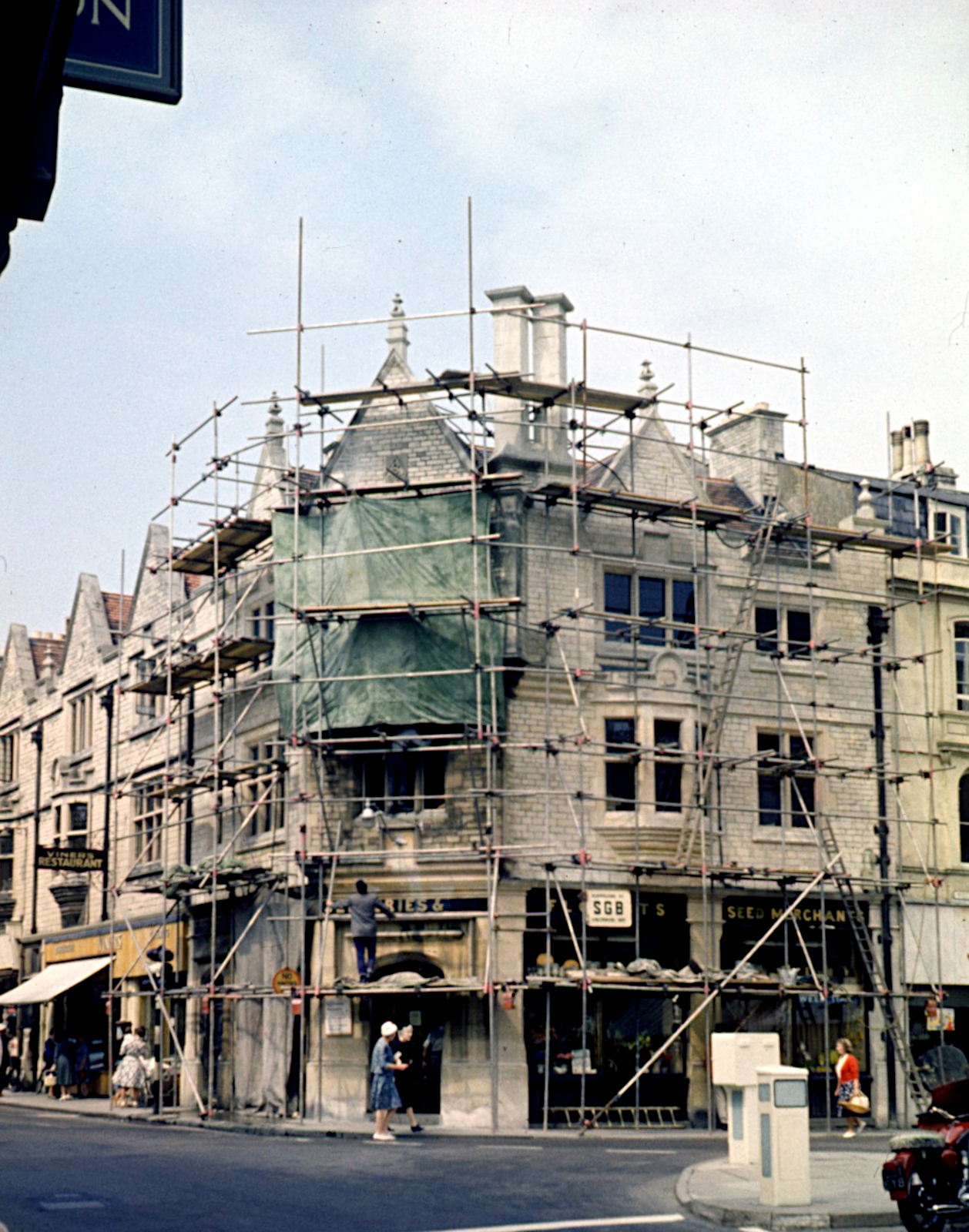
The business hub was at 2 Castle Street, now the Vodafone shop in the Market Place. The phone number was Cirencester 2 (Cirencester 1 was the Post Office, also in Castle Street), with private extensions to each of the nurseries. At this time the post office was happy to provide external extensions like this for any business that asked for them. When I was a child there was a small automatic exchange in the company’s main office. Previously, one of the office staff would have connected the extensions manually. The building housed a florist’s and garden shop downstairs with storage below in the cellar, there were offices upstairs, and on the second storey the landscape design department with enormous garden plans rolled up or pinned out on drawing boards. I don’t have a photo of the shop in the 1930s, but this one shows it being cleaned in the summer of 1962.
Dad was born in 1926, almost an afterthought following his older brothers born in 1907, 1910 and 1912. During the second world war John and Robert (Bob) joined the army while Richard (Dick) signed up for the navy. All three joined as officers. Mike signed up for the RAF as soon as he was old enough (in 1944). So towards the end of the 1930s running the family business fell entirely to my grandfather.
World events (October 1935): The Turkish government abolished all Masonic lodges in the country. (October 1930): The British airship R101, the world’s largest flying craft, crashed in France en route to India, 48 lives were lost.
As with the 1930s material, everything in this section will have a connection of some kind with these two decades.
Probably few people reading this will know that there was another branch of the Jefferies family, also running a nursery business, but in Lancashire. As far as I’m aware there was no connection between the two businesses, but there is a family connection.
John Edward Jefferies was born in October 1886 and ran his nursery business in the Stockport area. His second son, also John Jefferies continued running the business though the rest of the family went into teaching, the British Gas accounts department, and research (first with Glaxo-Welcome and later at Salford University’s Chemistry Department.
The John Jefferies of Somerford Keynes and later, Cirencester, had a brother. His name was Bradford Jefferies and he was a few years older than John. Bradford had two sons also called Bradford, though one died in infancy. The surviving Bradford’s uncle was therefore the John Jefferies from Cirencester. With me so far? It is a bit convoluted.
This Bradford Jefferies had several children, and one of them (Edward) is the one who ran a nursery business near Stockport. He married and their children were born in the 1920s, one of these, John Anthony Jefferies, continued to run the business . The business was still going in 2022 but I can’t find a recent website for them. They do have an entry on Facebook, however, and various listings on other business directories, though nothing seems to be being updated. I left a message on the Facebook page and had a reply from a member of staff so the company survives. It’s lasted a good deal longer its Cirencester equivalent.
World events(October 1925): John Logie Baird successfully transmitted the first television pictures with a greyscale image. (October 1920): The Polish army captured the Soviet cities of Tarnopol, Dubno, Minsk and Dryssa. (October 1915): In WW1 France, Russia and Italy declared war on Bulgaria. (October 1910):Infra-red photographs were first published. (October 1900): Quantum mechanics began when Max Planck put forward his law of black-body radiation.
If you enjoyed this or found it useful, please like, comment, and share below. (If you don’t see those links, click the article’s title above the main photo and they will appear.) Send a link to friends who might enjoy the article or benefit from it – Thanks! My material is free to reuse (see conditions), but a coffee is always welcome and encourages me to write more often!
Of course, non-local companies are far, far better than empty shops. Cirencester has fewer empty shops than most towns; and we do have a good proportion of small, local businesses springing up all the time.
What’s in an image? Sometimes quite a lot, more than meets the eye.
I’m posting an image every two days (or as often as I can). A photo, an image from the internet, a diagram or a map. Whatever takes my fancy.
Click to enlarge
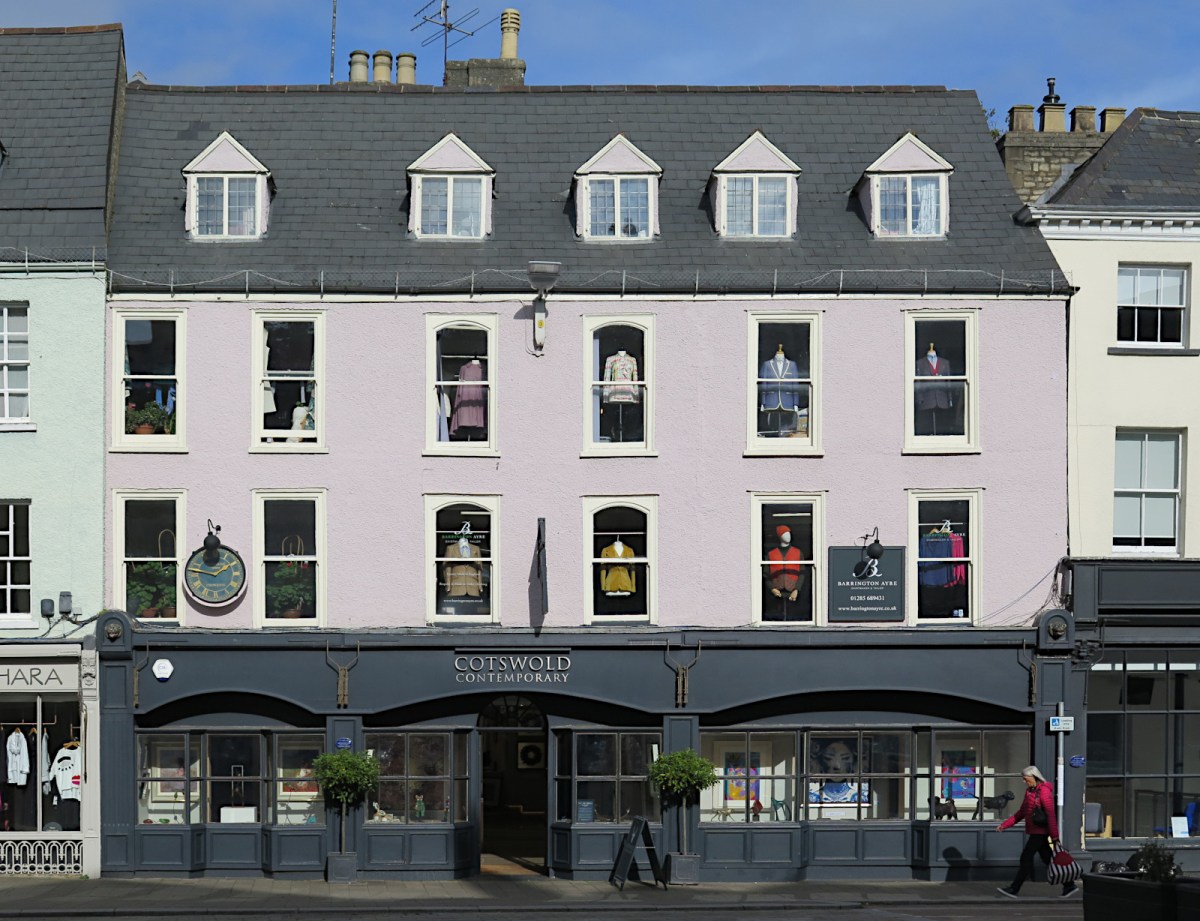
This shop was Stradlings when I was a child. It was a watch, clock and jewellery business and had been a clock maker at one time. If you enlarge the image you will see a clock between two first floor windows on the left. That clock is marked ‘Stradling maker Cirencester’, a relic and reminder of times past.
Businesses come and businesses go, that is normal, it has always happened. But something has changed dramatically in Cirencester as in towns across the county (and indeed much of the world). And it’s this – many of the incoming businesses are branches of large companies, often with little local knowledge or experience.
Of course, non-local companies are far, far better than empty shops. Cirencester has fewer empty shops than most towns; and we do have a good proportion of small, local businesses springing up all the time, especially restaurants, coffee shops and so forth. But the trend is clear, especially when you take the long view. I’m 76-years-old, but as a child almost every business seemed to be local. Perhaps the biggest exceptions were banks and building societies. Sometimes, it’s even in the names, ‘Nationwide’ is indeed a nation-wide building society!
But despite all this, many of the old names, like Stradlings, have left visible mark that can still be seen if you look closely enough. The old clock is still on the wall – a clock made in Cirencester! Not far from Cotswold Contemporary, the current owners of the clock, you’ll find an old sign above a shop front on the same side of the street. There are no words, just a black teapot and a cup and saucer. If you are ever in Cirencester Market Place, see if you can spot it, another emblem of the past. I won’t mention the current name of the shop, that would make it far too easy; but I will say that back in the day it was Anne’s Pantry. They sold little cakes, dainties and pastries to take away, or you could take a table inside for a cup of tea.
If you find the teapot or have memories of Cirencester to share, leave a comment.
Cirencester
For convenience, here’s a list of all the Cirencester area images:
If you enjoyed this or found it useful, please like, comment, and share below. (If you don’t see those links, click the article’s title above the main photo and they will appear.) Send a link to friends who might enjoy the article or benefit from it – Thanks! My material is free to reuse (see conditions), but a coffee is always welcome and encourages me to write more often!
Many satellites are launched every year for profit-making purposes … TV broadcasting, imaging, weather forecasting, and internet provision.
Some time ago I was asked, ‘Why explore space?’
It’s a good question; space exploration is very expensive, surely we could spend the money on better and more important things? Surprisingly, perhaps, spaceflight has become a very profitable industry. Although exploration per se remains almost entirely government funded, exploration in past decades has sparked the profitable space industries that exist today.
Taking the world as a whole, we spend a very large amount of money on space exploration, US$117 billion in 2023. It’s fair to say that the USA almost certainly spends more than any other nation, and China and India both have major space programs, so does Europe (taken as a whole) through the joint ESA programmes (ESA is not part of the EU, however). Russia and Japan are major players too. You can view the figures as a bar chart from Statista.
It’s not quite as simple as it sounds, though. For one thing, material and human resources are much more expensive in some countries than in others, so US$1 billion buys a lot less in the USA or Europe or Australia than it does in China, or India, or Brazil.
Another thing to consider is that space research, spaceflight, and space exploration are not all about spending a lot of money, they are also activities that can generate a great deal of income. Economics is complex and difficult.
I think it may help us if we briefly review the history of space exploration.
The history of spaceflight
We have to go back to ancient and medieval times to find the first hints that people wanted to travel beyond the Earth. Even thousands of years ago, some people thought about leaving Earth behind. The Bible describes Elijah being taken up in a fiery chariot. The Koran describes Mohammed on a winged horse. The Greek, Icarus, wanted to fly high above the Earth. Dante’s ‘Divine Comedy’ in 1320 describes a journey to the heavens. ‘Kepler’s Dream’ in 1608 describes how Earth would look from the Moon. In 1657 Cyrano de Bergerac described a journey from Earth to the Moon.
Of course, much of this was fanciful in various ways, but people were thinking about it. Science fiction became popular in the 19th and, especially, the 20th century and some of the ideas discussed seemed quite plausible. Engineering experiments with solid and liquid fuelled rockets began in the early 20th century, and that’s when some people began risking money (and sometimes their lives) to make progress with early rockets. Costs were involved, but no income was generated.
By 1944 the wartime German government could see the tide had turned against them, with losses on the Russian front and in North Africa. Italy had fallen to the Allies and by the middle of the year southern and northern France had been invaded and German forces were struggling to hold on. Germany had been developing new weapons for some time, and now they began to use them in a final attempt to reverse impending defeat. Jet aircraft, the first cruise missile (the V-1) and the first rocket capable of reaching space (the V-2, the first ballistic missile) all came into play at this late stage of the war. Firing the V-2 vertically in a test, Nazi Germany became the first nation to reach space at 174.6 kilometres (108.5 miles) on 20 June 1944. The rocket entered space vertically and fell straight back as it didn’t have sufficient fuel to attempt the horizontal velocity necessary to go into orbit.
After Germany’s defeat in May 1945 there was a scramble by the USA, the Soviet Union, and to a lesser degree by the UK to capture unflown V-2s, plans and information, construction and test facilities, as well as the engineers and technicians behind the technology.
Rocket technology was developed further, both for use as a weapon and also for scientific research and space exploration. This has led to many nations engaging in spaceflight and space exploration in the late 20th and early 21st centuries.
Recent developments
So now we have set the scene. Space exploration has become technically possible. It remains difficult and expensive, though the development of advanced and miniaturised electronics and computers for control, and improved fuels, materials, and designs have reduced the costs and look set to reduce them even more substantially in future. One major change in the last decade is that we now have the first reusable rocket boosters. SpaceX is already flying some of its Falcon 9 boosters more than twenty times. The costs savings are enormous and other rocket companies are trying to catch up.
Given all of this, why would we want to explore space?
Reasons for exploring space
First, it’s worth mentioning that the reasons for exploring space are the same as those for exploring more generally. People are born explorers: the youngest infant begins exploring the environment as soon as they can crawl. There are only two requirements – an ability to move from one place to another, and a desire to find out what lies further away.
Given the ability we now have to reach ever further into space, we just naturally want to investigate what is there and understand it to the best of our ability. These days, automatic systems can travel to dangerous and hard to reach places and return images and measurements without the presence of human travellers. So we have good images and many kinds of measurement from every large body in the Solar System, and growing numbers of the smaller asteroids and comets. But automated systems have limitations in terms of decision making and judgement, limitations that require the presence of people. These limitations are more severe than first appears given the great distances involved in exploring space. When a rover on the Moon takes an image, we may be able to view it within a few seconds and send instructions on what to do next. On Mars it might take twenty minutes to receive the image and another 20 minutes for the instruction to reach the rover. So a Mars rover needs to navigate and make decisions on avoiding obstacles semi-autonomously.
So far we have travelled only to Earth orbit and to the Moon, but the urge to go further remains. We’re a nosy and inquisitive race; we want to know more, we want to find out, we love to solve mysteries.
The benefits so far
This is unlikely to be an exhaustive list, there are many benefits already and new ones keep moving from theory to practice. I’ll list those I can think of below.
Photographing the Earth’s surface from orbit. This benefits mapping, weather forecasting, resource discovery, agriculture, military intelligence and much, much more.
Understanding geology by comparing Earth rocks and minerals with those on the Moon, other planets, rocky moons, and so on. We are learning how Earth and the other planets formed, and how long ago.
Astronomy has advanced as telescopes are operated from space. Earth’s atmosphere causes reduced image clarity and blocks many wavelengths of light, X-rays, and other forms of radiant energy. Light pollution from cities is also avoided by putting a telescope into orbit. It also becomes far easier to identify smaller objects that might collide with Earth and potentially cause serious damage and loss of life.
Probes have travelled to distant solar system objects to return images and sometimes samples of surface material.
Manufacturing in micro-gravity can produce medical, engineering and scientific materials that simply cannot be made on Earth. Ultra pure proteins have aided medical science enormously in some areas, helping scientists understand protein structures for example, or manufacturing life-saving antibodies and drugs.
Understanding the inhospitable conditions of space itself and the other planets in our solar system provides a perspective that helps us value what we have here on Earth.
Communications systems have benefitted enormously from spaceflight. From TV satellites providing hundreds of high-resolution channels, to satellite internet availability for ships, aircraft and remote regions, the exploration of space has provided the technology behind these improvements. Good internet access for remote areas improves disaster rescue, allowing much quicker responses.
Satellite navigation has transformed many aspects of land, air and sea travel. Who wants to manage without their satnav while driving?
Spin-off technologies like solar panels, stronger materials such as carbon fibre, recycling and purification of air and water were all developed first because of space exploration and are now proving invaluable here on the ground as well.
New resources are becoming available as a result of space exploration. Rare and expensive metals from asteroids, ices from comets and the moons of planets in the outer Solar System are likely to become useful in the near- to mid-term future. This is not yet commercially viable, but will become so as space transport systems develop further.
I hope that brief round up will help my readers understand some of the why-questions around space exploration. In the early days it was an expensive operation, funded by governments, and often justified by military considerations. Today, much space activity is done by companies with a profit motive. Launch services are now largely commercial in nature, so too is the transport of people and materials to and from Earth orbit and even now to and from the Moon. And finally, many satellites are launched every year for profit-making purposes as well – TV broadcasting, imaging, weather forecasting, and internet provision to name just a few.
Barges were able to move goods of all kinds between London and the River Severn via Oxford, Cirencester and Stroud
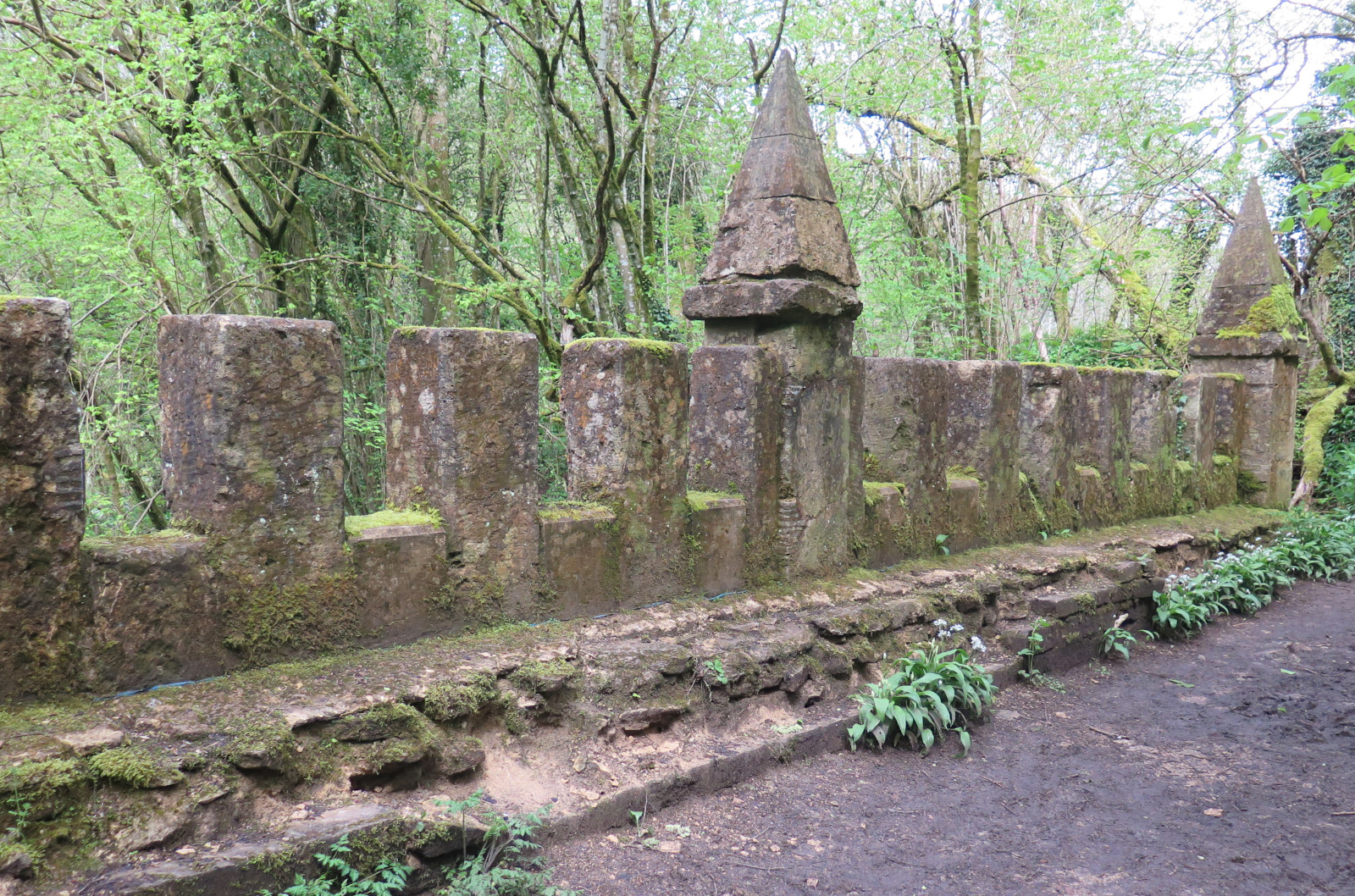
The parapet at the NW tunnel portal (Click image to enlarge)
The Thames & Severn Canal tunnel was opened in April 1789. The work was a major engineering achievement at the time.
There had been serious difficulty with the contractor originally chosen to do the work. But now it was complete, and barges were able to move goods of all kinds between London and the River Severn via Oxford, Cirencester and Stroud.
Here’s a short extract from the Gloucester Journal from 4th May 1789.
By a letter from Cirencester, dated the 19th ult., we learn that a great undertaking of conveying a tunnel sixteen feet high and sixteen feet wide, under Sapperton-hill and Hayley-wood (very high ground) for two miles and a quarter in length, through a very hard rock, lined and arched with brick, is entirely completed, and boats were to pass through it on the 21st ult.
By this opening communication is made between the river Severn, at Framiload, and the Thames near Lechlade, and will be continued over the Thames below St. John’s Bridge, and so to Oxford, etc., and London, for conveyance of coals, goods, etc.
It is now navigable from the Severn to Themsford by way of Stroud, Cirencester, Cricklade, being filled with water for the purpose near forty miles.
At the time of its execution the tunnel was considered a great undertaking; old King George III visited and expressed himself astonished with it, and that part of the canal at the east end of the tunnel is called “The King’s Reach,” probably in consequence of the visit.
The opening of the canal did not take place until the month of December, 1789, and the Journal of Monday, the 30th of that month, gives the following description of the event: —” On Thursday last was effected the greatest object of internal navigation in this kingdom. The Severn was united with the Thames by intermediate canal, ascending by Stroud, through the Vale of Chalford, to the height of 343 feet, by locks there entering a tunnel through the hill of Sapperton, for the length two miles and three furlongs, and descending 22 [sic 16] locks, it joined the Thames near Lechlade.
If you enjoyed this or found it useful, please like, comment, and share below. (If you don’t see those links, click the article’s title above the main photo and they will appear.) Send a link to friends who might enjoy the article or benefit from it – Thanks! My material is free to reuse (see conditions), but a coffee is always welcome and encourages me to write more often!
Notes from bygone years – Some more Januarys Hint: Click on the thumbnails for larger images.
January 2023 (1 year before publishing this article)
Flooding from the Churn
The River Churn burst its banks, most of the inundation was restricted to the flood plain, but some properties suffered a bit of damage. We were OK as we live on a hill, but anywhere down in the flood plain and most of central Cirencester is quite low lying.
Towards the end of the month I developed shingles. Although I had a rash on my left shoulder and upper chest, I had no discomfort with it other than a very slight itch. Eventually it faded away gradually and with no drama, and I’ve now been vaccinated.
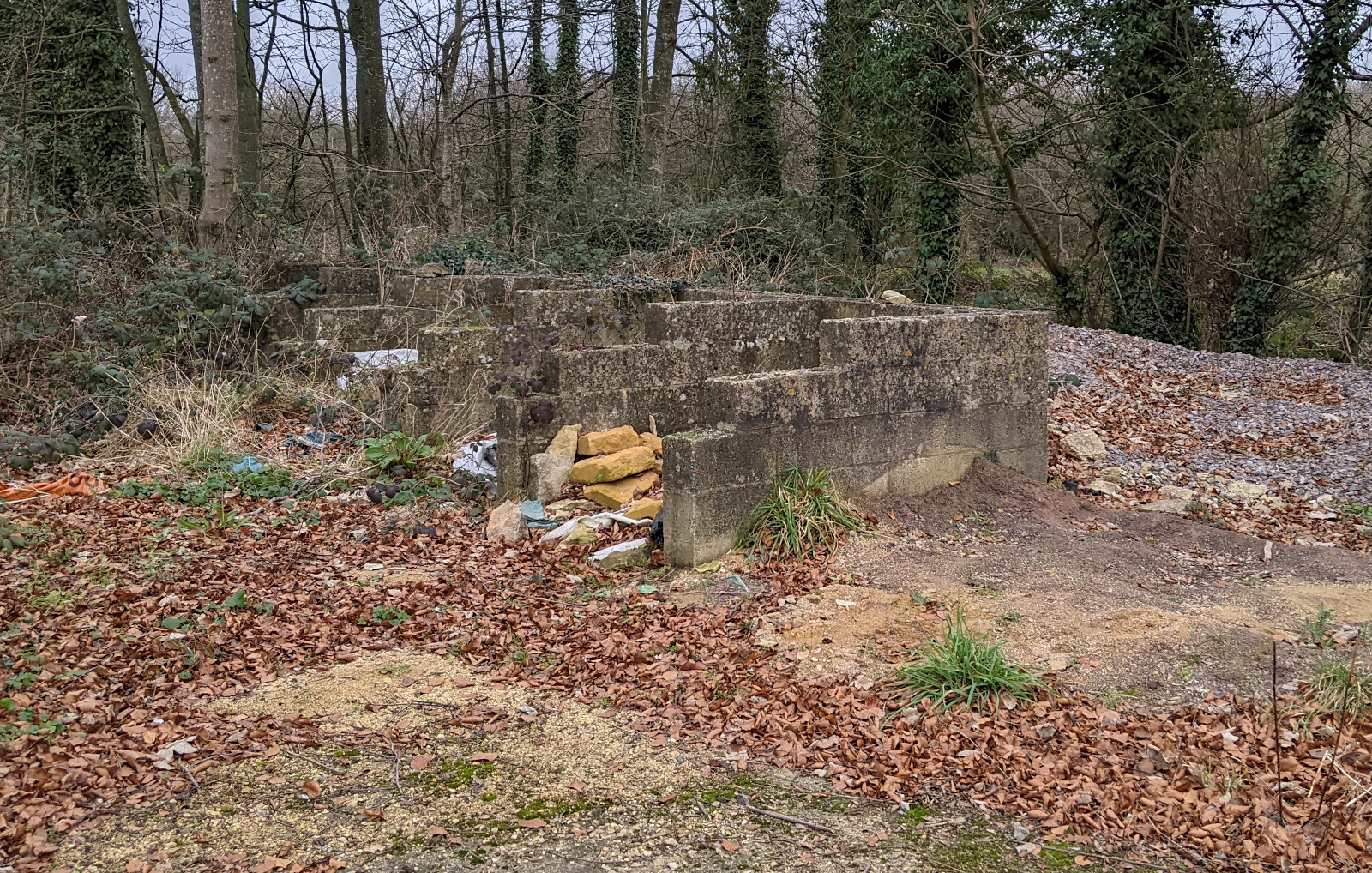
In January 2022 I looked around the Abbey Nursery where there still remains some evidence of John Jefferies & Son, the old family business. It’s now a small park and wildlife reserve – City Bank Park. The concrete surface and the block built bins for sand, gravel and other materials can still be seen in the photo. Tidy up and sweep away the leaves and it would look much as it did when I was a child and the site was still in use producing the town’s supply of Christmas trees.
JHM: I wrote about three objects in the evening sky, not all of them easy to see. – World events: The number of COVID cases worldwide passed 300 million and more than 10 billion doses of vaccine had been given.
In January 2019 it was the end of the road for Bennett’s Garage in Victoria Road, Cirencester. Dad always filled his car at Bennett’s as John Jefferies & Son had an account here. I once borrowed a ladder from Brian Bennett when I locked myself out of Churnside. The business continues at another site, but Victoria Road will never seem quite the same.
JHM: I posted a video of the Earth rising over the Moon. – World events: The Orthodox Church of Ukraine was granted independence from the Russian Orthodox Church.
In January 2014 Paul and Vanessa visited us and we drove over to Cambridge and spent part of the day there, enjoying the sights and the bustle of the crowds. Cambridge has such a great atmosphere and energy! However, we got caught in a torrential downpour waiting for the Park and Ride bus to get home.
JHM: I posted about meeting Gerald who was in his wheelchair all alone in the middle of Huntingdon. – World events:Latvia adopted the Euro, the 18th member of the Eurozone.
In January 2009 Meredith took delivery of a new cooker. We drove up to York for New Year so the Christmas presents arrived a week late; it’s almost like having Christmas twice! We always look forward to our winter trip to York.
JHM: I wrote about the journey and how we know the way. – World events: The cryptocurrency Bitcoin was created.
We visited my Mum and Dad in Cirencester for New Year; this was about two years before Mum died, though of course we didn’t know that. Treasure people while you can! Mum always laid a fine spread on the table and you can see some of it in the photo.
I made some progress with WebForum, an information website for Unilever‘s research labs around the globe; there were two of these in the UK, one in the Netherlands, and another in the USA. I think by this time the software had been rolled out to all sites except for the Netherlands where they decided to create their own version. Attention was turning instead to Y2K testing.
World events: The new Euro currency was introduced on 1st January.
Dan visited us and we looked at some of the sights in Bristol, including the Observatory up at Clifton near the famous Suspension Bridge, and later the Industrial Museum down in the docks area. The photo shows Dan, Beth and Judy in the museum.
World events: The Northridge Earthquake struck the San Fernando Valley in Los Angeles on 17th. Parts of a raised freeway collapsed and 60 or 70 people died.
We had a quieter New Year’s Day after a fairly full-on Christmas the previous month. Debbie and Beth played draughts while half-watching ‘Neighbours’ on TV.
World events: The European Single Market was created; and Czechoslovakia divided itself into independent nations, the Czech Republic (later Czechia) and Slovakia.
We were living at 22 Rectory Drive in Yatton, between Bristol and Weston-super-Mare. Debbie was nine at the time, and Beth was six. Judy might already have been teaching biology at Cotham Grammar School by this time and would have started a new term. I was working at Long Ashton Research Station.
World events: The Apple Macintosh went on sale in the USA, and President Reagan announced that a space station would be developed.
My Mum sent this postcard 0n 17th January to her mother (my Granny-in-Ireland) in the village of Coagh. She wrote, ‘We went to the theatre with Ruth and Martin, her boyfriend, and his parents. It was fun walking round Piccadilly Circus and Leicester Square with all the lights on. Ruth sends her love to you both.
World events: The USA severed diplomatic relations with Taiwan and established diplomatic relations with the People’s Republic of China.
Judy and I were living in our flat at 20 Belmont Road in St Andrews, Bristol. She was newly trained as a teacher, I was completing research towards my MSc thesis. The photo shows a view of Berkeley Square and the Wills Memorial Building (part of Bristol University) beyond it, taken from the top of nearby Brandon Hill. Comet Kohoutek was visible in the evening skies and we managed to spot it from the bay window in our flat.
World events: The F-16 fighter flew for the first time, and sextuplets were born in Cape Town with all surviving.
I began the second term of my third year at Bath University, Judy returned to Aberystwyth to continue her second year there. This was, as always, an unwelcome time of separation; but as compensation our engagement was announced in the Gloucestershire Echo. (It’s very tiny, click the image to enlarge it and you still might not see it at first.)
World events:The Beatles played live for the last time, and Richard Nixon was sworn in as President of the USA.
I was living at Churnside (37 Victoria Road) in Cirencester, with my Mum and Dad and three sisters. I was in the Fifth Form (now Year 11) at Cirencester Grammar School and just starting the second term in January.
World events: The US Government reported that smoking might be a health risk, and plans to build the World Trade Center in New York were announced.
I was 10½ years old at the end of January, and in my final year of Junior School. This was the year in which we would take our eleven-plus exams; the results decided which of us would go to the Grammar School, and which to the Secondary Modern; so the emphasis in this final year was partly to familiarise us with the style of questions typical of the eleven-plus. (Today these schools are combined.)
World events: The Soviet spacecreft, Luna 1, was the first to break free of Earth orbit, and Alaska was admitted as the 49th American state.
This was my second term at Querns School in Cirencester. It was a far happier experience for me than starting my first term: I knew my way around, I’d made some friends, and I had a good idea what to expect from my teacher, Mrs Hourihane; also I was more confident of spending time without Mum and Dad. I was 5½-years-old and I probably felt quite grown up! My teacher was a budding author as well!
I was 6 months old at the end of the month and we were living at Granny and Grandpa’s house (Churnside, 37 Victoria Road). I think Grandpa liked having a baby in the house again, apparently Mum found it difficult to get me back sometimes! Dad was by far their youngest child (his youngest brother, Bob, was 15 years older). Mum and Dad were on the list for a council house at the Beeches Estate, but those houses were still being built.
World events: Communist forces entered Beijing, in the USA Harry Truman was sworn in as President.
Dad was now driving my grandfather’s Wolseley on errands to the nurseries and managed to reach the amazing speed of 50 mph on 5th January. His ATC uniform arrived and he had opportunities to use the Link Trainer at South Cerney Airfield as well as examine some aircraft. He passed his Morse test at the end of January.
World events: The Allies landed at Anzio in Italy and a British vessel was sunk there by an early German guided missile.
If you live in or near Cirencester, or are visiting, I recommend this little gem of a place.
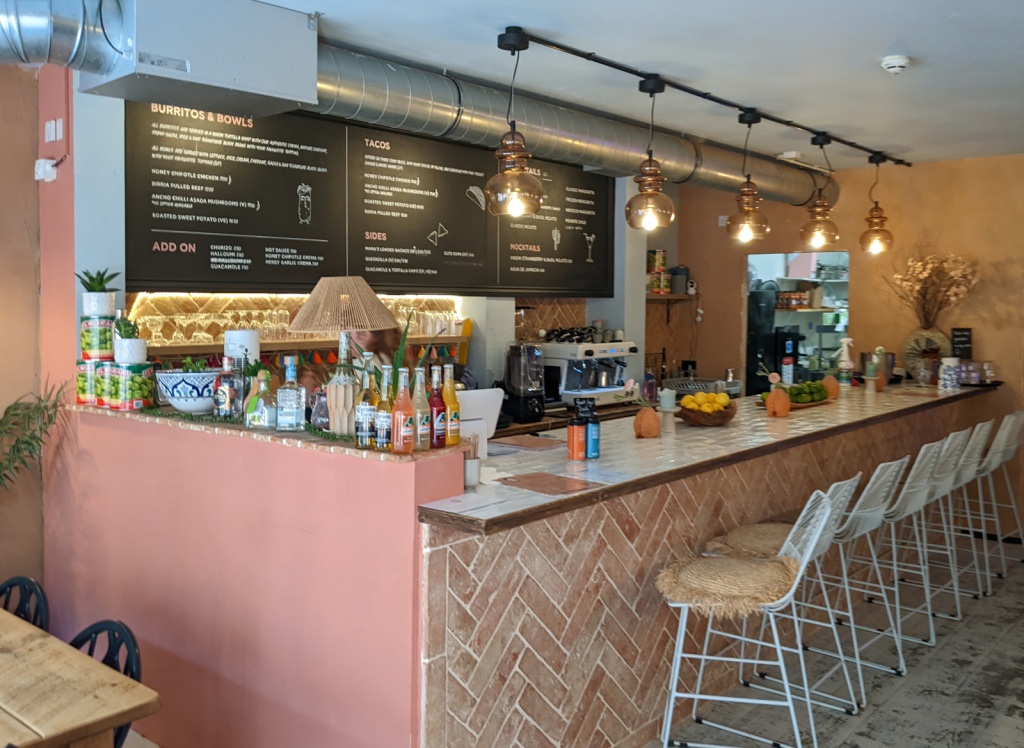
A new food outlet opened recently in Cirencester; we hadn’t had a chance to try it – until now. Burrito Mama is small, but very, very good.
Donna and I popped in at lunch time today to see what it was like. What we found was friendly, prompt service, lovely Mexicanesque decor, good coffee, tables inside and out, and an interesting menu. And when the food arrived it was nicely served and absolutely delicious. I chose their Ancho chilli asada mushrooms, and Donna went for the Honey chipotle chicken bowl. Both were great.
If you live in or near Cirencester, or are visiting, I recommend this little gem of a place. Check out their website online. Scroll down and take a look around. Book online or just pop in if they have space available. Locals will know where the Swan Yard is, very central, just beyond the west end of the Market Place.
Overall assessment… We’ll be back as soon as we have another opportunity!
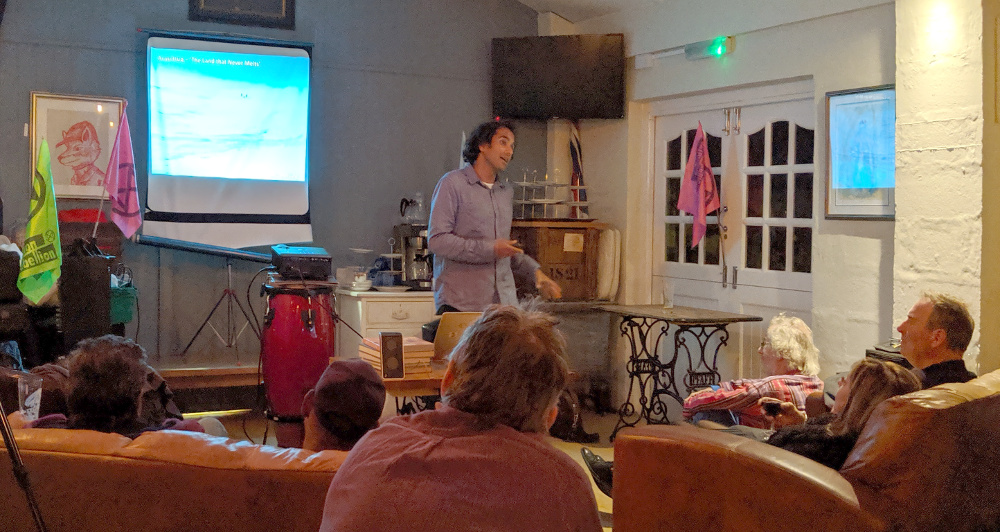
I went to a meeting at the Golden Cross in Cirencester a few days ago. We enjoyed a great presentation from Vijay Shah who spoke about his experiences in Arctic regions where climate change has been particularly severe. He also outlined other aspects of climate change including its causes and actions we might take to limit it and the damage it’s doing. Vijay pointed out that there are individual actions we can take in terms of our diet, modes of transport and so forth, and there are industrial and government actions that can be taken too. In the excellent discussion afterwards some of these individual and local matters were raised from the floor.
It was good to talk with others at the meeting, I was surprised by the wide variety of ages, professions, and opinions represented. And I was prompted to think about some new ideas that the talk sparked in my own thinking as I listened, chatted, and again as I walked home afterwards.
Some are original, others are already being widely discussed, some were mentioned at the meeting, but I present them here in the hope they will encourage others to think creatively about what is possible. Here are some of those ideas:
Streetlights – LED streetlights are becoming common in towns and villages, replacing the less efficient high-pressure sodium lamps just as they in turn replaced the older sodium and mercury lamps installed in the 1960s and ’70s.
But why not go further? Instead of drawing power from underground cables, why not fit lithium-ion batteries in the streetlight posts and top the lamp off with a solar panel and a wind generator? The one-off cost savings of not providing a mains power connection, and the lifelong savings of electrical energy would help offset the additional manufacturing cost. Once installed, the street lighting would be entirely green.
Greening the desert – Some deserts have ready supplies of seawater nearby, parts of the Sahara, the Kalahari, the west coast of South America, and regions of Southern Australia spring to mind. Building wind farms and solar farms in these coastal deserts would allow for green desalination, green pumping of the fresh water far inland, and the literal greening of large areas of desert. Not only could the land be used for crops, it might also be possible to establish areas of forest, thus sequestering significant amounts of carbon. And evapotranspiration would reduce the temperature and increase the humidity of the climate downwind of the greened zones. If a sufficient area could be greened in this way, clouds might form and reflect away some of the incoming solar energy
Solar car parks – Many towns and cities have public parking areas, asphalt ‘deserts’ where cars bake in the summer heat while we are shopping or working. Why not cover these areas with solar farms supported on frameworks above the cars and pedestrians? Most towns could generate as much power this way as would a small solar farm in the countryside. As a bonus, radiant heat transfer would be partially blocked from the covered area, so parked cars would stay cooler on hot days, and warmer on cold nights. And pedestrians would get shelter from rain and snow.
Using electric cars to balance demand – Electric cars have considerable amounts of energy storage and this could be used to help smooth power peaks and troughs. Cars plugged in overnight at home or during the day in town and workplace car parks would absorb wind power when excess is available, and return some of it to the grid at times of peak demand. Combined with dedicated battery storage facilities, this would make a change to fully renewable energy supplies possible.
Generating methane – Elon Musk is considering using green electrical energy to extract carbon dioxide from the air and combine it with hydrogen from water to generate methane and oxygen. Using the methane as a fuel would consume oxygen and produce carbon dioxide and water – a closed system. Originally this idea was intended to allow refuelling of SpaceX’s Starship on the surface of Mars, but he is now looking at the idea of using the same process on Earth to fuel the spacecraft. Extending the idea, methane has potential to be used as a storable fuel for air, sea and land travel. Clearly, as methane is a potent greenhouse gas, it will be essential to burn it in an oxygen-rich manner to make sure none escapes.
Using ocean trenches – Why not place organic materials (including plastic waste) in the subduction zones in deep ocean trenches where the material would be buried as layers of silt are deposited naturally, and in the very long term would be carried down by plate tectonics and processed by heat and pressure into simpler, harmless molecules.
Solar farms in polar regions – This is, perhaps, the oddest of ideas -but aspects of it may have some merit. Incoming radiation from the sun comes from low in the sky during a polar summer. Solar panels would need to be angled close to vertical and would throw very long shadows; they would need to track the sun across the sky, east to west. The shadows would provide some cooling by absorbing incoming solar energy, reducing the melting of ice and snow in the shadows. But what to do with the electrical power? I suggest radiators at the focus of parabolic reflectors pointing vertically upwards, sending the energy back into space. The atmosphere is transparent at visible, radio, and some infra-red wavelengths. Rather than trying to cover large areas, the idea would be to protect specific areas at risk of losing the white, reflective cover of snow and ice. This scheme might be a bit zany, but perhaps it will spark other minds to come up with more practical alternatives.
Solar rooftops – By no means a new idea, but many industrial and commercial buildings do not currently have solar power generation installed. Reduced taxation could encourage more rooftops to supply energy in this way, and it would be generated in towns and cities, right where it is needed. Lobby governments and local authorities to encourage this.
Burying organic matter – Organic waste and/or purpose grown biomass could be air dried and packed into disused coal mines or other available spaces. Sequestered in this way, the carbon content would be removed from the atmosphere, reducing the levels of carbon dioxide that drive global heating.
Over to you! – Maybe you can come up with some green energy ideas of your own; this planet needs all the good ideas we can provide. Anything that reduces our level of consumption or enables us to live in harmony with the natural world should be publicised and adopted as widely as possible. If you have a good idea, leave a comment and tell us about it. And make sure to share it as widely as you can.
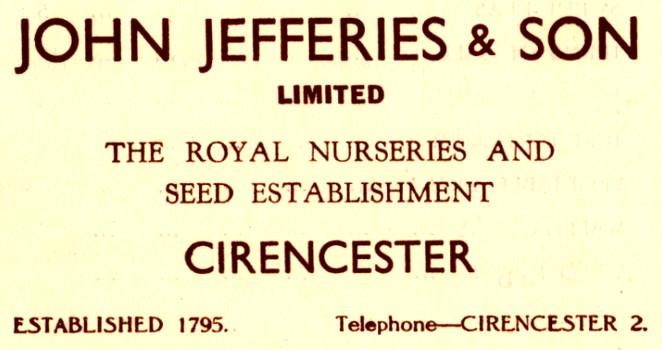
This was the family business, founded in 1795. It prospered for many years, growing and selling nursery stock to other businesses, the government, and to the general public. It ceased trading in 1984 and the garden centre business was sold to Country Gardens PLC, although the company was not officially dissolved until 1994.




























 Journeys of Heart and Mind

.jpg)
